Loading summary
Transcript35 lines
- [00:00]
A
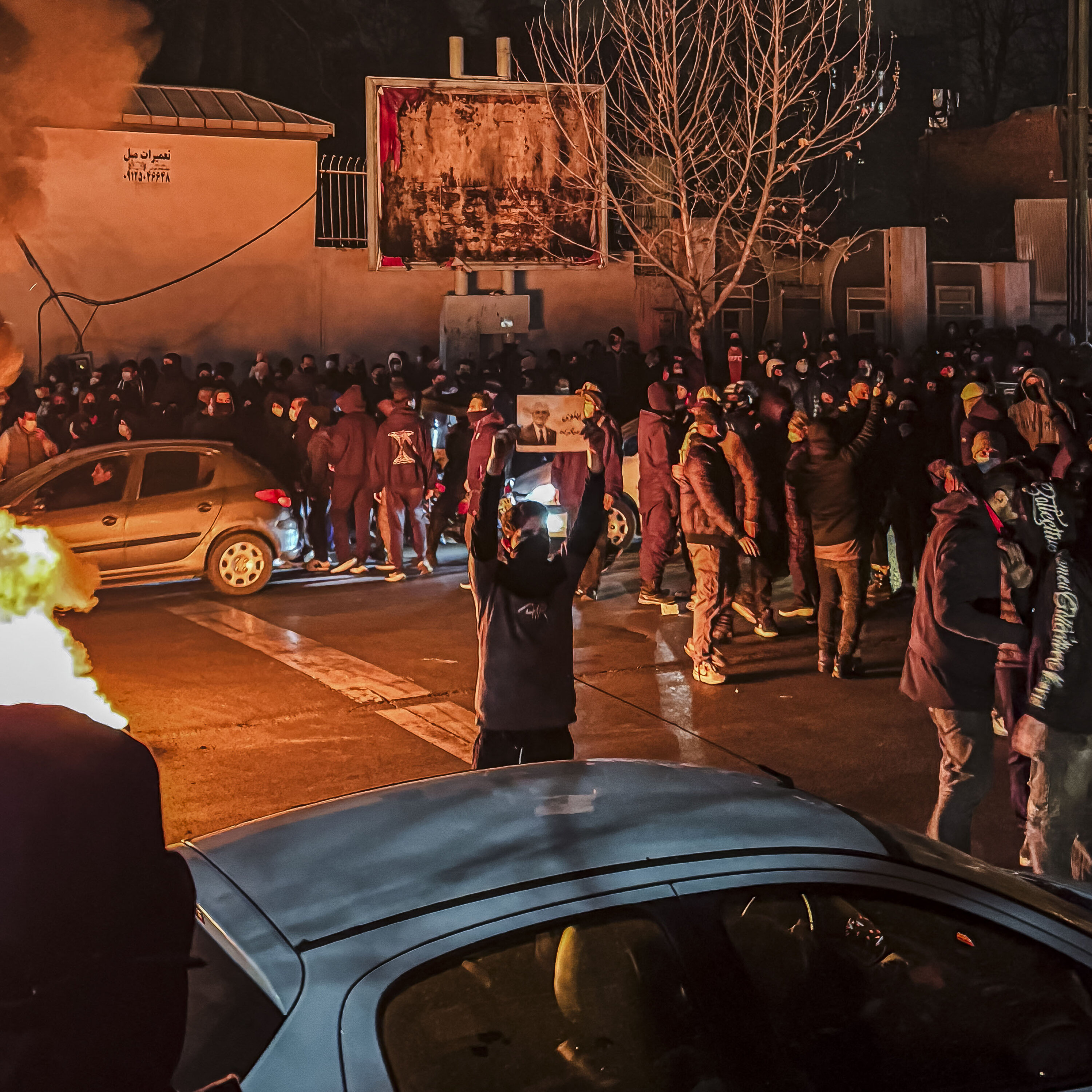
At CES. Michael McDermott, EVP of Samsung, spoke with Bloomberg Media Studios about what the company calls its next AI chapter, your companion to AI Living. It's a shift from AI as a feature to AI as a trusted partner in everyday life. Bloomberg Audio Studios Podcasts Radio News Protests over economic conditions in Iran have roiled the country for weeks. Anti government protests in Iran have entered a third 13th day as the country faces economic turmoil.
- [00:34]
B
It is a nationwide movement that has now swept through all 31 provinces.
- [00:39]
A
The death toll in Iran may be in the thousands, higher than previously feared. And while it's not the first time Iran's regime has faced massive demonstrations, this time feels different.
- [00:50]
B
What was unique about it, I think, is that the sheer desperation of the population brought all segments of the society together.
- [00:58]
A
Ali Vaez is the Iran Project Director for the International Crisis Group, an independent policy research organization that tracks conflicts around the world. And he says these protests in Iran are widespread.
- [01:10]
B
Rich and poor, old and young, secular and pious. And also it spread geographically in places that we had not seen protests before. Some of the regime's strongholds, including rural areas, and then again, it quickly spread to bigger cities.
- [01:27]
A
What also sets these demonstrations apart is the kind of support they're getting from a sitting US President.
- [01:33]
B
In a social media post, the commander.
- [01:34]
A
In chief said, quote, we are locked.
- [01:36]
B
And loaded and ready to go if Iran shoots and violently kills peaceful protesters.
- [01:42]
A
The Iranian regime was in a precarious position before this. Israel and the US Attacked Iran in June, and the country's currency, the Iranian real, has weakened dramatically in recent months.
- [01:54]
B
And so you put all of those things together, it's created not just a national sense of desperation but also a sense of finality that we're getting close to a moment of absolute deadlock across the board. The regime was and is failing and the people, I think, were just fed up with it.
- [02:18]
A
I'm David Gura and this is the big take from Bloomberg News today on the show. Weeks of protests in Iran and the possibility of international support threaten the Iranian regime. How we got here and what could happen next. Iran has been led by a religious authoritarian regime since 1979, and it has faced protests since then, but they've always been quashed by Iran's military and security forces, which are aligned with the regime. Ali Vaez, the Iran Project Director for the International Crisis Group, says there is something unique about the Dem demonstrations that are currently taking place across Iran.
- [02:58]
B
Iran is not unfamiliar with protests. This time the trigger was economic. The Iranian currency has lost about 50% of its value in the course of the past few months, 99% of its value, in fact, since the beginning of the revolution. And the economic downturn in the past few weeks created a real crisis. And the merchants in bazaar came to the streets protesting the market volatility. I think they never imagined that they would unleash an avalanche that basically covered the entire country very quickly and metastasized into an immediate demand for regime change. Now, of course, we have seen this before. It usually takes maybe a day or two for these protests to start spreading, but this was almost immediate.
- [03:46]
A
As you mentioned, in 2025, the Iranian rial slumped by about 45% against the US dollar. We've seen this dramatic weakening. What accounts for that? Why have we seen the currency depreciate so much?
- [03:58]
B
Well, first of all, David, I think it's the accumulated impact of sanctions. Iran has been in a state of stagflation for about 15 years. Second is that the markets, especially since last fall when the UN Sanctions on Iran were restored and it became clear that there's basically no light at the end of a tunnel for getting any sanctions relief anytime soon. And so there's no economic reprieve around the corner. There was some significant capital flight and dimming of hopes and expectations in the market in Iran. And I think all of these factors came together and created a perfect economic storm that the government simply did not have any answers to. The middle class was already hollowed out after years of sanctions, corruption and mismanagement. But the government was better at trying to look after its own core constituents, the lower strata of the Iranian society. But again, there was no cushion left now to try to bail them out anymore.
- [05:03]
A
How has their government responded to these protests?
- [05:06]
B
Well, look, these protests, I think, have had three phases. The first phase was the administration trying to see if there is a way to placate these protests by offering dialogue, offering subsidies, $7 to every Iranian, and hoping that it would go away. It did not work because the problems are so much deeper and widespread to be alleviated just with marginal reforms like this. And then the second week, we started to see the clampdown, the usual MO of the Islamic Republic, which is repress and carry on, refuse reforms. It was really back to that playbook. And then President Trump threatened to intervene. And I think that served as a perverse incentive for the regime to try to wrap up these protests before the US could move military assets to the region. And this is when we saw, coinciding with last weekend in Iran, a very brutal the regime brought down the iron fist with speed and ferocity that we've never seen before. The number of fatalities now ranges in a few thousands. Tens of thousands of people have been arrested.
- [06:31]
A
We are just a few months from the war back in June, and you had us and Israel attacking a lot of Iranian infrastructure, targeting scientists, military officials. How is that shaping the way the regime is responding to these protests?
- [06:44]
B
Well, you know, as I said, Iran has had experience with protests before, but this is really a once in a generation phenomenon that the regime was dealing with. And I think that made it feel that it is facing an existential angst for its survival. And it resulted in its resort to brutality, the kind of which we have not seen in decades. I think the fact that the regime believed that Israel would not just try to undermine it through military and kinetic actions or sabotage of its nuclear or military facilities, but also through subversion, also through infiltration. And of course, we saw in the June conflict an extraordinary degree of intelligence penetration by Israel into the Iranian system and society. And Israel was openly talking about trying to topple the regime. So some of that fear was not paranoia. Some of it was justified based on past experience. So all of this provided more ammunition for those within the system who were arguing that this should be nipped in the bud as quickly as possible.
- [07:59]
A
One tool the regime has at its disposal is control of the Internet. And we've seen that happen here over the last few weeks. I'm curious how that shaped our understanding of this protest movement and beyond that, the effect that that's had on protesters ability to organize.
- [08:13]
B
Look, the regime has no answer to the legitimate grievances of its population other than repression. And shutting down the Internet, as it has done repeatedly in the past, it serves multiple purposes. First of all, when the regime turns off the lights, the world doesn't understand the scale and scope of the atrocities committed until the regime has managed to re establish control. Partly this time around, we know about what has happened because the regime actually broadcasted it itself, broadcasted on state television. And the regime did that in order to instill fear in the hearts of the protesters. It is also to prevent communication and coordination between the protesters and to make sure that the images of bravery in one city do not spill over and encourage and incentivize other cities to come join the protest. And finally, it is to prevent cyber attacks or covert operations, as we know, to prevent internal forces from being able to coalesce into bigger masses that would be hard for the regime to contain and control.
- [09:26]
A
Elon Musk says he's going to make his Starlink Internet service available for free to Iranians. Is that likely to make any kind of a difference here?
- [09:34]
B
So look, there are some images and some information trickling out of Iran because the Blackout is about 99%. So it's about 1% of Internet connection that is still established. And part of that, I think, is coming through Starlink. So it's a positive thing that Elon Musk is doing, but it's still awfully insufficient. It is very difficult to get a comprehensive and accurate image of what's happening on the ground. I have not been able to reach my own family in the past six days. I don't know how they're doing. The landlines, mobile phones, Internet, all of it is down, and so it's really impossible to get a hold of them.
- [10:21]
A
Coming up, what President Trump has said about the United States support of the protesters and what could happen if the protest movement or intervention from overseas topples the Iranian regime. How do you shift AI from being a flashy feature to a trusted partner in consumers everyday lives on the ground at CES Bloomberg Media Studios, asked Michael McDermott, EVP of Samsung. Our 2026 vision is built around an AI companion. It understands you and responds intuitively. This intelligence works quietly in the background across TVs, home appliances and mobile devices. By putting AI at the center of everything we do, we're simply improving everyday life for everyone everywhere. The protest movement in Iran is facing a violent crackdown, including threats to kill popular oppos, leaders and activists that has drawn international condemnation. And President Trump has offered protesters his support. At an event in the Oval Office on Wednesday, Trump said he'd heard the executions were called off.
- [11:33]
B
We have been informed by very important sources on the other side and they said the killing has stopped and the executions won't take place. There were supposed to be a lot of executions today and that the executions won't take place.
- [11:45]
A
He was also asked about the possibility of US Military action in Iran, which he still won't rule out.
- [11:50]
B
Does this mean military action is now off the table against Iran? We're going to watch and see what the process is.
- [11:56]
A
I asked Ali Vaez, the Iran project director for the International Crisis Group, to unpack Trump's comments. In recent days, President Trump has been a very vocal supporter of the protesters. He's threatened a 25% tariff on goods from any country that trades with Iran, and he's also encouraged protesters to keep going, keep protesting, he wrote on social media this week. Take over your institutions. In another post, he wrote Help is on its way with no specifics about what that means. And when reporters asked him about that, the President declined to elaborate. What is the potential for US Involvement here and what could it look like as you see it?
- [12:32]
B
To be honest, it's anybody's guess. But there is a range of options available to the President. In the category of non kinetic. I would say that overall they're not going to move the needle that much because if you engage in cyber attacks, for instance, to hamper the repressive apparatus's ability to communicate, they can still, you know, it's a temporary measure. If you engage in sanctions or sanctions enforcement. First of all, one has to remember that Iran is already sanctioned to the hilt. And if the US Is to enforce, let's say, an oil embargo, it risks in the process endangering one of the most critical choke points in the world. And that would also have an inflationary impact on the US as well, because gas prices will go up in the same way that imposition of tariffs on China or on UAE or on Turkey, which are trade partners of Iran, would also have an inflationary impact on the United States. And in any case, it's unlikely to have an immediate impact that would save the protesters. So the non kinetic options I really don't think are going to be effective in the short run. Kinetic options come with huge risks and unforeseen consequences. The President can decide to go for political decapitation of the Iranian regime, try to eliminate the supreme leader or the government or additional military leaders. But there are two facts about the Iranian regime that one should not underestimate. One is that it's deeply entrenched, just like in Venezuela where the President decided that he's just going to remove the head and leave the rest of the body of that regime in place. And second is that it's also a deeply benched regime. It quickly replaced all the generals who were killed in June and started fighting back against Israel. And even in a scenario that one creates political vacuum at the top of the system, it might be replaced by either a more repressive set of leaders within the Revolutionary Guards, or it might be replaced by violent chaos. If we end up in a free for all in Iran, there is almost half a ton of near weapons grade uranium that is unaccounted for. In Iran, that's sufficient for 10 nuclear weapons and maybe dozens of dirty bombs. And this would be a major security breach for not just Iran and the region, but the rest of the world.
- [15:14]
A
This week, German Chancellor Friedrich Merz predicted The Islamic Republic is in its, quote, final days. He said. When a regime can only hold on to power through violence, it's effectively finished. Is this a regime on the brink of collapse?
- [15:28]
B
Look, the Islamic Republic is in a death spiral without any doubt, but when it would collapse is anybody's guess. I've been hearing these predictions literally for decades. And the reality is that other regimes, like the Syrian regime, survived on use of lethal force and repression for many years. So did Saddam Hussein, and it eventually required foreign military intervention. So it's hard to predict when the Islamic Republic will collapse. But there are certain things that are absolutely clear. This is a regime that is at a dead end. It has been ideologically bankrupt, economically bankrupt, politically at a dead end, even if it had a little bit of legitimacy left because its social contract was defined by providing safety and security instead of prosperity and pluralism. Even that fell apart last year when it exposed the country to foreign aggression as a result of its policies. So overall, I do believe that the Islamic Republic is doomed to fail. But when that happens, I think it's anybody's guess.
- [16:43]
A
Let me ask you last that we've talked a bit about the sort of what the transition would mean domestically. Let me pull back and ask about what it would mean for the Middle east and for the world more broadly. I'm thinking about the Saudis, the Qataris, the Israelis, also thinking about Russians and the Chinese. What would that moment of transition mean for the world as a whole?
- [17:03]
B
Well, it depends, David. I think the status quo is attractive for many because Iran is basically in a box, weak. It's dependent economically on China, militarily on Russia, and it is not able to really pose an existential threat to most of its neighbors and even to Israel. In terms of the threat it poses to Israel, it has been weakened. So as long as it doesn't lash out, I think a lot of Iran's neighbors would prefer Iran to remain in the weak state that it is right now. Now, a good scenario of Iran fulfilling its potential, turning into a G20 economy, a pluralistic, democratic society is actually unattractive to most of Iran's neighbors. To some of Iran's neighbors who have monarchies and are autocracies, this basically sets a precedent for their own populations that could be destabilizing to some of Iran's neighbors who have been able to reap the economic benefits of Iran's isolation. All of a sudden, there will be a major competitor, a major energy exporter, a major attraction for foreign investment, and this could be quite problematic. Also, Iran could be able to once again influence US Policy in the way that it was doing prior to the 1979 revolution. That would then diminish the privileged position of that some countries like Israel have. Now. The worst case scenario, which is Iran becoming another failed state, is also pretty unattractive for most of Iran's neighbors, with the exception of Israel, which I think will be okay with Iran descending into chaos and it's far away from Israel, as long as it's internally focused, it's not a problem. But for Turkey, there will be probably millions of refugees who would cross the border. For the Gulf states who want to invest on their economic plans and future prosperity, a country of 90 million being engaged in a civil strife with a lot of lethal weapons and facile material being unmonitored is quite problematic. So I think the worst and the best case scenario are not attractive. For Iran's neighbors, the status quo is, but unfortunately the status quo also doesn't appear to be very sustainable.
- [19:44]
A
This is the Big Take from Bloomberg News. I'm David Gura. To get more from the Big Take and unlimited access to all of bloomberg.com, subscribe today@bloomberg.com podcastoffer if you like this episode, make sure to follow and review the Big Take. Wherever you listen to podcasts. It helps people find the show. Thanks for listening. We'll be back tomorrow.