Loading summary
Transcript46 lines
- [00:02]
Commercial Narrator
What if you could make that stop? With LPL Financial, we remove the things holding you back and provide the services to help push you forward. If you're a financial advisor, what if you could have more freedom but also more support? Ready to invest? What if you could have an advisor that really understood you when it comes to your finances, your business, your future?
- [00:21]
Samantha Power
At LPL Financial, we believe the only
- [00:23]
Commercial Narrator
question should be what if you could
- [00:25]
Samantha Power
Paid Advertisement Anna Kendrick is not a client of LPL Financial LLC and receives compensation to promote lpl. Investing involves risk, including potential Officer Principal LPL Financial LLC Member Finras IP Small
- [00:33]
Commercial Narrator
businesses are the pulse of every community. They bring people together, create opportunities and drive growth. Chase for Business helps business owners like you with personalized guidance and convenient digital tools all in one place. With that guidance and your determination, you can take your business farther and help build a brighter future for your community. Learn more@chase.com business chase for business make more of what's yours the Chase Mobile app is available for select mobile devices. Message and data rates may apply JPMorgan Chase Bank NA member FDIC Copyright 2026 JPMorgan Chase Co.
- [01:10]
IBM Representative
So there's a lot of noise about AI, but time's too tight for more promises. So let's talk about results. At IBM, we work with our employees to integrate technology right into the systems they need. Now a Global workforce of 300,000 can use AI to fill their HR questions, resolving 94% of common questions. Not noise. Proof of how we can help companies get smarter by putting AI where it actually pays off, deep in the work the business. Let's create smarter business IBM
- [01:42]
Commercial Narrator
Bloomberg Audio
- [01:43]
Samantha Power
Studios Podcasts, Radio news
- [01:49]
David Gura
It's been almost a year since usaid, the United States Agency for International Development, was dismantled. The Trump administration shuttered it on July 1, 2025.
- [01:59]
Samantha Power
This was Elon Musk and Doge and a handful of tech Bros in a kind of fever dream, building on the shock and awe of those early days of the Trump administration more generally, but basically putting a knife through butter and then realizing that they could just go and go and go without Republicans or the President stopping them.
- [02:24]
David Gura
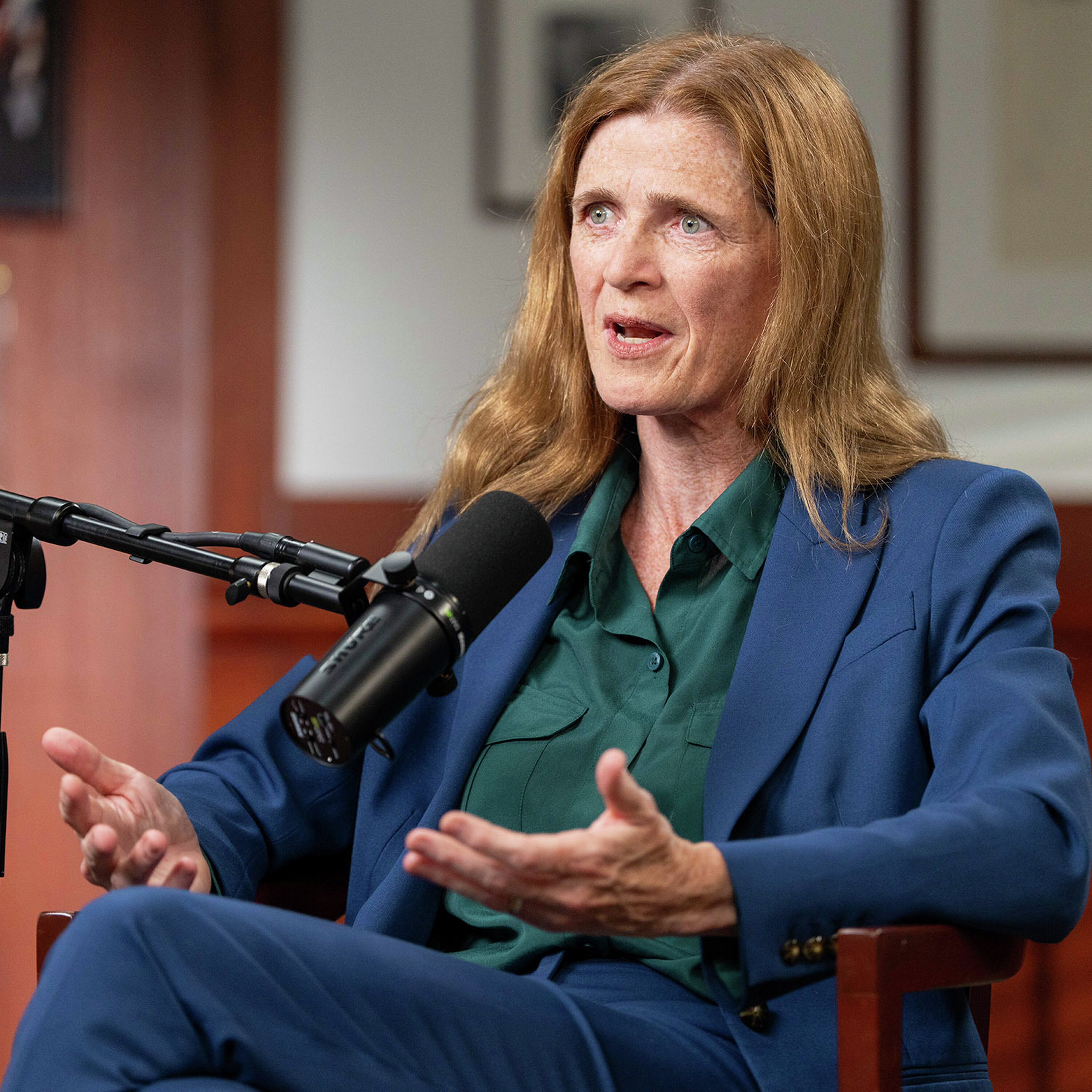
Samantha Power led USAID until President Trump started his second term, and she's the last person the US Senate confirmed to that job. Power was a journalist. She's a Pulitzer Prize winning author who became an advisor to Barack Obama in the Senate and the White House. During Obama's presidency, Power served as the U.S. s permanent representative to the UN. She was President Biden's pick to be USAID's 19th administrator. Ahead of the anniversary of the agency's end, I wanted to hear Power's perspective on the legacy of that agency and the costs of the Trump administration's cuts to foreign aid, her reflections on the way she wielded power when she had it, and her thoughts on how the Trump administration is changing the U.S. s standing in the world.
- [03:06]
Samantha Power
I mean, even if this administration had wanted to absorb US Aid in the State Department or significantly reduce or even end foreign assistance, there's a way to do it on a glide path in a way that takes account the human consequences. They did it in the way most designed to obliterate soft power, human capital, human trust.
- [03:35]
David Gura
I'm David Gura and this is the big take from Bloomberg News today on the show Ambassador Samantha Power. We're a year away from the dissolution, the end of usaid. You've called it the ravaging of usaid. And I'd like to start just by asking you to help us take stock of this moment and explain what's been lost over the course of the last year.
- [03:57]
Samantha Power
Well, the predictions are that 14 million lives will be lost by 2030. And we're already seeing expansions in hunger and severe malnutrition, a large number of deaths. Kids who just a year and a half ago would be able to have reliable access to a mosquito bed net now at risk of dying of a mosquito bite. No kid in 2026 on this earth should die from a mosquito bite when it is so preventable. So the death toll is, we see with Ebola our rapid response capacity eviscerated. There are still individuals who call themselves people who work on Ebola, but they are too few, they are too dispersed, and many of them lack the expertise that was exported when the USAID staff was terminated so abruptly. The unseen costs are equally dramatic. And that ranges from girls who are no longer getting an education because USAID was either helping support a school to do that or leveraging its other programming in health or clean energy or agriculture to push a government to move in that direction. So the soft power suicide for the United States, I think is pretty obvious when you pull the rug out from programming of this nature with no warning, with no regard for the human consequences of those actions. It's all system failure, an all system attack. And there's not one part of human development that has been untouched by this blunder.
- [05:37]
David Gura
I was going to ask you who this has affected and is likely to affect going forward. It sounds like children are going to pay a huge cost for this.
- [05:43]
Samantha Power
Yeah, the 14 million prediction from the Lancet in a peer reviewed study that are anticipated to die preventable deaths by 2034.5 million of those are likely to be children under five. And maybe one way to really bring this home is that over the last decades, every year we have seen child mortality drop every single year. And 2025, the year that USAID was dismantled, is the first year in decades where we have seen deaths of children under 5 increase.
- [06:18]
David Gura
What has this last year been like for you? I imagine you've had a lot of conversations with now former colleagues at usaid. What have those folks said to you and what have their lives been like in light of this happening?
- [06:29]
Samantha Power
Well, thank you for asking about them. It is 15,000 people who were directly employed in some fashion by USAID all around the world. About two thirds of the places they worked were crisis zones. So places that had suffered coups or conflicts or natural disasters and they didn't care. They worked in those places because they saw that America's fate was connected to the fates of those communities in which they worked. They put their lives on the line and they were spit up by their own government. They were literally in many cases physically escorted out of the USAID headquarters. If they were in Washington by security guards, that can't happen. If that were men and women wearing our country's uniform, military uniform, there would have been a complete uproar. The fact that they were wearing usaid, US Agency for International Development, with the agency mantra from the American people, somehow that meant that that uproar didn't occur and they were denigrated and lied about, described as radical left lunatics, when what they've been doing is the nation's bidding with bipartisan support for decades.
- [07:45]
David Gura
How much surprise do you have that Republicans, who I assume you knew before, through your work, two White Houses and here as an academician, have behaved in this way. Has it surprised you? Have you talked to any of them about their decision to back this?
- [07:58]
Samantha Power
Well, initially, in the early days, I had very productive, I thought, back channel text message exchanges and phone calls with Republicans who were the biggest champions of USAID's work, where they would reach out to me and say, okay, they're saying this. There's this claim that USAID spend this amount on this crazy program. You know, provide me with the facts. And we had these crack teams that had come together and were turning around the facts as best we could. So people were, you know, reaching out by text message all around the world to try to get information that could be used. And that was fact. Checked. I will say within a couple weeks, when it began to seem like more of a fait accompli, my text messages began to go unreturned. And that was crushing.
- [08:47]
David Gura
I want to ask you more broadly about soft power, which this country has practiced for a very long time. Is this a country today that still practices soft power? How much of that has been kind of neutered by what's happened over the last year and a half?
- [08:59]
Samantha Power
Well, as the former administrator of usaid, of course I'm focused on what I described earlier as the soft power suicide associated with terminating life saving programs and life betterment programs overnight. I mean, even if this administration had wanted to absorb US aid in the State Department or significantly reduce or even end foreign assistance, there's a way to do it on a glide path in a way that takes account the human consequences. They did it in the way most designed to obliterate soft power, human capital, human trust. And I should say parenthetically, they did it in a manner that they've just announced is going to cost them. $19 billion dollars wasted American taxpayer just because of cancellation fees, termination severances, basically. Talk about waste, fraud and abuse. $19 billion in taxpayer money that could have been used to save lives, being used because of the abrupt termination. But your question isn't really just about assistance. It's about soft power. And I think it is important to put even these dramatic cuts and these huge blows to America's standing in the broader context of threatening to invade Greenland, killing fishermen without much evidence being brought forward about who those fishermen are, being seen to act with complete impunity, being seen to use the powers of the White House as a vehicle for self dealing and family profiteering. So the denigration of our reputation and our standing, which you could argue the first blow to that or the first chapter in the book that was being written on soft power suicide, maybe came with USAID's dismantlement. But every day of every week a new chapter in that book is being written.
- [10:59]
David Gura
I'd like to talk about the Ebola crisis that's unfolding. A thousand cases or more reported so far more than 250 deaths in the DRC. What do you make of this happening? And I guess germane to our conversation. Were USAID still an operating concern, how would this be playing out differently?
- [11:20]
Samantha Power
I don't believe we would have a spiraling Ebola epidemic if USAID had not been dismantled. The USAID Emergency Response Teams had gone just over the last couple years from responding to outbreaks like this. And I will say, of course, this is a distinct outbreak. Not every outbreak is the same, and this is an extremely challenging one. But gone from responding in a manner that would take about two weeks to responding in less than 48 hours. And that is the reason that the flare ups, whether of Ebola or of monkeypox or whatever the latest pathogen is the smothering of those outbreaks in even the most hard to reach parts of places like Democratic Republic of Congo, that response time had become just a matter of hours or days because that infrastructure was in place. This also can't be separated from the decision to leave the World Health Organization and to gut the World Health Organization's emergency response funding as well. So we think about USAID and everything we would have done, we would also have been partnering with with World Health Organization and of course with the center for Disease Control, which has also seen substantial cuts in its international infrastructure. So, you know, we'll never get to go back in time and test this assertion that I'm making. But all we can do is point to the track record of usaid, the CDC and World Health Organization working in tandem since the huge outbreak of 2014, where we all learned very valuable lessons. And there's a reason why that this first month of this outbreak is the deadliest of any first month of a previous ebola outbreak, including 2014.
- [13:09]
David Gura
After the break, Samantha Power's perspective on the Iran war and the Trump administration's efforts to limit that nation's nuclear program.
- [13:19]
IBM Representative
So there's a lot of noise about AI, but time's too tight for more promises, so let's talk about results. At IBM, we work with our employees to integrate technology right into the systems they need. Now a global workforce of 300,000 can use AI to fill their HR questions, resolving 94% of common questions, not noise. Proof of how we can help companies get smarter by putting AI where it actually pays off, deep in the work that moves the business. Let's create smarter business.
- [13:48]
Public.com / Wise / Forimprint / Hartford Advertiser
IBM support for the show comes from public.com. if you're actively involved in your portfolio, you probably catch yourself repeating the same actions. Buying the dip, manually sweeping idle cash, putting on a hedge on public. You can now create AI agents that handle all these tasks on your behalf. Just describe what you want to do in plain English, like if the Vix hits 25, buy a put option on the S&P 500. Or if my cash balance goes above $20,000, move the excess into my direct index. You approve the workflow and your agent handles the risk, monitoring the market watching for your conditions and executing your strategies exactly as defined. An investing platform driven by your intent, not just your clicks. You can also get full read and write access to your account via the public API. Go to public.com market and fund your account in five minutes or less. That's public.com market paid for by Public Investing Brokerage Services by Open to the Public Investing Inc. Member FINRA and SIPC Advisory Services by Public Advisors LLC SEC registered advisor complete disclosures available@public.com disclosures when you own your
- [14:59]
Commercial Narrator
own business, you own every decision. Now own the card that rewards you for it. The Chase Sapphire Reserve for Business Card brings the best Sapphire Reserve benefits to business owners who expect hard working rewards. Designed to meet the needs of business owners at scale, this Pay in Full card elevates your travel experience and offers premium benefits and value toward business services that will take your business to the next level, fuel your business and maximize rewards with 8x points on all purchases through Chase Travel, 3x points on social media and search engine advertising, annual partnership credits and more. Make every journey more rewarding with a $300 annual travel credit and access to a network of airport lounges. Whether you're looking for pre flight productivity or time to rest and recharge. Chase Sapphire Reserved for business it's the card that gives back all you put in. Learn more@chase.com reserve business chase for Business make more of what's yours. Accounts subject to credit approval restrictions and limitations apply. Cards are issued by JPMorgan Chase Bank NA member FDIC.
- [16:08]
David Gura
The Iran war is in something of a holding pattern, with the US And Iran having signed a memorandum of understanding that creates a roadmap toward a potential deal. But that framework has already been tested. On Friday, President Trump accused Iran of violating a fragile ceasefire with an attack on a cargo ship in the Strait of Hormuz. As the United States Ambassador to the United Nations, Samantha Power worked on the Iran nuclear deal brokered by the Obama administration, the Joint Comprehensive Plan of Action, or the jcpoa, which President Trump scrapped during his first term. I wanted to know what she makes of where the negotiations stand now and whether she has any optimism a new deal could match or rival the previous one.
- [16:49]
Samantha Power
I suppose I am optimistic that the Trump administration wants to end this war because for the reason that the war has gone so badly for them, that's not an ideal negotiating posture. The Obama administration's negotiating posture was having mobilized the most severe sanctions against and expanding nuclear program that the world had ever seen, unity not only with our European allies but also with Russia and China, who threw their weight behind those sanctions. That unity was a major part of the and the severity of those sanctions was a major part of the story for why Iran came to the table and accepted the most intrusive inspection regime that had ever been negotiated. I mean, so many of the concessions that they made were the product of that pressure. The posture that the Trump administration is bringing to the negotiations, especially with an eye, I gather, on the November midterm elections, is gas prices are too high, the Strait of Hormuz needs to be reopened. This hasn't brought about any of our stated objectives yet, including permanently disabling or dismantling their ballistic missile program or curbing and permanently dismantling their support for regional proxies. And certainly it hasn't brought about regime change in that the regime is arguably even more hardline and radical and certainly more militarized, with the role of the IRGC even more central to every decision. So I think, given how it's going, I'm not optimistic that the deal is going to match that of the jcpoa. I suspect it'll be a far worse deal. But even if it were to match, the amount of. Of needless suffering that this war of choice has brought about is hard to find words for.
- [18:51]
David Gura
Israel was not a party to that memo of understanding that was signed by the president and the Iranians. But it continues to have influence over the course of events here. And there is a chorus, as you know, a growing chorus of people saying the US should reevaluate the way that it manages that relationship with Israel. I wonder if you're among that group.
- [19:12]
Samantha Power
The Israeli government is fighting wars with nowhere near the regard for civilian lives that our military, at least in every administration I've ever worked for, has demanded. And so that was true in Gaza when I was at USAID and we were pleading with the Israeli government to allow more humanitarian assistance to flow into Gaza. Very complicated situation in Gaza with gangs and Hamas, and I don't want to in any way downplay the complexity, but you can only control what you can control. And the Israeli government was able to inspect and monitor what went into Gaza and was able throughout the conflict to allow far more food and medicine in than it chose to do. So that's just one example. The number of attacks on hospitals, on journalists, the sort of appearance, at least by some individuals within the Israeli government of lumping all Palestinians in Gaza together, a sort of collective punishment mindset by some. And they're very explicit about it in their statements that that absolutely demands a reevaluation because it is US weapons in the main that are being used to fight in a manner that departs from the manner that we, in all of our statements vis a vis virtually any other country. We demand countries fight.
- [21:01]
David Gura
Coming up next, what Samantha Power wishes she could have done differently in Gaza as head of usaid and how she thinks the Democratic Party should approach foreign policy in the future.
- [21:15]
Public.com / Wise / Forimprint / Hartford Advertiser
Support for this show comes from public.com if you're actively involved in your portfolio, you probably catch yourself repeating the same actions. Buying the dip, manually sweeping idle cash, putting on a hedge on public you can now create AI agents that handle all these tasks on your behalf. Just describe what you want to do in plain English, like if the Vix hits 25, buy a put option on the S&P 500 or if my cash balance goes above $20,000, move the excess into my direct index. You approve the workflow and your agent handles the risk, monitoring the market, watching for your conditions and executing your strategies exactly as defined. An investing platform driven by your intent, not just your clicks. You can also get full read and write access to your account via the public API. Go to public.com market and fund your account in five minutes or less. That's public.com market paid for by Public Investing Brokerage Services by Open to the Public Investing Inc. Member FINRA and SIPC Advisory services by Public Advisors, LLC SEC registered advisor complete disclosures available@public.com disclosures when you own your
- [22:25]
Commercial Narrator
own business, you own every decision. Now own the card that rewards you for it. The Chase Sapphire Reserve for Business Card brings the best Sapphire Reserve benefits to business owners who expect hardworking rewards. Designed to meet the needs of business owners at scale, this Pay in Full card elevates your travel experience and offers premium benefits and value toward business services that will take your business to the next level, fuel your business and maximize rewards with 8x points on all purchases through Chase Travel, 3x points on social media and search engine advertising, annual partnership credits and more. Make every journey more rewarding with a $300 annual travel credit and access to a network of airport lounges. Whether you're looking for pre flight productivity or time to rest and recharge. Chase Sapphire Reserved for business. It's the card that gives back all you put in. Learn more@chase.com reservebusiness chase for business make more of what's yours Accounts subject to credit approval restrictions and limitations apply. Cards are issued by JPMorgan Chase Bank NA member FDIC Coffee Genius here Most
- [23:32]
Public.com / Wise / Forimprint / Hartford Advertiser
people see a busy cafe But I
- [23:34]
David Gura
see precision at every step, thanks to genius.
- [23:37]
Public.com / Wise / Forimprint / Hartford Advertiser
From global payments transactions, instant inventory, precise operations in sync. Absolutely genius. From sold out crowds worldwide to managing the morning rush, genius keeps operations running smoothly. One Portado, flawless pour, perfectly timed, just beautiful. Big league reliability for any business. That's genius.
- [24:03]
David Gura
You did a series of interviews at the end of your tenure. You were still in government, and in a handful of them you were asked about Gaza and the difficulty of getting humanitarian aid to people on the Strip. Now that some time has passed, do you think differently about that period of time? Is there more that you could have done under those circumstances?
- [24:21]
Samantha Power
I mean, it's tough because I'm here in an academic setting and I feel the freedom, of course, to speak and write and all of that that you don't have when you're in government. But I'm not helping any Palestinians here in the way that I had the chance to do, even if they understandably were immensely frustrated not only with the United States, but with USAID and the limits of what we were able to achieve. I mean, again, you don't get an A for effort, but USAID was the arm of the US Government that was pushing the hardest for the welfare of Palestinian civilians to be central to U.S. foreign policy. What could I have done differently? I mean, I wish I had been more persuasive. I wish that when we put in place a process to assess whether the Israeli government was meeting the assurances they had offered about unimpeded humanitarian access, and when USAID came forward and said they're not, I wish that my colleagues had embraced that finding because USAID was on the ground or our partners were on the ground, at the very least in Gaz Gaza. And those facts should have been integrated at the highest levels and should have informed the decisions about whether to continue the flow of military assistance. I was not sufficiently persuasive. I wish I'd been more persuasive. And yeah, I definitely spend a lot of time thinking, was there some way to have somehow taken what we saw was happening on the ground and had it land in a manner that shook us out of the traditional way of doing business? Because Israel wasn't. Because of October 7th and the trauma and the horror of what had been done to Israelis and for other reasons, owing to the nature of who constituted the government, Israel was not operating and continues not to operate in a business as usual manner. And yet there are aspects of the national security establishment that, that kept operating as if we were in a pre October 7th kind of relationship. And I Think now there's a lot of evidence that that's going to change, including even the Trump administration. Of course, the weapons flow is still happening, but the reluctance in both parties to see US Interests so driven by Israel's own actions and perspectives, and I think in both parties, a desire to see US Interests paramount, and in the case of, certainly the Democratic Party, U.S. values paramount, including international humanitarian law.
- [27:25]
David Gura
So you never thought of resigning?
- [27:27]
Samantha Power
No, because I knew I'd be here tweeting. I mean, the goal was to get as much assistance to Palestinians, and if President Biden was going to continue to provide military assistance, at least to leverage that assistance. So the Israeli military was being held to account for the attacks on civilians, hospitals, journalists, agriculture, the whole list of civilian infrastructure that was decimated. I just didn't have a sense that out of government that that would be impactful. And I did. And I think I said this in some of my last interviews, while this is the most important issue, especially foreign policy issue, for many young people, it was definitely one of the most important issues I've ever worked on in my career. One of the most frustrating, heartbreaking, for sure. I was also in a job where we were supporting Ukraine and we were averting famine in Somalia, and we were. And so there was a lot of good that could be done. And I think we have also seen that when the Trump administration came in and there was no usaid, as bad as the situation was for Palestinians in Gaza and the west bank before the Israelis, starting on January 20, 2025, had complete impunity to do what they wanted, and that what had been an insufficient flow of assistance became a trickle with almost no scrutiny from the Trump administration prior to the ceasefire.
- [28:56]
David Gura
I want to close by kind of looking ahead at Democratic foreign policy, at aid, in light of what's happened. A couple of decades ago, you wrote an essay in which you encourage Democrats to think more about the way they approach foreign policy that effectively, that kind of ceded a lot of that ground to Republicans who promoted this muscular foreign policy in the wake of Vietnam. Is this another moment when Democrats have to do a reinvention like that?
- [29:21]
Samantha Power
I think so. I think. But I would say that every time you're out in the wilderness, it's your responsibility to look at the world as it is and the world that it's going to be, because that's the one thing you don't have when you're in government is bandwidth and time for the kind of reflection of that nature. And I also think an infusion of talent and expertise that is unencumbered by some of the habits that grow up over the years. I think those fresh eyes are invaluable. So I'm pretty sympathetic to that idea. I think you want to marry it with a recognition that when you've gutted the federal government, when you've dismantled usaid, cut the State Department workforce by a very large percent, you're going to need expertise as well. So the other thing I'd say is how are we linking, whether in diplomacy or in our military deployments overseas or in our development, humanitarian work, how are we linking it to the welfare of the American people in a more compelling way? Given that the world, that climate, extreme weather events are going to increase, that technological displacement, job displacement is going to happen, given that warfare is going to be transformed as well by these new technologies, how do you convince the American people that these investments in the toolkit are worthwhile? Because what they're going to be seeing is a lot of some scary stuff coming down. So how do you summon positive leadership around a belief that America can do good in the world and that these investments can help stabilize what right now for people is feeling a little bit but rocky?
- [31:18]
David Gura
This is the Big Take from Bloomberg News. I'm David Gura. The show is hosted by me, Sarah Holder and Juan Ha. The show is made by Aaron Edwards, David Fox, Jeff Grocott, Paddy Hirsch, Rachel Lewis, Christie, Emma Munger, Laura Newcomb, Naomi Ng, Julia Press, Tracy Samuelson, Naomi Shaven, Victor Sweezy, Alex Segura, Julia Weaver, Yang Yang and Takayasu. Our executive producer is Nicole Beemsterboer. You can watch more of my interview with Samantha Power on Bloomberg.com to get more from the Big Take and unlimited access to all of bloomberg.com, subscribe today@bloomberg.com podcastoffer if you like this episode, make sure to follow and review the Big Take. Wherever you listen to podcasts. It helps people find the show. Thanks for listening. We'll be back on Monday.
- [32:07]
Public.com / Wise / Forimprint / Hartford Advertiser
Wise is the smart way to manage the currencies you need around the globe. When you send money abroad using your bank, you could get hit with hidden fees and exchange rate markups. There's a better way. Try Wise. Wise uses the exchange rate you'd usually find on Google, with no unwelcome surprises. Plus, most transfers happen in under 20 seconds, which means your money arrives in less time than you've been listening to me. It's simple and free. Free to sign up when you download the Wyze app. Be smart. Get Wyze T's and C's apply Whatever your goal, trade show giveaways, client Gifts or Team Gear 4 imprint has the promo products to match with thousands of options from apparel and drinkware to tech and totes, it's easy to find the right fit for your brand and budget. With standout choices at every price point and with their 360 degree guarantee, you can before imprint certain your order will show up just right, right on time. Explore more@forimprint.com forimprint for certain when you're running a business, the best days are the ones where priorities stay on track. For midsize and large companies, risk can affect multiple parts of the organization at once, from property and liability to cyber and regulatory challenges. At that level, managing risk becomes an ongoing discipline. At the Hartford, the focus is on helping businesses manage risk before it turns into something more disruptive. And when losses do happen, that work is paired with insurance coverage shaped by years of underwriting, risk engineering and claims experience. Learn more@the Hartford.com riskmitigation policies provided by Hartford Fire Insurance Company and its property and casualty affiliates Hartford, Connecticut.