Loading summary
Transcript81 lines
- [00:00]
Advertising Voice
If you follow markets, you know the value of long term thinking. You plan, you diversify, you prepare for volatility. But even the best strategies can't prevent every bad day. For more than 75 years, Cincinnati Insurance has helped individuals and businesses navigate tough moments. With expertise, personal attention and independent agents who focus on relationships, not transactions. The Cincinnati Insurance companies Let them make your bad day better. Find an agent@cinfin.com so there's a lot
- [00:36]
IBM Representative
of noise about AI. But time's too tight for more promises, so let's talk about results. At IBM, we work with our employees to integrate technology right into the systems they need. Now a Global workforce of 300,000 can use AI to fill their HR questions. Resolving 94% of common questions, not noise. Proof of how we can help companies get smarter by putting AI where it actually pays off, deep in the work that moves the business. Let's create smarter business.
- [01:05]
Advertising Voice
IBM, you need to make a huge presentation in an hour. Adobe Acrobat uses AI to take all your documents and generate a presentation with a single click. Build slides quickly and streamline the process. Need a last minute pitch deck? Do that with Acrobat. Need to level up your presentation design? Do that with acrobat. You have 30 plus documents that need to be simplified into a proposal. Do that, do that, do that with Acrobat. Learn more@adobe.com Dothatwith Acrobat Bloomberg Audio Studios
- [01:42]
Podcast Host
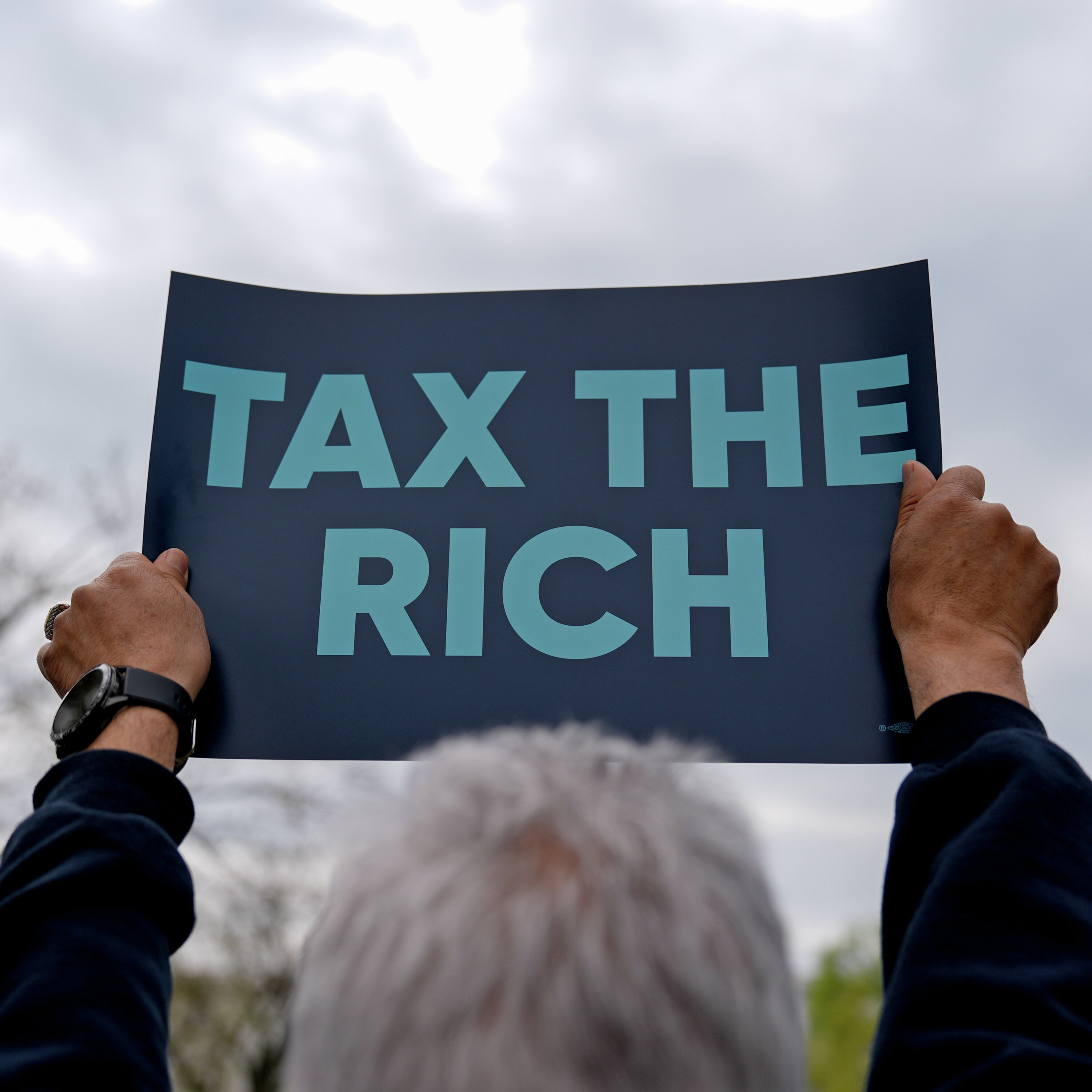
Podcasts Radio News Tax the Rich, Tax the rich.
- [01:50]
Sarah Holder
It's a call that's become increasingly popular from New York City to London.
- [01:55]
Narrator (Blood Is the Ferris Wheel)
We won't take it anymore.
- [01:57]
Podcast Host
Tax the rich, not the poor.
- [02:00]
Sarah Holder
Taxes are due next Wednesday in the US and while you put those finishing touches on your filing, many states are weighing what the future of taxes might look like for the country's wealthiest. California is weighing a ballot initiative to impose a one time wealth tax on residents worth $1.1 billion or more. Massachusetts Senator Elizabeth Warren and Vermont Senator Bernie Sanders are pushing for new taxes on ultra millionaires and billionaires at the federal level. And New York City Mayor Zoran Mamdani won on a promise to tax the wealthy too.
- [02:34]
New York City Mayor Zoran Mamdani
And ultimately the reason I want to increase these taxes on the top 1%, the most profitable corporations is is to increase quality of life for everyone.
- [02:41]
Sarah Holder
But the battle over whether and how to do this is pretty heated. Some of the people who'd be impacted argue that more taxes will stifle innovation, that they'll be forced to move.
- [02:53]
Charlie Wells
New Yorkers are going to flee.
- [02:54]
Narrator (Blood Is the Ferris Wheel)
They're going to flee New York because of Zohra and Mamdani.
- [02:57]
Sarah Holder
California's ultra rich are threatening to leave the state over a proposed billionaire tax.
- [03:02]
Charlie Wells
This debate gets incredibly emotional incredibly quickly.
- [03:07]
Sarah Holder
London based Bloomberg reporter Charlie Wells has been covering the worldwide movement to tax the rich from across the Atlantic, where European countries from the UK To France have been weighing similar proposals too.
- [03:21]
Charlie Wells
I always kind of think taxes are supposed to be boring, right? Like it's just policy. But this speaks to how money really is a representation of power.
- [03:32]
Sarah Holder
So at a time when the US Government has cut taxes on the nation's highest earners, the what's the state of the push to do the opposite? And how have past governments attempts to do this succeeded or failed? I'm Sarah Holder, and this is the big take from Bloomberg News. Today on the show, we unpack the growing, hotly debated push to tax the rich more. How could it work? Where has it happened before? And we take a closer look at New York City, where Mayor Mamdani is fighting an uphill battle to tax the wealthy and pay for his campaign promises. Charlie, when we hear calls to tax the rich, there are a few ways we can interpret that, right? Let's just start by defining those Aren't the rich already taxed?
- [04:27]
Charlie Wells
If I were going to give people one takeaway in this whole debate about wealth taxes, about policy change, it's to just remember that there are roughly three different ways that governments throughout time have taxed people, right? So it's been on wealth, which is kind of what's in the news. It's been on income, and then it's been on consumption.
- [04:51]
Sarah Holder
Income taxes, like the kind that come out of your paycheck. And consumption taxes, like sales taxes, have their limitations. They collect levies on salaries, shopping or dining, but not on accumulated wealth like people's assets.
- [05:08]
Charlie Wells
What wealth tax advocates are saying is, hey, look, you know, income tax policy really isn't working. We need to tax the value of the assets that these people hold beyond income, right?
- [05:21]
Sarah Holder
Wealthy people don't always make their money from traditional salaries. They may hold stocks, which can appreciate in value over time, or they may hold on to physical assets, which are typically only taxed when they're sold.
- [05:36]
Charlie Wells
And so valuing the properties, you know, maybe giving a break for a primary residence, but looking at secondary, tertiary and beyond residences, looking at financial assets, looking at art, looking at wine collections, and then taxing that.
- [05:50]
Sarah Holder
The idea is to tax the value of these assets because those assets, financial or otherwise, are what can really help wealthy individuals get wealthier.
- [06:02]
Charlie Wells
These super wealthy people are basically able to Say, you know what? I've got all these assets. I'm going to borrow against them for a really long time. So I'm not going to bring in a big income. I'm going to borrow against these assets that I have, keep my tax rate low, and then just pass those on to, you know, my heirs.
- [06:18]
Sarah Holder
For many generations, that's contributed to a wealth gap between the richest people and everyone else, a gap that in the US Is only growing.
- [06:28]
Charlie Wells
So this group of economists at Berkeley took a look at the cumulative assets of the 400 richest American households in the United States. And in 1982, those families, their cumulative assets made up 2% of GDP. Now it's 20%.
- [06:46]
Sarah Holder
Wow.
- [06:46]
Charlie Wells
So you see this. You see this big increase, right? 400 of the richest families. Those families, over that time, they've had an increase in wealth of about 7.5% a year. You think about income growth for the average American, 1.5% a year. So that's a part of it, right? It's this kind of growth in inequality, right? A small number of people holding this big amount of assets.
- [07:06]
Sarah Holder
As inequality widens, there's been a debate over how and whether the government should be capturing more of that wealth through taxation.
- [07:14]
Charlie Wells
So this group of economists at Berkeley, the same group, they looked at effective tax rates, right? So the amount of tax that these really wealthy people pay, and what they found is that the effective tax of the top 100 households in the United States was about 22% on average. Compare that even to the top tax rate for people in the top income bracket, right? So someone who might be making like $500,000 a year, they're working at a bank, they're working incredibly hard, their tax rate is 45%, right? So these incredibly wealthy people, 22%, people who are working a lot, who are getting their money through income, 45%. And then for the entire population, on average, it's about 30%.
- [07:56]
Sarah Holder
It's a pretty stark divide. And that imbalance exists in other countries, too. So increasingly around the world, there's been momentum around designing tax policy to account not only for income, but for assets. Norway, Switzerland, and Spain all levy taxes on citizens whose wealth is valued over a certain threshold. Some have done it for centuries. The Netherlands has its own levy that effectively works as a wealth tax. The US has never had a federal wealth tax. But at the local level, lawmakers across the country have been pushing for them.
- [08:32]
Charlie Wells
And so there have been a number of proposals in Europe, in the United States, a number of states that say, hey, look, let's take the value of wealth tax that, you know, at a low percentage point, say 2%. You've had calls for a global tax. This is from Gabriel Zucman, the French economist, saying we need a global 2% tax on wealth, not just income. We also have a call in California that's been really getting a lot of attention. This ballot initiative for a one time 5% levy on assets of residents of California who have a net worth of 1.1 billion or more. So this push to look not just at income, but to look at assets,
- [09:11]
Sarah Holder
what are the goals of lawmakers and advocates who back these kinds of taxes? Is it only about raising revenue?
- [09:20]
Charlie Wells
There are pressures that governments across the world face. Growth has slowed. Interest rates are higher. We have populations living longer. There is a lot of pressure on government budgets. I would say, based on my reporting, that is the number one aim is to close gaps. There also is this issue of perception. And a lot of the policy experts I talked to said that if you have this widespread sense of unfairness in a system, there is a need in some way to rectify it or at least make people feel like it's being addressed.
- [09:57]
Sarah Holder
Charlie says part of the reason some US States are so motivated to increase taxes on rich Americans is to offset recent federal tax cuts benefiting higher income earners that were extended and expanded last year. But actually implementing a wealth tax is easier said than done. France actually used to have a wealth tax in the 1990s. So did about a dozen other countries. Over time, many of them were phased
- [10:24]
Charlie Wells
out because they just didn't bring in the sort of revenue that advocates hoped. And, you know, one business school professor told me, basically, you know what? Both sides here tend to overestimate the efficacy or the danger of wealth taxes. You know, they never bring in a huge amount of revenue. The percentage that they take is usually, you know, between 1% to about 3%. They're sort of a substitute for other taxes that maybe some of these countries don't have.
- [10:51]
Sarah Holder
There are also challenges when it comes to calculating them.
- [10:54]
Charlie Wells
There are administrative issues, right? So if you think about what a wealth tax is, you're tallying up the value of all the stuff that someone owns every year and then figuring out how much you're going to tax on that, like that is a really big administrative challenge. And so it can sound really simple to say, oh, okay, all we got to do is 2% wealth tax around the world. Done. Making that happen is hard. It's expensive.
- [11:23]
Sarah Holder
But the other big problem is rich people tend to hate Them one of
- [11:28]
Charlie Wells
the most experienced tax advisors I spoke with who helps wealthy people with their tax planning. What she said to me was, rich people have a lot of resources to lobby against this sort of thing.
- [11:41]
Sarah Holder
That's what happened in the UK Britain
- [11:43]
Charlie Wells
is a really interesting case because it's sort of between Europe and the United States. So like the United States, it has never had a full on wealth tax, but it faces similar pressures that a lot of advanced economies have. That issue of slowing growth, that issue of a consumer under strain, that issue of inequality. And over the past two years, roughly since the labor government has come into power, there has been pressure on the government in the United Kingdom, at least in the Labor Party, from the left flank of that party, to bring in something like a wealth tax. And that kind of mirrored some policy discussions that we were also seeing in France. But in both countries, these policies, at least right now, from the parties in power, have not come into place. And I think that's because there was a lot of debate. There were a lot of threats from incredibly wealthy people to leave. And I think the threat of departures has been very, very real and very, very live. In the UK as you saw, a lot of wealthy people either go to lower tax jurisdictions or threaten to go. And I think that really seems scared the government.
- [12:49]
Sarah Holder
Charlie, how often do people actually leave? What does the data say about how these measures have played out over time?
- [12:57]
Charlie Wells
A lot of these policies have not really been in place for really long enough to see what would actually happen. And I think that's in a lot of ways why a wealth tax in the modern era is such an experiment. And so there's some numbers coming out of Massachusetts where you didn't have a wealth tax, but you saw this 4% surcharge on people from 2023 who had an income of over a million dollars. And what you saw was a big amount of, you know, assets leaving, but also a big amount of revenue coming in. Residents exiting Massachusetts took a net $4.2 billion in adjusted gross income with them in 2023. But then again, you can make another story here. When you look at the Massachusetts government brought in more than $6 billion in revenue from this policy. And so it's easy to kind of slice and dice. I think another thing is people are always coming and going, right? Wealthy people are very mobile. There's also a lot of entries. There's a lot of re entries. It's really easy to hear one number and think that the sky is falling. But look at the other numbers, right? And I think we need that data over time. We don't have it yet.
- [14:10]
Sarah Holder
After the break, we zoom in on one of the closest watched battles over a plan to raise taxes on high earners. Playing out in the richest city in the country.
- [14:24]
Podcast Narrator (Blood Will Tell)
When a birthday party in suburban San Jose turns deadly. 18 year old identical twins are arrested for suspected murder. One of them spends nearly two years in jail before the truth comes out. Authorities locked up the wrong twin. How could one brother let his twin take the fall? And why would the other give up his freedom for a crime he didn't commit? Blood Will Tell is a modern day Shakespearean saga about what we're willing to sacrifice for the people we love and whether our most tragic mistakes are worthy of redemption. Listen to Blood Will Tell, a new series from Audible and Campside Media. Wherever you get your podcasts,
- [15:13]
Podcast Host (Secret World of Roald Dahl)
you know Roald Dahl, he thought of Willy Wonka in the bfg. But did you know he was a spy? In the new podcast the Secret World of Roald Dahl, I'll tell you that story and much, much more.
- [15:25]
Podcast Host
What?
- [15:26]
Podcast Host (Secret World of Roald Dahl)
You probably won't believe it either.
- [15:28]
Sarah Holder
Was this before you wrote his stories? It must have been okay. I don't think that's true.
- [15:33]
Podcast Host (Secret World of Roald Dahl)
I'm telling you, the guy was a spy. Listen to the Secret World of Roald Dahl on the iHeartRadio app, Apple Podcasts, or wherever you get your podcasts.
- [15:47]
New York City Mayor Zoran Mamdani
I think we need to increase taxes on the top 1% by 2%. Why? We need to raise the state's top corporate tax rate to match that of New Jersey. And in doing so, this would raise $9 billion.
- [15:57]
Sarah Holder
New York City Mayor Zoran Mandani was elected on a progressive platform that he pledged to pay for with higher taxes on higher earners and big corporations. But instead of pushing a wealth tax proposal like in Spain or California, trying to levy taxes on the wealth that lives in yachts or fine wine, Mamdani is focusing on boosting taxes on wealthier New Yorkers income. The plan has a lot of people riled up.
- [16:25]
Laura Namias
I would hazard a guess that part of the reason this is getting so much attention is because of the mayor himself.
- [16:32]
Sarah Holder
Bloomberg reporter Laura Namias covers New York state and city politics.
- [16:36]
Laura Namias
He attracts incredible amount of attention, both good and bad. And so this idea is drawing even more criticism than it usually has.
- [16:47]
Sarah Holder
Mamdani has proposed raising corporate taxes and increasing the tax rate on New Yorkers who make over a million doll a year. And since he can't raise income or corporate taxes himself at the city level, he needs the state to act, that's proving difficult.
- [17:04]
Laura Namias
Previous millionaire tax income hikes have been proposed in response to economic downturns or like huge economic problems after the the Great Recession, amid the COVID pandemic, those were the times when there was the most political support in Albany for raising the taxes. And we're not technically in a downturn, so there's some concern about using this lever at a moment when it's not like of maximum importance. Or is this the pull lever in case of emergency, or should we just pull it whenever we feel like it?
- [17:39]
Sarah Holder
Mamdani is facing pushback from Albany right now, where New York Governor Kathy Hochul has resisted boosting the tax rate at all. The back and forth is an example of the political challenges that proposals to fund progressive measures with taxes on the wealthy can face.
- [17:55]
Laura Namias
Mayor Mamdani was elected on this platform of providing a couple of really bold campaign promises that were pretty expansive. Now, he has said that he would take whatever money he could get to fund the programs. But after his election and this year, he announced that the city was facing a massive budget deficit. So he is agitating heavily for tax increases at the state level.
- [18:24]
Sarah Holder
Mamdani has also offered a counter proposal, something he does have control over as mayor, raising property taxes across the board.
- [18:34]
New York City Mayor Zoran Mamdani
Faced with no other choice, the city would have to exercise the only revenue lever fully within our own control. We would have to raise property taxes
- [18:44]
Sarah Holder
that would require City council approval. So far, Mamdani's hardball at both the city and state level has hit political roadblocks. Hochul has continued to reiterate that she doesn't want to increase income taxes. Here she is speaking at a Politico summit in March.
- [19:02]
Podcast Host
What I want to make sure we are smart about is having a system in place where it's not just taxing for the sake of taxing and being conscious of the fact that I need people who are high net worth to support the generous social programs that we want to have in our state.
- [19:22]
Laura Namias
She's facing a reelection fight in November in a state that is not as blue as New York City is. Without her approval, it's very unlikely that a tax increase could go through. I mean, New York State has raised income taxes repeatedly. It's not a totally out there idea at all. And it pulls incredibly well. There's more than a simple majority support for raising income taxes on millionaires, and that's not like a new phenomenon either. For years and years, I think that that has been the case in New York. People support the idea of taxing the rich it's just that there are a lot of taxes already.
- [20:01]
Sarah Holder
I mean, from Mamdani's perspective, why focus on increasing income tax? We've seen other proposals that have focused on taxing wealth.
- [20:09]
Laura Namias
I think he's not opposed to wealth taxes. It's just incredibly difficult to do in practice. And income taxes work in New York. It yields a tremendous amount of revenue. It's easier to catch. The state tax department is like notorious or lauded, depending on where you're coming from, for their ability to track people and track their residency and make sure that people are paying. But a wealth tax is just very difficult to do on a state level.
- [20:37]
Sarah Holder
Well, one of the concerns that often comes up around these local or state level wealth tax proposals is that businesses or wealthy individuals will just leave rather than pay, which could lead to further economic strains. How is that dynamic potentially different in a city like New York, which has all of these other reasons that people, you know, move here and want to stay?
- [20:56]
Laura Namias
The data actually shows that it's inconclusive. The last time that New York raised taxes on millionaires, it did not appear to lead to an exodus of rich people out of the state, the kind of people who can afford to live anywhere. It doesn't. They're not that sensitive to changes in income taxes. The data suggests more that people are leaving from more middle income brackets than from the very top, and that that is potentially or likely because of housing prices, which is just another one of these cost pressures that people. But what some detractors would say and groups like the Citizen Budget Commission, which is sort of this nonpartisan budget watchdog that also opposes increasing income taxes, they would say that New York's share of the number of millionaires in the country has shrunk compared to other states. New York State is so reliant on the income taxes from incredibly wealthy people that if a few people leave who are extraordinarily wealthy, that could have an impact on the state's bottom line. And they use that revenue to fund things that just sort of baseline expenses like Medicaid and school funding.
- [22:09]
Sarah Holder
New York City has a deadline of June 30 to adopt a balanced budget. New York State's deadline was April 1st. They've blown past that. But the budget is expected to be done in the coming weeks. And regardless of where they land on Mamdani's hoped for tax changes and how other proposals across the country shake out, Bloomberg's Charlie Wells reminds us that in the US and in the UK, even the concept of income taxes for anyone was an experiment. Once upon a time, there was incredible
- [22:41]
Charlie Wells
debate on whether or not it was even appropriate to tax income. There were a lot of concerns that the government asking people how much money they made was this huge invasion of privacy. There were kind of national debates about this. So this incredible, incredible kind of push pull for something that now feels very normal. It feels very not controversial. There's a world where the changes that we're seeing in the economy, the changes that we're seeing in tax policy kind of have that kind of influence on a wealth tax.
- [23:16]
Sarah Holder
This is the Big Take from Bloomberg News. I'm Sarah Holder. To get more from the Big Take and unlimited access to all of bloomberg.com, subscribe today@bloomberg.com podcastoffer if you like this episode, make sure to subscribe and review the Big Take. Wherever you listen to podcasts, it helps people find the show. Thanks for listening. We'll be back tomorrow.
- [23:47]
Narrator (Blood Is the Ferris Wheel)
When beloved family patriarch Gary Ferris went missing, his family looked everywhere on their property until they came across something horrifying. It's a homicide.
- [23:56]
Charlie Wells
Absolutely.
- [23:57]
Narrator (Blood Is the Ferris Wheel)
The blame game in this family went round and round. This is Blood Is the Ferris Wheel.
- [24:04]
Podcast Host (Secret World of Roald Dahl)
I don't see how anyone can look
- [24:06]
Charlie Wells
at this story and think they were happy.
- [24:08]
Narrator (Blood Is the Ferris Wheel)
Follow and listen to Blood is the Ferris Wheel on the free Odyssey app or wherever you get your podcasts.
- [24:17]
Podcast Host (Secret World of Roald Dahl)
You know, Roald Dahl, he thought of Willy Wonka in the bfg, but did you know he was a spy? In the new podcast the Secret World of Roald Dahl, I'll tell you that story and much, much more. What you probably won't believe it either
- [24:31]
Sarah Holder
was this before he wrote his stories. It must have been okay, I don't think that's true.
- [24:37]
Podcast Host (Secret World of Roald Dahl)
I'm telling you, the guy was a spy. Listen to the Secret World of Roald Dahl on the iHeartRadio app, Apple Podcasts, or wherever you get your podcasts.