Loading summary
Transcript60 lines
- [00:00]
IBM Representative
So there's a lot of noise about AI, but time's too tight for more promises. So let's talk about results. At IBM, we work with our employees to integrate technology right into the systems they need. Now a global workforce of 300,000 can use AI to fill their HR questions, resolving 94% of common questions, not noise. Proof of how we can help companies get smarter by putting AI where it actually pays off, deep in the work that moves the business. Let's create smarter business IBM when you're
- [00:31]
The Hartford Representative
running a business, the best days are the ones where priorities stay on track. For midsize and large companies, that isn't always easy. Risk can touch multiple parts of an organization at the same time, often in ways that aren't immediately obvious. It might involve property liability or cyber. It could stem from regulatory requirements or challenges tied to a specific industry or the scale of an operation. At that level, managing risk becomes an ongoing discipline, not a one time decision. the Hartford, the focus is on helping businesses manage risk before it turns into something more disruptive. That means working with companies to identify where they're exposed, decide what matters most, and put practical standards in place so risk is managed as part of day to day operations. And when losses do happen, the Hartford can pair that risk control work with insurance coverage grounded in underwriting, risk engineering and claims experience developed over time. Learn more@thehartfort.com riskmitigation this plant shop a
- [01:31]
Juan Ha
perfectly balanced ecosystem thanks to genius from
- [01:34]
Adobe Representative
global payments, tracked inventory, seamless payments and reviews in one place.
- [01:40]
Juan Ha
Big league reliability for your business.
- [01:42]
Adobe Representative
That's genius. Bloomberg Audio Studios Podcasts Radio news
- [01:55]
Tim Stenovec
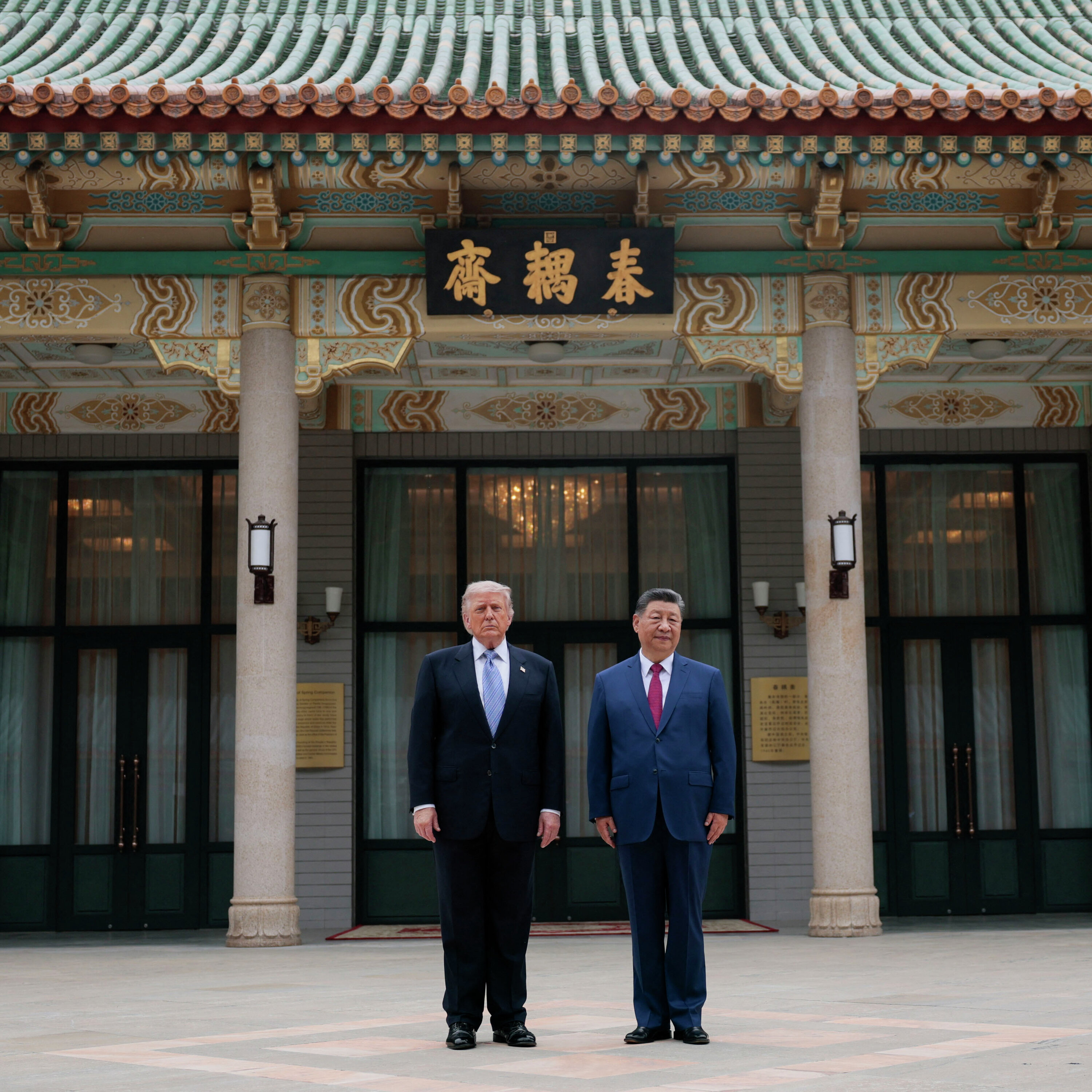
the Beijing summit between Presidents Trump and Xi Jinping of China is in the books.
- [02:00]
Jeff Mason
The President is on his way as
- [02:01]
Tim Stenovec
President Donald Trump left Beijing on Friday morning following 36 hours on the ground with Chinese leader Xi Jinping, some of the summit's accomplishments started to emerge.
- [02:10]
Adobe Representative
Trump said China agreed to buy American oil, 200 Boeing jets and soybeans, a
- [02:17]
Unnamed Trade Analyst
lot of great trade deals, including over 200 planes from Boeing with a promise of 750 planes, which will be by far the largest order ever.
- [02:28]
Tim Stenovec
President Xi called the meeting a milestone visit that established a new bilateral relationship, all against a backdrop of pomp and ceremony, A tour of the Temple of Heaven, a state banquet attended by the leaders and top CEOs with lobster soup, Beijing roast duck, crispy beef ribs and children waving American flags before the president's departure on Air Force One after years of tensions between the two global superpowers flaring up over Covid and spy Allegations, tariff battles and geopolitical conflicts, all this pomp was a big part of the message.
- [03:09]
John Liu
I think both leaders accomplished something just by the fact that they were able to have this event, the summit. I think it shows that there is an effort on both sides to stabilize the relationship and that economically is beneficial to both the United States and China.
- [03:25]
Tim Stenovec
John Liu oversees Bloomberg's coverage of China.
- [03:28]
John Liu
The domestic audience, seeing the American president here hearing all these nice things from President Trump, I think that in terms of getting something immediately out of the summit that was bigger for Xi. Although, of course, we also heard that President Trump is now inviting President Xi to the White House September 24th. And so there is going to be a reciprocal visit.
- [03:51]
Jeff Mason
I don't know that the president got any major, quote, unquote, deliverables, Bloomberg White
- [03:56]
Tim Stenovec
House correspondent Jeff Mason, but he certainly
- [03:59]
Jeff Mason
got the pomp and circumstance that he was looking for. This president in particular really likes being celebrated. I think it'll be interesting to watch how President Trump spins his trip in the coming days.
- [04:11]
Tim Stenovec
But the underlying frictions between the countries haven't gone anywhere. Chief among them the U.S. s military support for Taiwan.
- [04:19]
Jeff Mason
There are still so many simmering tensions in this relationship, some of which came out during that meeting. The Chinese put out a readout of the meeting while it was still going on, saying that President Xi had used pretty tough language with President Trump on Taiwan. I was one of a couple reporters who shouted a question at them about Taiwan and did you talk about Taiwan? They didn't answer that question. And President Trump looked a little bit frustrated on Taiwan.
- [04:50]
Unnamed Trade Analyst
He does not want to see a fight for independence because that would be a very strong confrontation. And I heard him out.
- [04:59]
Jeff Mason
They don't say eye to eye on a few pretty major things. And those major things are going to continue to be thorns in the relationship.
- [05:09]
Tim Stenovec
Welcome to the Big Take from Bloomberg News. I'm Tim Stenovec in for David Gura and Sarah Holder. Today on the show Big Take Asia, host Wan Ha takes listeners inside the Trump Xi summit. What the visit did and didn't accomplish and what to watch for as Trump and Xi navigate the war in Iran and China's ambitions in Taiwan.
- [05:34]
Juan Ha
Jeff Mason, John Liu, welcome. We're speaking on Friday morning Beijing time, just ahead of President Trump's departure from China. Now, this summit marks the first visit BY A sitting U.S. president to China in nearly a decade. Last time it was also President Trump. He visited in 2017 during his first term. What's changed in the US China relationship since then?
- [05:59]
John Liu
It was nine years ago, but it feels like it could have been 9 million years ago. Right. So much has happened since. You've had Covid, you had spy balloons, you had the CFO of Huawei arrested in Canada, Joe Biden's election, two trade wars, essentially. And now here is President Trump back in Beijing.
- [06:21]
Jeff Mason
The relationship has been influenced by a bunch of different factors. Certainly the COVID pandemic, which happened at the end of President Trump's first term, really soured the president on China. He seems to have gotten over that. You don't hear him bringing it up very often anymore. He was also more ambitious in terms of wanting to crack down on intellectual property theft and some of the other thorns in the relationship during his first term. Now he's more focused on getting business deals and getting some support from President Xi about the Iran war. Some of that economic ambition seems to have changed, and yet the president also really wants to have a relationship with China that is good for the economy of the United States.
- [07:10]
Juan Ha
And, John, I want to ask you then, what kind of tailwind does each leader come in with their economies, their political goodwill at home? Trump obviously likes to talk about negotiations like their card games. Right. So who's got the better hand here at this table?
- [07:26]
John Liu
I think the fact that both presidents are so eager to make nice speaks to the fact that they each have bigger fish to fry back at home. President Trump has the war in the Middle east with Iran. President Xi has an economy that is struggling. It is an economy that's overly dependent on exports at the moment. It's an economy that's faced deflation for the last two, three years. There are lots of pressing issues that he would like to be able to focus on, not being limited in his options by what Washington is doing in terms of sanctions and policies and diplomacy and elsewhere.
- [08:06]
Juan Ha
And, Jeff, the last time that these leaders met, the priority was trade and tariffs. Now, Trump, of course, has a bigger priority. As we've talked about Iran, how important and urgent is it for Trump to resolve the Iran war and the closure of the Strait of Hormuz?
- [08:23]
Jeff Mason
Well, he certainly did not want the Iran war to be the dominant focus of this summit. He was downplaying it a little bit in the days before he arrived in Beijing when speaking to reporters. But I think your question is spot on. It's hugely important to him. The Strait of Hormuz closure has had an impact not only on China and the US and that relationship, but on the global economy and honestly, on President Trump's focus with the midterm elections coming in The United States high gasoline prices in the US As a result of this war have certainly dimmed the political hopes of Republicans who want to hold on to control of both the House of Representatives and the Senate. Certainly the Iran war and getting that settled will be key to him in terms of his domestic politics going forward. In the readout that the White House released at the end of the meeting on Thursday, they said that President Xi also agreed that Iran should not have a nuclear weapon and did not think that the Strait of Hormuz should be subject to Iran's control. So that is a win in terms of being able to show that the US And China are on the same page.
- [09:35]
Juan Ha
And John, what about China? China is obviously the largest buyer of Iranian oil, taking in roughly 90% of Iran's exports there. But the country isn't dependent on it. Beijing has officially opposed the war, but it's largely stayed on the sidelines.
- [09:51]
John Liu
I think the main issue for Beijing when it comes to the war in the Middle east is what the secondary impact is on economies around the world. Because China wants to sell its goods and products to those markets, it's depending on exports to fuel economic growth back at home to create jobs. And and if higher oil prices are going to limit how many Chinese goods Americans or Europeans or people in Southeast Asia can buy from China, that is going to have a real impact that's going to cause pain. The longer the straight of Hormuz is closed, the more of an impact, the more pronounced that impact becomes for China, the more motivated Xi will be to try and do something. But at the same time, I think there is a reluctance because there's been some talk of maybe China could be a mediator in this war. But I think on the Chinese side there's this worry that what if a deal can't be reached? Is China going to end up looking like it's the bad guy? Is it going to get blamed for the deal not coming through? So there are lots of considerations I think Beijing is trying to balance.
- [11:01]
Juan Ha
One issue that's required a lot of balancing is Taiwan, which China claims as its own territory. Shortly after Trump and Xi concluded their closed door talks, Beijing released a statement about what was discussed. Let me read it here. President Xi stressed that the Taiwan question is the most important issue in China U. S relations. If it is handled properly, the bilateral relationship will enjoy overall stability. Otherwise the two countries will have clashes and even conflicts, putting the entire relationship in in great jeopardy. John, how significant was his statement?
- [11:40]
John Liu
So it was significant that President Xi brought up Taiwan With President Trump, it was not new. And by that I mean that every time an American president and a Chinese president have met, China has brought up the issue of Taiwan. It is by far the most important thing on the Chinese side of the relationship. President Xi made that clear to President Trump, and he would have said the same to President Biden, to President Obama. But what stood out this time was the very clear linkage to potential conflict. And that is a sort of language that we don't hear often. We have heard other Chinese officials talk about don't play with fire. We have not heard that from President Xi. So I think it does suggest that he is trying to convey this message with a higher volume to it.
- [12:32]
Juan Ha
We have seen in the past that US Presidents have walked this tightrope on Taiwan, what's known as strategic ambiguity when it comes to Taiwan. Jeff, I wonder if you can tell us a little bit about how previous administrations have handled this relationship, and is there any sign of a departure from Trump on the US approach to Taiwan?
- [12:54]
Jeff Mason
Certainly previous US administrations have wanted to maintain the status quo, and Secretary of State Marco Rubio essentially said that before this trip as well, that it was neither in the US's interest nor in China's interest for there to be any instability with regard to Taiwan or any changes. But I can tell you that before this trip, I spoke to some former US government officials who expressed concern that President Trump would be open to maybe shifting the US position on Taiwan, and that perhaps in the middle of a negotiation with President Xi, when he was seeking a business deal or support on Iran, that the impulsive nature of President Trump's presidency and just his personality and his leadership style would lead to perhaps a major concession on Taiwan. It doesn't appear as though that happened. So I think that will be interesting to watch in the coming days if we get any additional details, not only about what the Chinese said about Taiwan, which they were very quick to read out, but about what President Trump said in response.
- [14:01]
Juan Ha
The U.S. has approved some big weapons deals with Taiwan. U.S. presidents have, you know, really not discussed Taiwan arms deals with China. Xi has previously registered his displeasure with the US arms sales and has put Taiwan out there now and again as a very central issue. So the US doesn't want to talk about it, China does. Did you feel that either side blinked there?
- [14:27]
Jeff Mason
It's just hard to tell. Certainly they haven't announced any major shift in US policy towards Taiwan. If there were one, you know, even a slight shift would be a pretty big deal. But the impression so far from the US Side is that it did not.
- [14:43]
John Liu
I think it's really interesting if you look at what each side mentioned in what each side did not mention, right? So the Chinese mentioned Taiwan. The American side has been relatively reluctant to talk about Taiwan. The American side mentioned Iran. The Chinese side has been relatively reluctant to talk about Iran. I think it speaks to how each side has its own agenda in terms of what it's trying to get out of the summit. But also I think it shows how both sides in some ways are kind of talking past each other. Still,
- [15:17]
The Hartford Representative
Support for the show comes from Public Lately it feels like there are two types of investing platforms. Some are traditional brokerages that haven't changed much in decades, and others feel less like investing and more like a game. Public is positioned differently. It's an investing platform for people who are serious about building their wealth on public you can build a portfolio of stocks, options, bonds, crypto without all the bugs or the confetti. Retirement accounts? Yep. High yield cash? Yes again. They even have direct indexing. Public has modern design, powerful tools and customer support that actually helps go to public.com market and earn an uncapped 1% bonus when you transfer your portfolio. That's public.com market and paid for by
- [16:01]
John Liu
Public Holdings Brokerage Services by Public Investing member FINRA SIPC Advisory Services by Public Advisors SEC Registered Advisor Crypto Services by zerohash all in Investing involves risk of loss. See complete disclosures@public.com disclosures so there's a
- [16:17]
IBM Representative
lot of noise about AI. But time's too tight for more promises. So let's talk about results. At IBM, we work with our employees to integrate technology right into the systems they need. Now a Global workforce of 300,000 can use AI to fill their HR questions, resolving 94% of common questions. Not noise. Proof of how we can help companies get smarter by putting AI where it actually pays off. Deep in the work that moves the business. Let's create smarter Business.
- [16:45]
Adobe Representative
IBM Everyone has been there. Your team's feedback is scattered across emails, chats and sticky notes. It's a mess, but PDF spaces in Adobe Acrobat gives you one collaborative workspace to streamline every file and comment. So if you need six departments to finally agree on a proposal, do that with Acrobat. Need to turn a mountain of feedback into one plan of action. Do that with Acrobat. Want to stop searching for files and finally get everyone on the same page. Do that, do that, do that with Acrobat. Learn more@adobe.com do that with Acrobat.
- [17:29]
Juan Ha
I'm back with Bloomberg's Jeff Mason and John Liu, who've been covering the Trump Xi summit from Beijing. Now, Jeff, when these two leaders last met, the big discussion was Trump's Liberation Day tariffs, which the US Supreme Court has since ruled unconstitutional. How did tariffs factor into this round of negotiations?
- [17:50]
Jeff Mason
There was a sense that the two leaders might extend their trade truce with regard to tariffs on the US Side and with regard to rare earths on the Chinese side. We haven't seen any specific decisions released about that or discussed about that. But you're absolutely right to note that President Trump came in on one level with an arm tied behind his back on tariffs because of that Supreme Court decision. And that has taken away what he has largely used as a cudgel with the Chinese and with multiple other allies and competitors around the world. That said, even with that sort of legal hamstring on him, the president still is using tariffs, still talks about tariffs, has promised to find other ways to use them legally despite these new restrictions. And so though some analysts were saying that President Xi came into this summit with a stronger hand, that's certainly not how President Trump and his people viewed his position going into this meeting.
- [18:52]
Juan Ha
We're also hearing about the China U. S constructive strategic stability. John, what exactly is that?
- [18:59]
John Liu
So I think in many ways, I think it's about the relationship between Presidents Trump and Xi. So the way I would think about it is, Juan, if you and I are friends and we have some dispute, I nick your car by accident because we're friends, we're going to find a way to solve that conflict in a relatively amicable way. But if you and I hate each other and I accidentally tap your car, it's going to be a huge blow up. And so I think what that's speaking to is what is the fundamental underlying relationship like? Because that will determine how well these two countries can deal with conflict and problems as they arise. And they will definitely arise.
- [19:43]
Juan Ha
Jeff Trump came with an impressive high profile delegation. Tesla's Elon Musk, Apple's Tim Cook, and Nvidia's Jensen Huang. How did that factor into the various deals and the deal making there at the summit?
- [19:58]
Jeff Mason
I think it factored hugely into it. And President Xi had a separate meeting with some of those CEOs that Trump was not at. The CEOs were present in some of the pomp and circumstance parts of the summit, the welcoming ceremony and the banquet. And I think President Trump really liked that as a show of force of the business community coming together to support him and to support his goals with China. But it also goes deeper than that. I think the president really wants to come away with economic deals. And the takeaway from that is that there are positive benefits for the U.S. economy and for U.S. businesses from having an open relationship and trade between China and the US but as much as possible on US Terms. And that was part of his message while he was here.
- [20:47]
Juan Ha
And President Trump was able to walk away with some trade deals in hand. He said China will buy 200 Boeing planes. And U.S. trade Representative Jamison Greer also said he's expecting an agreement for American agricultural goods worth tens of billions of dollars. Jeff, are these big enough wins for Trump to come home with, especially ahead of the midterms?
- [21:09]
Jeff Mason
The president faces some major headwinds going into the midterms, there's no doubt about that. And certainly the fuel price, gasoline price is the biggest one. But he is a marketer, he is a salesman in chief. And so he will absolutely use these deals as a way to say, look what I did when I went to Beijing, this is going to help farmers, this is going to help manufacturing, this is going to help workers. You should continue to bless and support Republicans so that my agenda can go forward after the midterm elections. Whether or not it's enough is not a question that I'm able to answer, but I can certainly say he will use it for his case and for the case of his entire party.
- [21:51]
Juan Ha
John, let's step back for a moment. The summit really seems to be a reset for the US And China after such a tense year of tariffs and wrangling over trade. What can we expect going forward?
- [22:04]
John Liu
I think this trip is very important. I think it's even more interesting if you see it as the first of four potential meetings between Presidents Trump and Xi this year. President Trump is in Beijing, obviously, this week, but then he's invited President Xi to visit in September. And then potentially President Xi would be back in the United States in December for the G20 in Miami. And right before that, President Trump would be making another visit to China, to the city of Shenzhen for APEC in November. And so it's really setting up for a lot of discussion and diplomacy and deal making this year between the United States and China.
- [22:43]
Jeff Mason
I had some US Officials say that that lowered the bar in some ways for this meeting, that they didn't have to come away with as many major announcements or in Washington, speak deliverables, because they would have multiple other meetings this year already.
- [23:02]
Juan Ha
Now, Xi opened the meeting by saying the world is at a new crossroads and raised the question of whether the US And China can escape the Thucydides trap, which is the idea that when a rising new power like China threatens to displace an established ruling power like the US it's almost inevitable to result in conflict. John, what's the message that Xi is trying to deliver here?
- [23:25]
John Liu
I think what he's trying to say to President Trump is there is a difference between fate and choice. And President Trump and President Xi can choose to try to get along, they can choose to try and steer the relationship in a positive direction. But there are so many fundamental differences between the United States and China, be it political systems, economics, social norms, that fate might just dictate that these two countries inevitably must have some sort of conflict. And so I think President Xi, by bringing that up, is trying to emphasize that they have to proactively be trying to manage the relationship in a positive way or it will fall into conflict.
- [24:19]
Tim Stenovec
This is the big take from Bloomberg News. I'm Tim Stanovec in for David Gura and Sarah Holder. The show is hosted by David Gura, Sarah Holder and Juan Ha. The show is made by Aaron Edwards, David Fox, Jeff Grocott, Paddy Hirsch, Rachel Lewis Christie, Katie McMurran, Naomi Ng, Julia Press, Tracy Samuelson, Naomi Shaven, Alex Segura, Julia Weaver, Yang Yang and Taka Yasuzawa. There's Much more on Bloomberg.com get unlimited access to all of our coverage at a special rate for listeners@Bloomberg.com podcast offer. Thanks for listening. We'll be back on Monday.
- [25:01]
The Hartford Representative
When you're running a business, the best days are the ones where priorities stay on track. For midsize and large companies, risk can affect multiple parts of the organization at once, from property and liability to cyber and regulatory challenges. At that level, managing risk becomes an ongoing discipline. At the Hartford, the focus is on helping businesses manage risk before it turns into something more disruptive. And when losses do happen, that work is paired with insurance coverage shaped by years of underwriting, risk engineering and claims experience. Learn more@thehartford.com riskmitigation policies provided by Hartford Fire Insurance Company and its property and casualty affiliates Hartford, Connecticut as industries evolve
- [25:42]
Michigan Business Representative
faster than ever, companies need an environment that accelerates strategic growth, and Michigan delivers on that progress. Promise from emerging startups to global enterprises, Michigan offers what executives value most a resilient, innovative ecosystem, diverse communities that attract top talent, and a quality of life that supports work life Balance with our unified Team Michigan approach, businesses scale faster and compete at the highest level. Michigan Pure Opportunity Seize your opportunity@MichiganBusiness.org these
- [26:12]
Okta Representative
days, it seems like AI agents are just about everywhere you turn every field and every function. But without identity, you can't trust they'll serve your business instead of jeopardizing it. Fortunately, Okta helps you get identity right by securing your AI agents identities, giving you a single layer of control, a single standard of trust. So whether an AI agent supports a single user or your entire enterprise, with Okta you'll turn risk into opportunity. Secure every agent, Secure any agent. Okta secures AI.