Loading summary
Transcript54 lines
- [00:00]
IBM Representative
So there's a lot of noise about AI, but time's too tight for more promises. So let's talk about results. At IBM, we work with our employees to integrate technology right into the systems they need. Now a global workforce of 300,000 can use AI to fill their HR questions, resolving 94% of common questions, not noise. Proof of how we can help companies get smarter by putting AI where it actually pays off, deep in the work that moves the business. Let's create smarter business IBM when you
- [00:31]
Chase Bank Representative
own your own business, you own every decision. Now own the card that rewards you for it. Chase Sapphire Reserve for Business is a pay in full card that elevates your travel experience and offers premium benefits that will take your business to the next level. Sapphire Reserve for business offers 8x points on all purchases through Chase Travel, 3x points on social media and search engine advertising, airport lounge access, and more. Chase Sapphire Reserved for business. It's the card that gives back all you put in. Learn more@chase.com ReserveBusiness Chase for Business make more of what's yours Accounts subject to credit approval restrictions and limitations apply. Cards are issued by JPMorgan Chase Bank, NA member FDIC wise is the smart
- [01:15]
Wise Representative
way to manage the currencies you need around the globe. When you send money abroad using your bank, you could get hit with hidden fees and exchange rate markups. There's a better way. Try Wise. Wise uses the exchange rate you'd usually find on Google, with no unwelcome surprises. Plus, most transfers happen in under 20 seconds, which means you your money arrives in less time than you've been listening to me. It's simple and free to sign up when you download the Wise app. Be Smart. Get Wise T's and C's Apply.
- [01:46]
Chase Bank Representative
Bloomberg Audio Studios Podcasts Radio News it's
- [01:53]
Kevin Warsh
an honor, a true honor to be back at the Federal Reserve.
- [01:56]
David Gura
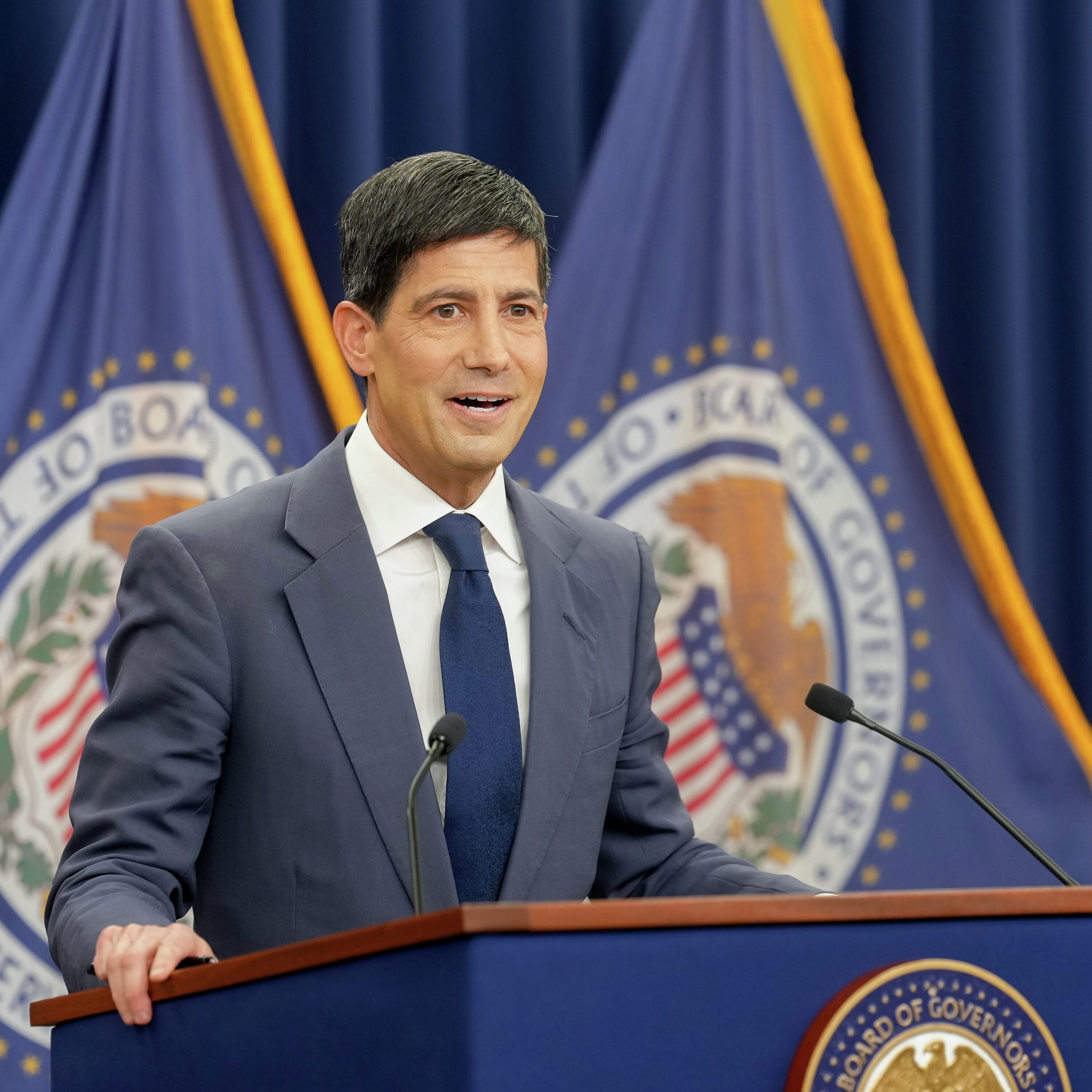
Kevin Warsh just made his public debut as chair of the Federal Reserve.
- [02:01]
Kevin Warsh
We're going to listen hard to what the experts say and make our own decision, but I can't give any forward guidance about what we're going to do next.
- [02:08]
David Gura
Less than a month into the job, Warsh just oversaw his first Fed policy meeting. And in his first news conference today, Warsh announced he and his fellow policymakers unanimously agreed to hold rates steady.
- [02:20]
Kevin Warsh
The committee decided to maintain the target range for the Fed funds rate at 3 1/2 to 3 1/4% in support of the Fed's dual mandate, a mandate
- [02:32]
David Gura
to achieve maximum employment and stable prices. The Federal Open Market Committee's post Meeting statement was shorter, a bit simpler, the Fed chair said, than we've seen in recent years. And it was hawkish in tone, reflecting the Fed's concern with inflation.
- [02:46]
Kevin Warsh
I am pleased to report that members of the FOMC are unambiguous and unanimous. This committee will deliver price stability.
- [02:57]
David Gura
The Fed chief's words are always scrutinized, and all the more so with Bush's comments today. He was President Trump's pick and the President has been very clear about his preference for rate cuts. But markets are looking for a rate hike and investors are watching the chairman of the world's most powerful central bank to see how independent he is. What we heard from Warsh today is his eagerness to reform the central bank on a variety of fronts with the
- [03:23]
Public/Hex/Okta Advertiser
goal of having a Federal Reserve that
- [03:26]
Kevin Warsh
is clear eyed about its mission, fit for purpose and focused on the future.
- [03:35]
David Gura
I'm David Gura and this is the big take from Bloomberg News. Today. On the show, I sit down with Bloomberg's Enda Curran, who was in the room for Fed Chair Kevin Warsh's first news conference for a conversation about what we learned about the new Fed chair's approach to one of the most powerful jobs in the world. And in broad strokes, how did Kevin Warsh do in his debut as Fed chair? What was the vibe in the room where he held this press conference?
- [04:03]
Enda Curran
I think it was the old hawkish Kevin Warsh who turned up. You know, remember, David, going into this meeting, there was a lot of discussion around credibility. What message would the new Fed chairman send on inflation given the whole political backdrop and the pressure on the Fed to bring down interest rates? Well, he seemed to send a pretty clear message that right now inflation is elevated, it's above where the central bank wants it to be. And he made a clear that price stability is going to be a focus for the Fed under his chairmanship. Now that's the kind of generous take, so to speak. He certainly, what he did not do was he did not signal that they would have to raise interest rates anytime soon. He stopped well short of that because obviously that's where you get into political dynamite territory. But you know, relative to what we expected, it was Kevin Warsh, the old Hulk on show.
- [04:49]
David Gura
Today we saw the statement heard from the Fed chair, one line delivered emphatically by Kevin Warsh. The committee will deliver price stability. Effectively, inflation is the chief concern here for policymakers.
- [05:00]
Enda Curran
So two things on that. Number one, it sends a signal that the Fed is serious about the inflation story. Right now we know that inflation hit a three year high last month. We know a lot of that is due to the Iran energy story. But not just Iran and energy, it's the AI spillover and it's other components in the economy too. So he's sending a signal that he is cognizant of it. But where he stopped short, David, was sending any signal about what they would do to get inflation back down. And that's kind of the gap left in the proceedings from today. He's saying, I don't want to give forward guidance. I don't want to tell you what we may or may not do, only to have to reverse course maybe or change plans later on. But plenty of people watching this today were making the point. You're making the point that you're worried about inflation, but you're not saying what you're going to do about it. So there's a kind of a feeling, there's a little bit of a missing part of the jigsaw there.
- [05:47]
David Gura
So we got the hawkish Kevin Warsh and we got Kevin Warsh the reformer as well. There was a lot of talk in the run up to this meeting and about whether Kevin Warsh plans to change the way that the Fed communicates, if he would make changes to a Fed standby. That's the dot plot part of the summary of economic projections. And before I ask you about that, just remind us what that is exactly.
- [06:05]
Enda Curran
Look, the dot plot is basically where the Federal Reserve officials jot down on a piece of paper where they think interest rates will be at the end of this year and next year. They do this once a quarter. And the dot plots today told us that a majority of the committee, well, nine of the 18, reckon interest rates could be increased by the end of this year. That's all it is. It's a simple signaling device. But of course, Chairman Warsh does not like it. He didn't put his dot down today because he doesn't believe in this idea of forward guidance.
- [06:36]
David Gura
So you said a majority.
- [06:37]
Wise Representative
9.
- [06:38]
David Gura
It would be not a majority had he given that dot. He didn't. Why was that the case and how did he explain that?
- [06:44]
Enda Curran
So you're quite right. So before Kevin Morsh got the job of running the US Fed, he was skeptical about forward guidance. He didn't like this idea of the dot plots anyway. And now that he's in office, he came out in the press conference, he got it off his chest early on to say, look, I did not put down my dot or my forecast for where interest rates are going. And that's because he doesn't like the exercise, he doesn't agree with it. He doesn't like that signaling. Now, again, this is where there's a bit of a gap left because, okay, if you don't like that, what do you want as an alternative? And, David, we can talk about it, but that's very good. Under the idea that they're going to have a much longer and bigger think now about what kind of signals they do send to the public about interest
- [07:22]
David Gura
rates before we get to that and what he has planned, what that big think is going to look like. There were a number of questions from your colleagues in the Fed press corps about if there isn't going to be forward guidance, how should they think about what the Fed is likely to do next? What does it mean in real terms if we're no longer getting the kind of forward guidance that was very common when Jerome Powell was the Fed?
- [07:43]
Enda Curran
I mean, on the one hand, it offers markets signposts, it gives investors and businesses and, of course, households signposts in terms of where interest rates might be going. But there's no shortage of critics of the dot plots, to be clear internally, David, at the Fed and you know, on the street, because the dots often turn out to be quite a meaningless exercise. You know, conditions change, circumstances change. Take this year, for example. Just in itself, at the beginning of the year in January, those dot plots were saying, we will cut interest rates this year. Well, you know, here we are in June, not that long since January, and a lot has changed. And now those dots are telling you that it raised interest rates. So people don't really think there's much value in giving those signals when you don't know what's going to happen in
- [08:23]
David Gura
the future to the big think that you mentioned. Kevin Warsh announced he's going to be appointing task forces for five key areas of the Fed's operations. So they are communications, the Fed's balance sheet, its use of data. There'll be a task force on productivity and jobs, and there'll be a task force on the inflation framework. He said, we're going to learn a lot more about this in the coming weeks. What is the significance of him doing this? He has been somebody who's been reform minded, talked about the need for the Fed to change, to evolve. What can we expect from all of these task forces? And the mantra throughout this press conference was, there's a task force for that.
- [08:57]
Enda Curran
So before he got the job, he was very critical of the Fed and the way it was run and the way it thinks about the economy and the way it looks at data and the way it sets policy. So he was very critical of the Fed and he prompts at one point what he described as regime change. And now he's got the job and he's making it clear that I've set out these bodies of these areas where we're going to focus on over the coming months to see where we can shake things up. For example, you mentioned like the communication strategy, how do we communicate what we're doing to the public and with the markets on its balance sheet on the areas its economists will focus on doing research. He said he's going to bring in outside experts to guide on this. He wants to have very different views inside these task forces. You know, to have a kind of a sub family fight. He likes family fights.
- [09:43]
David Gura
Said that a lot.
- [09:45]
Enda Curran
Yeah, but he wants little subplots of family fights going on as well. But you know, again, big headline. We don't yet have specifics, but we have to take it at face value. And at face value suggests there are going to be changes implemented at the Fed over the coming months.
- [10:01]
David Gura
What are the next challenges in store for the Fed and other central banks? That's next. With Bloomberg's end occurren.
- [10:10]
IBM Representative
The thing about AI for business, it may not automatically fit the way your business works. At IBM, we've seen this firsthand. But by embedding AI across hr, IT and procurement processes, we've reduced cost by millions, slash repetitive tasks and freed thousands of hours for strategic work. Now we're helping companies get smarter by putting AI where it actually pays off, deep in the work that moves the business. Let's create smarter business.
- [10:39]
Public/Hex/Okta Advertiser
IBM support for the show comes from public. Lately it feels like there are two types of investing platforms. Some are traditional brokerages that haven't changed much in decades. And others feel less like investing and more like a game. Public is positioned differently. It's an investing platform for people who are serious about building their wealth on public. You can build a portfolio of stocks, options, bonds, crypto without all the bugs or the confetti. Retirement accounts. Yep. High yield cash. Yes again. They even have direct indexing. Public has modern design, powerful tools and customer support that actually helps go to public.com market and earn an uncapped 1% bonus when you transfer your portfolio. That's public.com market ad paid for by Public Holdings Brokerage services by Public Investing Member FINRA SIPC Advisory Services by Public Advisors SEC Registered Advisor Crypto Services by ZeroHash all investing involves risk of loss. See complete disclosures@public.com disclosures when you own
- [11:39]
Chase Bank Representative
your own business, you own every decision. Now own the card that rewards you for it. The Chase Sapphire Reserve for Business Card brings the best Sapphire Reserve benefits to business owners who expect hard working rewards. Designed to meet the needs of business owners at scale, this Pay in Full card elevates your travel experience and offers premium benefits and value toward business services that will take your business to the next level. Fuel your business and maximize rewards with 8x points on all purchases through Chase Travel, 3x points on social media and search engine advertising, annual partnership credits and more. Make every journey more rewarding with a $300 annual travel credit and access to a network of airport lounges. Whether you're looking for pre flight productiv or time to rest and recharge, Chase Sapphire Reserved for business. It's the card that gives back all you put in. Learn more@chase.com reserve business chase for Business make more of what's yours Accounts subject to credit approval restrictions and limitations apply. Cards are issued by JPMorgan Chase Bank, NA Member, FDIC.
- [12:48]
David Gura
And did the Fed chair give any indication about how he's balancing pressure from the White House with President Trump's eagerness for rate cuts and outside pressures to tackle inflation and assert the central bank's independence?
- [12:59]
Enda Curran
He was asked had he spoken with President Trump since he's taken office, and he said, I have nothing for you on that. He was asked about his relationship with Treasury Secretary Besant, and he made the point. Look, we meet for breakfast every week. That's the normal tradition between Fed chairs and treasury secretary. So there's, you know, nothing untoward there. But he did give this kind of a signal that the Fed is independent when it comes to monetary policy. He spoke about this idea of having a wide lens but a narrow remit. That is, he wants to keep the Fed in its lane. Now, again, we don't have too many specifics by what he means on that, but I think he was trying to make the point that we're just going to tend to our own garden here. We're not going to wade into politics and the like. President Trump, I should also say, did comment on the Fed's decision to keep interest rates steady, but he kind of brushed it off. He sounded quite relaxed about it. All right, whatever. And it looks like they might even raise them later this year.
- [13:58]
Chase Bank Representative
It's not clear.
- [13:58]
Enda Curran
Do you have any? It could happen. I mean, it's hard to believe. It just keeps a country down. So right here, right now, look, when it comes to political pressure. Chairman Walsh is probably in a sweet spot. The real pressure, David, might come x months from now if the inflation story comes off the boil, if the energy story has changed oil prices down, et cetera, and if we're in a point where you could maybe argue the case, if you could, that you could cut interest rates for the economy while also arguing you can stay on hold, that's where the political pressure will probably come in.
- [14:28]
David Gura
And how did markets react to what the Fed did today and what Kevin Warsh said?
- [14:32]
Enda Curran
I think the markets took it in their stride, which is mission accomplished for Kevin Warsh. He did not want to come out of that press conference today, either blowing up bond yields or blowing up markets or sending signals that, you know, starts conversations around his credibility and that kind of thing. And I think on that front, from what I can see, he's. It's early days when, what is it, an hour or two hours since he spoke, But I think he's. He's pulled it off so far.
- [14:57]
David Gura
I want to go back to what the Fed chair said about inflation, what we saw in the dot plot. And what do both of those things say about sort of what the Fed and policymakers are thinking right now when it comes to inflation?
- [15:08]
Enda Curran
Yeah, I should say I've spoken a lot about, you know, Chairman of Water's views. But, David, the dot plot suggests that the rest of the people on the committee that sets interest rates at the Fed, you know, a good number of them, nine, are pretty worried about inflation, so much so that they're warning interest rates could go up this year. So clearly there is a divide among the committee in terms of how they need to respond. Now, all of that, of course, will be contingent on the data we get over the coming months. So, again, let's take the energy story, Iran, let's say that deal holds together, energy prices come off, you're going to have an impact on inflation data, and those dots will change, and the inflation sting will come out of that conversation. But at the moment, there are clearly enough people on that who are worried about inflation.
- [15:50]
David Gura
We have a Fed that is now extremely introspective, trying to figure out what it's going to look like in the future. If the Fed were to look at its peers, look at other central banks, what would it learn about the way they're approaching inflation? I'm thinking about the bank of Japan and the European Central bank, two banks that have raised interest rates at recent meetings.
- [16:08]
Enda Curran
It is interesting. We have seen big central banks around the world having to raise interest rates in response. You know, it's a slightly different energy story here. The energy shock hasn't been as pronounced. David, you will have economists who say the spillover from energy prices into the rest of the economy hasn't been that broad based here yet. But nonetheless, the mandate is they've got to keep a lid on inflation and make sure there's a strong labor market. And right now inflation is a bigger worry. And even if there hasn't been a great spillover so far, that might get worse in the weeks and months ahead, and therefore the officials need to be ready to go.
- [16:44]
David Gura
You and a Karin got the last question at this press conference and I want to play a little bit of that exchange.
- [16:50]
Enda Curran
Could you guide us through, please, some of the principles that guide your own reaction function and tell us a little bit about the kind of conditions that you think when the Fed should respond.
- [17:03]
Kevin Warsh
It's going to be a very unsatisfactory answer. The final question, the Federal Reserve has a lot of responsibilities, not just in monetary policy, but in supervision and regulation, consumer affairs and payments. My own view is our credibility comes from delivering on what we're saying we're going to do across everything we do. I've devoted more time in my first three weeks to monetary policy than all those things. But the more we, we deliver on our promises as good supervisors and good regulators, the more benefit we get, the more credibility enhancement we have in monetary policy.
- [17:39]
David Gura
What did you learn from that answer, Enda, about what the Kevin Warsh Fed is going to prioritize in the months and years ahead?
- [17:45]
Enda Curran
Well, he certainly covered a lot of ground there, David, and probably in truth, he probably didn't want to get into the details of what I asked him. The thinking behind that question was we haven't heard much from Chairman Walsh on monetary policy either in the kind of immediate buildup to him getting the nomination for the Fed chair job and since he got confirmed into the role. And it's kind of an inside baseball academic question to ask, you know, what's your reaction function? But it basically means like how are you thinking about inflation? What are the conditions and circumstances in which you would have to respond to that? And he didn't give us a lot to go on. So in fact, no sooner had I asked that question when Wash told me he would give an unsatisfactory answer, I had an email from someone on Wall street telling me it was very unsatisfactory. Press conference, full stop.
- [18:36]
David Gura
This is the big take from Bloomberg News. I'm David Gura. To get more from the Big Take and unlimited access to all of bloomberg.com, subscribe today@bloomberg.com podcastoffer if you like this episode, make sure to follow and review the Big Take wherever you listen to podcasts. It helps people find the show. Thanks for listening. We'll be back tomorrow.
- [19:04]
Public/Hex/Okta Advertiser
It's 10:01am on a Monday, all at once. Your sales leader needs to know which deals are at risk, your PM wants feature adoption by cohort, and your CFO needs one last graph for the board. Now your data team has to say no to somebody. Hex changes that. Ask any data question in plain English and get an analyst grade response, all backed by your actual business context as defined by your data team. Start saying yes to more data Questions at hex.AI Game Night Rush or any
- [19:37]
Kevin Warsh
night of the week.
- [19:38]
Public/Hex/Okta Advertiser
Really Genius keeps every order moving from online ordering to your kitchen to the front counter. Big league reliability for any business, that's genius.
- [19:50]
Wise Representative
These days it seems like AI agents are just about everywhere you turn, every field and every function. But without identity, you can't trust they'll serve your business instead of jeopardizing it. Fortunately, Okta helps you get identity right by securing your AI agents identities, giving you a single layer of control, a single standard of trust. So whether an AI agent supports a single user or your entire enterprise, with Okta you'll turn risk into opportunity. Secure every agent. Secure any agent. Okta secures AI.