Loading summary
Transcript61 lines
- [00:01]
IBM Executive
The thing about AI for business, it may not automatically fit the way your business works. At IBM, we've seen this firsthand. But by embedding AI across hr, IT and procurement processes, we've reduced costs by millions, slash repetitive tasks, and freed thousands of hours for strategic work. Now we're helping companies get smarter by putting AI where it actually pays off, deep in the work that moves the business. Let's create smarter business.
- [00:29]
Venture Global Representative
IBM Venture Global, we think about what can be done, not what's usually done through innovation. Venture Global is not only building some of the largest energy facilities in the world right here in the United States, but delivering American energy at a fraction of the cost in a fraction of the time. So while others are busy talking, we're busy building. That's Venture Global. That's unstoppable energy.
- [01:00]
The Hartford Representative
When you're running a business, the best days are the ones where priorities stay on track. For midsize and large companies, risk can affect multiple parts of the organization at once, from property and liability to cyber and regulatory challenges. At that level, managing risk becomes an ongoing discipline. At the Hartford, the focus is on helping businesses manage risk before it turns into something more disruptive. And when losses do happen, that work is paired with insurance coverage shaped by years of underwriting, risk engineering and claims experience. Learn more@thehartford.com riskmitigation policies provided by Hartford Fire Insurance Company and its property and casualty affiliates Hartford, Connecticut
- [01:43]
Bloomberg Audio Studios Announcer
Bloomberg Audio Studios Podcasts Radio news
- [01:50]
David Gura
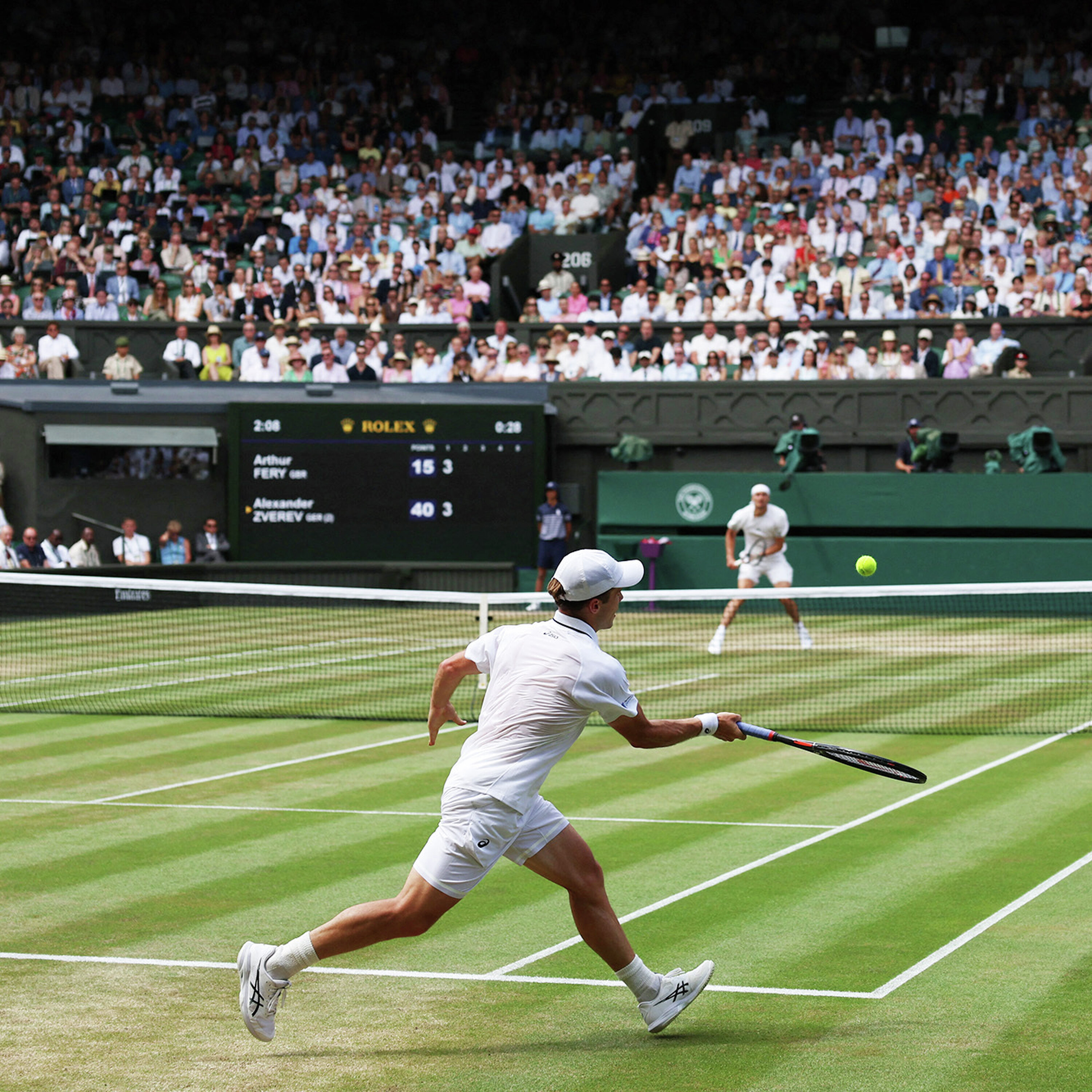
the Wimbledon finals are this weekend the pinnacle of the oldest and most revered tennis tournament in the world.
- [01:56]
Hannah Miller
Tennis has its established rituals, and Wimbledon is probably the most entrenched in those rituals.
- [02:03]
David Gura
Hannah Miller covers media for Bloomberg, and she got to see the action up close.
- [02:08]
Hannah Miller
The grounds are amazing. There's flowers everywhere, there's high tea. People are allowed to bring champagne into into the grounds.
- [02:16]
Wimbledon Official
Thank you, ladies and gentlemen. If you could avoid opening bottles of champagne when the players are about to serve. Oh, come on.
- [02:21]
Hannah Miller
If someone actually pops a champagne bottle and you hear the cork like, that's the noise, interruption. It's not necessarily people screaming.
- [02:31]
David Gura
Wimbledon brings in a lot of money. If you wanted to attend the tournament this year without waiting hours in the queue for cheap tickets, it could take you over $500,000 to secure a guaranteed seat on center court. That's almost double last year's price and triple the year before. Prize money for the marquee tournament is also on the rise. This year, the singles champs will each take home 3.6 million pounds, or nearly $5 million. But while players in other leagues have gained ground toward benefiting from their sport's overall profitability. The athletics Tennis reporter Matt Futterman says tennis sits in a more complicated gray area with athletes taking home less than 20% of the revenue.
- [03:16]
Matt Futterman
Compare that to the NBA, the NFL, Major League Baseball, National Hockey League. All of those athletes are guaranteed by their collective bargaining agreements about 50%.
- [03:29]
David Gura
Matt is the author of the forthcoming book the Cruelest Game. He says the disjoint financial model of tennis creates a system that can sometimes encourage players to to go hard with little payoff unless they're at the very top.
- [03:43]
Matt Futterman
You're seeing a lot of star players break down. The season is too long. It's 11 months. There's no off season, there's no breaks. The incentive is to play all the time. And you can't play all the time, especially now because the game has gotten so physical, so taxing. The matches are so much longer than they used to be. The planet's getting hotter, it's getting harder to do their jobs. The work conditions are difficult.
- [04:08]
David Gura
And it's not just players. Tennis as a whole is at a crossroads. And some key figures in the multi billion dollar sport are pushing for change to try to bring the business of tennis into the 21st century.
- [04:20]
Matt Futterman
Tennis is sort of the last frontier in terms of change and modernization and it is decades behind where other sports are.
- [04:34]
David Gura
I'm David Gura and this is the big take from Bloomberg News today on the show unpacking the complic business of tennis from media deals to player compensation. Can an old school sport stay up to date in a modern economy? Between the World cup and the Knicks historic win in the NBA finals, it has been a big summer for sports. But when it comes to the way sports are structured, one exists on an island of its own.
- [05:07]
Matt Futterman
Tennis is the ultimate oddball sport. It is so fractured, it's basically the United nations. No real authority or actually seven or eight different authorities and governing bodies. They all kind of hate each other, the athletics.
- [05:23]
David Gura
Matt Futterman says tennis as an organized sport has been slow to grow up. It became professionalized in the late 1960s.
- [05:30]
Matt Futterman
But the Grand Slam tournaments, the Australian Open, the French Open, Wimbledon and the US Open, which were functioning independently, they didn't want to give up their independence. Eventually you had these two things created called the ATP Tour and the WTA Tour, which were the men's tour and the women's tour. And then on top of all that, you have the International Tennis Federation, which is the world governing body, which is the sort of FIFA of tennis. And so you have this seven headed beast, all of these people who are running these things with different agendas, fancy jobs, big salaries. And while it would make a lot of sense for them to come together, I've really never known a sports executive who negotiated himself or herself out of a fancy job and a big salary.
- [06:25]
David Gura
That fractured landscape means it's hard for the sport to make deals in the way most other sports do. Grand Slams make a ton of money from media deals, but smaller tournaments, the scores of games on the ATP or the WTA tours don't come close.
- [06:40]
Matt Futterman
They've done an absolutely horrendous job of pooling their media rights. So they really devalue themselves. They compete with each other for both media deals, for advertising, and that drives the price down.
- [06:55]
David Gura
What does it mean for a corporate sponsor interested in backing tennis having the kind of fractured landscape that you describe?
- [07:03]
Matt Futterman
It is so hard for a corporate sponsor to get the value out of tennis that it gets from another sport. You take a company, I may just pick one out of the air that has had a big deal with Major League Baseball, bank of America, I think they have deals or they've had a deal, you know, with the league, and then a presence with just about every other team. And that's basically sort of one stop shopping. There's no way to do that in tennis. I was having a conversation with one of the top executives at BNP Paribas, which is probably the biggest sponsor of tennis in the world. And you know, one of their top executives, he said, I have something like 65 or 67 different contracts that I have to sign with different entities in tennis. And that's different media companies, different tournaments, different tours, different organizations. And so when you are a big sponsor and you're looking about how to spend your money, you know, you want to capture a big audience and you want to do it as easily as possible. Tennis is a hugely desirable audience, but they make it really, really, really hard for the people that are interested in tennis to connect with it and to partner with it.
- [08:24]
David Gura
If you're streaming Wimbledon in the US right now, you're likely watching on ESPN, which has exclusive streaming rights to the tournament through 2035. Bloomberg Media reporter Hannah Miller says Grand Slams like Wimbledon are hot commodities for the companies vying for a media deal.
- [08:41]
Hannah Miller
Tennis is set apart from other sports in that there are these must watch events. And you see that with the slam tournaments for tennis fans, those are going to be must see TV for them. So that does make it an easy sell.
- [08:55]
David Gura
Viewership has been on the rise, and so has participation. The number of Americans who play tennis has grown almost 60% since 2019.
- [09:04]
Hannah Miller
Covid has actually helped increase people's interest in the sport, whether watching at home or even trying it for themselves. It's an easy sport to understand. You know, when you have one person winning over the other, there aren't any ties. It's just two people grinding it out.
- [09:18]
David Gura
And despite this fractured tennis landscape, Matt Futterman says a rising tide in the sport does lift some ships. Even though Serena Williams was eliminated in the first round this year, her match set an ESPN record for Day two audience. Another great match in this weekend's finals could help drive interest in the sport's smaller tournaments or get more people playing.
- [09:41]
Matt Futterman
People are still talking about the five set, five and a half hour battle that Carlos Alcaraz and Jannik Sinner had last year at the French Open, the same way people still talk about the Roger Federer, Rafael Nadal, Wimbledon 2008 match. These sort of epic matches have a way of just capturing attention and grabbing people. They produce stars. They've put tennis sort of in the consciousness. I don't think there's any question that tennis is having a moment. And you know, that's down to people like Coco Gauff and Alcaraz and Sinner and IGA Witek and also Zendaya, who, you know, starred in Challengers.
- [10:27]
David Gura
But for players, good news at the top doesn't always trickle down to everyone else. That's coming up.
- [10:38]
The Hartford Representative
Support for the show comes from public.com if you're actively involved in your portfolio, you probably catch yourself repeating the same actions. Buying the dip, manually sweeping idle cash Putting on a hedge on Public you can now create AI agents that handle all these tasks on your behalf. Just describe what you want to do in plain English like if the Vix hits 25, buy a put option on the S&P 500 or if my cash balance goes above $20,000, move the excess into my direct index. You approve the workflow and your agent handles the risk, monitoring the market, watching for your conditions and executing your strategies exactly as defined. An investing platform driven by your intent, not just your clicks. You can also get full read and write access to your account via the public API. Go to public.com market and fund your account in five minutes or less. That's public.com market paid for by Public
- [11:34]
Matt Futterman
Investing Brokerage Services by Open to the Public Investing Inc.
- [11:37]
David Gura
Member FINRA and SIPC Advisory Services by Public Advisors, LLC SEC registered advisor complete
- [11:44]
Just Food for Dogs Advertiser
disclosures available@public.com disclosures most dog food brands don't really want you seeing how their food is made. Just food for dogs is the opposite. They actually invite you in. You can walk into any of their kitchens and see real human grade ingredients like chicken, beef, carrots and peas being prepared right in front of you. It's real food made in real kitchens. Nothing is hidden behind labels and that kind of transparency says a lot. Nothing to hide, everything to love. Go to justfoodfordogs.com and get 50% off your first order.
- [12:18]
Kyle McLaughlin
Hi, it's Kyle McLaughlin, host of the what Are We Even Doing Podcast. You know, my favorite part of the morning is that first cup of coffee. A small, quiet ritual that sets the rhythm for my day. That's why I appreciate DE'. Longhi. For over 50 years they've combined Italian craftsmanship and thoughtful design. And as the number one espresso machine brand in the world, they make it effortless. Just a damn fine cup of coffee in your own kitchen. Right now you can save 10% off your purchase at DeLonghi.com with code Kyle at checkout. After all, if it's not Italian, is it even espresso?
- [13:00]
David Gura
Making money as a professional tennis player is uniquely hard compared to other sports.
- [13:05]
Hannah Miller
It's very interesting, the contrast between like the highest end athletes and the lowest end. I think in other sports, if you're on an NFL team, you're doing very well even if you're on the bench
- [13:14]
David Gura
and not a starter, bloomberg's Hannah Miller explains. That's because in the NFL you're on a team which provides for some of your needs as an athlete.
- [13:22]
Hannah Miller
Tennis players, on the other hand, it's very individualistic. Everything is on you or, you know, you and your partner.
- [13:28]
Matt Futterman
If you're playing doubles, you have a lot of overhead.
- [13:31]
David Gura
That's the athletics tennis reporter Matt Futterman.
- [13:33]
Matt Futterman
Again, your agent is taking something on the order of 20% of all your endorsement deals. You've gotta pay a coach, you probably have to pay a physiotherapist. And remember, you earn money in pre tax dollars, you pay out salaries in post tax dollars, you've got a lot of travel expenses, you've got to find a place to train. It's the polar opposite about being a member of a team where the team takes care of all those expenses. In tennis, you're an independent contractor and it's all on you.
- [14:04]
David Gura
That makes the sport extremely top heavy.
- [14:07]
Matt Futterman
I mean, if you're Carlos Alcaraz or Jannik Sinner, you're probably making in the neighborhood of $100 million a year. But the bulk of that is going to be with endorsement deals and appearance fees and all sorts of things like that. So they are really in another stratosphere, the women. I think Coco Gauff is the highest paid player and she's up in the 30s in terms of millions of dollars. The rest of the top 10, you're still doing quite well. You should be in the eight figures, but then you have a pretty good fall off where you're getting into single digit millions. I'm not playing any violins for any of these people. You get outside the top 50, you start to get worried about falling outside of the top 80, because once you're outside the top 80, you're probably around breaking even.
- [14:57]
David Gura
Start to move outside the top 100 and you're likely losing money on the game itself. But unlike some other sports, Hannah Miller says one big tournament win can really make a difference for a lower ranked athlete.
- [15:11]
Hannah Miller
There's a great example of this with Arthur Ferry, who is, it's a Cinderella story. He's a Brit who had an amazing quarterfinal win over a top ranked player. He has gone overnight from being a no name to one of the biggest names in the UK right now. He will make at least £900,000 just from getting to this point in the tournament. If you look at his winnings prior, that dwarfs what he's gotten before. And he's also now a great target for sponsors and that'll be another great source of income as he goes along.
- [15:47]
David Gura
It's that point, the sponsorship deals that are never guaranteed but a possibility after a match or after retirement, that creates a model that keeps players in the game.
- [15:58]
Matt Futterman
The model for this is Arnold Palmer in the 1960s and Mark McCormick, who was the founder of IMG, which is sort of the first great sports and entertainment conglomerate and really the guy who made the sports business. And I think what McCormick and Palmer understood was that he could really be sort of the first great sports brand. He became something bigger in retirement than really he ever was during his playing career, especially from a financial point of view. And that has really been the model. Roger Federer is making far more money now than he ever did as a tennis player.
- [16:46]
David Gura
What would it take to kind of change the structure that you've described, this fractured structure of professional tennis, to make it work more in favor of the players?
- [16:54]
Matt Futterman
It's going to take a court in the US or a regulatory body in Europe to tell tennis that it is in violation of antitrust rules and it needs to reach a settlement. With the players.
- [17:13]
David Gura
A group of players is trying to force that change by suing the ATP and WTA tournaments and the Grand Slams. It's called the Professional Tennis Players association, or the ptpa.
- [17:24]
Matt Futterman
They have filed an antitrust suit, essentially charging collusion, that the organizing bodies of tennis basically work together with each other to create essentially a cartel, which is what all sports leagues are. Ultimately, they are cartels. The difference between them is that if you take the NFL, it has a collective bargaining agreement and the players have given their blessing for that cartel to exist. They're allowing them to break antitrust rules. They're allowing them to set things like salary caps. These are antitrust lawsuits that happened or had the potential to happen or were threatened to happen with the other sports decades ago, and they settled them out and now they're going on in tennis.
- [18:10]
David Gura
With the PTPA suit and broader questions about the future of tennis business model still in flux, Hannah Miller says the athleticism and stories the sport generates still keep fans coming back. And that love of the game keeps players coming back.
- [18:24]
Hannah Miller
Too many people would consider Serena Williams to be the queen, the goat of tennis.
- [18:30]
David Gura
Quintessential goat.
- [18:31]
Hannah Miller
Yes, she didn't perform as well as she would have wanted, as her fans would have wanted. But that's not to say that she's not going to come back again. So I'm holding out hope for the US Open. We'll see what happens.
- [18:49]
David Gura
This is the big take from Bloomberg News. I'm David Gura. The show is hosted by me, Sarah Holder and Juan Haas. The show is made by Aaron Edwards, David Fox, Jeff Grocott, Paddy Hirsch, Rachel Lewis Christie, Laura Newcombe, Naomi Ng, Julia Press, Tracy Samuelson, Naomi Shaven, Alex Segura, Julia Weaver, Yang Yang and Taka Yasuzawa. Nicole Beemsterboer is our executive producer. To get more from the Big Take and unlimited access to all of bloomberg.com, subscribe today@bloomberg.com podcastoffer. Thanks for listening. We'll be back on Monday.
- [19:28]
Optum Representative
Healthcare doesn't always work great. If you've ever waited on a refill or couldn't schedule an appointment, you get it. That's the kind of stuff Optum is changing. They're using data and technology to integrate patient care, pharmacy and everything else. So healthcare is connected, not complicated. What's that look like? Cheaper prescriptions that are easier to get and care that looks at the whole person, how you need it. Optum is helping make healthcare work as one for everyone. Learn more@business.optum.com here's something good on women's
- [19:59]
Bloomberg Audio Studios Announcer
health and longevity is brought to you by Seneca and our partner, LifeMD. LifeMD believes every woman should have access to affordable prescription medication and personalized care that understands the whole woman. Through virtual care and insurance supported options, LifeMD is making expert women's healthcare more accessible and affordable.
- [20:20]
Harley Davidson Narrator
250 years ago, America made a promise of life, liberty and the pursuit of happiness. Since 1903, Harley Davidson has been living it out on the open road at the next exit ramp with old friends, new ones, and the next generation of riders. Because the best part of any promise is keeping it. Harley Davidson Mother Motorcycles ride.