Loading summary
Transcript39 lines
- [00:00]
Microsoft Representative
Okay, before we get into it, little side note for the IT leaders listening in. I was reading up on a Microsoft Commission survey the other day and learned that teams using Windows 11 Pro PCs report 62% fewer security incidents compared to Windows 10 PCs, including three times fewer firmware attacks. Pretty significant. With security built in, you'll have AI ready it that sets you up for operational efficiency as well as long term resilience. Upgrade to Windows 11 Pro@Windows means business.com
- [00:34]
IBM Representative
so there's a lot of noise about AI. But time's too tight for more promises, so let's talk about results. At IBM, we work with our employees to integrate technology right into the systems they need. Now a Global workforce of 300,000 can use AI to fill their HR questions, resolving 94% of common questions. Not noise. Proof of how we can help companies get smarter by putting AI where it actually pays off. Deep in the work that moves the business. Lets create smarter business.
- [01:03]
Adobe Representative
IBM you need to make a huge presentation in an hour Adobe Acrobat uses AI to take all your documents and generate a presentation with a single click. Build slides quickly and streamline the process. Need a last minute pitch deck? Do that with Acrobat. Need to level up your presentation design? Do that with acrobat. You have 30 plus documents that need to be simplified into a proposal. Do that, do that do that with Acrobat. Learn more@adobe.com do that with Acrobat
- [01:39]
Sarah Holder
Bloomberg
- [01:39]
Podcast Announcer
Audio Studios Podcasts Radio News
- [01:45]
Sarah Holder
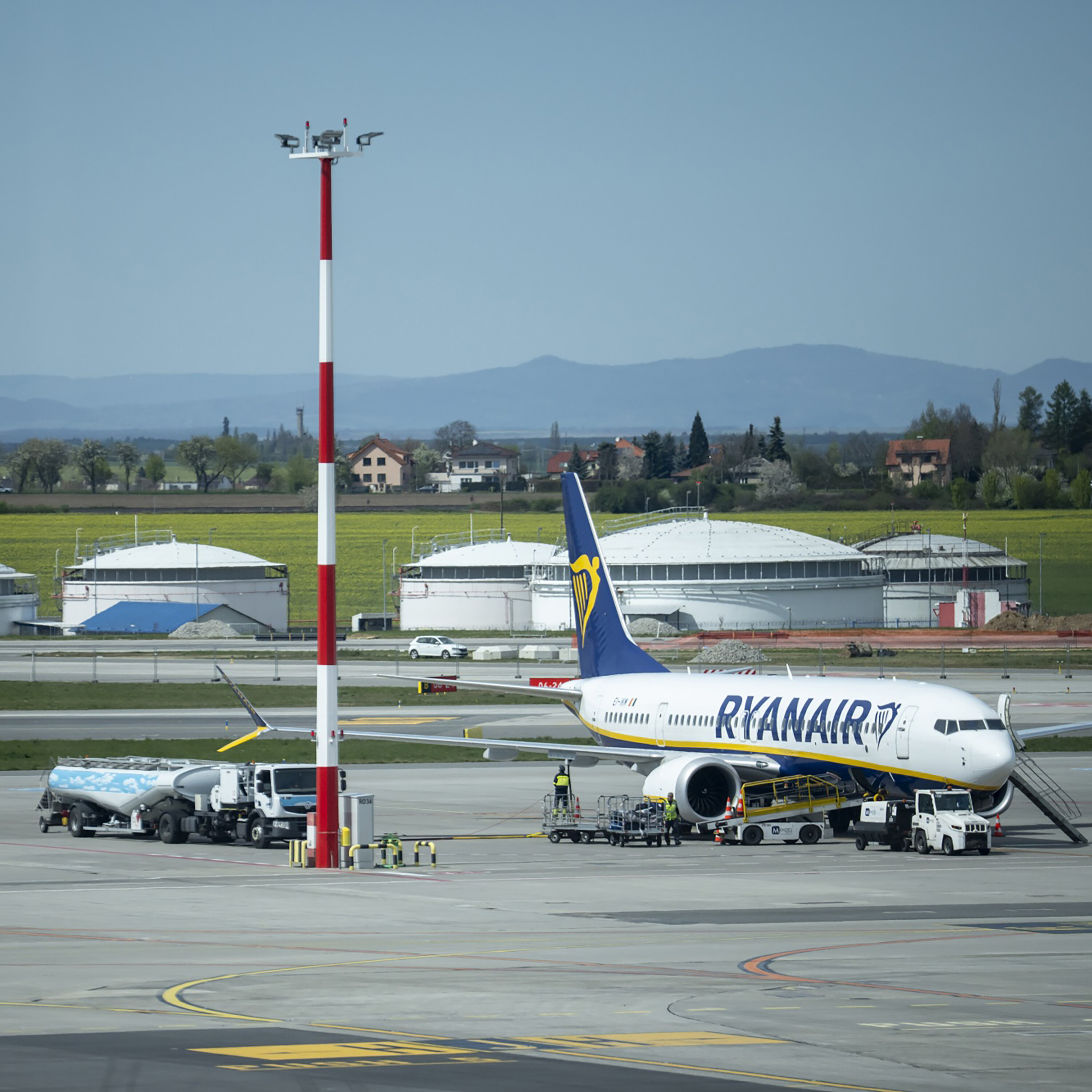
for global airlines, this year was supposed to be a big one. The industry had projected record profits, more than 5 billion passengers, and a busy summer travel season. But then came the war in Iran and the closure of the Strait of Hormuz, and with it a major disruption to global jet fuel supplies.
- [02:06]
Benedikt Kamel
There's been a lot of talk. Will we run out of jet fuel? Will we have to actually stop flying? Will my plane still take off?
- [02:15]
Sarah Holder
Benedikt Kamel oversees Bloomberg's global aviation coverage from Berlin. He says the fears of a jet fuel shortage grinding air travel to a halt haven't yet come to pass. But the strain on supply has caused other problems.
- [02:31]
Benedikt Kamel
So far, the big problem for airlines is not so much the availability of jet fuel, but it's the cost of that that has really created such a massive headache for the airlines.
- [02:42]
Sarah Holder
For some airlines, it could be more than just a headache. Over the weekend, Spirit Airlines shut down after years of financial problems, citing rising jet fuel prices as the last straw. Meanwhile, other airlines are responding to their rising fuel costs by trying to make them up Elsewhere by passing them on to passengers.
- [03:04]
Benedikt Kamel
We've heard from multiple airlines across the industry that they've said that we think we can push more of that extra cost through to the consumer. 30, 40, 50, in some cases, 100%. And that means higher ticket prices for everybody foreign.
- [03:26]
Sarah Holder
I'm Sarah Holder, and this is the big take from Bloomberg News. Today on the show, how the Iran war is putting a squeeze on airlines and passengers and how rising jet fuel costs could reshape the aviation industry. The reason airlines are so sensitive to rising jet fuel prices is is because fuel can make up as much as 30% of their operating costs.
- [03:54]
Benedikt Kamel
Jet fuel is one of the biggest costs for airlines, and it's one of the things that they can't really control. And the only other really major cost that they have is personnel, but that is something that they can control more. So you can furlough staff, you can think of other creative ways that you can reduce that. But on the fuel side, you really don't have any maneuverability. You really can't do very much. And that's why that cost has really hit them right to the bottom line. And the only thing that they can really do is try and pass that cost on. And the easiest way to do so is to pass it on to the consumer. So people like you and I, who will travel and who will suddenly find that the. The price of their ticket has gone up quite a bit.
- [04:40]
Sarah Holder
When you think about these rising prices, Benedict, how much money are we talking about for airlines?
- [04:47]
Benedikt Kamel
We heard from American Airlines that they expected by the end of the year to have additional fuel costs of $4 billion. So that gives you a sense. I mean, obviously that's stretched over a long period of time, but that gives you a sense of just how much money we're talking about. And that also gives you a sense of just how difficult this will be to absorb and to pass on to the consumer. So all the major airlines reported earnings in the last couple of weeks. And the one big theme that has come out of this for all of them is the costs going up, and we have to somehow pass them on. So we heard from United, we heard from Delta, we heard from American. And there's a great sense of uncertainty in the industry. If you think about the first couple of months of the year, there was a general sense of the demand is there, people are spending, people want to travel. That has gone out of the window. So since February 28th, since the war started, there's a lot more uncertainty built into this particular part of the industry. And the global economy. And that can be felt in the commentary, can be read in the commentary from airlines. So some have said we are suspending our outlook for this year. Others have said we have to revise our numbers. But very few have actually said we still feel good about the rest of the year. The near term outlook seems okay for now, but as anyone's guess, how things will progress. And everyone seems to understand that even if the war were to end tomorrow, the price of oil and therefore the price of fuel will not come down instantly. So that'll take time to then feed itself into the system again. We have disruption on the ground both in terms of the supply chains, but also in terms of the infrastructure on the ground. There is damage from the war. Some refineries have been hit that'll take time to repair again. So whatever happens next on the battlefield, as it were, it won't immediately lead to lower fuel prices and to lower ticket prices for the consumer.
- [06:47]
Sarah Holder
As we talk today, which markets have been hit the hardest?
- [06:51]
Benedikt Kamel
So Asia is, is hit fairly hard. They probably are the market that has the most acute shortage of jet fuel. And therefore that's, that's a particular area of concern. But then if you look into the U.S. it's really sort of a tale of two types of airlines. You have those that, that went into this crisis already quite weakened. And then you have others that went into it with a fairly solid balance sheet. So the big three, United, American, Delta, they're probably in the best position to wade through this and come out of it fairly unharmed. The other end. But then there are sort of the middle of the market carriers, the jetblues, the spirits of this world that are obviously much harder hit. And, and then we saw over the weekend that Spirit Airlines had to actually wind down operations. And that was a direct result of the cost of fuel and the surge in fuel costs that we've seen.
- [07:47]
Sarah Holder
There were, of course, other factors involved in the Spirit collapse. They'd been losing money for a while. They filed for bankruptcy just last August. They were hoping for this $500 million government bailout, which they didn't end up getting. But fuel prices were a big factor. And as you mentioned, other middle market carriers are also feeling these strains. There's been speculation that JetBlue could be headed toward bankruptcy, though the CEO recently told employees they're not considering that option. But I guess I'm wondering, Benedict, could jet fuel costs put more carriers out of business?
- [08:23]
Benedikt Kamel
That is certainly a risk. And what happened to Spirit is emblematic of the wider issues in the industry that you have very little wiggle room essentially. So if something goes wrong and you're already going into this weakened, then it's going to be very hard to survive it. And that's certainly the case for Spirit. So it really separates the stronger players from the weaker players. Whether other airlines will go bankrupt is impossible to say at this point. We heard from the Transport Secretary, Sean Duffy yesterday that he doesn't think that others will be in direct jeopardy, that others will have to declare bankruptcy. And at the same time, we know from some of the smaller players in the market, the frontiers and so on, that are going to the government and saying, could we count on you for some form of assistance should the going get tougher? Spirit probably in a unique position, already weakened and that ultra low cost model was already really struggling. So they probably only needed that last encouraging nudge to tip them over the edge of the cliff. What that means for others is too soon to say, but it's certainly not going to get any easier for other carriers.
- [09:33]
Sarah Holder
So, Benedikt, you mentioned the Asian market which saw these impacts first. We talked about the us. I want to turn now to Europe because the head of the International Energy Agency recently said that the continent has only about six weeks of jet fuel remaining before shortages begin to take effect. What could a shortage look like for Europe?
- [09:54]
Benedikt Kamel
That was quite an alarmist comment from the head of that agency. And some airlines have sort of gently pushed back on that and said, look, the outlook is always four to six weeks in terms of what we can see in terms of supply. Yes, fuel is expensive, no doubt about it, but we don't actually see a shortage. So there are strategic reserves that they can tap. They are looking to other markets. And then there is what is called sustainable aviation fuel, which is an alternative source of fuel that was all a rage a couple of years ago, then sort of fell out of favor a bit because it was expensive and it wasn't available in enough quantities. And now, interestingly, given this crisis, airlines are taking another hard look at this and seeing, okay, can I get my hands on more sustainable aviation fuel that is not kerosene and not oil based and might that sort of help me over the hump in the short term?
- [10:52]
Sarah Holder
So how might airlines adapt to the longer term impacts of the jet fuel squeeze? That's after the break.
- [11:05]
IBM Representative
The thing about AI for business, it may not automatically fit the way your business works. At IBM, we've seen this firsthand, but by embedding AI across hr, IT and procurement processes, we've reduced cost by millions slash repetitive tasks and freed thousands of hours for strategic work. Now we're helping companies get smarter by putting AI where it actually pays off, deep in the work that moves the business. Let's create smarter business.
- [11:34]
Public.com Representative
IBM Support for the show comes from Public Lately it feels like there are two types of investing platforms. Some are traditional brokerages that haven't changed much in decades, and others feel less like investing and more like a game. Public is positioned differently. It's an investing platform for people who are serious about building their wealth on public. You can build a portfolio of stocks, options, bonds, crypto without all the bugs or the confetti. Retirement accounts? Yep. High yield cash? Yes again. They even have direct indexing. Public has modern design, powerful tools and customer support that actually helps go to public.com market and earn an uncapped 1% bonus when you transfer your portfolio. That's public.com market ad paid for by Public Holdings Brokerage Services by Public Investing Member FINRA SIPC Advisory Services by Public Advisors SEC Registered Advisor Crypto Services by ZeroHash all investing involves risk of loss. See complete disclosures@public.com disclosures here's a paradox.
- [12:35]
My Policy Advocate Representative
We buy insurance for peace of mind. Yet the very policies we trust can deliver the biggest financial shocks across America. Millions of claims are denied every year, not because people did anything wrong, but because policies quietly excluded the things that happened. The the psychology of trust tells us we assume the contract is fair. But in insurance, the information gap is massive. The insurer knows every detail of what's covered. The policyholder rarely does. That's where my policy advocate comes in for just 27 cents a day. Their platform reads your policies and shows you in plain language where you're vulnerable. They're not selling insurance. They don't do that. It's about transparency, giving ordinary people the same understanding insurance companies have had for decades. Because when you know what's really in your policy, you you can plan, protect and avoid surprises. Before you trust your policy to protect you, let my policy advocate tell you what it really says. Visit mypolicyadvocate.com today. Peace of mind starts with knowing the truth. Mypolicyadvocate.com.
- [13:40]
Sarah Holder
As jet fuel costs rise, airlines have been trying to pass those costs onto consumers. And Bloomberg's Benedict Kamel says some airlines are also rethinking their routes.
- [13:52]
Benedikt Kamel
Some airlines are taking a hard look at what they're flying, how many routes they're doing, and they're taking out some capacity. That is one thing that airlines can do. They can take a Hard look at their route network and think about, do I really need to do this route? Do I really need to take this flight to a secondary or a tertiary airport that might have been nice to serve previously, but is not mission critical? So we are seeing that, that they are strategically taking some routes out of the network. That means they're consuming less fuel, and that probably helps the bottom line of the demand as well.
- [14:28]
Sarah Holder
How are we seeing different governments around the world stepping in and stepping up at this moment? Are there policy interventions or governmental interventions that are poised to help the airline industry weather this moment?
- [14:45]
Benedikt Kamel
Well, the most obvious one was President Donald Trump musing whether the government should take over Spirit Airlines. And there was considerable opposition even within the Trump administration and the wider government whether this is a good idea. This is an airline that was already in trouble. There were a lot of people saying that the US Government should not be in the business of owning an airline, whether it's a solid and healthy one or whether it's one that many people would say is a zombie airline at this point. So in the end, we know how it ended. No deal. And then therefore, the collapse. So that is sort of the most obvious way in which a government has stepped in. Over here in Europe, the airlines have lobbied with governments to sort of alleviate some of the burdens, be it taxes, that kind of thing. But nobody's outright asked for governments to intervene and to prop up airlines. So that hasn't really been the case other than Spirit, and the same is the case in Asia. So we're in a bit of a holding pattern at this moment and in a wait and see mode moment to see, okay, what can the airlines do proper? What can the industry do before they go cap and hand to the government? And so at the moment, it's more sort of on the fringes and on the sort of regulatory side and on the cost side, shall I say, wherever the government can alleviate things, but less so in terms of actually taking ownership of an airline, in terms of what
- [16:08]
Sarah Holder
the industry can do, are they looking at supply alternatives outside of the Middle east, like in the US And Canada? And realistically, how quickly could those supply chains get up and running?
- [16:21]
Benedikt Kamel
Well, that's a hard lesson that Europe in particular learned after the Russian Ukraine war, sort of, how quickly can you wean yourself off the existing supply chains? How quickly in this case could Europe, and in particular Germany, wean itself off Russian gas? And the answer is, these things take a while. It's a complicated, complex network that has grown over decades, and it's very Difficult to plug holes that come up and to go elsewhere. The jet fuel that is supplied in the US is slightly different from the one that is supplied in Europe. So there are complexities built into all of this that don't make it that easy to quickly switch from one supplier to the other. The most obvious thing that airlines can do is to look at their bottom line, is to look at their fleets, is to look at their cost base and to think hard about where can be more frugal. How can I make sure that I don't fly to certain markets where there is a risk that jet fuel is in scarce supply and therefore my aircraft might be stuck there? So some airlines are taking a hard look at some markets in Asia and thinking, well, maybe I don't want to fly there because I do want to be able to come back. So that is essentially what airlines are doing for the time being. But again, there are those out there who say the airline industry has learned over the years and over past crises, be it the 2008 financial crisis, be it 9, 11, be it corona, they have managed to adapt and they've always come out the other end. That's the more optimistic view that leaders in the industry like Tim Clark, who runs Emirates and who's run that airline for a long time, he takes that kind of a view, which is, give us a bit of time and we'll be just fine.
- [18:06]
Sarah Holder
As you mentioned, Benedict Airlines are passing some of these costs on to consumers. Right. As the busy summer travel season starts up. I'm wondering if you can break down where these price hikes are showing up, because it's not just rising ticket prices. Right.
- [18:20]
Benedikt Kamel
It's not just that. That's the most obvious one. But airlines are also getting creative when it comes to the more, should we say, hidden costs. Yeah. So adding a fee to the bag that you check in that previously might have been feature free. Lufthansa, for instance, the airline here in Germany, they recently did that. Or making it more complicated for you to add certain sort of perks that again, might have been free previously, getting rid of certain flights that might have existed previously. We just heard from Ryan that they are shutting some bases and saying this is no longer cost efficient. That means less choice for consumers. So the bottom line is your ticket will get more expensive. The things you can do with the ticket that you previously booked are going to get more expensive or are going to go away and your flight might disappear. So the ticket that you booked or that you thought you would book might no longer exist. So fewer Choices at a higher cost is sort of the bottom line.
- [19:19]
Sarah Holder
And could some of the changes to the consumer air travel experience stick if and when jet fuel prices come back down?
- [19:28]
Benedikt Kamel
Well, I mean, if there's one thing that we learned is that once you've gotten the consumer used to something, it's hard to reverse that. That means once you've sort of trained the consumer to accept higher prices, why go back? You know, once you've trained the consumer that they need to pay extra for certain things, why go back? You have to remember this is an industry that doesn't have lavish profit margins. The profit margins in the best of times are relatively thin. If they find that this is something that is stuck and there's no outward rebellion and there's no change in consumer behavior, then why go back? The good news for airlines is that the demand is there and particularly the demand for the sort of higher priced tickets is there. One thing that we've noticed since COVID is that people are upgrading. People are moving more to the front front of the cabin. People want to be treated better, they want to fly better. They're populating the lounges, they're buying premium economy, they're buying business class tickets. That is something that is still very much intact, that trend. So airlines are probably thinking, well, let's do this now while we can and while there still is demand. But you have to remember we're going to come out of the peak summer period and in what's called sort of the shoulder travel season. And that's where demand is weaker. And the real litmus test will be during that time. You can get higher prices when everybody wants to travel. But getting high prices pushed through the market at a time when demand is slim, that's going to be the real test case for the industry.
- [21:10]
Sarah Holder
This is the big take from Bloomberg News. I'm Sarah Holder. To get more more from the Big Take and unlimited access to all of bloomberg.com, subscribe today@bloomberg.com podcastoffer if you like this episode, make sure to subscribe and review the Big Take. Wherever you listen to podcasts, it helps people find the show. Thanks for listening. We'll be back tomorrow.
- [21:41]
Adobe Representative
If you follow markets, you know the value of long term thinking. You plan, you diversify, you prepare for volatility. But even the best strategies can't prevent every bad day. For more than 75 years, Cincinnati Insurance has helped individuals and businesses navigate tough moments. With expertise, personal attention and independent agents who focus on relationships, not transactions, the Cincinnati Insurance companies let them make your bad day, better find an agent@cin fin.com
- [22:18]
Microsoft Representative
okay tech leaders word on the street is security incidents are dropping way down with Windows 11 PCs built in. Security for the win upgrade to Windows 11 Pro@windowsmeansbusiness.com Every business has an ambition.
- [22:34]
Podcast Announcer
PayPal open is the platform designed to help you grow into yours with access to business loans so you can expand and hundreds of millions of PayPal customers worldwide. Your customers can pay all the ways they want today with PayPal, Venmo, pay later and all major cards so you can focus on the future when you need a partner trusted by millions. There's one platform for all business PayPal Open grow today at paypalopen.com loans subject to approval in available locations.