Loading summary
Transcript51 lines
- [00:01]
David Gura
The thing about AI for business? It may not automatically fit the way your business works. At IBM, we've seen this firsthand. But by embedding AI across hr, IT and procurement processes, we've reduced costs by millions, slash repetitive tasks, and freed thousands of hours for strategic work. Now we're helping companies get smarter by putting AI where it actually pays off, deep in the work that moves the business. Let's create smarter business.
- [00:29]
Optum Representative
IBM Healthcare doesn't always work great. If you've ever waited on a refill or couldn't schedule an appointment, you get it. That's the kind of stuff Optum is changing. They're using data and technology to integrate patient care, pharmacy and everything else. So healthcare is connected, not complicated. What's that look like? Cheaper prescriptions that are easier to get and care that looks at the whole person how you need it. Optum is helping make healthcare work as one for everyone. Learn more@business.optum.com wise is the smart way
- [01:01]
Wise/Boost Mobile Advertiser
to manage the currencies you need around the globe. When you send money abroad using your bank, you could get hit with hidden fees and exchange rate markups. There's a better way. Try Wise. Wise uses the exchange rate you'd usually find on Google, with no unwelcome surprises. Plus, most transfers happen in under 20 seconds, which means your money arrives in less time than you've been listening to me. It's simple and free to sign up when you download the Wise app. Be smart, Get Wise T's and C's Apply.
- [01:33]
Optum Representative
Bloomberg Audio Studios Podcasts Radio News
- [01:39]
David Gura
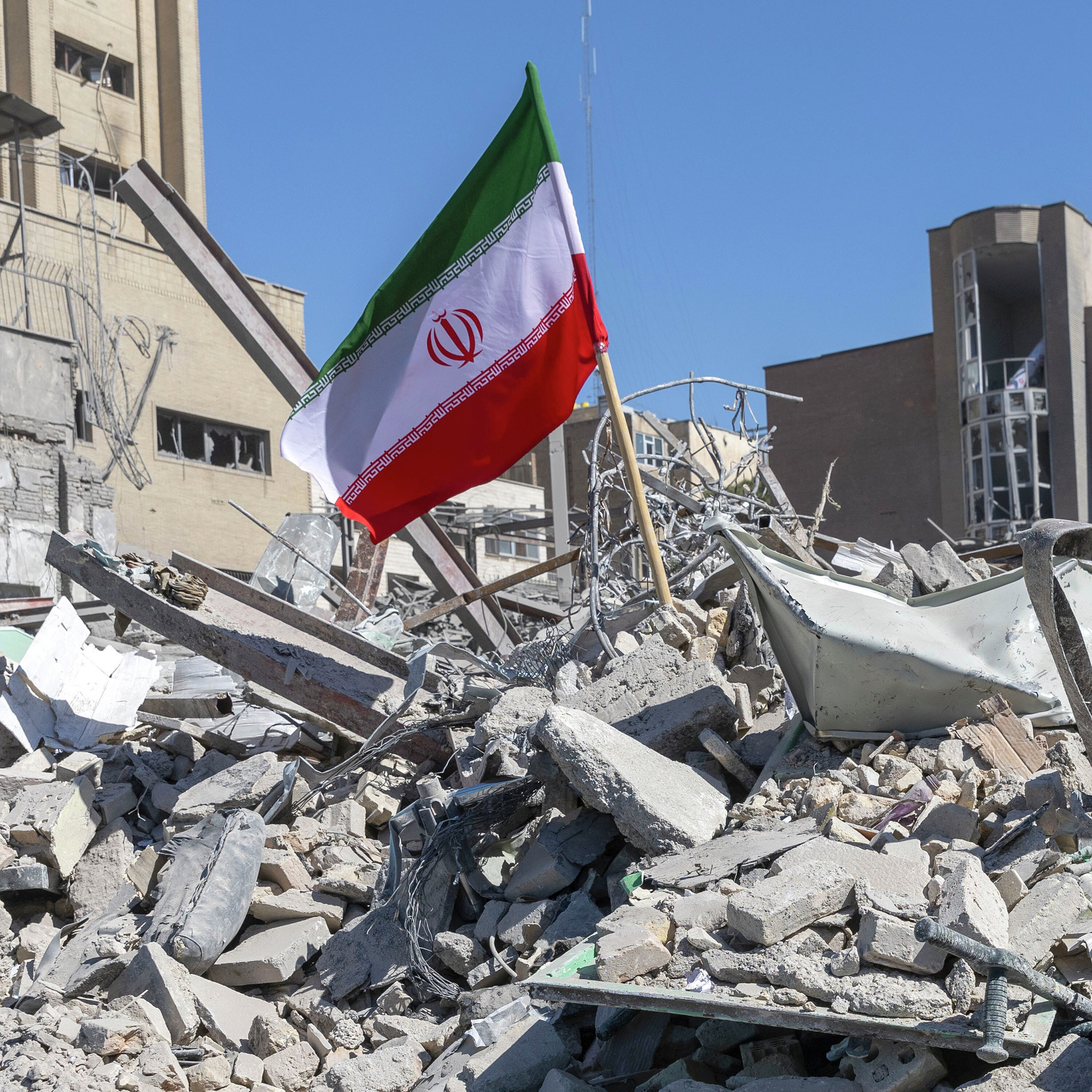
the Middle east has changed dramatically since Hamas attacked Israel on October 7, 2023. And the war with Iran has brought about even more dramatic shifts across the region.
- [01:49]
Peter Martin
There was so much at play.
- [01:52]
David Gura
Bloomberg's Peter Martin, one of our Middle east correspondents, were looked at how one day highlights those changes. March 31, 2026 there was a Kuwaiti
- [02:01]
Peter Martin
tank that had been hit by an Iranian strike that was sort of blazing in the Strait of Hormuz. Trump on that same day was berating European allies for refusing to help open the Strait of Hormuz. Israel was expanding its presence on the battlefield in Lebanon and beyond. Dubai was under direct attack from Iranian missiles and drones.
- [02:24]
David Gura
And on that day, thousands of miles away from the United Arab EMIRATES in the UK then Prime Minister Keir Starmer welcomed Syria's new President Ahmed El Shara to 10 Downing Street. He's a former Al Qaeda commander, and
- [02:37]
Peter Martin
together it felt like that day kind of encapsulated the global consequences of the war. You know, an impact on global shipping, higher energy prices, strained alliances, Israel's territorial expansion and subsequent diplomatic isolation.
- [02:53]
David Gura
Peter says that single day represents how much the Middle east has been transformed. Alliances have shifted, battlefields have expanded, and countries have had to redraw trade routes. And that has left the public divided. I'm David Gura and this is the big take from Bloomberg News today on the show. As a fragile ceasefire between the US And Iran falls apart, and as technical talks are enveloped in uncertainty, a look at what war has meant for the wider region and the world. How much has the Middle east changed since Hamas attacked Israel on October 7, 2023?
- [03:37]
Peter Martin
I mean, the region has been through a pretty profound transformation. Conflict has spread from Israel into Gaza and then all across the region. Lebanon, Syria, Yemen, Iran, and now in this most recent round of fighting, all across the Gulf states as well. During that period, Israel has emerged stronger militarily, but perhaps more isolated than ever politically. Iran's proxy network has been battered and weakened, but it has retained significant leverage over the global economy. And the Gulf, which for so long seemed insulated from turbulence in the Middle east, has really lost a lot of that sense of insulation and feels much more at risk than ever before.
- [04:20]
David Gura
When we talk about a place changing, what's changed exactly?
- [04:22]
Peter Martin
One of the things that we've seen break down is any sense of Gulf unity. Saudi Arabia before October 7th was moving toward normalization with Israel, perhaps some kind of Abraham Accord style agreement that really is, for the moment, off the table, given public perceptions in Saudi Arabia, elite perceptions of what Israel has done in Gaza with more than 70,000 Palestinians killed, and strikes across the region, including an Israeli strike in Qatar, which was extremely controversial. And the UAE has taken a completely different path. It's aligned itself much more closely with the United States and with Israel. And we've really seen the region kind of fold into two different opposing camps. That's a profound and I think probably lasting shift.
- [05:16]
David Gura
So our colleagues at Bloomberg Economics have kind of analyzed how attitudes and alliances have shifted over 10 countries in the Middle East. From that analysis, two countries emerged with the most strained ties. And I don't think that's going to surprise anybody. We're talking about Iran and Israel. So let's start with Israel. And I wonder, Peter, how you would characterize Israel's position in the Middle east today?
- [05:38]
Peter Martin
Yeah, you know, I think that Israel has emerged as militarily stronger. It has dealt severe blows to Iran's proxy network across the region. And in the 12 day war and the most recent war with Iran, has even been able to strike at Iran's own military capabilities on its home soil and to do that in lockstep with the United States, which in many ways is the high point of Netanyahu's career, something he's been building toward for 30 years. But at the same time, that's come at a huge diplomatic it cost for Israel. The country is arguably more isolated than it's ever been. Its conduct in its war in Gaza has damaged its relationship with Europe, countries across the global south, and much of the Arab world. Regional partners also see Israel differently. So while the United Arab Emirates has kind of doubled down on its close relationship with Israel, Saudi Arabia, the largest player in the region, has really taken pause and found it much more difficult to get closer to the country. And perhaps most important of all, Israel's longstanding special relationship with Washington has come under strain. Public opinion in the US has shifted quite considerably, especially on the Democratic side, but even inside Trump's base. And it's difficult to believe that that doesn't represent quite a profound weakening of Israel's position and its relationship with the US Long term.
- [07:08]
David Gura
I want to get more into that contrast that you're laying out between the UAE's approach and Saudi Arabia's approach. So you've talked about sort of the approach that the UAE has taken. What has Saudi Arabia done in kind? How does its approach to Israel in the Middle east more broadly differ from what the UAE's has been?
- [07:25]
Peter Martin
Yeah, you know, before, before October 7th, it looked like there was something of a unified approach to what Israel developing among the Gulf states. But October 7th really changed everything for the Saudi public and for Saudi politicians. That approach became untenable as images of malnourished children, of strikes across Gaza, disruption and rubble across the enclave built up. And the kingdom has moved away from that. At the same time, the UAE has kind of made the opposite choice. It's deepened intelligence and military cooperation with Israel. And we've really seen the region realign, with Saudi Arabia deepening its ties with Egypt, Turkey, Pakistan, and some of its other Gulf neighbors, and the UAE really doubling down on its relationship with Israel.
- [08:20]
David Gura
I'm reluctant, of course, to talk about Gulf nations as a monolith here, but my sense is there was widespread opposition to the most recent war that we've seen started, that being the US And Israel's attack on Iran. Could you talk a bit about what the direct consequences have been for those nations as a result of that war starting and continuing?
- [08:40]
Peter Martin
Yeah, I mean, for Gulf nations, it's really taken them to the front and center of Middle Eastern conflict for so long it looked like they were insulated from the kind of instability that we've seen in the Middle east long term. The UAE has been hit by around 3,000 drones and ballistic missiles from Iran. It's seen at least 13 people killed, infrastructure badly damaged, damaged. Qatar has had, I think something like 17% of its LNG capacity taken offline. Saudi Arabia, as a bigger economy, has been a little bit more insulated, but has also been roiled by the conflict as Bahrain, Kuwait, Oman. So it's really been very widespread and very difficult for Gulf states, which have long relied on this perception that they were something of an exception in the region as a way to attract investment expat populations and all that kind of stuff.
- [09:44]
David Gura
Coming up, assessing the economic changes and challenges in the Middle East.
- [09:54]
Public.com Advertiser
Support for the show comes from public.com if you're actively involved in your portfolio, you probably catch yourself repeating the same actions. Buying the dip, manually sweeping idle cash, putting on a hedge on Public you can now create AI agents that handle all these tasks on your behalf. Just describe what you want to do in plain English like if the Vix hits 25, buy a put option on the S&P 500 or if my cash balance goes above $20,000, move the excess into my direct index. You approve the workflow and your agent handles the risk, monitoring the market, watching for your conditions and executing your strategies exactly as defined. An investing platform driven by your intent, not just your clicks. You can also get full read and write access to your account via the public API. Go to public.com market and fund your account in five minutes or less. That's public.com market paid for by Public
- [10:50]
David Gura
Investing Brokerage Services by Open to the Public Investing Inc. Member FINRA and SIPC Advisory Services by Public Advisors, LLC SEC registered advisor. Complete disclosures available at public.com disclosures the
- [11:04]
Wise/Boost Mobile Advertiser
official language of football is trash talk, late night group chats, memes and unbelievable highlight clips. That's why Boost Mobile brings you our new Global Connection plan, the first plan ever made for WhatsApp. Get unlimited data, talk and text, international roaming and calls to over 100 countries for just $40 a month.
- [11:25]
David Gura
Forty dollar price includes $5 a month
- [11:26]
Wise/Boost Mobile Advertiser
autopay discount after 40 gigabytes of premium high speed data speeds will be lowered. Coverage not available everywhere. Visit Store or BoostMobile.com for details.
- [11:35]
Peter Martin
Amazon Health AI presents Painful Thoughts I
- [11:40]
David Gura
I can't stop scratching my downtown Mm, yeah, but I'm not itching to go downtown and tell A receptionist. I'm here to talk about my downtown. Some things you'd rather type than then say out loud.
- [11:54]
Peter Martin
There's no question too embarrassing for Amazon Health. AI chat your symptoms and get virtual care 24. 7 Healthcare just got less painful.
- [12:08]
David Gura
Peter, you've charted the geopolitical fallout from these wars. What about the economic fallout? What have these wars meant to what was or has been a real bright spot in the global economy?
- [12:20]
Peter Martin
Yeah, I guess the most immediate impact was on energy inflation. Brent crude rose, I think 60 plus percent in March to about $118 a barrel. U.S. gasoline prices surged above $4 a gallon. Costs for shipping increased, costs for insurance of shipping increased significantly. And of course, all of these disruptions have had a global impact. They've hit prices for fuel in Africa, where we've seen protests. They've hit prices for consumers in Europe and the United States. And of course, they threaten to have an impact on the midterms in the US as well, with the potential that this conflict will come back to bite Donald Trump.
- [13:06]
David Gura
You've taken me where I want to go next and that is how this is playing out, not just in the Middle east, but around the world. It's had dramatic effects on the relationships between Middle Eastern nations and many other countries. It strikes me in light of what you've just laid out there, there has to be a great deal of introspection in Gulf capitals about the relationships they have with other countries around the world, how they get energy out to other parts of the world. How are they thinking about the future when it comes to their relationship with the wider world.
- [13:34]
Peter Martin
Gulf countries are thinking about how they ensure that this never happens to them again. Saudi Arabia is talking about expanding its east west pipeline to the Red Sea to try and sidestep its dependence on the Strait of Hormuz. The UAE has said that it wants to completely eliminate its dependence on the Strait. So, you know, long term, they're looking to ensure that they can build up that insulation that they want to have. That's not possible for everyone. You know, Qatar is still going to remain dependent on shipping to remove natural gas from the country. But as far as they can, they're trying to build up resilience. Exactly. What the settlement around the Strait of Hormuz looks like at the end of this is still very much an open question. The Omanis have been talking to the Iranians directly about some kind of charge or toll on the strait, which is extraordinary when you think back to before this most recent Iran conflict began, where the status quo was free and open commerce through the Strait that looks like it's now gone forever and something else will emerge in its place. Just underlining really how profound some of these shifts have been since October 7th.
- [14:44]
David Gura
I want to ask you too, just about Israel's isolation. We have data about global attitudes towards Israel, how people are feeling about the Israeli government at this moment in time. We've seen more governments criticize the Israeli government. What does its path forward look like vis a vis the kind of broader global community?
- [15:03]
Peter Martin
It's really hard to say. Like, look, Netanyahu wants to continue strikes against Iran. He's doubled down on the kind of foreign policy approach that has heightened Israel's global sense of isolation, including inside the US and as long as that is the trajectory of Israeli foreign policy, which emphasizes absolute security, the necessity of reaching far beyond Israel's borders to uphold its sense of security at home. As long as that is the direction that Israeli politicians, Israeli strategists, want to take, I think it's super hard to see how it's going to recalibrate relationships with Europe, countries across the global south and much of the Arab world.
- [15:47]
David Gura
So, Peter, this conflict continues. A ceasefire really hasn't held. And because Iran controls the Strait of Hormuz, as you write, it does seem to have the upper hand here over the US when it comes to these negotiations so much as they are continuing.
- [16:02]
Peter Martin
It's fascinating because it's something that we've seen in protracted conflicts with the US Again and again. You think back to Vietnam, a much, much weaker adversary, managing to gain leverage by understanding what US Pain points are. In the case of Vietnam, it was the death of US Troops, which turned out to be the Achilles heel of the United States. And in the case of Iran, in this most recent conflict, it's the dependence of the global economy on energy and the leverage that Iran has over the Strait of Hormuz. And Iran famously has a very high pain threshold. It's dealt with sanctions and its political system, even in this most recent conflict, with massive American and Israeli strikes on the country, has proved capable of maintaining its, its position in charge and pushing forward. And it's difficult to see the US matching that.
- [16:59]
David Gura
Peter, let me ask you lastly, how permanently transformative have these last few years been?
- [17:04]
Peter Martin
There's nothing more dangerous to ask someone to do than make long term predictions about the Middle East. But you ask, so I will try. You know, I do think that there are some sort of themes that are likely to emerge as at least somewhat semi permanent. So Iran's proxy network is much weaker in the short term, and I think it will be difficult for Iran to rebuild that network in the short term, even as it maintains leverage over the Strait of Hormuz. Israel's isolation, as we discussed, is going to take a long time to reverse and would require changes in Israeli foreign policy, I think that don't look like they are on the horizon for now. Saudi Israeli normalization has suffered a huge setback in large part because of public opinion in the Kingdom. That one I think could change, I think in the short term, and probably the same with the rift in the Gulf that's emerged between Saudi Arabia and the uae.
- [18:05]
David Gura
Peter, thank you very much.
- [18:06]
Peter Martin
Thank you.
- [18:14]
David Gura
This is the Big Take from Bloomberg News. I'm David Gura. To get more from the Big Take and unlimited access to all of bloomberg.com, subscribe today@bloomberg.com podcast offer. If you like this episode, make sure to follow and review the Big Take. Wherever you listen to podcasts. It helps people find the show. Thanks for listening. We'll be back tomorrow.
- [18:40]
Optum Representative
Healthcare doesn't always work great. If you've ever waited on a refill or couldn't schedule an appointment, you get it. That's the kind of stuff Optum is changing. They're using data and technology to integrate patient care, pharmacy and everything else. So healthcare is connected, not complicated. What's that look like? Cheaper prescriptions that are easier to get and care that looks at the whole person how you need it. Optum is helping make healthcare work as one for everyone. Learn more@business.optum.com he's dribbling the ball with
- [19:10]
David Gura
everything on the line. He's driving down the pitch. He's facing price hikes and cuts past him. Carrier contracts tries to block him. Oh, he leaves him in the dust.
- [19:17]
Peter Martin
He's at the edge of the box.
- [19:18]
David Gura
He cuts the past. The non stop group chat, trash talk. He clears on goal. He shoots no unlimited data for $25 a month. Forever. Visit your local Boost Mobile store today
- [19:30]
Wise/Boost Mobile Advertiser
to get unlimited data with a price that never changes.
- [19:33]
David Gura
Boost mobile after 30gb, customers may experience lower speeds. Customers will pay $25 a month as long as they remain active on the Boost $25 Unlimited plan.
- [19:40]
Wise/Boost Mobile Advertiser
This episode is brought to you by Bobcat. They started the compact equipment industry through grit, determination and a whole lot of think we can't do that.
- [19:49]
David Gura
Watch us.
- [19:50]
Wise/Boost Mobile Advertiser
They set standards, broke records, empowered people to build bigger and higher, to dig deeper, to make the impossible possible. We've all been there with doubters telling us what we can't do. Who cares what they think? We don't need their permission or forgiveness we just get things done. So go ahead and doubt me, judge me, challenge me but when the time comes watch me, bobcat.