Loading summary
Transcript41 lines
- [00:01]
Sonesta TravelPass Announcer
Find home wherever you roam at Sinesta Es and Simply Suites. Stretch out and enjoy homelike amenities for however long you need. And when you're a Sonesta TravelPass member, staying at Sonesta Es and Simply Suites means earning points toward free nights, upgrades and more. Go to sonesta.com to book your stay and unlock their best rates with Sonesta Travel Pass here today, Rome tomorrow. Join now@sonesta.com terms and conditions apply.
- [00:27]
Adobe Acrobat Studio Narrator
Adobe Acrobat Studio your team's home base. Collaborate within a shared PDF space. You've got your docs, your plans, your specs, and then invite the crew to build what's next.
- [00:36]
Jeff Mason
They talk up the teamwork.
- [00:37]
Adobe Acrobat Studio Narrator
Here's an updated render. They think that this design could be a contender, but when somebody wonders what's the next steps, AI helps you finish the rest. Bolts are tight now your plan's refined. Run a smoother business when you're on the line. Do that with Acrobat. Learn more@adobe.com Dothatwith Acrobat.
- [01:01]
BlackRock iShares Announcer
With Bali from Ishares, you get access to both monthly income and growth potential in one simple ETF. It's the best of both worlds. Discover Bali iShares Large Cap Premium Income Active ETF iShares the market is yours. Visit www.ishares.com to view perspectives for investment objectives, risks, fees, expenses and other information that you should read and consider carefully before investing. Risks include principal, loss and the use of derivatives, which could increase risks and volatility. Monthly income is not guaranteed. Prepared by BlackRock Investments, LLC.
- [01:30]
Cincinnati Insurance Announcer
Bloomberg Audio Studios Podcasts Radio News Iran's
- [01:36]
Jeff Mason
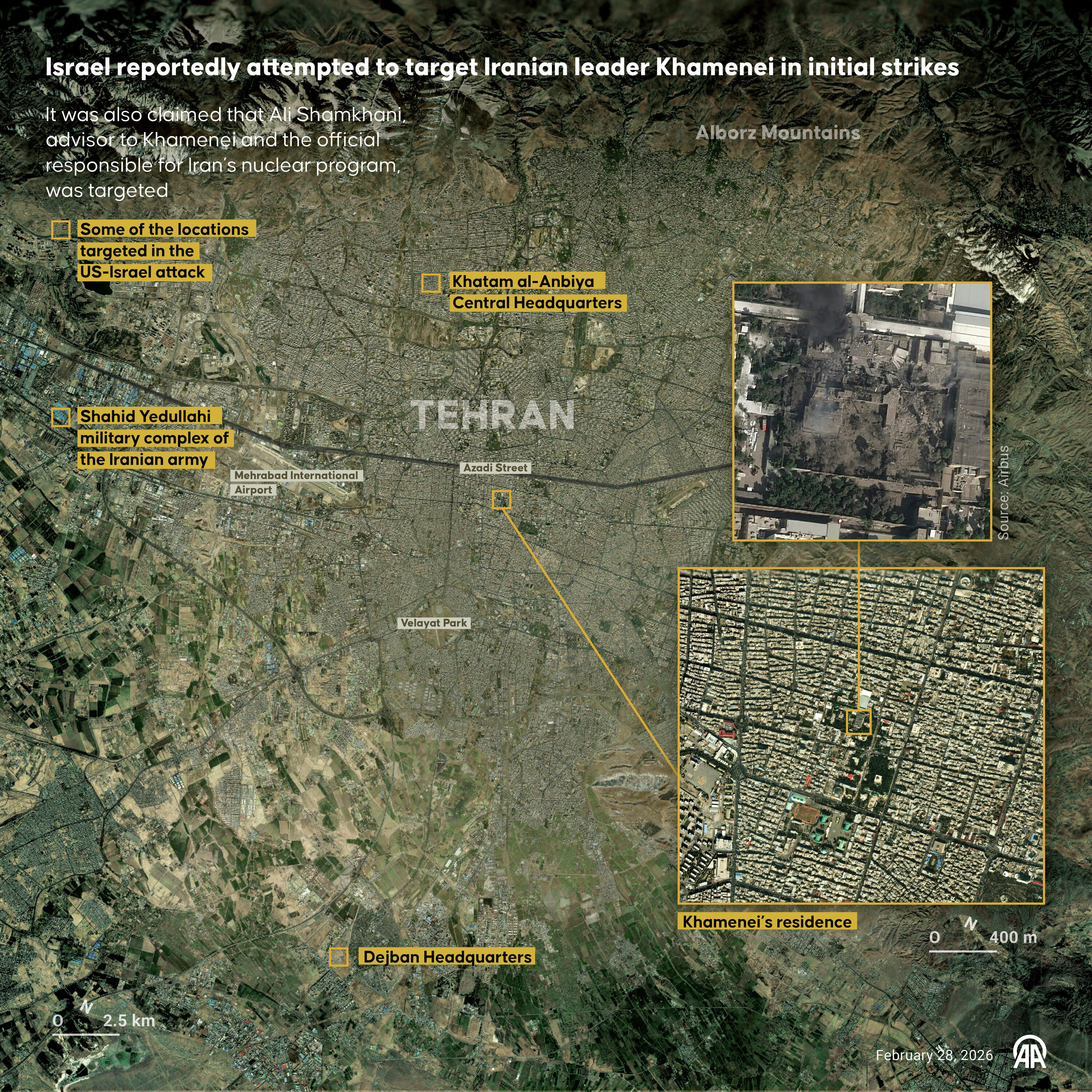
supreme leader, Ayatollah Ali Khamenei, has been killed in today's joint attack by the US And Israel.
- [01:41]
Adobe Acrobat Studio Narrator
Our objective is to defend the American people by eliminating imminent threats from the Iranian regime.
- [01:49]
Jomana Bercetchi
What the United States is doing is an act of aggression. What we are doing is the act of self defense.
- [01:57]
David Gura
Targets in Iran, Israel and elsewhere in the Middle east are under attack in an unprecedented escalation in the conflict between the US And Iran.
- [02:04]
Adobe Acrobat Studio Narrator
It'd be wonderful if they'd negotiate really in good conscience, good faith and conscience. But they are not getting there.
- [02:13]
David Gura
The combat operations come after weeks of negotiations between the US And Iran over what remains of its nuclear program.
- [02:19]
Jomana Bercetchi
This was not an imminent nuclear threat. This is a military action over regime change, not over the nuclear program.
- [02:26]
David Gura
Iranian state TV has reported that at least 200 people were killed in the strikes, responded with missile attacks on Israel and strikes aimed at U.S. assets in the region, where at least three U.S. service members have been killed. Iran says it sees no red lines as it continues to respond with counterstrikes. I'm David Gura, and this is the big take from Bloomberg News. Today. On the show, Bloomberg's Jeff Mason and Giovanna Bercetchi join me to discuss what we know about the timing and goals of this weekend's strikes and the risks of a widening regional conflict. Bloomberg White House correspondent Jeff Mason and Jomana Bersetchi in Dubai have been here with me all weekend long at Bloomberg, along with correspondents across the globe following this story. Jeff, we just now heard the tape from President Trump announcing this operation. He did it in a post on Truth Social, which is an unprecedented move by a sitting U.S. president. What has the president said, Jeff, about why they did this now, why they undertook this at this moment?
- [03:25]
Jeff Mason
Well, the president is pitching the operation as having been in response to a, an imminent threat. And that is something that no doubt people are going to question and look into. But that is the rationale that he used. His people also, his, his top advisors told him that the negotiations that were going on in Geneva with Iran about its nuclear program essentially came to a point where the United States concluded that Iran was not interested in talking about its ballistic missile program and was still interested in pursuing a nuclear weapon.
- [04:01]
David Gura
Jeff, what does the US Want? Is that clear? Are they using a playbook that they deployed in Venezuela just a couple months ago?
- [04:07]
Jeff Mason
Well, it seems very clear that regime change is something that they wanted because the president very directly referred to that in his statement when he encouraged people in Iran essentially to rise up and take this opportunity to take over their government. But they haven't. They being the United States in this case, have not laid out how they expect that to happen. And of course, there's some comparisons to the Iraq war and this operation. But where those comparisons don't continue, at least so far, is there are not US Ground troops in Iran. And so the president may have less ability to influence that, despite the fact that strikes are continuing.
- [04:45]
David Gura
Jomana, you're witnessing the escalation of this firsthand. You're based in Dubai, and I'm curious what things look like there in the wake of these strikes that we've seen.
- [04:53]
Jomana Bercetchi
Well, what you need to understand is that a substantial volley of missiles and drones have been directed at all of these Gulf states. And here I'm talking about the uae, Bahrain, Qatar, Kuwait, even Oman, who were obviously playing a key mediation role in those Geneva discussions. So that was also quite a surprising development. And while Most of the missiles and drones have been intercepted. There are bits of debris that actually did cause a significant amount of infrastructure damage. These are financial centers in the Middle east that have prided themselves on political stability and geoeconomic stability in the context of a broader region that tends to be quite hot and cold, I would say. And so the reaction has been pretty notable in that it seems as though many of these Gulf states are losing their patience with Iran. So we just had some comments from a key advisor to the UAE president and BZ warning Iran to return to their senses and to deal with their neighbors in a respectful fashion, because otherwise, and this is a quote, it confirms the narrative that Iran is the biggest source of danger in the region. At the same time, Iran has stopped one step short of going all the way of directly targeting residential buildings or civilian infrastructure or oil infrastructure. But who's to say that this isn't going to escalate further?
- [06:25]
David Gura
Jeff, I want to pull back a bit. And there was this meeting yesterday of the UN Security Council, which was called for by the Iranians. And Mike Waltz, the US Representative to the UN Was there making the case, the US Case for doing this. We've seen responses from other world leaders. European allies are holding an emergency meeting tomorrow. I was just talking with Senator Mark Warner of Virginia, who sits on the Intelligence Committee, and he talked about the prospects of this being really a US Israeli mission here, not enjoying wide support of allies. And how do you think about the way that the international community has responded to what's happened here?
- [06:58]
Jeff Mason
Well, I think, number one, that it's not something that President Trump is going to be too concerned about. And that's in large part because he, during this second term, and to some extent during his first term as well, has upended the international order with his own will and with his actions, be it from on the economy using tariffs or these strikes now in Iran and what was done in Venezuela. That said the international community and other countries and allies or enemies for that matter, of the United States have a right to voice their opinion. And the United nations is a place to do that. Whether or not that actually has an impact, though, we'll see after the break.
- [07:42]
David Gura
The risk to the Strait of Hormuz and to the oil market and with the US Military buildup where this could go from here.
- [07:51]
Public.com Announcer
Support for the show comes from public. Public is an investing platform that offers access to stocks, options, bonds and crypto. And they've also integrated AI with tools that can assist investors in building customized portfolios. One of these tools is called generated assets. It allows you to turn your ideas into investable indexes. So let's say you're interested in something specific like biotech companies with high R and D spend small cap stocks with improving operating margins or the S&P 500 minus high debt companies. Chances are there isn't an ETF that fits your exact criteria. But on public you just type in a prompt and their AI screens thousands of stocks and builds a one of a kind index. You can even backtest it against the S&P 500. Then you can invest in a few clicks, go to public.com market and earn an uncapped 1% bonus when you transfer your portfolio. That's public.com market ad paid for by Public Holdings Brokerage Services by Public Investing member FINRA SIPC Advisory Services by Public Advisors SEC Registered Advisor crypto services by ZeroHash sample prompts are for illustrative purposes only, not investment advice. All investing involves risk of loss. See complete disclosures@public.com disclosures so there's a
- [09:03]
IBM Announcer
lot of noise about AI, but time's too tight for more promises. So let's talk about results. At IBM we work with our employees to integrate technology right into the systems they need. Now a global workforce of 300,000 can use AI to fill their HR questions, resolving 94% of common questions, not noise Proof of how we can help companies get smarter by putting AI where it actually pays off, deep in the work that moves the business. Let's create smarter business.
- [09:32]
Cincinnati Insurance Announcer
IBM if you follow markets, you know the value of long term thinking. You plan, you diversify, you prepare for volatility. But even the best strategies can't prevent every bad day. For more than 75 years, Cincinnati Insurance has helped individuals and businesses navigate tough moments with expertise, personal attention and independent agents who focus on relationships, not transactions. The Cincinnati insurance companies let them make your bad day better. Find an agent@cinfin.com.
- [10:14]
David Gura
JOMANA in the statements that we got from the US President, from President Trump, from the Israeli Prime Minister Benjamin Netanyahu, there was this entreaty to Iranians to overthrow their government, to put down their weapons and to seek a change of government in Iran. What risks does that introduce? The call for that happening in the wake of an attack that was undertaken from the air, not on the ground.
- [10:35]
Jomana Bercetchi
Well, I have to think also that one of the reasons that Iran became such a focal point of the Trump administration was because of the demonstrations at the beginning of the year. That was the catalyst at least in 2026. Obviously, with the background of Iran's multi decade buildup of nuclear capabilities. But if you recall back in January, President Trump posted that help is going to be on the way for the protesters and the demonstrators who were taking to the streets. And of course we know that they were brutally put down by the Iranian regime. And over time those demonstrations started to peter out. And so here we are, you fast forward about a month later and the US have now got involved militarily alongside Israel. And it was pretty clear from that original video post that President Trump put up that his expectation is that the Iranian people should also use this as an opportunity to rise up. But of course that comes with many challenges. The major risk is that this could strengthen the hardliners hands. They could go down even more aggressively on the demonstrators, on the protesters. There could also be this push to rally around the flag as well and unite the Iranian people against these external threats that are coming through. But then also there's a real risk of broader retaliation. And right now I think the Iranian regime sees this as a very fight for their existence. And so they're not going to hold back at risk retaliating either against their own people or against neighboring countries, which is what we've seen in the last 48 hours.
- [12:11]
David Gura
Jeff, what do we know of what the president is watching for here? As you said, his rationale here has been changing, somewhat ambiguous. What is he looking for in the days to come?
- [12:21]
Jeff Mason
Well, certainly one of their primary objectives is to prevent Iran from being able to develop a nuclear weapon. And that's another thing that he talked about in his video statement. So the military campaign will no doubt be focused on that and on the resources and infrastructure that is available in Iran that could potentially be used for that and weapons programs, et cetera. Obviously, we know that they targeted Iranian leadership and no doubt he'll be watching how Iran responds. We know, as we were just discussing, that retaliation is happening. Does that changed any military calculations for President Trump? The United States, how did they respond to that? I imagine they're watching all of those things.
- [13:06]
David Gura
Jomana, let me ask you about the oil market, what this means for that. The Strait of Hormu is a key part of this conflict, a choke point where nearly 20% of the world's oil is transported. What is this likely to mean for oil prices in the days to come?
- [13:19]
Jomana Bercetchi
Well, even at the run up to this, oil prices had been lifted by a certain amount of what analysts called geopolitical premium because there was an expectation that a strike could happen at some point. So we were already up almost around 20%. We'll see where the market opens up. But to your point, the Strait of Hormuz is a key passageway for seaborne oil. And as of now, if you look at the traffic over the weekend, according to Kepler, they have their data analytics, it suggests that the flow of tankers is down around by 75 to 80. So essentially what's happening is tankers and vessels are avoiding going through the straits. So a significant drop in overall activity. At the same time. One thing that you need to think about is the oil that passes through that strait, most of it ends up going to Asia. So this is oil that's coming through from the Gulf countries, from Iran, but also other countries as well. Saudi Arabia, other GCC nations. The main buyer there is going to be China. And so if that oil isn't able to pass through the straits, then obviously the oil has to come from somewhere else.
- [14:27]
David Gura
Jamon, I understand that opec, that group of nations that produce oil, weighing an increase in production as a result of this.
- [14:33]
Jomana Bercetchi
Yeah, that's true. So they actually had their regular meeting today and on the back of that they announced an increase of production of more than 200,000 barrels a day. That was probably not going to happen in the absence of the weekend's events because the last couple of months they've just paused with their production output. In Q4 of last year, they were averaging around 137,000 extra barrels a day put back to the market. But in light of recent events and in light of perhaps a tightening of the market, they've opted to go with this extra supply increase, which also signals that at least a couple of countries within OPEC, Saudi Arabia and UAE, who've been pushing any way to increase OPEC's share, the global share of oil, are using this as an opportunity to get more of their oil back on the market.
- [15:26]
David Gura
Jeff, I want to end with what might be an off ramp for the President here. In the run up to this, there was a school of thought that because this might push up oil prices, maybe the President would avoid doing this, that he is under pressure to talk more about cost of living and affordability. And if gas prices were to rise, that would be a challenge to him and his party going into the midterm elections. How is he thinking about that and how much of a forcing mechanism do you think that's likely to be here as he tries to game out a path forward?
- [15:50]
Jeff Mason
Well, number one, he can't go back, so he's done it now and there's no way of erasing that and the impact that it's going to have on the economy and on oil prices is still tbd. I think that'll be very interesting to watch. Certainly you're right to say that the political risk here for him in terms of the midterms is it potentially robs him of one of his favorite talking points, which is that he likes to take credit for low gasoline prices. And gasoline prices are absolutely something that voters watch because it's a part of their daily lives. And when consumers see their prices going up, be it at the grocery stores or be it at the pump, they remember that at the polls. And is that an off ramp? I mean does it impact whether these strikes continue? I think the answer to that is no at this point because the United States is all in.
- [16:38]
David Gura
And jomana, what are the expectations in the region for where this goes from here?
- [16:42]
Jomana Bercetchi
I think it's very difficult for anyone to have really good foresight on how this is going to play out. The hope I think from the US side is that the ongoing attacks will either lead the Iranian regime to fully collapse on itself or, or eventually for it to capitulate. And the capitulation will only come if they have been decapitated at a senior level in terms of top echelon being taken out and at a military level in terms of their actual ballistic missile arsenal, their launchers being so severely damaged that they can't continue lobbying all of these missiles and drones into the region, into the GCC countries and into Israel. The Prime Minister, Israeli Prime Minister Netanyahu was just speaking as well and saying that they also expect to continue with these attacks over the next coming days. And if anything, I will say from the Gulf states perspective, the fact that they've been drawn into this and the fact that it has been so destabilizing for their own economies has probably hardened their own resolve. And for a while they had been seeking to have not necessarily the strongest relations with Iran, but at least have operational diplomatic relationships. This could be a huge game changer for the region. And one just last development that I would bring up as well is a phone call took place yesterday on Saturday between the Saudi Crown Prince Mohammed bin Salman and the UAE President mbz. The two leaders have not spoken in a couple of months over disagreements around the the forward path of Yemen. What this clearly shows you is that the whole region and the Gulf states are uniting at this point in time to bring down the temperature, to de escalate and to ensure that things really don't get out of control.
- [18:33]
David Gura
This is The Big take from Bloomberg News. I'm David Gura. This is a developing story. We're live blogging@bloomberg.com with the latest from across the globe. We have a special Bloomberg subscription offer for podcast listeners@bloomberg.com podcastoffer thanks for listening. We'll be back tomorrow.
- [18:56]
Sonesta TravelPass Announcer
Find home wherever you roam at Sonesta Es and Simply Suites Stretch out and enjoy homelike amenities for however long you need. And when you're a Sonesta Travel Pass member, staying at Sonesta Es and Simply Suites means earning points to toward free nights, upgrades and more. Go to sonesta.com to book your stay and unlock their best rates with Sonesta Travel Pass here today, Rome tomorrow. Join now@sonesta.com terms and conditions apply.
- [19:22]
Cincinnati Insurance Announcer
If you follow markets, you know the value of long term thinking. You plan, you diversify. You prepare for volatility. But in life, even the best strategies can't prevent every bad day a fire, a loss, a disruption that demands immediate attention. When that happens, what matters isn't just what you planned. It's who shows up. That's where Cincinnati Insurance comes in. For more than 75 years, they've helped individuals and businesses navigate life's toughest moments with care, expertise and personal attention. Together with independent agents, Cincinnati Insurance focuses on relationships, not transactions. Their approach is grounded in experience, follow through and trust built over time. Bad days happen, and when they do, you deserve an insurance partner who understands risk, respects what you've built and is ready to help you move forward. The Cincinnati insurance companies Let them make your bad day better. Find an independent agent@cin fin.com these days
- [20:23]
Okta Announcer
it seems like AI agents are just about everywhere you turn, every field and every function. But without identity, you can't trust they'll serve your business instead of jeopardizing it. Fortunately, Okta helps you get identity right by securing your AI AI agents identities, giving you a single layer of control, a single standard of trust. So whether an AI agent supports a single user or your entire enterprise, with Okta you'll turn risk into opportunity. Secure every agent. Secure any agent. Okta secures AI.