Loading summary
Transcript81 lines
- [00:00]
Michael McDermott
At CES. Michael McDermott, EVP of Samsung, spoke with Bloomberg Media Studios about what the company calls its next AI chapter, your companion to AI Living.
- [00:09]
It's a shift from AI as a feature to AI as a trusted partner in everyday life.
- [00:18]
Wilson Jones
Bloomberg Audio Studios Podcasts Radio news Watch.
- [00:26]
Sean Donnan
The step right there.
- [00:28]
Wilson Jones
All this lumber is lumber that got.
- [00:30]
David Gura
Out when you walk into the JW Junk Lumber Company, one of the first things you'll probably notice is how noisy it is.
- [00:38]
Sean Donnan
You go in, you put in earplugs. This place is loud, right? And there's a kind of real cacophony.
- [00:48]
David Gura
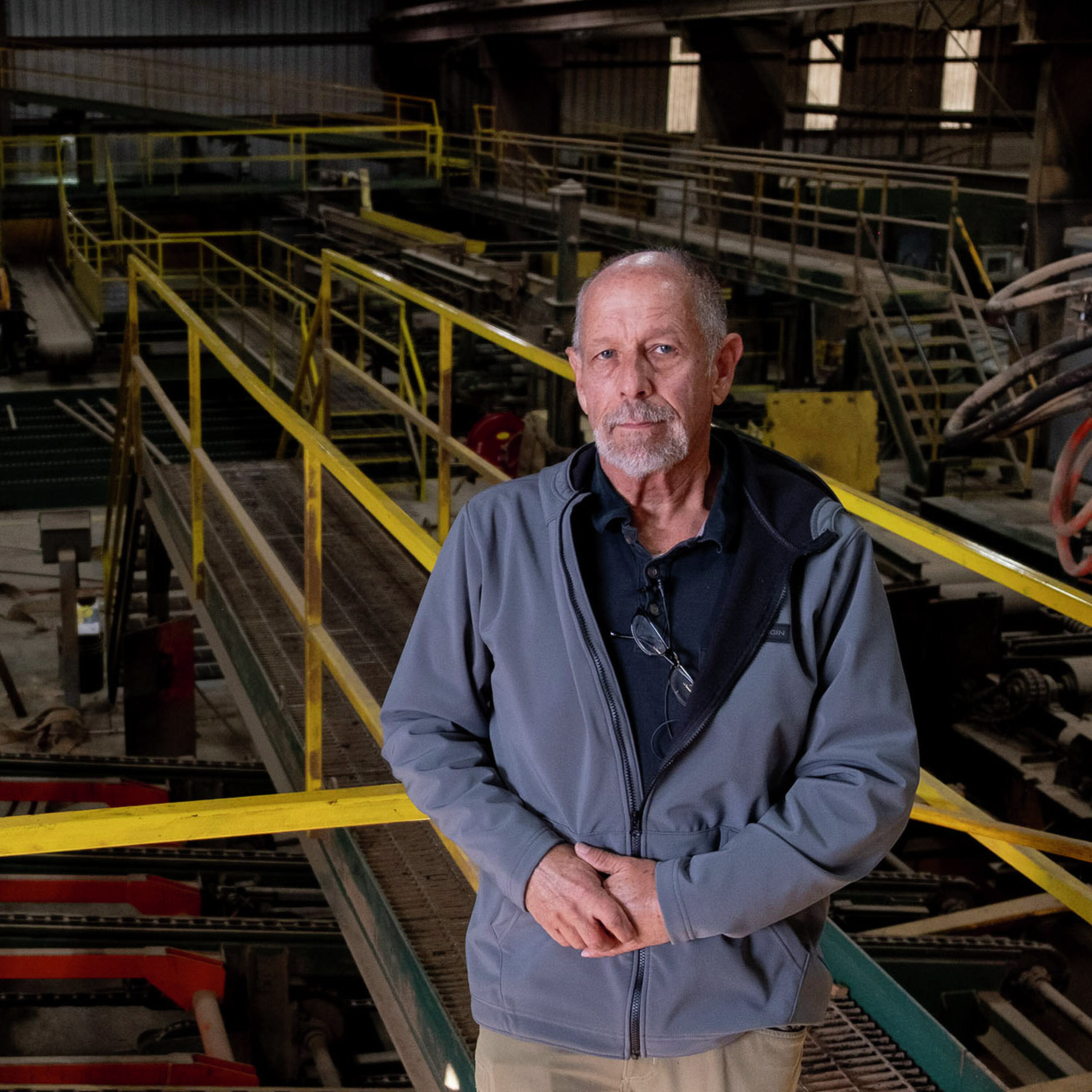
J.W.W. jones is a sawmill in Elizabeth City, North Carolina. From stripping off the bark and sawing to trimming, sorting and drying the wooden kilns every day the mill turns dozens of logs into processed lumber boards, the kind used in the visible wood in a house, like your baseboards or stair treads. Bloomberg economics reporter Sean Donnan took a trip to North Carolina, to the old North State with our producer Rachel Lewis Christie, to meet the Joneses, the family that runs the business.
- [01:18]
Sean Donnan
It's a mill that has been there and in this family since the 1930s. The J.W. jones Lumber Company focuses really on Southern pine.
- [01:30]
David Gura
The Jones family has been in the lumber business since 1882. Today, brothers Wilson and Steven co own two lumber mills. Stephen runs J.W. jones and Wilson runs Mackey's Ferry sawmill. And while the J.W. mill was as loud as ever, Mackey's Ferry sounded very different.
- [01:52]
Wilson Jones
I've grown all my life in the lumber business and to hear nature at a sawmill, I think for any lumberman is not natural. I don't want to be overly dramatic, but in a way it's as unnerving as watching a loved one take their final breath.
- [02:23]
David Gura
On July 1, the brothers decided to close down Mackey's Ferry. The tipping factor President Donald Trump's so called Liberation Day tariffs.
- [02:32]
Wilson Jones
When I say Liberation Day, I cannot put enough snark and sarcasm in my voice because we weren't liberated, wilson said.
- [02:42]
David Gura
They've mothballed it, meaning they're maintaining the mill for potential use or maybe to sell it. But altogether its production has shut down and the 50 people who worked at that mill were laid off.
- [02:55]
Wilson Jones
Liberation Day it did. At the time, it had damn near liberated me from our business and in essence it has. I'm bitter about that.
- [03:08]
David Gura
After Trump announced Sweeping tariffs on April 2, several countries responded with retaliatory tariffs, including China, and that hit Mackey's Ferry hard. Until recently, 70 to 80% of the wood coming from the Mackey's Ferry sawmill was going to China and Vietnam a primary market for US hardwood. While most of what comes out of the brothers other mill softwood ends up in the United States. After calculating the staggering cost of exporting lumber, the Jones brothers decided it was time to stop production at Mackey's. About a third of their overall business revenue disappeared.
- [03:45]
Sean Donnan
This is not just a story about a sawmill in North Carolina and a little crossroads of a place. This is a story about what's going on in a lot of rural America right now.
- [03:56]
David Gura
Since April, Trump's tariffs have shocked supply chains and raised prices of both imported and domestic goods. While President Trump has promised a manufacturing renaissance. Between April and August, the US actually lost 42,000 manufacturing jobs.
- [04:14]
Sean Donnan
They are the first generation in five to have to close something down in this lumber industry. Wilson's a man in the 60s, he's a storyteller, but he's also, you know, a proud man and he had tears in his eyes as he was describing this.
- [04:29]
Wilson Jones
In the old days you would hear the chipper, we'd have the air compressors going, you'd have the roar of the fans of the keels that ran 24, seven and you come in here and you'd hear all that throw throaty noise or that hum and roar. And now it's kind of depressing because you can get out of your car and shut the door and then you hear the wind blow.
- [04:59]
David Gura
I'm David Gura and this is the big take from Bloomberg News. Today on the show we head to North Carolina to understand how President Trump's trade war played a role in the closure of a family run sawmill and how his policies are affecting one of the oldest industries in America. The Jones family has been in the lumber business in North Carolina going back nearly 150 years.
- [05:29]
Wilson Jones
I've heard my mom tell stories about when I was born. They brought me home from the hospital and they went and knocked on the door. Four big old sawmill guys out here, you know, dirty and everything like that.
- [05:39]
David Gura
Took the hat off.
- [05:40]
Wilson Jones
Ms. Margaret. We want to come see the little boss man.
- [05:44]
David Gura
Wilson Jones's memories of growing up are full of sawdust, childhood games and wood chippings.
- [05:49]
Wilson Jones
We'd come out here and we'd sweep or we'd throw sawdust in the boiler or we'd play in the shaving's house.
- [05:57]
Stephen Jones
When we were little. He's got scarred one of these cheap.
- [06:02]
Wilson Jones
He's older.
- [06:02]
Stephen Jones
He used to beat up on me so I stabbed him with a pitchfork.
- [06:06]
Wilson Jones
And I can go out there and show you where he did it too.
- [06:12]
David Gura
The US lumber industry as we know it today started when settlers in America were still under British rule. Back in the early 1700s, North Carolina alone was producing over 50,000 British pounds worth of lumber annually. That's equivalent to about US$11 million a year today. North Carolina became the primary source of naval stores, the material used to build and maintain British ships. After the US won its independence and expanded farther west, the country's forests would fuel the industry for centuries. If they hadn't found wood here, there wouldn't have been an America. In the building of America, wood played a mighty part. But consumption of lumber in the US peaked in the late 1980s, that it's been dipping ever since. That's led to a steady decline in the number of US sawmills, many of which are small family owned operations. And American consumer tastes have shifted toward cheaper furniture made from particle board, MDF or laminate, commonly used by companies like Ikea and Amazon.
- [07:17]
Wilson Jones
My wife and I have a young couple that we've talked to. They were so happy that they got a new sofa for the new house from Amazon, $400. But I understand, you know, that people like Ikea, which is made with particle board and put together compared to a custom built cabinet or something like that. I don't have a problem with changing consumer taste. I don't have a problem that there's a different technology that is better than what we have or that makes us obsolete. I don't have a problem with that. I have a problem with the government policy making us obsolete.
- [07:57]
David Gura
Even before Trump's tariffs were on the scene, US hardwood lumber was still in a tough spot. Mackey's Ferry Mill, which the Jones family bought in the 1980s, initially served north Carolina's furniture industry. But when that industry started facing competition from China and going offshore in the 1990s, their market changed. And by the early 2000s, they were sending most of their lumber overseas. By 2008, as the financial crisis hit, the housing industry and the main market for their softwood mill, the hardwood operation, was keeping the family business afloat by selling most of its output to China.
- [08:33]
Sean Donnan
These are narrow margin businesses. There is not a huge premium on this wood. And in fact, one of the ironies of the global economy is that Wilson Jones will tell you it costs more to ship load of lumber to the port in Norfolk than it does to ship it from Norfolk to a port in China.
- [08:53]
David Gura
For a while, that approach was working. According to Wilson, the Mackey's Ferry Mill was regularly shipping millions of dollars in hardwood to their biggest customers in China and Vietnam. The Joneses had moved with the times. By 2017, China became the largest single market for exported lumber from the US followed by Mexico and Canada. And when the US imposed an escalating series of tariffs on China in 2018 during Trump's first term, the Joneses managed to weather the fallout even as China retaliated.
- [09:25]
Wilson Jones
We just kind of took it with our lumps and said, all right, you know what, I'll tell you what, we bore half of it of the tariff, and then our customer, they bore half of it. And that was kind of an industry wide thing.
- [09:39]
David Gura
But Trump's second term tariffs were even more aggressive. On April 2, the President announced a higher 34% tariff on Chinese imports. China, along with several other US trading partners, retaliated again. It would kick off a rapidly escalating trade war that sent shockwaves through global markets.
- [09:58]
Sean Donnan
I said, where are we now? We're at 145%. I said, Whoa, that's high. That's high. They were doing no business whatsoever and they were having a lot of problems. We were very nice to China. I don't know if they're going to be nice to us, but we were very nice to China.
- [10:12]
David Gura
For American hardwood, the reciprocal tariffs got as high as 125%.
- [10:17]
Sean Donnan
What took you over the edge here? What caused you to shut this down?
- [10:22]
Wilson Jones
Honestly, the market conditions in relation to the retaliatory tariffs that we have in China, they put the final nails in the coffin. But there are other inherent issues. There's a raw material issue. I didn't do a good enough job getting some of our people to pivot. And then there are real capital issues with being able to modernize and being able to modernize efficiently.
- [10:52]
Sean Donnan
But the final nail in the coffin.
- [10:54]
Wilson Jones
Was when we couldn't sell the land.
- [10:56]
David Gura
When President Trump imposed tariffs back in April, wood from Mackey's ferry worth some $500,000 was on its way to China as part of a regular shipment. Within days, that shipment was facing tariffs worth more than the wood itself.
- [11:11]
Sean Donnan
If President Trump pulled up here today and you walked him into the sawmill, what would you tell him?
- [11:18]
Wilson Jones
Well, I'd like to say what the heck? Actually, I'd like to say about nine different explanatives. But you know, President Trump, gee, I understand what you're trying to do, but you're on a fool's mission and you're not helping out a few. You're hurting a lot. If you put all These little communities together, from Maine over to Michigan down to Mississippi and Alabama, it's having the same effect on these small little communities. From the guy that's just stacking lumber to the guy that's sawing. Don't even care about the guy. That's the mill owner. What about those guys?
- [12:01]
David Gura
The White House did not respond to a request for comment. As the brothers criticized Trump's trade policies, Sean asked them if they voted for him and for those trade policies to begin with.
- [12:13]
Stephen Jones
I voted for Trump because there wasn't an alternative, I mean, at all.
- [12:18]
Sean Donnan
Did you vote for him all the way back to 2016?
- [12:21]
Wilson Jones
I voted for Trump all three times, didn't you? Yep, I did, but I literally was in the voting booth and I wrapped my knuckles and the Trump one hurt more, and that was the one that I voted for because it was just. It was so disgusting. And I hate to say that, but that's literally how I made that choice.
- [12:41]
Sean Donnan
Okay, so you voted for the. You both voted for the man. The man's policies have contributed to you going out of business. Do you have any regrets about voting for the man?
- [12:56]
David Gura
After the break, how the closure of Mackey's Ferry sawmill could impact the area's economy and how Wilson and Stephen feel about President Trump and his policies today.
- [13:13]
Michael McDermott
How do you shift AI from being a flashy feature to a trusted partner in consumers everyday lives on the ground at CES Bloomberg Media Studios? Asked Michael McDermott, EVP of Samsung.
- [13:22]
Our 2026 vision is built around an AI companion. It understands you and responds intuitively. This intelligence works quietly in the background across TVs, home appliances and mobile devices. By putting AI at the center of everything we do, we're simply improving everyday life for everyone, everywhere.
- [13:48]
David Gura
For years, Mackey's Ferry sawmill in North Carolina relied on exporting its goods to China and Vietnam after a dip in domestic demand for its high quality hardwood. But President Trump's trade war with China dealt a blow that the mill's owners say they couldn't come back from. As part of the administration's efforts to bolster some industries affected by tariffs, the US has prioritized bailouts for agriculture and soybeans over assistance for other industries like lumber.
- [14:15]
Sean Donnan
Tremendous amounts of the soybeans and other farm products are going to be purchased immediately, starting immediately.
- [14:22]
David Gura
Wilson Jones says some of the farmers who might benefit from that are relatives, but that across the board, from soybeans to lumber, they want something more.
- [14:31]
Wilson Jones
You hear Main street, you're talking about Main street in Columbus, Ohio. You're not Talking about Main street in Roper, North Carolina, I can say my relatives that are in farming, they don't want to bail out. And I would be willing to bet my industry colleagues in the hardwood lumber industry, they don't want to bail out. They want access to their market, and that door has been shut.
- [14:57]
Kelly Chessant
Well, I'm Kelly Chessant. I'm the economic and strategic development director for Washington County.
- [15:03]
David Gura
In the county where Mackey's Ferry is located, the damage from the mill's closure has already been done.
- [15:08]
Kelly Chessant
It is a big blow, especially now. You know, after Covid. Everybody kind of was on stall during COVID but then just to see one of your longest standing businesses closes doors. 50 guys are going to people, men and women, are going to lose their jobs. Yeah, that is a blow.
- [15:25]
David Gura
Kelly says Back in the mid-2000s, the region lost around 200 jobs when Canadian paper company Domtar merged with Weyerhaeuser, the owner of a local pulp mill. And a mill closure like this is another hit. Mackey's Ferry was one of the largest private employers in the county. Kelly doesn't know what this will cost the local economy yet. In lost business taxes, it's not as.
- [15:46]
Kelly Chessant
A significant blow as the Weyerhaeuser blow was for us, but it's still one of those ones that's gonna be felt in the community. So that was 20 years ago. We still haven't recovered from that. People want stability. And then when you have major companies like Mackey's, who's been here for over 100 years, closed, what does that say to the business viability here in Washington County? And I know we don't want that to be our message, but it's just one of those things where all of these rural and small communities are facing some of these same things.
- [16:17]
David Gura
The Supreme Court heard arguments earlier this month on the legality of the tariffs. The lower courts have ruled that they're illegal. And Sean says it's still unclear what restitution would take place if the Supreme Court agrees.
- [16:29]
Sean Donnan
Not all of that economic damage, if you talk to economists, people in business, small business people, is going to be fixed immediately. There is no easy solution to repair that. But for the Jones brothers, this is kind of too late. The story of tariffs is often a story of unintended consequences. Donald Trump did not intend to cause the shutdown of a sawmill in North Carolina when he imposed these tariffs on China. He was trying to rebalance an economic relationship. In his mind, these tariffs are going to help bring back manufacturing jobs. But the story of tariffs through history has always been that they lead to retaliation and unintended consequences. Do you have any regrets about voting for the man?
- [17:25]
Wilson Jones
There are some things I regret about voting for President Trump, yes, 100%. Trade policy is one of them. Even though that I wish he could have moderated his tone. Well, I understand you have to do one thing to get elected and then something else, but I wish it hadn't turned out that way. That being said, given to two people running regardless of what they said on the campaign trail, I would have voted for President Trump.
- [17:50]
Stephen Jones
Again, I don't necessarily have regrets. I mean, it came out that that's what he was going to fight for. And knowingly that would affect us, probably, but because the only place to really ship a volume of lumber was either Vietnam or China. And so, you know, it's going to affect us.
- [18:16]
Wilson Jones
But.
- [18:18]
Stephen Jones
I don't. Outside of not voting, I don't think I had a choice to vote any other direction. I don't like the way we're going about immigration, immigration strategy, if you will. But something had to be done to control our borders. I think that's being accomplished now. Having ICE and everything else, I, you know, I get tired. I don't even watch the news anymore. Just because it's the same thing over and over again. Kind of like insanity.
- [18:54]
David Gura
The last board at Mackey's Ferry sawmill came off the production line on September 29th. Wilson and Stephen laid off 50 people, some of whom had worked for the mill for decades.
- [19:06]
Sean Donnan
Is this the last of the wood in here?
- [19:08]
Wilson Jones
This is kind of the last of it packaged up and piled up. There'll be some we'll be able to sell here and there, but it's just we're trying to get the biggest chunks out of it right now.
- [19:21]
David Gura
Sean and Rachel, Vicky. About a month later, as the process of closing down was nearly complete, and amidst cobwebs and the simple electric hum of the lights, Wilson showed them what's left of Mackey's Ferry.
- [19:35]
Sean Donnan
You said you hadn't been here in a few weeks.
- [19:37]
Wilson Jones
Yeah, there's not really a lot that I can do. I learned it took a while because I'm not the sharpest tool in the shed, but I learned it like, you know, here these guys, instead of me telling them, take a step forward, step right, step left, go backwards, just say, okay, look, you know how to do your job, and walk away. Letting them do their thing. Yeah, let them do their thing.
- [20:01]
David Gura
The Jones brothers offered jobs to Mackey's ferry workers at the other mill, J.W. jones Lumber about an hour away. Only 10 out of the original 50 took them up on it.
- [20:11]
Sean Donnan
I write about economics. Economics is data. It's aggregate data. And we often lose sight of the fact that economics is people. An economy is its people. It's not its economists. Wilson Jones is one of those people.
- [20:28]
Wilson Jones
And then the other thing is, you're just going to stand around, make yourself miserable, pull your head out of your rear and try to make a difference where you can make a difference. Quit feeling sorry for yourself.
- [20:44]
Sean Donnan
That was. It's hard to see someone going through that and feeling that, that burden. It's the only way you can, you can, you can describe that, is that this is personal for Wilson Jones.
- [21:01]
David Gura
This is the big take from Bloomberg News. I'm David Gura. The show is hosted by me, Juan Hannah and Sarah Holder. Show is made by Aaron Edwards, David Fox, Eleanor Harrison Dengate, Paddy Hirsch, Rachel Lewis, Christie Naomi Ng, Julia Press, Tracy Samuelson, Naomi Shaven, Alex Segura, Julia Weaver, Yang Yang and Taka Yasuzawa. To get more from the Big Take and unlimited access to all of bloomberg.com, subscribe today@bloomberg.com podcastoffer. Thanks for listening. We'll be back on Monday.
- [21:32]
Sean Donnan
Sam.