Loading summary
Transcript48 lines
- [00:01]
LG Advertiser
When you buy LG, you get so much more than just an appliance. You get more done, more cost savings, more peace of mind and more control because LG appliances are designed to do more like washers and dryers with AI tech to take out the guesswork refrigerators that fit in tight spaces and keep food fresher longer or ranges with precise induction cooking and easy cleanup built in all with the style you want and reliability you can count on so you can get more from your home every day. LG appliances so much more make life easier with LG. See the latest models and savings now@LG.com
- [00:43]
AT&T Business Representative
not every sale happens at the register. Before AT&T business Wireless, checking out customers on our mobile POS systems took too long. Basically a staring contest where everyone loses. It's crazy what people will say during an awkward silence. Now transactions are done before the silence takes hold. That means I can focus on the task at hand and make an extra sale or two. Sometimes I do miss the bonding time.
- [01:08]
Microsoft Windows 11 Promoter
Sometimes AT&T business Wireless Connecting changes everything.
- [01:16]
AT&T Business Representative
Bloomberg Audio Studios Podcasts Radio news My
- [01:23]
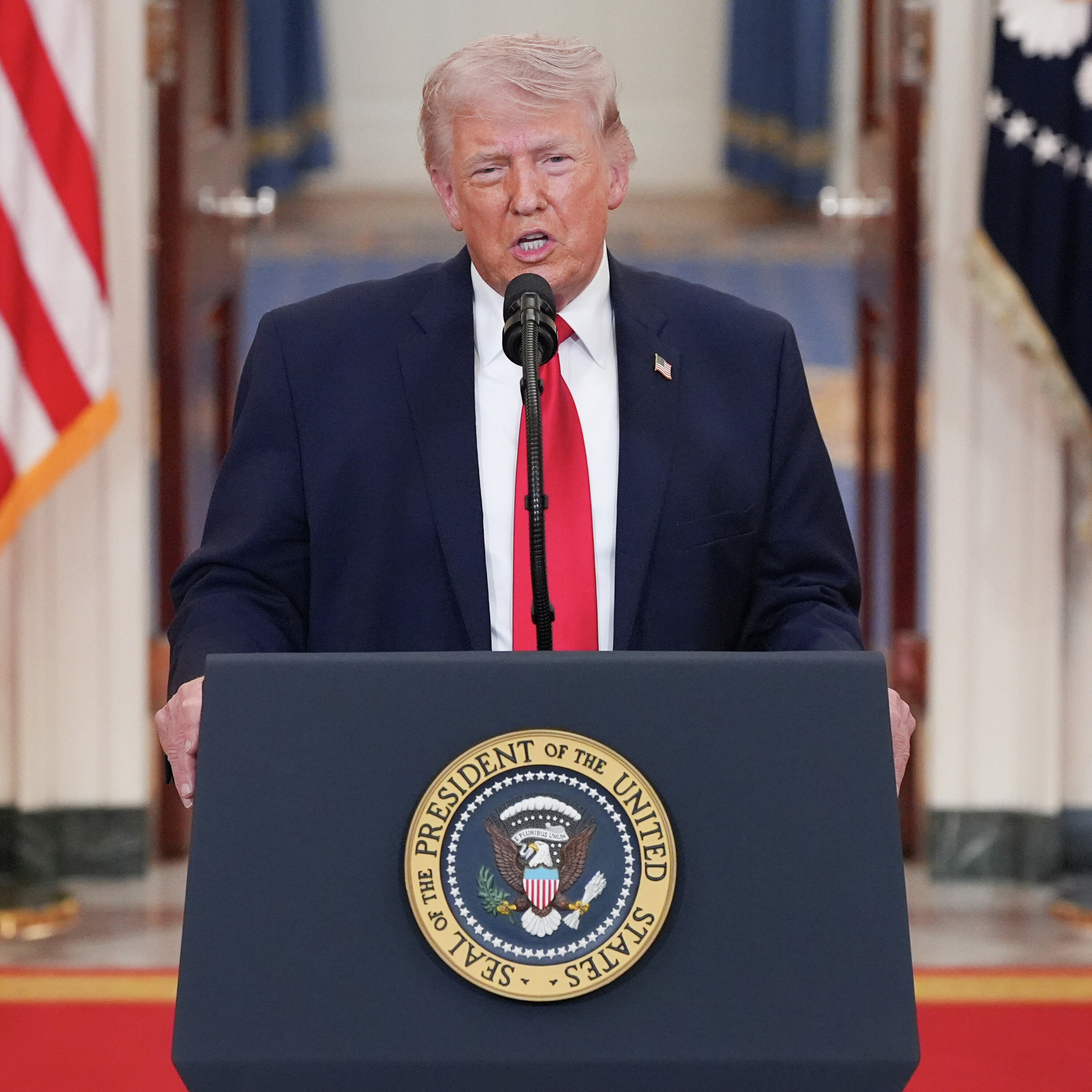
President Donald Trump
fellow Americans, Good evening.
- [01:26]
Sarah Holder
President Donald Trump addressed the American public last night in his first primetime address since the US and Israel launched strikes on Iran on February 28th.
- [01:35]
President Donald Trump
Our Armed Forces have delivered swift, decisive, overwhelming victories on the battlefield, victories like few people have ever seen before.
- [01:46]
Sarah Holder
What did we learn that was new?
- [01:48]
Jeff Mason
Honestly, we didn't learn new. A lot of new things.
- [01:51]
Sarah Holder
Bloomberg Washington and White House correspondent Jeff Mason says Trump stopped short of answering the most pressing questions about the war, including when and how it would end.
- [02:03]
Jeff Mason
He wanted to reiterate that he intends to end the war within two to three weeks. But he also delivered some mixed messages about that, which has been his MO for the last four and a half weeks about this war by saying that the United States was going to continue doing some major attacks and also lifting threats on Iran if it did not agree to a deal in the coming days or weeks.
- [02:30]
Sarah Holder
The war with Iran has choked global fuel supplies and roiled markets, and as the conflict has widened, thousands of people have been killed and injured in Iran and across the Middle East. CNN and Fox polling shows the majority of Americans disapprove of the war and Trump's handling of it. Jeff says amid the turmoil, Trump's speech was an opportunity to sell the war and the U.S. s continued involvement to the American people and to the markets.
- [02:59]
President Donald Trump
When this conflict is over, the strait will open up. Naturally. It'll just open up naturally. They're going to want to be able to sell oil because that's all they have to try and rebuild. It will resume the flowing and the gas prices will rapidly come back down. Stock prices will rapidly go back up.
- [03:18]
Jeff Mason
It was a sales pitch. Whether or not that sales pitch worked is another question.
- [03:23]
Sarah Holder
Right. How did that sales pitch go over?
- [03:25]
Jeff Mason
Markets are not impressed. The stock markets dropped and oil prices have gone up, which my guess is is the opposite of what President Trump thought was going to happen. I think he was looking to goose the markets a little bit by giving some more detail or clarity about the end of the war. And he didn't really give more detail or clarity. Instead, he gave additional mixed messages.
- [03:54]
Sarah Holder
I'm Sarah Holder, and this is the big take from Bloomberg News. Today on the show, Trump's latest attempt to pitch the Iran war to the American people and calm markets and why it's not working.
- [04:12]
President Donald Trump
My first preference was always the path of diplomacy. Yet the regime continued their relentless quest for nuclear weapons and rejected every attempt at an agreement for this reason.
- [04:25]
Sarah Holder
So, Jeff, I want to go through some of the things that President Donald Trump said and some of the things he didn't say in his speech last night. Trump and Defense Secretary Pete Hegseth have sent a lot of messages over the course of the war, sometimes contradictory, often shifting about US Objectives and intentions. So what specifics did we get about the administration's goals in Iran at this point?
- [04:48]
Jeff Mason
The overall goal that the president articulated and has articulated is a guarantee of some kind or an ability to say that Iran will not develop or obtain a nuclear weapon. There's a question mark over that. He is saying that that's an objective that they are achieving or have achieved. But there are some who are concerned that they haven't achieved that. And some conservatives in particular who are supportive of the war are concerned that maybe he is prematurely pulling out if in he does pull out in two to three weeks. Otherwise, he listed his view of what he sees as a broad military success in terms of decimating aspects of the Iranian military and its leadership.
- [05:37]
Sarah Holder
Right. He said while regime change was not our goal, the regime has changed. What did you make of that mixed message?
- [05:45]
Jeff Mason
Again, because they did talk about regime change early on. And you could really argue that the regime change has not occurred, even though the president in the last few days and along with Secretary Hegseth have specifically said the regime has changed. Well, has it? Because the new supreme leader or ayatollah is the son of the previous one who was killed on the first day of strikes. Still very conservative, still very, very anti us. So the president says that there is a more reasonable set of leaders that the US Negotiators are now talking to. We'll see. The evidence would suggest the contrary.
- [06:30]
Sarah Holder
I want to talk about timeline a little bit more because the president indicated that the war will last another two to three weeks. He says we're nearing the end. What do we know about the actual off ramp here?
- [06:42]
Jeff Mason
Well, a couple things. So I've covered the president for a long time, and one of his habits rhetorically is to say things like, I'll let you know in two weeks or we'll do this in two or three weeks. So you have to take that into account. Now, I don't want to say that that means he's not going to stop in two to three weeks, but I don't think markets are convinced of that. And I spoke to a source yesterday who used to work for Trump who also said to me, are you taking that deadline seriously? And he raised some skepticism because of the fact that the president does this, also because of the fact that the president could be being strategic in saying that by wanting to essentially create a false narrative for Iran or a head fake to suggest, okay, the US Is about to wrap up and then not do that again. Those are just question marks. The other bit of mixed messaging is the fact that he promised to really up the ante in terms of the military strikes in the coming weeks. And he also sort of contradicted himself in that he said in the Oval on Tuesday that a deal was not necessary with Iran for the US to leave, and then last night said, if they don't agree to a deal, then I'm going to destroy all of these things.
- [08:06]
President Donald Trump
If there is no deal, we are going to hit each and every one of their electric generating plants very hard and probably simultaneously. We have not hit their oil, even though that's the easiest target of all because it would not give them even a small chance of survival or rebuilding. But we could hit it and it would be gone.
- [08:30]
Jeff Mason
So that could be seen and I think is being seen by the markets as an escalation instead of a de escalation.
- [08:36]
Sarah Holder
Where do negotiations stand right now? How close could Iran and the US Be to a deal? What is the state of talks there?
- [08:45]
Jeff Mason
There are more mixed messages. We know that President Trump's envoys, Steve Witkoff and Jared Kushner, his son in law, were involved in the negotiations with Iranian counterparts before the war and Wright kind of up till the start of the war, and that they were involved in some outreach after that. More Recently, Vice President J.D. vance is involved in sending some messages from President Trump to Iran, but beyond that, I can't give you an exact sense of how the talks are taking place. I know that Pakistan has offered to be a location for in person talks, but that has not happened yet. To our knowledge, the talks are either through channels or by phone secure lines. We know that there are some talks going on. At one point, Iran denied that that was happening. But the question of who beyond the names that I just mentioned are involved and, and where it's going is kind of tough to tell.
- [09:45]
Sarah Holder
What else was missing from Trump's speech? I'm thinking about some of the other things Trump has been saying in recent weeks about NATO, about specific plans to open the Strait of Hormuz. What didn't Trump say that people were expecting or perhaps hoping that he would?
- [10:01]
Jeff Mason
Well, a couple things. Number one, you asked me earlier about the off ramp. He really didn't specify how that off ramp is going to occur. He did give the two to three week time frame, but he didn't say, then we're definitely done, then we're pulling back. So I think that was one thing that generated questions. You mentioned NATO and you were right too. He has been very critical of NATO allies, particularly Great Britain, for not stepping up to help the United States secure the Strait of Hormuz. And there was some explanation, expectation that he might have lashed out at specific countries or at NATO itself. He didn't do that. He did say that countries that rely on energy coming through the Strait of Hormuz should plan to go secure it themselves once the United States is gone. So what is the plan for the Strait of Hormuz? Is it just to leave it? Which is again the opposite of what President Trump had said at one point. At one point he said that he would run the Strait of Hormuz himself along with the Ayatollah. So I would say the ambiguity about the Strait of Hormuz, the lack of direct criticism of NATO and the lack of clear details on what an off ramp looks like were all things that were left unsaid or at least not spelled out.
- [11:26]
Sarah Holder
How that ambiguity is landing with allies, markets and voters. That's next.
- [11:35]
Microsoft Windows 11 Promoter
And pause really quick. Wanted to also mention that not Only is Windows 11 Pro designed to help unlock operational efficiency and build long term advantage for your business, it can seriously level up your team's productivity. And since I know you all love stats, guess what? I got Microsoft commissioned stats. Compared to Windows 10 PCs, Windows 11 Pro users reported on average 50% faster workflows and collaboration, 42% faster completion of demanding workloads and on average 61% longer battery life. Windows 11 Pro chip to Cloud security is designed to help employees stay protected and uninterrupted at the office, at home, the coffee shop, wherever they work. Speaking of uninterrupted, you IT managers are going to love this one. The Microsoft Commission survey also reported Windows 11 Pro PCs having a 62% drop in security incidents compared to Windows 10 PCs. Because Windows means business, upgrade to Windows 11 Pro at windows means business.com FKA
- [12:38]
Sarah Holder
twigs Body High Tour live across North
- [12:44]
AT&T Business Representative
America in 2026 with special guests.
- [12:48]
Sarah Holder
Get tickets now@livenation.com. Since the Iran war started a month ago, energy costs have become a major issue for the global economy and for households around the world. This week, the average price of Gasoline in the US climbed above $4 a gallon for the first time since 2022 after Russia launched its full scale invasion of Ukraine. And on Thursday, the price of dated Brent crude topped $140 a barrel, its highest level since 2008. I asked Bloomberg White House and Washington correspondent Jeff Mason how President Trump addressed the energy crisis caused by this war in his primetime speech.
- [13:34]
Jeff Mason
Well, the president did acknowledge gasoline prices have gone up, and I think that was very deliberate. That was at least a nod to the people in his base and others who are concerned about high energy prices. But he was also, while acknowledging it, slightly dismissive of it.
- [13:52]
President Donald Trump
The United States imports almost no oil through the Hormuz Strait and won't be taking any in the future. We don't need it, we haven't needed it and we don't need it.
- [14:03]
Jeff Mason
And he has said previously before that the energy prices, gasoline prices, will just come right back down as soon as the United States ends this war. And that's just not clear if that's going to happen, including because of the ambiguity over this trade of Hormuz. He may be correct that the United States doesn't rely on energy sources through that strait as much as some of US Allies do. And yet the United States is obviously interconnected with the global economy. And so if other countries are suffering because of Iran's control of the Strait of Hormuz after this war, that's going to have an impact on the United States too.
- [14:46]
Sarah Holder
How did oil markets react to Trump's speech, what was said and what wasn't said?
- [14:53]
Jeff Mason
So the oil prices have gone up and he, I think, was expecting that if he doubled down essentially in his remarks about this two to three week timeframe, that that would signal that he's got an off ramp, but in a very Trumpian way, because he also talked about what were essentially escalatory measures and additional threats. That hasn't gone over well with the markets who are looking for a clear indication that not only is the US Going to leave, but it's going to stop the hostilities. I would also say, since you brought up gasoline prices, that it's important to note how politically risky that is for him. We're in the spring. The midterm elections are in November. It seems like a long time, but it's not. And if those prices stay around $4, tick up more or even only tick down a little bit, that's something that voters may very well remember and take him to account for when they go to the polls
- [15:58]
Sarah Holder
through all of this. Diplomatic efforts to reopen shipping through the Strait of Hormuz seem to be underway today. Thursday, Iranian state media reported that Iran and Oman are drafting a plan to monitor traffic through the Strait of Hormuz. And European leaders are meeting Thursday to discuss how to get oil flowing through the strait again. Do we have any idea what these European leaders are planning?
- [16:24]
Jeff Mason
What I think that meeting shows is that the Europeans are taking it seriously, that when Trump says, you got to do this on your own. Certainly European leaders have had multiple wake up calls from the Trump administration during this second term, also during the first term. But then they had a president in the middle there, Joe Biden, who was much more of a European and a transatlanticist. Donald Trump is not. And when he says, you guys will have to handle this yourself, they're taking him seriously.
- [16:55]
Sarah Holder
I'm curious of how this war is playing with voters, especially as the midterms loom and especially within Trump's base. Last week you were reporting at the Conservative Political Action Conference, cpac. Can you walk us through what people were telling you and whether last night's speech addressed any of the anxiousness around the U.S. s involvement in this war?
- [17:22]
Jeff Mason
Well, I would start by saying that the American public broadly opposes the war, and that is pretty clear that the majority of Americans are not happy about the intervention by the United States and Israel into Iran, and particularly the ramifications, which have included the higher gasoline prices. Within the MAGA universe, which is President Trump's base, there is still a lot of support, and that is largely because a good chunk of the MAGA base will support President Trump with virtually anything he does or says. There have been signs of divisions, and I don't want to overplay or underplay those. The signs of divisions have come from sort of the top of the MAGA world. Higher profile people such as Tucker Carlson, Megyn Kelly, even a congresswoman like Nancy Mace has been pretty critical in the last week or so and said that if the president wanted to send ground troops in, for example, then he needed to come to Congress and get that approved. But the grassroots and those are, you know, just the regular voters who I met with at CPAC last week were nearly all supportive of the war and of the president. I did speak to one person who disagreed and believed that President Trump as a candidate said he would not start new wars. And this man also told me he thought Republicans were going to face a shellacking in November.
- [18:56]
Sarah Holder
I mean, going to war with Iran is incredibly politically risky for the reasons that you've laid out, not to mention all the other consequences of war, both economic and human. Are we getting any more clarity and what is driving him to continue this war in Iran?
- [19:13]
Jeff Mason
Well, what he has said, at least for the start of the war, was that they saw a window to do this and that negotiations led them to the conclusion that Iran was not serious about giving up its ballistic missile program or giving up its pursuit of nuclear weapons. And the president likes to see himself as a historic figure. He is a historic figure and he likes to portray himself as someone who will do things that others should have done. And you've heard him say that multiple times about this war, that previous presidents should have done this and they didn't. Now he's doing it. And you've even had some in Europe while being reticent to step in and help with the Strait of Hormuz, still conceding that what Trump was doing, what the United States is doing to Iran, does help protect them because Europe is closer and if Iran were to get a nuclear weapon could be at risk. But that's sort of the meta view of what's motivating the president. I think that's part of what went into his thought process for starting the war. And now politics surely seems to be part of the thought process for getting out.
- [20:31]
Sarah Holder
This is the big take from Bloomberg News. I'm Sarah Holder. The show is hosted by me, David Gura and Juan Ha. The show is made by Aaron Edwards, David Fox, Jeff Grocott, Eleanor Harrison Dengate, Paddy Hirsch, Rachel Lewis Christie, Katie McMurran, Naomi Ng, Julia Press, Tracey Samuelson, Naomi Shaven, Alex Sugiura, Julia Weaver, Yang Yang and Taka Yasuzawa. There's Much more on Bloomberg.com get unlimited access to all of our coverage. At a special rate for listeners@Bloomberg.com podcastoffer thanks for listening. We'll be back on Monday.
- [21:13]
Microsoft Windows 11 Promoter
Okay, tech leaders, word on the street is security incidents are dropping way down with Windows 11 PCs built in. Security for the Win upgrade to Windows 11 Pro at windowsmeansbusiness.com.