Loading summary
Transcript56 lines
- [00:01]
Courtney Subrahmanian
The thing about AI for business? It may not automatically fit the way your business works. At IBM, we've seen this firsthand. But by embedding AI across hr, IT and procurement processes, we've reduced costs by millions, slash repetitive tasks, and freed thousands of hours for strategic work. Now we're helping companies get smarter by putting AI where it actually pays off, deep in the work that moves the business. Let's create smarter business IBM for many
- [00:31]
Cigna Healthcare Narrator
men, mental health challenges aren't recognized until they've already taken a toll. Work pressure, financial stress, changing relationships and traditional expectations around masculinity can quietly wear men down, often without clear warning signs. In season three of the Visibility Gap, Dr. Guy Winch and his guests explore how these pressures show up, how to spot them earlier, and how men can access meaningful support. Listen to the new season of the Visibility Gap, a podcast presented by Cigna Healthcare.
- [01:01]
Sarah Holder
Being a small business owner isn't just a career, it's a calling. Chase for Business knows how much heart and effort go into building something of your own. Manage all your business finances, from banking to payments to credit cards, all in one place with Chase's digital tools. Plus access online resources designed to help your business thrive. Learn more@chase.com business chase for business Make More of what's yours the Chase Mobile app is available for select mobile devices. Message and data rates may apply JP Morgan Chase Bank NA Member FDIC Copyright 2026 JPMorgan Chase Co. Bloomberg Audio Studios Podcasts Radio News President Trump intensified his threats on Iran over the weekend in an expletive ridden truth social post threatening to bomb Iran's civilian infrastructure. And on Monday, Trump doubled down we're
- [01:58]
Donald Trump
giving them till tomorrow, 8 o' clock Eastern Time. And after that they're going to have no bridges, they're going to have no power plants.
- [02:08]
Sarah Holder
8pm Eastern time on Tuesday is the latest deadline Trump has given Iran to reopen the Strait of Hormuz to shipping traffic in an effort to ease oil price shocks rippling around the globe.
- [02:20]
Donald Trump
They asked for an extension of seven days, right? I said, Steve, give them 10 days. 10 days is up actually today. So I gave him 11. I guess indirectly I thought it was inappropriate the day after Easter.
- [02:35]
Sarah Holder
As the clock ticks on that ultimatum, Trump deflected questions about the potential of a ceasefire.
- [02:41]
Donald Trump
I can't talk about ceasefire, but I can tell you that we have a active, willing participant on the other side. They would like to be able to make a deal.
- [02:52]
Sarah Holder
This morning, Iranian state media reported that Iran had rejected a US Proposal for a temporary ceasefire and that it instead wants a permanent end to the war. After weeks of mixed messages, Trump's press conference provided little new clarity on where the conflict could go from here with a deal to open the Strait of Hormuz with or more destruction.
- [03:15]
Donald Trump
Do I want to destroy their infrastructure? No. It will take them 100 years to rebuild right now. If we left today, it would take them 20 years to rebuild their country and it would never be as good as it was. And the only way they're going to be able to rebuild their country is to utilize the genius of the United States of America.
- [03:38]
Sarah Holder
I'm Sarah Holder and this is the big take from Bloomberg News today on the show. Trump's threats on Iran are escalating and his deadline to open the Strait of Hormuz is looming. I speak with Bloomberg White House correspondent Courtney Subrahmanian to unpack the state of negotiations between the US And Iran and what comes next.
- [03:59]
Courtney Subrahmanian
This all to me suggested that maybe the administration is not as close to an exit as the President has projected over the past couple weeks.
- [04:17]
Sarah Holder
In a post over the weekend and in a press conference today, Trump has repeatedly threatened to strike civilian infrastructure targets, bridges, power plants. Courtney, can you put into context for us just how extreme these threats are?
- [04:32]
Courtney Subrahmanian
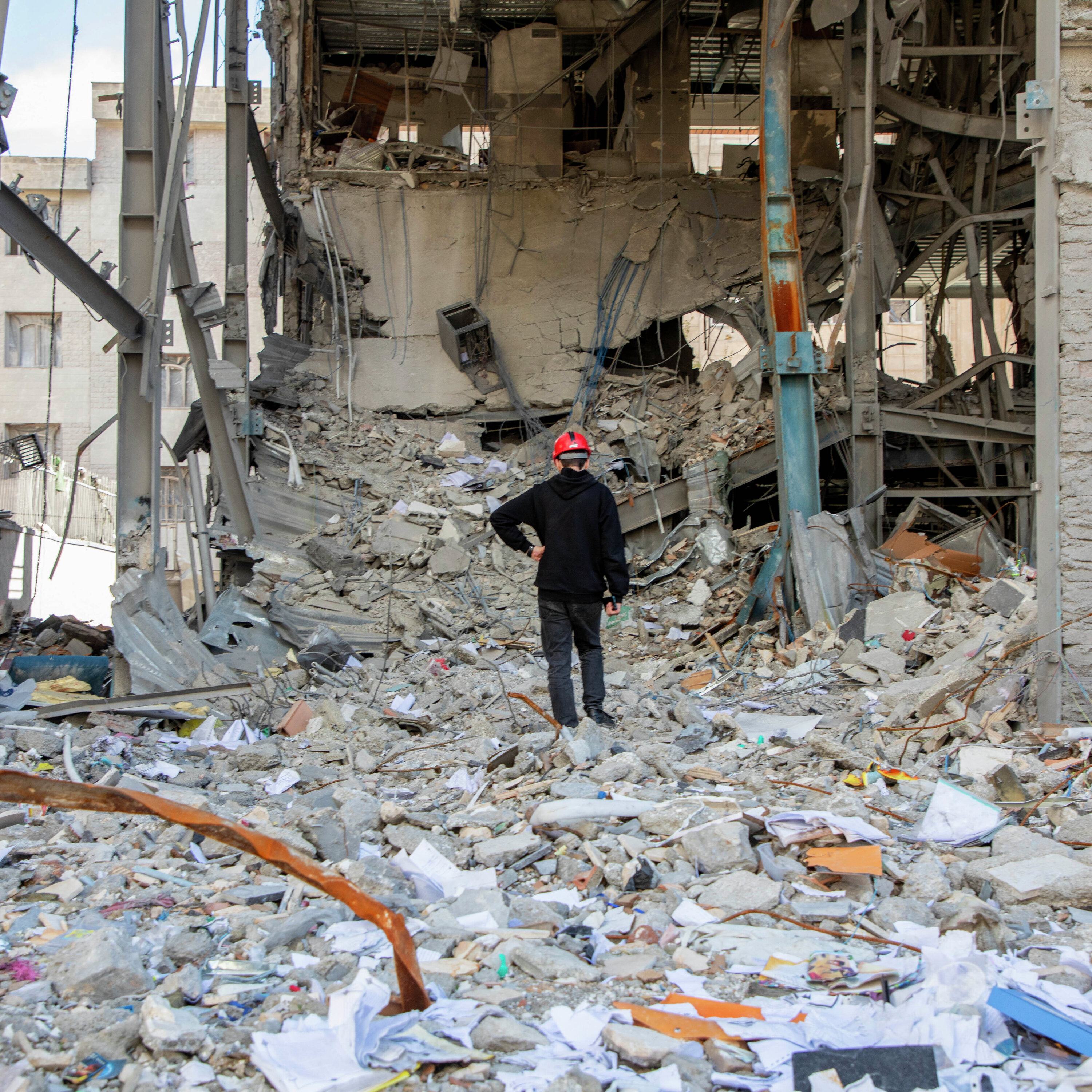
He specifically laid out a scenario in which the US could bomb civilian bridges, energy infrastructure, and said that these bridges would be burning, it would be gone by 12 o' clock tomorrow if Iran was not willing to meet the deadline that he set and meet the ultimatum of reopening the Strait of Hormuz. And of course, that raises a lot of alarm bells around the world. That would be a violation of the Geneva Conventions and would be considered a war crime. Israel in particular, I think, is a big question mark over this supposed threat, especially because they have said recently that a part of their objectives was that they wanted to leave a functioning state for the opposition to take control of. They wanted to give the Iranian people a reason to fight for the state and push back against the power structures. And so going after these civilian targets would be a misalignment with the Israeli objectives, which the has said they are in complete coordination and an alignment with Israel.
- [05:42]
Sarah Holder
On does this potential for US Escalation open the door to a new level of response from Iran? What can you expect Iran to do if the US Targets civilian infrastructure or even threatens to do so?
- [05:56]
Courtney Subrahmanian
They have said they would retaliate. And if you look at some of the reasoning and the rationale from the US as to why they launched this military campaign, they painted Iran as The world's number one terrorist, a terrorist state that has constantly targeted the US over the last few decades. And I think that especially given their objectives, which is survival at this point, we should expect to see some sort of retaliation, whether that is on U.S. soil or on U.S. military bases in the Gulf region.
- [06:38]
Sarah Holder
One of the key leverage points in this war for Iran and one of the key priorities for the Trump administration right now is the Strait of Hormuz. Trump has been trying to get Iran to open the Strait of Hormuz, issuing a series of ultimatums to the country over the past few weeks. What message does that shifting timeline send Iran?
- [06:57]
Courtney Subrahmanian
You know, the president has said that he thinks talks are going well in a series of interviews he's done with reporters over the last 24 hours. The idea is to buy more time because he has escalated these threats so much. The problem is the Strait of Hormuz is such a point of contention, particularly because Iran sees that as one of their biggest leverage points in these negotiations, in this entire war. This is something they economically are benefiting from, of course, but also it's allowing them to drag on this conflict. And the U.S. of course, would like to see Iran give up control of that strait in order to move forward. And I think they are just at exact opposite ends of agreement on who should control the Strait of Hormuz.
- [07:52]
Sarah Holder
Trump's press conference really brought that into relief. Trump said that the spoils, quote, unquote, should go to the victor in Iran, which he said was the US and that instead of Iran charging ships to transit the Strait, it should be the US Collecting the tolls.
- [08:08]
Donald Trump
I'd rather do that than let them have them run. Why shouldn't we? We're the winner.
- [08:12]
Sarah Holder
How do you solve that disagreement over who should collect tolls in the Strait of Hormuz in a day?
- [08:18]
Courtney Subrahmanian
I don't think you can. The problem here is Trump views everything through the Venezuela model, which he again referenced today. Right. This extraction of Nicolas Maduro and then going in and working with the remaining government and definitely taking over industry is not really a model that you can replicate in a country as big as Iran, in a region where this industry is so vital and critical to the countries around it and involves so many players, regional players. But the president doesn't seem to see that. And I think it's going to take more than a day to find common ground between these two sides.
- [09:08]
Sarah Holder
Well, let's talk about the state of negotiations right now, because Axios had reported that there were discussions about reaching a potential 45 day ceasefire between the US and Iran. But this morning, Iranian state media reported that Iran rejected a U.S. proposal for a temporary ceasefire and that it instead wants a permanent end to the war. Where does this all leave negotiations and talks with just a day on the clock before the President's latest deadline?
- [09:34]
Courtney Subrahmanian
White House officials have said this is one of many ideas on the table that the President is considering, which I think is probably true for any set of negotiations this administration has been through with regard to other conflicts. But we also have heard from Iran in different points in this conflict where they have refuted some of the messaging we've seen out of Washington. I mean, these conversations are happening, you know, behind the scenes through text messages, through phone calls. So I think it is hard to take either side at face value at this point until we get to this deadline and see what the US Is willing to do, whether or not Tehran is meeting their ultimatum at this point.
- [10:19]
Sarah Holder
Right. Iran has seen Trump pull out of the Joint Comprehensive Plan of Action, the nuclear deal that was worked out between the US And Iran this year. The US And Israel attacked Iran while negotiations with the country appeared to be ongoing. So I'm wondering, from Iran's perspective, how does that context weigh on them as these talks move forward? Why believe that this round of negotiations will be different?
- [10:42]
Courtney Subrahmanian
The US has used this playbook before. We've seen them talk about negotiation, characterize it or mischaracterize it as going well and then going into an action that the administration wants to take anyway. From Tehran's perspective, this could all be a replay of what happened last June when the US Decided to attack, attack Iran's nuclear facilities. There's just been an erosion of trust with the President's negotiators, Steve Witkoff and Jared Kushner, his son in law, which is probably why we've seen Vice President JD Vance enter the negotiations. He's also been speaking on behalf of the administration and taking a much more prominent role this time.
- [11:31]
Sarah Holder
And Courtney, where is Israel in all this? Can any deal be meaningful for Iran without Israel's cooperation or sign on?
- [11:41]
Courtney Subrahmanian
That's one of the biggest questions to me. I think they're one of the biggest puzzle pieces in putting this all together. As you mentioned, any deal that the President's negotiators work out needs to be coordinated with Israel, who has, by the way, continued attacking even into this week, even into today. But he does have a very close relations with Prime Minister Benjamin Netanyahu. And we did hear from Prime Minister Netanyahu yesterday that he was in contact. He had called the President to congratulate him on the search and rescue efforts of the two fighter pilots whose jet was downed in Iran. Netanyahu has been very clear that he has an open and frank relationship with President Trump and he has talked about the military objectives for Israel. I think that they have been mostly aligned with the US on guaranteeing that Iran could never receive a nuclear weapon, that they want to cease their missile program. But again, these are huge points of contention that Tehran has not come close to agreeing to. So where the status of these negotiations are at is still a question to be answered.
- [12:58]
Sarah Holder
What about other Gulf states? What kind of guarantees would they want out of a potential ceasefire deal or a permanent and to the war? And do they have a seat at the negotiating table?
- [13:09]
Courtney Subrahmanian
We've seen the Gulf states being pushed closer to the US Mostly because they don't have an option. They are probably pretty desperate for an off ramp as well, especially with the closing of the strait and some of the economic ramifications we've seen. But also even the attacks from Tehran on the region and on these countries. I think they are all pushing for some sort of last ditch effort to achieve a ceasefire in these final hours of the President's deadline. But the question is, you know, whether they will be successful in convincing the President to find some common ground.
- [13:58]
Podcast Advertiser/Host
Support for the show comes from Public. Public is an investing platform that offers access to stocks, options, bonds and crypto, and they've also integrated AI with tools that can assist investors in building customized portfolios. One of these tools is called Generated Assets. It allows you to turn your ideas into investable indexes. So let's say you're interested in something specific like biotech companies with high R and D spend, small cap stocks with improving operating margins, or the S&P 500 minus high debt companies. Chances are there isn't an ETF that fits your exact criteria. But on Public you just type in a prompt and their AI screens thousands of stocks and builds a one of a kind index. You can even backtest it against the S&P 500. Then you can invest in a few clicks, go to public.com market and earn an uncapped 1% bonus when you transfer your portfolio. That's public.com market ad paid for by Public Holdings Brokerage Services by Public Investing member finra, SIPC Advisory Services by Public Advisors SEC Registered Advisor crypto services by ZeroHash sample prompts are for illustrative purposes only, not investment advice. All investing involves risk of loss. See complete disclosures@public.com disclosures we buy insurance
- [15:11]
Cigna Healthcare Narrator
for peace of mind. But every year millions of claims are denied. Not because people did anything wrong, but because their policies quietly excluded what happened. Insurers know every detail. Policyholders rarely do. That's why MyPolicyAdvocate exists for just 27 cents a day. Their platform reads your policies and explains where you are vulnerable. They don't sell insurance, they deliver transparency. Before you trust your policy to protect you, let my policy advocate tell you what it really says. Go to mypolicyadvocate.com deadlines move, plans change and sometimes opportunities pop up out of nowhere when you need branded gear fast 4imprint is ready to deliver. 4imprint offers hundreds of promotional products in their 24 hour category. Everything from custom apparel, bags and drinkware to writing tools, trade show staples and high tech gear at 4imprint. They're focused on getting the details right, printing your logo with precision, packing your order with care, and shipping it out fast. And it's backed by their 360 degree guarantee. That's four imprint's promised your order will show up right on time, just the way you planned it. That's what it means to be four Imprint certain. So if you're prepping for a last minute event or jumping on a big opportunity, you don't have to settle or scramble with 4imprint fast reliable service and peace of mind are built right in. Check out their full 24 hour selection at 4imprint.com 4imprint for certain.
- [16:44]
Sarah Holder
Much of President Trump's Monday press conference was devoted to celebrating the success of a US mission to rescue the two airmen whose jet was shot down last
- [16:53]
Donald Trump
week in Iran, one of the largest, most complex, most harrowing combat searches, I guess you would call it, a search and rescue mission ever attempted by the military.
- [17:04]
Sarah Holder
What is this episode, the shooting down of the jet in the first place and the rescue mission. Tell us about how the US's military operations are going and Iran's military capabilities.
- [17:16]
Courtney Subrahmanian
You know, the US sees this search and rescue effort and the successful rescue of these two pilots as an affirmation of US forces and the military campaign. And Iran sees the downing of a US jet as a success as well. It's a question of survival. And you know, as much as the President said they have obliterated their Navy, their air force, Iran still has the capabilities to put up a fight. And I think that is one of the central problems with finding an off ramp here. So it's given both sides a reason to keep going and no reason to find a way out.
- [18:05]
Sarah Holder
It all is a Reminder that Trump campaigned on getting out of forever wars. So I'm wondering how this latest chapter in the Iran war, more than a month in, is playing with Trump's base.
- [18:20]
Courtney Subrahmanian
Polling has told us that a lot of the President's supporters, his core base supporters, are with him, which is something we've seen, you know, throughout his first term and second. But there is a real mismatch with what the President promised coming into office, coming into politics. Right. This was a man who very much said was against foreign intervention, was against dragging the US into new conflicts. But a lot of Republicans within his party have really questioned his decisions on dragging this war out, especially as we get closer to November. A lot of previous elections have told us that most US voters lock in their opinions by early summer, ahead of midterm elections. That's getting pretty close. And we still have no idea about whether the US will hold to these timelines that the President has promised, particularly because he keeps extending them. So, you know, if gasoline prices are still increasing, if, you know, the President is talking about the war in Iran instead of talking about tackling the housing crisis or talking about his economic agenda, then I think there's going to be real questions about whether his party is going to be successful in November.
- [19:51]
Sarah Holder
Yeah, the base seems to be loyal to Trump even through the Iran war. But the majority of Americans, according to CNN and Fox Polling, disapprove of this war.
- [20:02]
Courtney Subrahmanian
Republicans are extremely anxious about this war, especially as it drags on the deadline of how long he said this would the Americans would have to endure. The economic implications of this war are fast approaching and oil prices are not coming down. We have reported that the administration is even looking into modeling if oil prices jumped to 150 to $200 a barrel. That does not line up with the economic message that Republicans are pushing ahead of November.
- [20:45]
Sarah Holder
And the Trump administration has asked for $1.5 trillion for the department of Defense in its next budget, which would be a record amount of spending. So that just speaks to the amount of resources that the Trump administration wants to expend on this war, especially when
- [21:00]
Courtney Subrahmanian
they're cutting funding for domestic programs and some of the agencies like housing. Right. That is a huge issue and will be a huge issue in November.
- [21:13]
Sarah Holder
Lastly, Courtney, I want to ask about support for this war on the international stage. Trump has asked the US's NATO allies to get involved in the Iran war. They haven't. He's threatened to withdraw from the alliance. He's criticized the alliance. Trump has. Trump is scheduled to meet with NATO Secretary General Mark Rotte later this week and Trump often talks about who has the best cards to play. I'm wondering who holds the cards here.
- [21:40]
Courtney Subrahmanian
I mean, ultimately the President does. I think he's proven through and through at several points when he's gone after our NATO allies and questioned their role and their commitments. You know that they always end up coming to Washington to try and convince him of the importance of the NATO alliance and why it's critical that the U.S. stay in this alliance. Which is why I think we are seeing Mark Rutte come to the US this week to try and again educate the President, charm him as he has in the past and convince him that even though there is great trepidation about the size and scope of this campaign and involvement, that that does not detract from the US Allies commitment to the US But I think Iran has been almost a bridge too far for many of these countries who are not willing to follow the President down this path, especially as there is no clear end in sight at this point despite these negotiations, which have dragged on, frankly, for weeks.
- [23:05]
Sarah Holder
This is the Big Take from Bloomberg News. I'm Sarah Holder. To get more from the Big Take and unlimited access to all of bloomberg.com subscribe today@bloomberg.com podcastoffer if you like this episode, make sure to subscribe and review the Big Take. Wherever you listen to podcasts, it helps people find the show. Thanks for listening. We'll be back tomorrow.
- [23:33]
Podcast Advertiser/Host
When you're running a business, the best days are the ones where priorities stay on track. For midsize and large companies, risk can affect multiple parts of the organization at once, from property and liability to cyber and regulatory challenges. At that level, managing risk becomes an ongoing discipline. At the Hartford, the focus is on helping businesses manage risk before it turns into something more disruptive. And when losses do happen, that work is paired with insurance coverage shaped by years of underwriting, risk engineering and claims experience. Learn more@thehartford.com riskmitigation policies provided by Hartford Fire Insurance Company and its property and casualty affiliates Hartford, Connecticut this is Amy
- [24:14]
Sarah Holder
Robach alongside TJ Holmes from the Amy TJ podcast.
- [24:18]
Podcast Advertiser/Host
And there is so much news, information, commentary coming at you all day and from all over the place.
- [24:24]
Courtney Subrahmanian
What's fact, what's fake, and sometimes what
- [24:27]
Podcast Advertiser/Host
the f. So let's cut the crap, okay? Follow The Amy TJ podcast, a one stop news and pop culture shop to get you caught up and on with your day.
- [24:37]
Sarah Holder
And listen to Amy and TJ on the iHeartRadio app. Apple Podcasts or wherever you listen to podcasts. Hi, I'm Iris Palmer, host of the
- [24:46]
Courtney Subrahmanian
Against All Odds podcast.
- [24:47]
Sarah Holder
Every week, I'm sitting down with exceptional people who have broken barriers even when the odds were stacked against them, like Chef Victor Villa of Villa's Tacos. You know, the taquero from the Bad Bunny halftime show?
- [24:59]
Courtney Subrahmanian
It was great. It was. Was a big moment. It was special. And I felt like I was really representing my family, you know, my brand, my city. I was representing all taqueros, not only of, like, you know, the U.S. but of Mexico and beyond, all the taqueros of the world.
- [25:13]
Sarah Holder
Listen to Against all odds on the
- [25:15]
Courtney Subrahmanian
iHeartRadio app, Apple Podcasts, or wherever you get your podcast.