Loading summary
Transcript67 lines
- [00:00]
Adobe Acrobat Announcer
Introducing the all new Adobe Acrobat studio now with AI powered PDF spaces. Do more with PDFs than you ever thought possible. Need AI to turn 100 pages of market research into 5 insights with a click. Do that with Acrobat. Need templates for a sales proposal that'll close that deal. Do that with Acrobat. Need an AI specialist to tailor the tone of your market report to sound real smart in real time? Do that with the all new Adobe Acrobat Studio. Learn more@adobe.com do that with Acrobat.
- [00:35]
iShares / Wise Advertiser
With Volley from Ishares. You get access to both monthly income and growth potential in one simple ETF. It's the best of both worlds. Discover Bali iShares Large Cap Premium Income Active ETF iShares the market is yours. Visit www.ishares.com to view perspectives for investment objectives, risks, fees, expenses and other information that you should read and consider carefully before investing. Risks include principal loss and the use of derivatives, which could increase risks and volatility. Monthly Inc. Guarantee prepared by BlackRock Investments LLC.
- [01:02]
Public.com Advertiser
Support for the show comes from public on public. You can build a multi asset portfolio of stocks, bonds, options, crypto and now generated assets which allow you to turn any idea into an investable index. With AI it all starts with your prompt. From renewable energy companies with high free cash flow to semiconductor suppliers growing revenue over 20% year over year, you can literally type any prompt and put the AI to work. It screens thousands of stocks, builds a one of a kind index and lets you back test it against the S&P 500. Then you can invest in a few clicks. Generated assets are completely customizable and based on your thesis, not someone else's. Go to public.com market and earn an uncapped 1% bonus when you transfer your portfolio. That's public.com market paid for by Public.
- [01:52]
David Gura
Investing Brokerage Services by Open to the Public Investing Inc. Member FINRA and SIPC Advisory Services by Public Advisors llc. SEC Registered Advisor Generated Assets is an interactive analysis tool. Output is for informational purposes only and is not an investment recommendation or advice. Complete Disclosures available at public.comDisclosures.
- [02:13]
Adobe Acrobat Announcer
Bloomberg Audio Studios Podcasts Radio News now what I'm.
- [02:19]
President Donald Trump
Asking for is a piece of ice, cold and poorly located that can play a vital role in world peace and world protection.
- [02:31]
David Gura
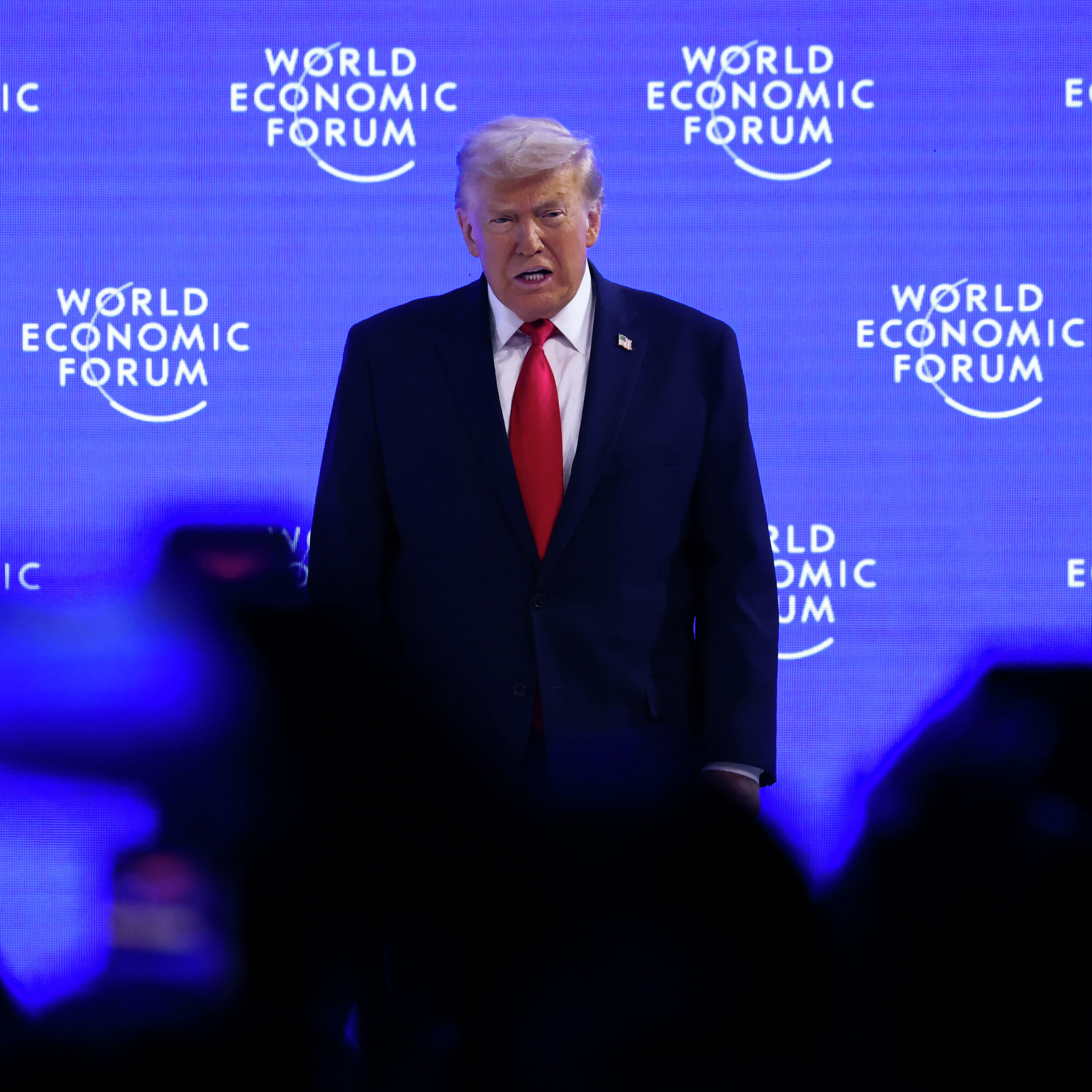
Today at the annual meeting of the World Economic Forum in Davos, Switzerland, President Trump laid out his most detailed case yet for why the United States should take over Greenland. Trump said the US Needs it for national security reasons and the US Is owed it because of how much the country has given its allies.
- [02:50]
President Donald Trump
It's a very small ask compared to what we have given them for many, many decades.
- [02:57]
David Gura
In the run up to the President's speech, the leaders of Canada, France and the United Kingdom responded to what Trump has said and posted about Greenland, including threats to tariff European trading partners over the issue, and signaled it could lead to the end of a global order that's been in place since World War II.
- [03:15]
Mark Carney
The rules based order is fading, that the strong can do what they can and the weak must suffer what they must.
- [03:23]
Public.com Advertiser
When we look at the situation, it's.
- [03:25]
Flavia Krauss Jackson
Clearly a very concerning time. The use of tariffs against allies is completely wrong. It is not the right way to resolve differences within an alliance.
- [03:38]
David Gura
So by the time Trump took the.
- [03:40]
President Donald Trump
Podium, so many friends, few enemies, many.
- [03:45]
David Gura
Of the prime ministers and presidents and senior executives in the audience were on edge.
- [03:50]
Flavia Krauss Jackson
He really turned the volume up, amped up the pressure by just, you know, leaving everyone guessing, you know, is he going to invade Greenland? What is he going to do?
- [03:59]
David Gura
That's Flavia Krauss Jackson, who oversees our economic and political coverage in Europe. She watched the speech in Davos.
- [04:05]
Flavia Krauss Jackson
So he made two big items of news. One, he said, I'm not going to invade Greenland.
- [04:11]
President Donald Trump
We never ask for anything and we never got anything. We probably won't get anything unless I decide to use excessive strength and force where we would be frankly unstoppable. But I won't do that.
- [04:27]
Flavia Krauss Jackson
And then he said, but I'm gonna put an offer on the table.
- [04:30]
President Donald Trump
So they have a choice. You can say yes, and we will be very appreciative, or you can say no, and we will remember.
- [04:41]
Flavia Krauss Jackson
The offer that he put on the table was almost like, I offer not to invade you, so you'd better sell me the island. I'll make you an offer you can't refuse. It's like something out of the Godfather.
- [04:53]
David Gura
As world leaders and the rest of us processed what Trump said, the President began a series of meetings. After he sat down with NATO Secretary General Mark Rutte, Trump posted an update on social media. The President said he decided not to impose the new tariffs he'd threatened on European allies. And he and Rutte had, quote, formed the framework of a future deal with respect to Greenland and, in fact, the entire Arctic region. I'm David Gura and this is the big take from Bloomberg News. Today. On the show, President Trump's collision with long standing US Allies over Greenland and how Canada and Europe will respond. By the time President Trump arrived in Davos he'd upended the agenda at the World Economic Forum's annual meeting. His speech became the marquee event, but many other world leaders decided to skip it. In an address that was about an hour long, the President made his case for the US Taking over Greenland. Over and over again, I asked Bloomberg's Flavia Krauss Jackson what we learned about how he plans to proceed. What did we hear from President Trump in terms of what his motivations are for doing this? The rationale, as he sees it, for the US Taking or acquiring this large island?
- [06:16]
Flavia Krauss Jackson
Right. I mean, Trump has rattled off a series of reasons of why he feels Finland should belong to the US he usually uses this argument of rare earths, which is very vague and generic, and it's a sort of catch all for many things in his understanding of the world.
- [06:33]
President Donald Trump
But there's so much rare earth than this. To get to this rare earth, you got to go through hundreds of feet of ice. That's not the reason we need it. We need it for strategic national security.
- [06:48]
Flavia Krauss Jackson
Then there is a national security aspect, which is very much the sort of the great game of, you know, the big powers that be, spheres of influence, which is very much how Trump sees the world.
- [06:58]
President Donald Trump
Right.
- [06:59]
Flavia Krauss Jackson
Western hemisphere is mine, so Canada, 51st state, Greenland, massive slab of ice, as he calls it, huge island belongs to me. Venezuela in the backyard.
- [07:11]
President Donald Trump
All we want from Denmark for national and international security and to keep our very energetic and dangerous potential enemies at bay is this land on which we're going to build the greatest golden dome ever built.
- [07:28]
Flavia Krauss Jackson
So if you put it in terms of, you know, what he calls the Donroe Dark chain, which is a sort of homage to Monroe, it's much easier to understand where all of this fits in.
- [07:39]
David Gura
Something else that's helpful, Flavia suggests, is to think about President Trump's background.
- [07:44]
Flavia Krauss Jackson
He's a real estate guy, and it seeps into his language. I mean, because they're saying, well, you already have a base here. If you want to send more people, you can. And he was like, yeah, but I want to own it.
- [07:56]
President Donald Trump
Because you need the ownership to defend it. You can't defend it on a lease. Number one, legally, it's not defensible that way. Totally. And number two, psychologically, who the hell wants to defend a license agreement or a lease?
- [08:15]
Flavia Krauss Jackson
And I think it's also worth remembering, look, he held the summit with Putin in Alaska. You know, Alaska was sold by the Russians to the Americans. He's like, great, this is done before. Why can't we do it? Again, oh, you know, he probably read, you know, read somewhere that, you know, the US Had a crack at, at buying Greenland back then. He's like, well, they didn't close the deal, but I can. So I think through that lens, you start to understand, you know, and he says he loves maps. You look at the map, it's massive. But he's also very dismissive of it, and he doesn't understand why they won't give it to him. He's like, oh, it's just a. A slab of ice, uninhab. So I think to hear the stream of consciousness on stage was probably the clearest sense of, like, where he's coming at.
- [09:01]
David Gura
What did we learn in that speech about how far he's willing to go to acquire this territory?
- [09:06]
Flavia Krauss Jackson
I think he's willing to go pretty damn far. And I think it's also, I mean, one thing that you also notice about Trump's approach is that no deal is there that can't be broken, ripped up, renegotiated. So just because he said, today, I won't invade, doesn't mean that in two weeks time, he decides, you know what? I've reconsidered.
- [09:24]
David Gura
I felt like the US And NATO were in this new, good place, that President Trump had wielded his influence to get member states to pay more money to the alliance. And yet the rhetoric toward NATO in the president's comments dispelled that sense. He was highly critical of NATO, the NATO alliance.
- [09:42]
President Donald Trump
The United States is treated very unfairly by NATO, I want to tell you that. And when you think about it, nobody can dispute it. We give so much and we get so little in return.
- [09:56]
David Gura
And just to dovetail these two things made it almost seem as though NATO owes him Greenland because of what the US has done over these last many decades.
- [10:05]
Flavia Krauss Jackson
Right. I mean, I think there was a great deal of revisionism of history, which is something, for example, that Trump has in common with Putin, who also has his own alternative view of the history of Ukraine. What I would say is that NATO is on its knees. And I would say that you're probably looking at a world where Marc Rote might well be the last Secretary General of NATO, because the whole way was conceived is in a world where the US Is largesse and generosity and policemen of the world, and looking out for it underpins the entire way that Europe came to see itself after the end of World War II. And it wasn't based on transactionalism. It was based on the Marshall Plan, and it was based on, yes, the US Wants to have a physical presence of troops in Germany and we will allow this to happen because it's a deterrent. Once you start questioning, well, why do I have soldiers there and you must pay me to have this presence, you're essentially turning the whole argument on its head.
- [11:15]
David Gura
Flavi. There was a sell off in the run up to this speech, but markets seemed, dare I say, pretty complacent as President Trump spoke. How do you interpret the way investors are looking at, yes, the president's comments, but more broadly, the position he's taken on Greenland and on these multilateral alliances?
- [11:32]
Flavia Krauss Jackson
Yeah, I mean, I think there's a really interesting piece that we wrote about the taco trade, that it's all good and well to sort of trade off the fact that how seriously can you take Trump and will he always take you to the brink and then walk back? But then at that point, you no longer have those natural defenses that help keep a leader in check. And I think at this particular moment in time, the fact that sort of the markets are playing along and not sort of responding to this greater volatility and the stakes are getting higher, but the bar to actually move markets gets higher turns the world into a much more dangerous place. Right. Because in the first iteration of the Trump presidency, the entourage was essentially trying to sort of keep him in check. That's gone. But now no longer. You know, the markets are doing that. And, you know, even speaking to investors here and CEOs and big people from Wall street, there's a sense of like, well, how do you manage Trump? Because you don't want to anger him. We're also making money. But some of the stuff that's happening is not okay.
- [12:44]
David Gura
After the break, how the rest of the west reacted to President Trump's speech at Davos and how his designs on Greenland could reshape the world order. That's next.
- [12:58]
Okta Advertiser
So have you heard the story about the prescription plan? With savings automatically built in, it's where a family of any size can feel confident the cost of their medication won't hold them back. Go to CMK Co Stories to learn how CVS Caremark helps members save just by being members. That's CMK Co Stories.
- [13:22]
Public.com Advertiser
Support for the show comes from public on public. You can build a multi asset portfolio of stocks, bonds, options, crypto and now generated assets which allow you to turn any idea into an investable index with AI. It all starts with your prompt. From renewable energy companies with high free cash flow to semiconductor suppliers growing revenue over 20% year over year, you can literally type any prompt and put the AI to work. It screens thousands of stocks, builds a one of a kind index, and lets you back test it against the S&P 500. Then you can invest in a few clicks. Generated Assets are completely customizable and based on your thesis, not someone else's. Go to public.com market and earn an uncapped 1% bonus when you transfer your portfolio. That's public.com market paid for by Public.
- [14:13]
David Gura
Investing Brokerage Services by Open to the Public Investing Inc. Member FINRA and SIPC Advisory Services by Public Advisors, llc. SEC Registered Advisor Generated Assets is an interactive analysis tool. Output is for informational purposes only and is not an investment recommendation or advice. Complete disclosures available@public.com disclosures these days it.
- [14:32]
Okta Advertiser
Seems like AI agents are just about everywhere you turn, every field and every function. But without identity, you can't trust they'll serve your business instead of jeopardizing it. Fortunately, Okta helps you get identity right by securing your AI agents identities, giving you a single layer of control, a single standard of trust. So whether an AI agent supports a single user or your entire enterprise, with Okta you'll turn risk into opportunity. Secure every agent, secure any agent. Okta secures AI.
- [15:07]
David Gura
Ahead of the annual meeting of the World Economic Forum in Davos, Bloomberg's Flavia Krauss Jackson says many world leaders were weighing the limits and risks of trying to make nice with the U.S. president.
- [15:18]
Flavia Krauss Jackson
I think it's important to remember that when the Europeans were thinking about how to handle how to manage Trump, they were really looking at Trump 1.0 and thinking, okay, flatter him. You know, don't speak out of term, throw him a couple of jollies, invite him to meet a king, fluff up the pillows at the Royal palace. And it's become very clear that Trump in this situation is completely different. And they have come to realize that that just doesn't work because Trump only respects strong, not weak. And Europe has very much been put in the latter category. So what you've seen in the sort of here in Davos, but in the sort of run up is very much a sor of soul searching of like, are we in the area of appeasement? You know, we've seen where this has gone with Neville chamberlain in the 30s. You know, no one is obviously comparing Trump to Hitler, but you know, the sort of historic parallels are sort of really reemerging and being reimagined and thinking, well, when was the last time that we sort of gave in thinking that this would work on Retaliation.
- [16:20]
David Gura
How much unanimity is there among European leaders in terms of how they might respond to what we've heard from the president?
- [16:26]
Flavia Krauss Jackson
There isn't. And I think that's the great tragedy of the European Union. And also what sort of makes it great, right? I mean, it is 27 countries, they don't always agree. And trying to come to an agreement, reach a consensus when there's such a divergence of views makes it very complicated. So you've got, for example, you know, the spoiler in the midst, you've got someone like Viktor Orban and then on the other side of the spectrum, you have, you know, someone like Emmanuel Macron who was, you know, belittled and berated in Trump's speech as an example of someone who, you know, says one thing in public, but in private kind of acquiesces, who will say, listen, it's time for us to use all the tools that we have to fight back. And I think what we're sort of seeing is Europe willing and able to stop trying to thread the needle and do something definitive. And really, because Europe has kind of flip flopped between acquiescing and then trying to do something strong, it risks actually doing neither.
- [17:34]
David Gura
Peer into that toolbox, if you would. And we've seen, yes, these European nations send military personnel to Greenland. We've heard talk of this anti coercion mechanism. We've seen a Danish pension fund offload a bunch of U.S. treasuries. What's in that toolbox? What could Europe use to, to respond here?
- [17:53]
Flavia Krauss Jackson
Well, I mean, this anti coercion instrument is essentially something that's never been used before. And you know, it's been dubbed the trade bazooka, but it would allow for the curbing of inputs of good and services. And it's, it's unclear how it would work and whether it would even potentially be detrimental for Europe to do it. So part of the sort of will Europe use it? It'? Is it just using it as a bluff tactic? And at what point is Trump going to call the bluff, which he has essentially done?
- [18:26]
David Gura
Canada's Prime Minister Mark Carney gave a big speech at Davos that's gotten a lot of play, effectively calling the end of the world order that's been in place for 80 years.
- [18:33]
Mark Carney
Let me be direct. We are in the midst of a rupture, not a transition. Over the past two decades, a series of crises in finance, health, energy and geopolitics politics have laid bare the risks of extreme global integration.
- [18:48]
David Gura
Give us the alternative worldview here as articulated by Prime Minister Carney, but I think embraced by a lot of these European leaders as well. What is their sense of this new kind of world order that's come out of this really deep disagreement they're having with the United States?
- [19:01]
Flavia Krauss Jackson
Well, what he's speaking to really is the dilemma that many of these so called middle countries have, which is they can't really strike alone. So what do they do? And they sort of rely on a sort of architecture of cooperation. And what that involves is essentially a kind of decoupling. It doesn't mean that in response you erect barriers, rather that you sort of start developing the relationships amongst yourselves. And so what that sort of essentially means is a more gradual distancing from what once, once an ironclad relationship but now has become an unreliable partner. So it doesn't mean that from one day to the other you suddenly like cut yourself off. But I think, and there's a very good quote that he put, which was middle powers must act together because if you're not at the table, you are on the menu.
- [20:00]
Mark Carney
The middle powers must act together because if we're not at the table, we're on the menu. But I'd also say that great powers can afford for now to go it alone. They have the market size, the military capacity and the leverage to dictate terms. Middle powers do not so very much.
- [20:19]
Flavia Krauss Jackson
The idea there is, and I think what Carney is saying is that is the equivalent, for example, of putting the wall even higher, erecting the barriers. And that's a lose, lose situation for middle countries because they're not going to be able to sort of survive short term.
- [20:36]
David Gura
I asked Flavia to contrast that with President Trump's vision compared to sort of.
- [20:40]
Flavia Krauss Jackson
Former administration, those idea of, you know, democracy and we want to, you know, take away the bad guys and bring the good guys. That's not how Trump sees the world. In fact, it's extremely interesting to see that even when he removed Maduro, who I think few people would argue was not a particularly pleasant person, certainly ran the country to the ground. He didn't insult, stall the leader of the opposition, which is what a natural step that one would have thought. No, he was perfectly willing to work with one of Maduro's people who is very much part of the old regime, because what we're seeing in the Trump world is vassal states, puppet states. So I think what we're starting to see certainly from Jan 3, is where his aspirations, where his leadership is going to take him. And I think that's what's been truly terrifying for the Europeans because Greenland would not be hard to take. And then it just becomes a question of, like, who would he install?
- [21:43]
David Gura
Flavia lastly, the theme of this year's gathering in Davos is a spirit of dialogue. How do you see this playing out? How do you see the conversation evolving from what we've seen over the course of this week in Davos?
- [21:55]
Flavia Krauss Jackson
We're not really seeing a dialogue, right? We're seeing the trading of barbs, insults, its escalation. And I think to the extent that we're going to see more of that, I think that's something that we just have to assume will happen. But now the question is, having thrown down the gauntlet on Greenland, watch out for other spaces, right, because Trump might hold back a little bit from Greenland, but don't forget that there's also Iran just around the corner. And he's also said that he's lots of options are being considered there. And in all this, don't forget that there's a rather sizable Chinese delegation here. And whilst everyone is eyes and ears have been elsewhere, they have been quietly meeting everyone and having probably some very interesting conversations. I'd be keeping a very close eye on what China does next.
- [22:53]
David Gura
This is the Big Take from Bloomberg News. I'm David Gura. To get more from the Big Take and unlimited access to all of bloomberg.com, subscribe today@bloomberg.com podcastoffer if you like this episode, make sure to follow and review the Big Take. Wherever you listen to podcasts, it helps people find the show. Thanks for listening. We'll be back tomorrow.
- [23:18]
Okta Advertiser
These days, it seems like AI agents are just about everywhere you turn, every field and every function. But without identity, you can't trust they'll serve your business instead of jeopardizing it. Fortunately, Okta helps you get identity right by securing your AI agents identities, giving you a single layer of control, a single standard of trust. So whether an AI agent supports a single user or your entire enterprise, with Okta you'll turn risk into opportunity. Secure every agent, secure any agent. Okta secures AI.
- [23:49]
My Policy Advocate Advertiser
Here's a paradox. We buy insurance for peace of mind. Yet the very policies we trust can deliver the biggest financial shocks. Across America, millions of claims are denied every year, not because people did anything wrong, but because policies quietly excluded the things that happened. The psychology of trust tells us we assume the contract is fair. But in insurance, the information gap is massive. The insurer knows every detail of what's covered. The policyholder rarely does. That's where my policy advocate comes in for just 27 cents a day. Their platform reads your policies and shows you in plain language where you're vulnerable. They're not selling insurance. They don't do that. It's about transparency, giving ordinary people the same understanding insurance companies have had for decades. Because when you know what's really in your policy, you can plan, protect, and avoid surprises. Before you trust your policy to protect you, let my policy advocate tell you what it really says. Visit mypolicyadvocate.com today. Peace of mind starts with knowing the truth.
- [24:49]
iShares / Wise Advertiser
Mypolicyadvocate.com this podcast is brought to you by Wise the Smarter Way to manage your money internationally if you're getting a headache from juggling different currencies and different bank accounts in different countries, there's a better way to receive money in the currency you need without the slow transfer times or HIDD fees. Meet Wise, the savvy way to handle your money internationally. Hold balances in up to 40 currencies with the mid market exchange rate on every conversion. Whether you're receiving payments from tenants abroad, earning as a digital nomad, or converting dividends from your international investments, the Wise Multi Currency account is for you. Be Smart, Get Wise. Download the Wise app today or visit wise.com Terms and Conditions apply.