Loading summary
Transcript70 lines
- [00:00]
Podcast Host (Ad Reader)
Support for the show comes from Public. Public is an investing platform that offers access to stocks, options, bonds and crypto. And they've also integrated AI with tools that can assist investors in building customized portfolios. One of these tools is called Generated Assets. It allows you to turn your ideas into investable indexes. So let's say you're interested in something specific like biotech companies with high R and D spend small cap stocks with improving operating margins or the S&P 500 minus high debt companies. Chances are there isn't an ETF that fits your exact criteria. But on Public you just type in a prompt and their AI screens thousands of stocks and builds a one of a kind index. You can even backtest it against the S&P 500. Then you can invest in a few clicks, go to public.com market and earn an uncapped 1% bonus when you transfer your portfolio. That's public.com market ad paid for by Public Holdings Brokerage Services by Public Investing Member FINRA SIPC Advisory Services by Public Advisors SEC Registered Advisor Crypto Services by ZeroHash Sample prompts are for illustrative purposes only, not investment advice. All investing involves risk of loss. See complete disclosures@public.com disclosures small businesses are
- [01:14]
Commercial Narrator (Chase for Business)
the pulse of every community. They bring people together, create opportunities and drive growth. Chase for Business helps business owners like you with personalized guidance and convenient digital tools all all in one place. With that guidance and your determination, you can take your business farther and help build a brighter future for your community. Learn more@chase.com business chase for business make more of what's yours the Chase Mobile app is available for select mobile devices. Message and data rates may apply JPMorgan Chase Bank NA Member FDIC Copyright 2026 JPMorgan Chase Co.
- [01:50]
Commercial Narrator (My Policy Advocate)
Here's a paradox. We buy insurance for peace of mind. Yet the very policies we trust can deliver the biggest financial shocks across America. Millions of claims are denied every year, not because people did anything wrong, but because policies quietly excluded the things that happened. The psychology of trust tells us we assume the contract is fair. But in insurance, the information gap is massive. The insurer knows every detail of what's covered. The policyholder rarely does. That's where my policy advocate comes in for for just 27 cents a day. Their platform reads your policies and shows you in plain language where you're vulnerable. They're not selling insurance. They don't do that. It's about transparency, giving ordinary people the same understanding insurance companies have had for decades. Because when you know what's really in your policy, you can plan, protect and avoid surprises. Before you trust your policy to protect you, let my policy advocate tell you what it really says. Visit mypolicyadvocate.com today, peace of mind starts with knowing the truth. Mypolicyadvocate.com
- [02:54]
Commercial Narrator (Chase for Business)
Bloomberg Audio Studios podcasts Radio News
- [03:01]
David Gura
for over a decade, Barbara Hoblitzel worked at the Department of Education. Most recently, she was in the Office of Legislation and Congressional affairs, and in that job, she spent a lot of time talking to people on Capitol Hill. Early last year, Barbara started hearing there would be layoffs in the department, and
- [03:18]
Barbara Hoblitzel
of course, it was very hard to get a straight story in terms of who was being impacted in what way.
- [03:24]
David Gura
Almost all Education Department offices were slashed, including the Office of Indian Education, which funds tribal schools and provides grants to support indigenous education. When that office announced it was laying off employees, Barbara says she got a call from a Republican senator's office and
- [03:40]
Barbara Hoblitzel
they were like, what the she says
- [03:43]
David Gura
that senator was getting a lot of angry feedback from constituents, were hearing these
- [03:49]
Barbara Hoblitzel
terrible stories and, you know, do they understand who is served by these programs? And, you know, to hear that from a Republican office, it was like, so nobody talked to you, huh?
- [04:01]
David Gura
For Barbara, that exchange was the first inkling of what was to come at the Department of Education.
- [04:06]
Liam Knox
It sounds strange, doesn't it?
- [04:07]
David Gura
Department of Education, we're going to eliminate
- [04:09]
Podcast Host (Ad Reader)
it, and everybody knows it's right.
- [04:12]
David Gura
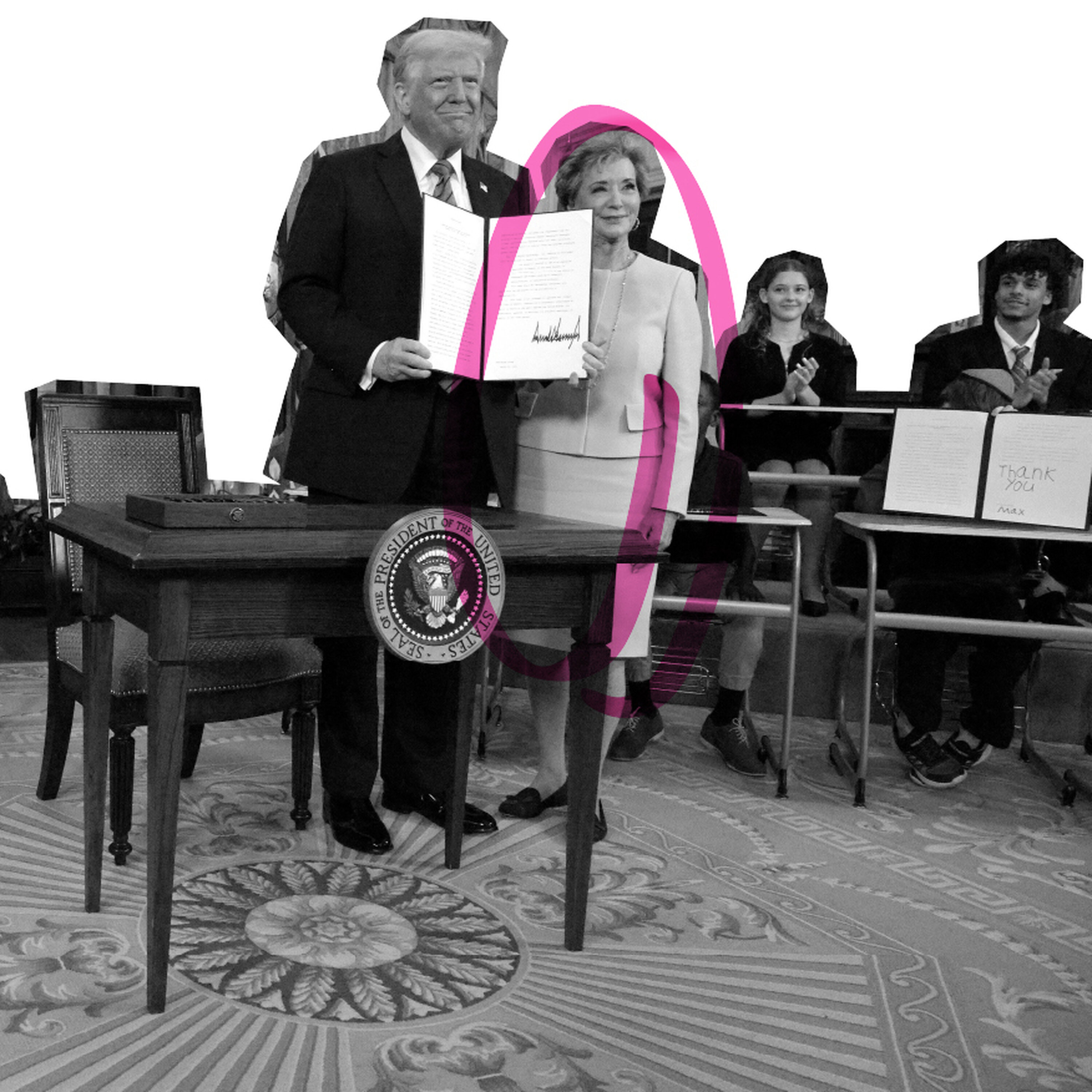
In March, President Donald Trump signed an executive order to begin shutting down part of the department. And in the first year of his second term, his administration cut the department's workforce by 40% with the stated goal of making the department obsolete, which concerns people like Barbara.
- [04:29]
Barbara Hoblitzel
That impacts students, it impacts faculty, it impacts staff, it impacts the nation across all education. And I don't think there's a real appreciation for just how much these programs touch individual lives.
- [04:50]
David Gura
I'm David Gura, and this is the big take from Bloomberg News today on the show Inside the Trump administration's efforts to gut the Department of Education, how it plans to reshape an agency that serves nearly every American student and school, and could its approach provide a blueprint for how the administration handles other agencies whose work it opposes. The Department of Education is housed in a sprawling building just off the National Mall. Back in September, Liam Knox, an education reporter for Bloomberg, paid it a visit.
- [05:26]
Liam Knox
Walking through the halls there, it's a very quiet place right now. There's a lot of empty cubicles and offices without name placards outside the door. Signs of massive reduction. It's viscerally apparent when you step inside the building.
- [05:44]
David Gura
State and local offices have primary control over curricula, educational priorities and the vast majority of school funding. But the federal Department of Education has a few main tasks, like making sure programs that receive its funding comply with civil rights laws, investigating complaints and increasing access to education.
- [06:04]
Liam Knox
And then, of course, its primary responsibility is basically is being a bank for the massive student loan portfolio that they manage.
- [06:10]
David Gura
When Congress created the federal Department of education in 1979, there was no single department that oversaw all of this. And the decades leading up to then were a busy time for American education policy.
- [06:23]
Liam Knox
The point was to consolidate a whole raft of federal programs that had been created during a pretty turbulent historical period for federal involvement in in education. That came with the civil rights movement, that came with President Johnson's war on poverty, about ensuring equal access to education, equal treatment within the American education system in a way that just the federal government had never been involved to that extent before.
- [06:50]
David Gura
Think of the Supreme Court's ruling in Brown v. Board of Education that declared racial segregation unconstitutional and tasked the federal government with enforcing integration.
- [06:59]
Liam Knox
You had school busing, you had all sorts of new federal aid programs, Pell and other grant programs to support students and schools that were disproportionately underfunded.
- [07:12]
David Gura
In 1979, President Carter pressed Congress to establish a Department of Education to put all those programs in a new cabinet level home.
- [07:22]
Liam Knox
This was a divisive political move at the time. Ronald Reagan campaigned in part on taking it apart right away. It was seen as another example of federal bureaucratic overreach into local decision making about what students go to what schools. And there was a lot of saber rattling about the encroachment there.
- [07:42]
David Gura
That saber rattling continued for decades. The heart of the argument was a common Republican refrain that the federal government's size and influence should shrink to empower local districts and state governments. But only Congress can fully dissolve a cabinet level agency. So the executive branch can't do away with the department on its own. But it can make cuts, big cuts.
- [08:05]
Liam Knox
At its peak when Carter created, It was over 6,000 employees. Reagan cut it down substantially in just its first couple of years to around 4,500 employees, which is where it maintained a relatively stable level. I think it went down to the high 3,000s under Trump's first term. Biden staffed it up again. But regardless, throughout its history, it's been the smallest cabinet level agency in the federal government. And it's not even close in terms of personnel, in terms of budget and funding. A lot of that money is distributed in grants to school districts. It's distributed through organizations that work with students on the ground. Obviously, the biggest piece of the Education Department is the student loan portfolio, which is about 1.6, $1.7 trillion.
- [08:51]
David Gura
But.
- [08:52]
Liam Knox
But this is not money that is put into the bureaucracy of the Education Department. It's money to be distributed out throughout the country. When you look at the actual Education Department's budget and personnel, it's, in fact, about as small as a federal agency can get.
- [09:10]
David Gura
Critics argue that the department, small though it is relative to other agencies, still has bureaucratic fat to trim. And no president has taken that argument. As far as President Trump in his second term, his administration has set out to cut the department as much as is legally possible, using a familiar strategy.
- [09:29]
Liam Knox
It's strikingly similar to how a company kind of entering bankruptcy or entering into a period of austerity might manage its decline.
- [09:37]
David Gura
Step one, bring in a new leader, and in this case, that's Secretary of Education Linda McMahon.
- [09:43]
Liam Knox
President Trump has a history of appointing business people to lead his executive agencies. Linda McMahon has some education experience. She was on the Connecticut school board for about a year, but largely she's a businesswoman. She ran his Small Business Administration during the first term, obviously the former CEO of World Wrestling Entertainment, and oversaw two decades of pretty tremendous growth, as well as lots of acquisitions and mergers and consolidations in that industry as it changed rapidly. And in my discussions with, you know, senior officials at the department, it's clear that that business experience is what is guiding her as she moves toward what she's called her final mission, putting herself and her staff out of a job. The President made it very clear when
- [10:29]
Barbara Hoblitzel
he hired me to do this job
- [10:30]
Liam Knox
that he wanted me to be the last Secretary of Education. The formal dismantling of the department came almost immediately after Secretary McMahon was confirmed by the Senate. About a week later, she sent out reduction of force notices to nearly half of the department's staff, over 1,300 people, and continued cutting the staff in other ways. Early retirement, buyout offers, voluntary severance packages, deferred resignation offers, and then the obvious kind of attrition that can come with the chaos and the precarity of a department that if your boss says it's time to shut down, then maybe for good reason, you're thinking, oh, maybe it's time for me to leave.
- [11:18]
David Gura
Over 600 employees have taken voluntary buyouts or chosen to retire early, including Barbara Hoblitzel, who handed in her resignation in April.
- [11:28]
Barbara Hoblitzel
Now, as a career staffer, Your job is to help the administration, whomever it is, advance their agenda. And there were just elements of the agenda of this administration that I felt I couldn't in good conscience advance.
- [11:43]
Liam Knox
Linda McMahon, the education secretary, her slogan for dismantling the department is returning education to the states. Education is local. It should be overseen locally by those
- [11:54]
David Gura
who best know local needs.
- [11:56]
Liam Knox
Some people say that that is exactly what they're doing and should be doing. Others say it's a bit of a euphemism. The truth is local school districts, state governments, are responsible for the vast majority of funding, decision making and, and governance at schools, at universities. And so when they say that they want to return education to the states, there's an extent to which it's already there. But I think the argument is that even those grant programs, even that money that is at the federal government is, you know, when it's managed from on High from D.C. it's managed poorly. That would be what Trump administration officials would say.
- [12:32]
David Gura
I think a lot of us are familiar with this product that the Heritage foundation, this conservative think tank, put out now a couple of years ago. Project 2025 President has tried to disavow himself from it. But when you thumb through that document and look at what was written about the future of the Department of Education, how much of what's in there has come to pass here in the second term of President Trump's administration?
- [12:54]
Liam Knox
Quite a lot of it. There's good reason for that. Lindsey Burke, who wrote the section on education in Project 2025, is a senior policy advisor to McMahon at the department. The three step plan broadly outlined in the Heritage Foundation's Project 2025 is being followed fairly closely by the administration. It starts with sweeping layoffs. We saw those last year. There's a lot of indicators to say that we will see more to come this year. The next step is to take the pieces of the department that they want to preserve and moving them into other
- [13:28]
David Gura
federal agencies, like moving programs for students with special needs to Health and Human Services or career training to the Department of Labor, moving the $1.7 trillion student loan portfolio to the Treasury Department.
- [13:41]
Liam Knox
That's a big move that they are still in planning mode on, but that is their goal. By the end of this, they've already started to move huge chunks of funding from the offices of Post Secondary and elementary Education into the Department of Labor. There's a real kind of idea, Both in Project 2025 and in the Trump administration, that managing education and outcomes should be a lot more tied to employment to the workforce, to the economy, and less just about education as a more abstract goal.
- [14:14]
David Gura
As more programs and staff shift to other federal agencies, the Education Department will continue to shrink until it's small enough to potentially disappear altogether.
- [14:24]
Liam Knox
The final step in Project 2025 is to take whatever's left and basically to convince Congress to axe the whole thing.
- [14:36]
David Gura
So how smoothly has the rollout of that plan gone, and what would it mean for the US if there isn't a Department of Education? That's next.
- [14:47]
Podcast Host (Ad Reader)
Support for the show comes from Public. Public is an investing platform that offers access to stocks, options, bonds and crypto, and they've also integrated AI with tools that can assist investors in building customized portfolios. One of these tools is called Generated Assets. It allows you to turn your ideas into investable indexes. So let's say you're interested in something specific like biotech companies with high R and D spend, small cap stocks with improving operating margins, or the S&P 500 minus high debt companies. Chances are there isn't an ETF that fits your exact criteria. But on Public you just type in a prompt and their AI screens thousands of stocks and builds a one of a kind index. You can even backtest it against the S&P 500. Then you can invest in a few clicks, go to public.com market and earn an uncapped 1% bonus when you transfer your portfolio. That's public.com market and paid for by Public Holdings Brokerage Services by Public Investing member FINRA SIPC Advisory Services by Public Advisors SEC Registered Advisor crypto services by ZeroHash sample prompts are for illustrative purposes only, not investment advice. All investing involves risk of loss. See complete disclosures@public.com disclosures being a small
- [16:00]
Commercial Narrator (Chase for Business)
business owner isn't just a career, it's a calling. Chase for Business knows how much heart and effort go into building something of your own. That's why they make business growth their priority. The Chase team takes the time to understand your mission, where you are now and where you want to go. Their broad range of solutions is designed with you in mind so you can bring your ideas to life. From banking to payment acceptance to credit cards, you can conveniently manage all your business finances all all in one place with their digital tools looking for tips and advice. Their online resources are always available to give you the solutions you need to help your business thrive. See how your business can get stronger and go farther with Chase for Business. Learn more@chase.com business chase for business Make More of what's yours the Chase mobile app is available for select mobile devices. Message and data rates may apply. JP Morgan Chase Bank Naomi Member FDIC Copyright 2026 JPMorgan Chase Co. We buy
- [16:59]
Commercial Narrator (My Policy Advocate)
insurance for peace of mind. But every year millions of claims are denied, not because people did anything wrong, but because their policies quietly excluded what happened. Insurers know every detail. Policyholders rarely do. That's why my policy advocate exists for just 27 cents a day. Their platform reads your policies and explains where you are vulnerable. They don't sell insurance. They deliver transparency. Before you trust your policy to protect you, let my policy advocate tell you it really says go to mypolicyadvocate.com.
- [17:34]
David Gura
The Heritage Foundation's three part plan to gut the Department of Education offers a clear blueprint to the Trump administration. But Bloomberg's Liam Knox says actually implementing that plan has come with challenges, starting with those mass layoffs.
- [17:48]
Liam Knox
There have been a number of court cases challenging these reductions in force. Some of them have been allowed to proceed. Others have been overturned. There were 260 employees at the Office for Civil Rights who were fired last March and then placed on paid administrative leave pending a court case over the legality of their dismissal because they fulfill sort of congressionally mandated roles because of the way that it was carried out. Specifically, there's a process and often it takes a lot longer than a couple of weeks. And those employees were kind of sitting in limbo for most of 2025 until
- [18:25]
David Gura
last month when the department reinstated them.
- [18:28]
Liam Knox
And so they're all back and working at the department now. It's not to say they won't be laid off again in the near future or that those firings are not the goal of the department eventually, but they've had a lot of hiccups and it's cost them a lot of money. There was a recent Government Accountability Office report that put the cost of having all of those employees not working but being paid, receiving benefits at anywhere from 28 to 38 million dollars last year.
- [18:55]
David Gura
For people who rely on programs or grants that used to fall under the Education Department, all that shuffling to new agencies has created new challenges.
- [19:04]
Liam Knox
Some of these offices that manage tens of thousands of grant programs have been slashed by, you know, 50, 80% even. That makes it a lot harder to be responsive to school districts that have questions, that have concerns, that are advocating for themselves, maybe that are applying for new grants. The staff that I've spoken to say, you know, it's not that there has been, you know, a stanching off of the flow of federal money into school districts or into organizations that help students, but rather that the kind of turbulence of it all has made it difficult for grantees, for school leaders to deal with, and especially for students and families.
- [19:40]
David Gura
One employee told Liam that grantees have been hesitant to reach out with questions or to raise problems for fear of attracting the administration's attention and putting their programs at risk. And all these changes, all that makes it difficult for the existing infrastructure and the department staff to serve the communities that rely on them.
- [19:57]
Liam Knox
Nowhere is that more true than at the Office for Civil Rights, where the Education Department's remit, which is to investigate and resolve complaints about discrimination, harassment, things that really affect students, ability to get a good quality education. The rate at which those are being taken up and being resolved is lower than ever.
- [20:16]
David Gura
During the first year of Trump's presidency, only two racial harassment complaints were resolved. In 2024, that number was 25. If you have Congress continuing to approve a budget and you have programs and sometimes staff being moved to these other departments, I guess I hear that wonder sort of what's changed as a result of that. I mean, we're still kind of funding and financing, we taxpayers still funding and financing a lot of these programs in this staff. What is the administration's response to that?
- [20:46]
Liam Knox
Secretary McMahon has talked about that strategy as being a kind of proof of concept for Congress. A lot of Republicans in Congress are nervous about the idea of eliminating the Education Department completely. It does not have the support that the administration would need to get it done legislatively as they, as they have to. And so this is a way for the department to show, hey, we're still going to fund these programs that your constituents really care about, like Pell Grants, like Title one, but it just doesn't have to actually be at the Education Department. For skeptical lawmakers, it's going to take a little while to prove that Congress
- [21:20]
David Gura
seems committed to education funding. Its latest budget maintained or increased funding for nearly all education programs, despite the staff cuts. And Trump's one big, beautiful bill actually increased the scope of the department's responsibilities. It established a new Pell Grant program for workforce training credentials and new earnings tests for colleges to qualify for federal aid.
- [21:42]
Liam Knox
And so there is a disconnect there. And their plan right now is to keep the policy shops at the Education Department, but take the oversight and management of the budgets, as well as most of the staff that actually do that practical day to day work and detail them to other agencies to show that it can be done there to effectively
- [22:00]
David Gura
to cleave the policy side of things. From the operations side of things, yes.
- [22:05]
Liam Knox
I don't think they would use the word cleave, but a lot of their critics certainly would and would say that once you move a program into a different office, into a totally different department, one of the goals of having all of these programs consolidated under an Education Department is that their success would be measured in terms of educational outcomes, educational access, by people who are experts in education policy and not by departments where the policy goals are different. At the Department of Labor, the policy goals are very different than the Department of Education. At the Treasury Department running the student loan portfolio, there might be a lot that changes in terms of the perspective with which that's run. It's run more like an actual bank. So, yes, that cleavage, I think is concerning some people. The administration would say that it shouldn't make a difference.
- [22:54]
David Gura
The Trump administration is not currently seeking to eliminate any other cabinet level agencies. But Liam says the playbook it's used with the Department of Education could be replicated on other parts of the federal government the administration doesn't support.
- [23:07]
Liam Knox
For example, like the Consumer Finance Protection Bureau, which Russ Vaught, Trump's kind of czar of management and budget at the executive agencies, has argued for defunding completely. Again, that is a congressionally mandated agency that if they want to gut it significantly, they're going to have to find creative workarounds just like they're doing at the Education Department. And so if the administration wants to do things by executive decree, they're going to need to find ways to do that that don't contradict with the authority of Congress with law as it's already been passed, because they just don't have the votes to do it otherwise, at least not right now. And those kinds of creative workarounds, getting rid of certain programs, especially getting rid of programs that the administration has said it views as, you know, borderline illegal programs whose goals align with like diversity, equity and inclusion. It could certainly be a template for hacking away at those pieces of the federal bureaucracy.
- [24:12]
David Gura
This is the Big Take from Bloomberg News. I'm David Gura. To get more from the Big Take and unlimited access to all of bloomberg.com, subscribe today@bloomberg.com podcastoffer if you like this episode, make sure to follow and review the Big Take Wherever you listen to podcasts. It helps people find the show. Thanks for listening. We'll be back tomorrow.
- [24:37]
Commercial Narrator (My Policy Advocate)
Here's a paradox. We buy insurance for peace of mind. Yet the very policies we trust can deliver the biggest financial shocks across America. Millions of claims are denied every year, not because people did anything wrong, but because policies quietly excluded the things that happened. The psychology of trust tells us we assume the contract is fair. But in insurance, the information gap is massive. The insurer knows every detail of what's covered. The policyholder rarely does. That's where my policy advocate comes in. For just 27 cents a day, their platform reads your policies and shows you in plain language where you're vulnerable. They're not selling insurance. They don't do that. It's about transparency, giving ordinary people the same understanding insurance companies have had for decades. Because when you know what's really in your policy, you can plan, protect, and avoid surprises. Before you trust your policy to protect you, let my policy advocate tell you what it really says. Visit mypolicyadvocate.com today today, peace of mind starts with knowing the truth. Mypolicyadvocate.com. With volley from iShares, you get access to both monthly income and growth potential in one simple ETF. It's the best of both worlds. Discover Bali iShares Large Cap Premium Income Active ETF iShares the market is yours. Visit www.ishares.com to view perspectives for investment objectives, risks, fees, expenses and other information that you should read and consider carefully before investing. Risks include principal loss and the use of derivatives, which increased risks and volatility. Monthly income is not guaranteed. Prepared by BlackRock Investments, LLC.
- [26:09]
Liam Knox
With four imprint, finding the right promo products can be easy. They call it four Imprint Certainty, which means you get free samples, expert help, art assistance and their assurance your logo looks great. 4imprint offers thousands of options to choose from, including branded apparel, drinkware, outdoor and more. And it's backed by their 360 degree guarantee. That's 4imprint's promise that your order will be packed with care and delivered on time. Need your order faster? 4imprint offers quick turnaround options too. Visit 4imprint.com to explore 4imprint for certain.