Loading summary
Transcript70 lines
- [00:00]
Michael McDermott
At CES. Michael McDermott, EVP of Samsung, spoke with Bloomberg Media Studios about what the company calls its next AI chapter, your companion to AI Living.
- [00:09]
Samsung Executive
It's a shift from AI as a feature to AI as a trusted partner in everyday life.
- [00:18]
Bloomberg Audio Studios Announcer
Bloomberg Audio Studios Podcasts, radio news.
- [00:24]
Sadi Nayak
If you see the job openings, it's for a senior role, a software engineering role in hydrogen.
- [00:32]
David Gura
Present level. Yeah.
- [00:33]
Sadi Nayak
If you scroll below, there is something related to audits. There's technology.
- [00:38]
David Gura
Earlier this week I went job hunting on LinkedIn with Sadi Nayak, a Bloomberg finance reporter based in Mumbai.
- [00:45]
Sadi Nayak
You can also experiment with other firms like say a Goldman Sachs.
- [00:50]
David Gura
Let's do Goldman Sachs.
- [00:51]
Sadi Nayak
Goldman Sachs has an opening in Hyderabad for corporate planning and management. Vice President so software engineering in Hyderabad.
- [01:00]
David Gura
Now I am not planning a career pivot or a move from New York to New Delhi. We did this so Sidi could show me that jobs in India's finance sector are not what they used to be. Sidi covers the big Wall street banks. JPMorgan Chase, Morgan Stanley, Goldman Sachs. For years much of the coverage of the global banking industry and its white collar employees was focused on the US And European. But Siddhi and I weren't looking for jobs in New York or Paris. We were looking in India where there is a hiring frenzy.
- [01:33]
Sadi Nayak
Wall street banks don't have a big presence from the retail side, but if you look at the corporate side as well as the investment banking side and.
- [01:41]
Bloomberg Finance Reporter
The wealth side, basically they have a huge presence. This is your JP Morgan, your Barclays, your hsbc, your Deutsche Bank.
- [01:50]
David Gura
Citi is on a team of Bloomberg reporters tracking Wall Street's growing reliance on Indian hubs. This is a shift that's accelerated as President Trump tightens visa requirements and as India's booming wealth management industry and private credit continue to grow.
- [02:06]
Sadi Nayak
JPMorgan Chase is hiring credit specialists in Bangalore. Goldman Sachs is hiring analysts to review loans tied to everything from commercial property to yachts. So what began as low skilled call center jobs in India have now evolved into a mission critical hub of global finance and technology.
- [02:36]
David Gura
This is the big Take Asia from Bloomberg News. I'm David Gura in for Wanha. Every week we take you inside some of the world's biggest and most powerful economies and the markets, tycoons and businesses that drive this ever shifting region. Today on the show, Indian based workers once supported American financial services firms. Now they're increasingly key to their operations. How India's government is encouraging Wall street firms to expand their footprint in India and how President Trump's new visa policies could speed up the push. India has been a tech hub for decades. In the late 90s and early 2000s, the country saw a call center boom with multinational corporations like American Express, IBM and Goldman Sachs setting up global capability centers or GCCs and staffing them with Indian workers. The goal was to provide 24,7 low cost operational support for customers in the U.S. here's Bloomberg City Nayak these firms.
- [03:42]
Sadi Nayak
Operations in India were largely to address grievances of customers or initiate sales through phone calls. So for example, if you're a client based in US and had grievances related to insurance, the chances were that Indians at these call centers would answer these calls and help address these concerns.
- [04:01]
David Gura
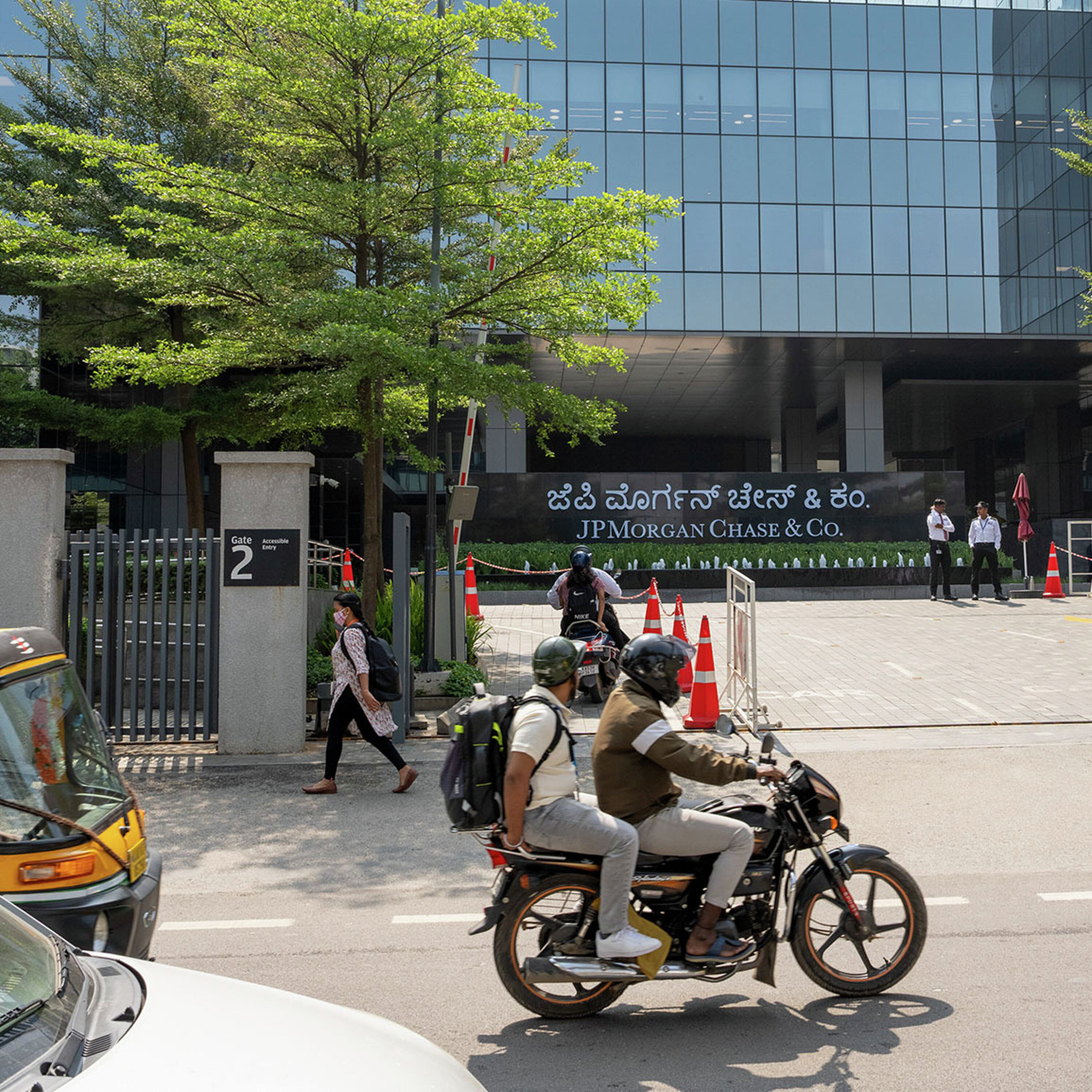
But that has changed dramatically over the last decade. Take Goldman Sachs as an example. In 2004, its office in the southern city of Bangalore had 300 employees, most of whom focused on tech and IT support. Today that same office is home to more than 8,000 employees. Those workers do everything from core financial analysis to risk management. The kind of jobs that used to be done in US cities.
- [04:27]
Sadi Nayak
Perception that Indian GCCs are providing call center jobs is kind of changing. GCCs that are now offshore centers established by these multinational corporations or financial services firms now deliver high quality, cost effective services and support their global operations. Call center jobs are now being outsourced to other emerging economies like Philippines. Property prices also are cheap because the value of rupee is depreciating vis a vis the dollar.
- [04:58]
David Gura
So it sounds like there is quite a boom here.
- [05:01]
Bloomberg Finance Reporter
How far along are we financial services firms? Banks have a significant employee base in India. The top six US banks in India, I.e. jP Morgan, bank of America, Goldman Sachs, Citi, etc. Employ about 150,000 people in India. We know that Goldman Sachs and Morgan Stanley have more staff in India than anywhere outside the us. What we understand from sources is that.
- [05:27]
Sadi Nayak
One European bank concluded that a catastrophe.
- [05:31]
Bloomberg Finance Reporter
In India, such as an earthquake would.
- [05:34]
Sadi Nayak
Disrupt its activities more than a similar.
- [05:36]
Bloomberg Finance Reporter
Disaster at its headquarters.
- [05:39]
David Gura
Is this going to be a bigger magnet do you think? In the years ahead?
- [05:42]
Sadi Nayak
It is going to be a bigger.
- [05:43]
Bloomberg Finance Reporter
Magnet because most of these colleges as.
- [05:48]
Sadi Nayak
Well as tech centers are churning out low cost talent on a large scale. There will be more opportunities for formal and informal workers. This is because there is no dearth of talent from the tech side in India. There's always a lot of graduates every year that get pulled up into these roles, which is why we can see the boom expecting to continue. And most of these firms trying to leverage on the talent that is built in India.
- [06:21]
David Gura
According to estimates from the national association of Software and Service Companies and consulting firm zinov, employment at GCCS in India is projected to jump 50% to as many as 2.8 million people by 2030. Sadi says employees at these GCCS are breaking ground too. A source told Bloomberg that BlackRock's Aladdin Portfolio Management platform was developed in India, as was Goldman's Atlas trading system. Then there's Zelle, the popular payment app. It was developed by Arizona based Early Warning Services. But Sadiq's sources told her that India played a crucial role behind the scenes.
- [06:59]
Bloomberg Finance Reporter
We have information from our sources that the technology behind running this Zelle app was entirely built out of India through Bank of America, Goldman Sachs gccs in Bangalore and Hyderabad. This was kind of inspired by the fintech revolution in India. We have a UPI Unified Payment Interface system in India where there is a bank to bank transfer of payment systems using a QR code. So most of these inspirations were kind of instrumental in making or building the Zelle app.
- [07:36]
David Gura
Could you situate this in kind of the broader Indian economy, How important it is, the growth of these GCCs, the importance of Wall Street's interest in putting some of these higher skilled jobs in India.
- [07:47]
Bloomberg Finance Reporter
So GCCs are a vital component of.
- [07:51]
Sadi Nayak
The Wall street firm's global strategies as well as for India's economic growth. They are fostering job creation, skill development and foreign investment in India that is in turn getting fed into India's GDP growth. Their revenue is expected to surge to $105 billion from about $40.4 billion in FY19, according to NAS Zinov estimates. So this is the kind of impact that we are talking about. Their growth in India is not just important for fueling economic growth, job creation, but also to get a lot of foreign inflow in terms of foreign direct investments in India.
- [08:37]
David Gura
This year, US immigration policy threw a wrench in India's workforce overseas, but it also became a boon for their domestic GCCs. How? That's after the break.
- [08:54]
Michael McDermott
How do you shift AI from being a flashy feature to a trusted partner in consumers everyday lives on the ground at CES Bloomberg Media Studios? Asked Michael McDermott, EVP of Samsung.
- [09:03]
Samsung Executive
Our 2026 vision is built around an AI companion. It understands you and responds intuitively. This intelligence works quietly in the background across TVs, home appliances and mobile devices. By putting AI at the center of everything we do, we're simply improving everyday life for everyone everywhere.
- [09:31]
David Gura
In late September, President Trump announced a change to US immigration policy with a big price tag, a $100,000 fee for an H1B visa application.
- [09:41]
Sean Leinart
The country would rather not have to pay $100,000, but they'd rather. How do you do that? You hire Americans. So there's an incentive to hire Americans.
- [09:51]
David Gura
The H1B is a non immigrant visa, which allows US employers to temporarily hire foreign workers in highly skilled rolesengineering, technology, medicine. When Trump made the announcement, the US Financial sector found itself relatively unprepared, says Bloomberg City Nayak.
- [10:08]
Bloomberg Finance Reporter
So Indians make up roughly 70% of H1B holders. When Trump first announced the $100,000 visa fee, it was seen as a big blow for Indians.
- [10:19]
Sadi Nayak
We had JP Morgan CEO Jamie Dimon say that the announcement caught everybody off guard. Apart from that, we had HSBC stating that the new 100,000 H1B dollar fee in the US was manageable due to their relatively low number of foreign workers compared to other firms.
- [10:40]
David Gura
JPMorgan AIPAC CEO and head of banking Sean Leinart joined Bloomberg TV's Menika Doshi shortly after Trump's announcement and expanded on the company's disappointment at how this would impact India's younger workforce.
- [10:52]
Bloomberg Finance Reporter
So will JP Morgan be moving more jobs to your GCC here?
- [10:56]
Sean Leinart
Yeah, well, that's a very good question. And if it was, it would be a shame because it obviously has been a great source of opportunity for Indian students. You know, India produces 2.8 million STEM students every year and they've gone all over the world, including.
- [11:11]
David Gura
In a statement to Bloomberg, a White House spokeswoman said changes to the H1B visa program were necessary to put America first. She said the bank's efforts to move jobs overseas is, quote, evidence that they were using foreign workers to undercut Americans wages. Though it is a change, it's not like the rug had gotten pulled out from under India's financial industry. Sadi says the Indian economy was expanding and the upper class was growing.
- [11:37]
Sadi Nayak
India is in the middle of a wealth boom. The boom had already started post Covid and Trump's announcement of the visa fee. Kind of gotten in for these firms like an incentive to hire more talent inward. Banks that might consider transferring a worker to the US May now be open to hire them in India itself.
- [12:01]
David Gura
An H1B visa used to cost on average around $5,000. JP Morgan is among the top 10 companies in the US that sponsors the most H1B visas. Sadi says the new visa fee has sparked some chatter among the banks.
- [12:15]
Sadi Nayak
Some of the Wall street banks in India were looking to talk to their counterparts in the US to talk to them about opening more roles in India, specialist roles in India, to kind of not be impacted by the higher H1B dollar fee.
- [12:34]
David Gura
Then there's the math involved in hiring people in India versus in a US city.
- [12:39]
Sadi Nayak
Firms know that the salary of an Indian tech engineer is much less than what it is in the US for an entry level role at a US Bank's gcc, an engineering graduate in India could earn anything between, say, 300,000 rupees to 800,000 rupees a year, depending on the location.
- [13:03]
David Gura
That's between four and $10,000 per employee.
- [13:07]
Sadi Nayak
That compares with a $60,000 annual fee for an Indian on a US visa and up to $120,000 for a US citizen in the same role.
- [13:17]
David Gura
Sadiq says these calculations are driving banks to think differently about the way they balance staffing in their offices in the US and in India.
- [13:26]
Sadi Nayak
This has actually accelerated the pivot to India. Wall street banks were hiring anyway. This fee is just a push, potentially bringing more jobs to India. So recruitment firms have told us that with the new fee, workers have started to question if a U.S. job is a priority for most of the employees.
- [13:47]
Bloomberg Finance Reporter
As well as the employers.
- [13:48]
Sadi Nayak
Firms have also realized that this is not going to be cost effective. And India, which was already seeing a GCC boom, would now benefit from this.
- [14:00]
David Gura
Trump said the higher H1B visa application fee is to address, quote, abuse of the program and to compel US Companies to hire Americans. But Sadi's reporting shows it could backfire and hurt the US Instead.
- [14:14]
Bloomberg Finance Reporter
Senior executives from at least two US banks in India are in talks to consider ways to ramp up their global capability centers in India. This is in response to the H1B visa crackdown. According to sources, some global lenders that had extended offer letters for positions in the US are also looking to either revoke them or create alternative roles at these GCCs.
- [14:39]
David Gura
That's bad news for the US job market potentially, but it could be great.
- [14:43]
Sadi Nayak
News for India if these jobs are coming to India. It is a boon for the job market. A tech engineer or a tech specialist who has just graduated has more options on the table. He has the option of getting into a startup, a gcc, a fintech firms. The role is being elevated in the sense that he has to do more jobs that involve research, legal, development, specializing, getting into certain spaces that only high skilled talent can tap into. That is the kind of opportunity boom in GCC has provided the tech talent. At the same time, if these firms are getting huge real estate spaces in India. They do require informal jobs as well, and that's kind of being a boon for the entire Indian job market.
- [15:45]
David Gura
Sadi says the government has seen an opportunity and is working on a set of policies to incentivize the financial sector designed to help the GCC ecosystem thrive.
- [15:55]
Bloomberg Finance Reporter
India announces its Federal Budget on the 1st of February every year. This is kind of a broad layout that the government has on revenues, taxations, incentives, etc. From our sources we have found out that there is a GCC policy framework that's going to be in the making so that more US Firms or more foreign firms are encouraged and incentivized to build more GCC hubs here. These banks employ a huge workforce in India. Foreign firms bring in a lot of capital for the long term. These are strategic investments made for a 15 to 20 year horizon, which is why the government wants to incentivize these firms to build more, more operations in India, set up more offices, employ more workers and kind of steer the job market.
- [17:00]
David Gura
Sadi says it'll be a while before we see how this pans out in India and in the US as banks recalibrate their global hiring strategies. One thing banks are watching and something that's holding them back from expanding too aggressively is how Trump could retaliate.
- [17:16]
Bloomberg Finance Reporter
So US Firms are walking a fine line as they look to shift more of these roles to India.
- [17:22]
Sadi Nayak
There is a risk that there could be a backlash from Trump and Trump.
- [17:27]
Bloomberg Finance Reporter
Could now target gccs next. It could bring gccs in Trump's crosshairs. When we spoke to our sources, we found that these banks were considering Trump's imposition of tariffs or sanctions on GCCs as a major risk to their operations. They said that most of these banks and their US Headquarters were talking to Trump about the issues and the fact that they were hiring a lot of people in India. So any impact of the government's orders would directly be felt on these banks operations as well.
- [18:08]
Sadi Nayak
But that is a story for another day.
- [18:18]
David Gura
This is the Big Take Asia from Bloomberg News. I'm David Gura. To get more from the Big Take and unlimited access to all of bloomberg.com, subscribe today@bloomberg.com podcastoffer if you like the episode, make sure to subscribe and review the Big Take Asia. Wherever you listen to podcasts, it helps people find the show. Thanks for listening. See you next time.
- [18:37]
Sadi Nayak
It.