Loading summary
Transcript54 lines
- [00:02]
Commercial Narrator
With LPL Financial, we provide the services to help push you forward when it comes to your finances, your business, your future. The only question should be what if you could Paid Advertisement Anna Kendrick is
- [00:11]
Bloomberg Reporter
not a client of LPL Financial LLC and receives compensation to promote lpl. Investing involves risk, including potential loss and principal. LPL Financial LLC Member Finras IPC when
- [00:17]
Corporate Advertiser
you're running a business, the best days are the ones where priorities stay on track. For midsize and large companies, that isn't always easy. Risk can touch multiple parts of an organization at the same time, often in ways that aren't immediately obvious. It might involve property liability or cyber. It could stem from regulatory requirements or challenges tied to a specific industry or the scale of an operation. At that level, managing risk becomes an ongoing discipline, not a one time decision. the Hartford, the focus is on helping businesses manage risk before it turns into something more disruptive. That means working with companies to identify where they're exposed, decide what matters most and put practical standards in place so risk is managed as part of day to day operations. And when losses do happen, the Hartford can pair that risk control work with insurance coverage grounded in underwriting, risk engineering and claims experience developed over time. Learn more@thehartford.com RiskMitigation Small businesses are the
- [01:17]
Commercial Narrator
pulse of every community. They bring people together, create opportunities and drive growth. Chase for Business helps business owners like you with personalized guidance and convenient digital tools all in one place. With that guidance and your determination, you can take your business farther and help build a brighter future for your community. Learn more@chase.com business chase for business make more of what's yours the Chase Mobile app is available for select mobile devices. Message and data rates may apply. JP Morgan Chase Bank Naomi Member FDIC Copyright 2026 JP Morgan Chase Co.
- [01:55]
Bloomberg Reporter
Bloomberg Audio Studios Podcasts Radio news.
- [02:06]
Rosalind Mattison
It's 4am and dozens of kitchen staff are cooking up a storm in a coastal village in southern Indonesia.
- [02:13]
Bloomberg Reporter
There's some doing the cooking, chopping up vegetables. Some are doing the packing.
- [02:17]
Rosalind Mattison
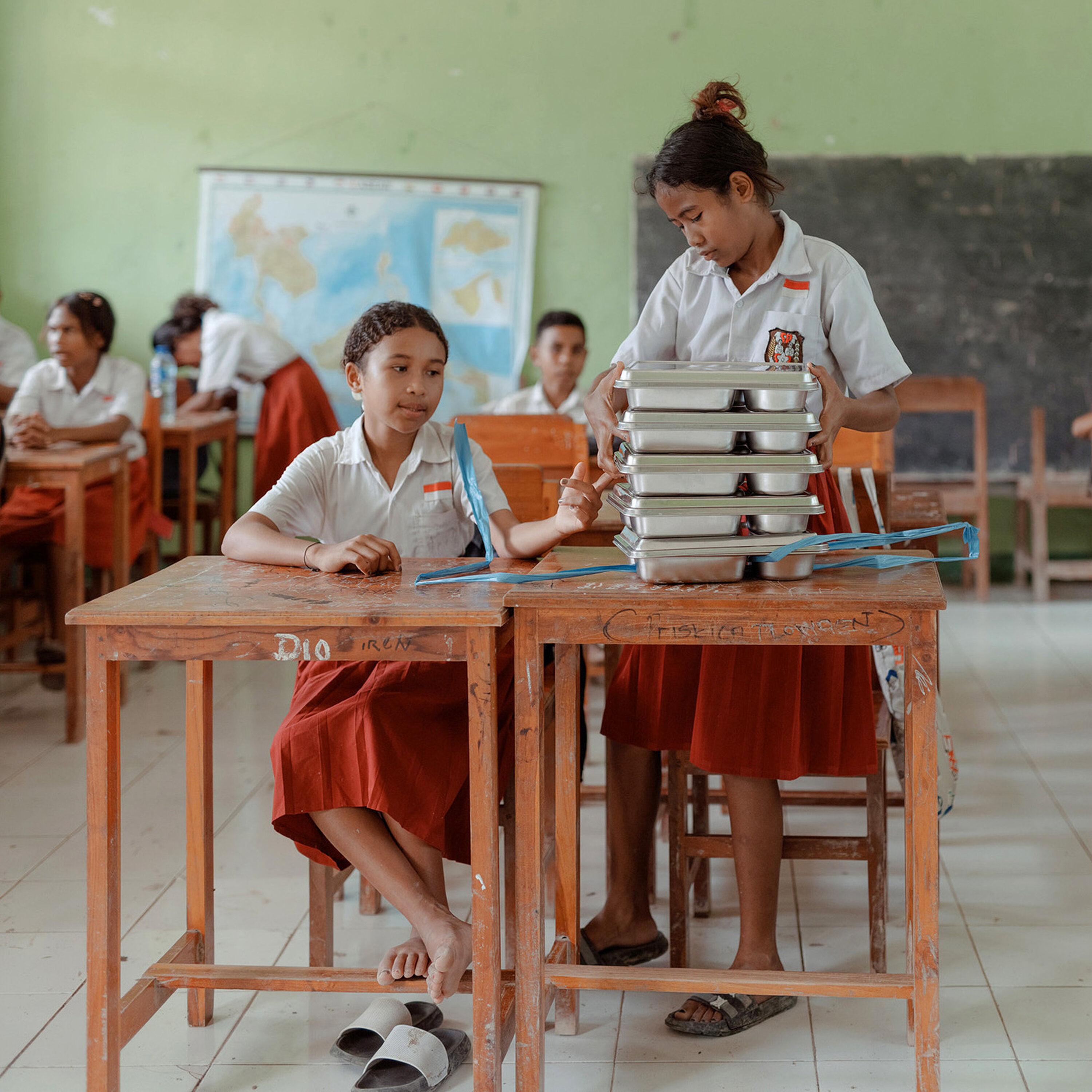
Rosalind Mattison is Bloomberg's chief Asia correspondent, based in Singapore. She and Bloomberg reporter Echo Lista Yarini visited the remote village kitchen in West Timor in March. There, workers prepare thousands of packed lunches that are delivered to school children, pregnant women and new mothers almost every day.
- [02:36]
Bloomberg Reporter
They're pretty functional, I would say. I mean, it's a reusable metal tray that's separated into compartments. You'll often get a portion of rice, sometimes egg, chicken or tempeh, a small portion of soup vegetables. Usually there's one piece of fruit. We saw watermelon, dragon fruit.
- [02:55]
Rosalind Mattison
The lunches are part of a vast state funded program in Indonesia where free meals are delivered to more than 60 million people.
- [03:03]
Bloomberg Reporter
It's a massive undertaking. Indonesia is the world's largest collection of islands and so you're talking about distributing free meals across thousands of islands, many of them far away from big cities like Jakarta.
- [03:19]
Rosalind Mattison
Providing free nutritious meals for children under 18 and pregnant women was a big part of Indonesian President Prabowo Subianto's election campaign. He launched the program in January 2025. And this past year he's been ramping up the program at a startling pace and cost.
- [03:38]
Bloomberg Reporter
It's now about $15 billion of allocation from the budget this year. And when you think overall national budget, that's a bit over 6% and on a par with things like the national health care budget.
- [03:53]
Rosalind Mattison
Foreign investors have expressed concern about the program's ballooning price tag, especially at a time when Indonesia's economy is already under immense pressure from a top Indonesian official about commodity export control plans that have
- [04:08]
Corporate Advertiser
rattled markets where this open of Indonesia and stocks are just getting absolutely tossed out the window.
- [04:15]
Rosalind Mattison
Despite investor concerns, Prabowo has doubled down on the program, saying it'll help create jobs, boost consumption and economic growth. But Rosslyn says there's little evidence to show that the program so far is anywhere near the economic game changer that Prabowo promised it would be.
- [04:32]
Bloomberg Reporter
Parents that we spoke to weren't really saving any money out of this program. They said their kids often came home still hungry. Investors are saying is this really going to be a massive multiplier for the economy? And they have doubts about that.
- [04:51]
Rosalind Mattison
This is the big take Asia. From Bloomberg News, I'm Rebecca Chung Wilkins filling in for wanha. Every week we take you inside some of the world's biggest and most powerful economies and the markets, tycoons and businesses that drive this ever shifting region. Today on the show, Indonesia's free lunch program, what it takes to feed tens of millions of people every day and how safety problems and ballooning costs are worrying investors and could threaten the future of the scheme. Roz, you visited some of the schools and community centres in Indonesia where these free meals were delivered. How did the kids like their packed lunches?
- [05:39]
Bloomberg Reporter
I think every child on the planet doesn't like green beans because they were all pushing those around on their plate every time. Sometimes they were swapping bits of the meals with each other that they didn't like or the ones they wanted. But I would also say, particularly in the rural area, there was a sense from these kids that they kind of appreciated the gesture.
- [05:58]
Rosalind Mattison
When Indonesian President Prabowo began laying the groundwork for his Free meals initiative, it was aimed at addressing a growing public health Crisis. As of 2024, nearly one in five Indonesian children were affected by stunting a condition linked to long term malnutrition. Prabowo has made fighting this condition personal.
- [06:21]
Bloomberg Reporter
He's very much attached his personal brand to this. And he was motivated by the desire, he says, to take better care of the people of Indonesia and to lift them up in a way to give them opportunities through better nutrition. And you can see how important it is to, to him. He's enlisting the military to help roll out this program. He's a former military general, as we know. He's a bit of a state interventionist at heart, a bit of a socialist when it comes to economic policy. So he sees a very strong role for the state in economic policy in Indonesia. And that has kind of cascaded through all his policies so far. Just last week, Prabowo announced that the government's going to take direct control of exports of some commodities through a new state export body. This is part, of course, of Prabowo's push for the state to play a larger part in the economy. He's argued that more of the profits from natural resources should stay home and be channeled into social programs and infrastructure. And of course, that includes his very, very big free meals program.
- [07:34]
Rosalind Mattison
Prabowo says the program is supposed to do much more than just improve nutrition. He says that it could transform the economy too.
- [07:42]
Bloomberg Reporter
So it is that idea again of leveraging off this program to not just improve child nutrition, which is very important, and their retention rates at school. So more kids turning up to school, but also staying at school. But it is that multiplier effect on the economy that he talks about.
- [08:00]
Rosalind Mattison
Prabowo talked about that multiplier effect at the World Economic Forum earlier this year.
- [08:06]
Corporate Advertiser
Our free meals strengthens our economy. More than 61,000 micro small and medium enterprises and cooperatives are now a part of this supply chain.
- [08:23]
Bloomberg Reporter
We are creating
- [08:27]
Corporate Advertiser
more than 600,000 jobs just at the kitchens.
- [08:32]
Bloomberg Reporter
So create an ecosystem of jobs locally. Wherever these central kitchens are located also potentially help consumption so that if parents aren't spending so much money feeding their kids, they have perhaps a bit more money to invest elsewhere in the economy. And essentially can it just be a contributor to GDP and to rising prosperity in Indonesia? So he's banking on this program to do an awful lot.
- [09:01]
Rosalind Mattison
For now at least, Indonesians seem to be on board. Opinion polls suggest the program has been fairly popular and the government has moved quickly to scale it up. Now there are more than 25,000 kitchens operating nationwide, each serving up to 3,000 meals a day. But as Ros found, the reality of delivering food at that scale and, and across an archipelago of more than 17,000 islands can be messy.
- [09:27]
Bloomberg Reporter
In the rural area, it's rough going. You know, the roads are often washed away, they're prone to flooding, they're potholed already, so the trucks have to navigate these roads to make each stop and they've got to try and make each stop on time. And they say every day they're feeling pressured to make sure that they do their deliveries on time. Another logistical challenge that they face, particularly in the rural area, is that there aren't big farmer markets open. They have to drive a couple of hours to another, bigger town to source produce. So that's another logistical challenge because it's sort of four hour round trip to get there and back.
- [10:06]
Rosalind Mattison
Then there's the question of food safety. Across the country, at least 15,000 children have fallen ill due to food poisoning linked to the program.
- [10:15]
Bloomberg Reporter
There were particularly early on, quite widespread and documented cases of food poisoning. There were some reports even of shards of glass in some meals. There are still those occurring, but they do seem to be tapering off. When we spoke to the head of the National Nutrition Agency, he was telling us very clearly they are penalising kitchens for infringement, so they might stop their payments for a couple of weeks. In extreme cases, they will close those kitchens entirely.
- [10:45]
Rosalind Mattison
Critics of the programme point to food safety issues like these and they're beginning to ask whether the program can actually deliver the kind of economic payoff promised by the government. Ros put that question to the head of Celios, a Jakarta based think tank.
- [11:01]
Bloomberg Reporter
The head of the think tank asked him how he would grade it. He said, well, I give it an F for now. And they've been critical in a bunch of ways about this program, including again, that idea of an economic multiplier and they don't see it. In fact, one thing they said is that anecdotally, that they have found evidence of an inflationary impact of this program at a localised level. So parts of Indonesia where there have been people saying, well, we're seeing increases in chicken prices and egg prices because the kitchens are hoovering up all these things.
- [11:38]
Rosalind Mattison
After the break, we look at the cost of running such an ambitious program. And why Prabowo's enthusiasm for this kind of social experiment is making investors nervous.
- [11:53]
Bloomberg Reporter
The thing about AI for business? It may not automatically fit the way your business works. At IBM, we've seen this firsthand. But by embedding AI across hr, IT and procurement processes, we've reduced costs by millions, slashed repetitive tasks, and freed thousands of hours for strategic work. Now we're helping companies get smarter by putting AI where it actually pays off, deep in the work that moves the business. Let's create smarter business.
- [12:22]
Corporate Advertiser
IBM Support for the show comes from Public. Public is an investing platform that offers access to stocks, options, bonds, and crypto, and they've also integrated AI with tools that can assist investors in building customized portfolios. One of these tools is called Generated Assets. It allows you to turn your ideas into investable indexes. So let's say you're interested in something specific, like biotech companies with high R and D spend small cap stocks with improving operating margins, or the S&P 500 minus high debt companies. Chances are there isn't an ETF that fits your exact criteria. But on Public, you just type in a prompt and their AI screens thousands of stocks and builds a one of a kind index. You can even backtest it against the S&P 500. Then you can invest in a few clicks, go to public.com market and earn an uncapped 1% bonus when you transfer your portfolio. That's public.com market ad paid for by Public Holdings Brokerage Services by public investing member FINRA SIPC advisory services by public advisors SEC registered advisor crypto services by ZeroHash sample prompts are for illustrative purposes only, not investment advice. All investing involves risk of loss. See complete disclosures@public.com disclosures find home wherever
- [13:36]
Sonesta Advertiser
you roam at Sinesta ES and simply suites, where longer stays feel comfortable, flexible and easy. Stretch out and enjoy spacious accommodations and homelike amenities designed to help you settle in and stay productive or relaxed for however long you need. And when you're a Sonesta TravelPass member, staying at Sonesta Es and simply Suites means earning points toward free nights, upgrades and more with every eligible stay. Go to Sonesta.com to book your stay and unlock the best rates with Sonesta Travel Pass Here today, roam tomorrow. Join now@sinesta.com Terms and conditions apply.
- [14:18]
Rosalind Mattison
Indonesia's free meals program is expected to feed nearly 83 million people, or around a third of the population, by the end of this year. To do that, the government has set aside $15 billion five times the amount it spent last year. That's according to the National Nutrition Agency. But Bloomberg's Rosalind Mattison says investors are worried about that growing price tag.
- [14:42]
Bloomberg Reporter
It is a large amount of the budget. They have looked to trim a bit of it. And the government is looking at cost cutting measures as a whole to try and save about $7.1 billion. That's again, as they're under pressure from rising energy prices and the impact of the war in, in the Middle East. And that's putting a lot of questions over the legal budget deficit cat, which has been set at 3% for a long time. And that's been a cornerstone for investors for many years. And they're looking at that closely and saying, are you going to breach that budget cap? And will the free meals program be a factor in you doing that?
- [15:21]
Rosalind Mattison
For more than two decades, Indonesia has lived with a strict fiscal rule. Since 2003, the government has been legally required to keep its budget deficit below 3% of GDP, a safeguard put in place after the Asian financial crisis. But in March, a government official suggested temporarily easing that limit to cope with higher oil prices for markets. Roz says that was a red flag.
- [15:46]
Bloomberg Reporter
Both Moody's and Fitch cited it that 3% figure as a factor when they lowered their rating outlooks on Indonesia this year. So the rating houses are watching that 3% figure very closely and saying the spending, a lot of this is coming from these big ticket programs, including free meals. It's coming at a time when investors are also nervous about the broader investability in Indonesia. Subianto last week announced the government would take control or direct control of exports of some of Indonesia's most important commodities. Indonesia is obviously a massive exporter of commodities, and particularly this is going to hit palm oil, coal and ferro alloys, which could include some nickel products. And it's a lot of money. More than a fifth of the country's export revenue last year came from commodities. So it's a very big player globally. And this is making investors worried because they're saying, hang on, no one knew this policy was coming. Everybody was taken by surprise. And does this mean that Indonesia is drifting further away from that mantra being market friendly? And also, what does it mean if you have greater state control over the economy, does that leave it open to greater political influence over state companies, for example?
- [17:12]
Rosalind Mattison
Even the bond market, usually the calmest part of Indonesia's markets, has started to show signs of strain. Government borrowing costs have been creeping higher. Prabowo has told Bloomberg that fiscal discipline remains a priority. And he's committed to keeping the budget in check. Some critics say the government needs to redesign the program to scale it back and learn how similar schemes have worked elsewhere.
- [17:39]
Bloomberg Reporter
Some of the people that we spoke to, they want it to be much more targeted. They say this idea that it has to go across everywhere in Indonesia, the one approach everywhere, no matter the demographics of that area, the socioeconomic status of that area, but put it in places of demonstrated need, have it regionalised and have much more collaboration with local administrations than there is occurring now. So they want it to be much more focused than it is. So the US and uk, for example, they kind of target kids who are specifically below the poverty line. So it's not a blanket thing. But for families who qualify, India has a very big program. It's much more decentralised, so it's a combination of federal and state government funding and states are responsible for the implementation. The states have to submit detailed plans on the number of schools, number of children, sort of transport costs and so on. And they work a lot with NGOs, and there is research that shows an improvement in literacy and health outcomes from that program.
- [18:45]
Rosalind Mattison
Ros says perhaps the biggest issue for critics of the program is the fact that it's being pitched as a cure all for a raft of Indonesia's equal economic ailments.
- [18:54]
Bloomberg Reporter
The government, or Prabowo and his administration expect this program to achieve so much on a macro level. You know, create jobs, consumption, help parents save, boost gdp, you name it, plus nutrition and school outcomes. If you look at free meal programs in other countries, they don't necessarily have such a vast set of goals around them. In a way, some countries they're simply focused on let's get a free meal each day to kids in need, let's hopefully improve their nutrition. And hopefully that means they come to school more and they stay at school more. They're not necessarily tied to a whole economic multiplier effect as they are in this case.
- [19:37]
Rosalind Mattison
Criticism of the program has come from all quarters and some people think it should be scrapped altogether. But Prabowo isn't backing down. Here's how he defended the free meals program in his New Year's speech in January.
- [19:53]
Corporate Advertiser
Are there shortcomings? Yes, in an undertaking of this scale, shortcomings are inevitable. Are there deviations? Yes, in an undertaking of this scale, there definitely will be shortcomings and deviations. But objectively, statistically, we can say that the program has succeeded by 99.99%.
- [20:18]
Rosalind Mattison
So, Ros, it's pretty clear that the program isn't going away, but it is already seeing some cutbacks. Because of pressures from rising oil prices, the government recently decided to cut back on meal offerings in some places from six days a week to five. What other changes do you think he might make to the program? Might he roll it back even further?
- [20:40]
Bloomberg Reporter
If anything, some investors are saying they see the chance that he accelerates next year because that's sort of the point where you start to think about your re election prospect. If you're going to you run a lengthy election campaign and if he is going to run for re election in 2029 then next year you start to see the signs of that. So very unlikely that he scales back. At least significantly there may be further changes to the program. You know, again, so not six days a week, but five days a week, which is already something they're doing. Perhaps they limit the number of kitchens, perhaps they do trim the budget for it even further. But there's no sense at all that he's going to make a wholesale departure from this program. He's put too much of his political capital into it to do so.
- [21:33]
Rosalind Mattison
This is the Big Take Asia from Bloomberg News, I'm Rebecca Cheung Wilkins. To get more from the Big Take and unlimited access to all of bloomberg.com, subscribe today@bloomberg.com podcast to offer. If you like the episode, make sure to subscribe and review the Beat takeasia. Wherever you listen to podcasts, it helps people find the show. Thanks for listening. See you next time.
- [22:08]
Commercial Narrator
If you follow markets, you know the value of long term thinking. You plan, you diversify, you prepare for volatility. But even the best strategies can't prevent every bad day. For more than 75 years, Cincinnati Insurance has helped individuals and businesses navigate tough moments. With expertise, personal attention and independent agents who focus on relationships, not transactions, the Cincinnati insurance companies let them make your bad day better. Find an agent@cin fin.com travel smarter, not
- [22:45]
Sonesta Advertiser
harder at America's Best Value Inn by Sonesta with convenient locations from coast to coast and value packed comfort at every turn, it's a practical choice for road trips, quick getaways and everyday travel that keeps things simple without sacrificing comfort. And when you're a Sonesta Travel Pass member, staying at America's Best Value Inn means earning points toward free nights, upgrades and more every time you stay. Go to Sonesta.com to book your stay and unlock the best rates with Sonesta Travel Pass here today, Rome tomorrow. Join now@sinesta.com Terms and conditions apply.
- [23:17]
Corporate Advertiser
This coffee shop running? Smooth, thanks to genius from Global Payments. Instant transactions, Effortless inventory and synchronized operations. Big league reliability for any business. That's genius.