Loading summary
Transcript45 lines
- [00:00]
Microsoft/IBM Business Representative
Okay, before we get into it, little side note for the IT leaders listening in. I was reading up on a Microsoft Commission survey the other day and learned that teams using Windows 11 Pro PCs report 62% fewer security incidents compared to Windows 10 PCs, including three times fewer firmware attacks. Pretty significant. With security built in, you'll have AI ready it that sets you up for operational efficiency as well as long term resilience. Upgrade to Windows 11 Pro@Windows means business.com
- [00:34]
Podcast Host/Advertiser
if you follow markets, you know the value of long term thinking. You plan, you diversify, you prepare for volatility. But even the best strategies can't prevent every bad day. For more than 75 years, Cincinnati Insurance has helped individuals and businesses navigate tough moments with expertise, personal attention and and independent agents who focus on relationships, not transactions. The Cincinnati Insurance companies let them make your bad day better. Find an agent@c infin.com the thing about AI for business?
- [01:11]
Microsoft/IBM Business Representative
It may not automatically fit the way your business works. At IBM we've seen this firsthand. But by embedding AI across hr, IT and procurement processes, we've reduced costs by millions, slashed repetitive tasks, and freed thousands of hours for strategic work. Now we're helping companies get smarter by putting AI where it actually pays off, deep in the work that moves the business. Let's create smarter business IBM,
- [01:42]
Podcast Host/Advertiser
Bloomberg Audio Studios Podcasts Radio News
- [01:50]
Sarah Holder (Bloomberg News Host)
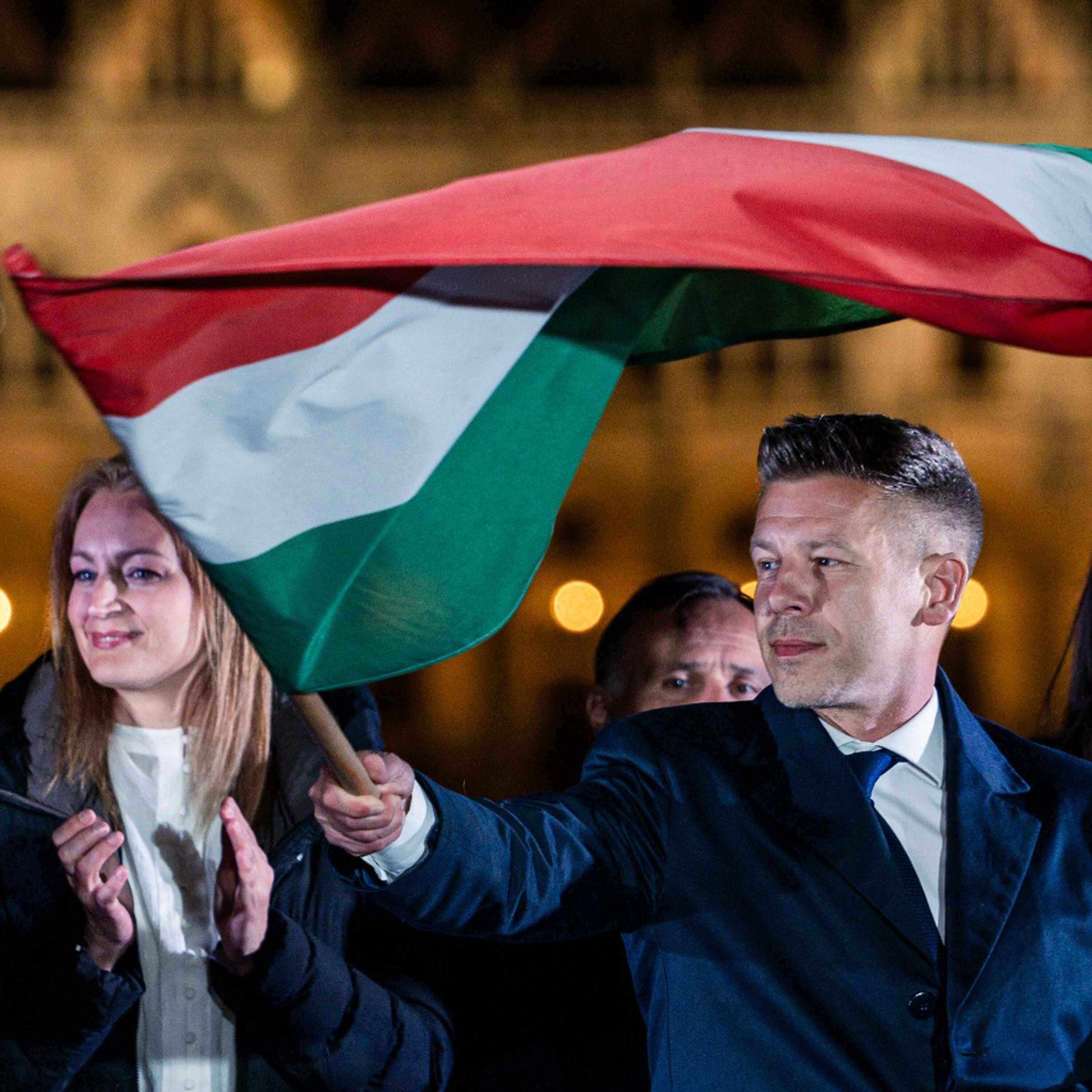
On Sunday, a new Hungarian opposition party won the country's election by a landslide, ending Prime Minister Viktor Orban's 16 years in power.
- [02:02]
Andrash Gerge (Emerging Markets Editor, Bloomberg)
We won. Not small, but big. Very, very big.
- [02:07]
Microsoft/IBM Business Representative
Together we changed the Orban regime.
- [02:10]
David Pressman (Former U.S. Ambassador to Hungary)
Together we liberated Hungary.
- [02:13]
Sarah Holder (Bloomberg News Host)
Peter Magyar, the leader of the opposition Tisa party, was once a member of Orban's party before breaking ranks in 2024. Magyar has promised to usher in a new era for the country, rooting out corruption in its government, turning around its struggling economy and bringing it closer to its European neighbors. Orban was a close ally of Russia's Vladimir Putin and a hero of the American right. Since taking office for the second time in 2010, he transformed Hungary into a so called illiberal democracy.
- [02:46]
Andrash Gerge (Emerging Markets Editor, Bloomberg)
The term illiberal democracy denotes the fact that we've still had elections, which international observers characterized as free but unfair. So the government wielded a great advantage in the way it controlled information machinery, a propaganda system, and amazing spending power which the opposition couldn't really match.
- [03:12]
Sarah Holder (Bloomberg News Host)
Orban also had some high profile international support, including from U.S. vice President J.D. vance, who appeared in Budapest with Orban last week.
- [03:22]
Microsoft/IBM Business Representative
Part of the reason why the President, United States sent me here is because that we think the amount of interference that's come from the bureaucracy in Brussels has been truly disgraceful.
- [03:32]
Andrash Gerge (Emerging Markets Editor, Bloomberg)
Orban's campaigns have tended to focus on the creation of a perceived enemy, usually around foreign policy connected to Ukraine or international financial institutions.
- [03:45]
Sarah Holder (Bloomberg News Host)
That's Andrash Gerge. He's an emerging markets editor for Bloomberg based in Budapest.
- [03:50]
Andrash Gerge (Emerging Markets Editor, Bloomberg)
And what Petra Magyar has seized on is that people would really like to be better served when they have to go to hospital for their children, to have better education or less crumbling schools, and to have positive campaign promises to fix those issues instead of creation of a perceived enemy.
- [04:12]
Sarah Holder (Bloomberg News Host)
Andras says at one point, Orban may have seemed invincible. But as the challenger gained traction, markets started to price in a Magyar victory.
- [04:21]
Andrash Gerge (Emerging Markets Editor, Bloomberg)
First and foremost, the Hungarian foreign the local currency. It's been strengthening for a number of reasons. But what but the prospect of a change in government has been among them. And now that the opposition won by a landslide, that just accelerated overnight. So it may embolden other political parties in countries that are similarly facing some variety of populist or nationalist governments in Europe or even beyond.
- [04:49]
David Pressman (Former U.S. Ambassador to Hungary)
You heard Hungarians shouting at the top of their lungs last night, Europe, Europe, Europe. Wanting to see Hungary once again firmly embedded in the West.
- [05:00]
Sarah Holder (Bloomberg News Host)
To understand what kind of message Orban's defeat might send the rest of the world, I spoke with David Pressman, a U.S. state Department veteran of three administrations who was the U.S. ambassador to Hungary under President Biden from 2022 to 2025.
- [05:15]
David Pressman (Former U.S. Ambassador to Hungary)
Viktor Orban has built a political empire that's basically about distracting from things that are real with things that are not. And at a certain point, I think people's lived experience, the pain with which they're trying to manage and muster their lives becomes too much to bear. It gives me a lot of hope that Hungarians were able to, despite all odds, render a verdict on Viktor Orban's system of illiberal democracy that has been deeply corrosive both to that country and to our alliances with it.
- [05:54]
Sarah Holder (Bloomberg News Host)
I'm Sarah Holder and this is the big take from Bloomberg News today on the show Hungary. After Orban, my conversation with former U.S. ambassador to Hungary David Pressman on what new leadership in Hungary could mean for Russia and Ukraine, the EU and the US and what obstacles Magyar's party might face as it seeks to unwind Orban's influence. Ambassador Pressman, thank you for joining us. What do you think it was about the Tisa party's platform that resonated with Hungarian voters and what really might change for Hungarians as a result of this election.
- [06:35]
David Pressman (Former U.S. Ambassador to Hungary)
Magyar spoke only about corruption. He wasn't talking about policy differences with the Orban government. He, he wasn't speaking about disagreeing with this aspect of policy or that aspect of policy. He spoke about dismantling a kleptocracy. Even this morning in his press conference, he referred to the Orban government as an organized criminal outfit. So he was running a campaign against, in his words, a criminal organization, as opposed to trying to differentiate himself and his party on particular aspects of social or international policy. Now, his victory presents an enormous challenge to the Tisa party, to him, and to the Hungarian people, because fundamentally what this exercise is going to be about is unwinding 16 years of state capture. So what that means in practice is that you have the judicial institutions that have been completely co opted and captured by a single political party. I'd also note one, one other thing that Magyar said this morning that I thought was pretty interesting is he referenced the foreign journalists in the room at his press conference and he said, you know, I don't think you guys actually understand the North Korea, like, nature of the propaganda that was in this country. And on that I really agree with him because I think one of the things that Americans and others haven't fully internalized is the power that the propaganda apparatus in Viktor Orban's Hungary had in shaping decision making of individual citizens, citizens of individual companies, of elites across the country, whether they were politically engaged or not. And so the project now, I think, for Hungary, for Hungarians and for Peter Magyar, is how do you create a country that is more pluralistic, where there is an exchange of viewpoints, whatever those viewpoints may be conservative or liberal, but that are not enforced by this regimen of fear.
- [08:33]
Sarah Holder (Bloomberg News Host)
I'll kick that question to you, though. What obstacles will Magyar encounter in unwinding this transformation of Hungary under Orban? And how could he go about executing that unwinding and moving Hungary in a new direction?
- [08:49]
David Pressman (Former U.S. Ambassador to Hungary)
Yeah, Sarah, I mean, it's a great question. And I think that the answer to that is it begins with removing from positions of power those who were placed in positions of power because of their loyalty to Viktor Orban. And in fact, you heard Peter Magyar call for the resignation of the president of the head of the Constitutional Court, the head of the Curia, the Supreme Court. He's called because he needs to. And so, you know, for instance, there is a sham university called Matthias Corvinus Collegium in Budapest which receives funding from the state oil company and by the way, the state oil, that money is coming from the state oil company's exchanges with the Russian Federation. But nonetheless, you have this entity that is run by Viktor Orban's political director. Now, what happens with that? You know, how do you unwind the state support for what is a effectively a political culture war organization that is funded by Hungary's financial entanglements with Russia? And I think that's going to be a real challenge. And similarly with the universities, you know, the universities. One of the things that Viktor Orban did is he transferred all of the assets of what were otherwise public universities to these private foundations. And then he installed his cronies as the boards of directors of those foundations and gave them a lifetime tenure. And so putting aside the academic freedom issues and all of that, you effectively saw the wholesale transfer of these public assets to the control of a single political party for life. And so what Tisa and what Magyar is now going to need to do is to untangle each of those transactions to regain control of each of those assets. You heard him this morning talk about the need for national Asset Recovery Project. You've heard him repeatedly speak about his intention to join the European Public Prosecutor's Office. I mean, there is an enormous amount of work ahead to find these assets, to recover them and put them in service of the Hungarian people once again.
- [10:56]
Sarah Holder (Bloomberg News Host)
How important is that process you're talking about to achieving some of Tisa's other stated aims, like providing basic services like health care and improving the Hungarian economy?
- [11:07]
David Pressman (Former U.S. Ambassador to Hungary)
They're integral because the reality is Hungary should not be in the economic position it's in. And there's no reason why Hungary's economy can't be flourishing. It's just that there's been such pervasive skimming by a group of kleptocratic elites for so long. And so I think that the financial transparency and accounting and accountability that is going to necessarily come is fundamental to his ability to deliver on improvements to the Hungarian people's lives. It's also, by the way, really important to your other. The other questions that you're suggesting with respect to Hungary's relationship with its allies and with international institutions.
- [11:53]
Sarah Holder (Bloomberg News Host)
So what does Peter Magyar's win mean for Hungary's relationships with the eu, with Putin? And what does it mean for Trump? That's coming up.
- [12:07]
Microsoft/IBM Business Representative
And pause really quick, wanted to also mention that not Only is Windows 11 Pro designed to help unlock operational efficiency and build long term advantage for your business, it can seriously level up your team's productivity and Since I know you all love stats, guess what I got Microsoft commissioned Stats Compared to Windows 10 PCs, Windows 11 Pro users reported on average 50% faster workflows and collaboration, 42% faster completion of demanding workloads, and on average 61% longer battery life. Windows 11 Pro chip to Cloud security is designed to help employees stay protected and uninterrupted at the office, at home, the coffee shop, wherever they work. Speaking of uninterrupted, you IT managers are going to love this one. The Microsoft Commission survey also reported Windows 11 Pro PCs having a 62% drop in security incidents compared to Windows 10 PCs. Because Windows means business upgrade to Windows 11 Pro@windows means business.com before we had AT and T Business Wireless coverage, our delivery GPS wasn't the most reliable. Once our driver had to do a 14 point turn to get back on route. A 14 point turn. An influencer even livestream the whole thing. Not good for business. Now with AT&T business Wireless routes are updating on the fly and deliveries are on time. And the influencer did get us 53 new followers though. AT&T business Wireless connecting changes everything
- [13:38]
Podcast Host/Advertiser
We've been doing mornings the same way for a long time now. Hit the snooze button, hit the snooze button again, roll out of bed eventually, then race to get out the door like it's some kind of obstacle course. But mornings should start strong. Breakfast is the most important meal of the day after all. And that's where Silk Protein comes in. It's a plant based beverage with 13 grams of complete plant protein and 50% less sugar than dairy milk. So you're not just starting your day, you're starting it better. Blend it into your spoon smoothie, mix it into your coffee, pour it over cereal, or just drink it straight when you're running late but still trying to make good choices. Ah, because however you mix it, those extra 13 grams of complete plant protein are the little bit of extra you need. A little extra readiness, a little extra boost, a little extra oomph. So let's mix up the old routine from here on out. Let's start our morning strong Silk protein feel planty Good.
- [14:45]
Sarah Holder (Bloomberg News Host)
Orban had a strained relationship with the EU and NATO allies in your role as U.S. ambassador to Hungary. You dealt with this firsthand, working to push through Russia sanctions packages. What does Orban's loss mean for these alliances?
- [15:02]
David Pressman (Former U.S. Ambassador to Hungary)
Yeah, I mean it's significant. I spent three years, you know, moving Viktor Orban from no to yes on Russia's sanctions packages, NATO expansion. Who should run NATO, Ukraine, accession to the European Union. And in each of these instances, Hungary's objection, Orban's objection, it wasn't policy, it wasn't substantive, it was dressed up as that. But fundamentally what he was doing was instrumentalizing Hungary's membership in these consensus based organizations, the European Union, the NATO alliance, in order to create pecuniary gain for himself and his party, he would take actions in the NATO alliance that were entirely designed to try to get the European Union to release money that it was withholding from Hungary because of their concerns about rule of law and corruption. Really, regardless of whatever Peter Magyar's policy is, I think whether he takes position X or Y in the EU or in NATO, I think, and I hope we have an opportunity to once again have an ally who is dealing with facts and with sovereign interests, not with personalized interests in maximizing personal power and personal wealth.
- [16:18]
Sarah Holder (Bloomberg News Host)
And one of the key sticking points is that Orban had pushed back at European efforts to support Ukraine in the Russia Ukraine war. Hungary recently blocked a $100 billion 90 billion euro EU loan for Ukraine. And Madur already has said that under his leadership, Hungary won't stand in the way of that loan. Can you say more about how significant this win could be for Ukraine as it faces Russia?
- [16:43]
David Pressman (Former U.S. Ambassador to Hungary)
I think there's across the board both in terms of the European Union's consolidated position on confronting Russian aggression in Ukraine, but also just more generally with respect to how the EU is able to navigate Russia issues and how the alliance is able to navigate Russia issues. Magyar's victory presents a significant advancement and step forward because the reality is that part of what Hungarians I think were rejecting, in rejecting Viktor Orban was his close relationship with Vladimir Putin was his increasingly close relationship with Xi Jinping.
- [17:21]
Sarah Holder (Bloomberg News Host)
Well, it's interesting when you talk about, you know, Orban's relationship with Putin. Bloomberg published a transcript of a conversation between Orban and Putin last year. Orban pledges to help Putin. He references this fairy tale about a little mouse that helps the mighty lion, Orban offering to be the mouse to Putin's lion. I'm wondering just how big of a blow is it to Putin to lose this ally or this little mouse.
- [17:46]
David Pressman (Former U.S. Ambassador to Hungary)
It's a big blow because one thing that Hungary was, one thing that Viktor Orban was, was a reliable vote to advance Putin's policies both in the EU and in NATO. You know, when I was ambassador, one of the things that irritated Orban and Fides party the most was when I would make that point, which is Viktor Orban as advancing Putin's policies. Because, remember, Orban's political career began as the guy who gave the speech Ruski's Kazakh Russians go home. And of this shaggy haired freedom fighter in the days leading up to the fall of communism. But what had happened is that he began to be so close to the Russians that Hungary's policy itself was virtually synonymous with what the Russians were seeking in both the EU and in NATO. And so I think it's going to, you know, to the extent that Putin seeks to divide our alliance, which he does, to the extent that Putin seeks to divide the European Union, which he does, he just lost, lost his ace card.
- [18:54]
Sarah Holder (Bloomberg News Host)
I want to end on the US and what Orban's Hungary has meant to the current US Administration. President of the Heritage Foundation Kevin Roberts said in 2022 that modern Hungary is not just a model for conservative statecraft, but the model Roberts organization, of course, produced. Project 2025. Vice President JD Vance went just last week to Budapest to appear alongside Orban, supported him. So what does Orban's loss mean for conservative movements, the right and the far right in the US and indeed around the world?
- [19:28]
David Pressman (Former U.S. Ambassador to Hungary)
Well, I mean, for starters, it will mean a loss of funding. I mean, one thing that Orban did while his own people and economy was suffering was he sent a lot of financial resources to far right parties across Europe and supported far right intellectuals and activists, including in the United States. So that will be one thing that is felt. But moreover, I think that as this story is unpacked and as people, including conservatives, look more closely at what was actually going on in Hungary and look more closely at Viktor Orban's policies in Hungary, I think what they will see, I hope what they will see is that this is not about conservatism. This is about kleptocracy. And so you can be a very conservative American and believe in very conservative social and even international or domestic policies and still take real concern at the kinds of corrupt acts that Viktor Orban was fostering. I mean, candidly, Secretary of State Marco Rubio just five years ago was one of those people who was voicing extraordinary concern about Orban's hollowing out of democratic institutions, about his proximity to Putin, about the malign influence in Hungary and its role in NATO. And obviously his positions have shifted since he became the Secretary of state. But, you know, I think Hungarians ultimately saw Donald Trump endorse Viktor Orban and they rejected Viktor Orban because they saw Viktor Orban as too close to Putin. And I think that in rejecting and not listening to Donald Trump. They saw Donald Trump and Vladimir Putin both rooting for the same guy. And that guy wasn't serving Hungary or Hungarians. And I hope that the fact that so many brave Hungarians who were really, you know, they were persecuted, they were prosecuted, they were investigated, they were humiliated by the government propaganda on a daily basis, but they stuck to it because they believed in their country, they believed in democratic institutions and democratic values. And their success yesterday should serve as a source of inspiration to so many beyond Hungary, including in the United States.
- [21:49]
Sarah Holder (Bloomberg News Host)
This is the Big Take from Bloomberg News. I'm Sarah Holder. To get more from the Big Take and unlimited access to all of bloomberg.com, subscribe today@bloomberg.com podcastoffer if you like this episode, make sure to subscribe and review the Big Take. Wherever you listen to podcasts, it helps people find the show. Thanks for listening. We'll be back tomorrow.
- [22:22]
Ana Navarro (Podcast Host)
I'm Ana Navarro and on my new podcast, BLEEP with Ana Navarro, I'm talking to the people closest to the biggest issues happening in your community and around the world. Because I know deep down inside right now we are all cursing and asking what the BLEEP is going on. Every week I'm breaking down the biggest issues happening in our communities and around the world. I'm talking to people like Julie K. Brown, who broke the explosive story on Jeffrey Epstein in 2018.
- [22:50]
Podcast Host/Advertiser
The Justice Department through we counted four
- [22:53]
Microsoft/IBM Business Representative
presidential administrations failed these victims.
- [22:57]
Ana Navarro (Podcast Host)
Listen to BLEEP with Anna Navarro on the iHeartRadio app, Apple Podcasts or wherever you get your podcast.
- [23:03]
Podcast Host/Advertiser
Hi, I'm Iris Palmer, host of the Against All Odds podcast. Every week I'm sitting down with exceptional people who have broken barriers even when the odds were stacked against them, like Chef Victor Villa of Villa's Tacos. You know, the taquero from the Bad Bunny halftime show.
- [23:18]
David Pressman (Former U.S. Ambassador to Hungary)
It was great. It was a big moment. It was special. And I felt like I was really representing my family, you know, my brand, my city. I was representing all taqueros, not only of, like, you know, the U.S. but of Mexico and beyond, all the taqueros of the world.
- [23:33]
Podcast Host/Advertiser
Listen to Against all odds on the iHeartRadio app, Apple Podcast, or wherever you get your podcast. Hello, gorgeous. It's Lala Kent, host of Untraditionally Lala. My days of filling up cups at Sur may be over, but I'm still loving life in the valley. Life on the other side of the hill is giving grown up vibes. But over here on my podcast, Untraditionally Lala I'm Scottish. Still, that lala, you either love or love to hate. It's unruly, it's unafraid, it's untraditionally lala. Listen to Untraditionally lala on the iHeartRadio app, Apple Podcasts, or wherever you get your podcasts.