Loading summary
Transcript42 lines
- [00:00]
A
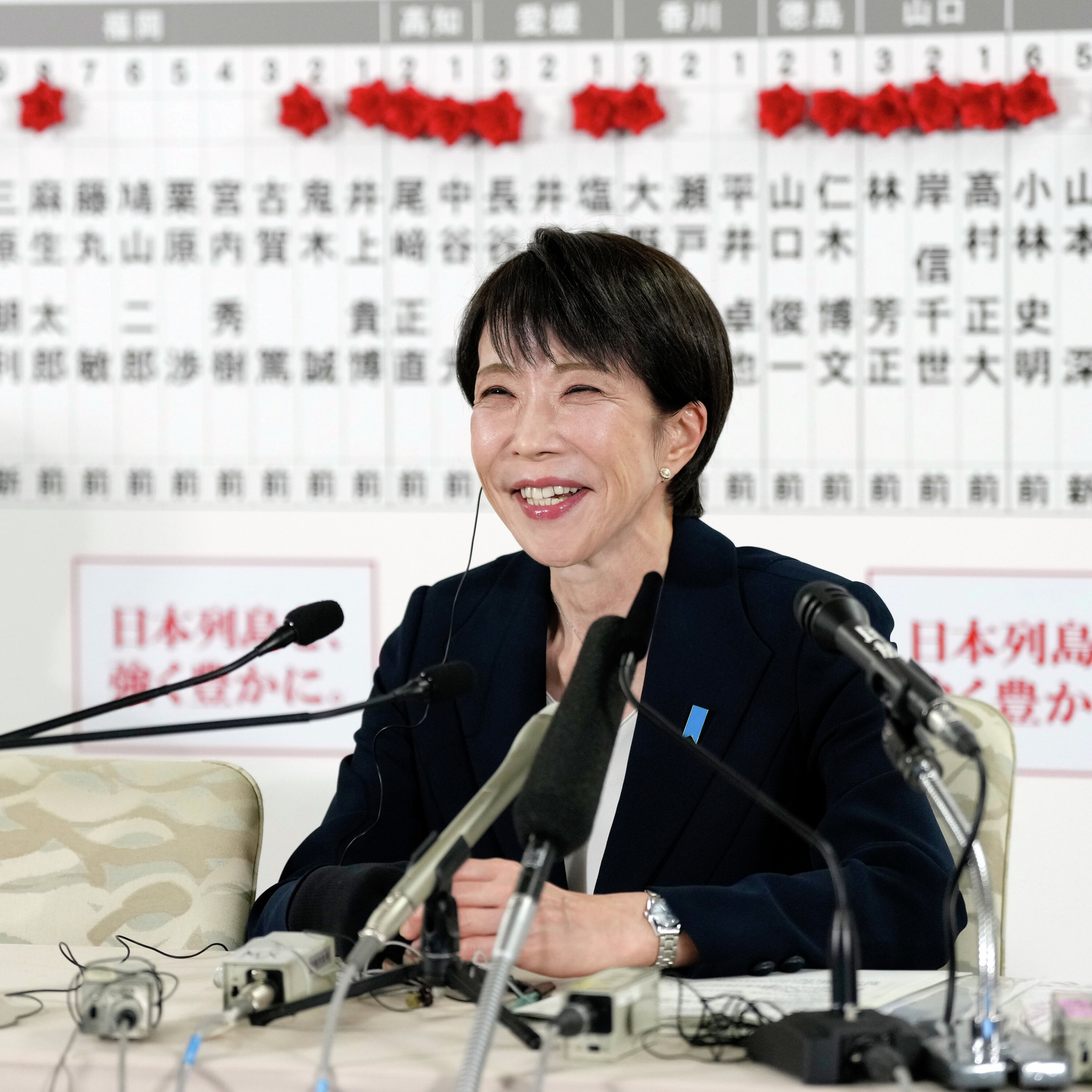
Premier Protein it's for getting after life, not just Fitness. With 30 grams of protein, 160 calories and no sugar added, helping people fuel their joyful lives. With Premier Protein, you can say yes to more. Whether it's crushing a big presentation at work, building an epic fort with the kids, or hitting the hiking trail with friends, Premier Protein offers delicious flavors like cafe latte, chocolate, caramel, vanilla, strawberry and cake batter, to name a few. Find your favorite flavor@premierprotein.com Bloomberg Audio Studios podcasts, Radio news the Nikkei, of course, already at a record high after that historic landslide victory by Prime Minister Takaichi.
- [00:44]
B
And her party, Japanese stocks are on a tear this week.
- [00:49]
A
Investors welcome the resounding election win for.
- [00:52]
B
Prime Minister Sanae Takaichi.
- [00:54]
A
The LDP winning a standalone super majority, positioning her as Japanese equities had surged like fresh record highs on Monday. Semiconductor stocks are doing really well. Defense related stocks are doing really well.
- [01:08]
B
Sakura Murakami covers Japanese politics for Bloomberg out of Tokyo. She says the country's stocks have gotten a big lift from Japanese Prime Minister Sanae Takeichi's historic election win this past weekend.
- [01:22]
A
I'm not sure anyone was really expecting this level of a landslide. 316 seats gained only by the Liberal Democratic Party. That's the most seats ever for the LDP since its founding in 1950.
- [01:37]
B
And that landslide victory came after Takechi made a big gamble. She came into power four months ago with a razor thin majority in parliament, but she wanted a mandate for a combination of conservative social policies and populist big spending pledges. So she called a snap election.
- [01:56]
A
I think everyone was expecting the LDP and Takaichi to win, but not to this extent.
- [02:03]
B
Takeichi's win gives her ruling party an outright majority in Japan's lower house.
- [02:08]
A
She'll be able to kind of push through a lot of the policies that she wants to do. She's pushed forward this idea of Japan being strong and and assertive on the global scene. Whether that's economically or militarily or diplomatically.
- [02:27]
B
It'S a historic win. But while she has the people behind her, the bond market remains skeptical of her plans for the economy.
- [02:35]
A
The single biggest challenge that Takaichi faces now is delivering on her campaign promises. That's crucial both for markets and in terms of regaining investors trust and also politically. You know, if she if she's seen as weak or unable to deliver on her promises, that's going to undermine her political strength as well. So it all comes down to the execution.
- [03:08]
B
This is the Big take Asia. From Bloomberg News, I'm Wan Ha. Every week we take you inside some of the world's biggest and most powerful economies and the markets, tycoons and businesses that drive this ever shifting region. Today on the show, unpacking Sanae Takiichi's landslide victory, what her vision for a more assertive free spending Japan looks like, and can she sell anxious global investors on her bold but risky economic plans. When Sanae Takiichi called a snap election last month, she was governing from a very shaky position. Her Liberal Democratic Party combined with its junior coalition partner were struggling to get by with a slim majority in Parliament.
- [03:56]
A
That means she had to do a lot of haggling, a lot of negotiating, a lot of discussing with smaller parties that had leverage over her because she didn't have a majority. She did have this razor thin majority in the lower house, which is more powerful, but it was 233seats out of 465. If one person couldn't make it to vote, she would have lost the majority. So that was how close she was. And to consolidate her power to really push through the policies that she wanted to see implemented, that was a gambit that's obviously paid off.
- [04:33]
B
Now take Ichi's viewed generally as a right wing conservative, but obviously the election results show that she has such massive widespread public support. What's behind her broad appeal?
- [04:46]
A
When I was at her rally, I noticed that she would go into her polities and the crowd responded the most when she talked about a strong independent Japan. And that wasn't strong and independent in terms of just the military and defense, but in terms of the economy. So when she talked about rare earths and not being so reliant on certain countries for rare earth supplies, she got like big cheers, basically. So I think that goes to show that people have been concerned about the economy and they see the strength that she's portraying and that she's trying to present to the public as a way forward, something they can be hopeful about for the future.
- [05:31]
B
And she's hugely charismatic, especially with her personal story. Right?
- [05:35]
A
She's got a great personal story. She rides motorbikes.
- [05:39]
B
Heavy metal drummer.
- [05:41]
A
She's a drummer. When she was in university, you know, she would rock up to her classes with pink hair. She had long hair, had pink streaks in them. She's such a character and you can see that in the way that she presents herself on social media as well. So one of the moments that went viral for her was this big hug that she gave Italian Prime Minister Giorgia meloni at the G20 last year. It was the first time that they met, but their eyes locked across the room and they just like jumped into this huge embrace which kind of went viral. And it's very unusual for a Japanese leader, I think, to have that level of closeness immediately and immediate rapport with a foreign leader.
- [06:27]
B
Now, Takichi styles herself as a conservative, but some say her economic strategy isn't what you expect of a conservative. Talk us through her political branding and what her particular vision of conservatism looks like.
- [06:42]
A
So she kind of ticks all those boxes of like a standard Japanese right wing politician. She wants to see a strong Japanese military, she wants to take a bold stance on China. So those are classically politically conservative issues in Japan. Economically though, I think Takaichi was wants to see a kind of rejuvenation of the Japanese economy. And that also includes letting companies fail, which was not really something politicians wanted to do previously, especially in terms of winning votes and having the political strength that comes from these sorts of companies that aren't doing too well, but are being propped up by subsidies from the government. And I think the focus is on productivity. Where can Japan's economy be more productive and what areas is the Japanese government subsidizing that isn't actually as productive as it could be? And that is very much focused on investing in the areas that need investment, but then slimming down the government and being very efficient in governance in general.
- [07:57]
B
Now Takechi and her Liberal Democratic Party have secured a supermajority in the important lower house. What does this mean for her politically and the party's ability to push through its agenda?
- [08:09]
A
Now this is huge for Takaichi because it gives her such a huge mandate. The ruling coalition still doesn't have a majority in the upper house, so there is that roadblock. But if you have a super majority in the lower house, the lower house is more powerful than the upper house and it can overrule the upper house. So that just gives her so much of a free hand to push through the policies that she wants to see implemented. Overall, it's about spending more, investing in the areas that need investment and seeing Japan's economy grow again. Investing in an economy for Japan that actually sees more growth like semiconductor related sectors and defense companies. She's talked so many times on the campaign trail about this island off the coast of Japan, Minami Torishima, that has apparently has rare earths, and she's talking about digging up these rare earths to ensure that Japan isn't so reliant. On other countries or a single country for its supply chain of rare earths. So this is kind of like the idea, the vision that she has for Japan.
- [09:24]
B
Voters love Prime Minister Sanae Takechi and overwhelmingly back her vision for a more assertive Japan. But the bond market is spooked by her fiscal policies, why her spending plan could be risky, and what her win means for Japan's geopolitical ties. That's after the break. Japan has grappled with economic stagnation for decades, but inflation kicked in during the pandemic. Bloomberg's Sakura Murakami says that it's now one of the most pressing issues facing the government.
- [10:07]
A
So Japan in the past 30 years hasn't seen prices rise at all. That's a whole generation of people who have not experienced inflation. But now in the past couple of years or so, we're actually seeing inflation in earnest. One of the most emblematic changes is the price of rice. It doubled in about a year. And rice is basically like the eggs or, you know, the bread of the average household in Japan. It's the staple grain. Before you know it, the price of everything has just gone up. And this is really weighing on the average Japanese household.
- [10:48]
B
To help families struggling with inflation, take Ichi promised a two year cut to the sales tax on food and non alcoholic drinks. But it was a controversial pledge. The move would cost about $32 billion in lost revenue annually. That's about 6% of what the country collects in taxes. Sakura says that investors were already uneasy about Japan's massive public debt, the highest among developed nations. And they're now rattled about a big spending plan with no clear way to pay for it.
- [11:22]
A
When she started her campaign, she put the sales tax cut on food front and center through the campaign trail. She's really toned down that messaging. She barely mentioned the sales tax cut in her rallies, in her speeches while she was on the campaign trail. I think that goes to show the impact the market jitters since the election win, she said. We'll continue to discuss this. Takaichi herself has also said, as has the Finance Minister Katayama, that the planned tax cut wouldn't require additional bond issuance. They've kind of said we are going to spend aggressively, but an important part of that is also spending responsibly. I think it's difficult for Takaichi to back out of it at this point, but you know, it is really about showing that this is doable, this is feasible, that there is alternative funding, and we haven't seen that yet.
- [12:22]
B
Yeah, that seems to be important since we obviously in the last few weeks we saw a meltdown in Japan's bond market. Right. Is the election results, you think, likely to calm nerves in the long run, or does it make investors even more jittery now that she has public support to push her spending policy through?
- [12:39]
A
So far, there's relative calm in the currency. Also in the fixed income markets. We're not seeing the kind of meltdown that we saw with Liz Truss when she announced her kind of fiscal plan. So I do think the aggressive spending part, the sort of tax cut part, tends to get more play. But she is really trying to emphasize the responsible part of it. She has been consistent about saying the clan tax cut won't require additional bond issuance. And that's kind of part of the fiscal finance that she's trying to portray as well.
- [13:17]
B
Sakura, I do want to pivot to geopolitics. Takechi made headlines shortly after becoming prime minister with controversial remarks that suggested Japan could intervene militarily if China attacked Taiwan. Of course, that stoked tensions with China that are still simmering today with her win at the polls. Are we likely to see Takichi really double down on that hawkish stance on China?
- [13:42]
A
Yeah, part of her appeal has been this kind of strong stand she's taken with China. And just in general, she's like, very straightforward. And I think this kind of unwillingness to back down under the economic pressure of China after her comments on Taiwan really appealed to the public. Polls showed that the general public was kind of generally in favor with Takaji's comments and also with how Takaichi handled the issue. That being said, you know, as I mentioned earlier, she's a conventional right wing politician. I think one of the things, for example, that she would want to do personally is visit Yasukuni Shrine, which is a very controversial shrine that honors the Japanese war dead, but also war criminals. Past visits to the shrine by Koizumi, by Abe, have really angered, for example, China and South Korea. When she was asked about a potential visit to Yasukuni yesterday after the election, she said she wanted to create an environment where all countries and all people can honor the war dead in the way that they want to.
- [14:55]
B
Now, we saw President Donald Trump endorse Takechi before the election and he's since congratulated her on the win. U.S. treasury Secretary Scott Besant also weighed in. Boy, has she had a big victory today.
- [15:06]
A
President Trump endorsed her last week. She is a great ally, great relationship with the president. And when Japan is strong, the US Is strong. In Asia.
- [15:17]
B
I wonder what we can expect out of these warmer US Japan ties. Japan is a US Ally sitting right next to the biggest US Rival, China. How is she going to navigate being sandwiched between these two global rivals on the world stage?
- [15:33]
A
So she's very much sort of leaning into her personal relationship with Trump. They have this natural rapport. She'll be going to the US In March ahead of Trump's visit to China. Trump has always grumbled about the US Having to defend other countries and other countries not really paying up for their own defense, and Takaichi is aligned on that thinking. She wants Japan's military to be stronger. She wants Japan to be capable of defending itself. So when she goes to the US In March, that'll probably be a topic of discussion between them. Takaichi already has plans to revise Japan's defense spending and Japan's defense policy as well. On the other hand, China's not going to be too happy about that. But that also plays into Takaichi's sort of policy with China. In the four months that she's been in office, she's already taken quite a strong stand against China. She's been very firm about holding her ground, and I think we'll see more, more of that during her term. And obviously, Japan's economy is very reliant on China's economy as well. There's a very strong trade relationship there. But Takaichi may be looking into decoupling and making Japan more assertive and independent in that respect as well.
- [16:59]
B
With this huge mandate that Takechi and the party has won, she has the power to move her agenda forward. How do you think that changes her political calculus going forward?
- [17:10]
A
I mean, she's been in office for four months, and the budget that she has passed so far was the budget from a previous prime minister. So this is the first time that she can actually do things her own way and pull together a budget that she wants to push through. And obviously, with the huge mandate from the public, she'll be able to push it through Parliament as well. So far, given that her hands were tied politically, given that she didn't have a clear majority, she didn't quite have the space to maneuver in the way that she wanted to. But now she has a clear mandate. The question now is how effectively can she actually implement the policies that she's pledged so far? It's been some talk for some time, but will we actually see these policies being realized and actually implemented?
- [18:04]
B
It sounds like this is actually where the hard work comes in right after.
- [18:08]
A
Yeah, right after the Big Win. Exactly. Yeah.
- [18:18]
B
This is the Big Take Asia from Bloomberg News. I'm wan ha to get more from the Big Take and unlimited access to allofbloomberg.com, subscribe today@bloomberg.com podcastoffer if you liked the episode, make sure to subscribe and review the BigTick Asia. Wherever you listen to podcasts, it really helps people find the show. To those celebrating Lunar New Year, Happy Year of the Horse. The bigtik Asia is dark next week. We'll be back after that. Thanks for listening.