Loading summary
Transcript58 lines
- [00:01]
IBM AI Business Representative
The thing about AI for business? It may not automatically fit the way your business works. At IBM, we've seen this firsthand. But by embedding AI across hr, IT and procurement processes, we've reduced costs by millions, slash repetitive tasks, and freed thousands of hours for strategic work. Now we're helping companies get smarter by putting AI where it actually pays off, deep in the work that moves the business. Let's create smarter business IBM for many
- [00:31]
Cigna Healthcare Podcast Host
men, mental health challenges aren't recognized until they've already taken a toll. Work pressure, financial stress, changing relationships, and traditional expectations around masculinity can quietly wear men down, often without clear warning signs. In season three of the Visibility Gap, Dr. Guy Winch and his guests explore how these pressures show up, how to spot them earlier, and how men can access meaningful support. Listen to the new season of the Visibility Gap, a podcast presented by Cigna Healthcare.
- [01:01]
Adobe Acrobat Advertiser
Everyone has been there. Your team's feedback is scattered across emails, chats and sticky notes. It's a mess, but PDF spaces in Adobe Acrobat gives you one collaborative workspace to streamline every file and comment. So if you need six departments to finally agree on a proposal, do that with Acrobat. Need to turn a mountain of feedback into one plan of action. Do that with Acrobat Want to stop searching for files and finally get everyone on the same page? Do that, do that, do that with Acrobat learn more@adobe.com do that with Acrobat Bloomberg Audio Studios Podcasts Radio News Lately,
- [01:46]
Sarah Holder (Bloomberg News Host)
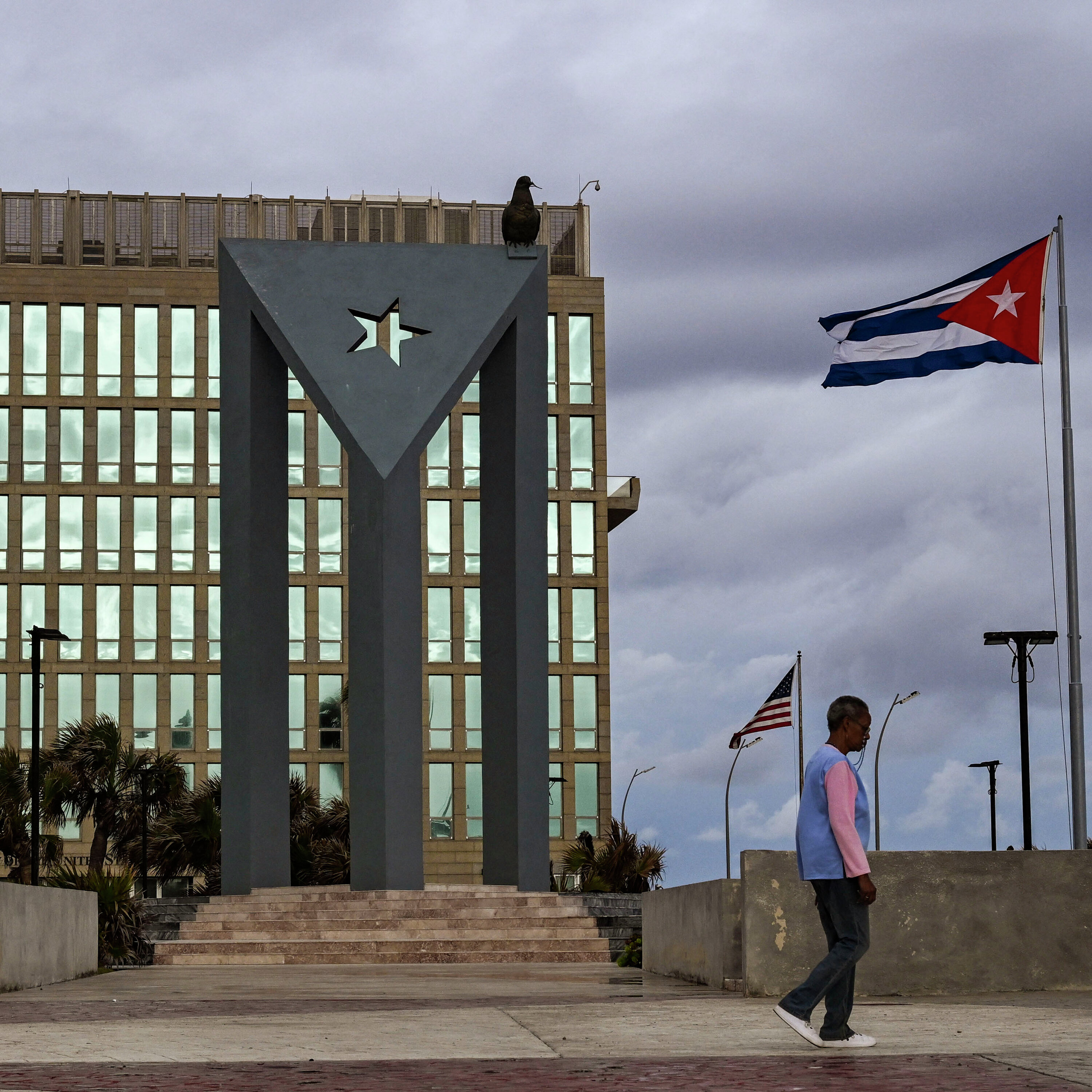
President Donald Trump has been talking more and more about Cuba.
- [01:51]
Jim Wiss (Bloomberg Reporter on Cuba)
You know, all my life I've been hearing about the United States and Cuba. When will the United States do it? But I do believe I'll be the honor of having the honor of taking Cuba.
- [02:03]
Sarah Holder (Bloomberg News Host)
Bloomberg's State Department and foreign policy reporter Eric Martin says Trump's interest in the island nation has been building in his second term. One of the first signs was his pick for secretary of state.
- [02:16]
Eric Martin (Bloomberg State Department and Foreign Policy Reporter)
The naming of Marco Rubio, senator from Florida, the son of Cuban immigrants to the US Having grown up in this Miami exile community and that being his political base as the nominee for secretary of state, was a strong signal that the communist governments in the Western Hemisphere were going to be a big focus of attention for the administration right out of the gate.
- [02:41]
Jim Wiss (Bloomberg Reporter on Cuba)
Under the new Trump administration, they put Cuba back on the state sponsor of terrorism list.
- [02:46]
Sarah Holder (Bloomberg News Host)
Jim Wiss covers Cuba and the Caribbean for Bloomberg.
- [02:49]
Jim Wiss (Bloomberg Reporter on Cuba)
And so that really kind of set the stage for everything kind of going forward.
- [02:53]
Sarah Holder (Bloomberg News Host)
And just over a year into Trump's second term, his Administration's hard line stance and its rhetoric has only picked up. After the US Captured Venezuelan President Nicolas Maduro, Rubio sent a warning to Cuba in a press conference.
- [03:08]
Jim Wiss (Bloomberg Reporter on Cuba)
Yeah, look, if I lived in Havana
- [03:09]
Eric Martin (Bloomberg State Department and Foreign Policy Reporter)
and I was in the government, I'd
- [03:10]
Wise App Advertiser
be concerned at least a little bit.
- [03:12]
Sarah Holder (Bloomberg News Host)
Then the US Imposed an oil blockade of the island, which has crippled its economy and energy sectors.
- [03:18]
Adobe Acrobat Advertiser
Now, since the US Ousted Venezuelan leader Nicolas Maduro in January, Cuba's main supplier of oil has been choked off, triggering weeks of blackouts. Some nights the entire island goes dark.
- [03:30]
Sarah Holder (Bloomberg News Host)
And just last week, Trump started talking about taking Cuba.
- [03:35]
Jim Wiss (Bloomberg Reporter on Cuba)
That'd be good. That's a big honor, taking Cuba. Taking Cuba in some form. Yeah.
- [03:40]
Sarah Holder (Bloomberg News Host)
The U.S. s approach to Cuba address, especially over the past year, has had significant impacts for people on the ground.
- [03:47]
Jim Wiss (Bloomberg Reporter on Cuba)
The United nations has basically said that the government can no longer deliver food and aid to kind of the most vulnerable parts of the population simply because they don't have enough gasoline to put in the cars.
- [03:58]
Sarah Holder (Bloomberg News Host)
So it's dire and it's all building, Jim and Eric say, to an inflection point, one that could alter the course of Cuba's history and the legacy of the Trump administration forever.
- [04:10]
Jim Wiss (Bloomberg Reporter on Cuba)
I mean, it's a huge moment. I mean, arguably everything's at stake right now for the government. They've been in power 67 years and it's looking really unclear if this one party system is going to survive the year.
- [04:23]
Eric Martin (Bloomberg State Department and Foreign Policy Reporter)
Quite frankly, we've seen a dozen presidents come and go, unable to change the government in Cuba. So if the Trump administration and Secretary of State Marco Rubio are able to bring about that change, it would be a huge legacy issue for them and a historic change that they would be implementing and catalyzing in Cuba.
- [04:48]
Sarah Holder (Bloomberg News Host)
I'm Sarah Holder and this is the big take from Bloomberg News today on the show Cuba at a turning point. Why the US has been ramping up pressure on the nation and what could come next. When the US Carried out a military operation to capture former Venezuelan President Nicolas Maduro in January, it was a pivotal moment for another country, too. Cuba. The relationship between Venezuela and Cuba is a key piece of context for understanding what's happening today. Here's Bloomberg's Jim.
- [05:25]
Jim Wiss (Bloomberg Reporter on Cuba)
So you know, when Hugo Chavez took power in Venezuela, he immediately or very soon after taking power saw enfidel, kind of a mentor and kind of a godfather. And of course, the two of them became kind of the leaders of what was known as 21st century socialism, Latin America. At the root of that relationship was Venezuela's support for Cuba Cuba was coming out of what was known as the special period after the fall of the Soviet Union, and they lost their Soviet backing. They went through a true economic crisis, and Venezuela stepped in as kind of its savior. And so this relationship developed where Venezuela was sending hundreds of thousands of barrels of oil a day to Cuba, and Cuba was paying for it by sending teachers, security personnel, engineers, and people of that sort. And so there was this barter system in place that worked very well for both sides until it didn't. And, you know, even as the Venezuelan economy started to fail, they still continued to support Cuba. And so Cuba, at the end of the day, was kind of very, very overly dependent on their Venezuelan patrons. And when Trump essentially cut that off cold on January 3rd, you know, the effects have been very, very evident.
- [06:45]
Eric Martin (Bloomberg State Department and Foreign Policy Reporter)
Protesting the latest power cut on the
- [06:47]
Adobe Acrobat Advertiser
streets of Havana after Cuba's entire electricity
- [06:50]
Sarah Holder (Bloomberg News Host)
grid collapsed last night.
- [06:51]
Jim Wiss (Bloomberg Reporter on Cuba)
The power cut comes as campaigners delivering humanitarian aid have started arriving in the country as part of efforts to mitigate the effects of Washington's blockade.
- [07:01]
Wise App Advertiser
In a nation used to hardship, Cubans
- [07:04]
Jim Wiss (Bloomberg Reporter on Cuba)
say the situation has never been worse. The president of Cuba, Miguel Diaz Canel, has basically said they haven't had a major oil delivery in over three months, basically, essentially since the US Incursion into Venezuela. And the US has basically threatened anybody who comes to Cuba's energy aid, that's particularly Mexico, with punitive sanctions if they do deliver fuel. Right now, as we're speaking, there is a Russian oil tanker on its way to Cuba, but there's no telling whether or not it's actually going to make it or not. One previously diverted at the last minute and ended up going to Trinidad, so they're not getting major oil shipments. Now. The private sector is being allowed, in theory, to bring in some supplies to cover its own needs, but those are minuscule and do not really address the issue at hand.
- [07:58]
Sarah Holder (Bloomberg News Host)
And what half those three months effectively without oil at all, meant for conditions
- [08:04]
Jim Wiss (Bloomberg Reporter on Cuba)
on the island, Conditions were hard to begin with, and now, you know, they're frankly quite terrible. There have been lots of reports, many of them unconfirmed, about people dying in hospitals as ventilators are getting cut off. That's part. And due to the power outages, which were endemic before the fuel crunch, but they've only gotten worse since then, Industry is grinding to a halt, and resorts, which are one of the big main money earners for Cuba, have had to shut down because there's not enough fuel. It's rippling all the way through society, and hunger is real. The United nations has basically said that the government can no longer deliver food and aid to kind of the most vulnerable parts of the population simply because they don't have enough gasoline to put in the cars. So it's dire.
- [08:47]
Sarah Holder (Bloomberg News Host)
And what has that dire situation that's already been a struggle for many people in Cuba. How has that changed the political situation on the ground and people's attitudes towards their government?
- [09:03]
Jim Wiss (Bloomberg Reporter on Cuba)
Well, you know, outright demonstrations, protests are essentially banned in Cuba. And yet there are more sounds, more rumblings of discontent over these last couple of weeks. There have been some very kind of high profile protests, including one in a little town called Moron where basically people got together and attacked the seat of the Communist Party in this town. So there's a lot of dissatisfaction on the street, some of it aimed at Washington, some of it aimed at the local authorities. I think there's a lot of blame to go around right now, but for the government itself, at least publicly, it's sticking to its ground.
- [09:38]
Sarah Holder (Bloomberg News Host)
I asked Bloomberg's Eric Martin, who covers the State Department and foreign policy for Bloomberg, about why the US has been putting this pressure on Cuba and its economy, what its goals are.
- [09:50]
Eric Martin (Bloomberg State Department and Foreign Policy Reporter)
Cuba has had patron states throughout the last 70 years. The US is really looking to follow in those footsteps in terms of a superpower that exerts great influence and control over the island. This is an administration that has articulated a national security strategy, an actual document released in December that is very focused on asserting US Preeminence and dominance in the Western Hemisphere. We've seen China in particular trying to establish a foothold and a presence in Cuba in recent years. We've seen this patron relationship that Venezuela had with Cuba for several decades, even going back to the relationship of the Soviet Union in Cuba in the 1960s. And so this has been a national security threat across different American presidencies. But it's also a priority for the Republican Party and for voters, particularly Cuban exiles in Florida. And this is administration that we see a lot of influence from Florida. And so there's a lot of constituents here that would like to see a change and an opening and a more democratic, more US Friendly Cuba.
- [11:09]
Sarah Holder (Bloomberg News Host)
I am wondering, Jim, what role do Cuban Americans and Cuban expats play in all this? How are they reacting to the situation on the island?
- [11:17]
Jim Wiss (Bloomberg Reporter on Cuba)
Well, that is really interesting. I think the diaspora has been waiting for this moment for 60 years. And they are interested in investing, they are interested in seeing changes in Cuba. The Cuban government kind of in theory, is trying to open the doors to that. Just in recent weeks, they have announced legislation that would allow Cuban exiles to invest in companies and own companies in Cuba and kind of participate in the economy. But there's still so many hurdles both on the US side and on the Cuban side. For that to actually happen, we shouldn't hold our breaths and wait for the wave of Cuban investors coming from Miami.
- [12:02]
Sarah Holder (Bloomberg News Host)
You mentioned one of the ways that the Cuban government has been responding, but what steps have they taken? What signals have they sent over the last three months as the US has ratcheted up this pressure?
- [12:14]
Jim Wiss (Bloomberg Reporter on Cuba)
It's interesting. I think one thing they've been doing is kind of acknowledging it. President Miguel d' Escanel has gone on national television a couple of times now and, you know, and basically said, yes, we're hurting. These U.S. measures are affecting us. And they keep describing as akin to collective punishment, everybody on the island's gonna suffer because of these U.S. policies. And so on one side, I think they are kind of acknowledging their vulnerabilities and their pain in a way that maybe they haven't in quite some time, acknowledging that the US is hurting them. And on the other side, again, for the lack of a better phrase, I think it's just defiance. They keep saying that, yes, we're willing to work around the margins, we're willing to let Cuban exiles invest, but we're not willing to discuss who leads our country.
- [13:07]
Sarah Holder (Bloomberg News Host)
So without an obvious exit ramp, where could this all be heading? What paths is the Trump administration angling for? That's next.
- [13:21]
IBM AI Business Representative
The thing about AI for business, it may not automatically fit the way your business works. At IBM, we've seen this firsthand. But by embedding AI across hr, IT and procurement processes, we've reduced costs by millions, slash repetitive tasks, and freed thousands of hours for strategic work. Now we're helping companies get smarter by putting AI where it actually pays off, deep in the work that moves the business. Let's create smarter business. IBM.
- [13:51]
Cigna Healthcare Podcast Host
For many men, mental health challenges aren't recognized until they've already taken a toll. Work pressure, financial stress, changing relationships, and traditional expectations around masculinity can quietly wear men down, often without clear warning signs. In season three of the Visibility Gap, Dr. Guy Winch and his guests explore how these pressures show up, how to spot them earlier, and how men can access meaningful support. Listen to the new season of the Visibility Gap, a podcast presented by Cigna Healthcare.
- [14:21]
Wise App Advertiser
This podcast is brought to you by Wise, the app for international people using money around the globe. When it comes to sending money abroad, many providers claim to offer free fees and competitive rates, but don't be fooled. This can be code for inflated exchange rates. With the WISE account, you can send, spend and receive money in over 40 currencies without ever having to worry about hidden fees sending pounds across the pond. Most transfers arrive in 20 seconds or less. Spending reals in Rio. The wise travel card gives you the mid market rate on every purchase. No costly markups on your bill. Getting paid in dollars for your side gig. Avoid hidden fees and get the real exchange rate every time. With 24. 7 access to live support, your international transactions with WISE are quick, transparent and safe. Plus wise runs over 7 million daily checks to catch and prevent fraud. 15 million people already trust WISE to manage their money internationally. Be smart, Get Wise Download the Wise app today or visit wise.com Terms and Conditions apply.
- [15:26]
Sarah Holder (Bloomberg News Host)
I want to walk through some of the possible paths US Cuba relations could take from here, starting with diplomacy. Both the Trump administration and Cuban officials have confirmed they're in talks. So Eric, what do we know about who exactly is at the table and what each side is looking to achieve with these talks?
- [15:43]
Eric Martin (Bloomberg State Department and Foreign Policy Reporter)
So we reported last month that the US Is looking to replace Cuban President Miguel Diaz Canel, that he is somebody who they see as having failed in terms of his economic management and his leadership in Cuba. We know that Raul Castro, the former president and the brother of Fidel Castro, his grandson, whose name is also Raul, he's called Raulito or sometimes his nickname is El Congrejo the Crab, has been having discussions with the Trump administration via Secretary of State Rubio. That's one name that we've seen out there as somebody who is more open, who is more of a global business minds, is more open to making a deal as less ideological. We saw an important signaling mechanism where in a recent speech by Miguel Diaz Canel, the President Raul Castro's grandson, he was in the room for that speech, which was very unusual. And so the Cuban authorities have acknowledged that these talks are going on. The US Is looking to use economic pressure, particularly by cutting off energy sales to the government, but permitting energy sales to the small but fast growing small and medium sized enterprise and businesses in Cuba to foster this private sector, which they then see as leading to a political opening in Cuba. So it's kind of the same in some ways similar to comparable to the process that we saw the attempts in Russia in the 1980s to have an economic and political opening.
- [17:20]
Sarah Holder (Bloomberg News Host)
Yeah, well I want to talk about that potential opening because last week on March 16, the Cuban envoy to the US said the country is moving to allow more investment from Cubans Living abroad. How big of a change is that? And how did the Trump administration respond to that news? Is that the kind of deal that they're looking for here?
- [17:38]
Eric Martin (Bloomberg State Department and Foreign Policy Reporter)
Well, Secretary Rubio has responded to that by saying it's not dramatic enough in terms of the kind of moves that the administration needs to see. And there's a lot of skepticism in the exile community about putting money into Cuba, investing money in Cuba with a government with a history of expropriation. Many of the people in the exile community in Florida are either from families that have themselves in living memory, had assets expropriated, or they can remember from their parents and grandparents what that experience was like. So there's a lot of skepticism to this offering by the Cuban government in terms of opening to outside investment. Just a feeling like this is not nearly enough for what people need to see in terms of. In terms of an opening and in terms of a democratization.
- [18:32]
Sarah Holder (Bloomberg News Host)
And, Eric, in the lead up to these talks, and even as these talks are ongoing, members of the Trump administration have also implied that they could take a tougher approach in Cuba. Right after the US Captured President Maduro in Venezuela in January, Secretary of State Marco Rubio told reporters, quote, if I lived in Havana and I was in the government, I'd be concerned. And earlier this month, Senator Lindsey Graham told Fox News that, quote, iran is going down and Cuba is next. So, Eric, what do we know about whether the US Is considering a military option in Cuba?
- [19:05]
Eric Martin (Bloomberg State Department and Foreign Policy Reporter)
Well, we haven't yet seen reporting of military preparations to invade Cuba or strike Cuba. But the rhetoric that we've seen from President Trump has been speaking about. Shortly after our story, he came out and talked about the idea of a potentially friendly takeover of Cuba. He's more recently entertained the idea that it could be a friendly takeover or not so friendly. And so he's teased this idea of using force in Cuba. Already, the threat of force and interdiction has stopped. For instance, Mexico, which was the main supplier of oil to Cuba after Venezuela, from sending oil to Cuba. And so we've already seen the threat of force at work here, Eric.
- [19:49]
Sarah Holder (Bloomberg News Host)
We've talked about sort of three ways that the Trump administration is pursuing putting pressure on Cuba. The first is, you know, continued talks, diplomacy, deal making. The second would be military intervention. And the third would be using financial pressure to make Cuba dependent on the US do we know about which option the Trump administration prefers or which option would be most likely?
- [20:12]
Eric Martin (Bloomberg State Department and Foreign Policy Reporter)
Well, one thing we've seen from President Trump's comments is that his expectation and his view is that Cuba wants to make a deal, but he's also talked about Cuba being dealt with. He's repeatedly said Cuba would be dealt with after Iran. So I think one important signal will be watching what happens with the current war in Iran if there is a de escalation or a negotiation to reopen the Strait of Hormuz to de escalate the conflict in Iran. And so attention, I think is likely to turn more to Cuba if there is a resolution or an easing of the conflict and the war in Iran.
- [20:53]
Sarah Holder (Bloomberg News Host)
And Jim, I want to turn back to you here. The US has opposed the communist government in Cuba for decades, since the 1960s. How significant would any of these outcomes, a diplomatic resolution, a military intervention, an economic takeover, be in the sweep of Cuban history? And what message would they send to the rest of Latin America?
- [21:15]
Jim Wiss (Bloomberg Reporter on Cuba)
I mean, this would be incredibly significant. I mean, as you've mentioned, ever since Kennedy, successive US Presidents have been trying to either force a change, negotiate a change, finesse a change in the island. And it's never happened. The government has always rallied. The government has always been able to protect itself. It's an incredible story of kind of political survival in Cuba. And so if they ended that 67 year run of single party rule, if Trump was the one to do it, that would be incredibly significant. There is this really romantic notion about Cuba in the Latin American left. I suspect that a Cuba that actually fell, that succumbed to Washington, would only increase kind of the nostalgia of what Cuba once was. I think we'll be dealing with the consequences of whatever happens in Cuba one way or another for decades to come in Latin America.
- [22:13]
Sarah Holder (Bloomberg News Host)
This is the Big Take from Bloomberg News. I'm Sarah Holder. To get more from the Big Take and unlimited access to all of bloomberg.com, subscribe today@bloomberg.com podcastoffer if you like this episode, make sure to subscribe and review. The Big Take. Wherever you listen to podcasts, it helps people find the show. Thanks for listening. We'll be back tomorrow.
- [22:44]
Adobe Acrobat Advertiser
If you follow markets, you know the value of long term thinking. You plan, you diversify, you prepare for volatility. But even the best strategies can't prevent every bad day. For more than 75 years, Cincinnati Insurance has helped individuals and businesses navigate tough moments. With expertise, personal attention and independent agents who focus on relationships, not transactions. The Cincinnati insurance companies let them make your bad day better. Find an agent@cin fin.com from coast to
- [23:20]
Sonesta Travel Advertiser
coast, unlock adventure at Red lion hotels by Sonesta, where restful sleep, friendly service and trusted local knowledge are part of every stay. Red lion makes it easy to feel welcomed, comfortable and connected wherever the road takes you. Whether you're traveling for business or pleasure, you can spend less and make more of every trip. When you sign up for Sinesta Travel Pass, you'll get their best rates instantly. Go to sonesta.com to book your stay and unlock the best rates with Sonesta TravelPass here today, Rome tomorrow. Join now@sonesta.com terms and conditions apply. These days it seems like AI agents are just about everywhere you turn, every field and every function. But without identity, you can't trust they'll serve your business instead of jeopardizing it. Fortunately, Okta helps you get identity right by securing your AI agents identities, giving you a single layer of control, a single standard of trust. So whether an AI agent supports a single user or your entire enterprise, with Okta you'll turn risk into opportunity. Secure every agent, Secure any agent. Okta secures AI.