Loading summary
Transcript38 lines
- [00:00]
Michigan Business Promoter
As industries evolve faster than ever, companies need an environment that accelerates strategic growth and Michigan delivers on that promise. From emerging startups to global enterprises, Michigan offers what executives value most a resilient, innovative ecosystem, diverse communities that attract top talent, and a quality of life that supports work life balance with our unified Team Michigan approach, businesses scale faster and compete at the highest level. Michigan Pure Opportunity Seize your opportunity@MichiganBusiness.org sending a file is easy. Making sure your clients understand the file is the hard part. But with PDF spaces in Adobe Acrobat, you can give your clients the full picture with custom intros, audio summaries and a helpful AI assistant to your docs. So if you want to stop the endless follow ups, do that with Acrobat. Need to make your docs crystal clear. Do that with Acrobat Want to make sure your clients get everything they need to hear? Do that with Acrobat learn more@adobe.com do that with Acrobat Small businesses are the
- [01:04]
Chase for Business Representative
pulse of every community. They bring people together, create opportunities and drive growth. Chase for Business helps business owners like you with personalized guidance and convenient digital tools all in one place. With that guidance and your determination, you can take your business farther and help build a brighter future for your community. Learn more@chase.com business chase for business make more of what's yours the Chase Mobile app is available for select mobile devices. Message and data rates may apply JP Morgan Chase Bank NA Member FDIC Copyright 2026 JPMorgan Chase Co.
- [01:42]
Bloomberg Audio Studios Announcer
Bloomberg Audio Studios
- [01:45]
Sarah Holder
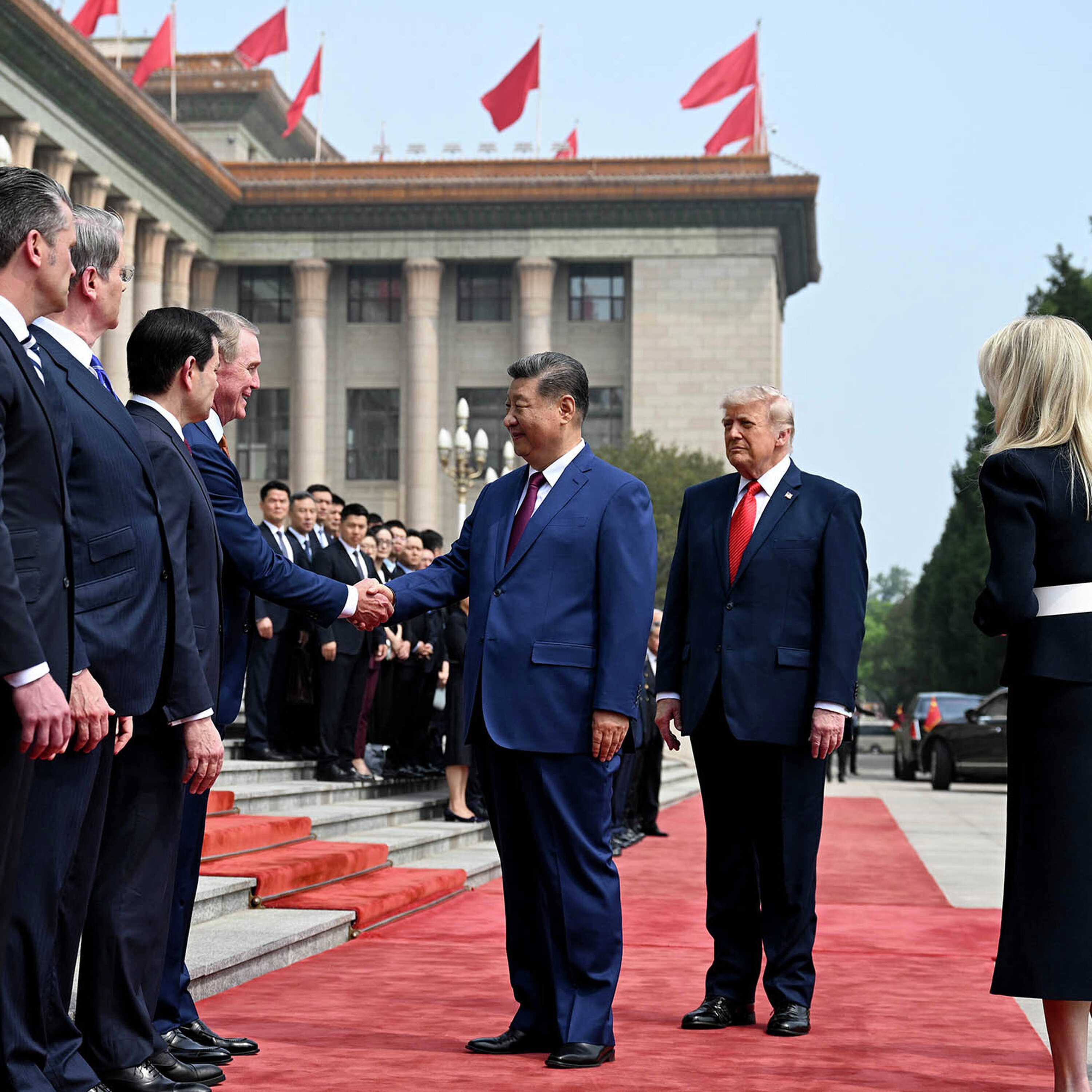
Podcasts Radio News President Trump is back in Washington after his summit in Beijing with Chinese President Xi Jinping, a remarkably positive summit that appeared to bolster both leaders.
- [01:59]
Public Investing Representative
President Xi is an incredible guy.
- [02:01]
Sarah Holder
While adding little clarity to the many pressing pre summit trade issues, the biggest
- [02:06]
Brendan Murray
question was really how would the two leaders resolve this ongoing issue of the ceasefire in tariffs that they've had for about the past six months or so?
- [02:17]
Sarah Holder
Brendan Murray leads Bloomberg's trade coverage.
- [02:19]
Brendan Murray
Would they try to extend that? Would they try to escalate with some of their rhetoric? Would they get into a debate about whether tariffs were going to be part of the relationship going forward?
- [02:32]
Sarah Holder
During the summit, Xi talked a lot about building a relationship with the US Defined by what he called constructive strategic stability.
- [02:40]
Brendan Murray
You can say many things about the way President Trump has handled tariff policy in the past year. Constructive wouldn't be the first one that the US Trading partners would come up with. Maybe reconstructive or even destructive. So right at the very start of this, the Chinese have focused the Americans on something that's constructive and stability, that the relationship has been very rocky, especially over the past 12 months. And it's in the interests of China and it's in the interest of the United States to see the relationship not devolve into an even more damaging trade war.
- [03:21]
Sarah Holder
That stability could soon be tested, Brendan says, by climbing energy prices and the possibility of new US Levies.
- [03:30]
Brendan Murray
The world will wait and see how the next several months play out as the two leaders plan to meet again and as the US Prepares to roll out another wave of tariffs that will replace those that the Supreme Court struck down back in February.
- [03:49]
Sarah Holder
I'm Sarah Holder, and this is the big take from Bloomberg News today on the show. In the wake of the Trump Xi Summit, where does the globe's biggest trade relationship stand? How are US Companies navigating this challenging moment, from tariff refunds to high gas prices? And what does it all mean for consumers? Brendan, over the weekend, the White House announced several new deals that came out of the Trump Xi summit. They said China is going to buy 200 Boeing planes and at least $17 billion worth of agricultural products from the U.S. the next few years. Why did China agree to buy all these American products, and how big are those wins really for the US Well,
- [04:37]
Brendan Murray
China really needs commodity imports from the rest of the world, and they used to buy a lot more from the US Than they have in the past couple of years. And so if you take agriculture, what U.S. trade Representative Jameson Greer has announced is $17 billion in agriculture products on top of the 25 million tons a year in soybeans that the Chinese are purchasing now. 25 million tons of soybeans is about 12 or 13 billion dollars. So what we're talking about is 30 billion dollars worth of agricultural products, which is essentially the amount that China was buying four or five years ago. So we're going back to what the baseline used to be with this deal that the Trump administration has walked away from in this latest Beijing summit. Now, you mentioned Boeing, aircra. These are a mainstay of US China trade negotiations in particular, and especially the ones with the more diplomatic spotlight on them. Boeing employs tens of thousands of American workers, and it's this iconic company around the world. And China needs airplanes for its growing commercial fleets, and they were going to buy Boeings anyway. And in fact, some people thought that the president would come away from this summit with double the 200 they talked about. And the message there seems to be, at least from the Chinese side, is we'll buy a couple hundred. We're going to need 750, but we'll see how the relationship goes. And those airplanes basically just remain on the negotiating table.
- [06:18]
Sarah Holder
Right. And we should note that Boeing shares actually fell as much as 5.4% after this deal was announced. So when it comes to those aircrafts, it's a win, but it's not as big of a win as the US Perhaps expected, wanted, or could get in the future. And when it comes to agricultural products, the US Is basically back to square one in terms of the Chinese trade relationship there.
- [06:41]
Brendan Murray
Yeah, exactly. And these are taps that China can turn on or off depending on how they see the relationship. Again, it's leverage that they have now realized that they can use on top of other things that they've used recently to get the Trump administration to offer some things that they want.
- [06:59]
Sarah Holder
When it comes to consumer impacts, though, I'm curious. You know, one of the positive signs that we saw going into these meetings was that China had already on Thursday renewed import licenses for hundreds of US Beef plants, which China had allowed to lapse last year in response to Trump's trade war. I'm wondering what that could mean for beef prices that Americans are seeing at the grocery store.
- [07:20]
Brendan Murray
Well, this is an interesting one because there's an actually a beef shortage in the United States right now, and it's become a political issue in a lot of places. A pound of ground beef now costs almost $7 in the United States. And this just is part of the basket of everyday sort of mainstay staple items that Americans are paying for that they, they're paying a lot more for than they used to. So you couple that with China is now going to buy more U.S. beef, you would think, and I'm an old commodities reporter, I sort of know how supply and demand works, especially with China. When China starts buying more of supply of, it gets tighter and the price goes up. So it's an interesting one. On its surface, it looks like a market opening for the U.S. but the consumer impact may actually backfire in this particular case with beef.
- [08:15]
Sarah Holder
And Brendan, we also have to talk about the status of US China tariffs. Trump told reporters on Friday that the two countries did not discuss tariffs during the summit. But on Saturday, China's Commerce Ministry issued an update saying that China and the US had agreed to establish a trade council and that both of them were would work towards reducing tariffs on some products. So I'm wondering what changed and what kinds of tariff adjustments could we actually see ahead.
- [08:42]
Brendan Murray
You mentioned this trade council, and the US Calls it a board of trade. And this is where the Treasury Secretary, Scott Besant, has said that they will look at about $30 billion worth of trade between the two countries and discuss ways to, as he said, UN Tariff those products. And so this particular Board of Trade will look at things that are non sensitive, not vital to national security or anything like that. Low value goods is is what Scott Besant called them and decide whether they can lower tariffs on them. And so that would be one of the forums for the discussion about tariffs. Now, whether President Trump and President Xi talked about tariffs, we don't really know that the two directly spoke about them, but certainly their aides did. And that have been something that would have been fairly prominent topic of discussion, at least on the sidelines, if not in front of the cameras.
- [09:38]
Sarah Holder
After the break, Bloomberg's Brendan Murray on what the tariff talks mean for US Consumers and how companies are planning to deal with the rising costs of international trade.
- [09:53]
Bloomberg Audio Studios Announcer
If you follow markets, you know the value of long term thinking. You plan, you diversify, you prepare for volatility. But in life, even the best strategies can't prevent every bad day a fire, a loss, a disruption that demands immediate attention. When that happens, what matters isn't just what you planned, it's who shows up. That's where Cincinnati Insurance comes in. For more than 75 years, they've helped individuals and businesses navigate life's toughest moments with care, expertise and personal attention. Together with independent agents, Cincinnati Insurance focuses on relationships, not transactions. Their approach is grounded in experience, follow through and trust built over time. Bad days happen, and when they do, you deserve an insurance partner who understands risk, respects what you've built and is ready to help you move forward. The Cincinnati Insurance companies Let them make your bad day better. Find an independent agent@cin fin.com support for
- [10:55]
Public Investing Representative
the show comes from Public. Public is an investing platform that offers access to stocks, options, bonds and crypto. And they've also integrated AI with tools that can assist investors in building customized portfolios. One of these tools is called Generated Assets. It allows you to turn your ideas into investable indexes. So let's say you're interested in something specific like biotech companies with high R and D spend small cap stocks with improving operating margins or the S&P 500 minus high debt companies. Chances are there isn't an ETF that fits your exact criteria. But on public you just type in a prompt and their AI screens thousands of stocks and builds a one of a kind index. You can even backtest it against the S&P 500. Then you can invest in a few clicks, go to public.com market and earn an uncapped 1% bonus when you transfer your portfolio. That's public.com market ad paid for by Public Holdings Brokerage Services by Public Investing Member FINRA SIPC Advisory Services by Public Advisors SEC Registered Advisor crypto services by ZeroHash sample prompts are for illustrative purposes only, not investment advice. All investing involves risk of loss. See complete disclosures@public.com disclosures small businesses are
- [12:08]
Chase for Business Representative
the pulse of every community. They bring people together, create opportunities and drive growth. With a widespread presence in communities across the country, Chase for Business supports small business owners at a local level that makes it possible for you to connect, learn from each other and grow together. There's a real commitment to seeing small businesses succeed. The Chase for Business team has knowledge and expertise that span a wide range of financial areas. They can help you make more informed decisions as you navigate the complexities of running your business. They'll help your business grow with individual guidance and convenient digital tools all in one place. With that guidance and your determination, you can take your business farther and help build a brighter future for your community. Learn more@chase.com business chase for business make more of what's Yours the Chase Mobile app is available for select mobile devices. Message and data rates may apply JPMorgan Chase Bank NA member FDIC Copyright 2026 JPMorgan Chase and.
- [13:14]
Sarah Holder
After the Trump Xi summit, both the US and China have indicated that they're willing to lower tariff rates on specific products. But Brendan Murray says there's still a lot that we don't know about what these changing levies will look like.
- [13:28]
Brendan Murray
So let's take this in two parts. We have billions and billions of dollars of Chinese imports that have tariffs on them. They were rolled out last year in sort of a shotgun approach, and it caught up a lot of things that will never be reshored in the United States. That's after all, the goal of Trump's tariffs is to encourage production back on US soil. Some of those things and Scott Bessant even mentioned fireworks. Americans are never going to make fireworks again. The Chinese have dominated that particular industry for a long time and so it doesn't really make sense to have tariffs on fireworks. Particularly in the US's 250th birthday year. There are going to be lots of celebrations over the summer, so we could see this Board of Trade take a look at these kinds of things and say, you know what? We don't really need the tariff on fireworks or other Items like those, so we'll just reduce them. Now, $30 billion in trade is something like a tenth of all US and China trade. So it's not going to be a huge game changer, but there'll be symbolic moves to lower the tariffs that are already being applied. The other aspect of this that the US Trade Representative James and Greer has brought up are these so called 301 investigations. And there are two big ones focused on China. One has to do with industrial overcapacity and the other one has to do with forced labor. Now, these authorities are fairly legally sound, unlike the IPA tariffs that the Supreme Court struck down. So these 301 investigations, and Jamison Greer has said that they're coming out in the next several weeks, the results of these investigations that they have to do, and those could provide the basis for tariffs on China and many other countries. So essentially what the Trump administration wants to do is use these new authorities to replicate the ones that the Supreme Court struck down and have a sort of a similarly constructive tariff wall around industries that it wants to protect and industries that it wants to draw production back to the United States. So we could be sitting here in a month or two, and President Trump and President Xi have had these, you know, the good vibe summit that they had. But we could be watching the United States put different tariffs on China and we'll see how China responds this time. Last time they retaliated. And so we could be back in a situation where the US Says we are going to put tariffs on these particular items based on this new authority that we have run this investigation on, and you're going to have to live with it. And China's tariff rate, the average tariff rate on Chinese imports into the US right now is about 20%, according to estimates from Bloomberg Economics. But if these new tariffs come into effect, that could go back above 30% where it was last year at this time.
- [16:31]
Sarah Holder
And as you noted, when Trump and Xi met previously in South Korea, they put this moratorium on retaliatory tariffs for a year. But that deal expires in November and there was no movement on extending this tariff reprieve during these talks. So to you, does that signal that the story is not over?
- [16:50]
Brendan Murray
To me, it signals that there's a lot to watch between now and November. The current, the temporary tariffs, the 10% that were in place since the Supreme Court ruling, those expire July 24th. So there's another mark on the calendar to keep an eye on. That's when these other 301 tariffs could be in place in force by then. President Xi and Trump plan to meet sometime around September. A lot will depend on whether they can sort of maintain this detente that they've created. So what will be very interesting to watch is can President Trump, who spent a good part of last year threatening China, escalating with China, re escalating, taking the tariffs on Chinese imports to 145% at one point? Can he maintain and stay within this, as we said, this constructive relationship and keep it stable between now and four or five months from now?
- [17:50]
Sarah Holder
I want to talk for a second about the state of the US Tariff picture generally in the US the scramble to file for tariff refunds has been underway for a few weeks now. Where does it stand?
- [18:03]
Brendan Murray
It got off to a fairly slow start. This is the Customs and Border Protection Agency that needs to process paperwork filed electronically that will return about $166 billion back to American importers for the tariffs that the Supreme Court has ruled illegal. So this first stage of the refund process, which can last up until around mid June, is going to return something like 36 billion of the 166 billion. So, you know, roughly 20%. It's going to take a few months to get those refunds back to the importers who file for them. So it's been a slow process that importers are going to have to be patient with. And we're already seeing signs that companies are starting to estimate how much of those refunds are going to be part of their earnings over the next couple of quarters. We heard last week from Under Armour, the sportswear company, and they said that they're going to get an estimated $70 million back from the government. Now that will help them obviously, but they said that offsetting that 70 million was going to be about $35 million worth of headwinds from extra fuel costs and essentially energy shock related expenses. So companies are going to get these big refund checks back, but a lot of it's just going to go to the extra expenses that they're paying tied to diesel prices and all sorts of other energy related things that they're paying a lot more for these days.
- [19:46]
Sarah Holder
And meanwhile, the Strait of Hormuz shows no indication of reopening anytime soon. I'm wondering if you could just tease out some of the layered pressures on US Companies right now.
- [19:57]
Brendan Murray
I think the main one question for companies is how long can they withstand the uncertainty, whether that be uncertainty about tariffs. And there certainly will be plenty of that to come in the second half of the year as they await whatever new tariffs the Trump administration is going to apply on imports from lots of different countries, not just China. And in the same way, the uncertainty that comes with with higher diesel prices, higher jet fuel prices, higher transportation prices in general, and how those are going to affect their bottom lines and their ability to hold market share, those are only going to get progressively worse, and they're getting closer and closer to the United States. It's more of a slow shock to the global economy than it is a sort of sudden jolt. And and you can be sure that the political folks in the White House are looking at this and looking at the November midterms and saying we need a solution to this sooner rather than later. Otherwise the inflation and the affordability narrative that the Democrats use against us is only going to get louder and the pain to the economy that much deeper.
- [21:20]
Sarah Holder
This is the Big Take from Bloomberg News. I'm Sarah Holder. To get more from the Big Take and unlimited access to all of bloomberg.com, subscribe today@bloomberg.com podcastoffer if you like this episode, make sure to subscribe and review the Big Take. Wherever you listen to podcasts, it helps people find the show. Thanks for listening. We'll be back tomorrow.
- [21:49]
Bloomberg Audio Studios Announcer
If you follow markets, you know the value of long term thinking. You plan, you diversify, you prepare for volatility. But in life, even the best strategies can't prevent every bad day a fire, a loss, a disruption that demands immediate attention. When that happens, what matters isn't just what you planned. It's who shows up. That's where Cincinnati Insurance comes in. For more than 75 years, they've helped individuals and businesses navigate life's toughest moments with care, expertise and personal attention. Together with independent agents, Cincinnati Insurance focuses on relationships, not transactions. Their approach is grounded in experience, follow through and trust built over time. Bad days happen. And when they do, you deserve an insurance partner who understands risk, respects what you've built and is ready to help you move forward. The Cincinnati Insurance companies Let them make your bad day better. Find an independent agent@cin fin.com Owning a
- [22:51]
HomeServe/Mint Mobile Advertiser
home is full of surprises. Some wonderful, some not so much. And when something breaks, it can feel like the whole day unravels. That's why HomeServe exists. For as little as $4.99 a month, you'll always have someone to call a trusted professional ready to help, bringing peace of mind to four and a half million homeowners nationwide. For plans starting at just 4.99amonth, go to HomeServe.com that's HomeServe.com not available everywhere. Most plans range between $4.99 to $11.99 a month. Your first year terms apply on covered repairs. Ryan Reynolds here from Mint Mobile with a message for everyone paying big Wireless way too much. Please, for the love of everything good in this world, stop with Mint. You can get premium wireless for just $15 a month. Of course, if you enjoy overpaying. No judgments. But that's weird. Okay, one judgment anyway. Give it a try@mintmobile.com Switch upfront payment
- [23:43]
Sarah Holder
of $45 for three month plan equivalent to $15 per month required Intro rate first three months only, then full price plan options available. Taxes and fees extra. See full terms at mintmobile.
- [23:50]
Chase for Business Representative
Com.