Loading summary
Transcript74 lines
- [00:01]
IBM Representative
The thing about AI for business, it may not automatically fit the way your business works. At IBM, we've seen this firsthand. But by embedding AI across hr, IT and procurement processes, we've reduced costs by millions, slash repetitive tasks, and freed thousands of hours for strategic work. Now we're helping companies get smarter by putting AI where it actually pays off, deep in the work that moves the business. Let's create smarter business.
- [00:29]
Venture Global Representative
IBM Never bet against American Grit or American Energy through innovation. Venture Global is not only building some of the largest energy facilities in the world right here in the United States, but delivering American energy at a fraction of the cost in a fraction of the time. So while others are busy talking, we're busy building. That's Venture Global. That's unstoppable energy.
- [01:01]
Chase Bank Representative
Small businesses are the pulse of every community. They bring people together, create opportunities and drive growth. Chase for Business helps business owners like you with personalized guidance and convenient digital tools all in one place. With that guidance and your determination, you can take your business farther and help build a brighter future for your community. Learn more@chase.com business chase for business make more of what's Yours the Chase Mobile app is available for select mobile devices. Message and data rates. May apply JP Morgan Chase Bank NA Member FDIC Copyright 2026 JPMorgan Chase Co. Bloomberg Audio Studios Podcasts Radio News
- [01:47]
Andrew Zimbalist
the
- [01:48]
David Gura
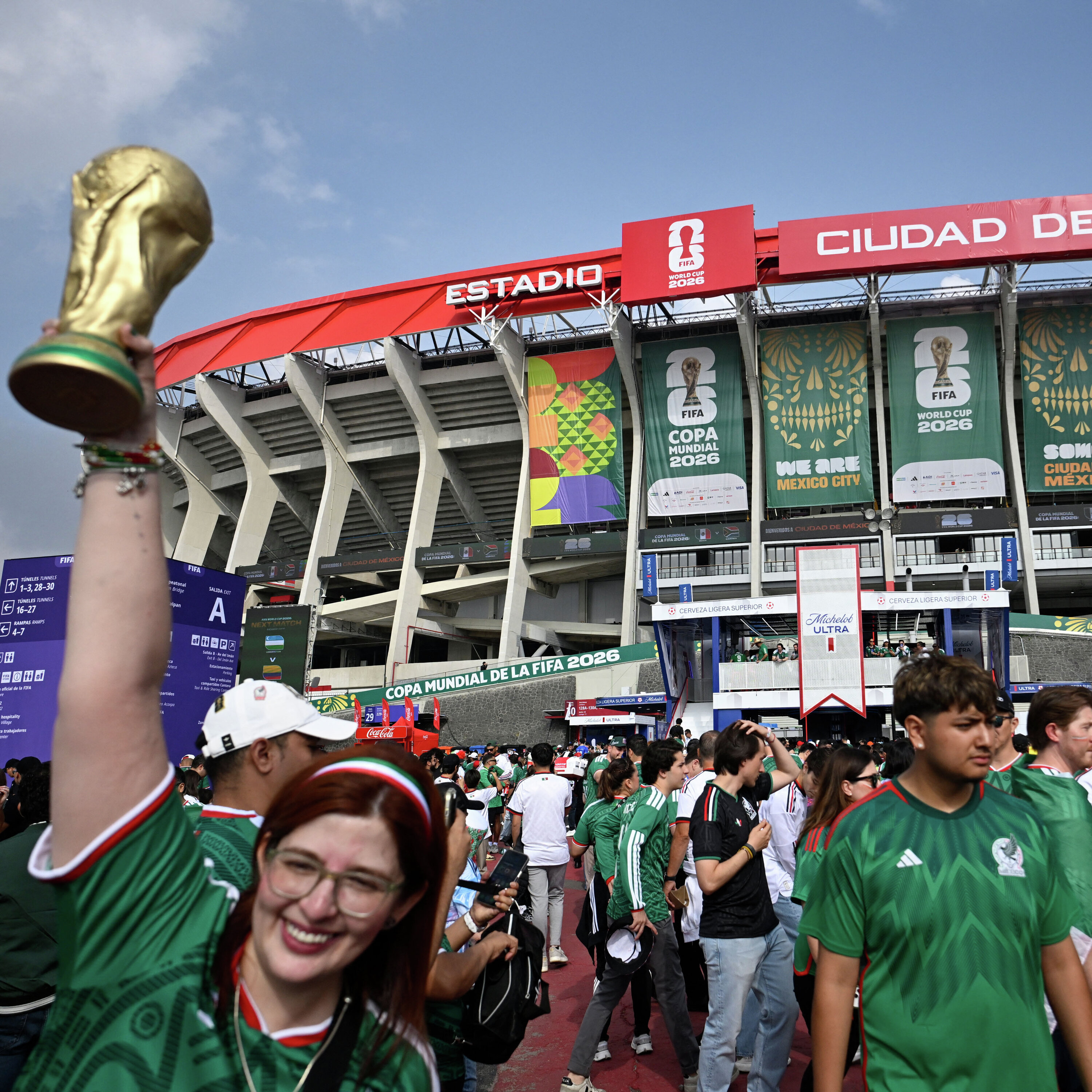
2026 FIFA World cup kicks off today in Mexico City.
- [01:52]
Andrew Zimbalist
Oh my God,
- [01:56]
IBM Representative
the biggest world.
- [01:58]
Vanessa Perdomo
I never thought that I would actually be going to FIFA World Cup. The World cup is in my backyard. In one way or another, I am
- [02:05]
Chase Bank Representative
going to be a part of it.
- [02:06]
David Gura
The tournament is expected to be historic.
- [02:09]
Vanessa Perdomo
It's by far the largest on a million different scales. Right on this fact that there's 48 teams instead of 32, 104 matches instead of 60 or so. So on that scale, it is going to be the biggest sporting event the world has ever seen outside of the Olympics.
- [02:28]
David Gura
Vanessa Perdomo covers the business of sports for Bloomberg. She says this year's cup also marks the first time FIFA's matches will be spread across three host countries, Mexico, Canada
- [02:38]
Interviewer
and the United States.
- [02:40]
Vanessa Perdomo
I think they like being able to say we have the biggest tournament in the world. This is the biggest sporting event ever. I think the way they will try and frame it is that we're getting more people involved, but I think the main thing we're going to see is more games, is more revenue. FIFA takes all the revenue from every single game that happens, so it's hard to say that's not the end goal there.
- [03:04]
David Gura
But that increase in revenue could come along with headaches for fans.
- [03:08]
Vanessa Perdomo
There is growing backlash tonight over the cost of ticket prices for the World Cup.
- [03:13]
Public Investing Representative
Why are the World Cup 2026 tickets so expensive?
- [03:17]
Vanessa Perdomo
Flights expensive. Yeah. Hotels expensive. Food expensive. And then Fif said, wait, let's make the tickets crazy, too.
- [03:27]
Andrew Zimbalist
Some of the ticket prices for the final match at MetLife Stadium in New Jersey just outside of New York City, some of them are going now for 15 or $20,000 per ticket.
- [03:38]
David Gura
That's economist Andrew Zimbalist. And the countries hosting the matches also face some big hurdles. Who stands to profit the most? And with ticket prices for marquee games in the tens of thousands of dollars, who is the people's game for?
- [03:53]
Andrew Zimbalist
Well, there's this mythology out there that FIFA uses and that the IOC uses for Olympics. And the mythology is that since the entire world is fascinated by the games and people around the entire world will be watching the games, streaming or on television, that there's a tremendous amount of exposure that your city gets from hosting the games. If there are a couple of billion people around the world who are tuned in to the game, then those couple of billion people will learn something about your city. Well, they might or they might not.
- [04:30]
David Gura
I'm David Gura and this is the big take from Bloomberg News today On the show, FIFA's big bet to turbocharge the 2026 World cup to make it the most profitable World cup in history. Who's getting rich and who's footing the bill? So the World cup is here.
- [04:48]
Interviewer
I'm curious if you're going to go and if there are any matches that are like top of mind for you that you're most excited about?
- [04:53]
Vanessa Perdomo
Well, I am going to go. I'm going to the first match in Philadelphia this weekend, which I'm really excited about. But also the first match at MetLife against Brazil. Morocco, I think is going to be one of the best big games of the group stage. It's going to be amazing.
- [05:08]
David Gura
This year's World cup is FIFA's biggest ever, with 50% more teams and more than 60% more matches. I asked Bloomberg's Vanessa Perdomo for her read on why FIFA decided to expand this year's tournament.
- [05:20]
Interviewer
Why did they make those changes? Is it just purely opportunistic, like they could add more games, more participants, or was there a need to kind of do that this time around?
- [05:28]
Vanessa Perdomo
There definitely wasn't a need for it. You know, I don't think anyone in the soccer landscape had asked for it. The players certainly hadn't asked for it. The federations didn't ask for it either. You know, you already have players who are. Their seasons are really long anyway. International soccer is a huge timeframe, so it wasn't needed. A lot of people liked the way the last few tournaments work, but this isn't the first time we've seen an expansion. We see expansions throughout time. And I think that it was just an opportunistic thing where they thought, let's add more people in. And there's both sides to it. Now you're letting in new nations, teams who have never been here before, which is really exciting. And I think that's part of what the World cup is about. But it was really opportunistic from FIFA to decide we want to expand the tournament. This is what we're seeing. With the club World cup added last year, it's just adding more tournaments to add more revenue for FIFA.
- [06:22]
Interviewer
FIFA saying this is going to be the most profitable World cup yet. How much money is this tournament expected to generate?
- [06:28]
Vanessa Perdomo
That's a very interesting question. And you know, this World cup is expected to generate anywhere between 11 and $13 billion. And it's hard to say why a nonprofit needs to generate that much money.
- [06:41]
Interviewer
Which FIFA is.
- [06:42]
Vanessa Perdomo
Which FIFA is a nonprofit. The last World cup generated about 5 to 6 billion dollars. So I think that what they will say is this goes into soccer federations around the world, and it's about growing the game around the world, and particularly when you come into the US Market, which they need to do a lot of growing the sport in the US to try and bring it up to
- [07:03]
Interviewer
the rest of the world as A
- [07:05]
David Gura
nonprofit for FIFA's stated mission is to promote the development of soccer around the world. The organization makes money in all kinds of ways, from marketing and licensing rights to valuable broadcast deals with companies like Fox and Telemundo. But another big way FIFA makes money is from ticket sales. And this year, FIFA introduced what they call variable pricing, a system that sent ticket prices through the roof.
- [07:30]
Interviewer
For the uninitiated, how does dynamic ticket pricing work?
- [07:33]
Vanessa Perdomo
Dynamic ticket pricing basically is a fluctuation system, right? It's. They had 500 million people say they wanted tickets for stage one of the world cup entry round, entry round of tickets. And those tickets were said to be starting at 65, $69. And by the time you have 500 million people saying they want those tickets, the prices skyrocket because of supply and demand.
- [07:57]
David Gura
That system has pushed the price of the cheapest tickets for some of the most popular matches into the four figures range. And the best seats are running at $10,000 or more. By contrast, a ticket to this year's Champions League final in Budapest was capped at €950, or roughly $1,100.
- [08:15]
Interviewer
What has the reaction been like from fans to using this model? I mean, I feel like I got the first emails about tickets now. It was a long time ago, many, many months ago. But has there been kind of a slow boil? Was there immediate outrage? How have fans reacted to using this system?
- [08:29]
Vanessa Perdomo
Oh, there was absolutely immediate outrage, especially immediate outrage from European fans who do not understand this ticket pricing. They do not understand what dynamic ticket pricing is. They have a very capped system in Europe. So there was a lot of people saying that they were planning on traveling over, but they can't afford it anymore because of, you know, the ticket pricing. Why would they go? So there was immediate outrage on that front. And then obviously, you know, us fans aren't happy either. You know, you, you'd thought you'd be able to take your family potentially to some of these games. The whole idea is that it's supposed to grow soccer in the US but if you can't take your family or whoever to games, you're kind of cutting people off there. But at the same time, when we look at tickets for the super bowl, when we look at tickets for the NBA Finals for a Taylor Swift concert, this is what we're used to in the US
- [09:22]
Interviewer
have policymakers and politicians kind of put their finger on this, this outrage? Have we seen them react to this in any way?
- [09:29]
Vanessa Perdomo
Oh, they definitely have. We've seen a lot of Congress people come up and step up and say we need to do something about the ticket pricing. There has been an investigation now into ticket pricing and we saw a report recently actually that someone had pointed out that there were huge groups of tickets available on secondary ticket pricing, which could be FIFA trying to sell them in a different way.
- [09:50]
Interviewer
In a way, really, there is an
- [09:52]
Vanessa Perdomo
investigation into it because, you know, they don't want empty stadiums. There is a risk that you are going to see stadiums and see the broadcast that they might not be empty, but they're not going to be as full as they would have initially thought.
- [10:09]
David Gura
Skyrocketing ticket prices could mean additional revenue for FIFA, but what could it mean for host countries preparing for an influx of soccer fans?
- [10:17]
Interviewer
That's next.
- [10:23]
IBM Representative
So there's a lot of noise about AI, but time's too tight for more promises. So let's talk about results at IBM, we work with our employees to integrate technology right into the systems they need. Now a global workforce of 300,000 can use AI to fill their HR questions, resolving 94% of common questions, not noise Proof of how we can help companies get smarter by putting AI where it actually pays off, deep in the work that moves the business. Let's create smarter Business IBM Support for
- [10:53]
Public Investing Representative
the show comes from Public. Public is an investing platform that offers access to stocks, options, bonds and crypto, and they've also integrated AI with tools that can assist investors in building customized portfolios. One of these tools is called Generated Assets. It allows you to turn your ideas into investable indexes. So let's say you're interested in something specific like biotech companies with high R and D spend small cap stocks with improving operating margins, or the S&P 500 minus high debt companies. Chances are there isn't an ETF that fits your exact criteria. But on Public you just type in a prompt and their AI screens thousands of stocks and builds a one of a kind index. You can even backtest it against the S&P 500. Then you can invest in a few clicks, go to public.com market and earn an uncapped 1% bonus when you transfer your portfolio. That's public.com market ad paid for by Public Holdings Brokerage Services by Public Investing member FINRA SIPC Advisory Services by Public Advisors SEC Registered Advisor crypto services by ZeroHash sample prompts are for illustrative purposes only, not investment advice. All investing involves risk of loss. See complete disclosures@public.com disclosures when you own
- [12:05]
Chase Bank Representative
your own business, you own every decision. Now own the card that rewards you for it. The Chase Sapphire Reserve for Business Card brings the best Sapphire Reserve benefits to business owners who expect hardworking rewards. Designed to meet the needs of business owners at scale, this Pay in Full card elevates your travel experience and offers premium benefits and value toward business services that will take your business to the next level, fuel your business and maximize rewards with 8x points on all purchases through Chase Travel, 3x points on social media and search engine advertising, annual partnership credits, and more. Make every journey more rewarding with a $300 annual travel credit and access to a network of airport lounges. Whether you're looking for pre flight productivity or time to rest and recharge. Chase Sapphire Reserved for business it's the card that gives back all you put in. Learn more@chase.com reserve business chase for Business make more of what's yours Accounts subject to credit approval Restrictions and limitations apply. Cards are issued by JPMorgan Chase Bank, NA Member, FDIC.
- [13:15]
David Gura
For FIFA, expanding the World cup and introducing dynamic ticket pricing might seem like a pretty good deal, but for cities, it's less cut and dry.
- [13:24]
Andrew Zimbalist
If you're a host city for the World cup, you sign a contract as a host city with FIFA, and that host contract requires the city to take care of all of these needs.
- [13:36]
David Gura
Andrew Zimbalist is an economist and a professor at Smith College who studies the business of sports.
- [13:41]
Andrew Zimbalist
Security is one of them. Transportation is another one. Sanitation is another one. Producing fan fests in the city is another major expense. So the host city agreement with FIFA says it's the city's responsibility to take care of all of this. FIFA is going to earn over this quadrennium, this four year cycle that the current World cup will take place in. FIFA's going to earn something like $13 billion. They're not sharing any of that loot with the costs of actual hosting.
- [14:15]
David Gura
In the US the federal government has stepped in to help shoulder some of these costs. The Trump administration has made $625 million available to US cities hosting world cup games. It's an investment that comes after more than a year of FIFA courting the president directly. The organization has leased an office in Trump Tower, and FIFA's president bestowed on Trump the first ever FIFA Peace Prize.
- [14:40]
Andrew Zimbalist
There are 11 host cities in the United States, so we're talking roughly about 60 million per city. That's a good chunk of money, but it's not nearly enough. On the cost side, the estimates are running between 100 million and $200 million per host city. I think some of those figures might be too conservative, but nonetheless, if you have on one side of the ledger a cost of $100 million to $200 million, on the other side of the ledger, you essentially have zero. Then that's the financial fallout. Some cities, like Chicago, were offered the opportunity to host games and turned it down because they realized they would be losing money on it.
- [15:19]
David Gura
With the exception of Russia in 2018, every World cup since 1964 has lost money.
- [15:26]
Andrew Zimbalist
Economists who have done independent scholarship on this question have virtually, with universal agreement, found that hosting the World cup games is not a boon to the local economy either. In the short run, in the long run.
- [15:42]
David Gura
So ask Bloomberg's Vanessa Perdomo why a country would do this.
- [15:46]
Vanessa Perdomo
I think for this tournament and for other things like the LA Olympics that are coming up, you want to be seen as, you know, the eyes of the world are on you. Which is really enticing. But I think it's the idea of, especially under President Trump, using sports as a beacon of light and a unifying hope, because it really is that. And I think it's just a way to be perceived better by the public.
- [16:15]
Interviewer
Sports diplomacy.
- [16:16]
Vanessa Perdomo
Sports diplomacy, exactly.
- [16:18]
Interviewer
We've talked a lot about the us. How about Canada and Mexico? How are they. How have they been preparing for this World cup and thinking about how to maybe avoid massive cost overruns in those two countries?
- [16:29]
Vanessa Perdomo
Mexico has been putting a lot of, you know, strain and thought into security for this tournament. Very big for them. But also I've heard in Mexico, they're also not happy with the way that things are being run and the way that ticket prices are being handled in Mexico as well, which is interesting because they actually have a completely different system, totally different than here, totally different than in the us. So I think fans across, you know, Mexico and Canada are also feeling the same sort of problems that we are, but they have a very different system because they have a lot less games. But I have talked to people in those areas, and they feel like this World cup is thought of as the US's World Cup. And we're just kind of here being talked about a little bit, but not a lot.
- [17:15]
Interviewer
A backdrop to all of this is the Trump administration's crackdown on immigration. And I'm curious, sort of how that has affected who's been able to get here to play and watch games. Who might be affected going forward. What do we know about that?
- [17:28]
Vanessa Perdomo
Well, we know that Iran has set up camp in Mexico instead of coming to play in the us. They have their games in the us, but because of the visa situation and because of the World cup, they decided to set up camp in Mexico and they're going to actually have to enter in and leave on the same day of. Of the game. You know, which is not something that's very common at all. Fans of certain countries like Iran and other countries are not allowed. They're simply not allowed. And they didn't really change that for fans. They have been more lenient about certain things. There is bonds that were put on countries for visas because one of the things they were worried about was people overseeing their welcome. That's very. That's been very apparent from the Trump administration. But they did take away some of the bonds for specific countries is $15,000 that people had to put up in order to come. But if you proved that you had a World cup ticket, you are now allowed to bypass that visa bond. But a lot of people who have been to every single World cup in their lifetime are not coming because they couldn't get visas on time or simply because they don't like the way this World cup is being handled. And I've heard that actually a lot some people aren't coming simply because they don't like the way this World cup is being handled by the US by FIFA.
- [18:48]
David Gura
What is this World cup kind of
- [18:49]
Interviewer
the way it's set up, the way tickets are allocated and priced. Tell you about the way this tournament's going to look going forward. When you look at future World Cups, how much is that going to be modeled over what we have here?
- [18:59]
Vanessa Perdomo
I think they will keep the size of the tournament the same, at least for now. I think, you know, we'll see 48 teams again in 2030. Definitely in, you know, 2027 with the women's World cup is going to be the first time they have the expanded field there. We will potentially, hopefully, fingers crossed for me because I'm a big, you know, soccer fan. But in 2031, host the women's World Cup. I think we'll see a very similar model there. But the problem is in other places, like in 2030 when you have the World cup returning to Europe, they have different systems there and they are capped. You know, you're not allowed to run the tournament the same way with ticket prices there. So it'll probably end up being a lot more affordable. Then we'll see it go back to a similar system there. But I think they're not going to let up on the revenue they're generating from this World Cup. There's no way FIFA's going to go back to $5 billion in revenue after generating over $11 billion.
- [20:05]
David Gura
This is the big take from Bloomberg News. I'm David Gura. To get more from the Big Take and unlimited access to all of bloomberg.com, subscribe today@bloomberg.com podcastoffer thanks for listening. We'll be back tomorrow.
- [20:30]
Venture Global Representative
Paramount is now the home of all your BET favorites.
- [20:33]
Vanessa Perdomo
What? Yes.
- [20:34]
Venture Global Representative
With all new episodes of Tyler Perry's Divorce Sisters you've always liked, a little drama. Plus a whole new world of movies like Gladiator 2. Now I will control an empire original series like the Shy.
- [20:46]
IBM Representative
Just make sure we protect each other.
- [20:47]
Venture Global Representative
And live sports like ufc. Welcome to the history new home, same family. Your BET favorites are now on Paramount Plus. Subscribe now. Ryan Reynolds here from Mint Mobile with a message for everyone paying big wireless way too much, please. For the love of everything good in this world stop with Mint. You can get premium wireless for just 15amonth. Of course, if you enjoy overpaying. No judgments. But that's weird. Okay, one judgment anyway. Give it a try@mintmobile.com Switch upfront payment
- [21:22]
Vanessa Perdomo
of $45 for three month plan equivalent to $15 per month required Intro rate first three months only, then full price plan options available, taxes and fees extra. See full terms@mintmobile.com A burst pipe?
- [21:31]
HomeServe Representative
A dead water heater, the AC calling it quits? Who do you call? HomeServe is an easy way to handle unexpected home repairs with plans covering stuff basic homeowners insurance usually won't. Instead of scrambling for a contractor, you make one call to get the repair process started. Join the millions of customers who trust home serve right now. Go to homeserve.com podcast for 50% less your first year. That's homeserve.com podcast savings compared to renewal price void in Florida.