Loading summary
Transcript61 lines
- [00:01]
IBM Executive
The thing about AI for business, it may not automatically fit the way your business works. At IBM, we've seen this firsthand. But by embedding AI across hr, IT and procurement processes, we've reduced costs by millions, slash repetitive tasks, and freed thousands of hours for strategic work. Now we're helping companies get smarter by putting AI where it actually pays off, deep in the work that moves the business. Let's create smarter business.
- [00:29]
Nathan Hager
IBM Never bet against American Grit or American Energy through innovation, Venture Global is not only building some of the largest energy facilities in the world right here in the United States, but delivering American energy at a fraction of the cost in a fraction of the time. So while others are busy talking, we're busy building. That's Venture Global. That's unstoppable energy.
- [01:00]
Public.com Advertiser
When you're running a business, the best days are the ones where priorities stay on track. For midsize and large companies, risk can affect multiple parts of the organization at once, from property and liability to cyber and regulatory challenges. At that level, managing risk becomes an ongoing discipline. At the Hartford, the focus is on helping businesses manage risk before it turns into something more disruptive and and when losses do happen, that work is paired with insurance coverage shaped by years of underwriting, risk engineering and claims experience. Learn more@thehartford.com riskmitigation policies provided by Hartford Fire Insurance Company and its property and casualty affiliates Hartford, Connecticut
- [01:43]
Bloomberg Audio Studios Announcer
Bloomberg Audio Studios Podcasts Radio news
- [01:50]
Wan Ha
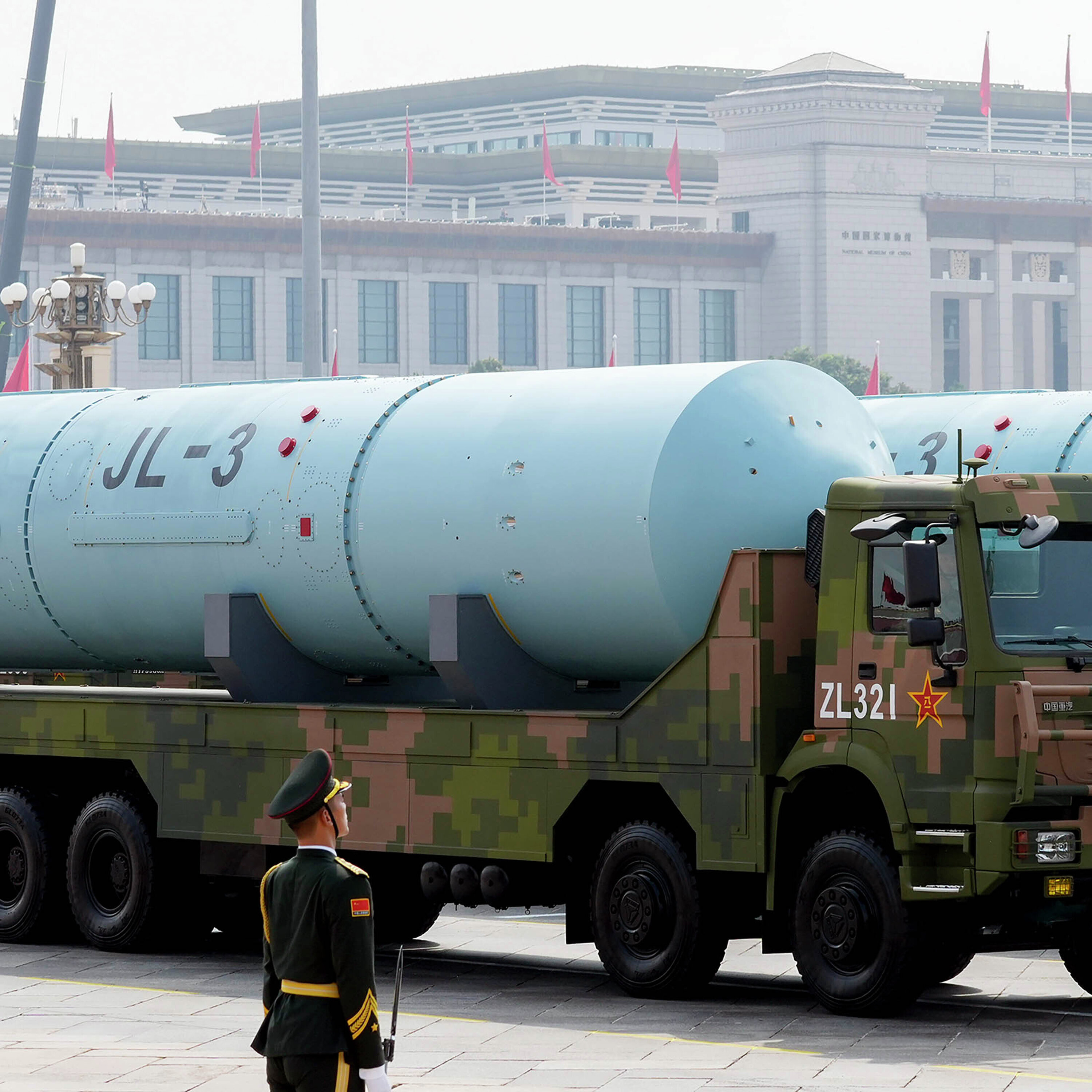
China test fired a long range ballistic missile into the Pacific Ocean on Monday, rattling its neighbors and putting a display of military capability on the global stage that hasn't been seen from Beijing in years.
- [02:08]
Rebecca Chung Wilkins
The missile it flew over the exclusive
- [02:10]
Nathan Hager
economic zones of the Federated States of Micronesia, Nauru and Kiribati and landed about 1,000 kilometers northeast of the Solomon Islands.
- [02:20]
Rebecca Chung Wilkins
Australia has been clear that this proposed test is in the context of a rapid military buildup by China, which is
- [02:28]
Wan Ha
Japan, Australia and New Zealand, who were all notified shortly before the launch, swiftly condemned the test, calling it concerning and destabilizing for the region.
- [02:39]
Rebecca Chung Wilkins
China was conducting the first full range test of a Chinese submarine launched ballistic missile.
- [02:48]
Wan Ha
Rebecca Chung Wilkins covers Asia government and politics for Bloomberg.
- [02:52]
Rebecca Chung Wilkins
It's not the first time that it's launched from a submarine, but it's the first full range test and it's the first time we've seen it launched into the Pacific at this distance and also publicly.
- [03:04]
Wan Ha
This past year has been a big one for China's military. A recent Bloomberg investigation showed that the country has ramped up its missile production last Year's missile buildup was was the biggest expansion since President Xi Jinping took office in 2013. Back in September, while reviewing a military parade, President Xi gave a clear directive. He said China's soldiers must accelerate the building of a world class military. And Rebecca says this week's missile launch was a highly public flex. One that signals Beijing believes it's on track to build one of the world's most powerful militaries.
- [03:53]
Rebecca Chung Wilkins
Xi's big ambition here is about having a so called modern military. And the target he has always set himself is the 100th anniversary of the PLA and that falls in 2027. It's not just the capabilities which are concerning, but the fact that Beijing appears to be projecting its power. So one big issue for neighboring countries and of course for the US is that this might be a new sort of normal.
- [04:28]
Wan Ha
This is the big tech Asia. From Bloomberg News, I'm Wan Ha. Every week we take you inside some of the world's biggest and most powerful economies and the markets, tycoons and businesses that drive this ever shifting region. Today on the show what a surprise missile test says about China's willingness to flex its military muscle and what a Bloomberg investigation reveals about Beijing's secretive defense sector and the country's growing arsenal. Now Rebecca, China just conducted a missile test that drew criticism from Japan, New Zealand, Australia and the United States. What was it testing and why did it set off so many alarm bells?
- [05:14]
Rebecca Chung Wilkins
So China essentially was conducting the first full range test of a Chinese submarine launched ballistic missile. So this is essentially a ballistic missile launched from a submarine and it landed in the Pacific, so about northeast of the Solomon Islands. And it's one, one of the more advanced so called SLBMs that it's tested. I think most experts would know and probably assume and understand that China has this capability but we haven't seen China do this before publicly. And so there is this interpretation that it's not just the capabilities which are concerning but the fact that this is some kind of strategic signal. And one part of that is essentially showing that they can apparently perhaps match the US which regularly tests these kinds of SLBMs.
- [06:04]
Wan Ha
And what did Beijing demonstrate about its capabilities with this test that we hadn't seen before?
- [06:11]
Rebecca Chung Wilkins
So essentially these types of ballistic missiles are one key part of China's fuller nuclear deterrent capability and fuller ability to hit back against any nuclear attack. So this is sometimes referred to as its second strike capability. And that's essentially a country's ability to retaliate if they were to be hit by A nuclear strike. And there are three key elements of that, right? So the sort of so called nuclear triad, you want to be able to respond from land, from sea and from the air. And so this specific leg of that triad is the sea based capability. And it is a cornerstone of nuclear deterrence. And so sort of like mutually assured destruction, right? It's a cornerstone as Beijing sees it and as other countries around the world see it, from deterring other countries from attacking you with nuclear power. It is also worth mentioning that testing your srbms at full range is something you would do as a normal part of operations to make sure that everything worked both for your own peace of mind and to establish deterrence. It's something the US does all the time.
- [07:20]
Wan Ha
Now we know this missile had a dummy warhead. What sort of a payload is it designed to carry and how far can this missile travel?
- [07:31]
Rebecca Chung Wilkins
So experts say this is likely a test of either a JL2 or this newer JL3 missile. Both of them are capable of carrying nuclear warheads. Chinese media has experts citing that it's probably a JL3 and that has an estimated range of about 9,000km. The big issue, of course, is that it could reach the continental U.S. now,
- [07:56]
Wan Ha
how rare is it for China to launch a missile test like this out into the open sea?
- [08:01]
Rebecca Chung Wilkins
So we have seen certain instances in the past, and the one that really comes to mind is back in 2024, China launched an intercontinental ballistic missile. So when we think back to that nuclear deterrence triad, this would be in that land category. And that was concerning back at the time. It was the first time they'd tested that kind of missile in that format for about four decades.
- [08:23]
Wan Ha
Let's talk a little bit about the timing here. This comes before the start of the NATO summit. The US is in the middle of the annual RIMPAC naval drills it hosts with more than dozen other countries around Hawaii. And that of course excludes China. And it's on the heels of a new alliance between Fiji and Australia. What kind of message is Beijing trying to send with this timing? You think so?
- [08:47]
Rebecca Chung Wilkins
This is a really interesting question because there's so much ambiguity and it is, to be frank, being really hotly contested by nuclear experts and political scientists at the moment. What does the timing mean? So on the one hand, this is a public event and clearly intended and expected to be visible. But there is another line of argument here, which is that China's military is essentially this huge, lumbering bureaucratic machine and that a test like this would have been months in the works possibly longer. So I think rather than sort of debating necessarily the significance of this day or this particular date right at this moment, particularly as you think of the NATO summit, the RIMPAC exercises, I think we can make a stronger argument that this is part of China's wider push for military readiness as well as this proud projection at this moment where all corners of the globe are essentially arming up.
- [09:46]
Wan Ha
Now, a spokesperson for China's Foreign Ministry has sought to downplay Monday's test, saying that Beijing warned relevant parties in advance and complied with international law. She added that the test wasn't directed at any country in particular and urged people following these developments to, quote, not over interpret this. Which countries in the region might see this though as a provocation.
- [10:11]
Rebecca Chung Wilkins
Japan has expressed its concerns over China's increasingly active military activities. Essentially it doesn't want ballistic missile launch training in its airspace or territory. And Australia and New Zealand have both also expressed that essentially this is an unwelcome development. New Zealand specifically has picked up on this concern that this may be a recurring pattern. And I do think it's important to note that while countries have expressed their concerns, China itself does maintain it has a no first use policy when it comes to nuclear and essentially it argues that nuclear deterrence from its point of view is actually adding to international stability.
- [10:53]
Wan Ha
I want to shift to the US for a bit. A State Department spokesperson condemned the launch saying, quote, at a time when the United States is working harder than ever to prevent nuclear proliferation, China is doing the opposite. Rebecca, it's not entirely clear that China even notified the US of this test. If that is indeed the case from a diplomatic standpoint, how problematic is it? If the US wasn't even informed, the
- [11:21]
Rebecca Chung Wilkins
US has clearly expressed its displeasure. And if indeed this is a JL3 missile, this is obviously also a very clear demonstration of a missile that U.S. experts say could target the continental U.S. it's also one worth considering that China may also be testing this sort of so called constructive relationship of strategic stability. That's the new phrasing that it's using to describe the relationship between China and the US After President Trump and presidency had that sit down, which for all intents and purposes did seem like a sort of reset of relations and at least putting relations on a more stable if not positive footing. I'm not necessarily sure that it's fair to say Beijing is doing this specifically to provoke the US or with knowledge that it is going to be a deliberate and a clear provocation. I think Beijing has shown that it is keen to stabilize ties and to keep ties stable. But the US is also going to be facing pressure from its allies in the region who are feeling this threat to and are feeling under threat.
- [12:29]
Wan Ha
After the break, what a Bloomberg investigation reveals about China's secretive missile program and how it fits into President Xi's military ambitions.
- [12:43]
Public.com Advertiser
Support for the show comes from public.com if you're actively involved in your portfolio, you probably catch yourself repeating the same actions. Buying the dip, manually, sweeping idle cash, putting on a hedge on Public you can now create AI agents that handle all these tasks on your behalf. Just describe what you want to do in plain English like if the Vix hits 25, buy a put option on the S&P 500 or if my cash balance goes above $20,000, move the excess into my direct index. You approve the workflow and your agent handles the risk, monitoring the market, watching for your conditions and executing your strategies exactly as defined. An investing platform driven by your intent, not just your clicks. You can also get full read and write access to your account via the public API. Go to public.com market and fund your account in five minutes or less. That's public.com market paid for by Public
- [13:39]
IBM Executive
Investing Brokerage Services by Open to the Public Investing Inc.
- [13:42]
Public.com Advertiser
Member FINRA and SIPC Advisory Services by Public Advisors LLC SEC registered advisor complete disclosures available@public.com disclosures want to pull off
- [13:53]
DSW Advertiser
the season's freshest trends? You just need the right shoes. That's where designer shoe warehouse comes in. Loving wide leg jeans. Pair them with sleek low profile sneakers. Obsessed with the sheer trend? Try it with mesh flats, Feeling Boho comfy sandals nail the whole free spirited thing. Find on trend shoes from the brands you love like Birkenstock, Nike, Adidas and more at DSW.
- [14:22]
Bloomberg Audio Studios Announcer
Not every sale happens at the register before AT&T business Wireless. Checking out customers on our mobile POS systems took too long. Basically a staring contest where everyone loses. It's crazy what people will say during an awkward silence. Now transactions are done before the silence takes hold. That means I can focus on the task at hand and make an extra sail or two. Sometimes I do miss the bonding time.
- [14:46]
Nathan Hager
Sometimes AT&T business Wireless Connecting Changes everything.
- [15:00]
Wan Ha
I'm back with Rebecca Chung Wilkins, who covers Asia, government and politics for Bloomberg. China is seemingly both expanding its missile program and being more open about that program. Rebecca, how does this fit into China's broader defense strategy?
- [15:16]
Rebecca Chung Wilkins
So I think there's two elements here. The first is thinking about the sub launch missiles and the key element is nuclear deterrence. More Broadly, I think there is of course, this issue of Taiwan front and center. Taiwan continues to be a real focal point for Beijing. Beijing sees it essentially as a renegade province of China that it is inevitably going to, as it would say, reunify with. And bolstering that missile capacity is critical to any attempt if China were to try and forcefully take Taiwan.
- [15:55]
Wan Ha
I want to talk a little bit about what we know about the missile program. Let's start with the publicly available information. Just how big is China's missile arsenal?
- [16:06]
Rebecca Chung Wilkins
China doesn't make the size of its arsenal public. And as you would expect, details about lots of its missile supply chain are pretty scarce. So the Pentagon estimates that China has at least 3,000 ballistic missiles and 300 ground launched cruise missiles as of 2024. And that is a pretty pretty big jump from their estimates from 2015. So about nearly 150% more ballistic missiles than they estimated they had back in 2015. That's essentially when the US started systematically disclosing their own estimates on Beijing's missile arsenal. But it is worth stressing they are only estimates.
- [16:50]
Wan Ha
If that's true, it's quite an expansion.
- [16:52]
Rebecca Chung Wilkins
Yes, we've seen a major expansion. And there are other signs too that kind of indicate this big ramp up.
- [17:00]
Wan Ha
Well, Bloomberg recently did an analysis of Chinese corporate filings that pointed to ramped up missile production.
- [17:07]
DSW Advertiser
Right.
- [17:07]
Wan Ha
Wonder if you can talk us through what that project found.
- [17:10]
Rebecca Chung Wilkins
Yes, so essentially we examined nearly 400 listed firms to basically try and get a look under the hood of China's missile program. And through that analysis, we found companies that were directly tied to the missile supply chain. So firms that produce things like for example, infrared sensors or stealth coatings. We found that China's missile production appears to be booming. And it's really all down to this sort of network of little known companies. So we found the number of firms that disclosed producing key missile components rose to about 80 last year. And if you compare that to Xi's first year in office, that's more than double. And then again, when you look and drill down within that group, we also saw that last year had the highest percentage of companies reporting record revenues of any during Xi's tenure. So again, our analysis indicates that that's a result of a surge in new orders that was intended to expand China's missile program.
- [18:14]
Wan Ha
Now, at the same time, China is also undergoing a massive cleanup of its military, the People's Liberation Army. Right. Tell us about Beijing's campaign. Why is President Xi shaking up the military leadership now?
- [18:28]
Rebecca Chung Wilkins
Essentially we are seeing the Biggest purge of top officers from the Chinese military in about half a century. But this anti corruption campaign actually kicked off as soon as Xi came into power and in many ways was a form of also ousting political rivals and cementing his own authority politically. But we then saw this military purge kick off really in full force in 2023. And we had these investigations into the rocket force and into this issue of military procure. And there were very, very high profile departures. So former defense ministers expelled from the party, as well as a host of other officials and senior leaders and other folks lower down the rungs. And it reached the Central Military Commission, which is essentially the body that oversees the pla. It's chaired by President Xi. And the real concern at the heart of it was military preparedness. Was this anxiety or this concern that if corruption is rampant with the military, that perhaps is concealing its real capabilities. So analysts are pretty conflicted about what is the intention and why the cleanup is really happening right now. On the one hand, you have some people that argue that this is coming from a place of confidence that she feels secure enough to reshuffle hand have this enormous amount of disruption at the highest levels of his military. But on the other hand you also have people that argue essentially the opposite, that the fact that he is having to reshuffle at the highest echelons of the military shows that there are vulnerabilities and weaknesses that he cannot ignore, particularly if any kind of military action is on the table. The unspoken anxiety that some experts point to is essentially this concern that if there is rampant corruption in the military, it may not perhaps be as ready or as prepared to take Taiwan by force.
- [20:43]
Wan Ha
What do you think in the end this says on a broader level about Xi and China's ambitions?
- [20:49]
Rebecca Chung Wilkins
I think Xi's big ambition here is about having a so called modern military. And the target he has always set himself is the 100th anniversary of the plaque and that falls in 2027. Now that has led to some speculation about 2027 and Beijing's plans for Taiwan in that year. Some argue that this deadline is perhaps the reason why there is this theory that Beijing may have intentions to invade or take Taiwan by force in that year. That question aside, this focus of having a modern military that essentially can take on and is a leader globally and of course unspoken that can rival the US has been a priority. And this deadline and this date has been a real focus of President Xi since he came to power. And when you think about the two superpowers of China and the US coming up against each other and China's rivalry with the us this is ultimately about having a military that, in simple terms could defeat the us.
- [22:13]
Wan Ha
This is the Big Take Asia from Bloomberg News. I'm wan ha to get more from the Big Take and unlimited access to all of bloomberg.com, subscribe today@bloomberg.com podcastoffer if you like the episode, make sure to follow and review the Big Take wherever you listen to podcasts. It really helps people find the show. Thanks for listening. See you next time.
- [22:42]
Optum Advertiser
Healthcare doesn't always work great. If you've ever waited on a refill or couldn't schedule an appointment, you get it. That's the kind of stuff Optum is changing. They're using data and technology to integrate patient care, pharmacy and everything else. So healthcare is connected, not complicated. What's that look like? Cheaper prescriptions that are easier to get and care that looks at the whole person how you need it. Optum is helping make healthcare work as one for everyone. Learn more at business.optum.com get the news you need in just 15 minutes.
- [23:14]
Nathan Hager
Start your day with welcome to Bloomberg Daybreak, the podcast with a global view on the stories that matter. I'm Nathan Hager.
- [23:20]
Optum Advertiser
And I'm Karen Moscow. Join us each morning for curated stories
- [23:24]
Rebecca Chung Wilkins
on current events, politics, business and foreign
- [23:27]
Nathan Hager
relations, plus one conversation on the day's biggest developments, all in just 15 minutes.
- [23:32]
Rebecca Chung Wilkins
Subscribe to Bloomberg Daybreak for a precise,
- [23:34]
Optum Advertiser
thoughtful take on the stories that matter.
- [23:36]
Nathan Hager
Listen to Bloomberg Daybreak each morning on Apple, Spotify, or anywhere you listen.
- [23:42]
DSW Advertiser
I've been hearing for decades that the markets can solve climate change. Today, we have more incentives for market solutions than ever. And emissions are rising on this season of drilled carbon cowboys, the story of three market solutions colliding in one multinational boondoggle.
- [23:59]
Public.com Advertiser
Gotta give Bruce and the guys credit. They're Republicans. They don't give a about any of this stuff.
- [24:04]
DSW Advertiser
Listen on the iHeartRadio app, Apple Podcasts, or wherever you get your podcasts.