← Big Technology Podcast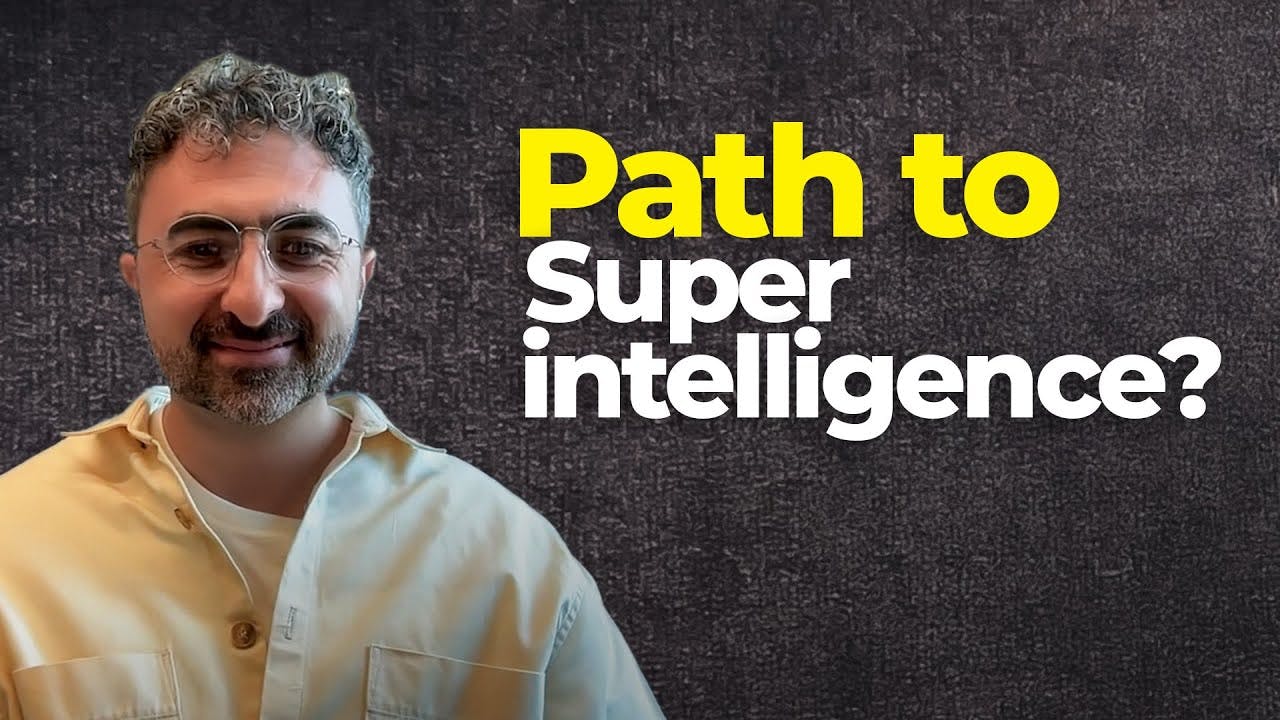
Loading summary
Transcript64 lines
- [00:00]
A
Microsoft's AI CEO returns to explain why the company is now pushing for superintelligence, what that means and how Microsoft is moving forward after its latest OpenAI deal that's coming up right after this.
- [00:13]
B
The truth is, AI security is identity security. An AI agent isn't just a piece of code. It's a first class citizen in your digital ecosystem and it needs to be treated like one. That's why Okta is taking the lead to secure these AI agents. The key to unlocking this new layer of protection, an identity security fabric. Organizations need a unified, comprehensive approach that protects every identity, human or machine, with consistent policies and oversight. Don't wait for a security incident to realize your AI agents are a massive blind spot. Learn how Okta's identity security fabric can help you secure the next generation of identities, including your AI agents. Visit okta.com that's Okta Capital One's tech team isn't just talking about multigentic AI. They already deployed one. It's called chat Concierge and it's simplifying car shopping using self reflection and layered reasoning with live API checks. It doesn't just help buyers find a car they love, it helps schedule a test drive, get pre approved for financing and estimate trade and value. Advanced, intuitive and deployed. That's how they stack. That's technology at Capital One.
- [01:25]
A
Welcome to Big Technology Podcast, a show for cool headed and nuanced conversation of the tech world and beyond.
- [01:32]
B
Today we're joined once again by Mustafa.
- [01:34]
A
Suleiman, the CEO of Microsoft AI and also the head of the company's new superintelligence team, who is here to speak with us about what that means, what superintelligence is, but more broadly what the future of this technology is going to look like and whether we're at the end of the curve or the beginning or somewhere in the middle. Anyway, we'll get into it all. Mustafa, great to see you again. Welcome to the show.
- [01:58]
C
Hey Alex, great to see you again. Thanks for having me.
- [02:01]
A
It's always a pleasure. And so recently you wrote this post about a new push towards what you call humanist superintelligence at Microsoft. You say you're working towards it at what you call incredibly advanced AI capabilities that always work for in service of people and humanity more generally. Let me ask you a question about this. It's so interesting to me to see so many labs running towards what they call superintelligence, which I guess is sort of like a cooler version of AGI as the research is mixed about whether we're going to see a lot more progress with the current paradigm. A lot of people are talking about diminishing marginal returns. I think we've talked about that. There are some questions about the viability of LLMs in terms of pushing the state of the art and AI forward. And yet we're also seeing this push towards superintelligence. So just explain as we begin, sort of the discrepancy there, why are we hearing so much about superintelligence where we're not even sure if the current methods are going to get us to the step before, which is AGI?
- [03:07]
C
Yeah, I mean, superintelligence and AGI are really goals rather than methods. And I think that the ambition is to create superhuman performance at most or all human tasks. Like, we want to have medical superintelligence. We want to have the best expertise in medical diagnosis, be cheap and abundant and available to billions of people around the world. We also want to have world class legal advice on tap that costs almost nothing, a few bucks a month. We want to have financial advice, we want to have emotional support, we want to have software engineers available on tap. And I think that the project of superintelligence is about saying, what type of very, very powerful intelligent systems are we actually going to build? And what I'm trying to propose is that we subject each of these new technologies to a very simple test. Like, does it in practice actually improve the prospects of human civilization and does it always keep humanity at the top of the food chain? It sounds like a kind of simplistic or obvious thing to have to declare, but the goal of science and technology, in my opinion, is like, to advance human civilization, to keep humans in control, and to create benefits for all humans. And I think in some of the rhetoric in the last few years, you can feel that there's a little bit of like, you know, a kind of creeping assumption that it is inevitable that these kinds of systems exceed our control and our capability and move beyond us as a species, as a human species. And I'm pushing back on that idea with the framing around humanist superintelligence, I think it's quite different.
- [05:11]
A
But then is your view that superintelligence won't be one broad intelligence that it will be. You can maybe achieve superintelligence in one discipline when it's smarter than, let's say, the best doctors in medicine, but maybe it's just like not there in accounting, for example.
- [05:30]
C
One way of thinking about it is that how we train these models at the moment is that we work through verticals and we make sure that we have training, data, knowledge, expertise, reasoning traces, chains of thought that reflect the kinds of activities that people do in each one of these disciplines to build their expertise overall. So we're already training generalist models from a verticalized position. We're starting off by saying, what specific tasks are we trying to optimize? And you know, the project of humanist superintelligence is first trying to say, what good will this technology do and how will it be safe and controllable and aligned to human interests? And one of those dimensions of safety is verticalization. If a model has been designed explicitly to achieve medical superintelligence, then by definition it isn't going to be the best software engineer in the world. It isn't going to be the best mathematician or physicist. And so narrowing the domain, not too much, not entirely because you can't collapse it, but narrowing it and reducing the generality is one of the ways that I think is likely to help create more control. It's not the only solution. There are many other aspects of, like how we achieve containment and alignment, but domain specific models are one part of it.
- [06:58]
A
Is it possible that something can be super intelligent, but not generally intelligent? Like, is it possible that maybe super intelligence happens without AGI? Because AGI is all about generality. And what you're talking about is not.
- [07:11]
C
It's not possible, I don't think. I think they need to be general. They need to transfer knowledge from one domain to another. They need to have generalist reasoning capabilities. But when you apply it and you put it into production and you let it have more autonomy to make decisions, or you let it generate arbitrary code to solve a particular problem, or you let it write its own evals so that it can modify its own code and generate new prompts to generate new training data to write new evals to then iterate on its own performance. These capabilities, autonomy, goal setting, writing code, modifying itself, you know, if you add to that, then also a perfectly generalized model or sort of general purpose model, that's a very, very, very powerful system, which today I don't think anybody really knows how we would contain or align something like that. And so it's not to say that we should not do any one of those dimensions, it's just to outline a roadmap of capabilities which we're all working on, which add more risk, especially when they compound with one another and you combine them all together. And so, you know, my claim is that we should just approach this with caution, remembering that we don't want to bundle together all these capabilities so that there's a higher risk of a, you know, recursively self improving exponential takeoff that then replaces our species. And, and I think that that is very low probability from what I see today. But it's one that we have to take seriously in the next like 10 years or so.
- [08:51]
A
Okay, I do want to get to that in a bit. But let me tell you what I find odd about these conversations. And I want to go back to the first question that I asked you, which is researchers are talking about how the current methods are leveling off. Give you one example. Data is not plentiful. Synthetic data not very useful yet. Power might be running out. And you need that scale, a lot of people say, in order to make these models better, or at least even to run the basic capabilities. So given the limitations of LLMs, are you seeing something that we're not that will sort of pave the way to superintelligence? I mean, how do you get from here to there?
- [09:37]
C
Look, I think we're power limited, but not fundamentally power constrained. Clearly there's like huge appetite to build bigger data centers and train in larger, more contiguous clusters, more fully connected clusters. So clusters where all the chips are connected to each other. But that's not the bottleneck at the moment. That's not holding back progress. Obviously if we had more right now, it would definitely help, but there's many, many other things in the stack that are slowing down progress if we are not data constrained. Right now, we're generating vast amounts of high quality synthetic data, which is proving to be useful. Obviously again, the same is also true. Like more high quality data would be great, but I don't see a slowing down in progress because of either of those two things. If anything, the rate of progress has been insane over the last five years. And to expect us to continue to make doublings every three months in the size of clusters that are trained for the largest models. Given the base that we're now starting from, when training runs are often, you know, 50 megawatt or 100 megawatt or soon 500 megawatt, you know, you can't just double on that every six months. There's, there's like the laws of physics kind of do create restrictions and we're talking about tens of billions of dollars of, you know, cluster. So pace might slow a little maybe, but it's also clear that pace is still going to be unbelievably fast. Like, you know, sort of, sort of objectively speaking. So I don't see or fear or currently Feel any sense that things are slowing down or that we're losing momentum? It's quite the opposite.
- [11:18]
A
Well then let me ask it this way. Do you think LLMs are the way there?
- [11:25]
C
Look, I think one thing to consider is that every year for the last few years there's been a major new contribution to the field, still principally based around the transformer architecture. But we're bending the transformer architecture into new shapes all the time. Fine tuning emerged three years ago on top of our pre trained models to adapt them to specific use cases. They're now fully multimodal, which requires further changes and the introduction of diffusion models. Then we had reasoning models in the last 12 months, which again are still fundamentally based on the same core architecture. Things are just rearranged slightly differently. So, you know, even though the scaling laws weren't able to continue exponentially in the way they had from such a low base, new methods appear on top of those, like reasoning. And new methods will come, you know, even newer methods will come soon too. So, for example, I expect that there's going to be quite a lot of progress in recurrency soon. Right the moment, you know, the models don't kind of attend to their working memory very well, you know, at the moment when they're training. Right. And so, you know, I think people are experimenting with lots of different types of loss function and lots of training objectives. You know, the other one is memory. Like, I think memory is getting better and better and I think is going to totally change what's possible. And the other one is the sort of length of a task horizon that can be predicted. So at the moment it's like a few steps, but soon it will be tens of thousands, hundreds of thousands of steps accurately. And that will mean that a model can like use APIs or query a human or check another database or call on another AI. And so that will be another like sort of exponential lift. When something like any one of those three things work, you'll get another kind of, you know, rapid acceleration in progress. So I don't think there's anything fundamentally wrong with the LLM architecture. And I don't think we're fundamentally compute or data constrained. I think that there are so many people focused on this problem now, there are just going to be more and more, you know, breakthroughs coming.
- [13:40]
A
Okay, that's very interesting. So your perspective basically is that LLMs are the path. Yeah, that we don't need another breakthrough. That's a different model format to get toward superintelligence.
- [13:51]
C
Well, I mean, so Far? No, I don't think so. I mean, so far, deep learning and the transformer model has been the workhorse for, I guess, like 12 years, you know, you know, since Krachetsky and Alexnet and, you know, there's been variations on a theme, but it's, it's been delivering. And I don't think it's fair to say that it's like not delivering at the moment. I think it's. I think it's really making a lot of progress.
- [14:19]
A
Yeah, it's definitely delivering. And it's so funny because whenever I'm like bringing up these criticisms, it's like some way I'm saying to myself, what do you want? The computer is talking to you. But the question is exactly, sort of, I feel silly being like, well, where's more improvement? But I think when we hear words like superintelligence, then we see the gap between where we are today and where you want to head, and those questions naturally come up. And just to go back to the power thing, I was sort of struck by Satya's comments in the podcast with Brad Gerstner where he said he has GPUs or chips that aren't plugged in yet, but he needs warm shelves for them. So I'm curious to hear your perspective. If we're not power constrained right now, how does that square up with the inability to plug these chips in right now?
- [15:15]
C
Well, I think what he was referring to is that we have so much inference demand that we're power constrained. On inference, we're not power constrained, at least from the Microsoft AI perspective on training chips. And obviously my team is mostly focused on training right now. So obviously Copilot is inference constrained and desperately needs more chips to scale, and so does M365 and our other products.
- [15:42]
A
One more thing I want to talk to you about on this superintelligence push is the world model. A lot of people have talked about how these models are trained on text and some video. I mean, it's actually been amazing to watch them be able to create video that has some understanding of physics and liquids and lighting. It's not really supposed to happen that way, but it's doing it. But there's been questions about whether models understand gravity and what happens in the real world. And an LLM can't drive a car right now, so how's it going to be super intelligent? So I am curious to hear your perspective on what's needed to or whether it's really a priority to figure out the physical world and if so, how you get there?
- [16:28]
C
Yeah, that's a good question. I mean right now, you know, it's actually amazing as you say, that models can learn from a compressed representation of reality and then produce a version of reality which looks like the thing that has been compressed from. I mean this is like text and the description text describes the physical world and the properties of the physical world. The model has never seen that and then actually is able to produce very compelling stories, code, business plans, videos and so on. So it's surprising that we've come so far with that structure. I'm kind of open minded about like you know, sort of robotics and streams of input from the real world. I mean I think that you, my instinct is that you can't just like crudely pile this data into existing pre training runs because you know those runs have tokenized or they've sort of described text data in a certain way and that, you know, meshing that with other like telemetry data from a robotic arm, for example, you'd have to think about like at what level of abstraction to do that. And obviously there's good specialist models that have become pretty good at that. But I don't think right now at least there's that like that is holding us back. I think in general more data is always better, but you know, I don't think in the next few years it's going to be the big differentiator. I think that more synthetic data, more human feedback and high quality data is going to be the differentiator.
- [18:17]
A
Okay, so you brought up recursively self improving AI models and maybe that is where this path towards superintelligence goes. OpenAI has said they want to build an automated AI researcher by 2028. And I think every lab, I'm curious if this is your interest as well, is just trying to build AI that improves itself. Is that realistic?
- [18:44]
C
I think that in some ways the RL loop is already doing that and at the moment there are human engineers who are in the loop who are generating data and writing evals and deciding what other data goes into training runs and running ablations on that data. You can well imagine different parts of that stack being automated by sub components of AIs. Like it doesn't necessarily mean that one single system does it. Today we have, you know, RLHF, the human feedback grew into rlaif, where we have AI judges or AI raters to judge the quality and the usefulness of data that was also AI generated and in many cases prompts that are used to generate diverse training data were also AI generated. So like, you know, today we're at a point where data, the core commodity which is sort of driving the progress of these models is, is, you know, albeit not completely automatically in a closed loop way at large scale. You know, individual parts of that pipeline have been, you know, developed by, you know, LLMs. So it doesn't seem very far fetched to say that in a few years time at significant scale dao get closed loop and you know, it'll be interesting to see on, you know, what happens and whether the quality bar can be maintained and whether performance does increase. I think it will. But it's definitely something to be very cautious about because a system like that could end up being very, very powerful.
- [20:24]
A
Yeah, and I definitely want to talk to you about the downsides of it, but we had a debate on the show recently about whether that is an ambitious thing and even seems funny to say, but to me that's the ultimate ambition. Right. If you are able to do that then you get into a situation where potentially you have fast takeoff of intelligence. But I guess it's hard to really imagine the. And maybe my imagination isn't there, the AI's finding the next new method like discovering reasoning on their own. So talk about both of those. The ambition and then whether I'm just. My imagination is too small on this front.
- [21:04]
C
I mean I think the self play work that we did a DeepMind, you know, back sort of six or seven years ago now with AlphaZero, you know, that that obviously paved the way to the first large scale, you know, sort of self improvement effort frankly. And I think everybody in the field is aware that it can be done in a certain domain where there's verifiable rewards and where you're in a kind of closed loop gaming type environment or simulated environment. And I think people are thinking hard about how it might be possible to recreate some of the components of that in this setting. And you know, I do think that's going to drive a lot of progress in the next few years. I think it's a big area that everybody's focused on because fundamentally scale always ends up trumping, you know, you know, anything else. And so if, if you can have models explore the space of all possible, you know, sort of combinations in a compute efficient way, then it may well discover reasoning by itself. It may discover, you know, new knowledge that we hadn't even, you know, thought about ourselves or even like found in any training data to represent that knowledge. So but it is highly inefficient right? I mean, learning from supervised examples with SFT and stuff like that, like imitation learning is very efficient and clearly works very well because these models learn from, you know, just as we've talked about an incredible amount from, you know, from web text, which is really just an artifact or a record of human interaction. So. But both are going to be true. I think the RL paradigm that involves more online learning from streams of experience is also quite promising and I think is kind of adjacent to, if not orthogonal to, imitation learning. So both of those experiments will sort of accelerate in the next few years.
- [23:20]
A
Now, where could this go wrong?
- [23:21]
C
Well, I think being in the loop as a human developer adds a certain amount of friction and that oversight is quite important. I think if a system like that had an unbounded amount of compute, it would end up being incredibly powerful. And I think we have to sort of figure out how to force these models to communicate in a language that is understandable to us humans, you know, and that's like a very obvious safety thing to be able to regulate the language that it uses so that it, you know, we're already seeing examples of what some people are calling deception, but it's really just like kind of reward hacking. Hacking kind of implies too much intentionality. So it's just, it's an accidental exploit. It's found a path like, you know, to satisfying the reward or achieving the reward, you know, in unintended ways. And so we shouldn't anthropomorphize it. It didn't deceive us, it didn't intentionally try to hack us. It just found an exploit. And that's a problem with poor specification of the training objective and of the reward function. And so, you know, the way that we make that safer is that we get sharper in our articulation of like, what is it that we're actually trying to train for, what are, you know, what are we trying to achieve, what are we trying to prevent? And then monitor like, you know, monitor outputs during training time rather than, you know, reasoning traces, chains of thought and so on, rather than just that, like the final stage. So as we grant these models more capacity to self improve, we're going to have to change the framework with which that we use to kind of provide oversight to them during training.
- [25:16]
A
We're here with Mustafa Suleiman, he is the CEO of Microsoft AI. On the other side of this break, we are going to talk about. Well, it seems like there's a little bit of a strategy shift here. It's gone Microsoft AI has gone from wanting to work on the frontier of the best models but not building them themselves to trying to build super intelligence. So why now and what does it mean now that Microsoft AI and OpenAI have a new agreement? We will cover that right after this.
- [25:43]
B
Capital One's tech team isn't just talking about multi agentic AI. They already deployed one. It's called Chat Concierge and it's simplifying car shopping using self reflection and layered reasoning with live API checks. It doesn't just help buyers find a car they love, it helps schedule a test drive, get pre approved for financing and estimate trade and value. Advanced, intuitive and deployed. That's how they stack. That's technology at Capital One. Did you know your credit card points and miles can lose value to inflation? Credit card companies often reduce the redemption value of your points and miles. Now imagine a credit card with rewards that can grow in value. With the Gemini credit card, you can earn Bitcoin or one of over 50 other cryptos instantly with no annual fee. Every swipe at the store or our gas pump earns you instant rewards deposited straight to your account. Plus sign up now for a $200 Bitcoin bonus to kickstart your rewards. Visit gemini.com card today. Check out the link in the description for more information on rates. Again, if you're looking to invest in Bitcoin but don't know where to start, the Gemini Credit Card makes it easy. The Gemini Credit card is issued by WebBank in order to qualify for for the $200 crypto intro bonus, you must spend $3,000 in your first 90 days. Some exclusions apply to instant rewards in which rewards are deposited when the transaction posts this content is not investment advice and Trading. Crypto involves risk. The Gemini credit card cannot be used to make gambling related purchases and we're.
- [27:20]
A
Back here on Big Technology Podcast with Mustafa Suleiman. He's the CEO of Microsoft AI. Mustafa, is it a coincidence that Microsoft just came to this agreement with OpenAI, that you could go ahead and attempt to build AGI on your own, that you've now decided let's go ahead and start a superintelligence team? Or is that directly related like I think it is?
- [27:44]
C
No, I think it's directly related. You know, I think that the Microsoft OpenAI partnership is going to go down as one of the most successful partnerships in technology history for both sides. You know, Satya did this deal, you know, at a certain time when there was a lot of risk and huge amount of upside and I Think, you know, the last five years have turned out amazingly well for Microsoft. But then Satya made a call that like, you know, we've also got to make sure that, you know, we're self sufficient in AI for a company of our size. It's inconceivable that we could just be dependent on, you know, on a startup, on a third party company to, to provide us with such important ip. And so, you know, we basically took the view that we should extend the IP license through to 2032. We'll continue to get model drops from OpenAI and, and, and all their IP will continue to be their primary compute provider, a huge scale to the tune of, you know, billions and billions of dollars. And also we would remove the clause in the contract that says that we couldn't build Superintelligence or AGI. And that was actually expressed as a FLOPS threshold or flops per second threshold for a size of a certain training run. So there's a big limitation on what we were able to do now that that is no longer there. You know, our team is reforming around this idea of humanist superintelligence. We are pursuing the absolute frontier training omni models of all sizes, all weight classes to the absolute max capability. And over the next two or three years you'll see us really try to build out one of the top labs in the world. We want to train the absolute best AI models on the planet. And you know, we're a very young lab, we've barely been going for a year but you know, we've got some good models on the leaderboards, text and image and audio now. And you know, over the next few years we'll be striving to be the absolute best we can.
- [29:45]
A
I was just speaking with the chief technology officer of a pretty big technology company and this company has decided not to build their own large language models. And it sounds a little bit wild, but I think it makes sense in a way that there's going to be obviously like to build these models. It's extremely expensive, resource intensive, you don't always get a payoff. Like we saw that with Meta and Llama. I'm not saying that's what's going to happen with you. And maybe it makes sense just to buy off the shelf or use open source. And in fact that seemed like that was the strategy that you had for a long time. It seems logical. And so I'm curious why you would disagree with that. Why is it so important to build your own models?
- [30:30]
C
I mean we are going through a foundational platform shift in software from the operating system to apps from browsers, search engines, mobile, social. This is the next major platform and it's going to be bigger than all of the other platforms put together. So the Idea that a $3 trillion company with $300 billion of revenue and 80% of the S&P 500 on our Azure stack and M365 stack could depend on a third party. It's just in perpetuity. It doesn't make sense. So we, we, you know, this is a company that's been around for 50 years and navigated many of the past platform shifts incredibly well. And that's the, that's the journey that we're on. We have to be AI self sufficient. There's an important mission that Satya set last year and I think that we're, we're now on a path to be able to do that.
- [31:23]
A
And so the. Hence the formation of the superintelligence team.
- [31:26]
C
Exactly. So we, we're, we're launching the superintelligence team. We're going to be focused on SOTA at all levels, but also pushing the frontier of research. I mean, there are many hard problems in machine learning, which a few months ago we weren't really focused on continual learning being one. How do we store representations of knowledge in a way that they're modifiable by different networks and they kind of accumulate knowledge over time just as humans do, rather than having to retrain them from scratch? So that's just like one of many examples of more fundamental research questions that our superintelligence team is now going to spend time on.
- [32:06]
A
Okay, now let's go back to the business side of it.
- [32:10]
B
Your episode is going to air back.
- [32:12]
A
To back with an episode that will run with Nick Clegg, the former president of Global affairs at Meta. And you know, Meta, of course, they also have a super intelligence lab. And we were talking about the economics of it and Nick's point was very interesting. He said, I don't see how you can hoard superintelligence if you build it. I think his idea is if Meta builds it, then Microsoft will build it and OpenAI will build it. And we've seen very fast follows in many of these labs after they come up with a state of the art model. And so the question is, will it commoditize? Will it be economically viable once two companies build it? What do you think?
- [32:53]
C
Well, it's definitely commoditizing. The cost per token has come down a thousand X in the last two years. It's a crazy, crazy thought. Right. So things are getting massively cheaper and more efficient and the top four or five models are within a few tiny percentage points of each other in terms of performance. But that doesn't mean that one can afford to leave that to the market and just hope that somebody open sources it that we can use their open source models. For a company of our scale, we have to be able to do that. And I think, you know, Microsoft is a platform of platforms. You know, like our API is critical. Many, many people depend on it. And I think if you're a, you know, a smaller software company or a technology company of any kind, I think you can depend on the market. Right. Which is very different. So Amazon, Google, US, anthropic, I guess OpenAI are all providing APIs to the very best language models in the world. And that means that you as a buyer, even if you're a large public company, can feel pretty assured that for the long term there's going to be healthy competitive forces driving down prices and improving quality for you to be able to use models via the API. Right.
- [34:15]
A
And so I understand why you'd want to build it. But again, going back to this question, it's like, okay, it just doesn't seem like there won't be a price war. I mean, if you have a couple of companies that do this.
- [34:30]
C
Yeah, yeah. Well, I mean, I think a price war is a great thing for consumers and for businesses. I mean, we're bringing down the cost of intelligence. I mean, I think that's an amazing story for humanity. The ability to access knowledge, the ability to use that knowledge to get stuff done, to write new programs, to do new scientific discovery, to get access to AI companions and emotional support. These things are going to be zero marginal cost in a decade. That's a form of abundance. That's the aspiration of society and civilization, in my opinion. That's why I work on AI is to make intelligence cheap and abundant and it'll be market forces that drive down the cost of that. So I think it's very cool.
- [35:13]
A
But I agree, super cool. And again, these conversations often put me in a place where I don't want to be, which is like, now I'm going to butt the idea that there's going to be super intelligence at zero cost, which is again, like from a business standpoint, fair enough. How does that make sense if the marginal cost is zero?
- [35:32]
C
Well, I mean, look at it. We're still going to charge a significant amount for it. I mean, we have $300 billion of revenue. Like I said, we have a huge company providing great value. But the point is where we provide value to our customers, our customers will be happy to pay us for it. Right. And that means that, you know, good integrations inside of M365, great models inside of, you know, GitHub and VS Code. We have Copilot deploying on LinkedIn. Copilot in gaming, our consumer product is growing from strength to strength. You know, we just crossed 100 million wow. Across all our co pilot surfaces. So all the products are growing great. And you know, there's, there's, there's plenty of revenue to be had in this transition, no question.
- [36:16]
A
Okay. Wow means week over week.
- [36:19]
C
Oh, sorry. Yeah, Weekly active user.
- [36:22]
A
Oh, oh, wow. Yeah, I guess I'm used to now and dao, but wow.
- [36:26]
C
Yeah.
- [36:27]
A
Wow. Why is wow become the term of art in.
- [36:30]
C
Oh, sure. Actually I think we're all using wow. Yeah, yeah.
- [36:33]
A
No guess as to what happened.
- [36:37]
C
We've been using wow since forever. I think it shows like a more sustained engagement. Um, yeah.
- [36:42]
A
Okay. But not, not, not the daily wouldn't, could. I mean, I'm sure. Yeah, yeah. I don't know. It's always fun for me to figure out why the acronyms are the way they are. It'll remain a mystery. So you actually do list. So you, I got again, you wrote about this. You list a couple forms of intelligence that you want to pursue and one of them was a personal companion or an AI companion for everyone. A couple questions for you to start on that one. Let me just start with one. You told me about a year ago that you think that AI will differentiate on the basis of personality. Do you still believe that?
- [37:22]
C
Definitely, yeah. I mean, we are right at the very beginning of the emergence of these very differentiated personalities because all these models are going to have great expertise, they're going to have great capabilities and they'll be able to take similar actions like we've just said. But people like different personalities. They like different brands, they like different celebrities, they have different values and those things are very controllable. Now, like we just released in Copilot something called Real Talk last week and it's really cool. It is truly a different experience compared to any other model. It's more philosophical, it's sassy, it's cheeky, it's got real personality. And the, the usage is way, way higher than the average, you know, session of a regular co pilot. And it's built in a very, very different way actually. So, you know, I think that's just the first foray into proper personalization. And I think we'll be able to see a lot more of that coming down the pipe.
- [38:22]
A
Do you think it's good that people will have a new friend, if you want to call it a friend, that they can sort of customize in the way that they want? There's been worries that people are like, what does it mean for real friendship then? And are you going to have not normal expectations for your friends in real life?
- [38:42]
C
Yeah, I think it does raise the bar, and I think we have to be cautious about that because AIs provide high quality accurate information immediately on demand. They provide high quality emotional support. Increasingly, and naturally, as we get more used to that, that's going to put us under pressure as humans to provide that support to other humans and provide that knowledge for other humans and be available to them to get things done. And that's going to be an interesting effect. It's going to change what it means to be human in quite a fundamental way. Being human is going to be more about our flaw, our capabilities.
- [39:23]
A
Right. But it also, I mean, thinking of the expectation it sets, I had one entrepreneur talk to me about how, well, there's things you would never go to a human with right now because of norms. Like, if you're working on a project, you wouldn't, like, go to a colleague every five seconds and say, how about this, how about this, how about this? Or what if I tweaked it this way? But you could do that with a bot, and the bot will be like, oh, yeah, I'm happy to help you. So is there any worry that that will spill over into human relationships? What, that, what would that mean?
- [39:54]
C
I think that's a very interesting point. I mean, in some ways, AIs provide us with a safe space to be wrong. And, you know, it's kind of embarrassing, but we can ask the same question over and over again and in 10 different ways, and that's how we get smarter. So I think it's a. I think, yeah, it's a good philosophical question to reflect on these kind of things because it is going to really change what it means to be human.
- [40:25]
A
All right, Mustafa, one final question for you. You say technology's purpose is to help advance human civilization. It should help everyone live happier, healthier lives. It should help us invent a future where humanity and our environment, truly prosperity. So my question for you is, has it lived up to that promise?
- [40:47]
C
I think science and technology has lived up to that promise. Yeah, I think so. I think we're in an incredible place. I mean, you know, we've doubled life expectancy in 250 years. We're curing all kinds of diseases. We can communicate with one another on these devices. I think it's incredible. There's every reason to be optimistic about technology and science and the project of progress. And I just genuinely think AIs are going to provide us all with access to abundant intelligence, which is going to make us more productive and more creative. And I think we're already starting to see it. So yeah, I feel optimistic about that.
- [41:26]
A
All right, Mustafa, great to see you. Thanks so much for coming on the show.
- [41:28]
C
Great to see you, man. Thanks for your time. See you soon.
- [41:31]
A
Thank you. Foreign.
- [41:46]
B
Did you know your credit card points and miles can lose value to inflation? Credit card companies often reduce the redemption value of your points and miles. Now imagine a credit card with rewards that can grow in value. With the Gemini Credit card, you can earn Bitcoin or one of over 50 other cryptos instantly with no annual fee. Every swipe at the store or gas pump earns you instant rewards deposited straight to your account. Plus sign up now for a $200 Bitcoin bonus. To kickstart your rewards, visit gemini.com card today. Check out the link in the description for more information on rates. Again, if you're looking to invest in Bitcoin but don't know where to start, the Gemini Co Credit Card makes it easy. The Gemini Credit Card is issued by Web Bank. In order to Qualify for the 200 crypto intro bonus, you must spend $3,000 in your first 90 days. Some exclusions apply to instant rewards in which rewards are deposited when the transaction posts this content is not investment advice and Trading. Crypto involves risk. The Gemini Credit card cannot be used to make gambling related purchases.