← Big Technology Podcast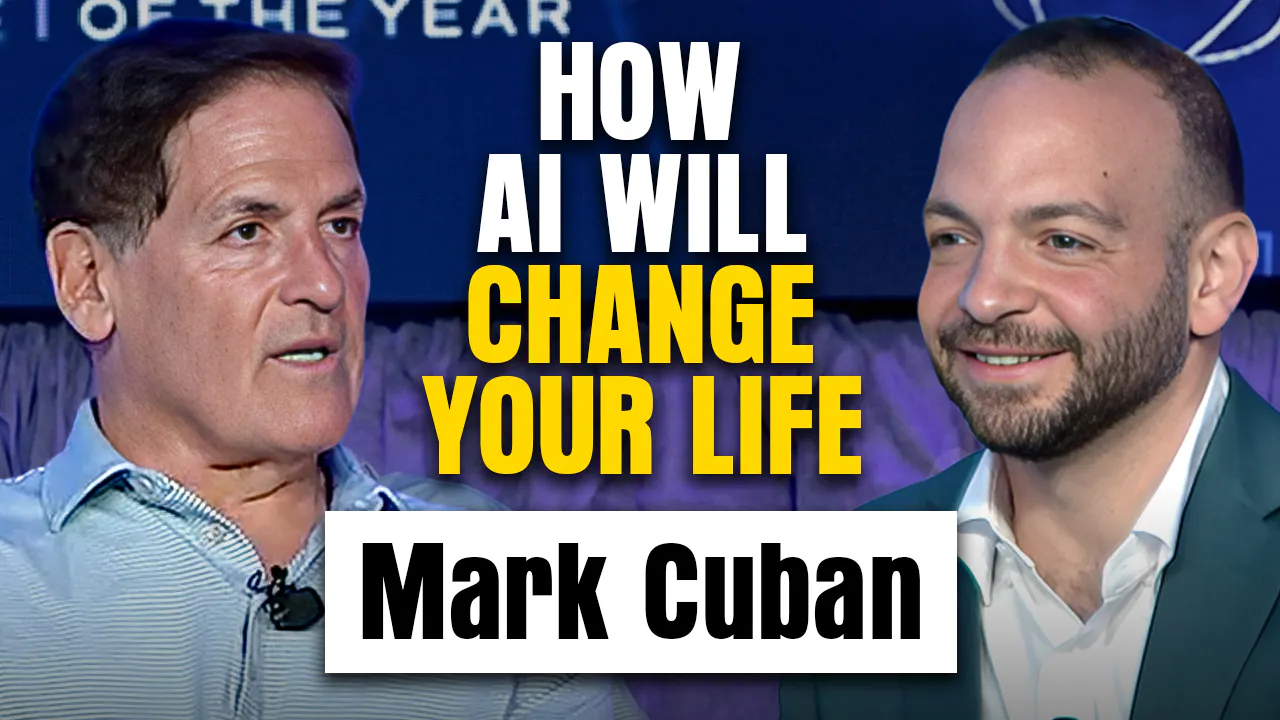
Big Technology Podcast
Mark Cuban: AI Hype vs. Reality, OpenAI's Wasting $1 Trillion, Lebron vs. Jordan
00:54:25
Loading summary
Transcript129 lines
- [00:00]
A
We have a great crowd today, and we're definitely going to be putting this on YouTube. So I want everybody at home to hear how many people we have in the crowd. Make some noise. I'm Alex Kantrowitz. I'm the host of Big Technology Podcast, and I'm thrilled to be here with Mark Cuban for a conversation about everything AI. Mark, welcome.
- [00:20]
B
Thanks for having me.
- [00:21]
A
So we're in the middle of this moment where we're hearing about the revolutionary power of artificial intelligence, where every day new capabilities are talked up.
- [00:30]
B
I mean, heard that. Yeah.
- [00:32]
A
And despite the hype, our day to day isn't changed very much. For most people, ChatGPT is something they might try one day or it's a better Google. And so an AI agent is something that, you know, sounds like it's in the future but isn't applicable today. So how would you describe the gap between the hype and the reality on the ground today?
- [00:54]
B
I don't think there is a gap. I really don't. I think, you know, if you're not using one of the large language models, whether it's Claude, my favorite, chatgpt, Grok Gemini. You know, from a business perspective, since this is a business and student audience, you're falling way behind that if you don't know what an agent is and you happen to work at a company or run a company, you're falling way behind. It's not that AI is smart. It's not like Arnold's walking through the door. It's not like it's going to take over everything. But like every other technology tool that preceded it, it's having a major impact. I mean, I've been around long enough. I remember selling PCs to people who said, we don't need PCs, and then talking to people saying, well, we're going to connect them together. I started a company to do that. Oh, we don't need them to connect. I'll just take this floppy disk and I'll just carry it over to this PC. Then the Internet came along. What's the Internet? Right. And we started a company, Audionet, which was the first streaming company. And people thought I was an idiot. They're like, wait, you want to be able to use this PC to listen to sports and radio and watch things? Dude, I'll just turn on the TV and radio. You're a moron. You know, and then it just goes on and on. And there was always a group of people that were first and always a group of people that were naysayers and the people that were first typically ended up getting further ahead. And I think it's the same with AI today.
- [02:26]
A
But hold on, because I was doing my research not as long ago as February 2026, you referred to AI as the equivalent of a hungover intern.
- [02:37]
B
Right, but that's agents. Right? Because what I was saying is, you know what an agent can do when you put together an agent, whether you're using Cloudbot, you know, cloud, whatever it may be, it does all the tedious work that you don't want to do and all the stuff that you hope to get to at some point, but you just don't have the time to get to. So you get that intern probably hungover Friday morning, and that's there any other kind, Right? And so it's easy to get all those things done using an agent. And you can let the intern stay out later, come to work later, because this agent's gonna work 24 7.
- [03:21]
A
Now, you've expressed some skepticism along the way. I definitely agree with you. Right now we're in this moment where you need to be using it. But I think you've been measured in your comments around AI in a way that some of the hype folks have not. And so here's the question to you. You've been on the front lines of a couple of big changes in technology. The way that the AI labs describe this moment is that it is an exponential. It's kind of an amazing thing where the horizon seems to be getting closer as opposed to further away. And they say that makes it different than our typical technology shifts, which tend to progress linearly. They're important, but linear. Where do you fall exponential or linear?
- [03:59]
B
Exponential.
- [04:00]
A
What makes you say that?
- [04:01]
B
Just because it's changing so rapidly when it's linear, like back in the PC days, or even your first iPhones, remember, you know, you got your first iPhone and then you heard the news about a new iPhone, and that iPhone was faster, more memory, you know, better connectivity. And that's linear, right? You know, just one step and you wait for the next step, and then you get to a point of diminishing returns where, like, you don't really care. Whatever number iPhone we're at, right? It's good, but there's nothing so stupendous that's going to make you have to replace with AI, the changes are just coming so fast. You know, the agentic AI, the ability to do so many different things. If you're trying to program being able for anybody, like, you know, for cost plus drugs, I like to compare our pricing to Other competitors. And I just went in the cloud and said, okay, go to these three sites. Here's a list of all the products that cost plus drugs carry. Take the top 25 most expensive. And every week I want to report comparing the prices. 12 minutes later, boom. I mean, that was inconceivable. You know, I can write software. At least I could write software, you know, or you can hire somebody. You can even get a drunk intern to do it. But to be able to tell Claude on your phone to do it and say, I want to be able to click on it from any browser and, you know, it's going to have a couple issues. No, this isn't right. Reformat this. I'd rather have it this way. And then it just goes back and forth. I mean, that's nonlinear. That's up and to the right.
- [05:33]
A
Tell me about the origin of this drunk intern metaphor. Have you encountered many of them? Were you one?
- [05:40]
B
Where's my beer? That's after this. You know what? There's not a lot of jobs I've excelled at. That was one of them.
- [05:53]
A
If this is an exponential, then what? Where does it go? I mean, with the iPhone, you're right, it plateaued. IPhone, 15, 16, 17, they all look the same. I was speaking about the iPhone earlier today, and I couldn't really even mention what number it was.
- [06:07]
B
I couldn't remember either. Just here as we were talking about it. Yeah.
- [06:09]
A
And it's my job to follow this, but if AI is not going to
- [06:12]
B
have that, you need a drunk intern
- [06:15]
A
or Claude or cloud. So if AI is not going to have that plateau moment, where does this moment of technology go?
- [06:23]
B
Well, to say it won't have a plateau moment, that's different than it being up into the right and exponential. It can continue to grow exponentially and have. And change its features and change what it can do and change how it can change business and education in so many different industries and then reach a plateau. Because like right now, if you just showed. If you. I'll give you the perfect example where a. AI isn't so good. Right? So if you were blind and you had a CNI dog and you were at an intersection, and you also had a cell phone with AI and you had the choice between using your seeing eye dog or holding up the phone and having it guide you. I'm taking the seeing eye dog every time. Right. When you think about AI today and for the foreseeable future, it's not gonna know the. It's not gonna know the consequences of its actions, right? So if you take, if you ask ChatGPT or any of them something and it gives you bad advice, it has no idea whether you know what's gonna happen because you took that bad advice. But a two year old that is on a high chair with a sippy cup, he knows, or she knows that when she pushes that sippy cup off the high chair, mom's gonna come running and the baby's gonna be laughing its ass off, right? It knows the outcome of its recommendation or if it knows the consequences of its actions. And that's a big difference, right? And so while AI can help as a business tool, it's not the end all, be all, where it's gonna make all decisions for you. And I think right now we're bifurcating into two types of ways or two types of people that use AI. People who use AI so they don't have to learn anything, and people who use AI so they can learn everything. And you see the difference there, right? I can go to AI and like, okay, I just gotta come up with this report for my boss. Here it is, I put it in, it gives me the research, I give them a report, okay, or oh my God, my boss is interested in this subject they want to report. I want to learn everything I can and I want to be able to use AI, you know, different AIs so that I can come up with the best resolution for what they're looking to accomplish. I know I want to learn more about all this so I can be better prepared to help them in the future. And so people get nervous when people just use it, you know, just without, without caring or trying to learn. But, but the opportunity to use it to learn it is the great democratizer of knowledge like we've never seen before. I mean, you can be an 8 year old in the worst set of circumstances in your home, in the worst neighborhood anywhere in the world. But if you have access to a smartphone and you can go to chatgpt.com or whatever it is, or Claude AI, you have access to every library, pretty much every professor, every, every consultant, and you can ask any question. Oh, okay, I'm interested in learning about social studies, the Constitution, right, whatever. And you can just say teach me and it'll put together a program to teach you. And so those people who are using AI to learn, those people who are curious and just want to keep on learning more, AI is phenomenal. You, you will always have an edge over everybody around you. If you're using AI to learn, if you're just using it just so you don't have to do the work and it's your drunk intern. I mean, you're going to struggle.
- [10:07]
A
One quick tangent. Actually, the way that AI gets better is very much like that child with the sippy cup. The way that these labs have been training these models is you have a desired behavior. When it gets there, you reward it. When it doesn't get there, you don't punish it, but you don't give it the reward. And it learns to optimize. So maybe it can even press.
- [10:25]
B
But you have to define the optimization that you're looking for. You have to define all the goals, you have to know all the context, right? In real life, we don't know the context for everything. We don't know what's coming next, we don't know how soon it's going to happen. So not all that information is available to train those models. It's like if you just went to any AI right now and, and just said, tell me how the war in Iran is going to turn out. Whatever it says is, you know, I mean, pretty much useless. And that's the way things, you know. So you have to know where the output of the AI you're using matches what you're trying to accomplish and just training on it. Like for games, it's easy, right, because there's only so many permutations. But for real life, trying to figure out the context, it's much harder and it's not nearly as valuable. But within business, we tend to have goals, we tend to have standards, we tend to have a path, we have processes. And AI is a great tool to allow you to optimize all those things.
- [11:28]
A
So how do you build a business today given the tools at your disposal? Is it different than the way you would build a business previously? I mean, ultimately you're trying to serve customers. Do you mean one of the big things that businesses are thinking through is do I turn over my customer service to these GPT models? But I imagine there's more fundamental questions about the way to build a business.
- [11:48]
B
Well, it just depends where you are in your business life cycle or are you starting a business if you already have a business? The things that you've considered outsourcing, you know, your customer center, your customer call centers, whatever it may be AI agents are perfect for. So you can do that. The stuff you would give to an internal AI agents are perfect for. But if you have a big business, let's just, you know, we hear a lot of stories about huge public companies that they try they spend a lot of money to try to implement AI and it doesn't really get them a return on investment. And people say, why if AI is so great? Because you already are running your business the way you've always run it. And in order to take advantage of AI, to answer your question, you have to reformulate your business completely to build it on AI. It's the difference between running a business before PCs and computers and running a business after PCs and computers. You would do it completely differently. So starting a company now using AI, I mean, there's so many different ways that you can use, you know, agentic AI to do processes and optimize steps that you would take to communicate and then just to use the large language models to learn. And learn is not the right word. But to accelerate things, using a ChatGPT or Claude is a great typing hack. Like, we got a letter, an email today from somebody asking us something about our website, and there was a legal question associated with it. So I just cut and paste the whole thing into Claude and I put a link to the website and I said, show me all my options that I should consider here. You know, there's just. Those are things. Normally in the past, I'd be like, okay, I got to get the lawyer, I got to get the person in charge of this group. And that group. Now I just run it through, learn it, understand it myself, then I go to that person and say, is this correct? And I spend far less with the lawyer, I spend less time optimizing with the person ahead of this group, et cetera. So when you're working to create a business and you're going to take a completely different path using AI than you would pre AI.
- [13:58]
A
And that's why, you know, to go back to the question I led with, why I think we're seeing this moment where we have this technology, it's very powerful, but it's not permeated through everything we do. It's because what you just described, that process you described of there's a question, I'm going to go to Claude and maybe not a lawyer and work through my options. It's great if you're at the top of the company. In a company that, as you mentioned, has done things their way for a very long time, there's a certain granting of entrepreneurialness that needs to happen for somebody who's not at the top to be able to go in and say, I'm gonna actually use this technology to its potential. I'm gonna be entrepreneurial within our established company.
- [14:43]
B
Absolutely. Like I told my daughter who's getting ready to graduate from college and get a job at a consulting company, you have to learn this, because if you're not the person who knows you know how to do vibe coding or do all these different things with agents and cloud, somebody, whoever does, is going to take your place.
- [15:00]
A
But isn't the bigger question whether her boss will allow her to do that?
- [15:03]
B
No. I mean, it is and it isn't. Right. You have to know, you have to use this as a tool and understand how it works so that as it evolves over time, it can change and changes rapidly. You. You can keep up with it. If your boss enables you to use that extra knowledge, great. If they don't enable you to use that extra knowledge. Extra knowledge, they're not gonna be your boss very long. And if the CEO doesn't understand that, he's not or she's not gonna be the CEO very long. And if they still keep that CEO who's not using AI to get ahead, you tell me so I can start a company to kick their. Because that's reality, right? Literally. You know, when we started streaming and I gave you the example, it was like, okay, it's a PC now, and it's a pain to be able to stream, but someday you'll just click and the video will come on. And that's what we have today. You know, you have to be able to see where your business could go and understand how to use the tools available and, you know, kind of guess where those tools may take you. And particularly now with AI going back to what I said earlier, the biggest challenge for a company is going to be for the CEO to make that decision that, hey, we're going to have to blow up a lot of what we do to recreate our company, because if we don't, somebody else will, and they'll have far less expense to be able to do it. When it's all said and done over the next three years, there's going to be two types of companies. Those who are great at AI and those who went out of business.
- [16:42]
A
Yeah, we could see a new era of competitiveness because there already is. The door is going to be open to those to come in and disrupt.
- [16:50]
B
It's already wide open. Like, you know, all of you could take out your phone right now, go to your favorite large language model, come up with an idea for a business. Instead of coming to me and saying, mark, is this a good idea? Just go in and say, okay, here's what I want to do. Here's what I think. We write me a business plan and tell me the good, the bad and the ugly about this, how I should finance it, what the economics should be. Ten minutes later, I'll give you an example. When I was trying to teach myself how to learn how to use this stuff, I'm like, okay, I want to come up with an idea and see if I could take it all the way to a patent. I'm like, okay, so let's imagine that we have a button that we'll put on a shirt that has a video camera in it that can record 24 hours, then automatically send it to my phone or my PC, everything that it's recorded and save that for me. And I want a bill of material. I want a business plan and a bill of materials and a patent application. 12 minutes. Now, was it all absolutely correct? No. But I went back and said, okay, get me vendors and approximate cost for all the bill of materials. You know, everything that goes into a product minutes. And not that it had to be perfect, but think about what had to be done before. If I wanted to go through the same process, I'd go to Google. Hey, I'm thinking about putting this together. Da da da, da da. And then you see 15 blue links and seven of them would be garbage like you just wasted your time on. And then you'd have to go through all of them. Now it, you know, composites it and puts it together in the way, in the format that you want based off of everything that's been trained on and you know, the probability that this is the best response. And any questions you have, you just ask it. Just the idea that this is a time hack, right? Just a time saving tool that allows you to fill your curiosity and learn things that's insanely valuable for anybody everywhere. Like I said, you could be a 6 year old, you can be a 96 year old trying to figure something out, and this is just going to allow you to do it more quickly. And as it gets more powerful, it's just going to have more impact.
- [18:52]
A
But on the other side of that, like, isn't it a little bit annoying to you as an investor because of the slop coming in? You're someone who famously answers your email. I'm sure you've noticed something in your inbox that many of us have noticed in our inbox, which is that a lot of inbound emails now sound exactly the same. Yeah, of course they're written by ChatGPT,
- [19:11]
B
but I created an agent to look for those things. Seriously, you know, you get a lot of garbage, but I always got a lot of garbage. Like, you know, on Shark Tank it was like people would have the next Uber, the next this, the next that. Right? Because people just copy. And I've always said, you know, if there's a thousand people doing the same thing, why do you want to be the thousand and first? Or if there's 10,000, why do you want to be the 10,000? The first? And it's going to be the same thing with AI. Now, is there going to be kind of a revolt against AI at some level? Yeah, of course. You know, we're going to do more things in person because there is so much in AI you're going to be more interested in face to face communications, face to face events than you are going to be in the 10,000th email that said, Hey, I saw your LinkedIn profile and you look really smart and I think you'd be great for this job. I'm like, you're sending that to me,
- [20:08]
A
Seriously, did you take it?
- [20:13]
B
I applied. But you know, so yeah, there will be things that are just over the top, but that's because we're in the beginning. Everybody's trying different things because look, you know, a lot of that is going to go right into our spam folder and you know, just like we get spam calls still that are just annoying as hell, right? But at least it tells you now it's spam, whereas before it didn't. And it'll. Same thing will happen with your email inbox and you know, other communication tools where AI will advance far enough, where it'll be a little battle between their AI trying to get through the spam bot or the spam filters. And you know, that's just part of the progression.
- [20:53]
A
I mean, isn't a cool part of this though, that while it does definitely democratize the ability for people to pitch an email, it also creates the ability for people who may not be technical to build that minimum viable product and actually show it to you.
- [21:06]
B
Oh yeah, for sure.
- [21:07]
A
For all the people that I'm sure you've heard and we've all heard, hey, I have an idea for an app. Do you have a developer? No, no, you're never going to do it, but now you're really able to do it because you can have Claude build 100%.
- [21:19]
B
That's probably even worse, right? It's just like, hey, I need to raise some money so I can go out and get a developer.
- [21:23]
A
Not anymore.
- [21:24]
B
Not anymore, right? And if you're not willing or don't realize that you could just go to Claude and learn this stuff and do an mv, a minimum viable product, then you're not somebody I'm going to invest in. Because the number one skill set that you can have as an entrepreneur or as an employee or as a student is curiosity. And there's no better way to fill that curiosity and keep you curious than AI. I mean, when I was younger, I used to go into bookstores and sit in the aisles and look at the books I couldn't afford to buy or go to a library. Same thing. Or then, you know, like many of us, when the Internet hit, it'd be like, okay, and you find yourself going down these rabbit holes on the Internet. But now it's just so much faster, easier, more direct. It's just a better tool that you need to learn how to use.
- [22:14]
A
There's one more side to this, which is that the market has been really punishing software stocks because it's become that easy to build software. And I think one of the things investors have realized is that all this software that's being built is built to scale, but never perfectly suits people's needs. There's a lot of room to disrupt them. With AI, potentially you can have a lot more custom software and they're calling it the SaaS apocalypse.
- [22:40]
B
Yeah.
- [22:40]
A
Do you think that that sell off is justified?
- [22:43]
B
Yes and no. Depends on the company. Right.
- [22:46]
A
So that's great because I'd love to know who is safe and who's going
- [22:50]
B
to be disrupting it's. Yeah. Anyways, I won't go there.
- [22:57]
A
How about, how about just the fundamentals of these type of companies?
- [23:01]
B
Yeah. No, what you got to have is some unique IP that is not shared. Okay, so I'll give you an example. A company called DocuSign. Right. All the things that we sign. You would think that's easy because there's other companies, Adobe and others who do all that. But it's a global company and all the laws associated with signing a legal document are different from city to city to state to state to country to country. And you have to know all those things. So that's a unique differentiation that you don't want to be dependent on the AI having rights. So that's an example.
- [23:34]
A
Pushback on that quickly is just that the AI agent will go and find the local regulation and put it.
- [23:39]
B
No, but you've got to go, you got to know where to send it to go first and what are you going to have it do? Spider? Every single municipality and every City in every state in every country. It's just not. It'll cost you more in tokens than it will in value. Right. Than you'll get in value. So I think if a company has IP that as part of their software, and when I say ip, not just, okay, our software is a little better, faster, cheaper, more. This is a database of things that you can't get anywhere else, that they're not making available to. To AI to be trained on. It's their classified information. Then I think those companies will be okay if they just, you know, if they're just sold by the seat and it's just a standardized piece of software, they're in deep doo doo.
- [24:29]
A
Yeah. When Anthropic, there was a rumor that Anthropic was going to release a legal plugin, the entire legal section of the software just went poof.
- [24:40]
B
Yep.
- [24:41]
A
But that does seem like, though, you know, maybe that's ill advice because they do have proprietary information.
- [24:45]
B
Well, yes or no, because all those are coming from PACER and other legal databases. Right.
- [24:49]
A
Okay.
- [24:49]
B
Right. Because I talked to a law firm because I was having the same type of conversation, and I'm like, can we take all of your legal briefs and this and that and train from them like, no, they're proprietary, A and B, they're specific to a client and we can't share them. But that's for a law firm. That's not for the legal software.
- [25:10]
A
Okay. Speaking of another area that may be disrupted, consulting is a field that people talk about often as things like implementation and doing business analysis. You can prompt that. And one shot, it probably. You mentioned that your daughter is going to work in consulting. Did you bless that?
- [25:26]
B
Yeah, of course. Yeah.
- [25:27]
A
Because there's going to be a period
- [25:30]
B
of time where somebody's got to help all these companies figure out how to implement AI and not only implement it, but how to reformulate their businesses. Because how you do things in an AI universe where you're trying to be more productive, more profitable, more competitive, it's going to be completely different. The hardest challenge for those CEOs is am I willing to blow up my business knowing that my stock price could collapse in the meantime, and then I have to build it up. And working for a consulting firm, you know, you hopefully have a lot of proprietary information that will allow you to guide that CEO as they go through that process.
- [26:11]
A
Let's talk briefly about the business of AI. I mean, from someone in your perspective, looking at the amount of investment that's gone on to these AI companies must be fascinating. OpenAI recently announced that they had raised 110 billion, which is I think 3x largest IPO ever. They're planning to spend more than a trillion dollars in infrastructure in the coming years. I'd love to hear your perspective, not on the spend, but on the return needed to make those numbers work.
- [26:39]
B
They'll never get it. Yeah, they're just shitting away that money. I mean, at scale, right? It's not that AI is not going to work, but look at Apple, right? They haven't spent next to anything, but they've got a foundation where they can just plug and play into their devices. But there's a lot of FUD being put out about the spending. Right. We're going to spend a trillion dollars because we need all this data center capacity. Well, the data center, the ability to process is going to get faster, cheaper, right. And it's going to happen faster and quicker than people expect. And so I think a lot of the numbers that they're throwing out there aren't going to come to fruition, you know, which is why I say they're full of shit. It's not going to happen. But those who have just gone all in, some of them are spending more cash than they have available. And I understand why. I just don't. I'm not convinced that for all of them it's going to work. And the reason why is we don't know if the business of foundational models, the ChatGPT, Geminis, Grok, Clyde, et cetera, is going to be like the streaming industry where there's one leader and a bunch of players that make money or some that make money at least or search where there's effectively one company. And so they need to raise all the money, go all in and spend everything they can kiss all the rings they need to kiss around the world in hopes of being the one. Right? It sounds like Morpheus. I'm just waiting for Keanu Reeves to walk through the door. But. So it's going to be very difficult, but I don't think it's going to pay off the way they expect.
- [28:23]
A
They're shitting away the money.
- [28:24]
B
At scale, it's hard to do, right, but, but if you don't go all in like that, you can't keep on raising money because as it zigs and zags and you don't know where it's all going to go. If you're not still raising money, you're in deeper trouble because you don't know if you know, if you're not the winner, then you've got problems.
- [28:46]
A
Let me make their case for the sake of argument. Right now, what we're seeing is a moment in the AI world where the training has gotten to the point where it's less general. You focus on certain capabilities. We know Anthropic has Focused on code, OpenAI has focused on health care and it's difficult to train up really well in those disciplines. And you see things like Anthropic leading in code for a while because they've gotten good at it. So that to me would suggest that there's going to be multiple winners here potentially.
- [29:17]
B
But in a vertical, right, like Healthcare, you've got open evidence, and open evidence is actually going out and buying intellectual property. ChatGPT is not. And what you're starting to see happen, and will happen even more and more, if you own intellectual property, you're going to see fewer people applying for patents, because the minute you apply for the patent, it's available to everybody, which means every model can train on it. And when I go and talk via Cost Plus Drugs, when I go talk to hospitals and research campuses and schools, I tell them, do not publish, sell. Because the minute you publish, even though it makes you feel better and you seem like you're, you know, a bigger dog in the community, all of a sudden, every model has been trained on it and you've given away your advantage. And so when it comes to verticals, I don't know necessarily that they're going to be able to buy the IP they need going forward. Now what Claude is doing with Anthropic and focusing on programming, that's not really a vertical per se, right? Because it can be used for everything. It's really, really process driven and I think that's smart. But when I look at the other ones, you know, Gemini has an advantage because Google Search is Gemini, right? And so now when you do a search, it comes back with an AI response and it can sell ads around it. I don't know what meta is going to do, I don't know what OpenAI is going to do when it's all said and done, because I don't think you, you know, you can, I always call like healthcare for OpenAI is a feature, it's not a product. And it's a feature that, you know, open evidence has that others can add just by going spending money on the ip. And then you've got the bigger problem. Like when you think about all these foundational models today and for the next few years, they are built on text and Pictures, not really video. They don't know what's happening in the real world. You know, like I mentioned the example about the 2 year old pushing the sippy cup off the high chair. Like it doesn't understand that, you know, it's not, if you fed it all kinds of information, it's not going to be able to come up with E equals MC squared. And to do that you have to understand physics, you have to understand the world. And so we're going from large language models, I think, to what's called a worldview approach where it's built on, on understanding the physics of the world and being able to take video and understand it. I invested in one company that's putting up satellites that can look at different materials and tell you what the makeup of those natural materials are. Is it wood, is it rock, whatever is in there, like a spectrograph. And I think that's going to supersede a lot of what Claude and Grok, et cetera are doing. And so we haven't seen the best of AI in my opinion. And it's going to just get crazier and crazier and crazier. And so when you think about all these people spending all this money, look, if you're the best programming, you know, like Claude is, and that's your niche, great. But I don't know what the niche of these other ones are, do you?
- [32:30]
A
No, but I don't think there's going to. I mean, if you have three, four winners, maybe that works. Maybe three. Any more than that, it's going to be difficult.
- [32:38]
B
I mean it's like then you, then you're just a website. Yep. You know, you're just an app and you just spent a trillion dollars to be an app.
- [32:48]
A
It's a lot of money. Let me ask. Most leaders know how work is supposed to happen, but when it comes to how it actually gets done day to day across tools, teams and handoffs, they're mostly guessing. That's exactly the problem. Scribe Optimize was built to solve. Trusted by over 80,000 enterprises, including nearly half of the Fortune 500. It gives leaders a live view into how work is really happening across approved business apps without interviews, manual process mapping or extra effort from the team. And because it's continuously analyzing real workflow activity, the insights stay current instead of going stale the moment a process changes. You can see which workflows are happening, where time is going and which tool rules are involved. It automatically surfaces top issues, explains why they're happening, and even recommends ways to fix them with estimated time savings. And importantly, it's built with privacy in mind so activities only captured in admin approved business apps and user level data is anonymized by default. The kind of visibility that used to take months. Now it's just always on. If you're ready to stop guessing and start seeing, Visit Scribe How BigTech that's S C R I B E How slash BigTech look, if you have a kid in school right now, you know the drill. What you take 20 minutes of homework, ends up taking two hours and usually ends in tears. And every good tutor? Well, they're fully booked for months. This episode is brought to you by Brainly. Brainly is an AI powered personal tutor built by educators, not a general purpose chatbot. It doesn't just give your kid the answer, it walks them through step by step explanations so they actually understand the material. It learns how your child learns, diagnoses when they're struggling, and builds a personalized learning path in under three minutes. Available 247 there's no scheduling headaches and it's just a fraction of the cost of a private tutor. Finals are coming. Build your teen's study plan now. It only takes minutes. Go to brainly.com bigtech to get 50% off your first Brainly subscription with my code Big Tech that's B R a I n l-y.com BigTech
- [34:54]
B
Insurance isn't one size fits all, and shopping for it shouldn't feel like squeezing into something that just doesn't fit. That's why drivers have enjoyed Progressive's Name your price tool for years. With the Name your price tool, you tell them what you want to pay and they show you options that fit your budget enough hunting for discounts, trying to calculate rates, and tinkering with coverages. Maybe you're picking out your very first policy. Or maybe you're just looking for something that works better for you and your family. Either way, they make it simple to see your options. No guesswork, no surprises. Ready to see how easy and fun shopping for car insurance can be? Visit progressive.com and give the name your price Tool a try Take the stress out of shopping and find coverage that fits your life on your terms. Progressive Casualty Insurance Company and affiliates Price and coverage match limited by state law
- [35:47]
A
Let me ask you this. You're someone who gained national notoriety by being somewhat brash and rebelling against the establishment.
- [35:59]
B
Fuck that. No way
- [36:04]
A
do you see some of yourself in the Sam Altman's and Dario ammo days in the world.
- [36:09]
B
Maybe a little bit In Dario, but not in Sam.
- [36:13]
A
Say more.
- [36:14]
B
I mean, you know, Dario now is trying to scare the shit out of everybody, right? But that's part of raising money. Like when we had Broadcast.com back in the day, I would say we're just going to replace cable and satellite and all that. And it didn't. You know, but I kept on saying it's going to be in a couple years. And here we are 30 years later, and we've kind of gotten there. And so I think Dario is pushing forward with Claude. And I think, to your point, their niche with programming and agents, I think is going to hold for them. And I think they understand they may have to move to a worldview environment as well. Sam is all over the map, and I think that'll backfire on him. I just think, you know, they were. They were buying up 40% of this company's memory chips, right? And they just backed out of that. You can't do that. You know, at some point, people stopped trusting and stopped wanting to do business. You know, they just moved him to. From their safety committee, I think, to something else. I forget all the details. I think, you know, Sam's accomplished a bunch of amazing things, but I just. I just don't see how either one of them communicating is beneficial for anything but raising money.
- [37:26]
A
So what would your advice to them be they're doing.
- [37:29]
B
They don't need my advice at all. Right. You know, you just. It's so early. It's just changing so fast. You know, you've just got to stay connected to as many people as possible. But I think you have to be more involved at lower levels as opposed to just programmers. I think, you know, Apple's got it right in some respect in that everybody with an iPhone, it's going to be plug and play to plug in whichever model you want. And they'll have the ability at some point just to swap those out for their own if they choose, or just like they've done with search engines, just pay or be paid. But I think you want to be where kids are and showing schools how to use AI so that it's a democratizer for education and a tool for teachers to be able to, you know, bring out that light in every student's eyes. You know, right now, when we teach, we teach by the teachers there. They create a syllabus. They've got the subject matter, and then we teach everybody the same way, and then we explain. Expect all the students to know the answers to the same questions, and teachers freak out. Well, all you gotta do is use AI. Well, the only reason teachers are getting it wrong is because they're asking the same questions of every student in the class. Right? They're telling them to respond with an essay and every student has to respond the same essay. When in reality, when I talk to teachers, what I tell them is, you know, the hard part for you is to get, to get that light in the kids eyes to get them really excited about a subject matter. And with AI, you can personalize teaching to each individual student. You can say, okay, we're doing American history and we're learning about the Constitution. You know, little Billy in sixth grade or whatever is maybe isn't as good a student. So I'm going to, we're going to put together a project under AI that works at Billy's speed, reformulates the questions for Billy based off of his answers and then keeps the teacher and parents in the loop so they can see where little Billy is. And hopefully you can even mod, you know, you can even have the AI personalize it so that it's more interesting. You know, if they like learning more about Paul Revere than George Washington, right? You spend more time on Paul Revere to get them more interesting. You can personalize any topic with AI. You can't do it with traditional teaching. And going back to your question about, you know, for the AI companies, I think by getting students and teachers excited about the capabilities and features of the AI that you're offering creates a foundation that, that they'll, they'll want to be comfortable with and they'll stick with those tools for a long, long time.
- [40:20]
A
Isn't it true that personalized tutoring to a student gets you like two standard deviations above the mean?
- [40:28]
B
I don't know. I don't know. It just makes sense to me.
- [40:31]
A
Someone knows. No, you're just laughing. Okay, it's true. From the front row. I'm pretty sure that's the numbers. And it's just been inaccessible to so many people because of the expense. But if you're able to scale that
- [40:42]
B
up, look, there's time, there's expense, and you know, there's a difference between homework. Teacher said, I got to write an essay on da da da da da, I've got to memorize da da da da da. And going home and on your laptop or phone or whatever you have available to you, having it presented to you with graphics and videos in a manner that's fun, that the AI will understand if you're engaged with it or not. And think about that. It's not hard for an AI to know if you're answering the question questions. It's not hard to know if you're giving more engaged answers. It's not hard to know if you're asking a question or if the student's asking questions. And it's not hard to grade the test and grade the answers and then summarize it for the teacher and the parent. And then the parent can make suggestions based off of conversations. The teacher can. That's just so unique. And not only does it apply to teachers, kids, it applies to teaching anybody anything. Like, if you've ever used NotebookLM from Google, where you could take it and turn whatever you want, a training manual into a podcast. I mean, it is insane, you know, doing a training podcast for, you know, how you want to keep the restrooms at the American Airlines center clean. And it's a man and a woman. Yeah, we were just talking. We were just going through the training manual of how to keep the restrooms Spleen. This is really interesting, the tools that they use. I mean, whoever thought that this mop could work like this, and they made it so, you know, because kids, particularly today, don't want to read. But if you put it in a podcast format, particularly one that makes you crack up when you're talking about mops, and you know how you're going to mix the solution to clean the floors, it's just changed how we educate people. And if you take advantage of that and learn from it and learn to apply it, you will have an advantage as an entrepreneur, as a CEO, as a manager, as an employee, as a student, as a teacher, all across the board. If you don't and you're doing it the same old way, you get the same old shit back.
- [42:54]
A
Who does succeed then? In this era?
- [42:59]
B
Whoever learns how to use the tools the best. You know, whoever realizes that the operative word, the key word in an AI world is iterate. As the tools change, you have to keep on iterating, iterating continuously recognizing you're going to get smarter, your employees are getting smarter, your customers are going to get smarter. Agents will communicate and they'll be smarter. So you have to be in a position, you know, as an entrepreneur. I. I know what it's like to have thresholds that we all try to hit. I got a half a million in sales. Yeah. Get a million in sales.
- [43:32]
A
Yeah.
- [43:33]
B
Making money. Yeah. Up to 10 employees. Yeah. You know, and then you start thinking, okay, I've got this company down, my customers like me, but in an AI universe, you have more so than now. You're gonna have to continuously improve because anybody can come in and, and say they're not improving, they don't understand this new tool. And so I'm going to go compete with them. You have to continuously iterate.
- [43:58]
A
I've heard from more than a few people that they believe that using these tools inside their companies effectively means they're training the AI to replace them. That has to be true in some cases. What do you think happens in the broader job picture here? When this technology continues to ramp, there's
- [44:16]
B
going to be displacement, there's no question about it. But I'm not. You're one of those people that says jobs will be optional, like Elon Musk said, or 50% unemployment. No, there's things that if all you're doing is reformatting or you're answering a question yes or no, then there's a good chance you're going to be replaced by AI. But if you're a critical thinker, there's always going to be a need for you. If you're a critical thinker and you understand how to use the tools so that you understand where best to use an agent, where best not to use an agent, where best to do, you know, vibe coding, where best not to. And you, it's like I was telling my daughter, if you learn how to use these tools and you know how to think critically, you're curious. So you're always learning, you're always going to have a job because as I said, AI doesn't know the consequences of its action. You don't want to be in a business where you just trust the AI and it's like, oh shit, what did it do? You know, you need somebody as the buffer to understand how, where, when and why or why not to use it. And that's critical and that's middle management in a lot of cases. And on top of that you're going to have companies like I said earlier, that have to completely reinvent themselves. And when you reinvent themselves, you're going to need people that understand how to make all these pieces work. And so I, you know, I think there's going to be plenty of jobs. And if I'm coming out of school, you know, my daughter already has a job. But if, if I'm 16 years old, if I was graduating today, or if I was a 16 year old looking for a job, I would learn everything there is to know about AI and I would go to small and medium sized businesses and say, let me walk in the door and all those things, things that you know you need to do, that are the bottom of your to do list. Let me show you how to use an agent to do those things because in doing so you'll be more productive, more competitive, you'll make more money. And I'll give you a perfect example. One of my shark tank companies is called Rebel Cheese Dot Com. They sell vegan cheese and they ship it all over the world. And they like a lot of companies that ship products in boxes. You know, for those of you who ship stuff in boxes, you know, there's different size boxes for ups, dhl, whatever. And you start in one zone and there's a different price to ship to a different zone. And then you also probably know that they don't ever charge you the right price. Does that sound familiar?
- [46:45]
A
Yep.
- [46:46]
B
So what this company did, Rebel Cheese, was they wrote a little agent that took a picture of the box when it's getting ready to ship and determine the size, looked at the price, look at the invoice, took a picture of the invoice, compared them and when they were different, created the credit request and are saving $50,000 a month. And it's all automated, they don't have to touch it. That's where the agents come in and come in handy. And you have to know how to implement that. And most small to medium sized businesses don't understand that yet. And they don't have the resources to just, you know, allocate people. They don't have the drunk interns or the sober interns, you know, to just go do it. And anybody here who's an entrepreneur knows there's always 10 things that you say you're going to do on Saturday and never get to, right? Always. And so that's what agents are good for. And so if I were graduating today, I'd be going to these small, medium sized companies charging them 100 bucks an hour. And then because these, these AI systems, they kind of drift each time there's a new version. Those agents might need to be modified. You have recurring income coming in all the time to go back and check and keep them up to date. There are so many kids that took one computer class, you know, know some python that are going to be able to go do these things there. There's not gonna be any shortage of jobs there. But if you try to work in a big company and become an entry level software engineer or programmer, that's just not going to be there. Because the people in that big company, they're going to have Training, they're going to have older people that are in the IT department that know they need to learn this stuff and those, those entry level jobs aren't going to be there.
- [48:30]
A
Don't worry, they're not hiring for those anymore.
- [48:31]
B
No, they're not. Yeah, they're not.
- [48:33]
A
Yeah. Just to clarify, I was thinking that your, your advice was the young person should go, go in house at a company, at a small company. But why wouldn't they then just start their own business and sell that as a service?
- [48:48]
B
Well, when I say go to small, medium sized businesses, that's what I'm saying, right? Go to them and you know, show them just like the Rebel Cheese example, show them all the things that are too tedious, time consuming and you don't know if you'll get a return. If you hire somebody to do it. That's a of perfect thing to bring somebody in for a few hours, a few weeks and have them define agents and allow the agents to do the work for you. And if you don't know what an agent is, you're going to have to learn. And the best way to learn is go to ChatGPT or whatever and just type in there, I'm new to all this AI stuff. What the hell is an agent? Can you teach me how to do it and how it impact my business? And let me just tell you part two to that. If you as a CEO, manager, employee are afraid to have a heart to heart conversation with your AI, you're going to fall behind. And I'm not talking about your personal life. Is this the right guy for me? Should I date this girl? No, but what I'm saying is it's weird to start talking to your AI and then having a conversation and, and then thinking, okay, I need to have another one. Like I have mine hooked up in my car and I'll be driving and talking to it and I'll catch myself. This is strange, but you've got to get over that hesitancy because like some of the answers, like I gave you the patent thing, they're good answers. Like you were like, that shit is good. And if you don't have, if you don't do that, if you don't allow yourself to feel comfortable with that, your career, your business life is going to be a lot more difficult if you
- [50:30]
A
speak with it a lot. Mark, do you ever ask it, can you tell me my deepest, darkest secrets or psychoanalyze me?
- [50:36]
B
I can be weird.
- [50:41]
A
They're counting us down a couple more minutes.
- [50:43]
B
Sure.
- [50:44]
A
Do you guys Want a couple more minutes? All right, good news. I have a lightning round.
- [50:51]
B
Oh, that's never good news for me.
- [50:55]
A
Would Jordan or LeBron win one on one?
- [51:00]
B
Jordan.
- [51:01]
A
Jordan.
- [51:01]
B
Yeah, no question.
- [51:05]
A
Could Kobe beat either of them?
- [51:07]
B
Yeah, I mean they're all so good. In any given game, one can beat the other.
- [51:12]
A
Indiana alumni.
- [51:14]
B
Yep.
- [51:15]
A
All right, Hoosiers. Is Fernando Mendoza going to be a top 10 quarterback in the NFL?
- [51:22]
B
Of course.
- [51:23]
A
Okay, favorite candidate in 2028,
- [51:32]
B
Mark Cuban.
- [51:34]
A
They're saying Mark Cuban.
- [51:37]
B
Bart Simpson.
- [51:40]
A
I don't know, I thought we might get that answer. He said Bart Simpson. Is there anyone you wouldn't vote for?
- [51:49]
B
Yeah, I got a lot of buddies that no chance I would vote for. No, it's not 2028 yet. And look, there's nothing I can say about politics that's going to change people's minds. And so you know, I'm in the healthcare business with cost plus drugs. Republicans need low priced drugs, Democrats need low priced drugs. That's all I care.
- [52:13]
A
That's a winning message. Should the NBA shorten games?
- [52:17]
B
Yes. To 40 minutes.
- [52:20]
A
Say more about that.
- [52:22]
B
Anybody here watching March Madness? Now, if you're a Duke fan, you were upset there weren't eight more minutes in their last game. But nobody's upset that it's 40 minutes. If you're into the WNBA, you're not upset that it's 40 minutes. If YOU watch Olympic basketball, you're not upset that it's 40 minutes. You know, high school basketball, you know, all college games. And so by cutting back to 40 minutes from 48, it's equivalent of shaving about 14 games off the season, which I think will help the players bodies and I think it would make the games better because you know, we all kind of pitter patter till the fourth quarter and now the fourth quarter comes quicker and every possession impacts more. Plus there's more upsets because you know, there's fewer possessions and every NBA team is still good. And so one team gets hot, you'll see more upsets. I just think it's, it's better across the board for everybody involved. And the other thing is, if you look at TV ratings or streaming ratings, what's the number one sport? Football. How many minutes of actual game time is there in a football game? 12. 15. If you look at ratings for sports, the less amount of game time, actual playing game time, the higher the ratings. People need their chips and guac in the NBA. I mean, if you look at hockey, hockey has the hardest time on tv. What happened with baseball ratings when they shorten the game straight up.
- [53:59]
A
Maybe they could take away all those timeouts at the end of the game.
- [54:02]
B
Well, I don't even mind the timeouts in a 40 because we did take away some of the timeouts. But if the game's only 40 minutes and there's just more action that counts, I think that changes the game.
- [54:12]
A
I had an idea that you can have an AI make a new rule every game. So one game, the three point is actually worth four points. One game if you dunk, you're rejected. One game, you're just playing three periods, not four quarters.
- [54:26]
B
You tell me how that league goes and then I'll call you.
- [54:30]
A
I'm gonna. I think you're on board here. Last one, easy one. How do you fix the NBA draft?
- [54:38]
B
I think, you know, shortening the games is one thing. See, people think it's about tanking. It has nothing. Even the NBA is wrong in this. They think it's about tanking. It's not about tanking. It's how do you rebuild a team team. And to rebuild a team when you're bad, your payroll is lower. So you have more flexibility in trading picks. I think you make the game shorter. I think you limit the number of picks even more so that a team can trade from like it's for seven years. You limit it to not trade three years and you eliminate the, you reduce the number of team, number of first round picks that a team can own at any one point in time. Because once you can't accumulate any more picks, there's no reason to stay under the cap. And you know, if you can't stay under the cap, you might as well try to get better. So that's what I would do.
- [55:25]
A
Love it. All right, I'm going to turn it over to Dwayne and I just wanted to say thank you to all of you.
- [55:29]
B
You've been amazing. Some follow the noise. Bloomberg follows the money. Whether it's the funds fueling AI or crypto's trillion dollar swings, there's a money side to every story. Get the money side of the story. Subscribe now@bloomberg.com
- [56:08]
A
the right window treatments change everything. Your sleep, your privacy, the way every room looks and feels. @blinds.com We've spent 30 years making it surprisingly simple to get exactly what your home needs. We've covered over 25 million windows and have 50,000 five star reviews to prove we deliver. Whether you DIY it or want a pro to handle everything from measure to install, we have you covered. Real design professionals, free samples, zero pressure right now. Get up to 50% off with minimum purchase, plus get a free professional measure@blinds.com rules and restrictions apply.