← Big Technology Podcast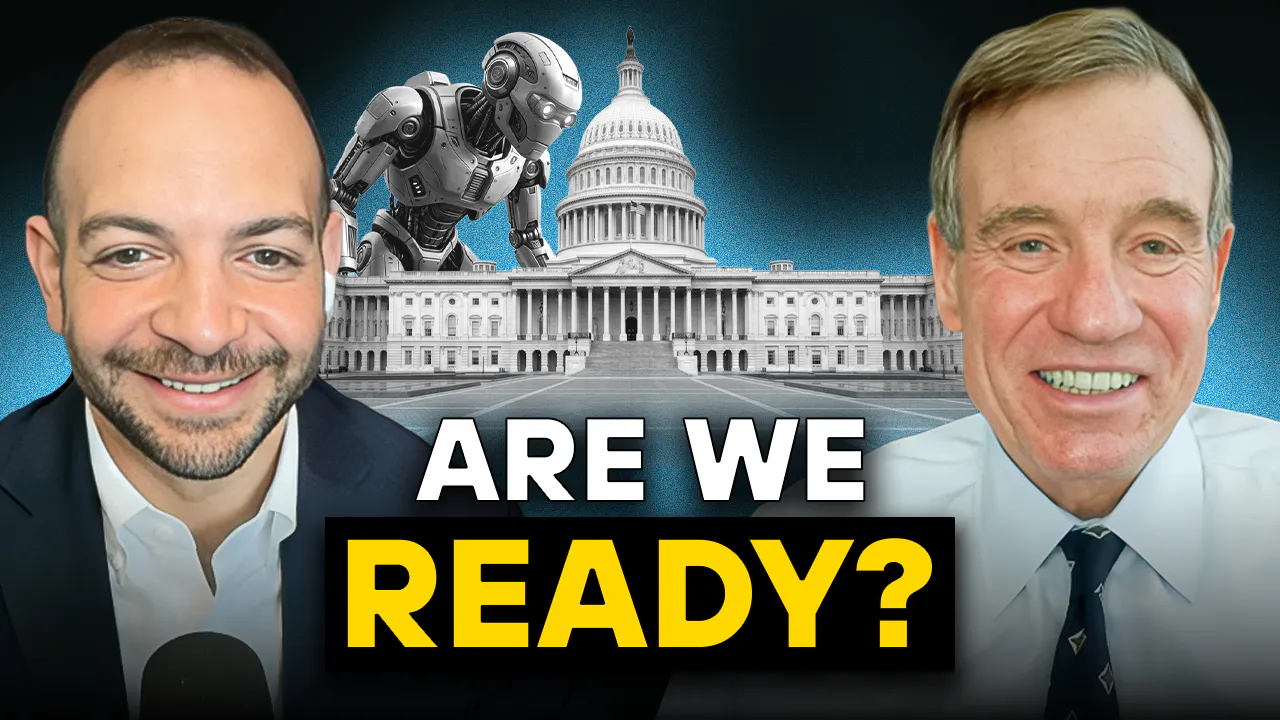
Loading summary
Transcript60 lines
- [00:00]
A
If AI progress is actually moving on an exponential, are we ready? Let's talk about it with US Senator Mark Warner right after this.
- [00:08]
B
Fiscally responsible financial geniuses, monetary magicians. These are things people say about drivers who switch their car insurance to Progressive and save hundreds. Because Progressive offers discounts for paying in full, owning a home and more. Plus, you can count on their great customer service to help when you need it.
- [00:29]
A
So.
- [00:29]
B
So your dollar goes a long way. Visit progressive.com to see if you could save on car insurance. Progressive Casualty Insurance Company and affiliates. Potential savings will vary. Not available in all states or situations.
- [00:42]
A
Welcome to Big Technology Podcast, a show for cool headed and nuanced conversation of the tech world and beyond. We have a great show for you today. U.S. senator Mark Warner is here with us. We're going to talk about whether the government is ready for fast AI progress, what government data says about AI driven job loss so far. And the latest on that small anthropic situation with the Pentagon. Senator Warner, great to see you again. Welcome to the show.
- [01:05]
B
Alex. Thanks so much for having me.
- [01:07]
A
So it's been four years since we last spoke and I reached out because I had been getting freaked out, I'll be honest. I'd been speaking with some folks in and around these AI labs and there's a belief among them that AI technology is moving on an exponential and could have real disruptions. And I think for me and many others who've been watching this, that was marketing language a couple months ago. But now there's at least a percentage chance that that's real. And I'm freaked out because I'm not sure if the government is ready for an exponential. Silicon Valley might do exponentials. Washington does linear or backwards sometimes. I wanted to just get your take on. I know you're right into this. Everybody says, you know, go to speak to Senator Warner. He's the one that knows what's going on. But I want to get your take on the general vibe in Washington today. Do you think there's awareness among, you know, rank and file members of Congress and the Senate that something might be brewing, that there will have to be drastic action to head off the negative consequences if it happens?
- [02:16]
B
Well, Alex, I don't think government's ready. I don't think society's ready. And I know the same AI optimists who are talking about this. I actually think they have changed their pitch and are now holding back because they're freaked out about freaking out people. And I've seen like, you know, and I am still long AI in terms of value. But boy, short term, next three to five years, the economic disruption is going to be. I just think we are not ready at all. We don't have good data, we don't know what's happening. An example I like to give is if you just look at Anthropic's Claude products this year, how Claude has already kind of disrupted the whole software business. Now the market recovered a little bit, but then it hit the same thing on the HR business. The markets don't respond that way that quickly. If people aren't saying there's going to be fundamentally dramatic change in kind of industry fundamentals. And that's just two areas and I think there's much, much more to come.
- [03:31]
A
So I've heard you say this a couple Times that the CEOs may be downplaying the impact. I know they speak with you privately. Are they telling you things like saying hey Senator one or don't say this to other people, but here's what we think or what brings you to that assessment?
- [03:47]
B
What brings me is the CEOs who are saying this in the AI space and what I'm hearing privately from big brand name firms who are saying they're cutting off or cutting in half the number of interns or first year hires. I even heard from a nationally known law firm that has decided to hire no first year associates are going to take a pause and see how this works out before they even hire all these kids, after they've done everything to get through law school and they got a job offer, they thought with a big brand firm and then it's, it's going away. Nothing. They did. And because of AI. Yeah, because of AI. And I hear, and I hear like so many companies that are midsize who say, you know, I had one guy the other day saying, you know, I had 23 people do this back office function, now I got three. Isn't that amazing? And the thing is we are not even collecting data on this yet. That's why I've got a bill with Josh Hawley, very bipartisan, that says to bls, Bureau of Labor Statistics, we need to start measuring this. And not just in terms of firms like Jack Dorsey saying he's cutting 40% of his staff because of AI. And whether that's true or not, we won't know for sure. But that kind. But also try to measure jobs that would traditionally have been created. Because my view is that this is going to particularly hit kids coming out of college, coming out of graduate school. We're at about 9% recent college graduate unemployment, I think that number will actually go to 30%. And the economic disruption that will have not only on those young people that don't get jobs, but their parents who help finance their college education. And the level of kind of fear that is amongst everybody I know that's in college at this point, I don't think people are factoring that in. And, and to say government's not ready would be an understatement.
- [05:45]
A
Right. And we're going to talk about some legislation that you have brewing and, and you know, but it takes more than one or two senators here. And you know, you've already passed the clod test, Senator Warren, which is you're a senator that knows what Claude is. 100 U.S. senators. How many of them do you think know what Claude is?
- [06:04]
B
Well, I hope more than you. And I think. But you know, and again, I don't know if you want to go now into the whole Clyde's part of Anthropic, whether we want to go down that path now, but I would argue that anthropic. Pick your anthropic OpenAI. Obviously Google is doing well. We've got a half dozen LLMs that are making major advances. But what's happening to Anthropic at this point, as they were doing business with the Defense Department and being very well used and the Anthropic leadership crosswise with Hegseth at DOD and obviously any company, if they're going to do business with DoD, has to make some accommodation. But the idea that we're going to turn over to Pete Hegseth the ability to completely decide that these AI tools can be used totally for surveillance without any guardrails, or even potentially worse, creating AI weapons without a human in the loop, that's big fricking deal. And we ought to have, if we were not in this war with Iran at this point, I think, you know, that would have been a major focus. And what is even happening with this? I'm trying to rally the tech community to say, regardless of what you feel about Trump and Hagsa, you know, if you're having these decisions and then Hegsef is going to declare, is trying to declare Anthropic a supply chain risk that would mean that not only Anthropic couldn't DO business with DoD, but any company, and virtually every major company in America does some level of business with DoD. They couldn't do business with Anthropic as well. This would be the ability for a single individual to write a Death sentence to major American tech companies. And people need to realize this stuff is happening real time.
- [07:51]
A
Okay, so I guess, like the reason why I'm asking, the awareness. And I take your point, we're going to talk a little bit more about this in the second half about the anthropic. Do DOD or the war, the dispute they're having with the Department, Defense, Department of war, whatever you want to call it, we'll talk about that a bit more. The reason why I asked is because. And maybe this dispute is giving more awareness to anthropic. I just want to see if you could reassure me. Or maybe you're saying that there is little reassurance that when it comes to the list of priorities that your, your colleagues have, that this at least ranks. Because I, I remember reporting on the social media stuff five, 10 years ago. It was clear that there was no. There was. And you know what? I guess we sort of came out of it okay.
- [08:41]
B
Well, Alex. But we did.
- [08:42]
A
But this is. My worry is the same. There's the same lack of awareness in the government for something that could happen faster.
- [08:49]
B
Well, amen. Amen. Like, social media was a challenge. And you know, I had bipartisan bills on data portability, interoperability, delegability, which is now basically called agentic AI. We had things about dark patterns. There was lots of bipartisan action and all the social media companies, you know, they all said, yeah, we want some meaningful regulation until you put words on the page and we batted zero. We still haven't even done the fricking kids online safety bills. So social media is a challenge. It has, I think, effects, you know, psychic effects, psychological effects, I'm sorry, on young people. But it is tiny compared to AI. When we think about the stories already we're hearing about AI leading kids potentially to suicide and we're seeing what was kind of a spot story just six months ago of people becoming romantically involved with AI agents. Now this is actually a statistical thing you can look at and that's just on the kind of psychological societal effects, but on the job effects we just don't have. We don't have good data. We have people, I think, shifting blame. I saw Amazon. They've announced 11,000 job losses. They say none of that's due to AI. But I gotta just tell you, you wouldn't have literally not billions, but trillions dollars of private capital coming in. If these enterprises don't, the investors don't think they're going to return. Now, some of this may be because we're going to have great healthcare breakthroughs or have AI created jobs, which I believe, but in the short term, the amount of AI job dislocation is going to be jaw dropping. And I don't think the majority of senators understand it. I think they can be convinced. And I just fear that what we've got now is the overriding agenda coming out of the Trump administration is they are kind of AI accelerators pedal to the metal because we got to beat China and we do have to beat China. But the idea that we are not going to think about any guardrails or about the short term economic consequences I think is really frightening. And as somebody who still believes the power of AI, by the way, there's no way we're putting the genie back in the bottle anyway. Could have positive effects. We could actually have populism on the left and the right coming together to try to snuff out the innovation and do it ham handedly. So boy, boy, this is, you know, as I'm, I'm trying to get hired one last time in this job and probably the major reason is if I can help navigate, you know, some of these AI solutions and I don't pretend to have by any means all the answers. Matter of fact, if we, I think Alex, we may have talked about this at one point. We go way back in time like three years ago. The, I think, well, at least at that point thought through, well, guarantee of a job was let's at least make sure everybody has basic coding skills. That was well intentioned but was obviously not the right answer since those are the first jobs being limited.
- [12:05]
A
And so when you think about the way that your colleagues view this, is it high priority, medium priority or low priority for them?
- [12:13]
B
Listen, this stuff is hard. I, I don't, you know, I joke, but it's kind of true. There is no linear relationship between me spending more time on AI and actually thinking I have a better understanding. I get, you know, it, it is evolving so quickly. I think most members, you know, and this is a human reaction. If you don't get it and it seems too complicated, you want to try to punt on that. And that allows for simple minded solutions like let's just shut it down or let's just have a moratorium. All data centers for a year. That's not going to answer the question. So we do have to navigate it. And what small value I hope I can add is not turning this into a partisan issue and trying to find folks on both sides of the aisle that says, hey, we gotta grapple with this China and the rest of the world is moving ahead. There is no way we can reverse this. But we are not powerless both to put guardrails in effect and also say in terms of the economic dislocation. And my challenge to the AI community is you guys are right. If government defines us all, we'll probably screw it up. So you guys help us define what this transition looks like. Look at the training or reskilling, whatever tool we want to call it, but you also got to help pay for it because the cost of this are going to be amazing.
- [13:41]
A
Yeah, and I'll explain a little bit about the question, my line of questioning here. I just wanted to see if you think the government would be able to move fast if we end up seeing this exponential. I'll even take your words. You said recently in a great YouTube video about the AI challenge. This is as dramatic as a change as anything I've seen in my lifetime. You said, think about the transformation brought by the Internet and this AI inform, AI transformation at the rate we're seeing, it could be over in the next two to three years. And, and you know, I again, like I've read, I know you have legislation, you have three bills, at least three bills in action right now on AI gathering data, trying to understand the implications here, trying to head off the issue. And it's different. Like it's not, you can attack it in a way that it's not like stop it. Right. It's like maybe help people who are being, who are, who are at risk of job dislocation. But I'm not very reassured hearing the way that you describe the way that this issue is being handled in the Senate, that, that, that speed is going to be met.
- [14:44]
B
Well, I'm not sure I can point to a policymakers anywhere in the world that's figured this out. I got good bipartisan legislation. Let's put a commission together similar to the cyber solarium, that actually put some points on the board, you know, commission of the economy of the future. We've got, you know, bills to get BLS to start reporting on AI job disruption. I've got a bipartisan bill about how AI is going to affect the financial markets and how we ought to think through this. They are, I think thoughtful, but they are self acknowledging here, small incremental steps when it very much could be the holy shit moments and can we think big and you know, if Donald Trump, the disruptor, if he had an ounce of either empathy or collaborative spirit, somebody that is a disruptor could actually help us through this. But I want to be more optimistic, but I'm, I am terrified. I mean, I had somebody come in the other day and it was like, I thought it was a very interesting thing saying, you get, you know, you get three couples of parents together who are talking about their kids. 10 years ago would have been, you know, this globalization. I don't know if my kid's gonna get a job. Five years ago it'd be, oh my gosh, I'm really concerned about whether my kid is getting addicted to social media. Now, the conversation. And this is happening at such a level that our policymakers get it. They are terrified that their kids have done everything right. They're going through college and there may not be a job there.
- [16:23]
A
Right. And can I just say so I brought up social media as an example of our U.S. legislative body's ability to deal with technology effectively. But it's different than social media. I think we both agree here that with social media the big disagreement was, are you going to tell Facebook, like how to handle its news feed what to do? This isn't necessarily legislation that needs to be or policy that needs to be. Can we tell the AI companies to stop making their models to be able to handle the negative effects here? It's more like, how do you stimulate job growth, retraining and even that's probably not proven. But that's what gives me hope, is that there's a chance that, that that can be. And the fact that you have these bipartisan bills that that could be second material.
- [17:10]
B
You know, I've talked to some of my friends in the industry who say, like, let's at least deal with things like non consensual nudes. Do you want your young daughter or son to be portrayed with a deep fake out there? And everybody says yes. But then you get, you know, Elon at Grok saying, no, we, you know, we're gonna be an outlier and we default to the lowest common denominator on some of this. You know, the idea of these horrific stories of people being guided to suicide, you know, we can say, well, we're, you know, we're going to try to correct the model a little bit, but we're always lagging. I mean, I do think I'm kind of freaked out about this, you know, the idea of who you turn your romantic interest to. I think we all remember that movie a few years back called, I think it was called her, where the main character fell in love with a kind of a chatbot. That stuff is happening now, not in tiny numbers, but is Actually starting to appear statistically. And then we come to the, you know, the job dislocation. You know, the biggest in most kind of mid tier public universities, the number one major for most young people is business or business administration. Those are the jobs that you come out and you go work for a firm for a couple years as a young analyst or whatever. Those jobs are gone. I mean, somebody said, Jeff the other day, I'm not sure this is right, but maybe some of these companies ought to pay an incentive to get more people into nursing as opposed to business administration. We ought to at least disclose to people that the job prospects in some of these fields are going to dramatically change. And I'm just not sure, I'm just not sure whether we're ready. And one of the scary things that I've found and again, I want to be more optimistic is like you talk to the leading AI companies, the leading AI thinkers and they'll give you a partial answer. Well, gosh, we're going to build a lot of data centers so that the traditional trades will have an increase and that will be a short term increase in terms of building those facilities. And there's going to be obviously huge needs for more electrons. So I'm a big advocate that we'll never be able to power this without small modular nuclear or other kind of decentralized power generation. But that's still going to be a relatively small number. And then you say, well, how do we make sure that whatever you're going to do, you can use AI to become better skilled at it? And everybody's kind of got soft terms because they're making up right now. But gosh, we got to have that stuff ready yesterday. And it'll be very interesting to see, you know, even this hiring cycle as we get, you know, close to graduation in May in colleges, it'll be very telling. Yeah, it's going to be very telling.
- [20:05]
A
New grads get jobs. We're going to learn very quickly. So I'll say a couple things. First of all, as someone who's married to a nurse, I agree with you. It's a good career path. And I always tell her at least one of us will be employed in the long term on AI romantic relationships. I mean, can't possibly believe that adults should not be able to enter into these relationships with AI chatbots. Is that more of a minor thing that you would in terms of legislation? Right?
- [20:35]
B
I, I don't know. I mean, really obviously on minors and you know, you, and trust me, I'm not, you know, big brother here and saying we can prohibit behavior of adults, but at some point, as a functioning society that needs to procreate, that needs to have human relations. I just think we ought to have at least a discussion about this. And I just think that my friends in the community need to either not blow it off and say, oh, we can't when there's nothing we can do, or, you know, at least we put a bigger warning sign, you know, adults are going to do what they're going to do. But the fully informed before you go down some of these rabbit holes and the ability to have any kind of shared common truth as we think about how AI could affect political debate. I am terrified right now of, of disruptions in our 26 election from foreign sources or frankly even the president's willingness to try to say he wants to have the feds take over our elections. And we have not seen deep fakes used in a massive way so far. But as we know that technology is evolving on a monthly basis and it only takes one major screw up in an election cycle, for example, for people who already are losing faith to lose faith in our basic democratic processes.
- [22:10]
A
Right. So you're running for a fourth term, three term senator at this point. And one of the things that I love when I speak with politicians is we can talk about polling. And no one reads polls better than people like yourselves. So I want to read to you a couple polls about AI's popularity or lack thereof, and sort of get your read on what it could mean politically. This is from the NBC News poll. You might have seen it. A majority of registered voters, 57%, said they believe that the risks of AI outweigh the benefits. And a plurality of voters view AI negatively and don't believe either Democrats or Republicans are doing a good job handling policy related to the rapidly advancing technology. I guess let's leave the reaction to Democrats and Republicans aside for a moment. What are the consequences? And we've tried to figure this out on the show, but no one better to speak about it than with you. What are the consequences for this AI industry if it continues to pull so low is there. Are they opening themselves up to political.
- [23:14]
B
They're opening themselves up. I think the first line will be the war against data centers, you know, and they are big. They use a lot of power, you know, and that becomes almost a proxy for the overall concerns about AI writ large. And you know, they're going to have to go ahead and make sure that people's electric bills don't go up, that the water Supplies don't go up, that they are better, that they are better screened. You know, I got a county in Virginia that took their AI revenues and put it all into affordable housing so people see a tangible benefit. And in Virginia, we're on the front line. We're data center, you know, heaven in
- [23:53]
A
terms of the biggest state data centers
- [23:55]
B
in the US and we're having a major debate right now at the state level about trying to extract somewhere between 500 million and a billion dollars a year from the industry. I would hope the industry would lean into some of these things and say we're going to, yes, we will voluntarily help and we will dedicate that to this economic transition. It's happening so quickly. I'm not sure we're going to get that together. And I'm no longer the governor or the state official, but the industry, the tech industry writ large has basically said, and I say this is a pro tech guy. My business background was tech, I'm a big believer. But the tech industry so far has generally said, rightly so, policymakers don't get us, we can blow them off. That was clearly the success of the social media platforms to never have any regulatory basis at all. And then when you do have overregulation, say from the EU and they'll point to the EU and say, you listen, we don't want to be like Europeans. They have no innovation at all. So getting it right is hard. But on this one, you know, when I and this one, if they kind of ignore and say we can blow off any regulatory or any framework or we have no obligation, I think it could bite them. Now it's not going to disappear. AI, these models are out there and the fact that, you know, and China clearly is investing at an amazing rate, but even if America closed down, the models can transfer to another entity that has the compute power. So this is not going away and in a certain way. Not to sound old school, wistful, but if there was ever a time where the world as a whole ought to be thinking through this rather than nation state competition, it is on this issue. And I absolutely do believe that we are. Now, whether it's full AGI or full process, we're getting close to where the magic that happens inside these models, I don't think, at least I've heard from many of, and they're mostly guys have said we don't really understand how this is what all is happening. This is way beyond just predictive of the next word, which was kind of the, the AI 101 model that people got educated on long, long time ago, like two years ago.
- [26:20]
A
Okay, let me run this by you before we end this segment because you mentioned the data centers. I was stunned. So there was a series of negative polls about AI that came out recently. And I was stunned at the way people feel about data centers. So this is from Pew. I'm sure you've seen this poll. Far more Americans say data centers are mostly bad than good. For the environment at 30, 39% to 4%, for home energy costs at 38 to 6% and the quality of life for those that live nearby, 30% to 6%. I mean, goodness, that is a terrible, terrible polling numbers for these data centers. Does that mean that just they're going to be places where they are just not going to be built because the opposition is so high? I saw there was an Axios report that said something like half of the data centers that are expected to be built this year are delayed. Now, some of that is part shortages, but I think community opposition is going to be big part of it.
- [27:15]
B
Well, the interesting thing too, and rightfully some of the tech companies will say, well, you actually look at the electric rates for states that have done a lot of this, they've not seen a dramatic rise. But I think they have to do more than just say, hey, we're going to cover your no increase, you know, utility and electric electric rates. I think they got to put that in statute. I think they got to, you know, move more towards, you know, self generation that is adjacent to the AI facility. So it doesn't go into the full, you know, into the full grid. And I think we have to document that. I think they have to do more on the water usage. I think they need to do a much better job on just visual screening. These are big ugly buildings and yes, they are, but the thing a little bit is they are making progress. But to go into a community and sell that when the only image you have is of say, you know, data centers in Northern Virginia that are still old school, last generation, that's a hard sell. Now there always will be a jurisdiction that needs that additional revenue to get by. And they do, you know, they do generate revenue and they don't bring a lot of kids because they don't have a lot of jobs adjacent. But there needs to be a rethinking on this. And I do think, you know, that the, the state battle that's going on in Virginia right now, I've said to the industry, you guys got to watch this because we are the mother lode of data centers. And if there is some adjustment of the kind of economic deal that's going to happen in Virginia that is going to be copied by every other state around the country. And my pitch to the AI industry is, you know, don't just fight it like mad. Be proactive and say, yes, we're going to chip in more and we're going to chip in more. Not only make sure your electric rates don't go up and they are properly shielded, but we're going to actually put money on the table to help through this economic transition. And I, you know, I get a lot of Ed nods but you know, the lack of specific policy ideas. Alex, I've talked to everybody I can and most policy experts and others are observing the problem or want to do things like I'm trying to collect data, but what the actual reskilling retraining program looks like, we don't have a lot of a good example so far.
- [29:46]
A
Yeah, I'm sensing some frustration with tech companies.
- [29:50]
B
Yeah, I mean it's. But I kind of get it. You know, if you think about the big, the big guys, you know, they've been pounded on for years since most of the big guys act the hyperscalers. Most of them actually started, you know, as either social media or you got Amazon and Microsoft and some of those. But they've kind of gotten through with, you know, kind of good lip service but no, no rules or regulations in place. And it's kind of like this time, I think the seriousness and back to your numbers on data centers. The fear is real and palatable and I don't want this innovation to stop but I do think sitting down and figuring this out in a more forward leaning way is really essential. And, and that's what I'm desperately trying to do here. And this job at least is not allow this to be kind of divided Ds versus Rs.
- [30:50]
A
All right, let's take a quick break and then come back and talk a little bit more about Anthropic and the Pentagon and the state of AI in warfare back right after this. Are you stuck staring at your W2? Are tax refund worries holding you back? You probably have fomu the fear of messing up the fix using TurboTax on Intuit credit Karma. They find every credit and deduction to help you get every refund dollar you deserve or your money back. It's time to overcome your fear of messing up and get your taxes done right. Start filing today in the Credit Karma app.
- [31:29]
B
This episode is brought to you by indeed. Stop waiting around for the perfect candidate. Instead, use indeed sponsored job jobs to find the right people with the right skills fast. It's a simple way to make sure your listing is the first candidate. C. According to Indeed data, sponsored jobs have four times more applicants than non sponsored jobs. So go build your dream team today with Indeed. Get a $75 sponsored job credit@ Indeed.com podcast. Terms and conditions apply.
- [31:57]
A
And we're back here on Big Technology podcast with Senator Mark Warner. Senator, it's always great to speak with you. I was looking at the date of our last conversation. I can't believe it's been four years.
- [32:06]
B
Alex, that's mind blowing.
- [32:08]
A
We gotta make us know.
- [32:10]
B
I didn't believe that either. Yeah.
- [32:13]
A
So let's just, let's pick up on the anthropic thing. The US Government right now. So you've definitely stated your, you know, your opposition to them being labeled as a supply chain risk in the first half. The US Government right now is in the middle of removing anthropic from federal agencies. There's actually a six month phase out that the President has ordered. Is this so, so can you talk about, because you know government agencies very well. Can you talk about like is this something that anthropic is already being removed and you can't really see them being put back or is this six month deadline something like we've seen in the past with TikTok, which could just be a six month deadline because we know they need anthropic that just gets pushed back again and again. Which is it?
- [33:00]
B
Alex, great question. Again, I go back to like the TikTok issue. President Trump in his first term and his treasury secretary was good friends with Steve Mishin, literally convinced me about the national security risk around TikTok because of particularly the ability to alter the message and more the propaganda than the data collection. And then obviously President Trump completely flipped on that issue and TikTok's here to stay. And I still like to get more of the details on the controls the new American owners have. So I don't know the answer to that. Whether this is talk or they're actually being disconnected and to take out what is, at least at this moment in time, probably the market leader and when there are actually benefits happening from the usage. And I'm, you know, I got no particular beef for anthropic or, you know, I'm not carrying their, their water here. But I am saying when you can get thrown out, what happens to anthropic could happen to OpenAI and could happen to Amazon, it could happen to Google. You name the, the entity and you're gonna have to go through a political litmus test. Now, I think Anthropic probably screwed up their negotiations with Department of Defense. But to put up this supply chain designation, which I don't believe has ever been designated against an American company, this is a death warrant. And I don't think any company, technology driven or not, wants to have a single individual. This is not even the President. This is Secretary Hegstadt making that determination without some due process. This is a big fricking deal. And I just hope. And this will be the. I think the jury's out on this. I've been trying to talk to all of the other tech companies to say even if you are Anthropic's biggest competitor, you don't want this precedent set. Particularly because at least with this administration, as we've seen time and again, they may love you today, but that doesn't mean they're going to love you tomorrow. And take the political figure, think the Marjorie Taylor greenery. If that kind of up and down approach is applied to all of our leading tech companies, who's going to, we're going to see where we've always had advantages in terms of our international take up. People are going to say, heck, maybe it's better to go with the Chinese model.
- [35:34]
A
Okay, so you're the vice chair of the Senate Intelligence Committee. Was or is the Pentagon making a AI based surveillance program of Americans? That was one of the central contentions.
- [35:46]
B
I do not know the answer to that and I should. This administration has not been forthcoming. And unless we have, unless we have bipartisan oversight, we're not going to get those answers. And I think there have been concerns raised and I, you know, and this is not just around the Intelligence Committee. It ought to be also the Armed Services Committee and others. And I think I've had conversations with a lot of my Republican friends. I think I'm making the case that this is a big deal, that we gotta know some of this. We might decide that that is the right choice. We may even decide, although I can't imagine this would be the case, that we're ready to move to AI weapons without a human in the loop. And it's easier to make the decision, for example, on an AI weapon without a human in the loop on defense, you know, having a missile system that would fire based upon an inc that's the adversary to protect an aircraft carrier makes. There's an argument there without a human in the loop on the offensive side, it's a much more challenging argument. But we ought to have those arguments rather than a single person in terms of Pete Hegseth making that determination.
- [37:00]
A
Palantir recently demoed Maven Smart System at a conference and showed how it selected targets. Seems like Palantir is actually far more consequential in war fighting than Claude. Although maybe there have been updates where Claude was embedded that we don't know about. I'm curious from your position because you know this better than, than most or almost everyone, how important is Palantir there? And when you think about the war in Iran right now, are is just. Is it Palantir selecting the target?
- [37:29]
B
I think a little bit about that. I think Palantir is a. Has been a very successful company. I think Anduril has been a very successful. I think the idea that these new entrants are shaking up the primes in many ways makes sense. I also actually think that Alex Karp is thoughtful on a number of these issues. I know I raised real concerns about Palantir and the six other technology companies that have taken contracts with Department of Homeland Security. And I've been extraordinarily concerned that, you know, DHS or ice, as we saw people targeted in Minnesota, I mean, literally a lady who was up for the global entry pass got denied because they had evidence that she'd shown up at a protest. Do we really want DHS or ICE making those determinations? And I've, you know, Palantir and some of the companies are saying they are not doing that. But how do we independently validate that? This is where we're entering into this realm where at some point you still need third party objective, whether they be academic or other experts trying to help keep both sides honest in terms of both sides, both being government and the tech companies. And I found with some of these companies a willingness to participate. And at least they've told me they're willing to participate through, through that kind of review and oversight. But it really is going to take both political parties in D.C. to realize this is not a Democrat Republican issue. This is like we're setting the ground rules for stuff that if we don't put ground rules in place, could lead to a pretty spooky place. There's a reason why I think the overwhelming majority of science fiction movies about the future have this kind of dystopian future, because that default is actually easier than thinking this through in a rational way.
- [39:31]
A
On the Palantir side of the, of the Iran war, obviously, where it seems like the United States did target and hit that girl school in Iran, and it was presumably bad targeting. Are you. Because again, as the vice chair of the Senate Intelligence Committee, do you have any idea of whether US Technology layer like Palantir was involved there?
- [39:56]
B
You know, I think we need a full investigation. And what. I'm. I'm a little old school that I think we ought to, you know, restrain making a conclusion before you get all the facts. This girls school was literally right adjacent to, you know, an Iranian military base. Was this dia? Was it centcom? I mean, I think we need to get the facts out on this. But we all know technology makes mistakes, and that's where the rub comes with this kind of horrific event. Let's get the facts before we draw conclusions. But what is problematic is that when the President of the United States, I can't believe he was briefed with his initial reaction that this came from the intelligence community. Oh, this was the Iranians bombing their own school. And then they kind of said, well, like, here's the material that showed it was an American, you know, missile. And then he said, well, maybe they got them. When that kind of absurdist response comes from the commander in chief, that undermines, I think, not only the confidence of the American people that we're going to get the truth, and it also doesn't help us in terms of how the world views us. For all our flaws, we have been generally viewed as the good guys. And when we lose that designation, that doesn't make America safer. I'll just leave it at that at this point.
- [41:29]
A
Okay. That's a very telling answer. That's very interesting. All right, I have a couple more for you before we leave. First of all, on the AI job disruption question, you've mentioned bipartisanship a number of times.
- [41:41]
B
You.
- [41:42]
A
I want to put this to you. I'm going to be in D.C. in a couple weeks from now, and I'd love to interview one of your Republican colleagues.
- [41:49]
B
So, yeah, I'd love to date somebody like Mike Rounds is very thoughtful on this stuff. I got a lot of Republican friends that I think would love to sit down with you and, you know.
- [41:59]
A
Right.
- [41:59]
B
And especially on some of the. The weapon issues. I think Mike Rounds is, you know, frankly ahead of me on. On thinking through some of this stuff.
- [42:06]
A
Okay. So maybe we can. I can get in touch with your staffers after this, and we can find a way to connect with them. That would be great. Okay. Also, four years ago, we talked about an issue that's been, I think, really Important to me, really important to many Americans, which is that we see, you know, whether it meets the legal definition or not, insider trading within Congress. And you are great in your statement saying we shouldn't see this anymore. But here we are four, four years later. This is just one example that came through my timeline this week. It looks like Josh Gottenheimer. Sorry, yeah, Josh Gotten Heimer, who's on the House Intelligence Committee, bought Exxon twice in early February. Now, who knows if that's necessarily connected to the fact that the Iran war was brewing, but doesn't look great. Why do you think it's been so difficult for the Congress to pass legislation around this?
- [42:57]
B
I can't answer that. I mean, I don't know. It seems like it should be a no brainer, you know, and I'm lucky enough that I was able to put all of my stuff in a blind trust, independent, I don't know anything I own, you know, and I think we've kind of completely gotten out of all trading and I've moved from mostly stocks to I think mutual funds. But there are, you know, there, there are issues I've seen like I was a venture capitalist for many years before I got into this stuff. I've invested in companies that have took 10 to 15 years to go from startup to a public company. And then I have a policy that if something becomes public, we try to sell it. But that still shows up as why is Warner selling this stock right now? Why? I don't want to own the stock at this point. But you know, it is. Should you have to disgorge even before in a company that you had long before you were in public service. There is some complexity to this stuff. And again, I've been very, very lucky. I've got the freedom that I was able to do very well in technology. I'm going to be fine regardless. I don't want to chase people out from even going in public service because if they're kind of somewhere along their career and you know, they, they were a founder of a single company, what do they do? I, I don't know the full answer, but all of those are, are nits actually compared to we ought to have a rule that members of Congress shouldn't trade stocks. But here's the part, Alex, that makes people more cynical. I am right now in the middle of the final negotiations on trying to put in place certain rules around crypto. You know, crypto is here to stay. There are some, again, real beneficial aspects of crypto. But if we're going to have a market structure bill. We've already asked a stablecoin bill. You know, one of the things that makes it difficult to get it finished is when the president, United States says so grossly, totally enriches himself through this industry and wants to say he wants to have ethics rules apply to Congress and members of the cabinet, but not to the first family. It's, you know, we ought to be passing these ethics restrictions, but boy, oh boy, there ought to not be a carve out for the any anybody whose name rhymes with grump.
- [45:44]
A
Okay, well, I'm with you on that. Look, Senator Ward, I can't say I'm more reassured that Congress has it under control on the AI front, but I am really thankful that you're out there, you know, stirring it up, working across the aisle and trying to make some progress out there. I'm sure it's not easy and appreciate you doing it. I appreciate you spending the time here again.
- [46:01]
B
Now, Alex, we should do this more than a quadrennial basis because these issues are coming, as you know. I know. And we really need. This is one of the things I would appeal. You've got a very sophisticated audience. You know, if part of your audience has got ideas or suggestions, please, you know, I'm wide open for business on what these policy notions ought to be, so you can get to me easily online. But it's going to take all of us in this because getting it wrong, boy, oh boy, getting it wrong can be a major disaster. But thank you for having me on, Alex.
- [46:40]
A
Definitely. Yeah, it was, it was great having you. And I'll tell you, social media, that beat took me about 10 years before I ended up in D.C. covering hearings. And the speed at which I had to, you know, call and say, we got to talk about AI is, is much faster. So thank you again and I'm sure the audience won't be shy in writing.
- [46:57]
B
You let me know. Thank you, Alex. Be well.
- [46:59]
A
Thank you. All right, everybody, thanks for watching and we'll see you next time on big technology podcast. Quick Pause. Something useful for you. Love fishing. TikTok isn't just for young people. It's full of real tips. Better knots, better baits, better, better catches. Quick videos from people who actually fish. Download TikTok now.
- [47:34]
B
Jackson Hewitt has a great tax prep deal. $149 or less. Missing out is like ignoring the check engine light in your car. You regret it? Seriously, the price is only 149 or less, no matter how complicated. So don't wait. Like when you get a password expires today. Alert. Or you're shopping online and there's only one item left. It's like your taxes are in the cart. Just complete the purchase. Hurry. This deal for $149 or less is like your phone at 1%. It's about to power down. Limited time offer for new clients on federal returns. Participating locations only. Terms@jacksonevo.com 149.