Loading summary
Transcript430 lines
- [00:00]
A
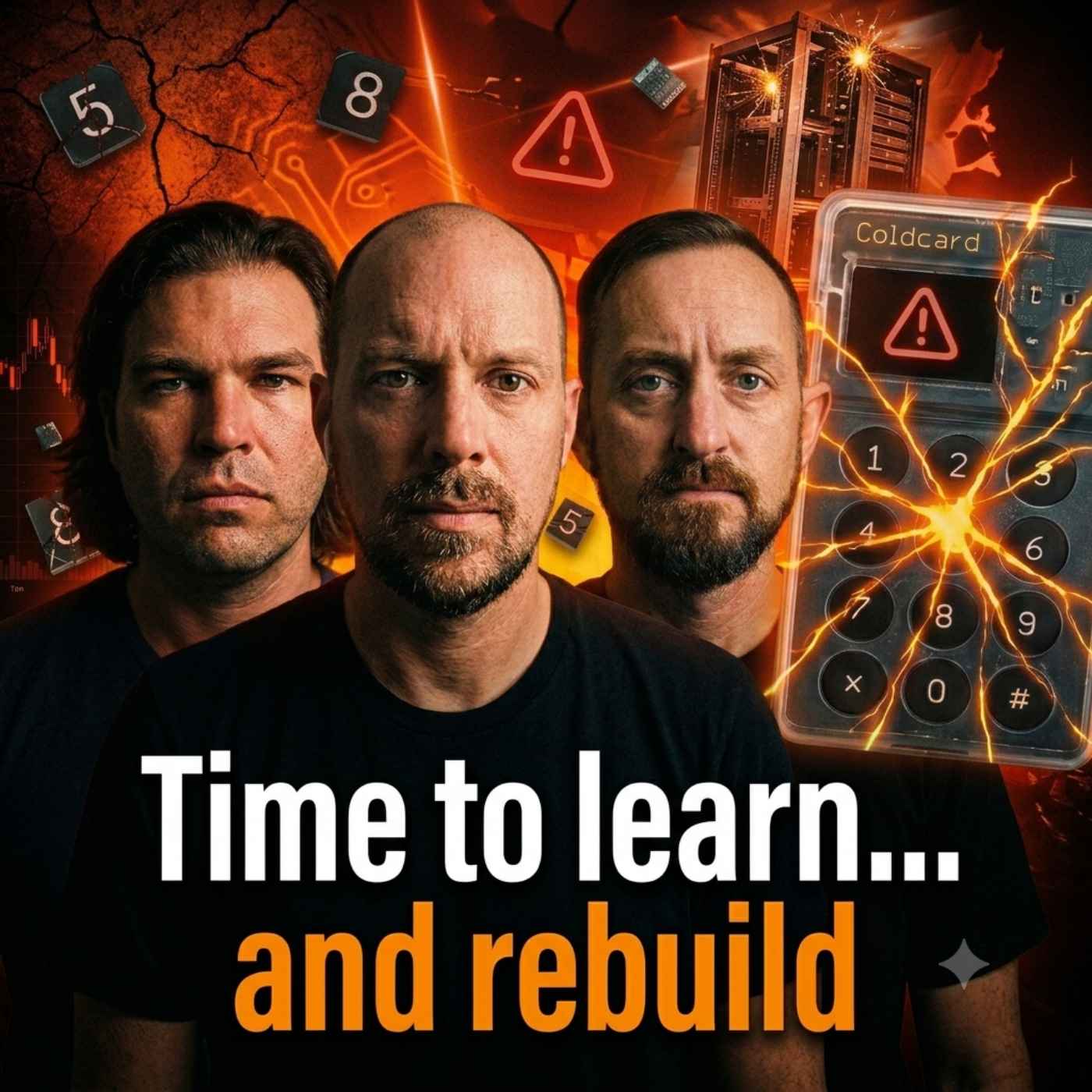
What is up, guys? So we all got really humbled. Recently, a highly widely used and highly respected hardware wallet, the cold card, just got undone in literally the worst possible way. It was realized that the keys generated in the device itself actually had no entropy. There was. The randomness was essentially skipped. So you know how the point of a bitcoin key is to make it so attempting to guess your private key is like trying to pick out an atom at any particular location anywhere in the literal known universe, and that even trying to guess them takes the entire energy of the sun. Well, the mistake in the cold card firmware basically made it. So your key was hidden in the size of about a football field and took about 20 minutes, 10 to 20 minutes of GPU worth of energy and 10 to 20 minutes of GPU energy got exploited en masse and just started wiping all of these wallets. And I'm sure you've heard by now, it's. It's a hell of a mess. Mechanic couldn't even join us today. I know he's probably scrambling to find and help and do all sorts of stuff around this mess. But we do have my brother, myself and Steve on the show and we get into a lot of things about what the hell we learned from this. Some of the, like how we. How could we have. You know, it's really easy to be like, hindsight, pick out all the things that we don't like or that weren't perfect, like what hard and fast rules can we determine so that if we went back, we could see forward that this problem was going to arise. Because it doesn't help us if we can, like, identify things that know, justify the way we. The horrible way we feel about it in hindsight, because that won't stop it from happening again. And so that's kind of the point of this episode and probably a little while going forward to figure out what. What exactly did we learn from this and also to understand that AI has changed the game. And it's not, it's not just like, oh, this would never have been found without AI. It's. It's simply that the scope of people and the capacity to find and exploit a weakness is now available to a million times as many people as it was previously. And that should be taken into account because a lot of security in software and stuff is just people not having the time or the energy to go poke holes in everything. It's difficult now. It's not now. It just takes a couple of conversations with Kimmy and Fable 5 to find a hole and then write a script to exploit it. And that's what I think happened. And that means that, you know, when we started coding with AI, when we, when we got to that point with LLMs, we should have realized that the Lindy effect and the built in assumptions about all the devices and the software we were using should have been reconsidered. It should have been retested because the dynamics, the conditions of the environment had changed enough that it's extremely unlikely for those assumptions to have held true. And I think we have a perfect example of exactly when it doesn't. So we get into a lot of stuff. We get into other things as well. But you know, it's hard to not just kind of like talk about all the things that happened here and how people behaved. MVK carried himself and the nature of open source versus source available. Something that I absolutely did not appreciate and what it might have meant for the scrutiny or lack thereof. So I won't lead the episode too much. Steve and Jeff have some really good points, so we'll just go ahead and get into it. Hope you guys are safe. By the way, get your crap off a cold card. I have a. I had a cold card in every one of my setups. Every single one of them. I somehow managed to dodge this bullet. Haven't dodged every bullet in the past, but get your. I've got like a video. Last video kind of gives you a walkthrough or hopefully a simple process a bunch of other people have as well. So please just get it off your cold card. Don't. Don't assume it's safe. Just do it. There's no reason not to. And you know, it's a good practice to just refresh your whole setup and go through everything again anyway. So take it as an opportunity. If you didn't lose coins, thank God, you know, if used a passphrase, if you rolled the dice. But with that, let's go ahead and get into today's episode. This is guys Roundtable staying humble. Welcome to the Roundtable. It's been a hell of a 24 hours. I have not had that much sleep. I apparently am the only one who
- [05:55]
B
was
- [05:57]
A
in the group. I think that is vulnerable to a single sig cold card thing that I had to take care of in the middle of the night. But we'll get into it in just a minute. Welcome back to the show, Steve. Oh, mechanic cannot be with us, which is very, very sad because I'm sure he would have a lot to say about this.
- [06:16]
B
But.
- [06:16]
A
But we do Have Steve and Jeff. What is up, guys? How you doing, Jeff?
- [06:21]
C
What's.
- [06:22]
A
What's new with you?
- [06:25]
C
I mean, I don't know. I'm good. I'm. I'm okay.
- [06:30]
A
Good. Steve.
- [06:31]
C
Preparing. Preparing to. Preparing to see you guys. And.
- [06:38]
A
Yeah, we're going up to Kanedistan to see my brother trapped in exile.
- [06:46]
C
And I don't know, man, it's. It's so, like, I talked to my lawyer, like, sometime a couple weeks back or something, and. And just like, the. Like, it's so demoralizing to. To like, the. The. The nature of our situation and the likelihood that there's going to be any sort of help, granted, is. Is. Basically has made it very hard to find it, like, to finish filling out the mountain of paperwork that I still have.
- [07:20]
A
Yeah.
- [07:21]
C
And even, like, writing. It's so. It's so weird. It's such a weird feeling to have a problem that is so massive in my own life and to not be able to communicate anything about how, like, it, you know, in. In comp. Like when you start writing about somehow just feels trivial. Like it doesn't. Like, I don't know how to make anyone
- [07:52]
A
feel the importance that. That it is to you or.
- [07:56]
C
Or why.
- [07:57]
A
Yeah, no, I. I get that.
- [08:00]
C
And I mean, because we're. We're fine. We're not gonna, like, die or anything,
- [08:07]
A
but you got your keys, you got. I mean, you got your.
- [08:11]
C
Yeah, yeah. I don't have. I don't have a single sig cold card wallet or anything like that. And so. So I'm. You know, we're okay. But. But it's just.
- [08:25]
A
Can't come home.
- [08:26]
C
It's just a whole. Whole different. Yeah. Can't come home. And. And it's just so weird. Like, you can frame it in a lot of different ways. I don't want to frame it like I'm some sort of horrible, poor me victim, you know, but, like, how crazy is it that anybody from anywhere in the world can come to the US Pop out a baby, and then that baby goes home with a full citizenship and a passport. They can be raised in India or wherever for 18 years and then come back with all of the. All of the benefits of citizens, you know, like, they're completely an American citizen. Whether they speak the language, whether, you know, no cultural, you know, no shared cultural values, nothing. They come back as a full, you know, American citizen and then can apply to bring, you know, any of the rest of their family here or to the US and then I am an American citizen. I looked it up actually our family on both sides dates back to prior to the country even being a country.
- [09:35]
A
Really.
- [09:36]
C
I didn't know both sides. Americans, all four surnames. All four surnames of like our parents
- [09:44]
A
go back to pre1776. That's nuts.
- [09:48]
C
Are from a couple may even be from the 1600s, but their presence in North Carolina in particular dates back to early 1700s.
- [09:59]
A
Well, I know that on mom's mom's side somewhere there's like a tiny bit of native. We're like as much Native American as Elizabeth Warren, I think, right? 120 64th.
- [10:14]
C
Yes, they are the ones that, that are likely here have been here the longest and. And so like early 1700s is when the primary migration for all of them was the. And so.
- [10:28]
A
But you can get married and your wife will never be so.
- [10:32]
C
Yeah, so I can get married. And if she wasn't already in. In progress of becoming a Canadian citizen, it's very likely she would never be allowed here. Like there. It's at this point, you know, we don't know how long this forever war is going to take. And you know, two weeks, man.
- [10:51]
A
Two weeks to flatten the regime.
- [10:54]
C
It's very insane.
- [10:56]
A
Two weeks to fix the Middle East.
- [11:00]
C
Bitcoin is a great help to people in Iran and a great help to anyone that has to escape the US or you know, do things internationally anyway.
- [11:13]
A
Ironically, they can't. Because of capital controls, they cannot buy directly from manufacturers for almost all of the time. So none of the people we know over there have a cold guard.
- [11:25]
C
That's good. It's good for them.
- [11:26]
A
That's good for them. Steve, how are you doing, man? Safe. Are you safe from the cold card hurricane?
- [11:36]
B
Yeah, I'm safe from it, but I mean, it's affected me deeply. By the way, we didn't mention at the beginning we're recording this the day after the cold card hack. Oh, yeah.
- [11:47]
A
I guess this will be out for
- [11:48]
B
about, you know, I've been up all night. I'm sure a guy has too. I've just been. We've all been trying to figure out what's going on. I'm sure by the time listeners are listening to this, um, everything will be much more clear. Um, yeah, just gut punched. Um, I think about all of the people that I recommended cold cards to over the years. I feel just this enormous weight on my heart about that.
- [12:24]
A
Um, like, how many took my advice and don't even. Like I can't even contact them, you know? Yeah, right.
- [12:32]
C
I've been hitting up all morning yeah,
- [12:34]
A
I've been sending texts. Everybody I can think of. Everybody I can think of.
- [12:39]
B
Yeah. And then there's the anger that I'm trying to, like, suppress about NBK and his pompousness and his arrogance over the years. And I still don't understand how they could have missed this. I just.
- [13:03]
A
For the amount of scrutiny and, like, extra things that they stick into all the other stuff. This seems like the craziest thing to have missed.
- [13:15]
B
Yeah, I mean, I'm trying to keep my mind from going conspiratorial with it. Like, that's where I'm at, because I know right now, it's just, how do we get the world word out? I mean, do you want to. Do you want to give a rundown of what happened, or do you want me to or what? Well, I mean, sure, people know by now, but. Sure.
- [13:38]
A
But just. Just in case. And we. Hopefully a video is going out while we're recording this, because I just did a rant on it and try to get as much relevant details. This is why my thought about the theme of the show, so to speak, is humility, because I feel like NVK's dismissal, and I've heard it from a number of people, you know, and I. I have appreciation for people who are pretty stubborn and, you know, stick to their guns and who will be contrarian. But also to just, you know, not be willing to admit that you're wrong is. Is a bad security mentality, you know, and to dismiss when somebody see finds something that could be a vulnerability, it seems like it may have had nothing to do with it, but it coincided. So it's hard to say it didn't. But when they got really kind of protectionist and defensive about the use of their system, like from the. What was it? The GPL license, I believe, originally, or I might have that backwards. But when. When it was basically open source and then they went to source available, it actually forced them to rewrite all of the firmware. And this was in the 2020, I believe, somewhere in the 2019-2021 zone that all of this was occurring. Um, and they updated their stuff in an attempt to move away from the setup that was being cloned for a different product for a competitor, because they were very unhappy about this. Um, and there were other reasons for them to do this. There were other things that they were also trying to implement and take advantage of at the same time. So they could have very well rewritten the firmware anyway. But the fact that they were trying to be Protectionist and not have other people use what they built was was an added factor. It was definitely a piece of the puzzle. And this is when they introduced a bug that basically killed the onboard entropy when creating a seed phrase. So everything about like protect your hardware wallet, make sure that nobody can guess the pin and it bricks it if you do it too many times and that you can. It's wiped every time you unplug it. And all this, the. The dummy wallets, all of it, all of it is on top of the fact on the assumption that Your key has 256 bits of entropy or 128 with 12 and 24 seed words and all that stuff and there's no way to look at your seed words and know that there's high entropy. But essentially what was happening, the vulnerability, the failure of the firmware was so bad that keys on chain that are publicly testable against meaning it's just publicly available to brute force and just see if maybe I can get into it essentially had from MK3 on like was the entropy of a rough like an eight character password which is very easy to brute force. Mark 4, Mark 5 and Q had an extra layer. So there's like a handful of different things that go into the like base entropy or elements of creating the actual key. And it's like the buttons that you press, the time code, the timestamp in the device, the UID of the chip or device or whatever. I think there's like one or two other things. But the thing is is that like these are all very range limited. So if you've never connected your device to the Internet or to if you air gapped it, which was the whole point of cold card right Is to air gap. The whole thing is if you've never air gapped it then when you boot it up your timestamp is going to be starting at zero. And so like if you set up the key within the first 10 minutes there's your I got like you know, 200 tries to figure out where your timestamp was right. And if or 600 if you get did in 10 minutes. And then your UID is also bounded like you know what range of IDs the device is likely to have, the amount of the buttons that you press, you can just walk through the process of pressing the buttons and see what was likely the input into the thing. And so if you can kind of get that initial seed, that initial data which maybe there's this like, you know, it's like a seven or eight digit number Right. Something that you can do on a GPU like that, on all the possibilities. And then literally there's no other. The added entropy that was supposed to generate the super complex key failed. You can just deterministically recreate the key on the mark III and prevene actually did this. He put after the vulnerability was disclosed. And this is the crazy thing about being in the age of AI is that people who don't know anything about anything are able to just plug this into Fable, give it the GitHub, give it the disclosure, and then tell it to create a script to exploit this. And it's working. Kimmy can just like one or two shot the thing. And Praveen literally did this. And he made a post that he regenerated the private key of 2 of the address that had already been addresses that had already been emptied and proved that he could basically empty it again. And it took like minutes. And so people who did everything right, who wrote down their seed phrase, who got a hardware wallet, who literally did everything they were supposed to and did the cypherpunk wallet and took the right recommendations, and the people who would actually know what the hell. Why the hell dice rolls, why the hell were important because they got a freaking cold card because it lets you do that, are the people who got most hit by this. And they are all vulnerable. Everything after like 2020, they're all vulnerable. And if you update, they have a new firmware version. And if you update the firmware, it's your seed, it's your original seed that makes your device better and your device is no longer at risk or, or whatever. If you generated a new seed, well, now it would finally have some damn entropy. But your balance.
- [20:21]
B
I'm not sure I believe this about the firmware.
- [20:25]
A
Oh, I'm not, I'm. I'm saying that like, if this was a fix, I'm not, I'm not, I'm not using any coal cards. I've removed cold cards from my setup. My recommendation is to don't touch cold.
- [20:33]
B
Yeah, but just, just think about the logic here.
- [20:35]
A
Yeah.
- [20:36]
B
They're saying that they released firmware that fixed the problem. Right? They're saying this. So that means that the problem was in the firmware. It was identifiable. And when they made this new firmware, they confirmed that the firmware was indeed pulling the real random numbers from the true random number generator. That means they have the possibility to confirm that the firmware is pulling the numbers from the true random number generator. They have that possibility to diagnose that. And Find that and they didn't. And you're telling me that for five years they didn't. Given that they have the possibility to
- [21:27]
A
confirm, they can unit test that their
- [21:30]
B
firmware is pulling numbers from the true random number generator. They never tested that. The logic does not make sense at all. I mean, either you don't put out firmware and you say, sorry, we have no way of knowing when we put out new firmware if it is indeed pulling numbers from our true random number generator. But if you say that, you know that the firmware is working now, what the fuck happened? For five years you never tested, you had the ability to test that your firmware could pull from the random number generators, and you. And you didn't test that. Like, that's what I'm saying is like, I'm trying so hard to not go conspiratorial here. Like, it's, it just blows my freaking mind.
- [22:29]
A
It's like changing the consensus code to Bitcoin and then not running it on testnet first. You know, like, I can understand being complacent that, like, oh, Mark 1 and Mark 2 and the first versions of Mark 3, they're all secure. We're all, we're safe. And then, like, think like, I don't need to test this again. But you changed it. You changed it.
- [22:48]
B
You know, I mean, the simplest thing you could do. So, like, you know, you take one of these cold cards out of production and you rewire it to do nothing but produce random seeds continuously for five years. Then you look at the space of the seeds that it's continually producing. Like, I get that you couldn't do that in like a day or two because the processor probably doesn't run faster, fast enough. But, like, all hardware manufacturers need to have all of their devices producing new seeds on loop nonstop. It just blows my freaking mind that the, the, the world's simplest tests of hardware devices is not being done. I mean, I'm not trying to freak everybody out, and maybe there's something I'm just not seeing here.
- [23:43]
A
Maybe, yeah, I don't have the code, the lines of code, like, in front of me.
- [23:49]
B
I mean, maybe the answer to my first question is that it was genuinely impossible for them to tell whether or not the firmware was pulling from the random number generator or there was reason
- [24:04]
A
to assume that it was, but the reason that it wasn't wasn't obvious, you know?
- [24:12]
B
Well, I mean, but. Because, like, the way I read it, you know, another thing that doesn't make sense to me, that the, the Pseudo random number generator, the one that doesn't work very well, is a fallback option for the real random number generator.
- [24:29]
A
And that's the one that was being used. And why does it not have 128 bits of entropy? Why does the fallback have anything?
- [24:37]
B
Why is that there in the first place? I mean, like, if the true random number generator is not working, the device needs to not turn on. It doesn't need to fall back into a different mode.
- [24:50]
A
That's a good way.
- [24:51]
B
It should just absolutely not function. Why in the world did they design a fallback mechanism to what would be a purpose of having a bad random number generator in there ever? What would be any purpose of that? That's what I'm saying. It's like, this does not make any freaking sense at all.
- [25:10]
A
Yeah, a fallback for that makes no sense. That's like saying that there's a fallback for getting into your hardware wallet without a pen. You know, it's like, no, you don't get into it without the pen.
- [25:24]
C
Like, I see in. In the automotive world and divide everything now, the engineering, the failure mode engineering is just completely gone. Like, people don't think about failure modes at all. But what you're describing is like, instead of like Alexis forgetting how to roll its windows up when the battery dies, which is a thing, what you're saying is it like, oh, if the battery dies, the Lexus, it remembers how to roll the windows up, but only halfway. Why the fuck. Why the fuck would you have a mode where it only goes up halfway? Yeah, like, that doesn't make sense, you know, so that means you thought about the failure mode and you made it shitty. Like, you made it shittier than like, it just doesn't.
- [26:05]
A
You purposefully made it not work.
- [26:07]
B
No, I think it. I think it's more like, let's say you have a car with a braking system, but you have a computer that, that will not turn on the car if it knows that the brakes don't.
- [26:18]
A
The brakes aren't working.
- [26:19]
C
Sure.
- [26:19]
B
And then what you do is you build in a braking system that you know that doesn't work. That is a backup mode, and you know the real brakes aren't working. And then you put it into the backup mode that you know doesn't work. And then you let them drive the car.
- [26:37]
C
You call it the emergency brake, but the emergency brake doesn't work.
- [26:42]
B
And you know that the emergency doesn't break, doesn't work. It's not a surprise. Like, why was that random number generator in there?
- [26:49]
A
The Operation should be deterministically tied to whether or not the frequency freaking electrons go through the true random number generator, like, exactly.
- [26:57]
B
And you're telling me they did not have the ability to see whether the electrons went through the random number generator, but now magically, all of a sudden they do. And the firmware they know goes through that now. I mean, I'm doing this again, man. I'm just a roller coaster of emotions. It just goes from being really sad. Gut punch. Don't get mad. Anger isn't happening or anger isn't helpful and. But I just. Oh, God, I don't know. You're going to release this later.
- [27:36]
A
Yeah. If anybody has a cold card and they still haven't moved it away as of this recording, I have yet to. I've been watching carefully or closely for anybody with a mark 4, mark 5 or Q to who's got hit, and so far I haven't seen it. Um, which means that you haven't seen what Mark 4, Mark 5 or Q get wiped yet?
- [28:03]
B
Oh, no, there's. I. I was on Spaces all night, man. There's tons of them.
- [28:08]
A
Shit. They're not posit. I didn't see them in.
- [28:11]
B
Yeah, I mean, there's spaces running 247 on Twitter. If you hop in there, like all you have to do is listen for 30 minutes. I mean, people don'. Post on X, but they'll say it in spaces. Like, I got hacked, I got hacked, I got hacked, I got hacked. It is. I mean, I mean, to put a cap on it, I have to realize, okay, the Bitcoin space, you have the ETF people, you have the custody on Coinbase people. You're already talking about most, most people there.
- [28:43]
C
Yeah.
- [28:43]
B
Once you move into the hardware wallet space or the wallet space, you got people that just don't have much on their phone wallets. Then you have kind of the treasure people and the ledger people, and that's probably half. Then you have the cold card people, which is like another half. And then, then we're talking about the cold card people that didn't do a dice rolls or whatever. Might be most of the cold card people, I don't know. But then you. Then you have like seed signer and the dice rollers and stuff. So like the overall community, I mean, what are we talking about? Maybe it's probably a handful of percentage, right? Yeah, I mean, it's, it's not enormous. Or is it? Because, like, are the exchanges using this too on the back end?
- [29:33]
A
Like, that's what, that's what that's what scares me is, you know, which multi sig at Coinbase has a cold card in it? Is it even multi sick? You know?
- [29:47]
B
Yeah, actually, I, maybe I shouldn't think about it like that because when I say ETF and, and Coinbase, like, it's. It's all this stuff is on a hardware wallet somewhere. Yeah, it's like.
- [30:00]
A
Or.
- [30:01]
B
I don't know.
- [30:02]
A
But the fact that every single group has somebody in it who's saying, I got wiped. Everybody that I know that I've asked, I've tried to get them to confirm they're all Mark 3, but I haven't been on any spaces. So my subset of the people I've been in contact with is probably way less than people jumping up.
- [30:21]
B
And I don't think it's even started yet, man. I don't think half the people that got hacked even know yet. You know, we got lucky with the first one because the attacker, like, sent themselves a honeypot. But imagine if the attacker made different transactions for each person he hacked.
- [30:38]
A
Yeah.
- [30:38]
B
There would be absolutely no way to tell on chain what was a part of this hack job.
- [30:45]
A
And there's a ton of them being spent with like huge sats per V byte. And people are suggesting that those are hacks. It's hard to determine exactly. Um, but. God, this is going to go on for a long time.
- [31:05]
B
Yeah, I mean, this is going to go on for a long time. I mean, surprisingly so. I was, I've been checking the price. Unless something's changed in the last hour. Yeah, surprisingly, the, the price has, like, only moved like, 1%.
- [31:29]
A
Yeah. Price is done.
- [31:31]
B
I missed nothing, which is, I guess, you know, I, I don't understand this relationship really. You know, like, it's always been weird to me how the price, I mean, the prices stay completely flat through all these spam wars. I mean, like, the, the, the price just sometimes just seems so. Unrelated to what's going on under the hood. But like, I, you know, I wonder if there's going to be like a New York Times article on Monday or something.
- [31:59]
C
Or. But.
- [32:01]
B
But maybe it's like, nope, people are just gonna be like, yeah, look, we have.
- [32:05]
A
It's just gonna sound like another hack.
- [32:08]
B
Yeah, it's just gonna be. Well, yeah, Bitcoin has like one of these weird hacks like once a year, you know, like, it just happens. Like. But I think it's just so real because we know what cold card meant to the, to the Maxis, to the real ones, you know?
- [32:24]
A
Yeah. I think it literally this this hits different to the people that get it, like, that actually know something about managing keys and cold storage. And this hits them harder than it hits anybody else because, like, no, none of the normies. None of the normies and like, basic crypto people had a cold card, you know, like, it was only the really serious people. I feel like.
- [32:51]
C
Ledgers unaffected.
- [32:53]
A
Ledgers unaffected. Jesus Christ.
- [32:56]
B
Well, I mean, so that. That there's another point. Okay.
- [32:59]
A
Yeah.
- [32:59]
B
These ledgers and treasures, they say that they're uninfected because they know for sure that their firmware pulls from the. The random number generator.
- [33:11]
A
Yeah.
- [33:13]
B
Is this, is this knowable or not? Like, if this is knowable, whether it pulls from the random number generator or not. And ColdCard went five years without even looking. Yeah, I just find that so hard to believe, man. I mean, the. The amount of negligence there. Like, if they have to go to court for this and they have to tell the court that they, they never tested whether their random number generator was even turned on, like, oh, my God. And that's the only way they can get out of it, I think. Right? Because they. They can't say they. They did test it. Like, I. Oh, man.
- [33:53]
A
We'll probably know more in the next couple of days. They were a little bit vague about the post on it, but I didn't. I haven't. There's a couple of things I've saved that I haven't got into specifics. For anybody who still has something on a cold card, just the easiest way, the first thing to do is literally just get it off. If you have any other wallet set up already, just go ahead and move it on.
- [34:24]
C
Yeah, any wallet, green wallet, aqua wallet, anything on your phone, Anything is safer
- [34:28]
A
than a gold guard set up a nunchuck. Any kind of like basic software wallet. You probably already have a software wallet that you're using in some fashion or that you know of or have set up. Just use that one. Make a new key if you don't have one and just send it to it. For those of you who don't have the software wallet that you set up with. With your cold card immediately accessible if you just do. Sparrow is my favorite on desktop. I'm not even sure if they have this for mobile. Probably not, but maybe they do. Maybe they do. But Sparrow, you can just connect the hardware wallet and then it will see it and which you have to turn it on in Settings, actually on the. The USB in the cold card, but import the key store and then it will search all. You don't have to like select. Oh, I want Seg, Segwit, Legacy or Taproot or whatever your derivation path, it just searches the whole derivation path and just finds are there addresses here, are their balances here, whatever. And then you can immediately spin from it. So it's like no previous setup. Sparrow doesn't have to know what's going on. You just plug it in, you say import and then it will go and you can find your balances. Obviously doesn't work for multi sig with, you know, you need a multi sig setup, but for a single sig cold card you can do that. That is the quickest way that I know to just see what's on the cold card and then get it off. And just get it off.
- [36:03]
B
Yeah. And we should be clear that there, if you did roll your dice a hundred times like it's advised to, there is no evidence that that is broken. Yeah, that that's any different than any other. So Wicked, Wicked last night on spaces was talking about the test that he did with importing words and then adding, adding the random dice rolls and he imported the same words and added the same dice rolls both on the cold card and on the seed signer bitkey or whatever, and he got identical results, identical phrase.
- [36:52]
A
Okay, good. So it is properly taking the outcome. That's a good test. Shout out to Wicked for that one.
- [36:59]
B
Yes. So we do know we don't have any evidence to believe that
- [37:06]
A
there was a fallback that ignored the dice rolls.
- [37:10]
B
Yes, we don't have any evidence that the dice rolls could have been ignored is what I'm saying.
- [37:18]
C
The idea of having the, having the wallets just set up to generate keys over and over is, is like, that's a good test. Makes perfect sense. Yeah.
- [37:27]
B
Like, why would you not be doing that?
- [37:29]
C
Yeah, well, I mean, I mean if you're, if you're building hardware wallets, that should definitely be something on your mind. But, but that's a great test because then the longer it runs you can just analyze it for crash, you know, for, for, for collisions or whatever. And there shouldn't be any. So you know, if you've, if you've got any, then you're, you, you know, statistically. Oh, there's something very wrong here. So.
- [37:56]
A
Yeah, well, you can just statistically check your, your, your key space and you'll just see that there's a tiny range.
- [38:02]
C
It's like, why am I not tiny?
- [38:04]
A
Yeah, absolutely. Why there's this huge space. Why the hell is it all grouped together?
- [38:09]
C
Yeah, I guess if you're running. If part of your randomness was a timestamp, just leaving one running wouldn't work. Or would it? Is that, is that part of your.
- [38:20]
A
You could run it for years in your timestamp range would still just be so tiny.
- [38:25]
C
It would be tiny. I just mean, I just mean that you might not. Would you end up with collision if you're. Well, you would.
- [38:31]
A
Well, it wouldn't be. It wouldn't be about solution. It would be about ranging.
- [38:34]
B
Okay, but the timestamp is only to. To initiate the, the pseudo random number generator. The, the bad run all that IUD stuff. It's just to like give it a seed and then once it gets the seed, it starts going. So you could just give it the seed once and just run it continuously. And like you said, like, you don't even have to do the whole search space. You can just analyze like the number of collisions that you're getting and like, you know, the first month or so. And that should statistically tell you.
- [39:05]
C
Right.
- [39:05]
B
You know, if you're getting like, you know, 10 collisions, you should be able
- [39:09]
A
to get a collision in a couple of minutes because that's what people are doing right now.
- [39:12]
B
Well, that's what the gpu. I mean, if you're actually running this
- [39:16]
A
on the hardware of the code, it's
- [39:19]
B
gonna be like a hundred times slower.
- [39:20]
A
But to test your firmware, you don't need to test it on the hardware. You should test it on the hardware also. But you should first test your firmware on the gpu, you know.
- [39:29]
B
Yeah, I mean, that's true.
- [39:31]
A
Your model of it.
- [39:34]
B
But the issue is pulling from, like, if you tried to simulate this not in the actual card, like, you wouldn't have the hardware of the true random number gener. So you, I think you do have to actually run this test on the card itself. Okay, but still. Yeah, why are, why are they not running?
- [39:52]
C
You should have multiple, multiple wallets set up running this if, if it's. If they're slow, run 10 of them.
- [39:59]
B
You know, Run a hundred of them.
- [40:01]
C
Yeah, 100 of them. Whatever.
- [40:03]
B
And like you said, like, I mean, I. People might accuse me of like Monday morning quarterbacking here. Like, hindsight's 20 20. Yeah, I don't know, man. I don't think so, man. Just testing, just proving that the data you're getting is from the random number generator. That doesn't seem. Oh, only in hindsight would you have thought to test that.
- [40:27]
A
I don't know, man. Well, for all the other hardware wallet manufacturers out there, don't get caught on something that stupid, you know, like, like yeah. Now you have the opportunity to let someone else take the fall. If you haven't done that, if you're not doing that, if you're not checking that, or you did miss a unit test for something like that because you just assume that the open source tool you used is going to do the job for you. You got lucky. You got lucky as that cold cart did it first. Because now you have no excuse. Like your true random number generator should be deterministically tied to the operation of the device and you should test the ever loving shit out of the fact that that's happening. This is everybody's life savings. This is everybody's exit plan, man.
- [41:26]
B
Yeah, I do have a positive note or something that. Something that has changed deep inside of me because of this. Which is a good thing. Yeah. I had been kind of on the fence about the open source nature of things. I've at times in my life defended a private company for keeping some of their stuff closed source.
- [41:48]
A
Same.
- [41:48]
B
That's done.
- [41:49]
A
Thanks.
- [41:50]
B
I'm sorry Scott. 9,000 bit x 9 bit x. Scott, like you're right. I was wrong. There is absolutely no excuse for anything like this to be closed source. I agree. Absolutely.
- [42:04]
A
No, I agree.
- [42:05]
B
I mean that those days are over for something like this. I mean if it's code that you're running that only you are running on your server and you're not distributing that code to anybody else, that's one thing. But if you're baking that code inside of a device and you're selling it to people, that shit has to be open source.
- [42:25]
A
Yeah. Honestly, in just the age of AI like the, the conditions of the ability to reproduce and, and exploit something have changed so dramatically in like time and resource costs that I think like 10, 15 years ago there was a better case to be made. Today I think you're only hurting yourself and they. I also think that we as like bitcoiners now don't have any excuse not to be red teaming all this crap. This is actually why I still think that like for like what do you
- [43:04]
B
mean by red teaming?
- [43:06]
A
Putting like using an open source software and giving it to Fable 5 and spending a couple of hours or taking a. Taking a little bit every single day to learn about how something works, have it explain something and then just have it brute force and help come up with ways like well maybe you could do this. Could we attack it this way and just go to town, Just go to town, think about all be like, be Adversarial to all the stuff that we use? Like, like, is that not our obligation to make it better? And yeah, people who don't know jack about code can now actually participate. You know, a lot of it is just brute forcing. A lot of it is just like actually putting the, the code to the chip now and you don't need to know what the code means to do it anymore.
- [43:56]
C
So.
- [43:58]
A
And I think that's when, when hackers are doing that in the opposite direction. They're trying to find vulnerabilities that way. The only time we, the only way we build the stuff safe is if we're doing it too.
- [44:10]
C
Is the, I mean, Guy and I were talking about this a little bit earlier. Do we have any. Like, how sure are we that the tap signers and stuff are okay? Have you heard anything about that, Steve?
- [44:25]
B
I mean the, the failure mechanism that ColdCard has is definitely unique to them, to their setup. It was because the, the portion of the thing that had the failure was not open source. Like pretty much all the other hardware, wallets code is open source and people have verified that this mechanism just does not exist in other ones. I mean we can't be sure that there's not another.
- [44:56]
C
Is there some, is there. I mean, I guess it could be possible that there was some fault in the random generate number generation in the tap signers, because that's theirs too, right?
- [45:07]
A
Did they use that same mechanism to generate the keys. Oh, the fundamental keys for the tab signers that get sent out for the tap signer?
- [45:14]
B
Oh, I have no idea. Yeah, that's a, that's a great question.
- [45:17]
A
I don't know either. And I freaking love the tab signers. I have them in every. I have more tap signers in my setups than I have cold card. And I'll be honest, that scares me. Like they haven't, they've act, they've said that tap signers are fine, you know, all that stuff. But you know, the first announcement was that Mark 4, Mark 5 and Q were fine and it was only Mark 3 that was vulnerable. Gave it a couple hours and that wasn't true anymore. So
- [45:49]
B
it's unbelievable. Yeah, I guess there's another slightly positive thing that's not very positive. Apparently there's kind of a movement for the white hack hackers that are just stealing everyone's funds and with the hope that they're going to be able to return them to them someday.
- [46:12]
A
I reached out to a number of people, but got mixed results. I think everybody's just like, I got two GPUs. You know, like, I could, I could go to town and just try to preemptively, but like, but it's like, you know, what if you take somebody who was actually going to like, you run into this problem, like, there's no way for it not to have so many trust issues and so many like, verification issues, you know?
- [46:39]
B
Yeah. And then that's all on you.
- [46:42]
A
And that's all on you. It's all on you. It immediately becomes like my responsibility to try to figure it out.
- [46:47]
B
And if you up, it might be you that goes to jail.
- [46:50]
A
Yeah, yeah, yeah, yeah.
- [46:54]
B
I mean, that's, that's the serious risk.
- [46:56]
A
I mean, but it's like I, I feel so. I feel so helpless though, to be like, I'm not. I'm just gonna like posted episode and then just good luck, guys. You know, it just like,
- [47:09]
B
I don't think there's anything else we can do.
- [47:14]
A
Yeah, the attempt to orchestrate that, like, you know, there's like an element because like, you could get. You can have scammers who just hack the keys too and then find out that, like, you'd have to make it that your address. Yeah. You know, your ad. The addresses that you got would. You would not be able to make public because then you just have hackers come in and be like, oh, they're mine. And then like, okay, well, what do you do? You KYC the people so that when you send it to them, if somebody else conflicts. Conflicts that. Or contests it. I mean, that. Oh, it's like. Well, it was this guy that I gave the bitcoin to, you know, like. Because then they just got hacked a different way, you know, like the, the, the thief still got the coins and you know, what's, what is it now that I, I have KYC information for people like it. Like, I don't. There's just no, there's no easy solution.
- [48:11]
C
No, it doesn't work.
- [48:12]
A
It doesn't work.
- [48:13]
B
You don't want to do that unless you're an expert. Unless you're like, you know, expert, very public about it.
- [48:19]
A
You distribute the trust. Like, you know, I don't think somebody
- [48:24]
B
at Coinbase might be able to do this, you know, with a huge announcement, you know, but I don't think individual can do this.
- [48:32]
A
Yeah,
- [48:35]
C
I don't see how they could even do it with. I mean, unless you had some, some proof that, oh, this money moved one time from a Coinbase address. And so we pulled it out of this address. I mean, like, how do you how
- [48:49]
A
do you, like, you could do it like a clawback like that maybe, is that if you, you could just check all of your customers because like, most of them now have to say that, like, oh, I am sending out to my address and, and like, basically commit to that being the case. And then they could scan all of those addresses and try to brute force all of them and then basically extract it and withhold it for that known account, you know, but you run the risk of them having sent it to somebody else because it's always people, they've already kyc'd. They wouldn't be able to do it outside of their customer base in. In any sensible way or realistic way, I think, without just a ton of other problems.
- [49:37]
B
Yeah, but still, we need. I mean, hopefully this will happen sooner rather than later. But I think we need a real good explanation for why this was not tested earlier, because I know this is Steve conspiracy hat guy, but we need to know that this was not a state attack. That, I mean, this is a back door. This is a back door into a hardware wallet. That's exactly what this is.
- [50:13]
C
What kind of employees.
- [50:14]
B
Whether it's an intentional backdoor or an accidental backdoor is a question, but this is absolutely a backdoor into your hardware wallet. How did it get here? Is it really believable that it could have gotten here by accident? Like, I'm, I mean, I'm doing this because we're recording. You know, if, if this was live, I, I probably wouldn't be, you know, I'd just be trying to help people do what they can do. But, you know, people aren't gonna see this, hear this till Monday, right?
- [50:45]
A
Yeah,
- [50:47]
B
but, yeah, I mean, yeah, if you're hearing this on Monday and you still haven't done anything about your code card that doesn't have any random dice rolls added to it, like, get on it now.
- [51:00]
A
Yeah, if you're doing this on the way to work, turn around, you got sick.
- [51:06]
B
And like, it really does suck because I've, you know, I've heard a lot of people on these spaces being like, yeah, I'm gonna. I'm going into gold for a little bit, or, yeah, I'm done with self custody. You know, I'm. I can't do this.
- [51:24]
A
And this is the worst lesson.
- [51:27]
C
Yeah, that is awful. But I can't.
- [51:30]
A
You can't fault somebody for.
- [51:33]
C
Well, you can't. But at the same time, like, multi sig is the answer and it's not that hard anymore.
- [51:41]
B
But cold card, Multi sig's broken too.
- [51:44]
A
Cold card.
- [51:45]
C
Multi. No, you don't use cold card. Sure.
- [51:47]
A
But yeah, you could.
- [51:50]
C
I mean, if you had a cold card in a multi sig setup, you're fine. Right? Like you still need to fix it.
- [51:58]
B
I mean, you got like a month maybe.
- [52:00]
A
Right.
- [52:00]
C
You need to fix it. But if, if you have one cold card in a multi sig setup, you
- [52:07]
A
have one compromise key, you know?
- [52:09]
C
Right. Having one key compromise is.
- [52:12]
A
And as I understand it too, is that if you haven't, because of how the script is revealed on spend. So if you created a multisig, even if it's three cold cards, you only sent bitcoin to it, and you never sent bitcoin out that, not until you first send it out have you revealed the information necessary to begin brute forcing your keys or to reveal basically the nature of your multi sig setup. It's. It's just a hash essentially up to that point.
- [52:51]
B
But yeah, but you better, you better send it all at once.
- [52:55]
A
You got to send it all at once with a high fee. Because like if you can, the second they see that and they recognize that this is in the space of vulnerable things, they could recreate two of the keys in minutes and.
- [53:08]
B
Well, no, they already have, they already have the private keys for all of your public keys. They just didn't know those public keys went together.
- [53:16]
A
Oh, think about that. Yeah, you gotta slipstream it. Like, you gotta do it out of band. You gotta mine your own freaking transaction. Oh my God, I didn't even think about that. They could just go ahead, just generate everything.
- [53:40]
B
Yeah, I mean, I multi signature and you know, I'm. I've always had this feeling that's why I rolled the dice originally is that I took a lot of classes in my electrical engineering days about randomness and random number generation and I just walked away.
- [53:57]
A
Bring it up every show.
- [54:00]
B
Yeah, it's very deep in my heart.
- [54:02]
A
I feel like every time we talk something like that comes up.
- [54:06]
B
Yeah, it is. It's like electronics do not do randomness, guys. Randomness comes from reality.
- [54:14]
A
Yeah.
- [54:14]
B
Like they say there's a. Maybe there's a true random number generator in these cards. That's because it's like sensing something about reality, you know, it's sensing the amount of particles hitting it or something.
- [54:27]
C
The best random number generators are like things that use like the camera or
- [54:31]
A
something that even if it's use noise from the mic image from the camera, like sensor, like even like the iPhone. The iPhone, like secure element stuff or whatever, takes like data from every single sensor you have like every single thing.
- [54:48]
B
And like that's gotta come from reality, man. Like you should always roll dice. Always.
- [54:56]
A
It should come with a freaking paradigm.
- [54:58]
B
Because if you think about those sensors, like you're talking about like the temperature sensor or the microphone sensor or something like that. Mm. You're assuming that the sensor's working correctly. Like what if something goes wrong with a sensor.
- [55:13]
C
Yeah.
- [55:14]
A
And there's not predictable noise, you know, like.
- [55:18]
B
Yeah, exactly. It's. Yeah. Roll the dice another way. Another. Like stepping back and looking at this. Yes, right now we are in this moment when the most serious accident was to self custody people. If you step back and you look at bitcoin as a whole, it's still not even close that the most risks happen to the people that custody that give their coins to exchanges. Still on the whole, 99% of hacks happen to exchanges in terms of amount of bitcoin.
- [56:01]
A
And the reason this one hurts so much both in the, the hacks themselves and in the amount stolen is just because it hit self custody. Like that's what makes it so different because that almost never happens. Like yeah, you can one off fish somebody or break into a treasure that you have in your person and you're like trying to get something off ramp, you know, whatever. Like those are like edge case and like always already very difficult to protect against anyway because the attack vector is different. But this is like a fundamental I. The way that maybe tens, thousands, maybe tens of thousands of people generated keys is fundamentally effed. You know, so like everybody's individual sort of.
- [56:56]
C
You can compare it to like, like the airplane crash compared to every other transportation crash. But this airplane had a, it is, is a safer way to travel. But this airplane had a lot of, a lot of important people on it.
- [57:08]
A
Yeah. You know, this is still just stuff around Bitcoin. You know, like it's not a fundamental problem with bitcoin. I think it's not a fundamental problem with the key system. You know, it's, it's a, it's the human error of an implementation of it. And but man, you know, it, it exposes something about the nature of Bitcoin's guarantee is, is how reliant it is on, you know, Bobby Shell actually had a, a good point is, you know, we shouldn't be putting so much faith in things created by man because humans are fallible and that there's an element to that that even suggests that, you know, bitcoin itself has a shelf life. Bitcoin itself has a, a degree of risk that something like Gold doesn't have. And that will always be an element of the speed and a kind of feedback loop of its Lindy effect, you know, like that people will only trust software so far. People only trust a network so far. It's a lot easier to trust a rock that hadn't humans had nothing to do with. You know, and that despite the fact that I think the nature of its vulnerabilities is very different than something like Fiat and something like gold. It is, it's not simply it is better by an order of magnitude in something like Fiat, but it also has a very different failure mode when something like this can go wrong. Who cares whether or not like quantum is theoretical or total BS or not. But the, the idea that there could be a, a failure of the cryptography itself, even if it's just an implementation, you know, AES or ECDSA or whatever, could. Could literally just be, especially in the age of AI like there could just be a vulnerability in the fundamental implementation of it. Not even in the theory, not even in the fact of whether or not the curve itself is broken, but right
- [59:52]
C
there could be, there could be something that was done wrong.
- [59:55]
A
Yeah. And of course Quantum, like this is a dry run for quantum. You know, like if you send your coins like and you exposed your hash, you exposed the script at all, like, like this is the type of thing that would occur. And I think, I think it lends a little bit more credence to the idea that we should be putting a little bit into the insurance policy. No matter how stupid it may seem to, to think it's anything other than theoretical from a practical standpoint of is
- [60:24]
C
that everything is just diversification. Like I don't think that gold is an insurance policy. Yeah, I don't think that. Because how long ago would somebody have thought they still trying to tell you that a diamond is a good investment. You can buy a real diamond. Don't. Don't buy one of these lab diamonds. Buy a real diamond.
- [60:42]
A
I'm like, yeah, it all.
- [60:43]
C
You can't tell the difference. You can't tell the difference between a real diamond and a lab diamond. If someone doesn't. Who's making it doesn't put in the dye that makes it different.
- [60:53]
A
Yeah, right. It's artificial scarcity now.
- [60:56]
C
So there is no. Like, diamonds are completely worthless. Completely. Like there is no value there. It's. You might as well have.
- [61:04]
A
Well, they're worth the amount of heat that it takes, the amount of heat and pressure it takes to make them. Or they're. That's their base price. Right. Is the, the cost to make more of them.
- [61:15]
C
And so as energy costs drop in terms of, you know, your ability to produce energy, like, that is not, it's not a significant, like, I guess proof of work is now the cost of a diamond. But I mean, you know, it takes a lot of heat to make glass too. And you know, you can get, what are they, the, the I throw away glasses, Zirconium or whatever. Yeah. You know, like, it just, we're heading to a place and, and that's a good thing. Like, and in some ways it's great because it'll probably happen very hard and you can, you can make, that's what I was going to say is you can make, you can make all sorts of really great cutting tools and stuff with diamond blades. And that's awesome. But the problem is, is that that means the diamond's not a good investment. And that means that it could mean that all sorts of rocks and things can be, you know, we can, we may be able to one day figure out how to transition one thing to another and, and then you no longer have scarcity of gold or anything else.
- [62:18]
A
Well, I mean, we kind of know that you can irradiate, like with enough energy, you can turn lead into gold, you know.
- [62:27]
C
Well, what I'm saying is that it, it may be that something like bitcoin is the only thing that is possibly trustworthy in the long run, but during
- [62:36]
A
the transition, we have to beat the hell out of it for a really long time. Right.
- [62:40]
C
Is this going to be the, the version that is, that makes it the whole way.
- [62:44]
A
Yeah,
- [62:47]
B
I, I still, I, I, there's still no question that in my mind, like, bitcoin is going to be the money on earth or some fork of, of bitcoin, some, some kind of cryptocurrency.
- [63:00]
A
It's the primary. It, it still remains. Like, I'm not divesting from anything, you know.
- [63:06]
C
It.
- [63:06]
B
Yeah.
- [63:07]
A
I mean, interesting to think about the, the uniqueness of its trust profile. Like, you know, like, how do people begin to trust or believe in what's the, the limit of the capacity of people who don't understand something to, to use it safely? And I think, I think in that context it's less about that. Does bitcoin become the dominant money or the idea of a cryptographic money become dominant or not? I think that's, I think that's just where we're headed. Like a digital money that remains digital and is cryptographically secure, I think is the only path forward. To actually have, to actually have progress. Either that or we're just going to be stagnant to a certain degree until we figure it out. Or there's going to be this massive drain. It's going to be like walking through, you know, syrup, like until we get to that. And the question is, how long does it take? I think the more difficult it is to trust and the more, the more pushback there is against the Lindy effect, proving that it, it will survive. You know, like the, the more it's kind of threatened or we have these. If there is a quantum key thing, I think if we have any sort of preparation or whatever, like I think it can survive that. But how many more decades does that, does that add to it being the, the standard kind of thing? You know, So I don't know. I don't know.
- [64:37]
C
Well, and to have digital money at all, it feels like it's gotta have, it's gotta be this system or something like it. I don't know how banks are going to survive. I mean they're still just leaking in a way that, you know.
- [64:51]
A
Yeah.
- [64:52]
C
Like having a pull system at all is just not working, you know.
- [64:57]
A
Yeah.
- [64:58]
C
I don't, I don't know how that's going to survive.
- [65:00]
A
The age of AI interrupts or causes. Causes problems.
- [65:03]
C
Yeah, right.
- [65:04]
B
Yeah.
- [65:04]
A
Causes problems with that even worse than, than this. Yeah, it's crazy. It's crazy how much.
- [65:13]
B
Yeah, I mean I think the, we're going to get past this and yeah. You know, people are going to know they have to roll dice and people, hardware manufacturers are going to know that they have to. Everything's got to be open source. And like the combination of those two, like the, the dice rolling thing that's going to get rid of the whole random number generator thing. That's, that's just going to be a part of the responsibility now. But honestly it's fun and it's like, it's like rewarding. It's one of those like, you know, you know, you know, it's like, oh, I do have to trust this device. You know, it's like it really removes a lot of that trust. You're like, your subconscious knows the randomness is there. So self custody is still the way forward. Sorry if that wasn't what you guys are talking about.
- [66:02]
A
No, no, that makes sense though because it is these moments that even create the mottos like this will probably be the. Be your own entropy.
- [66:14]
B
Roll your own crypto.
- [66:15]
A
Roll your own crypto.
- [66:19]
B
We were wrong.
- [66:20]
C
Roll your own crypto. Oh Jesus.
- [66:24]
B
Don't roll your own crypto, but roll your own randomness.
- [66:26]
A
Roll your own randomness, but hold your own keys. Stay humble, stacks ATS and roll your own randomness. I like that, man.
- [66:36]
B
I got a funny story about yesterday morning before, before any news of the hat came out.
- [66:40]
A
I was sorry. Just every hardware wallet. Oh no, go ahead, just offer that, offer that. Like get, get a good pair of dice. Get an open source dice creation tool and put a pair of dice in with your hardware wallet and let people
- [66:54]
B
do the dice rolls with the hardware.
- [66:56]
A
Maybe 99% of people don't do it, but just, just hint at it, you know, just like, like that can't be expensive, you know, your $200 freaking hardware wallet. Put $2 worth of high quality dice in there.
- [67:10]
C
Can you do. Is there a protocol for like 32, 30 sided die, 32 sided die or whatever? Like.
- [67:16]
A
I'm sure there is. You could, we could get it down to, you know, 24 good rolls. 24 good rolls from the customer, from the user. I bet that can be a standard roll your own randomness. Oh man. But yeah, it's, it's, it is exactly. Things like, you know, it's not like more times than I can count that there have been days like this in Bitcoin. You know, they've all been different and have had different degrees in attacking or been a kick, kick to the balls or hitting the gut to different groups or different subsets. And I think a big part of why this one just hurts so bad is that this has been the most reliable. The rules that were followed and the, the laws or lessons that were followed by the people who got hit in this one have been the most hardened and most reliable for the entire history of bitcoin. And even they got hit. You know, that's like, that's the really painful thing about this. And I am shocked by the number of people like kudos to everybody out there because I didn't even freaking dice roll on my cold heart. Like, I just trusted, I just trusted the, the randomness in the device. I, you know, I just was like, I got a hardware wall. I got my keys offline. I'm just generating, you know, I got. This is overkill already. I totally dismissed it. And the number of people who, you know, just because I've talked about it on the show or because it was like the cool element of the feature of Coin Kite that you could roll your own dice and they understood entropy. Like the number of people in the audio nights, audio notes are people that I'VE talked with who said, yeah, I got it and I just rolled my own dice just for fun or that's why I got the cold card. Like, kudos to those people, man. Like, way to go. Way to go.
- [69:30]
C
Yeah, that's awesome.
- [69:31]
A
Like, to, to actually, like, go the extra mile and think that hard and specific. Like, now I feel stupid for never having done it. I didn't even tried it. I've never even tried the roll your dice. Like, I've talked about it like a bunch because I thought, I think it's cool to have it as a feature, but I just thought about it as an arbitrary feature, you know, like, not like a. Not a important to have, but just kind of a nice to have. And I just got shown up by like a bunch of random plebs who did it. Respect.
- [70:08]
B
Respect. Can I, can I tell my quick story now?
- [70:11]
A
Tell me your story. Tell me your story.
- [70:13]
B
Okay, so yesterday morning before the hack, I was driving to pick my wife up from a doctor's appointment and I was listening to the recent interview with Natty Brunel and Jack Mallers about how he's, you know, got forced out of. Got forced out of 21. You guys heard about that, right?
- [70:35]
A
No, I didn't. I haven't heard the details, but I, I pseudo heard a rumor, somebody mention it, and maybe Mavis in the Raleigh bitcoin thing or something. I like, saw a comment somewhere.
- [70:46]
B
Well, the, the TDR on that is that 21 wanted him to sell strike to 21. Strike. I mean, Maller's maintained individual ownership over Strike had no intentions of making it a public company. The board of 21 said, hey, you know what would make 21 look a lot better is if we own Strike Jack. Who does that was the end of that.
- [71:18]
A
Kudos. Walk away.
- [71:22]
B
Jack's walked away from a lot of money because he was just like, no, man, that's my baby. I'm sorry. I'm not selling you my baby.
- [71:28]
A
Amen.
- [71:29]
B
And so, amen.
- [71:32]
A
Shout out to Jack. Good on you.
- [71:33]
B
Yeah, man, shout out to Jack. But another thing that Jack said in that interview is like, you know, one thing I've learned about Bear markets is that when you think it's really bad and just like, it can't get in any worse, it's about to get 10 times worse. And when he said that, I was just like, huh, I guess I could get a little worse.
- [71:56]
A
Hours later, I was like, I guess
- [71:59]
B
I could go down 50k or something. Like, I guess he's right. And it was just like then in a matter of hours, it got. It was just like, boom. All self custody, dude, he called it so well, so well, man.
- [72:19]
C
So I'm very out of the loop. What the hell is 21?
- [72:22]
A
And 21 is the Bitcoin treasury company that one of the. We're just going to dilute our equity to buy more bitcoin and then you can buy our equity to own the shares of bitcoin companies.
- [72:38]
C
So are they wrecked because of the price?
- [72:40]
A
21 was also one of the ones that has the intent of. Had the intent, but I don't think of owning profitable bitcoin companies as well.
- [72:49]
B
Exactly. And guess what? The only profitable bitcoin company is right now.
- [72:58]
A
And so. And all the treasury companies, I'm not sure how much you've kept up with it, but they're just getting obliterated. Like, just absolutely obliterated. And so Jack was like, as they said, you know, apparently 21 was trying to buy Strike. Be like, well, for profitable companies, this would be great for 21 to have in their thing so that we can sell 21 and make 21 look better. And good on Jack for. For keeping that separate.
- [73:34]
B
He walked away from hundred million, man. I mean. Oh, I'm sure try. Valuation is large.
- [73:41]
A
Yeah. Strike is a great company, dude. I know a lot of people, I know a lot of people who have been sending their bitcoin to strike.
- [73:47]
C
If, if 21 is struggling so bad, how would they have the money? They would just like raise money from somewhere else to buy Strike.
- [73:55]
B
They got no problem raising money, man.
- [73:57]
A
Yeah, no. And they have a crap ton of bitcoin. Like, like a. An enormous amount. But you're tying it to the structure. The question is, is the structure going?
- [74:08]
B
Problem with these treasury companies is like, they raise all this money and they say they're going to do this mixture of buying companies and buying bitcoin, but they can't find any companies to buy, so they just end up buying bitcoin and the bitcoin price just keeps going down.
- [74:25]
A
Yeah.
- [74:28]
B
Hey, I do have something that's in your world a little bit. For the first time ever, I retweeted something that was slightly political. It was Fauci, a clip from him five years ago saying, like, I'd be happy to take the stand and tell everybody everything because I got nothing to hide. And then it fast forwards to his clip last week where he pleads the fifth.
- [74:52]
C
I plead the fifth. Yeah.
- [74:54]
B
What color is your tie? Yeah.
- [74:57]
A
Oh, dude, all the Fauci stuff. Yeah, let's let's do that. I want to. I want to read something that just is insane to me. The lies on that son of a dude.
- [75:11]
C
Like, all of it seems like clown world to me. Like, this is all just for show, and nothing's gonna come. He's all about it.
- [75:17]
A
He's got a pardon. So, like, no, but nothing's gonna happen.
- [75:20]
C
Well, the pardon. The pardon should not. Like, they could destroy the pardon if they wanted to. There's no. You can't.
- [75:26]
A
True.
- [75:27]
C
You can't issue. You can't issue blanket pardons for something somebody hasn't done. Like, that's just completely complete nonsense.
- [75:34]
A
But they're not going to.
- [75:35]
C
But the Trump administration wants to do it to. For themselves, and so they're going to honor it so that they can also grant themselves a blanket pardon when they leave and. And get away with all the crap they've been doing. Yeah, but I don't know. Like. Like what. What bothers me now is that everybody is still talking about it. Like, oh, yeah, it was a lab leak. Oh, it was this. It was that. It's like, no, motherfucker. They used your tax money. They created a bioweapon in conjunction with China, and they released the thing because China had Hong Kong uprisings they needed to squash. Bibi was about to go to jail, and the US Needed to crush the first of the Epstein. Like, needed to drown out the first of the Epstein controversy. This was on purpose. It's been on. It's been happening. Lyme disease was on purpose. Like, the pharmaceutical company has. Companies have been generating these literal chronic illnesses to line their own pockets. They've been doing this for, like, for years and decades and decades. Like, the thing. The allergy to meat is something they created. Lyme disease is something they created. Like, and. And thankfully, what's his name, rfk, actually came out and said this. But. But there's still. Everybody's just, oh, it was just a leak. These things were leaked from labs. RFK said, yeah, this was leaked, and this was leaked, too. And so that is, like, the first person that's saying things that are like, oh, okay, maybe you should question whether it's actually a leak or not. But, like, it just bothers me so bad that, like, everything is treated like, this is an accident or these were not. They're just. Oh, they're just poor, incompetent people. No, these people are just.
- [77:21]
A
No, they're malicious. Listen to this. Listen.
- [77:23]
C
This.
- [77:23]
A
They're. They're malicious. They're malicious. This is about power, control and profit at the hand of government enforcement. And it's in his freaking diary. It's in all of the stuff that is leaked. Listen to this. After much going back and forth, this is something that Foushee wrote. This is his words. After much going back and forth between the CDC and the other docs, including me, Vivek, Vivek, Steve Cha, and to some extent, David Kessler, we thought we had gotten them to pull back from making the statement that the vaccines were not effective at all in preventing infection and transmission. The reason this is an issue is that if they came out with that statement, which in fact is not entirely true, since there is some degree of modest but declining protection, as you would expect, then this would conflict with the statement and effort of recommending people get the updated bivalent BA5 vaccine in September. And in addition, it would undermine the DOJ's efforts at mandates for vaccines under certain circumstances. In any event, the CDC agreed to pull back on the statement of absolute lack of efficacy of vaccines against infections and transmission. They said that they. They have tried to get them and succeeded in getting them to not tell people that this isn't going to do for you.
- [78:51]
C
That it's not effective. Yeah.
- [78:53]
A
That it's not effective. That it does not prevent transmission. To keep everybody in freaking bags with crap over their faces, locked out of schools, locked out of going to the grocery store. Because it would undermine the DOJ's efforts at mandating them that they get the damn shot. And he profited from all of this. He has shares in all of this shit. And this is exactly the thing the people in the FDA do not have to say what they have investments in. They share all of this stuff. They all get paid for this stuff.
- [79:32]
C
We also know that he was getting paid for remdesivir. And remdesivir, they tried to push it in response to one of those Ebola scares previously. You know, like every. Every few years, they say, oh, this is. Ebola's come, you know, like. Like they do some sort of thing and the news tries to push and create a sort of pandemic, but. But usually, like, it just doesn't last more than a week or so. Zika or, you know, some sort of thing. During one of the Ebola scares, they tried to use remdesivir as a treatment and it was causing kidney failure. Well, kidney failure presents as pulmonary edema, which is fluid in your lungs. And so what he did was he said, oh, well, that means we need a respiratory virus to push my cure. He owns shares in remdesivir. And the hospitals got paid like somewhere between five and 15 grand to administer remdesivir to people when they. Anybody that came in that was sick and remdesivir was causing kidney failure, which then looked like pneumonia, which was the next step, which got people put on the ventilators. So basically, anybody that came into the
- [80:47]
A
hospital, they jacked up the death numbers to make as much money as they could off of it. Yeah, they jacked it up as high as they could. And here's the crazy thing. Here's the crazy thing. Do you know when the death stopped? The moment the payment stopped. The moment the payment stopped.
- [81:06]
C
That makes sense.
- [81:06]
A
If you look at the. The chart of. And what's funny is that this means one of two things. Either people actually stop dying because they. They changed their. Their actions of how they. And probably a little bit of both because they changed their actions to have more people survive and actually stop doing stupid or things that literally kill people. Or. And probably the larger subset is that they were lying about who's dying from COVID They were just putting it on, you know, people who were killed in motorcycle accidents and people who were shot.
- [81:44]
C
Yeah.
- [81:44]
A
Which we have tons of evidence of. And that all they stopped doing. Why would they need to do that if they're no longer getting paid? And it was literally April, April 2022. And this just like spike, spike, spike, and then April, and it's like, down. It's gone. Everybody's healthy now. Everybody's. Everybody's fine. And this is where. This is how they do all their numbers of, you know, 6 million people saved. And it. The whole thing is just utter bullshit. Like, you get anybody trying to trust any of the data around all this. If you pay people to come up with a statistic, to make a statistic, you will get a statistic like, like. Like if you know nothing about human nature, if you don't understand that right there.
- [82:31]
C
I saw a great meme this morning. It was Fat Bastard from Austin Powers.
- [82:36]
B
Y.
- [82:36]
C
And it said at the top, why are you selling our. To us politicians? Why are you selling out our country to. To another country, to a foreign power? Because I ate a baby. And that's like, all of our politicians have all, like, eaten children. And they're participating. They're participating in this insanity.
- [83:03]
A
That's funny.
- [83:06]
C
I don't know, man. It's crazy.
- [83:11]
B
Sorry.
- [83:11]
A
We so being distracted.
- [83:13]
B
I got. I got bartender drama.
- [83:16]
C
Bartender drama.
- [83:17]
A
How's that going, you know?
- [83:19]
B
Oh, I tell you. Tell you one thing that makes Me feel better. There are bar. There's only two types of bars. There's bars that have too much drama, and there's bars that nobody goes to. So I carry that in my back pocket pretty much every day. At least I have problems, you know. I could have no problems.
- [83:41]
A
Yeah. Could have no problems.
- [83:42]
B
Yeah. Oh, my boyfriend's. Go ahead.
- [83:48]
C
Your boyfriend's what?
- [83:50]
B
My boyfriend's stranded in Wendell and his car's broken down and I got to go get him. I'm going to be like three hours late for work. I'm like, is he calling a tow truck? Is he towing the car back to Raleigh? I'm pretty sure he can hop in the tow truck.
- [84:11]
A
That's how that works.
- [84:13]
B
That's how that works. Yeah. I'm not sure I'm buying this story.
- [84:21]
C
AAA is very cheap. You should buy all of your employees triple A. I know.
- [84:26]
B
Actually, I said that. I was like, I'll give you my AAA number. I'll make sure he gets in the truck. But, yeah.
- [84:33]
A
This morning, guys, after I got a couple people's. I was so worried about one of my best friends. I was. I was really scared that maybe I had given him one of my extra mark threes. Not thinking about it. All right, what was. What would be the difference? Right? You know, like, then. But it's crazy to think how. How close you can always be to losing something that you count on, you know, like, you don't know everything. You can't plan for everything. And as soon as you think you do know and you are certain, you are usually going to be humbled. Like, and the longer you aren't humbled, you're just. You're just waiting. You're just waiting for it. But like, yep, I went back out and I was just like, my kids are good. They're out playing in the front yard just because they like dirt, you know?
- [85:47]
C
Because they like dirt.
- [85:48]
A
I was eating it. Family's good. We got a good house.
- [85:55]
B
Yeah.
- [85:56]
A
It's full of. And disorderly and organized. Unorganized.
- [86:00]
B
But I do have to confess, I've the majority. I mean, all of my net worth. I mean, I own the bar, but all my net worth other than that is still in bitcoin. I did sell enough to cover the small loan that I took out, so that. That brought my net worth back to zero. And now it's all still in bitcoin. But, yeah, I just wanted to confess.
- [86:29]
A
That's fair.
- [86:30]
B
Somebody. I've never really sold any bitcoin, but I just sold enough to cover that
- [86:34]
A
Loan, because, like, you never know.
- [86:37]
B
You never know, man. If bitcoin goes to zero, I can still survive. But if bitcoin goes to zero, I'm definitely going to be debt free for sure.
- [86:48]
A
Yeah, no, that's.
- [86:50]
B
But I don't think it will. We're two days out now and the price hasn't even budged. It's just so crazy.
- [86:57]
A
But honestly, anybody who criticizes somebody for that is. Is just unbelievably foolish, you know? Like, the whole point of bitcoin is sovereignty and security. And like, that's the philosophy around it. And that doesn't mean aping in every last thing. Like, that means being secure, you know, like, that means having like a foundation that you can count on. And that means just as much on, you know, hedging your bets and not. Not over leveraging. I have learned that freaking lesson. God, I have learned that lesson. I've been so stupid with that.
- [87:45]
B
It's crazy that bitcoin was at 120,000 and my liquidation level is at like 30,000. And I'm. I'm like, I got nervous today. How nuts is that? Yeah, Bitcoin, 90% drop Bitcoin. Oh, my God.
- [88:07]
A
And it can do it. Oh, man.
- [88:12]
B
Speaking of which, Unchained Capital wouldn't pick up the phone today. And then I. Because, like, Unchained Capital, right? Like, so they have multi sigs with
- [88:23]
A
probably cold card managing. Yeah, tons of cold cards. Nunchuck's recommended wallet is cold card.
- [88:30]
B
Exactly. Everyone is like, you go to do an Unchained Capital loan, they're like, we'll accept some other hardware devices but really use a cold card. So that probably means they're all using cold cards on their back end.
- [88:44]
A
They're all freaking out, man.
- [88:46]
B
Do you think those guys are sitting in their freaking cubicles rolling dice? I don't think they are, man.
- [88:52]
A
Nope.
- [88:54]
B
So, like, what's going on? Like, I'm missing there? They said they were. They wouldn't pick up the phone today. And then they emailed everybody that said we're gonna have office hours. Basically, you can call and shut the fuck up and listen for an hour. So I'm actually missing that. But I mean, I can look at that multi sig. So it's fine.
- [89:21]
A
I will say too, that I, you know, all criticisms and stuff, aside from for Coin, Coin Kite and MBK and all the rest or whatever, it ain't easy to build stuff, man. You know?
- [89:38]
B
No, it ain't easy, man.
- [89:40]
A
It is not easy to build.
- [89:43]
B
I'm trying to give him the benefit of the doubt. I really am. I really am. I just can't stop that conspiracy guy. In my head, he's always going, dude, he's a nice.
- [89:54]
A
He bugs the out of me all the time.
- [89:56]
B
All the time.
- [89:57]
A
Poking at me.
- [89:58]
B
Knock, knock, knock.
- [89:59]
A
Somebody did this on purpose.
- [90:01]
B
Remember I was right about Bitcoin. Remember I was right about COVID Remember? Remember?
- [90:12]
A
What'd I tell you when you heard Fauci? What I tell you?
- [90:16]
B
I mean, Earth is there. I just said.
- [90:22]
C
Yeah. Most of my life is built on that guy, so
- [90:28]
A
I can't. I can't ignore him completely.
- [90:32]
B
Oh, God, what an. It's like that episode of Mr. Robot Man.
- [90:38]
A
Wait, which one? I mean, I need to watch that whole show. I started that.
- [90:42]
B
Honestly, just watch the first two episodes. That's where you'll get what that show is about and how awesome it is. After that.
- [90:52]
A
And then you're done.
- [90:54]
B
No, after that. It's still entertaining just because of the action and the plot and stuff. But, like, the. Like the.
- [91:01]
A
I watched the first season. It was good. It was really good. I wanted to continue.
- [91:04]
B
I thought you hadn't seen it all. Okay, no, yeah. I mean, I wouldn't say it gets a lot better as you go on in the first season, but just Evil Corp.
- [91:12]
A
I was about to say, I never saw. I never saw the E. COIN stuff, which I. I really wanted to because. Because all the memes about it, you
- [91:18]
B
know, I mean, Evil Corp and the. The consortium. Michael Saylor's consortium. I mean, those things are freaking identical, aren't they? Jeff, did you see it? Did you see it was Mr. Robot?
- [91:32]
C
No, not seen it at all.
- [91:34]
B
I mean, don't you think, Guy, am I stretching it a little too far?
- [91:42]
A
I don't know. I'm talking to your conspiracy, Guy. I don't know. I don't know, man. I don't know how to think about, like, I've always had, like, a lot of respect, like. Because that whole consortium stuff, like, I cannot imagine any two companies less that I would be like, man, why the hell are you. BlackRock and Coinbase. BlackRock and Coinbase. Come on. Come on.
- [92:12]
B
We're not Wall Street.
- [92:14]
A
Fidelity Digital Assets has been pretty dope. They were like. The Fidelity Bitcoin crew was awesome, like, way back in 2012 and 2013.
- [92:24]
B
Yeah, I don't know about them anymore.
- [92:26]
A
I don't know, man. But that's a. That's a hell of a weird group right there. I certainly don't. It's got Bitcoin foundation vibes. To me.
- [92:39]
B
Yeah.
- [92:40]
A
And it's not a good look. I wouldn't want. I would want on being a piece like just like, like, you know, like for the. The pain and the, the fallout of Block Stream and Adam back and what's his face like Reuben and everybody who had continuous conversations with Epstein. And even if it was all. Even if every single thing that I found, they were all talking about money, they were all talking about investments. That was the whole conversation. The dude had tons of money and he was throwing money at everybody. So of course they were. You know, those conversations happened. But Jesus Christ, when do you not learn that, like, just don't associate with these people, you know, like, don't put. Don't have, like, be like Jack, if Blackrock is going to sign on to your thing. Be like Jack, just think, you know, maybe I don't want Blackrock in the, in the group that even if I'm not even talking to him, I just don't want him on that piece of paper with my name, you know.
- [93:44]
C
Yeah, there's a. There's a thing I think that happens too is that, I mean, I think they will use your association with them against you. I think all of this bitcoin fud, you know, which has done serious damage people, literally, I see all the time on Facebook, people think bitcoin was created by Epstein. Now doesn't make any sense. It's completely so stupid. But they were successful in associating bitcoin with Epstein in. In some circles. So, you know, I'm not sure how big it is exactly. Maybe I'm just seeing bots, you know, trying to retweet it or whatever. But have people ask me, you know, and, and I think that there is some degree to which when you associate yourself with some of these people, they now think they own you. And. And you have basically entered the mafia and you. You cannot leave. There is a degree to which if you interact, you create, you enter into a transaction with Miriam Adelson. She thinks she can kill you if you don't, you know, play by her rules anymore. Like, I literally think that that is truly the case with some of these people. I wouldn't want anything to do with anybody, anybody attached to Blackrock or anything else. There is some reason that all these companies owned by Blackrock or that Blackrock owns shares in have to have like a Rainbow Pride Day commercial. Like, like, why are the Carolina Panthers have a fucking rainbow commercial? Like, nobody that is a heavy nobody that watches football gives a fuck about any of that. Why like, and the guy that owns the Carolina Panthers comes into our hometown sometimes in his 120 foot yacht or whatever it is. And I actually want, like, I wanted to ask, like, I, I, I've seen him a couple times and actually asked him some stuff about his boat and whatever. And, and it was not long after that that I saw the commercial.
- [95:41]
A
I was like, like, what is it?
- [95:43]
C
Like, do you have babies in a closet somewhere? Like, what, what is it that that is. Like, there's no way you give a shit about this. Like, yeah, what actually is it that is causing all of these companies to like, shoot themselves in the foot with marketing that they know? I mean, like, Target did it, Budweiser did it. They all, they all like, do these stupid things that they know they have to know is going to hurt them. But it's part of the, you know, the cultural, the, the moral degradation agenda.
- [96:19]
A
I think it's that the fiat political club becomes more important than the customer base.
- [96:25]
B
Yeah, because same with what's happening with Core.
- [96:29]
A
It's about dominance and not being fought by the political system that it's going to give you, you know, put you on a 45 degree incline while everybody else just get pats on the back and is standing next to the dude at the speech and getting all the coverage. On every mainstream media thing, if you're aligned, you ev. Life is just easy. If you're big, if you're rich and you're aligned, everything's easy if, if you, if you do not step in line. It's just like the people, like, they saw the video the other day of everybody standing over that girl, like, with their fist, and she won't take, she like, wouldn't put her fist up over. I think it was the Black Lives Matter.
- [97:09]
C
I don't know.
- [97:09]
A
It was one of those stupid, like, they're in, you're either with us or against us. Yeah, all that stuff.
- [97:13]
C
Yeah, yeah.
- [97:14]
A
And, and she just wouldn't do it. Like, that's the thing. Who wants to live like that? Who wants to live with 800 people standing over them so screaming in their face? And that's what it's like. And as soon as you get into that group, those, all those social pressures come with it. And it's tied to every, every benefit that you got. You know how Epstein got girls to basically become sex slaves was he would find, I heard so many of these stories or whatever of this girl who thought that she was just saved that he bought her an apartment in New York, which was nothing for him on his budget, you know, set her up, got her in touch with the modeling agency and gave her a life for months and months. Got her used to it, got her comfortable, and then just, you know, says, you should have fun with this friend of mine. And then just edged them into it and then just. Just attached as many strings as possible to their livelihood so that they felt trapped. That, like, oh, I made it. I'm. I'm pleased now. I appreciate this person. They helped me. They've done all of these great things. My life has totally changed. All of these opportunities are in front of me, and now I only have to get on my knees this one time. I only have to get on my knees this second time. You know, and after you compromise yourself just a couple of times, then it's just normal. Then it's just how. How you have to play the game. This is just the social pressure. You have to. And that's what they're doing. They're getting on their knees, you know, in all the different ways. They're. They're doing the commercial that everybody says they have to do. They're. They're. They're adhering to their group because they don't want to lose the investors they just got. They. They don't want the political system to. To fight them. They don't want the mainstream media to stop talking about them and thinking that they're the good guys. They don't want to be trumped. Like, you know, look what happened to him. And he's playing, he's playing the game like he, like he even.
- [99:16]
C
Oh, he's. He's sold out completely, dude. He didn't even.
- [99:20]
A
And that's the thing, is it, like, as soon as blackrock is on that piece of paper alongside your name, don't think that just because you feel really strongly about it that you're not putting yourself in that position. Like, you're gonna. You're setting yourself up to. It's leverage. It's leverage. You're going into debt on what you can get out of it. You're not owning your opinion. You're not owning your position. You're not owning your company. You're leveraging. You're just leveraging in the social and political sphere. You want their association and their money for its benefits, but you're going to pay for its price.
- [100:01]
B
Yeah, the funniest thing about that announcement with the consortium, it was like two days. Day one was Michael Saylor saying, We announced this consortium $15 million sent to Core devs to work on the projects that we think are important. And in that announcement, it was like, importantly, we will not take a position on BIPs, on soft fork proposals. That was in the language of that consortium. Day two, very next day, Michael Saylor, 110 point essay. Taking a passionate position on a BIP soft fork outcome. It was, it was like, it was almost comical. It's just like, bro, could you like space this out? Like even like a week, like two
- [100:57]
C
weeks to flatten the curve, man, you know, like, come on.
- [101:00]
B
Nobody in their right mind thinks the consortium isn't going to be taking positions on software. Show me one person who believes that. That was just funny.
- [101:13]
A
As if they couldn't.
- [101:14]
C
He originally said, let's not do this, you know, didn't he originally say, like some years ago that we don't, we don't need anybody donating money to the devs to like direct development?
- [101:28]
B
He's completely 180 on so many things like, I will never sell my bitcoin. I will never sell my bitcoin. Oh, of course I'm going to sell my bitcoin. I will never fund core devs. I will never fund funding core devs is attack on bitcoin. I'm going to be the largest funder of core devs. Like, I mean, he's just spiraling, dude. I just think this guy has lost it.
- [101:48]
A
I think it's like one of those things, like you end up with like these platitudes that don't make any sense, like you never sell your bitcoin or whatever. Like people are going to take you literally for that and that's not possible. That's not even like slightly realistic. In what world could nobody ever sell their bitcoin? And so how do you do anything other than set yourself up for failure
- [102:16]
C
when that is sort of like saying, I'm going to live.
- [102:20]
A
Sure, it sounds better than I'm going to on net, always have more bitcoin, but they're going to think, you're never going to sell your bitcoin and you are going to get drugs through the mud when you do, when you inevitably sell your 3,000 Bitcoin, you know.
- [102:38]
B
Yeah. And then he thought he made it better by saying, no. What I meant was, you don't sell your bitcoin. He literally said that. He was like, no, see, what I meant was you don't sell your bitcoin, but I can still sell my bitcoin. He thought that made it better.
- [102:59]
A
Yeah, it's funny. And what I think he did, aside from the fact that aside from the fact that I think it makes him look foolish because he has to figure out how to justify a previous statement. But he actually is right about the idea of, like, bitcoin as a liquidity measure, a liquidity tool that when you can sell 3,000 bitcoin in the market and then, you know, buy it back in two weeks and like, basically nothing happens in the market, you are proving to everyone that this is liquid monetary capital. Like, this is. This is something that you can hold in your Treasury. And you get like, he is doing the thing, proving the point of bitcoin, but he's doing it in a way that makes his actions that would actually be beneficial to the idea of bitcoin as a Treasury asset look like something that he's failing at, you know, like that. That he's now having to defend or change his statements or whatever. Because. Because just the way it's framed, you know. But anyway, that is.
- [104:01]
B
I don't really care about the selling bitcoin thing. Like, that's a big deal. I mean, every.
- [104:07]
A
You just sold some to get rid of your debt.
- [104:11]
B
Yeah, exactly.
- [104:12]
A
Yeah, of course you did.
- [104:13]
B
The bigger deal, though, is the funding core devs thing. Oh, yeah, I agree there because he literally said word for word, if I ever start funding core devs, then I am attacking bitcoin. He literally said that word for word two years ago.
- [104:30]
A
I was about to say, I haven't seen that, but that's.
- [104:35]
C
I remember something.
- [104:37]
B
Bitcoin. He's doing exactly what he says. My opinion, man. Yeah, it's. It's. It's like that thing where you, like, you're talking about with the companies, the Bud Light and the Carolina Panthers and stuff. Like, yeah, there's that weird political thing, but, like, another thing that's going on there is they just don't think that their support system is irrelevant. It's like the man who, like, divorces his wife and then only when he's divorced, he realized that his kids were, like, giving him that emotional support system that he needed to stay strong. Like the once, like. Like bitcoin core and Carolina Panthers and Bud Light and Michael Saylor. All these guys are saying these plebs are just not important. And, like, I just think they're gonna find out, like, the plebs are the support system. The plebs are the thing that holds the. The whole thing up.
- [105:25]
C
Yeah, yeah, that's fair.
- [105:28]
B
Well, but hey, I. I gotta get going, but I did want to.
- [105:33]
A
Yeah, yeah.
- [105:35]
B
I just wanted to, like, end on one thing. I'm Getting a little annoyed at people saying, trying to simplify this cold card thing as an AI hack. You know, it's like, guys, the random number generator was not plugged into the freaking motherboard, guys. Okay. Oh, yeah, fancy AI discovered that the computer was unplugged. No, guys, this was. The random number generator was not connected. This is not like some crazy genius AI thing. Yeah, like, I'm getting kind of annoyed seeing that explanation to everything.
- [106:13]
A
It's just that the capacity, like, it does make. It does make a huge difference. That AI, quote unquote, found this because it's somebody who couldn't have found it, who is able to exploit it. It makes us. It makes a difference in the realm of security and software and software products. Similar to how anybody being able to post on YouTube affects what used to be three broadcast companies that controlled the narrative. You know.
- [106:42]
B
Yeah, that's fair.
- [106:43]
A
Is that it opens it up to an entire world and there will be a very painful transitionary period because we've thought for a long time that devs are this magical super smart. It's kind of like, you know, oh, doctors are super smart and you got to just trust and do whatever they say. It's like, oh, people are dying from the vaccine and they lied about all this crap. And now there's this awakening of like, oh, my God, I can't trust a damn thing. I can't trust anything. They're all full of crap. They're all just getting shares of all the stuff that they tell me to inject in my body. They don't even really care what the consequences are. Because when I'm up with an immune disorder and can't sleep, or my kid has God knows what side effects from all of this, they're sleeping. They're sleeping. They got paid more. In fact, they might even get a bigger check when they add to my prescription list. And like, that realization of the. The kind of window into, like, being able to see that there's. There's no magic sauce and everybody's just banging bricks together is that, you know, you can just have an AI and just be like, break the coal card. And anybody with any degree of competency who really took the time to look into it could have found that. But that used to be a very small group of people, you know, especially with those who had access to something that's trying to be obscured and, you know, would need some degree of, like, reverse engineering if they don't see all the pieces of it or they don't have the entire, you know, Schema of the. The tool or something. And now that's just a. That's just, you know, how many tokens is it? And that means that a hundred thousand people can do something that used to be in the realm of a hundred.
- [108:35]
B
Yeah.
- [108:35]
A
And that. That means that it does change things. It does matter. But this is not some super intelligence broke critical bitcoin security. This is a gpu was able to check something that used to take human time and labor that people just didn't bother to check. And something was built wrong. Something was just broken. And it poked the holes and found it.
- [109:05]
B
You know, something wasn't freaking connected.
- [109:09]
A
Something. The cord was not into the back of the monitor and nobody was checking the monitor, you know, because it's facing the other damn way.
- [109:18]
B
All right, guys, I gotta run.
- [109:21]
A
Yep. All right. Thanks, man.
- [109:23]
B
See y' all later.
- [109:24]
A
Great for the roundtable. Catch you later. That's our two sides later. I hope you guys enjoyed that episode. Stay humble. Realize that a lot of things are changing and, you know, there's no silver bullet to any of this. I wish so badly that this hadn't happened. But I also. I also see the anti fragility, you know, I see. I see how quickly everyone is responding and changing their behavior and changing how they think about this. Like, the number of people who have, like, I've seen like four. I've been like, trying to keep specifically a note, especially on like the. The bitbox. Like now that bitbox is a sponsor and it's another wallet that I've loved. I'm like, Jesus Christ, let's do security audits like crazy. I do not want the f. If I'm going to be doing this again. And. And I've. I've gone through and have been in the process of doing my own stuff. I haven't really gotten to devote that much attention to it. But all the audits, because it's, you know, fully open source and everything. So we can do that. We can do that now. Which is scary that, you know, such a big shift has happened in kind of the ground, you know, the playing field that we're standing on. But, you know, it's also wild that something that I could never verify I can actually participate in now. And. And it's not because I understand the code. It's because I might have a little bit of creativity or good conceptual understanding about how to attack and where to attack with these things, and I can learn and get better at those things. That's. That's one of the things I feel like I have done really good is understanding a risk profile, understanding attack surfaces. But that doesn't mean I know jack about firmware, you know, and so I, I think in an attempt to try to force the silver lining out of the fact that it still just feels like, feels like hell right now. Like, I just, I know people are like, now we're in the zone of people getting off vacation and coming home and finding out, you know, this is going to make everything stronger. You know, anti fragility is about the fact that it's not that something exists and bad things don't happen. Like, because it's, because it's better. Quite the opposite. It's that explicitly when bad, when the worst things happen, it gets stronger. And I feel like I'm seeing all of those signs and that an area where we have been complacent and frankly arrogant. Not just, you know, MBK's attitude, but I mean like all of us, all of us, we just thought we had the hardware wallet thing figured out. You know, we had our cipher punk calculator and that was that. And we got punished for that. And so not the first time I've been humbled, certainly won't be the last. But the next time let's, let's have it not hurt so much. Let's, let's stay vigilant on this one. At least, you know, we should know the fucking entropy going into the hardware wallet. And we should verify the ever loving shit out of that. That thing needs 10,000. That's what I'll do. Maybe that's what I'll do. I'm gonna figure out how to do. I'm just gonna build myself a suite from everybody else's stuff. Probably a suite of the unit tests. I'm gonna run everything, every damn thing through it. But anyway, anyway, thank you guys for listening. If you want to replace your cold card, um, I got a discount code for a bitbox check on some of those audits. I'll have details on my findings and you know, everything about all the other hardware wallets and stuff as I, as I finally get time to go through it and stay safe. Use multisig, man. It's just not that hard. I should have pushed it harder because that's the only reason I really dodged this bullet is because I had pretty even everything that was vulnerable to cold cards. It was multi sig at least. And that bought me enough time. So stay safe, learn what you can. Don't let this kill your passion for, you know, sovereignty, for actually getting to a better place. You know, these are. These are the growing pains of flipping the entire system upside down. And I think people just think, oh, it's just a digital thing. It's like, no, everything is reversed. Everything is reversed. Responsibility is reversed. How you verify is reversed. Permission is reversed. Control is reversed. The entire dynamic of how and why we interact with this thing, it is a push, not a pull. The entire thing is reversed. It's turned on its head. And it will take generations to really work out all of the kinks and change the mindsets necessary and educate the people in such a way that this will actually be the norm. This will actually be second nature. And in the meantime, there's gonna be a lot of growing pains. And this was a particularly tough one. So with that, I'll catch you on the next episode. Thank you guys for listening to the Roundtable. Forget to subscribe and I will catch you on the next one. That is our two sets.