Loading summary
Transcript287 lines
- [00:01]
A
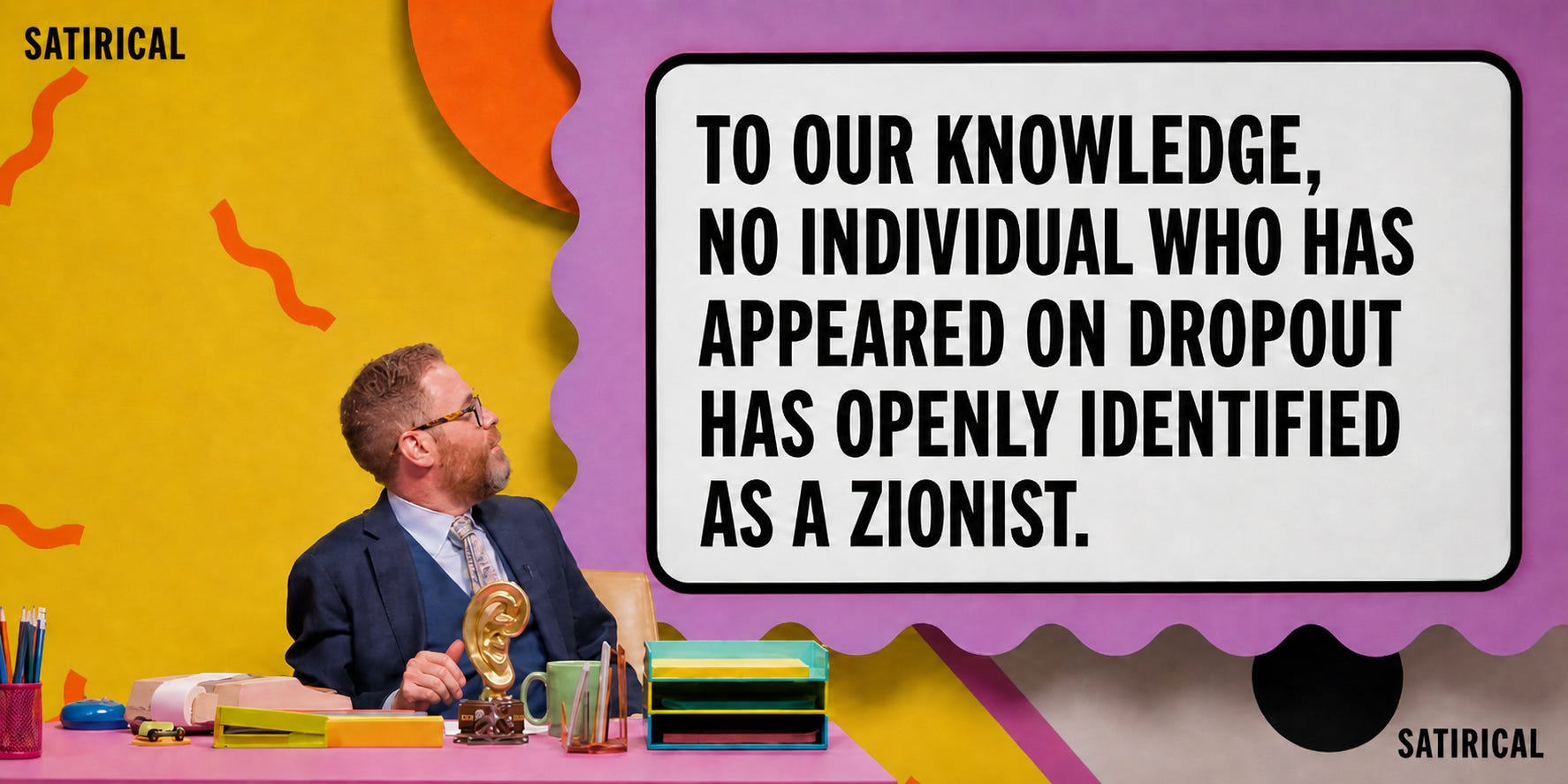
Hello, you're listening to a preview of a premium episode of Blocked and reported. This one is about Dropout tv, a wildly successful online channel for funny stuff. But they also got into a little bit of trouble involving cops, involving Jews and. Or Zionists. So if you want to hear the whole thing, go to blocked andreport.org and become a premium subscriber. Best deal in media either way. Hope you enjoy the preview. All right, Katie, get to it. You said you have a quick thing to start the show. I'm a very busy guy with a lot to say. Just get to it. Come on, hurry up. Hurry up.
- [00:39]
B
All right, Jesse. Well, you know how I'm a Do Gooder. You know that, right?
- [00:43]
A
A Do Gooder?
- [00:44]
B
Do Gooder.
- [00:45]
A
You can't even pronounce Do Gooder, let alone be a Do Gooder. But, yes, you are. For listeners who do not know the illustrious backstory of this podcast, you're Do Gooding included, you would. You would go over to your racist, ailing neighbor's house every night and sponge bath him whether or not he wanted it. And cut his toenails.
- [01:07]
B
Yeah, something like that. I also.
- [01:08]
A
Oh, and you helped. And you helped give housing to what turned out to be a pedophile.
- [01:13]
B
A couple of pedophiles.
- [01:14]
A
I wish newcomers might think we're making it up. And you did not. You didn't seek to give housing. Right. I want to make sure I remember.
- [01:22]
B
I did the background check after I provided the housing. There was not housing at my house. I got taken in by some fads. Some fads. Some sad stories. And then I paid for some people's housing, and then I bothered to Google them after the transaction had already been completed. But I have a new thing that I'm doing.
- [01:39]
A
Okay.
- [01:39]
B
I am starting. I'm starting to volunteer at our local community radio station for pedophiles.
- [01:45]
A
I know.
- [01:45]
B
Hold the applause. And so I went. I went yesterday, and I had my first meeting there, and they asked me if I, you know, like, what I'm interested in, what I could do. And I said, no audio production. I don't want to be helpful in that way. What I want to do is just sit and work at the desk. But they said, you know, if you have any interest, as time goes on, as you get more established, would you have any interest in starting a radio show? And I said, no, but. But what do you think about this show on community radio on Washington State Public Radio? No, it's not. It's different. It's Community radio.
- [02:20]
A
Well, yeah, like, okay, I. I Find it very funny that they're like, look, they think this is going to excite you a lot. I bet they're like, look, if, if you play your cards right, you might have a chance to do some on air stuff. We're not making any promises. We have to first make sure that you've got like a voice for like. That's really funny. You should just. Are you just going to keep going with this act, this charade, this facade?
- [02:43]
B
I don't think it's. I don't think it's much of an act. I mean, the whole thing is that I don't. I want to be. I want to do the thing that gives me the most joy and not the thing that is actually would be of the most service to them. So for me, the thing that would be the most joy is sitting at the desk greeting people as they come in. It's a dog friendly office, so Moose will be there.
- [02:59]
A
Oh, why do you. Why. Of all the. Of all the, like, ways to volunteer or give back to your community or feel more connected, why sitting at the community radio desk? How did you pick this?
- [03:11]
B
I want to. I want to get out of the house. I want to meet people. It's genuinely a very good radio station. I do want to be a part of it. I just want to be a part of it in an extremely labor, unintensive way.
- [03:21]
A
That's fair enough.
- [03:23]
B
Or, or if you're interested. I'm just saying if you want this show to be on the radio, I could probably pull some strings.
- [03:28]
A
Hello, welcome to Blocked and reported today the northern woodpecker is threatened by. I don't know. I don't even know how to fake
- [03:39]
B
it anymore in this town. They actually are having a very blocked and reported controversy right now. We might have to talk about some point. There was racist incident at the local Victorian fair.
- [03:48]
A
Wow. Well, looking forward to updates on that. Yeah, we don't have time for that today though.
- [03:53]
B
I said racist. Let's go with racial.
- [03:55]
A
Sorry, Racial. Not racist. It was a racial incident up for debate. Katie, you're an audio expert from all this volunteering you're doing. Why do my. Why does my waveform look asymmetrical?
- [04:05]
B
It has something to do with your voice.
- [04:07]
A
Your voice is so up. I looked into the problem and your voice is all up. This is going to be a long and involved episode, really? Episodes. I want to talk about Dropout tv, an online comedy channel I have a somewhat torture relationship with. Have you ever heard, had you heard of Dropout TV before?
- [04:26]
B
This I have heard of it because I have talked to you about it.
- [04:30]
A
Okay.
- [04:31]
B
I have heard the words dropout tv, partial credit.
- [04:34]
A
As it turns out, the history of the channel is actually pretty interesting. I want to go through a little bit of that before we get to the controversies we'll be discussing. Are you ready for some history, Katie?
- [04:42]
B
I'm ready for it.
- [04:44]
A
Way back in 2000, a website called CollegeHumor was launched by a pair of 18 year old best friends who were in college at the time. Josh Abramson and his childhood friend, Ricky Van Veen. Ricky Van Veen, by the way, now
- [04:56]
B
married to Alison Williams of the famed butt eating.
- [04:59]
A
That was the context in which she came up. But she's so much more than that. I want to make sure they're still married just because the divorce rate is so high in this country.
- [05:05]
B
Is it? Or is that.
- [05:07]
A
No, I was literally. Oh, they separated in 2019. I was literally just checking to make sure. Okay, the divorce rate. Like I said, we're pro marriage podcast. Here's a very helpful 2020 Wired article by journalist Kate Nibs that would later relate the site's earliest days. Katie, just read from this bit.
- [05:26]
B
Okay, so this it. I assume that means college humor linked out to friends. That's friends. And scare quotes like drunk stepfather and fatwilly.net, and. Some of college humor's earliest splashes reflected this fratty attitude. In 2004, it hosted the election Erection contest, where young women would submit risque pictures with no more bush or carry 04 scrawled on their bodies. The team started selling its own merch, including a foam hand called the Big Shocker, meant to resemble a sexual finger position.
- [05:52]
A
Are you familiar with the Shocker?
- [05:54]
B
I'm trying. I'm like, I'm doing sign language now to try to figure out what that is.
- [05:58]
A
Is it two fingers?
- [05:59]
B
Three fingers? Oh, is it a thumb? Just one thumb?
- [06:03]
A
It's one. It's one in each.
- [06:04]
B
Its biggest challenge was appeasing advertisers who were squeamish about commitment to boobs and bros. In addition to bulking up its written content, CollegeHumor offered a premium version called CollegeHumor RAW. We should rename our primo blocked and
- [06:17]
A
reported Raw Bar Pod Raw Bar Pod
- [06:19]
B
After Dark that offered jokes that were too offensive and images deemed too dirty. Internet archive screenshots of college humor from the time suggest that the dirty images were mostly women's nipples.
- [06:29]
A
So this was like a pretty successful site from early on, partly because they used a lot of other people's Unpaid work. Like people would post to it. And back in 2000, great model. If you're on the Internet back in 2000, you would actually enter the URLs of different websites and go there. Katie, describe the esthetic of this Screenshot of circa 2000.
- [06:49]
B
Collegehumor.com it's very GeoCities, like very early website, you know, link. Link. Bloggerl Is that what they called it? Not. Not a blogger. It's like links on the side. It's just. It's like a very old website. Shitty photography in the front.
- [07:04]
A
It's a photo of what, like at overturned trash can on a quad and a couple of kids passed out. Dudes fully dedicated to grinding your academic efforts to a halt. Yeah, when I was in college and after we definitely passed around some college humor stuff, was this just like out of sight of your. Of Your Teen and 20 Something World in Asheville where you were like burning down courthouses or whatever?
- [07:26]
B
I definitely had never heard of college humor while I was actually in college. I was way too busy having an in person social life I don't like. The Internet was a very small part of my college life.
- [07:38]
A
I wish I could say the same. By the time the original team actually for us we would do.
- [07:43]
B
Did you go to parties?
- [07:44]
A
Of course I went to parties. Although Brandeis didn't really have a lot of parties.
- [07:48]
B
Like land parties or like party parties.
- [07:50]
A
I was gonna say there was me and a couple kids on my floor, including my like in the same room roommate would play World of Warcraft 3 via our local area network because we had never seen an Internet Internet connection that fast.
- [08:03]
B
I'm trying to remember. So college. Did you have a. Did we have Internet in dorm rooms in college?
- [08:11]
A
Yeah, totally. Well, I mean, I'm sure maybe it was like the early days of them being wired, but I. It was shockingly fast and you could just like there was this shared network thing where you could download all this media for free. Except then we started getting legal letters. I got a legal letter at one point and they shut that shit down.
- [08:30]
B
But yeah, oh yeah, that's right. We talked about that in our net neutrality episode.
- [08:34]
A
Anyway, by the time the original team who founded CollegeHumor graduated from college, the site was getting 2 million views a month. So these two bros, they keep working on the site and then as home Internet connections become more powerful, they pivot to video and they begin to specialize in sketch comedy. So some of these offerings had to do with college directly. There was stuff like the six girls you'll date in college. Not. Not really. Not really applicable. The six guys you'll date in college not applicable to you. There was also. There was a really funny recurring series called if Google Was a Guy. The full run of the if Google Was a Guy sketches was posted six years ago. Racked up almost 50 million views since then. Strong nostalgia factor. Katie. Let's just watch a few seconds and embed to give people a sense of this next.
- [09:21]
B
Okay, so there's a bunch of people in a line going into an office.
- [09:25]
A
Hello there is today, tomorrow New Zealand. Yes. Foot, same length Europe. What Inch, Same length Europe.
- [09:33]
B
Gmail.com.
- [09:36]
C
what is Bitcoin Butthole.
- [09:39]
A
Imagine if Google was a guy. I find this funny and I like the nostalgia of like, because it relies a little bit on the novelty of Google itself. Like that's why it's funny.
- [09:47]
B
What year do you think this would have been from? Because I like. I don't find this particularly funny, but the quality of the video is quite high.
- [09:53]
A
This. Let's see if it says in the thing.
- [09:55]
B
It can't be that it's what is bitcoin. So it can't be that old.
- [09:59]
A
Yeah, this is not like their earliest, earliest stuff, but this is sort of what it evolved into basically. But this was so this was posted in 2019, but it was just like the full series from. From years earlier. Anyway, the site also earlier, before this led to sister projects like Vimeo. Do you remember Vimeo?
- [10:18]
B
Oh, totally. Vimeo was where I started watching High Maintenance and it was. It was so good. The early. They later they put the. It was sold to HBO and they later put all the old Vimeo episodes on hbo. It so good as a video series or as a Vimeo series. Like maybe 1012 minute clips, really high production values. The guy is now doing by the way, a video series on substack.
- [10:44]
A
The high Maintenance guy.
- [10:46]
B
The guy. Yeah, the guy. And by the way, also by the way, I once saw him on the Bambridge island ferry.
- [10:51]
A
That's a really cool story, Vimeo. In case people don't know, it's just a video hosting platform. There was also a novelty T shirt site called Busted Tees that spun off from from college humor. More importantly, college humor helped launch some pretty big names such as Adam Conover of Adam Ruins Everything in the podcast. Factually, who we will get back to in a bit. The comedy duo slash show Jake and Amir was also another big early college humor hit. So for a while this was all going pretty well, at least by the
- [11:21]
B
standards of like a college two Ferns between two ferns. Was that college humor a couple times?
- [11:27]
A
Yeah, that's a good question. Because a couple times I would remember this or that early viral video and think it was college humor. It was actually funny or die or vice versa. Between two ferns was funny or die. But the two sort of occupied a similar space. In 2006, a media giant called IAC led by the billionaire Barry Diller. IAC like to just acquire different Internet properties across different areas. They acquired 51% of College Humor. So the company College Humor was actually at one point housed in the same glassy building in Chelsea as the Daily Beast. After the IAC acquisition. That was when, like college humor really became an incubator of talent and started generating stars. But it all eventually fell apart. Vimeo lost its battle with YouTube as a streaming platform. CollegeHumor itself collapsed. The story of how it collapsed is actually interesting. Goes to what I, what I said earlier about how we used to go to websites so you would, you would just sign on to the Internet and you would open up different websites, which is not really how we surf the web these days, as you say, right?
- [12:30]
B
No, it's not. I don't surf. We stand there and like a wave of shit, a tidal wave of shit
- [12:37]
A
comes at us, blasted onto our face and chest. And there's no. There's no way to turn it off. And we're chained into place in some like S and M torture dungeon.
- [12:45]
B
It's coming from every device in your house, including now your refrigerator.
- [12:48]
A
It's all just shooting shit onto you and you can't escape it. Whereas before it was a more passive, pleasant, sit down, have a sip of your latte, type in different websites URLs. But yeah, social media has changed this immensely. And in college humor's world, the so called pivot to video was. It was a big inflection point. Did you ever work for an outlet that pivoted to video?
- [13:10]
B
So Grist. I was at Grist around the pivot to video era. So like 2015. And we did. We like there was a video team there and quite a good video team. And so we did do a lot more video, but we never stopped doing text.
- [13:27]
A
Right.
- [13:28]
B
Thank God. Because the pivot to video turned out to be. It was like Facebook's algorithm all of a sudden.
- [13:33]
A
Oh, we're gonna. Katie, we're gonna get there. Believe me. This is all about the Facebook Algori algorithm. But when I was at New York magazine.
- [13:38]
B
Sorry, sorry to interrupt you. We're currently living through the second pivot to video, which will hopefully die as quickly as the other one did.
- [13:45]
A
No, this one, I think this one, unfortunately, is here for good. Basically, every ringer podcast I listen to seemingly, you know, which is mostly sports podcasts, Seemingly all of a sudden, they all are not only on video, but on Netflix. And, like, there's been this real investment in podcasts having to be on video that we are so far eschewing. But people.
- [14:04]
B
Well, we do have a YouTube channel. It's just that there's nothing on it
- [14:09]
A
except hard, hardcore Slovenian pornography.
- [14:12]
B
I think that. I think that we are auto uploading all of our content to YouTube. It's just there's no actual video that.
- [14:19]
A
So that sentence you just said, that's a sign of a good strategy. I think we are auto uploading all of our content to YouTube. Katie Herzog is chief video coordinator for Permaburn Media, LLC.
- [14:30]
B
Hey. Hey. We have. In the last 28 days, we have 12 extra subscribers.
- [14:36]
A
Hell, yeah.
- [14:36]
B
And it looks like, yes, we are auto uploading all of our. All of our video.
- [14:41]
A
Well, that's just our audio to video. Yeah. When I was at New York magazine, basically how it worked was there was this sense that Facebook was the traffic fire hose, and you needed to adapt to Facebook and sort of make your stuff Facebook friendly. So New York magazine invested heavily in video, and it was really this thing of like, this is how we are going to continue to make money. And College Humor did something similar. In 2017, the site began posting videos to Facebook rather than its own hosted website. So it had some presence on YouTube and elsewhere, but it's. Most of its efforts were focused on Facebook. And at the time, Facebook was boasting some really incredible viewing numbers on its video. So it seemed like the place to be for online video. And that's why it got the attention of outlets like New York Magazine. So this was going on with big mainstream publishers as well. So Facebook was set up so that viewers would watch an entire video without leaving the site. And this would sort of leave College Humor in a lurch in terms of its own ability to make money and to monetize its audience. And Facebook's viewer numbers did turn out to be quite literally incredible in the sense that they were fake. It turns out that Zuck and co were deliberately lying about their video views in order to attract business and try to beat YouTube. They were inflating views by 152, 900%. This practice was uncovered, and Facebook was forced to pay $40 million as a MEA culpa, which is probably what Zuck Spends on like protein shakes weekly. It's true pocket change to him.
- [16:14]
B
I mean, was this just straight up fabricated or was it like they were three seconds of a video with autoplay and that would count as a view
- [16:22]
A
the way the Hollywood Reporter reported on it, a class action alleging the social media giant overstated the average time its users spent watching video. And this was a settlement that led to the 40 million to resolve it.
- [16:34]
B
Okay, gotcha.
- [16:35]
A
So this Adam Conover, who again we'll get back to, he has a 2020 Twitter thread laying this out that that I found useful. But essentially college humor kept pumping money into its Facebook presence, as did competitors like Funny or Die. And this strategy did not pan out and it helped lead to the almost complete destruction of college humor. I should note that Kate Nibs Wired article mentions that people's opinions differ on how much of the blame to lay at Facebook's feet. Some people actually think the role of YouTube was really important too, but that's just a different version. Similar story, which is like we produce content and we post it elsewhere without a good way to turn that into money.
- [17:10]
B
Right. And this has been a problem across the industry since social media became a thing that I mean, and also like this also corresponded with the collapse of the ad market because of companies like Craigslist doing free ads. Things like that.
- [17:22]
A
Yes. But a lucky few would soon find a way out of this mess. The year is 2018. College humor is flailing, but it announces this new product. And it's interesting watching this video we're going to embed of Sam Reich, at the time the president of CollegeHumor, appealing directly to fans to try something new. Katie, watch this video. And this is a long clip, but I think it's worth listening to to give a sense of where media was in 2018.
- [17:48]
C
Hey, guys. Sam here. I'm going to talk to you about College Humor, the YouTube channel and Comedy empire. That's really just the people you see here. This is TJ. He does VFX questions.
- [18:00]
A
Showing off, buddy.
- [18:01]
C
I started running CollegeHumor's video team 10 years ago when I looked like this. Gross. Those were the weirder, humbler days of the Internet. Remember Ebaum's world?
- [18:15]
D
And action.
- [18:16]
C
Making Internet videos is challenging mostly because it pays dick. And dick doesn't pay for Internet videos.
- [18:23]
B
I don't understand.
- [18:24]
A
The script calls for a knight, castle and a dragon. Would you settle for me, the conference room and my dog?
- [18:30]
C
I can't say no to that. Sure, we get advertisers on college humor, but advertisers rarely want to make the same stuff we do. Like for instance, a new season of
- [18:41]
E
Troopers I've returned to destroy your planet.
- [18:46]
C
Instead, they want to make branded content
- [18:49]
B
with a blast of flavor from Chompsky's potato chips. Now eat the chips.
- [18:54]
A
Eat through the mask.
- [18:56]
C
That's why we got into tv, to make bigger, better shows. But on tv, we answer to the networks and the network's answer to, you guessed it, Chomsky's potato chips. So we can't make anything as R rated as, say, precious plum.
- [19:10]
A
So we sayin TV ain't want us fuck a bag. Can't say that.
- [19:15]
B
We suggest eat a bag of Chompskies, that is.
- [19:20]
A
I can't stay mad at you. Hey, don't be a sellout.
- [19:26]
C
Nowadays, many of our YouTube videos are deemed controversial and don't make any money. Controversial can mean anything as small as, say, implied nudity.
- [19:36]
A
For the record, he is completely naked.
- [19:38]
E
Well, the script called for it.
- [19:39]
A
It actually called for implied nudity. You heard him, right? We're already here. Didn't you Uber here, By the way? We'll blur it on the day. Which is why you didn't need to be naked.
- [19:48]
C
So what do we do? How do we produce the shows we want and you want without watering them down for advertisers or networks? The answer is by going straight to you. Today we're announcing Dropout, our new subscription service. With Dropout, you'll get access to new, bigger, better, longer uncensored shows from the people behind CollegeHumor.
- [20:12]
A
Get it faster? Minions Faster.
- [20:17]
B
No, substantial.
- [20:18]
A
No, that.
- [20:18]
B
Too hard.
- [20:19]
C
Too easy. It's like Netflix, but worse and cheaper.
- [20:24]
A
So, Katie, like, having watched that, it seems like Reich felt like he had to very specifically sell people just on that concept of paying content producers directly for their content. No.
- [20:34]
B
Yes. I mean, this was. I'm sure there were some paywalled blogs.
- [20:40]
A
There's definitely some.
- [20:41]
B
Yeah. But back, you know, 10 years ago, what year was this? 2000. So not even.
- [20:45]
A
This was 2018.
- [20:46]
B
Not even 10 years ago. The idea of asking people to pay
- [20:50]
A
for your content, unless you were a big bundled thing like the New York Times or whatever.
- [20:54]
B
Right.
- [20:54]
A
But this, this was like a little bit different or even.
- [20:56]
B
Or maybe like a very niche, like, investment blogger, you know, but the idea of, like, pay. Of asking someone to pay for your podcast or to pay for your essays was. Wouldn't have occurred to me at least, or I think much of anyone else. It was just like the Internet was built on an ad market at that time.
- [21:13]
A
Yep. And we should note that like on a lot of the business merits, we now know that for certain types of products like this model, having subscribers pay you directly is just so much better and more stable than the ad supported models that preceded it. So Sam Reich recorded that in 2018, in 2019, this scrappy newsletter startup called Substack convinced me to launch something on there the year after you and I launched this podcast on Patreon. And now we're on substack 2. Why do you laugh? This is all. None of this is funny because Substack
- [21:42]
B
came to me in 2019 and tried to convince me to leave my job at the Stranger to. To start a Substack newsletter. And I was like, guys, I make $50,000 a year. I have benefits. You are crazy.
- [21:57]
A
I can never be an independent brand of any sort.
- [22:01]
B
You want me to give this up for a newsletter? I should have done it.
- [22:05]
A
So. So when, when Dropout, this new product, Dropout, was launched and Sam Rice is trying to get people to pay for it. This is the start of the era of crowdfunding. And Dropout really did catch the first wave of this revolution in the relationship between people who make content and the people who consume it.
- [22:23]
B
Okay, and just to be clear, the relationship between CollegeHumor and Dropout, you might have said this, but just because I wasn't listening, what's the relationship?
- [22:30]
A
Dropout is the new paid product from CollegeHumor at the time of 2018.
- [22:35]
B
It's their Primo.
- [22:35]
A
It's basically their primo. And the theory is they can use that money people pay for, for higher production values and better stuff without being dependent on advertisers. Gotcha now. This does not work at first. In 2020, the company's value is still in the toilet and IAC actually sells it to Sam Reich, who at the time had been there since 2012. Here's what he said about this period in an interview with the NPR show. It's been a minute.
- [22:58]
F
And the last go at this, their last big push with us was subscription was why don't you go try to form a little boutique Netflix of your own. And so we did. And again, it wasn't a failure, but it wasn't earth shattering success. And they got really bored of us really fast and tried really aggressively to sell us. And it was only that they tried so aggressively to sell us, which is not a wise thing to do if you have something you want to sell. The worst thing you can say to a potential buyer is I need this gone. Now they're like, oh, My God, what's wrong with it? Which allowed for me to step in because there were so few other offers. I made IAC a kind of a creative offer which involved very little cash. And by very little, I mean zero.
- [23:54]
D
Like no money. Like no. No money.
- [23:57]
F
Yeah. They gave me the company for the low price of free.
- [24:01]
A
It's just so unheard of.
- [24:03]
F
Yeah, well, in exchange for keeping some
- [24:07]
D
of it so they maintain some ownership, but they just said, look, like, just take this off our hands. Essentially.
- [24:14]
F
Essentially, yeah.
- [24:14]
B
Okay, now that is a really good deal. Who is Sam Reich?
- [24:18]
A
Sam Reich. So he's now the CEO and he would come to play an important on screen role as well. He's. He's a comedy guy who, like me, grew up in suburban Massachusetts. Like me, he's Jewish. Little known fact about me, one small difference between the two of us. Whereas my father is not former Secretary of Labor Robert Reichstag, Sam Reich's father is former Secretary of Labor Robert Reich. So that's just a fun fact about Sam Reich.
- [24:42]
B
Famed nimby.
- [24:43]
A
Famed nimby, famed very short man and former college professor of one Jesse Singel.
- [24:49]
B
Oh, really? Huh. Interesting.
- [24:50]
A
Yeah. Before he moved out to Berkeley, he was a Brandeis professor. He taught a course called wealth and Poverty that I thought was amazing. It blew my little freshman mind.
- [24:58]
B
Did you have a relationship with him?
- [24:59]
A
Well, a sexual relationship, but that does. That was unrelated.
- [25:01]
B
This was before. Me too. It was fine.
- [25:03]
A
Sam Rice comes across in every interview. I've heard of him as a really good, level headed. I think he's universally beloved by the people who work for him. As Kate Nibs put it in her Wired story, Reich is beloved within the college humor community. Wired spoke with more than a dozen former employees, and the praise was unanimously effusive. Rare for someone who has just laid a bunch of people off, because that's what he had to do. He buys his company for almost zero. He cannot pay all these people. He lays off most of them.
- [25:29]
B
Okay, so he has this company with no employees. What did he do with it?
- [25:33]
A
Yeah, very few employees. The sense I get is that he's trying to like, consolidate whatever's there there. In terms of the remaining employees, I. They had also already maybe filmed some stuff that hadn't yet been put online. And he's just trying to squeeze what he can out of the remaining performers and to somehow launch new offerings that would actually help dropout make money. That's what it's called at this point. It's dropout. And he, as it turns out, has Been wildly successful at that. So last year it was announced that Dropout had crossed the threshold of a million paying subscribers.
- [26:03]
B
Wow, that's a lot.
- [26:04]
A
That's even more than usual. Slightly. Slightly, yeah.
- [26:09]
B
And what is the content like? Is it collegehumor esque?
- [26:14]
A
I think it's like significantly evolved and changed from there. Like the bread and butter of Dropout is improv comedy. And this comes in a few different. What's that? Yoinks for Katie.
- [26:26]
B
I'm not an improv fan.
- [26:28]
A
I was gonna say, part of what's gonna be interesting about this episode is I think you're very funny. A lot of people think you're funny. I frequently, like when I need people to listen to me, I think that
- [26:36]
B
I'm joking when I' not. I'm actually the opposite of funny. I'm extremely not funny. But no, I will, because I'm so not funny.
- [26:44]
A
Six to 25 times a year I will meet someone who will say they're a listener and I'll be like, thank you. And they'll be like, Katie is so funny. And then just an awkward pause, silence descends, and I'm like, I'll say, what about me? And they'll say, I have to go to the bathroom. Yeah. It's unscripted, AKA improv. Oh. What I was going to say is you're very funny, but you're not someone who, I don't think you seek out humor. I can't imagine imagine you going to a stand up show, let alone an improv show.
- [27:13]
B
I saw Robbie Hoffman last year.
- [27:15]
A
Was it good?
- [27:16]
B
Yeah, it was pretty good. It was pretty good. You know, like for me, like going to it, like if I, if I do like a little bit of a, like a twitchy smile, that to me that's like a big laugh.
- [27:27]
A
So Dropout. Yeah, mostly improv comedy. So Sam Reich himself, he hosts the show's Game Changer and Make Some Noise. Make Some Noise actually spun off from Game Changer because the premise of Game Changer is they basically play a different game every episode. I think Make Some Noise is. Katie, stop it. You are being mean to these very,
- [27:48]
B
very wealthy, successful improv comics.
- [27:51]
A
The whole reason we're doing this podcast is because maybe four or five months ago YouTube started fire hosing my ass with dropout TV stuff and I thought it was extremely funny. It's really, really good. I think Make Some Noise is the one I've seen the most clips of and it's pretty analogous to Whose Line Is It Anyway? Sam Reich, you are such a boomer. Up. I'm not Sam. Right. So Sam Rice stands at a podium. He does these prompts for the contestants. They haven't seen the prompts before, and they just have to sort of perform on the spot. So, yeah, I'm not gonna, like, have you done improv?
- [28:24]
B
You seem like you've done improv.
- [28:26]
A
Let's try right now. Give me. Give me a. Give me a location. No, just one minute. One minute improv. So give me a location.
- [28:32]
B
Bermuda.
- [28:33]
A
I just landed. Where's the beach Tour.
- [28:35]
B
Yes. And that was really good.
- [28:38]
A
We should add this to our repertoire, I think I did improv this.
- [28:42]
B
I fucking knew you did.
- [28:43]
A
I don't know if this is more revealing about me or improv. I went to one meeting of the Improv Club in 9th grade when I was at, like, my peak awkwardness, and I was like, these two kids are too awkward for me. I can't. I can't. I can't handle the 1998. Jesse found improv too cringe. Cringy to do. I think improv is really. A lot of improv sucks. Obviously, if you go to your average local troupe, it will not be good. Good. I think really good improv is actually extremely good. And I think also because there's been this sort of revolution in, like, increased understanding in how filmmaking is done, we now know that, like, Steve Carell in Anchorman, a lot of your favorite scenes, you know, many of them might have been improvised. So I think there's a growing understanding that, like, you've never seen Anchorman, which is one of the funniest. Okay, whatever.
- [29:29]
B
I have been watching Rooster. Have you seen that? It's Steve Care. Yeah, it's on hbo.
- [29:34]
A
It.
- [29:34]
B
It's funny. It's. It's. It's. It's genuinely funny. It's. The writing's really good. It's Steve Carell playing a professor, like a visiting professor at a college.
- [29:44]
A
Oh, and you like it?
- [29:45]
B
I don't laugh at it, but I like it. I enjoy it, of course.
- [29:49]
A
Well, okay. I'm just. I. I am not going to embed that many dropout clips in this episode because they just don't translate to audio only. But let me just give you a couple for a taste. So you tell me what you think of this. Katie. Watch this first one.
- [30:00]
F
Kermit the Frog, representing himself on a murder charge.
- [30:05]
D
Well, golly, I understand that the prosecution
- [30:09]
A
has presented a really compelling case, and
- [30:13]
D
obviously Fozzie Bear was a close friend, but ask yourself this question. If I were to be the one that killed Fozzie Bear. Why would I have recorded going to see him alone that night? Wouldn't I have wanted to cover that up? Doesn't this speak that I've been framed? My name written in the ledger of the motel was written in pink glittery ink.
- [30:42]
B
Ladies and gentlemen, I think I've watched enough. Two questions. One, why is anyone laughing at that?
- [30:48]
A
And two, because it's funny.
- [30:49]
B
Why is he talking like you?
- [30:50]
A
Why is he talking like me? That's it's pretty anti semitic. I'm gonna embed one other one cuz it's Massachusetts themed and I can't resist.
- [30:59]
G
The man from Nantucket holds a press
- [31:01]
A
conference to set the record straight.
- [31:05]
E
All right, I gotta get back to the docks. I don't have all day, but I hear there's a lot of rumors going around. Okay, I'm already seeing a question here.
- [31:12]
B
Timmy Sullivan from the Boston Globe. Are there any photos you could provide us? Yeah. Prove it.
- [31:18]
A
Why don't you look my long?
- [31:20]
E
But it's not so long. I can suck it.
- [31:22]
B
I told you.
- [31:23]
E
I cannot curl myself up like an armadillo and give myself a self suck. Okay, I can't go full pill bug mode. Have I tried?
- [31:32]
B
Sure.
- [31:33]
E
Spinal flexibility is what it is, folks.
- [31:36]
A
I knew it. I knew it.
- [31:37]
E
Look there once.
- [31:38]
A
Oh, good for you.
- [31:40]
E
There's a man from Nantucket since birth and he knows his own self worth. He just says yuck when he heard about self suck. It's not long but has quite some girth.
- [31:53]
A
I find this stuff very funny. A lot of people find it funny. More than a million paid subscribers find it funny. Make Some Noise features a rotating cast of both dropout regulars and guests. The original quote unquote Noise boys are Brennan Lee Mulligan, who we'll get back to Zach Oyama and Josh Rubin. They also bring in other cast members from the broader dropout universe as well as guests. This includes some big name guests like Ben Schwartz. Lisa Gilroy.
- [32:16]
B
Never heard of him.
- [32:17]
A
You've never heard of Ben Schwartz?
- [32:18]
B
No.
- [32:19]
A
I can't tell if you're joking or not.
- [32:20]
B
No, I'm not joking.
- [32:21]
A
Do you know who Sonic the Hedgehog is?
- [32:23]
B
Look, of course I've heard of Sonic the Hedgehog, but I. Tell me you're not gonna tell me that he's related to Sonic the Hedgehog.
- [32:28]
A
Ben, voice. Sonic the Hedgehog?
- [32:30]
B
Sonic had a voice?
- [32:31]
A
You really are not acquainted with high culture.
- [32:34]
B
I'm a woman.
- [32:35]
A
I'm going to rattle off some other names that to normal people might mean something. Lisa Gilroy, who is hilarious. Is on their. Pete Holmes. You know Pete Holmes?
- [32:42]
B
Yes.
- [32:42]
A
Wayne Brady.
- [32:43]
B
You know Drew Carrie.
- [32:44]
A
Yeah. He was on Whose Line Is It Anyway? Another highlight of Dropout is a fake talk show called Very Important People. This is hosted by Vic Michaelis who's probably the second most famous cast member on the channel.
- [32:56]
B
Never.
- [32:58]
A
Vic is a is a she or they. And you just. So you're off to a good start by calling she they. Vic Michaelis has actually acted in in movies and TV shows and stuff. She was actually on a apparently well regarded Hallmark Hanukkah movie that I have not.
- [33:14]
B
Okay, now that's funny.
- [33:15]
A
Our listeners said that it was very good when I asked him about this in the chat. So I find the format of Very Important People very brilliant. They will have one of their in house performer or performers get put in a ridiculous outfit and ridiculous makeup. They don't know beforehand the what they're going to be dressed as. And then they just have to create a character on the spot and get interviewed by Vic Michaelis. Does any of this even hypothetically do anything for you? Katie Herzog?
- [33:39]
B
Not a thing. I'm like I stopped listening to you. This is. I like not. No.
- [33:45]
A
I knew this was going to be a challenge because we're going to get to the juicy controversial stuff. But I need to explain what it is. And you're so dead to comedy and to the joys of life.
- [33:55]
B
Let's just fast forward to the part where someone wears a Confederate costume to the Victorian fairy.
- [34:02]
A
See, you're funny.
- [34:03]
B
That's happened. That happened in Port Johnson. That's what I'm going to talk about on my radio show.
- [34:07]
A
Do you we got to get you on Dropout. Although I think after this episode the odds of that will have diminished to even closer to zero than they already will. Okay, I was going to do a couple more clips. We'll just put them in the show notes. One of my favorites involves Vic Michaelis interviewing two foul mouthed babies with British accents played by grown men. I find it hilarious. I won't subject you to it but you do commit. You are committing to putting them in the show notes. Right.
- [34:37]
B
I will put the links in the show notes.
- [34:39]
A
Thank you ma'. Am. I think all this stuff works really well. Like I said when I mentioned this to our listeners in the chat, there are fans of ours who watch these shows. Again, more than a million people do. I think the performers are really good at what they do and I think the chemistry is evident because they've been doing this for a really long Time.
- [34:57]
B
Okay, so it's a bunch of fake game shows, improv, and giant babies being interviewed. That's the whole thing.
- [35:02]
A
That's a good chunk of it. But the biggest hit is something really different. So Brennan Lee Mulligan is probably the single most famous cast member at this point. Like Vic Michaelis, he's done some, quote unquote, normal mainstream acting on, like, Peacock and stuff like that. He's also, for many years, been a huge Dungeons and Dragons nerd. And he has turned a show that is centered on the cast members and guests of Dropout playing Dungeons and Dragons into the biggest thing on Dropout TV. It's called Dimension 20.
- [35:34]
B
Really? I don't want to yuck anyone's yuck yet.
- [35:37]
A
Yuck their yuck or yuck their yuck?
- [35:39]
B
No, I don't.
- [35:39]
A
I don't. Fact check.
- [35:40]
B
I think that adults should. What adults should be doing with their time is sitting around smoking cigarettes. That's what adults should do.
- [35:49]
A
So just for any Dropout fans who find their way to this show for the first time, you are directly.
- [35:54]
B
I'm just saying that, look, I'm not gonna. Again, I'm not gonna yuck anyone's yuck. I won't do that here.
- [35:59]
A
But you keep saying yuck their yuck when you mean yuck their yuck.
- [36:02]
B
I don't mean.
- [36:02]
A
Surely you don't care about yucking their yuck.
- [36:05]
B
Just keep going. Just continue. We have a lot to get through.
- [36:09]
A
We really do. This show, Dimension 20, has ridden this wave of interest in just nerd culture. Nerd culture has exploded in the age of social media. A live episode of Dimension 20 featuring many of the dropout TV stalwarts, sold out Madison Square Garden.
- [36:29]
C
What?
- [36:30]
B
Wait, Dungeons and Dragons roleplay?
- [36:34]
A
Yeah.
- [36:35]
B
We couldn't even sell out the fucking comedy seller.
- [36:38]
A
We did sell out the. Okay, hold on. Don't be more harsh on us than you need to be. We did sell out the comedy seller, I think in Boston. We were. We narrowly sold out the 300. We narrowly did not sell it.
- [36:51]
B
Start doing more roleplay.
- [36:52]
A
Dungeons and Dragons. I think part of the story I'm going to tell you has to do with really intense parasocial relationships. And I think part of that can be explained by this strange aspect of all this that Brendan Lee Mulligan, the host and usually the Dungeon Master of D20, talked about with Adam Kahn over on Factually. We'll drop that here and you are
- [37:14]
G
there doing perhaps the archetypical performance that no one should watch. The thing that people feel that they should do in their basements.
- [37:25]
A
Yes.
- [37:26]
G
Away from prying eyes. Even if someone opens the door. Mom, get out of here. Do not.
- [37:34]
E
You.
- [37:34]
G
You drop your elf voice.
- [37:36]
A
No.
- [37:36]
D
Yeah.
- [37:37]
G
I cannot have another person witness me do this activity. You're doing it first for countless tens of thousands of people.
- [37:44]
D
Yeah. It's crazy the thought playing D and D was a thing. Far from sharing it with thousands of people live and in person. The thought of the wrong people finding out that you had played D and
- [38:04]
A
D.
- [38:06]
G
There's literally posters around LA of Brennan Lee Mulligan's gonna be playing dd. That would be your nightmare. When you' don't tell anybody we're doing this.
- [38:16]
D
Like a drop top jeep with a
- [38:18]
A
bunch of letterman jacket wearing jocks are gonna ride by and go, these nerds are at the Hollywood Bowl June 1st. Let's get them.
- [38:25]
D
Truly insane. Really insane.
- [38:27]
A
Does that, Katie, does that at all help you understand why this might attract such a fervent following?
- [38:32]
B
Yes, because people who were beat up in high school all need to stick together. If you have a big mass of them, you know, it's like animals who have to stick together. Like penguins who all gather in a mass to avoid the walls. Winds.
- [38:43]
A
It's like that to avoid the winds.
- [38:45]
B
The winds on Antarctica.
- [38:47]
A
I thought they got in that circle to avoid predators. That's to keep the winds.
- [38:51]
B
Yeah, it's both.
- [38:52]
A
Do they play Dungeons and Dragons?
- [38:53]
B
Yes, but just with their feet.
- [38:57]
A
That. That helped me understand it a little bit.
- [38:59]
B
Like you understood it the whole time.
- [39:02]
A
I've never played Dungeons and Dragons in my life. There was a period. That's it. That's all you get. If you want to hear the whole thing, go to blockedreporter.org and become a premium subscriber. Thank you for listening. Shalom.