Loading summary
Transcript155 lines
- [00:00]
A
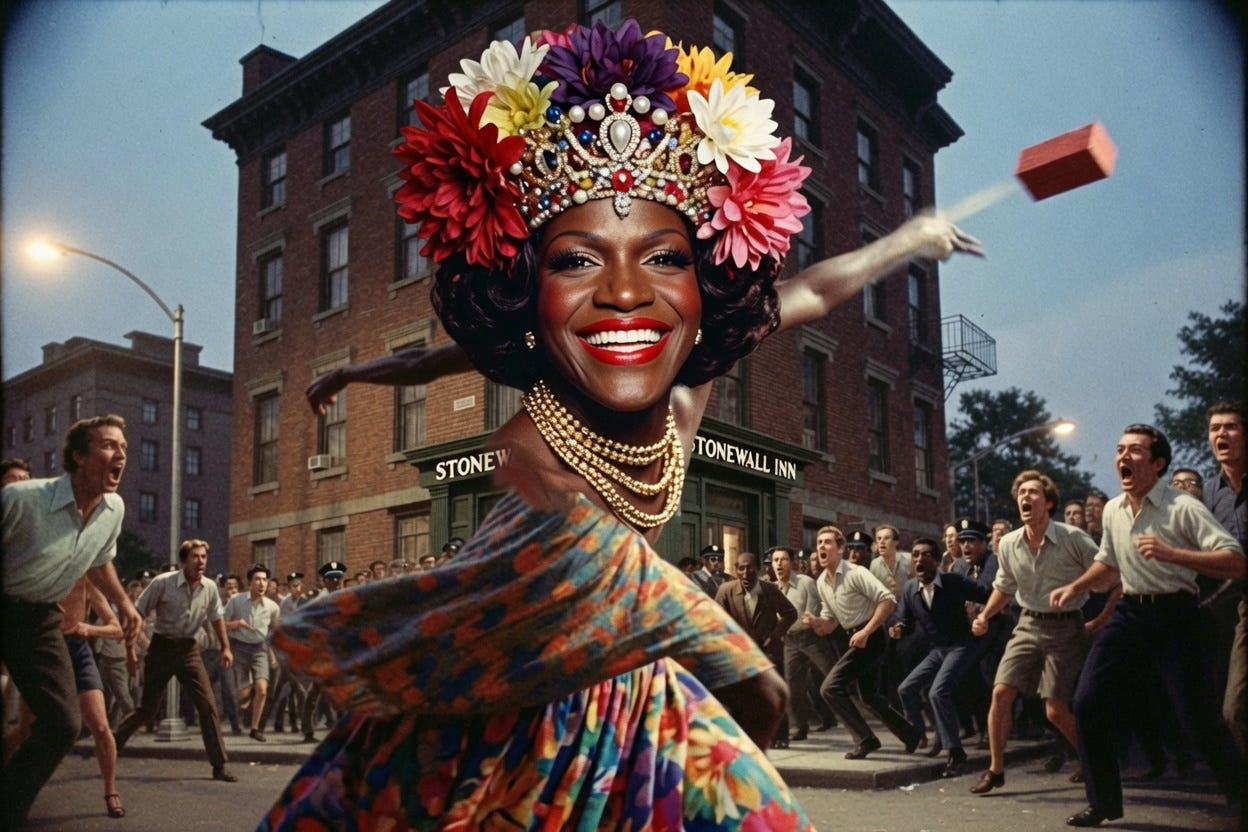
Hello. You're listening to a preview of a premium episode of Blocked Reporter. This is part two of Katie's investigation into whether Marsha P. Johnson threw the first brick at the Stonewall Inn riot. The answer to this question is so goddamn shocking that you should just make sure you're sitting down when you listen to this. We go into a lot of other details about this, about the parallels to the Matthew Shepard case, about, I don't know, memory, legacy, identity. There's a lot of good stuff there. I hope you'll listen to the whole thing. If you want to go to blocktoreported.org and become a premium subscriber, thank you and enjoy the preview.
- [00:43]
B
Jesse, do you hear that?
- [00:45]
A
I do. It's like I'm into club.
- [00:48]
B
We are into club. We are officially in remix territory. Our primos voted 55% to 45% to change the theme song to this version of the theme song, which is human created. We have been assured. So this is it. This is. This is the future, folks. We're in the. In the clear.
- [01:10]
A
But for Primos, not for regular episodes, just for Primos. People were furious at the idea. People really liked this new. This new version by. What's his name?
- [01:20]
B
His name is Jeff. Truly.
- [01:21]
A
Truly. Truly. Jeff. Yeah. But there was. There was a lot of excitement about this. There was also a lot of dismay at the idea of losing the song you bought for, I think, two nickels six years ago, it was either 20
- [01:35]
B
or $40, which today is like 80 or $100.
- [01:39]
A
Well, because of Bidenflation, it's probably like $1,000. I think people have a Pavlovian response to it just because this is such an incredible podcast. It's not a good song by any objective measure.
- [01:50]
B
I sort of understand because, like, maybe 10 or 12 or 15 years ago, NPR updated their song, and I'm still mad about it.
- [02:00]
A
Okay, so I guess people have strong feelings about these things.
- [02:03]
B
It's true.
- [02:04]
A
Speaking of things people have strong feelings about, we are rounding out. Well, I guess Pride Month is over by the time anyone hears this. But we're rounding out our Pride Month coverage by doing part two of your investigation into who threw the first brick.
- [02:22]
B
That was the most Jewish you've ever sounded.
- [02:24]
A
It was genuinely accidental.
- [02:26]
B
And then I. Chick chock's name.
- [02:28]
A
Some chick chock. So, yeah, just. Let's. Let's just get into it. Katie, who threw that brick? Was it me? Was it you?
- [02:35]
B
Okay, so first, I'm going to start this with a trigger warning. Marsha P. Johnson was A biological male who used both male and female pronouns. This does not seem to have been a particularly fraud issue at the time. Like, people. Some of the people who knew Knew Johnson back then use he. Others use she. I listen to a lot of archival tape of people talking about Marsha P. Johnson. It's kind of mixed. I'm going to use female pronouns as an adult when I'm talking about Marsha P. Johnson as an adult. I know this is going to bother some of our listeners, but frankly, I just find it easier to use she, her pronouns in this case because that's the convention. That's what I always hear. It does come naturally in this case, and also because I would like this to be the sort of thing that people can send to their friends and say, look, I know you're planning on getting a Marsha P. Johnson tramp stamp, but you might want to listen to this episode first. And I think those people are going to immediately reject everything else I'm about to say if I use he him pronouns. So apologies to anyone who might be triggered by this, But I have faith that our listeners can handle it. What do you think, Jesse? Can they handle it?
- [03:34]
A
I think they can handle it.
- [03:35]
B
Okay. So there has been just an incredible amount of myth making around Marsha P. Johnson. And an essential part of that myth is that she threw the first brick at Stonewall, or alternately, the first shot glass. And it was her actions. It was that action that sparked what became known as the Stonewall Riots. I got a text yesterday from a friend who was at the Pride March in Anchorage, which, by the way, large contingent of furries, which I suppose makes sense, because where else could you wear a fursuit in summer, not get heatstroke? But he said that during the parade, someone marching yelled, who threw the first brick? And the crowd responded, marsha P. Johnson. Not a lot of bar pod listeners up there, I guess. So this myth persists, and that's what we're looking into today. And I want to say up top. You know, it's interesting that this is in many ways recent history, and yet it's still very hotly debated. It's not as if we're talking about the Stone Age here. And yet it's hard to know what's real and what's not. So, as I mentioned on the last episode, I'm relying on many different sources here. One of the primary texts I used to put this together was David Carter's book, Stonewall, the Riots that Sparked the Gay Revolution. Now, as you will hear, I think that David Carter is a big reason for the spread of the Marsha P. Johnson mythology.
- [04:45]
A
Like, like he put like, that's. It's from his book. He said it in the book.
- [04:48]
B
Not in his book. It's not in his book. It's something that came later. This will make sense in a little while, but let's start at the beginning. So Marsha P. Johnson was born Malcolm Michaels Jr. On August 24, 1945, in Elizabeth, New Jersey. She then he was the fifth of seven kids. Dad worked at the GM assembly line, mom was a housekeeper. The family was religious. They attended an AME church. And fun fact, Marsha remained a practicing Christian for the rest of her life, although her spirituality was a bit schizophrenic in nature.
- [05:19]
A
So wait, Marsha P. Johnson was like, is this sort of the classic case of a trans woman who from a very early age feels like they're a girl, or is it more complicated than that?
- [05:28]
B
So she said in an interview not long before her death that she started wearing dresses at the age of five. But there's no, I get no sense that John or Michaels, Malcolm Michaels, thought. Ever thought that he was literally female. And that interview was pretty shocking. Like, Johnson says that she knew boys, had sex with boys as a child because she and a neighborhood boy used to. Or he, at that time in a neighborhood boy, used to jerk off together. He also says that he was raped as a 13 year old. And it's fairly graphic. But she's also like. Or he's this. I'm sorry, the pronouns are gonna get really confusing here. But she's also laughing. I'll spare you the details, but it sounds like childhood others would consider traumatic. I'm not sure that Johnson ever saw it that way. But as a child, Malcolm Michaels was sort of the prototypical gay boy, you know, highly effeminate and bullied for it.
- [06:16]
A
Okay, so close. Closer to an effeminate gay boy than someone who was like, insisting, I'm a girl from a young.
- [06:21]
B
From a young age, yes, like to wear dresses, liked boys. But in everything that I read, including a lot of Johnson's own words, I never get that sort of contemporary way that we talk about gender or some people talk about gender, like, born a girl.
- [06:39]
A
Okay.
- [06:39]
B
So after graduating from high school in 1963, Malcolm Michaels moves to New York with one bag of clothes and $15. And once there, he becomes Marsha P. Johnson. She started. She at that point starts wearing women's clothing at least part time, later full time, and adopted the name First Black Marcia. And Then later, Marsha P. Johnson. And she would say that the P stands for pay it no mind.
- [07:00]
A
Okay, so this sounds like someone who was, like, fairly, you know, non conforming in the more general sense. And in this is the mid-60s. So, like the sort of counterculture hasn't really taken off yet.
- [07:12]
B
Yeah, she was eccentric, a hustler, a prostitute, often homeless, in and out of psych wards, in and out of jail, but seemingly very well known and often loved. So in interviews of people who knew Johnson at the time, they seem to see her as almost holy, like this very spiritual being from another realm, you know, often decked out in flowers. They called her Saint Marcia. Although, like, this is people looking back after she died, the adoration could be revisionist history. Johnson comes across as a. As a character, you know, and there's people like that in every town. Someone everyone knows, maybe a little bit crazy, but a fixture of the community. And Johnson did become somewhat of an icon in New York even before the story went global. So, like Andy Warhol's Silk screened her.
- [07:54]
A
Okay, so like, back in the 60s, there were. I don't think we really had transgender as a category, but there were people who called themselves transsexuals. Was. Was Marsha P. Johnson in that category?
- [08:05]
B
Not even transsexual. It was transvestite. Okay, so she described herself alternatively as gay, a transvestite or a drag queen. And this the thing that happens now where you aren't supposed to, like, dead name people or acknowledge that they are not who they always were. That ethos is newer. There was no question that Johnson was a man. And David Carter explains in his book that there were all these subtypes of what we would now call transgender or transsexual. So, like scare queens or flame queens who were super effeminate gay boys. And in general, I think it's a mistake to try to pose today's norms onto the past. That said, I suspect if Johnson were alive today, she would probably call herself transgender. And I say that because in one interview that she did in December 1970, she said she was on her way to getting a sex change.
- [08:56]
A
Yeah, I mean, that would seem to be pretty strong evidence that Marsha P. Johnson wanted to identify as a woman.
- [09:02]
B
Yeah, I mean, I don't think she ever did the snip snap. But, yes, I think that. I think that had the term transgender been part of the vernacular in the era that we're talking about, she would have qualified. And so. And the woman who did that interview with her. So the interview was with Marsha P. Johnson and Sylvia Rivera. And it was conducted by Liza Cowan, who is an interesting character in her own right. So she founded Dyke Magazine. I've spoken to her a few times over the years. I had no, like going into this. I had no idea that Liza had ever spoken to Marsha P. Johnson. But she did the first interview with her and Sylvia Rivera. It was supposed to be about fashion. Liza worked for a local radio station, and the idea was to interview people who were cross dressers, basically interview them about clothes and gender. So she did this interview, and she later donated to the Lesbian Herstory Archives, which I mentioned last week because they're fighting with a Instagram account called Lesbian Herstory. Of course, like typical Pride Month, lesbian infighting. It's how we celebrate. And the Lesbian Herstory Archives misfiled this interview. So it sat for, like, 50 years until an archivist from Making Gay History, that. That's the podcast. A guy who found. Who worked for them found it rebirthed this thing that had sort of been lost to history. And I asked Liza, by the way, what she thought of Johnson and Sylvia Rivera, the sort of sanctification of them as the leaders of the Stonewall riots and the queer rights movement, what she thinks about that. And Liza just founds. Finds the whole thing very weird. She says it's complete nonsense. She said, what are you going to do? The myth is like a snowflake that turned into a snowfall that turned into an avalanche, and you can't stop an avalanche.
- [10:32]
A
Huh. That's vivid.
- [10:34]
B
Yeah. So back to Marsha P. Johnson, the human, not the myth. So she was kind of nuts. David Carter writes that she was deeply religious, but also, quote, deeply disturbed. While her religious pronouncements could have the irregular tone of direct experience, they also had the unsettlingly weird quality of statements made by a person suffering some from psychosis. She was also, according to those who knew her, both sweet and generous, but also volatile and sometimes prone to violence and outbursts that is not usually mentioned in the hagriographies.
- [11:02]
A
This reminds me a little bit of the sanctification of Matthew Shepard, where totally Matthew Shepard was himself a really troubled young man. And a book by Stephen Jimenez, the Book of Matthew, talks about that. And it's just the same thing where you sort of.
- [11:18]
B
And a drug addict.
- [11:18]
A
Yeah, it's the same. The same sort of thing where, like, you take a human figure who has flaws and who has a certain legacy, and you sort of sand down the rough edges of who they were as a person.
- [11:29]
B
Yeah. And With Johnson, I think it was a bit more of an organic process with shepherd, his mom, and some local queer activists. Like, they made the decision.
- [11:41]
A
We are going well in national, I mean, national gay activist groups.
- [11:44]
B
Absolutely.
- [11:45]
A
Because he became a martyr.
- [11:46]
B
Absolutely, yes.
- [11:47]
A
If you take someone's life and you remove. Reduce it to one incredibly important and symbolic moment, whether it's a horribly violent death in Shepard's case, or this triumphant brick throwing in Marsha B. Johnson's, like, I think that's what's going to happen. Like, it's just. It's easier for them to be a hero or martyr if you don't take their actual full biography into account.
- [12:08]
B
Yeah, yeah. Okay. Now, the story of the Stonewall Inn is itself pretty interesting. It, like, as a business, it was actually started by a mafioso named Fat Tony.
- [12:17]
A
Hey, I'm Fat Tony. I'm gay. Is he gay?
- [12:21]
B
He was not. He was not gay.
- [12:22]
A
I'm not gay. I'm straight Fat Tony.
- [12:25]
B
Him and three of his associates from the Genovese crime family. The other owners were Zuki Zarfos, Tony the Sniff, and Joey.
- [12:32]
A
I'm Gay Zookeezer. Oh, wait, they're all straight, I take.
- [12:34]
B
Yeah, I think they're all straight. Joey does not get a cute nickname. I don't know what was wrong with him.
- [12:38]
A
They're just. Just a guy named Joey.
- [12:40]
B
Yeah.
- [12:40]
A
So I'm just Joey.
- [12:42]
B
So the mob owned a lot of buildings in that area. And at the time, it was common for gay men to be arrested for cruising. Sodomy laws were still on the books. Plus, the state liquor authority considered any bar that would serve openly gay patrons disorderly and would deny or revoke their liquor license. So no legitimate bar could openly serve gay customers. And so the mob sensed a business opportunity here. They would pay off the cops, and then the gays could drink in relative peace. Although the drinks were quite expensive and watery at that. And the place was kind of a dump. So the business that had been in this space before was called the Stonewall Inn and Restaurant. And it had caught fire a few years before. So when Fat Tony took it over, he just painted all of the walls black so you couldn't see the fire damage.
- [13:25]
A
Usually a guy from the mob buys a building and then it burns down. Yeah, that's an interesting reversal.
- [13:30]
B
Yeah, they didn't invest much in the upkeep. But again, gay bars were illegal, so they called it a bottle club, like a private members only club to get around the liquor laws. But in reality, they served anyone who could get in the door, which was not everyone, by the way. They had bouncers trying to keep out undercover cops. So you had to look gay enough to be convincing. And it was also kind of racist, which I know is very surprising. You'd run gay bars in the 1960s would be a little more woke.
- [13:55]
A
Did they have like a little cartoon that was like, you must be this gay dancer to make it clear you
- [14:00]
B
have to switch your hand?
- [14:02]
A
So, okay, so the clientele were sort of. I mean, who were they? They had to look. It's interesting, at a time when homosexuality was still stigmatized and it was probably dangerous to be an out gay man. The. The people who showed up there had to look outwardly gay or they had,
- [14:18]
B
you know, know someone who knows someone. Yeah, yeah, but that's the thing. The clientele was gay, man. So in the revision, this was like a bar that lots of like drag queens and transvestites hung out together. That's not true. Like there were the occasional lesbian and transvestite, but it was really a gay man's bar. So David Carter himself writes in his book, the presence of drag queens at the Stonewall Inn has been much exaggerated over the years.
- [14:43]
A
Okay, so let's get to the actual riot. What happened?
- [14:46]
B
Okay, so at 1:20am on Saturday, June 28, 1969.
- [14:50]
A
Wait, that's like literally today when we record this.
- [14:52]
B
Holy shit.
- [14:53]
A
What are the odds?
- [14:54]
B
You're right. What are the. And it's. It's right now. It's 240, which is double.120.
- [15:01]
A
What the fuck?
- [15:02]
B
Crazy.
- [15:02]
A
In 1969, 69 is a really funny number. What are the odds?
- [15:07]
B
Whoa, we are in the zone in the time warp here. Okay, that is a strange coincidence. So exactly how many years ago, Jesse?
- [15:17]
A
790. 60.
- [15:20]
B
No.
- [15:21]
A
Oh no. 6, 69. No, it's 20. 26. 31 plus 26 is 57.
- [15:29]
B
Good work. Okay, I knew that. So that night, nine police officers entered the bar. They were led by Deputy Inspector Seymour Pine from Manhattan's first division of the Public Morals and.
- [15:40]
A
Sorry, the anti.
- [15:41]
B
Yes, the.
- [15:42]
A
The homophobic public mor. Police officer was named Seymour P. Okay, continue.
- [15:49]
B
That's why he was so much. He was actually. His interest was less in gay guys having a drink and more in the mafia.
- [15:53]
A
Gotcha.
- [15:54]
B
So his. His supervising officer told him to shut down these mafia run gay bars. They'd actually raided the Stonewall just a few nights before on June 24, without much incident. But patrons and owners were over this. So here's a quote from David Carter's Book about the prior raid on June 24. As Pine prepared to leave the Stonewall Inn at the evening's end, one of the bar owners sneered. If you want to make a bus, that's your business. We'll be open again tomorrow. The words stung Pine, in part because he knew they were true, but they also sounded to him like a challenge. He would be back. So this is what is leading up to the night of the actual riots.
- [16:30]
A
Okay. So one of the owners is like, you know, flirting a little bit with date. Not to justify it, but sort of asking for it a little bit.
- [16:36]
B
It's very homoerotic. Yeah.
- [16:38]
A
If you come back here, I will kiss you so hard.
- [16:41]
B
So Pine and his officers come back on early Saturday morning. And this time, Pine hopes to shut the bar down for good, or at least for more than 24 hours. There are other undercover officers already inside as well. So the cops enter the bar, they turn on the lights, they cut the music, people stop dancing. They're confused, they're annoyed. It's Saturday night, they want to party. And police start lining people up. They're taking IDs. The police separated the transvestites into one room. And the reason. Yeah, the reason for this, Jesse. This is interesting. So here's David Carter again. Any men the agent snared in women's clothes would be examined to determine if they were simply wearing women's clothes or were transsexuals who had undergone a sex change. If they had had the operation, they would not be arrested.
- [17:22]
A
Huh. That's. So I. It's not going to make it in my book, but I was doing a little bit of research on Magnus Hirschfeld, who's like just a, you know, German sexology legend. And he had an institute in Berlin. He had to flee because of the Nazis, but he. Even in Weimar, Weimar era Germany, which is, like, pretty libertine and open minded, like, it still wasn't a good idea to be like, a guy wearing women's clothes, but he would, he would give them, like, a doctor's note to show to police, and apparently it worked. It's like my doctor says, I have a condition, so let me dress like this. But this, this seems sort of similar to that.
- [17:53]
B
Interesting.
- [17:55]
A
Just in case anyone's curious, the document Hirschfeld would give to. Would give to his. His clients or patients, whatever was called the Transvestitenshein or the transvestite pass. That's.
- [18:10]
B
Wow.
- [18:11]
A
Germans are very literal about this sort of thing.
- [18:13]
B
Yeah. So transvestites in one room, gay men in the Other. Both groups were giving cops a hard time.
- [18:18]
A
And it's Hirschfeld, not Hirschfeld. I'm sorry, I'm sorry. I'm just gonna keep interrupting.
- [18:21]
B
There were some lesbians there too. There were at least two lesbians in the bar who one witness said were being frisk. More police come in. They're seizing the alcohol. They're trying to get IDs to get. They're trying to get everyone out of the bar. They're deciding who to arrest and who to let go. But as people exit the bar, they don't go home. They're standing outside milling around. It's 1am or 1:30am on a Saturday in the summer. They're in a mood and more and more people start to roll up. So the police put the first people they're arresting into the paddy wagon. And these are actually Mafioso, not patrons of the bar. And when those guys get arrested, the patrons cheer. And then they start arresting the pre op transvestites. One hits a cop with a handbag, he then clubs her. And the crowd continues to grow. And then the catalyst happens. They with the wrong butch. So, Jesse, please read this from David Carter about a lesbian who had been in the bar that night and was arrested for wearing less than three articles of gender appropriate clothing. She was wearing a suit.
- [19:15]
A
Can't just make one point before I do.
- [19:17]
B
Yes.
- [19:18]
A
You know how like whenever there, there's. It's just, you know, funny to think about sort of collective memory and collective trauma because oftentimes whenever there's a talk of restricting sports categories back to natal females, people like, oh, what are you going to. Like, oh, you're going to take high schoolers and like, physically examine their vagina, which is never the case. Like, there's always other ways to do it.
- [19:40]
B
But you can do a cheek swab.
- [19:41]
A
That's literally what the cops did here is they're literally checking people's genitals to see whether to arrest them. That's crazy. In 1969.
- [19:50]
B
Yeah. They don't want to play in the women's softball team.
- [19:52]
A
Yeah. Okay, wait, so what am I reading?
- [19:53]
B
You're reading this from David Carter.
- [19:55]
A
She fought. This is the. You mentioned a stone cold butch who wasn't having none of that. She fought them all the way from the Stonewall Inn's entrance to the back door of a waiting police car. This is a real Katie Herzog type. Once inside the car, she slid back out and battled the police all the way to the Stonewall Inn's entrance. An unknown woman who recorded the scene in a letter, emphasized the lesbian's fury. Everything went along fairly peacefully until. A D word here, as I get to that part, you say it. Everything went along fairly peacefully until a dyke lost her mind in the streets of the West Village. Kicking, cursing, screaming and fighting. But after she reached the stone wall, the police pulled her back to the police car and again placed her inside it. She got out again and tried to walk away. Do these. These doors not have locks? This time an officer picked her up and heaved her inside. According to yet another account, at around this time, a woman, possibly the same lesbian, urged the gay men watching her struggle to help her. Why don't you guys do something? That is one. I've said this a lot when I describe what it's like to work with you, but that is one persistent lesbian.
- [20:57]
B
It's true. It's true. So according to David Carter's book, this is what sparks the riot. This was also, by the way, the recollection of Howard Smith. He was a columnist for the Village Voice, who was there that night. The Village Voices offices were across the street from the Stonewall Inn. He's there. He wrote, quote, the turning point came when the police had difficulty keeping a dyke in a patrol car. Three times she slid out and tried to walk away. The last time, a cop bodily heaved her in. The crowd shrieked, police brutality. Pigs.
- [21:26]
A
Okay, and who, who was this lesbian?
- [21:28]
B
I'm not going to tell you right now, but we will come back to that.
- [21:30]
A
Margaret Thatcher.
- [21:32]
B
At that point, the crowd erupts. It's full on mayhem. A battle in the streets. The police end up barricading themselves inside the Stonewall Inn. Rioters try to set the building on.
- [21:42]
A
Do you know what, do you know what a lock in is?
- [21:44]
B
Like? What? What? Like church kids do.
- [21:47]
A
What?
- [21:47]
B
Yeah, like at a church, kids do it.
- [21:50]
A
I thought. I thought. I. In like England and Ireland. I think it's mostly associated with Ireland. It' you're supposed to. I don't know what you're talking about. You're supposed. The bar is supposed to shut down because it's closing time, like in the city. Oh, and they lot, they like close the shades and lock everyone in so they can keep drinking. This is a reverse lock in because instead of bar. Let me finish. This is really important. Instead of bar patrons locking themselves in a bar to protect themselves from the cops, the cops are locking themselves in a bar to protect themselves from the patrons.
- [22:17]
B
It's also what youth groups do as like a co ed slumber party where kids flirt for the first time in churches, church basements.
- [22:25]
A
So, like, they're go meet it.
- [22:26]
B
Meet a Christian, Jesse.
- [22:28]
A
I did. I did once. Okay, continue.
- [22:31]
B
So the police are inside the Stonewall Inn, and the rioters are outside, trying to set the building on fire with them inside. But police reinforcements quickly arrived and put it out, and the riot spread from there, lasting for the next five nights.
- [22:45]
A
Okay, and did they attack other buildings or just Stonewall?
- [22:48]
B
Fun fact. They also attacked the Village Voice, which, again, just across the street. So there were two reporters from the Voice on the scene that night, and they published pieces about what happened in the following days. And the gays were not happy about it because they use terms like faggot and dyke. So David Carter writes that later in the week, quote, not only did Voice reportage enrage the gay population, it also came quite close to consuming the Voice itself in flames when a group of gay people considered setting fire to the Voice's office that night. The anger that led to this discussion of whether to burn down the Voice office was apparently caused by not only by the reporting on the riots, but also the Voice's various past lights towards gay men and lesbians.
- [23:28]
A
Huh.
- [23:28]
B
If only they'd had a Glad truck.
- [23:30]
A
So wokeness had already gone too far by that point. Yeah, in 1969.
- [23:34]
B
So the first night, obviously the most famous. The bar actually reopened the next day. Night two was also intense. The Gay Liberation Front. That was an activist group. They mobilized. There was more chanting and marching as well as street battles. There was looting. Garbage cans were set on fire. There were three arrests.
- [23:50]
A
That, but not dumped out and stolen.
- [23:52]
B
No, importantly, the Knicks didn't win the championship.
- [23:54]
A
Just set on fire.
- [23:55]
B
Actually, they might have.
- [23:56]
A
They won four years later. Four years later?
- [23:57]
B
Oh, you've got it memorized.
- [23:59]
A
Well, that was no. 73 was their last one. Anyway. This is unimportant. Let's continue.
- [24:03]
B
There were three arrests the second night, and then it rained the next few nights, and it basically burned itself out by the next weekend.
- [24:09]
A
In case you're curious, they won in 1970. I'm not probably inspired by the Stonewall rise.
- [24:14]
B
The Knicks have always been the gayest basketball team. You told me that last week.
- [24:18]
A
Trying to think who the Wouldn't Portland be? The Jazz. Yes. Yes. Yeah, definitely the Jazz. Okay, wait, so are we gonna get to, like, what exactly Marsha P. Johnson did or didn't do?
- [24:27]
B
Yeah. So she was there. She marched, she chanted, she rioted. But she was not there when it started. She did not throw the first brick, despite what you will Read on Instagram
- [24:37]
A
or hear she had to go find a brick. It's not her fault.
- [24:40]
B
For another eyewitness account, we can turn to Fred Sargent. He is a gay rights activist. He wasn't drinking at the bar that night, but he got there right after the raid. He witnessed the whole thing. He's also featured in Carter's book. And for a sense of how he feels about the revisionist history of Stonewall, read the tweet that he posted on June 1st of this year.
- [24:57]
A
Oh, you said June 1st. It was June 2nd.
- [24:59]
B
June 2nd.
- [25:00]
A
It's that time again. Pride Month. That time of year when so many say so much about two people who did so little. Damn. Shots fired.
- [25:06]
B
Yeah. So Fred really takes issue with the mythologizing of Marsha P. Johnson. Here's what he wrote and spiked in 2023. Jesse, please read this.
- [25:13]
A
We often hear today, particular, particularly during Pride Month, that the modern LGBT movement was created by, quote unquote, trans women of color. According to this new myth, it was they who led the resistance known as the Stonewall Riots in New York in 1969 and who inspired the gay liberation movement that followed. The trans woman most often credited with leading that rebellion is Marsha P. Johnson. This story first began to circulate widely in the early 21st century. Johnson has since been the subject of numerous glossy magazine articles, LGBT history books, and celebrated documentaries. The problem with this telling is that no one who is alive back then and no one who was actually there, as I was, would ever say this.
- [25:48]
B
So Fred is unequivocal here. He was there. Marsha P. Johnson did not throw the first brick. She did not start the riot. Now, Fred is a turf. His Twitter bio says hashtag Stanley Glennar. His feed is full of turf rhetoric. So I'm sure some people would discount him based on that alone.
- [26:05]
A
Well, but just even not knowing what the answer is, because I don't. Or, like, what the. I know you're skeptical, but I don't know exactly what went down. I think anyone who knows the tiniest bit of gay history, even just a tiny bit, would know that. Like, you know, for example, I was reading about the de Pathologization of homosexuality, which I think was 1973. They took it out of the DSM. This required a lot of activism by these early gay rights, like early modern gay rights groups, and they were just getting organized. They had these fights over tactics and how confrontational to be and respectability, politics. There just wasn't the idea that black trans sex worker. Yeah, there wasn't an organized trans movement in, in that way yet where you could like accurately say it was led by these people. It just, it's sort of. There's something that's not to say that obviously they did. Not to say they didn't exist, but this was like very early on, before that was like a more established activist presence.
- [27:03]
B
So totally this was a fringe. A fringe and truly marginalized group of people.
- [27:07]
A
Truly marginalized.
- [27:08]
B
I mean, even like when you and I were growing up in the 90s, like my first exposure to what we now now call transgender people were transsexuals on Jerry Springer. You know, she. Males. There's some. The big surprise is that your. Your girlfriend has a penis or whatever. Like.
- [27:26]
A
Well, like Crying Game and then Ace Ventura spoofed that. It was like. Yeah, it was couched in disgust and like.
- [27:32]
B
And this is 30 years after Stonewall.
- [27:35]
A
Yeah.
- [27:35]
B
And Marsha P. Johnson was basically a poor black, you know, mentally ill, drug addicted, later HIV positive kind of crazy person.
- [27:46]
A
It's a weird. It's a weird sort of like historical colonialism where you're colonizing the past to pretend that like, yeah, back then we all looked up to this proud black trans woman. I'm guessing that was just not the case.
- [27:58]
B
Right. And we don't have to take Fred Sargent's word. You know, he's a turf. You could dismiss him if you want to. We can actually just listen to Marsha P. Johnson herself. So here's a clip from an interview with Marsha P. Johnson.
- [28:09]
A
That's it. That's all you get. If you want to hear the conclusion of this crazy tale, go to blockchainreport.org and become a premium subscriber. Hope you enjoyed the preview. Bye.