← The Origins Foundation Podcast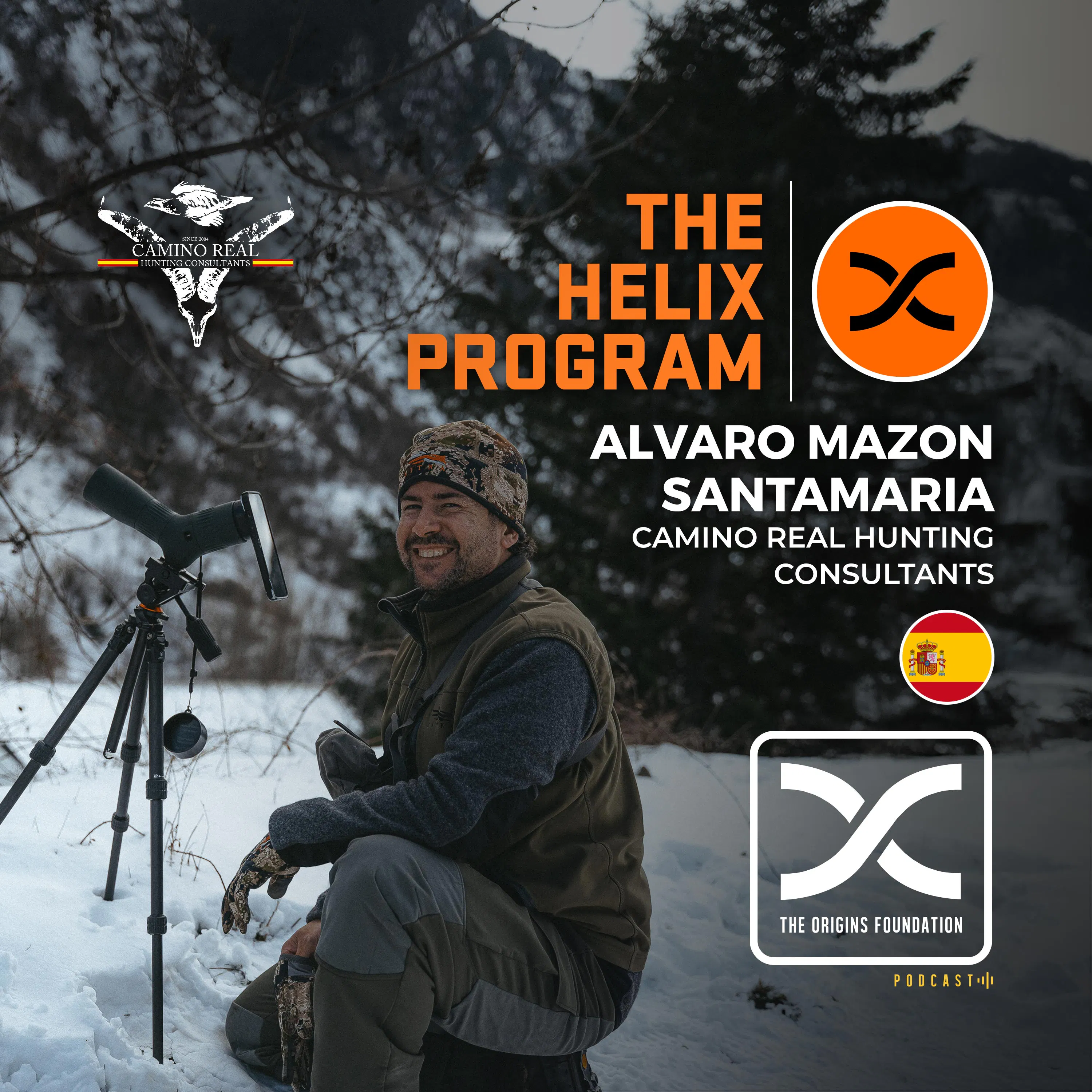
The Origins Foundation Podcast
Alvaro Mazon + Camino Real || The Helix Program #2
00:25:27
Alvaro Mazon, another Helix Program participant, shares the story of how his hunting profession (he’s based in Spain) proudly supports the people, wildlife and places he calls home. What are the benefits to people, wildlife and communities in Spain by hunting with Alvaro? Find out here.
Loading summary
Transcript52 lines
- [00:00]
FishingBooker Narrator
Planning a fishing trip shouldn't feel like a full time job. With fishingbooker.com you can find and book the perfect fishing trip within minutes. FishingBooker.com connects you with trusted fishing captains around the world. Booking is fast, easy and secure with access to verified customer reviews, loyalty rewards and around the clock customer support. Everything you need to book with confidence is in one place. So head to fishingbooker.com and start planning your next fishing fishing adventure today.
- [00:30]
Robbie
Alvaro Mathon is the owner operator of Camino Real. Camino Real is a part of our Helix program at the Origins foundation and this podcast is a part of the Helix program podcast series in which we get an understanding of the benefits that come from hunting with somebody like Alvaro. What are the benefits to people? What are the benefits to wildlife? What are the benefits to communities? Specifically in Spain, because that's where Camino Real is based on. But you'll hear from Alvaro in some of the places that he's hunted around the world and the benefits that he's seen from hunting with him in these places. So without further ado, Alvaro. So five years ago, there was a reason why I started this movement. And the truth then is the truth now that we need to champion our narrative. We need to champion the truth around what we do and who we are. There's a sweet spot with a gun, you know, too heavy and it's a
- [01:26]
Alvaro Mathon
burden to walk with. Too light and you whipping it.
- [01:29]
Robbie
Why is the project so important to the hunting community? It's. It's a. I think it's not only
- [01:34]
Alvaro Mathon
important, I think it's.
- [01:35]
Robbie
I think it's vital. I think it's. It's just in time. It's like snakes and ladders. You guys are climbing the ladder and then somebody does something stupid and you just slide. That is such an amazing analogy. Snakes and ladders.
- [01:48]
Alvaro Mathon
Yeah.
- [01:48]
Robbie
You know, ivory, in my opinion, was the plastic of its age. Okay.
- [01:53]
Alvaro Mathon
The expenses are going up. It goes a long way with families. We have families that do need it.
- [01:58]
Robbie
Let me close this door because I have a little wiener dog. What are you laughing because I said wiener.
- [02:04]
FishingBooker Narrator
I'm really glad you finished the sentence out.
- [02:07]
Robbie
I'm sorry the first happened.
- [02:10]
Alvaro Mathon
What are we doing here today?
- [02:11]
Robbie
You're telling the whole world. Alvaro Mazon, right? Or am I saying that wrong? Am I saying it? Yes, Correct Spanish. Spanish accent. Alvaro Mazon. Yes.
- [02:30]
Alvaro Mathon
You guys don't know how to pronounce the Z properly, but that's not a very important thing.
- [02:35]
Robbie
Tell me, tell me how do you.
- [02:37]
Alvaro Mathon
It should see, it's It's Mason Mathon.
- [02:42]
Robbie
Alvaro, Mason from Camino Real in Spain. Welcome to the Origins foundation podcast, specifically the Helix program out for the series that we are doing. You are a member of our Helix program and these podcasts are set up in a way that somebody can get to know you, Alvaro, in what hunting with you does for, for people, for wildlife of communities all over the world or mainly specifically your home territory in Spain.
- [03:14]
Alvaro Mathon
Right.
- [03:14]
Robbie
That's where you, you hunt out of the most.
- [03:18]
Alvaro Mathon
Yes. Well, first of all, thank you very much for having us here, Robbie. It's a great pleasure being part of it and, and contributing to what you guys do, which is fundamental and it's a way of spreading the word in a different way. And I think you guys are doing an excellent job. So thank you very much for considering us.
- [03:37]
Robbie
You're welcome. And just as a side note, Alvaro is my problem child today. He missed a podcast appointment earlier today. He didn't have signal because he was hunting and so we've made accommodations for him today.
- [03:51]
Alvaro Mathon
Yes, sorry for that. We are busy in this time of the year. Of the year. We just dropped hunters this today in the airport and we're picking up clients tomorrow. So it's a bit of a hectic time ahead of us, which is something good to have, but sorry for that and yeah, well, as you very well pointed out, we're mostly headquartered in, I mean we're headquartered in Spain. Most of our hunts take place in Spain, but we also do quite a bit of things in Europe, Africa and of course Asia. Mainly focused in mountain hunts all over. So. So yeah, very, very excited.
- [04:29]
Robbie
You've been outfitting for how long?
- [04:33]
Alvaro Mathon
For seven years now, time flies.
- [04:36]
Robbie
I actually had to, but Camino Real had been established already. Right. Your father was an outfit and operator, right?
- [04:45]
Alvaro Mathon
Correct. Both my dad, whose name is also Alvaro, and Juan Antonio, who's like, I always call him my uncle, he's not actually my uncle, but I've been, I mean both of them established the company back in 2004 for their passion to hunting. They both come from very different backgrounds. One is a very well reputed veterinary and my dad is a guy coming from finance. But due to the experience that they had from hunting all over, they decided it was a very good point to become. They were, they were not actually outfitters in Spain. They would, they, they, they started it as a hunting international hunting agency or consultancy, let's put it that way.
- [05:39]
Robbie
Right.
- [05:39]
Alvaro Mathon
Because at the end of the day, and I mean ever since they were very much passionate about, about this job aside of their professional what they really did in the past and in 2015, yeah, 2018, excuse me, I was doing something else and I decided to make a big change in my life and follow my dream which was basically became an outdoor in Spain. And still today I haven't regret my decision. It's been a great decision. I've always have had a good example which as you know was Carl Van Zael from Jon X Safaris. Back when I was a young boy I would spend my summer holidays working with them in South Africa and ever since I said, yeah, I would love to become part of something. So I decided to quit my previous job and do what I do today. I'm very happy to it.
- [06:40]
Robbie
It is 2026 and my friends, big changes have happened in the world of firearms suppressors. The $200 tax stamp fee is now gone. Huge win for hunters, huge win for shooters, and a huge win for your wallets. If you're thinking about elevating your shooting experience and adding a suppressor, Silence Essential is the best way to shop. And you don't even have to get off your couch to do it. Go to silenceessential.com, browse hundreds of suppressor options. They literally have all the popular makes and models. Then their experts will walk you through setting up your account, creating a free NFA trust, and then submitting your application to the atf. Once approved, Silence Essential ships your new suppressor directly to your door. That's when you're going to have to essentially get off the couch. It's a game changer, guys. You haven't done it yet. Do it. The old days of waiting eight to 10 months on a suppressor are gone. It's more like two weeks. Some have even gotten their suppressors in shorter timeframes. It's never been easier to start shooting suppressed. Get started today by visiting silencercentral.com it's really the simplest way to get your suppressors. Bushnell is eager to help you get set up for conservation success. That's right. They want to help you. The conservation and research community is dominated by good people doing good things and investing significant time and effort for the benefit of habitat and the species. So what do you need to do? Pretty simple. Send us your conservation story and or your conservation wish. Could be managing whitetails. Could be understanding your environment or species or something else related to conservation. What would you be able to do if you had a great trail camera setup? We will select the best story every other month and send you a camera bundle. Cell camera, normal SD camera, SD cards, as well as optics. Everything you need to get set up for success. I can't wait to see what you submit. You can email us, DM us, message us, whatever you want. We are not hard to find. Good luck. So what was it, what was it about John, sort of John X and Carl that sort of stood out to you?
- [08:54]
Alvaro Mathon
I could, from what I've seen in the past, actually have had the, the. I've been very lucky to, to travel a bit with my dog hunting in many places. And I could never imagine with so many problems we had in the past to be able to come across with an outfitter who had everything so much under control like Carl did and his, his pages and everything. I mean, the kind of work they do and the way everything is organized is absolutely brilliant. And I thought it was a very good example of what we all in the industry should be looking forward. They make a big effort in making everything look so smooth and in the end of the day, everyone who hunts there becomes part of a family. It was totally different from what I had seen in the past and I thought it was a good example. I was very young then, I'm still young and I'm trying to follow the example of, of what they do and I, I think they, they do an excellent job and that actually make me like light on my, on my brain and, and wanted to, to follow his path.
- [10:05]
Robbie
So in Spain, I want to understand a little bit about, you know, what happens as a result of you hunting in Spain. So there's two play, two sort of ways that you hunt in Spain. Number one is you hunt on property that you own or you lease. Your typical roe deer hunting, I assume those private landowners, what are those private landowners doing for wildlife? Are they, are they putting things in place for the habitat for roe deer? What's going on there?
- [10:31]
Alvaro Mathon
Well, absolutely. I mean, and that could be obviously extra polite or follow the example in the different species that we have in Spain at the moment. We In Spain have 13 different huntable big game species in each of them in various or different parts of the Spanish peninsula or the Spanish country. And yes, you very well point out we have several ways to hunt in these places. One is hunt privately, where we have private landowners who actually take care of everything and they put everything they have to try and take care of those areas just, just for hunting. I mean, if there was no hunting in this private places, there would be no, no investment or no, or no conservation put into these places. But what is more, more important is that that's obviously refers to only private people, but, but there's thousands of little towns and small villages scatter around that country. Every single town or village that you can point with a finger on a map, they somehow rely on hunting. It doesn't matter. There's always someone in these small villages, Whether it's a five people village or a 3,000 people village, there's at least someone who will own, will have a hunting license, will own at least a shotgun or, and, and, and will be a hunter. And I think that's very important for us to highlight because many times in the media we, we hear that there's so much anti hunting going on and blah, blah, blah. But the truth is that Spain is a traditional hunters destination in which every single place relies, even if it's a small portion of their income, they rely in hunting so much that it's part of our culture and it's so important to us all. And in that sense, everything related to these remote places and small villages has some kind of relationship with the hunting world. And that's very important to highlight as well.
- [12:59]
Robbie
Yeah, you know, it's. When you get into these villages, luckily I've seen some of these villages, obviously there are, there is some sort of tourism happening, right. There's old castles and all those kinds of things and tourists coming in. But you know, the amount when, when you talk about small villages, hunting has a, a major sort of slice of the pie when it comes to the economic impact. Because you know, it's not only you're getting number one, you're getting your quota from the local hunting organization, right. So you're paying the local hunting organization. There's an economic generator there. You've got local guides that go with you, showing you where things are. Afterwards you're having a beer at the local pub in the little village, you're having lunch in the little village. Sometimes you're staying in accommodations in that little village. There's a huge economic generator that happens in these Spanish countrysides, right?
- [13:55]
Alvaro Mathon
Absolutely, Robbie, you're perfectly right. And what it's very important for everyone to understand is that in many places where we hunt, as you will pointed out, roebucks or even ibex, there's some places where we hunt ibex that we actually drive through. Villages that are totally abandoned, unfortunately. Beautiful villages with hundreds of years old that are falling apart because there's nobody there living anymore. And we are actually there. And even though that specific village might be abandoned, the neighbor village which might hold. And I'm serious, here's Maybe three, five, five people in the village. There's always a bar and there's always a restaurant and there's always little accommodation where we actually stay, which is also very nice for us to offer that kind of experiences to the hunters that we host. Because at the end you're giving the full experience of being in a very little town, remote place. It was very funny with the hunters that we just dropped at the airport. They were saying we went to a very beautiful hotel in the southern part of Spain. We were hunting southeastern ibex and we were just us in the hotel. We were in Easter holidays and everyone was having a great time, close to the villages, close to the beaches on the coast, but no one was in the mountains. And we were the only people in a very beautiful hotel right in the foothills of the south of the Sierra Nevada mountains. And it was just ass. So that gives you a very good idea of how important hunting is. It is for these people. And this is, this was actually a very nice hotel, very. A luxury hotel.
- [15:47]
Robbie
So it's a, it's a rural economic driver, right, that happens everywhere. It happens in America, happens in Spain, happens in France. It's this, just this. The, the people using the rural countryside would typically are hunters constantly going in there, constantly investing money into the local economy.
- [16:06]
Alvaro Mathon
So essentially everywhere, everywhere, even if you push it to the furthest point, even the gas stations where you would just drive by. We drive many miles in Spain to drive from one place to the other because all the species are very separated between different mountain ranges. So we drive many miles per day. And many times you just get into your next destination is maybe 10 May, 10pm like you're driving in a very windy road, there's nothing around, and all of a sudden, oh, there's a gas station with a, with a, with an old man that works there. That obviously relies on the people who drive by, which is very, very few people. And most of those will be hunters. So. So, yeah, that gives you a very good idea of what we're talking about. Definitely is a very important thing.
- [16:56]
Robbie
Alvaro, what else have you seen? You obviously have hunted in South Africa, you've hunted in Russia. Can you give me any specific examples of things that you've seen that hunters have done for people, for communities, Any projects that you've seen?
- [17:13]
Alvaro Mathon
Oh, absolutely. I mean, there's, there's many, many things going. Going on in Spain. There's, there's, there's a few projects that, that have been going on, but they're, they're very, very focused on Special seasons or special times of the year like Easter or Christmas. And I think there is a lot of opportunity that we have to keep on fighting for and pushing forward so that the non hunting communities can. Can actually see what's going on. Because there's. There's quite a few things. But I think we have to push ourselves to make it even stronger. I'm talking about just staying because I mean as a western country we might be very much focused on other staff and the world goes too quickly and. And there are many things going on like such. For example, there. There was a huge event that took place in Madrid in Christmas time where all the meat that was hunted during a few couple of of treatment hunts were all given away to the. To the people who really needed in. In several places.
- [18:19]
Robbie
That's cool.
- [18:20]
Alvaro Mathon
They. There was a very nice big Monteria or driven hunt where all the funds raised were sent to a few organizations that had to do with child racing and schools. And it was phenomenal. But still there is a few things to do. But however, in many other countries that we working, there's. There's many things going on and hunting has become a very important part of it. Last Last August I was hunting in a very remote place of. Of Russia actually. Just to give you an idea. It took us six whole days just to get to the. To the place where we were going to actually hunt and. Six days crazy, six days to to come back. So you can imagine how far east and north of Russia we were. And there everything is. Relies on the hunting, on the hunter hunters that go there. The last village we got to, I mean it was the most remote place. There was nothing. We had to stop there in a little house. They call it hostel. But it was actually nothing close to what a hostel really is. It didn't have any toilets, any bathrooms, any.
- [19:46]
Robbie
Any.
- [19:46]
Alvaro Mathon
Any. Any drinkable water. There was nothing but everything that the lady or the. Or the. Yeah. The lady that. That used to take care of us there. She hadn't seen anyone for eight months. Wow. And after. After a hunt we would take all the meat to her so that she could share the. The meat and the. I mean they would take care of everything of course the meat and the skin and the coat and everything of the. Of the animal just to. To have some kind of. Of protein and resources for her. And obviously the. The little amount of money that would we would spend there. It's. It would just be for hair and your family for taking care of us. And that's. That's incredible. Like in you go to the very, it's almost farthest point on Earth, right?
- [20:34]
Robbie
It's like you don't even think about something like that in Russia, but it's like Africa.
- [20:40]
Alvaro Mathon
It's way more remote than any place in Africa I've been to, Robbie. It's like being in Mars. And even there everything has to do with the hunting and the hunting community and the hunters are welcome because they know what it's all about.
- [20:58]
Robbie
That's amazing. Amazing, amazing, amazing. You've also been involved in. You built a school. You helped us build. Not a school, but it's a kitchen area right in John X.
- [21:10]
Alvaro Mathon
Yes, yes. That was an incredible break that Carl, together with the help of our good friends, ducked from splitting image Taxidermist. They did a fantastic job. And yeah, those kids are having so much fun and such a, I mean such a, such a good project. Of course it's always nice to be part of, of new projects, whether it's in Spain, Europe, Africa. I mean, I don't, we don't really care as long as the money is put in what we, and what we need to do to, to, to make good decisions and good projects to help as many people as possible.
- [21:48]
Robbie
Yeah, that's what we want, right? And that's what we're showcasing, is showcasing that, you know, hunters are really making a difference. They're really putting their hearts into. Obviously they love to hunt, but there's also the element of economics, the element of community upliftment, the elements of helping people that comes with hunting all over the world.
- [22:09]
Alvaro Mathon
Well, it's, it's very important. And people might not think that that's also an important fact of, of what we do. And, and, and it's not only important because you're helping people with, with, with, with good facts and, and with, I mean, and, and with, yeah, true facts. But it's also a good way for us as hunters to show the world that it's not just about what people used to think, that it's killing the animal. We do so many things around hunting. I mean, there's social programs going on. We're getting incoming to those places, this place, remote places that we're mentioning that if it was not for hunting or hunters, but there was no way these people would even make a living out of the year. Like this place we're talking about in Russia, the season is just maybe one and a half month after August or September. The temperatures drop to minus 60 degrees. There's no possibility of any human being around. And there's such a remote place so poor people. And it's actually a great gratitude to be part of something that you actually help the people. But it's also, as I say, important to spread the word of what we do and what hunters do and what our features are able to do. And you guys, with all the programs that you're enhancing and that you're promoting, do such a great job.
- [23:44]
Robbie
Well, thank you, bud. Well, Alvaro Mafon, thank you so much for coming on the Origins Foundation Helix Program podcast series. Camino Real is his operation, his outfit. Check him out if you're going to go hunting in Spain. And obviously, check out what we do at the Helix program in terms of showcasing the proof of what hunting is doing for people, wildlife, and communities all over the world. Alvaro, thank you.
- [24:10]
Alvaro Mathon
No, thank you very much. That was shorter than what I'd expected.
- [24:14]
Robbie
Well, that's it for today. I appreciate you listening. As always, leave a review, share it with your friends, and most importantly, do what's right to convey the truth around hunting.