← The Origins Foundation Podcast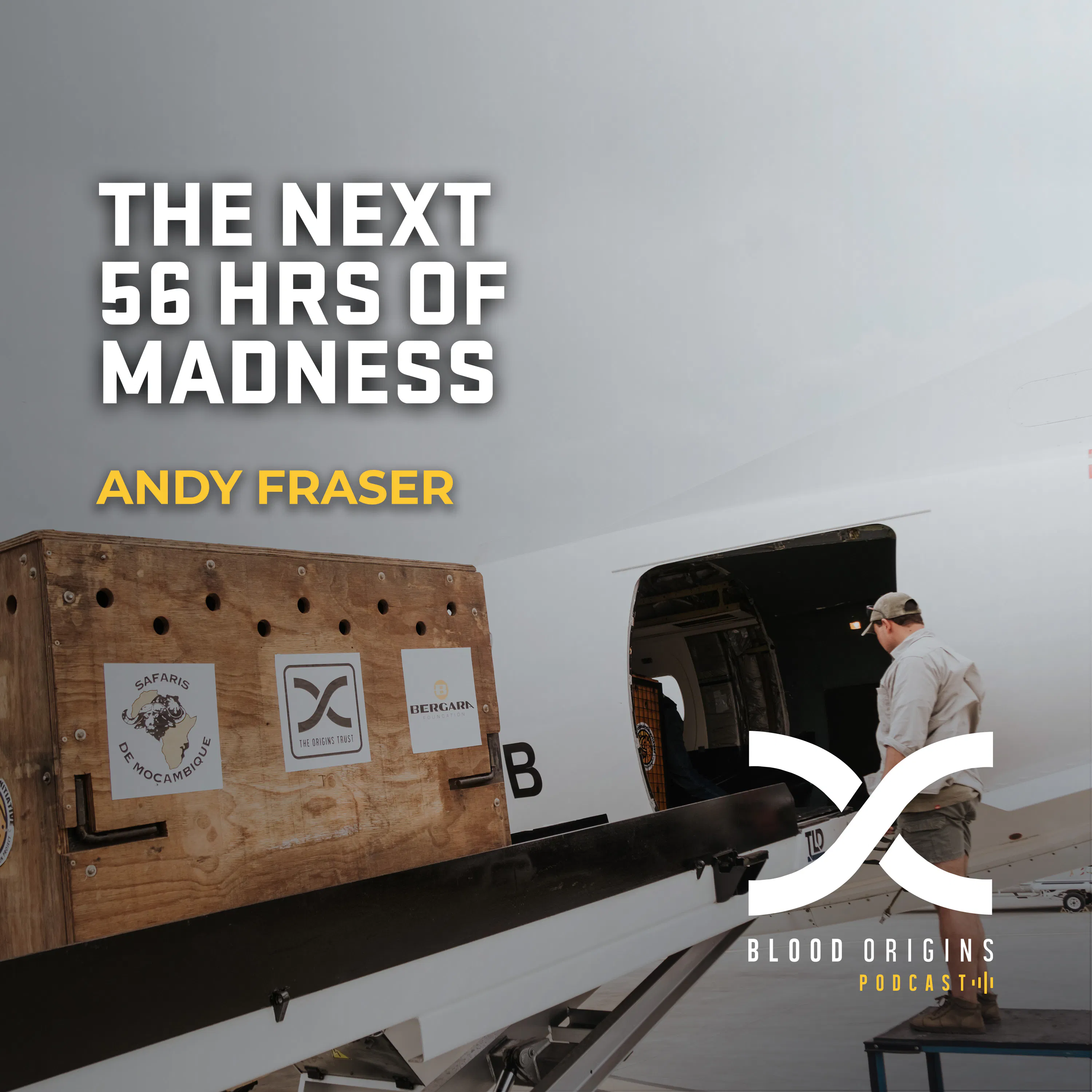
The Origins Foundation Podcast
Episode 575 - Andy Fraser || The Next 56 Hours Of Madness
00:56:01
We’re back for PART II of our miniseries covering the historic cheetah relocation that The Origins Foundation has undertaken from South Africa to Mozambique. Wildlife veterinarian, Andy Fraser, joins Robbie on the ground once again to discuss the difficulty of the sheer size of the project relocating the first 12 cheetahs. This podcast will bring you on the ground with them as they discuss the challenges and rewards of such an ambitious conservation project. From the epic photo of napping on a pile of cheetah’s during an exhausting 50 hour trip, to 10 hours of driving in each direction - this is a no-holds-barred discussion. Be warned, this podcast was recorded at 11:30pm at night waiting for a plane to arrive from Zimbabwe to put the last 4 cheetahs onto!
Loading summary
Transcript313 lines
- [00:00]
FishingBooker
Fishing trips anywhere, anytime fishingbooker.com want to plan your next fishing trip without the hassle? FishingBooker.com is the best way to find and book a fishing charter anywhere in the world. Whether you're chasing trophy fish or just looking for a family day on the water, fishingbooker makes it simple, fast and secure. With thousands of experienced guides, verified reviews and 24. 7 customer support fish, FishingBooker takes the guesswork out of planning. Visit fishingbooker.com and book your trip today. FishingBooker fishing trips made Easy Wanna plan your next fishing trip without the hassle? FishingBooker.com is the best way to find and book a fishing charter anywhere in the world. Whether you're chasing trophy fish or just looking for a family day on the water, fishingbooker makes it simple, fast and secure. With thousands of experienced guides, verified reviews, and 24. 7 customer support. FishingBooker takes the guesswork out of planning. Visit fishingbooker.com and book your trip today. Fishing Booker Fishing trips made easy Andy.
- [01:05]
Andy Fraser
Fraser is a wildlife veterinarian out of South Africa. He has been our primary vet for the Punyami Cheetah Project. Andy Fraser got his veterinary degree from Honestaput, which is the number one veterinary school in South Africa. Just a incredible reputation. Andy runs Royburg Veterinary Services with his partner Maria. And Andy, as I said, has been the number one vet for us in our cheetah project. And so in the latest cheetah relocation move, Andy and I put the podcast headsets on at about 11:30 at night. You'll, you'll hear us. We're a little bit loopy because we've been going for about 20 hours thus far and we've got about 30 minutes of sleep in front of us before we go for another, oh, 10 to 14 hours. And so we want to lay down a podcast just to give you an idea of the sense of what we do and how we do it and the lengths that we go to when it comes to conservation. So enjoy this little bit of a loopy conversation between Andy and I at 11:30 at night, sitting in a private airport terminal in Johannesburg, waiting to translocate four cheetahs from South Africa to Mozambique. So there's a reason why I started Blood Origins, and that reason is simple, is that I wanted to convey the truth about hunting.
- [02:37]
Robbie
It brings awareness to non hunters that.
- [02:42]
Mike Axelrod
It'S more than just killing animals. How do I start it?
- [02:47]
Robbie
Brittany My name.
- [02:49]
Mike Axelrod
Does my hair look okay?
- [02:50]
Robbie
My name is Mike Axelrod. Start again. Yeah, I hated it too.
- [02:54]
Andy Fraser
Braxton you said something in the car to me.
- [02:57]
Robbie
You said that you were living on borrowed time. There's a perception around who hunters are, what we're supposed to be.
- [03:05]
Mike Axelrod
And.
- [03:06]
Robbie
And a. A feminist that works for a nonprofit that is a hunter that has only eaten wild game for the last 20 years is likely not the thing that people think about when it comes to a hunter. Stop breathing so hard. Yeah. Is it that hectic that we're breathing too hard?
- [03:30]
Mike Axelrod
No, that was not breathing that hard.
- [03:33]
Robbie
I don't know. Are you unfit? Aren't you training for the Comrades Marathon or something like that?
- [03:37]
Mike Axelrod
Comrades is actually funny. I don't feel fit when I'm ready to run it.
- [03:41]
Robbie
How many? It's a marathon, right? 26 miles.
- [03:44]
Mike Axelrod
No, dude, it's 90 kilometers.
- [03:46]
Robbie
Okay, how many miles is that?
- [03:48]
Mike Axelrod
50 something miles.
- [03:50]
Robbie
Yeah, you're breathing hard into the. Just bring that thing away from your, like, nose.
- [03:55]
Mike Axelrod
Yeah, see, I'm used to flying with a helicopter headset. And then you got to have it.
- [03:59]
Robbie
Really close, you know? 11:30 in the evening. You should have like, a resting heartbeat of like, 40. If you read. If you go into the Comrades. All right, hold on. Let's check. 90 kilometers. Kilometers to miles. Why do they call it the Comrades Marathon then, if it's not a marathon? Have you ever asked that question?
- [04:18]
Mike Axelrod
Because it's an ultramarathon.
- [04:19]
Robbie
Well, then why don't they call it the Comrades Ultramarathon?
- [04:22]
Mike Axelrod
Because that sounds stupid.
- [04:23]
Robbie
Well, that's what it is. 55 miles, dude. 55 miles. Have you run it before?
- [04:30]
Mike Axelrod
Yes, this is my fourth one.
- [04:33]
Robbie
Your fourth one?
- [04:34]
Mike Axelrod
Yes, sir.
- [04:34]
Robbie
Why? Do you. Do you just love pain?
- [04:38]
Mike Axelrod
I think the last. No, I don't love pain.
- [04:42]
Robbie
Is the Comrades marathon not painful?
- [04:44]
Mike Axelrod
No, it is painful. Even a marathon is painful.
- [04:50]
Robbie
Just to warn everybody, this podcast may go in several directions because it is 11:30 at night. I woke up at 4:30 this morning, and at 3:30, which is in four hours time, we'll be flying four cheetahs to Mozambique.
- [05:10]
Mike Axelrod
Yes, sir.
- [05:11]
Robbie
So it may get a little wonky. Ultramarathon pain.
- [05:17]
Mike Axelrod
It's nothing like the pain of 50 hours in the car between T and Y.
- [05:24]
Robbie
So the last time you moved cheetahs, you flew into Mozambique. 12 cheetahs in. In an embraer, right?
- [05:32]
Mike Axelrod
Yes, sir.
- [05:33]
Robbie
You. I heard you slept on top of the cheetahs.
- [05:36]
Mike Axelrod
I had a very brief nap in a 50 hour trip, and somehow a photo of it made it into a newspaper.
- [05:47]
Robbie
So let's rewind the clock. Let's do the last cheetah the first 12 that we moved. Talk through. Like, I don't need details. I just need like the 50,000 foot view of what you did in 50 hours.
- [06:04]
Mike Axelrod
Okay. We traveled about 3,000 kilometers by road.
- [06:10]
Robbie
Okay, no, that's not helping.
- [06:11]
Mike Axelrod
What?
- [06:12]
Robbie
Give me hours. Like how long did it take you to drive there?
- [06:14]
Mike Axelrod
10 hours to get the cheetahs. 10 hours from home to the reserve that we loaded five cheaters at.
- [06:21]
Robbie
Five cheaters drove. How long were you in the reserve for? 2 hours.
- [06:27]
Mike Axelrod
No, so we helped out with a black rhino that morning. Okay. And then did the cheetah that afternoon then. So the cheater was probably an hour and a half worth of work there.
- [06:37]
Robbie
Okay.
- [06:38]
Mike Axelrod
While the cheetah were on a separate.
- [06:40]
Robbie
Vehicle, did you charge me for an hour and a half that day or did you charge me for nine hours a day? Do I need to go check the invoice?
- [06:47]
Mike Axelrod
Yeah, you're welcome to. So. But the 20 hours of traveling is free. Okay, that's friends in Van Gogh conservation rate.
- [06:58]
Robbie
Okay. Okay.
- [07:00]
Mike Axelrod
So then 10 hours back. 10 hours back. While the cheetahs were traveling to the airport in Johannesburg, we traveled straight back to Royburg, which is where we left from.
- [07:08]
Andy Fraser
Okay, look guys, I'm a hunter, right? And when I go hunting, I like to figure out how to get my trophies back home as expeditiously as possible. Well, you don't have to look much further than Safari specialty importers. We know that trophy importation can be quite a headache. That's why safari specialty importers strives to make it as easy and hassle free as possible. They have access to a bonded warehouse. You, you won't be charged storage fees and you get a dedicated team that's readily available and will update you at every step in the process. They'll even go one step further. Safari specialty importers is working with us at Blood Origins and they are going to donate $100 from every shipment that they work with to conservation projects that include anti poaching, community development and wildlife conservation. At the end of the day, choose to spend your money with a team that's dedicated to you and is dedicated to helping show how hunting is a great conservation model. Hassle free logistics, fuel and conservation go with safari specialty importers. Did you know that in 42 states it is 100% legal to buy a suppressor and protect your hearing. Silencer Central pioneered the simplified silencer buying process. It allows you to buy a suppressor online or over the phone. You go through all the paperwork with a certified expert and that suppressor Ships directly to your front door. I don't even believe it, but I've done it and it's come to my door. You can buy a suppressor and have it shipped to you. They offer the best in service, a suppressor expert to make sure you get the suppressor you want. And from there they take care of everything. They take care of the paperwork, the applications to the atf. They even set up a free trust if you want one. And if you don't have the money, put down an interest free payment plan. It's incredible. You get access to your own customer portal online. It tracks your progress. So why not go get started today? Go to silenceessential.com or call 866-811-6536. And with today's fast approval times, you're actually going to be shocked at how quickly your suppressor arrives at your door. Bushnell has been a longtime supporter of Blood Origins. And in keeping with the spirit of our collaboration, we've come up with an amazing idea. Bushnell is eager to help you get set up for conservation success. That's right. They want to help you. The conservation and research community is dominated by good people doing good things and investing significant time and effort for the benefit of habitat and the species. So what do you need to do? Pretty simple. Send us your conservation story and or your conservation wish. Could be managing whitetails, could be understanding your environment or species or something else related to conservation. What would you be able to do if you had a great trail camera setup? We will select the best story every other month and send you a camera bundle. Cell camera, normal SD camera, SD cards as well as optics. Everything you need to get set up for success. I can't wait to see what you submit. You can email us@infolotorigins.com DM US, message us whatever you want. We are not hard to find. Good luck.
- [10:20]
Mike Axelrod
To then do the four tutors that were in quarantine. Five tutors that were in quarantine in Rooiburg. Okay, and then so that was 4am in the morning. We left Roeburg at about 7am in the morning and arrived at Ortambo at about 10 o'. Clock.
- [10:36]
Robbie
Okay.
- [10:37]
Mike Axelrod
Went through all the inspections at the airport and then hopped onto the plane with a 12 cheetah. Um, because Mark Toff bought the other two up from Natal, flew into Tet in Mozambique.
- [10:48]
Robbie
How long was that flight? Was a quick flight, yeah.
- [10:50]
Mike Axelrod
Hour and a half, two and a half hours, I think.
- [10:52]
Robbie
Okay.
- [10:52]
Mike Axelrod
Yeah, two and a half hours.
- [10:53]
Robbie
Not like the four and a Half that we're going to experience tomorrow.
- [10:56]
Mike Axelrod
A smaller plane.
- [10:56]
Robbie
Yeah.
- [10:57]
Mike Axelrod
So, yeah, four o' clock in the afternoon, I think we arrived in Tet, which was quite a spectacle. Offloading the 12 Cheetah crates onto, I think four different Buc EE's with two support Buckies.
- [11:08]
Robbie
And all the vehicles were on the Runway?
- [11:09]
Mike Axelrod
Yes, sir.
- [11:10]
Robbie
Had they all pulled onto the Runway?
- [11:12]
Mike Axelrod
Yeah. Did you have to? Like, the plane landed and they're kind of like six vehicles reversed up to the side of the plane and probably a hundred people in Harvard's vests like.
- [11:21]
Robbie
Oh, really?
- [11:22]
Mike Axelrod
Super excited to see the cheetah.
- [11:23]
Robbie
Yeah.
- [11:25]
Mike Axelrod
Super keen to help.
- [11:26]
Robbie
Were the cheetahs growling and like that?
- [11:28]
Mike Axelrod
No, they were tranquilized nicely.
- [11:29]
Robbie
Okay. Yeah.
- [11:30]
Mike Axelrod
So they go through like ebbs and flows through the process like some.
- [11:35]
Robbie
So these four cheetah that we have now, they've been tranquilized?
- [11:37]
Mike Axelrod
Yes.
- [11:38]
Robbie
When you were putting them in the crates, did you top them up?
- [11:42]
Mike Axelrod
So Sean used the combination of drugs to anesthetize them.
- [11:47]
Robbie
Used the same combination that you used?
- [11:49]
Mike Axelrod
No, different ones. Similar drugs, but different.
- [11:51]
Robbie
Okay.
- [11:51]
Mike Axelrod
And then while we're reversing them, we give them a dose of an additional tranquilizer that. But separate to the ones that were in the darts. Different families of drugs. This is a long acting injectable and that'll keep them properly chilled out for at least 48 hours. Oh, cool. Yeah. So they're going to be very chilled out even when they get into the Boma.
- [12:12]
Robbie
Okay.
- [12:12]
Mike Axelrod
Yeah. Because that should be 18 to 20 hours.
- [12:15]
Robbie
Okay. So now you're at the Ted Airport and you are expecting a quick 14 hour drive through. 14 hour drive.
- [12:24]
Mike Axelrod
10 to 14 hours.
- [12:25]
Robbie
10 to 14.
- [12:27]
Mike Axelrod
To the Zambezi River.
- [12:28]
Robbie
Yeah.
- [12:29]
Mike Axelrod
And then we'll cross the Zambezi into the Panyami Reserve.
- [12:33]
Robbie
Yep.
- [12:34]
Mike Axelrod
And then cross the Panyami River.
- [12:36]
Robbie
Yep.
- [12:36]
Mike Axelrod
Onto the side of the Panama reserve that the boma's in.
- [12:39]
Robbie
Yep.
- [12:40]
Mike Axelrod
So that, that was supposed to be from Tet max, sort of 20 hours.
- [12:44]
Robbie
Okay.
- [12:45]
Mike Axelrod
Which then ended up being about 30 hours, 35 hours. Yeah. So it was hectic. Yeah, pretty like rough, rugged.
- [12:56]
Robbie
It was probably was in 20, 20 kilometers an hour. We're literally 20 hours that road.
- [13:00]
Mike Axelrod
I average. So we did about 150 kilometers on Nice actually. Nice tar road. And then we went off the T into the rural area. I just, I think the roads had had quite a bit of rain on between when Justin was given the estimate and when we actually got onto the roads. And I think having the convoy of vehicles with live cargo on the back is what made us so slow.
- [13:25]
Robbie
Yeah, sure.
- [13:26]
Mike Axelrod
And then writing off vehicles in accidents and stuff doesn't speed up.
- [13:30]
Robbie
You were in the vehicle. How is it that it had the accident. Right.
- [13:33]
Mike Axelrod
That crashed that rear end of the vehicle in front of us.
- [13:36]
Robbie
So what happened there, Robbie?
- [13:39]
Mike Axelrod
It was like 6:30 in the morning. Sun's kind of just coming up. And we had asked the driver to like back off a bit because he didn't know what a following distance is.
- [13:48]
Robbie
Yeah.
- [13:49]
Mike Axelrod
And every time the vehicle in front of him would come up to an obstacle, he would have to slam on brakes and you could kind of almost feel the cheetah slide forward in the crate. So I just asked him to back off a bit. And I just. Between my great Portuguese and his shocking English, I don't think he understood what we needed. And yeah, he just rear ended, maybe fell asleep. But we kind of woke up with him sliding downhill into the vehicle in front of him.
- [14:18]
Robbie
Smashed it.
- [14:19]
Mike Axelrod
Yeah. Properly. Radiator gone.
- [14:20]
Robbie
And everybody was super upset, like. And Justin just came and said, move the cheaters, get the cheaters off. Stop complaining. Let's keep going.
- [14:30]
Mike Axelrod
Yeah, we were kind of not like headless chickens, but we were, we were upset, not focused on the plan. And he was just like, guys, hey, get the crates off. Put them on the vehicle that's got the luggage. Put the luggage on another vehicle's roof. Took about 10 or 15 minutes.
- [14:46]
Robbie
And that was pretty good Ford planning because Justin was like, we had an extra vehicle like, that would fall. Yeah. So something like this, like a vehicle breaking down. Can't go anymore. Move the tubers.
- [14:56]
Mike Axelrod
So we had asked him beforehand to always have a spare vehicle. And then so like the moment we got, we had to then start using that spare vehicle. We started making plans to have an additional spare vehicle coming from the other side because that is going to happen, like in that kind of terrain, you're going to have a wheel fall of a vehicle or someone's going to get stuck or I mean, or one of the other vehicles that actually ended up being one of our strongest vehicles in the first 100km on the tar road lost its, like water. Its radiator cap. Yeah. So just like went just at a random stop to check. The cheetah was like puffing in steam and luckily found the radiator cap like jammed in with. Oh my gosh, radiator. Unbelievable vehicle and managed. And because it was a Toyota Land Cruiser, just like filled it up with cold water and started first time and kind of caravan cruise. Jeez, and there was that right at the start of that chaos.
- [15:48]
Robbie
How much? How many, like, I think Jack has tried to like, write it all down. Like all of the chaos, all of the wrenches.
- [15:58]
Mike Axelrod
Yeah.
- [15:59]
Robbie
Did you have like a fuel line then?
- [16:01]
Mike Axelrod
We had a second accident within like.
- [16:03]
Robbie
A hundred, like a kilometer from leaving the airport.
- [16:06]
Mike Axelrod
Oh, yeah, yeah. So that same vehicle that overheated was like dripping diesel or like the guy's like, hey, he's got to fill up. Okay. But that doesn't make sense because we told you to fill up before we left. It's like, yeah, but something's not right. While he's like standing at the gas station, it's just leaking diesel all over the concrete floor. So managed to find that one of his fuel pumps was just not connected to. It was supposed to be.
- [16:30]
Robbie
Jeez.
- [16:32]
Mike Axelrod
Reconnected that and Yeah, I mean, just like. Because that wasn't the plan. The plan was to fly them, like the route that we're doing now. Yeah.
- [16:40]
Robbie
To the rust.
- [16:41]
Mike Axelrod
Supposed to be start to finish. 20 hours.
- [16:43]
Robbie
Yeah.
- [16:44]
Mike Axelrod
And then we had rain within a week of the planned translocation. Unseasonal, like late rain. That just was a complete touch wood.
- [16:53]
Robbie
We have not. There's no rain on the horizon. No rain.
- [16:58]
Mike Axelrod
If it does rain, it's going to have to start dripping now. And I think this time if we get to Tetan, it's possible pouring with rain. And yeah, Hugo and his guys from Mozambique might have to take over.
- [17:10]
Robbie
Yes, exactly. Take start helicoptering.
- [17:13]
Mike Axelrod
Yeah, exactly. We'll make another plan. So. Yeah, but it was hectic. But. But good. In the end, I think we definitely pushed the limits of the cats. But. Yeah. Everything okay?
- [17:25]
Robbie
Yeah. And we've released 1, 2, 3, 4, 5 cats now.
- [17:29]
Mike Axelrod
Yeah. With five days ago. Super exciting.
- [17:32]
Robbie
Three more this weekend.
- [17:34]
Mike Axelrod
Super exciting.
- [17:35]
Robbie
The big boys will go out this weekend. And we're all sitting on pins and needles of the, the. The Kalahari boys biggest intimidated, intimidating cheaters of our, of our coalition and all the cheaters that we have serious brutes of cats.
- [17:49]
Mike Axelrod
And the fact that there's three of them together doesn't bode well for anything else that they come up against.
- [17:55]
Robbie
Yeah. But if they come against, you know, some females, you know, so like that.
- [18:00]
Mike Axelrod
That can be good and bad. So sometimes, like an experienced female, if she sees a coalition like that, she'll just submit. Whereas, like a young, inexperienced female might, like, put up a fight and they can bully her to death. And that. That does happen. And. But we obviously hope it doesn't.
- [18:15]
Robbie
And.
- [18:15]
Mike Axelrod
But the Increased survivability of the release of a coalition like outweighs, you know, that risk. I mean, if you have a coalition of three that can defend themselves against other, you know, large fe lids and stuff, and then they. Leopards and whatever. So it, it does have its, its benefits. So we hope that.
- [18:33]
Robbie
And we've got a coalition of three here with us. Yes, that's about to move.
- [18:37]
Mike Axelrod
Which the. These are like slightly younger cats. So these may.
- [18:40]
Robbie
But they were together.
- [18:42]
Mike Axelrod
Well, they, they come from two different litters. But then, which is not totally normal that they then formed a coalition. We think that there's some, there's a familial link. So one of the two of them come from one of Dina King's like super moms and the other one comes from one of that mom's daughters. So there are, there is a familial link which obviously somehow socially has allowed them to form a coalition.
- [19:08]
Robbie
What happens in the wild, do we know? Does the single just come across the double. The two and the two just like, we're not going to fight you, I think join our crew or what?
- [19:19]
Mike Axelrod
I think without that familial link, they don't, they don't. It's much more rare that for them to form a coalition like that without a familiar link and you'll have a, you know, that's when you get a solitary male. Whereas obviously with, you know, females, they like to be alone, they like to breed alone and raise their cubs alone. But they also socialize with males in their territory. Like, I've got a reserve close up to us where you've got a female with four cubs and two big males. So that whole group, you know, seven cheetah chilling together. It's pretty nice to see you, especially now.
- [19:53]
Robbie
Interesting.
- [19:54]
Mike Axelrod
Yeah, especially now the cubs are big and the, the two big males are probably the cub size. But to see the whole group together with no aggression, like it's one big family. So it's pretty interesting.
- [20:07]
Robbie
Yeah. How many cheetah do you think you've moved?
- [20:13]
Mike Axelrod
Sure. Probably since I've made Vince, we've probably been involved with at least 150, probably 50 leaving South Africa and about a hundred within South Africa. Yeah.
- [20:27]
Robbie
Do you think how many Mike Toft? No, Mike. The thing with Mike was Mike. We did a podcast with Mike talking about rhino de horning. He's done 4,000 rhino dehornings.
- [20:39]
Mike Axelrod
But remember, Mike's had so much time in the saddle and like he's just, he's in, he's in a really Nice rhino dense area where they also dehorning a lot. So you know, a lot of those animals can be repeat, you know, repeat visits in a way if you're dehorning an animal every 18 months or 24 months. Yeah, but still they're awfully, I mean the amounts of experience just getting to work with Mike and because he's just, he's also such a gentleman, you know. So like getting to work with him on that last introduction to Punyam, it was just amazing since it was such a, like mention of a human.
- [21:12]
Robbie
So you know, you know one of the things that I heard is why are we moving so many cats? You know, why 18? Why not just 6? Why not just 8? And as I understand it, and you, you fill in the gaps here is we know there's going to be mortality. Okay, what's the average mortality of movement? 40%.
- [21:36]
Mike Axelrod
Yeah, up to, up to 50% in the first 12 months is normal. And remember that's various reasons, eh, Some like we've obviously Panama's a, a big boundary with the Zambezi River. The Zambezi river in that area is full with crocodiles and the things that will eat cheetah that try and cross any kind of waterway. So it can be natural predation, like a crocodile grabbing one of them. It can be anthropogenic stuff like snaring gin traps, you know, think like indiscriminate meat poaching kind of incidences where guys are trying to snare a piece of meat and a cheetah walks through that snare and we can have inter intra species aggression. So cheetah killing cheetah. We can have run ins with lions which is normal anyway where cheetah exist. Lions and spotted hyenas will kill cheetah. That's their biggest cause of mortality as a species. And then obviously disease challenges, things like that. Some of the cats that we're introducing come from the dry parts of South Africa. Obviously Panyame is quite a dry reserve for Mozambique, but being on the, on the boundary of Zambezi, it may be a new environment for those cats. So there'll be some adaptation that they've got to go through.
- [22:55]
Robbie
So is it just a matter of like having potentially nine on the landscape, surviving eight surviving on the landscape versus two or three and then bringing in another six and having another two or three in the future.
- [23:06]
Mike Axelrod
So I think aiming, aiming for nine is maybe shooting low. But if you end up with nine after 12 months that are settled and you maybe have a female with a litter of Cubs that's already kind of successful. The moment you've got at least one female breeding, you, You've shown that the, the group is kind of settling and starting to do their thing.
- [23:28]
Robbie
Yeah.
- [23:29]
Mike Axelrod
And then. Yes, cheetah translocations historically have been far more successful. When you introduce a subsequent.
- [23:38]
Robbie
Yeah, but why the, why the big number in the beginning? What was Vince's like? As I understood, it was just, it's flooded.
- [23:44]
Mike Axelrod
So. So literally, numbers in this kind of game will put you in a much stronger, like, footing to, to achieve success.
- [23:53]
Robbie
As a start.
- [23:54]
Mike Axelrod
As a start, yeah, sure. But the, the more cats you can introduce quicker or right at the beginning, the quicker you're going to get to a successful project. And remember, any kind of project like this has got a kind of finite timeline. If you don't get it right, four months, the project itself is also from within is also going to say, okay, cool, we tried, we tried.
- [24:16]
Robbie
Just not going to happen.
- [24:17]
Mike Axelrod
Maybe this was a. Maybe this was one that, you know, we stuck our necks out, but we've got to give in and, and give up.
- [24:23]
Robbie
Yeah, yeah, yeah.
- [24:24]
Mike Axelrod
And because you can't just.
- [24:25]
Robbie
Which is okay.
- [24:26]
Mike Axelrod
Yeah, it is.
- [24:27]
Robbie
So, I mean, you have to bite the bullet and say, we tried. You know, trying is a good thing. And if it doesn't work. Okay, it doesn't work.
- [24:34]
Mike Axelrod
Absolutely. Like, I mean, cheetahs should be in that habitat. Obviously they've got quite a hectic human wildlife interface to the south and you've also got an international border just on the west. So if they leave to the west, they enter Zimbabwe and if they cruise down to the south, they enter Zimbabwe but then hit a quite a densely populated rural farming area.
- [25:00]
Robbie
So.
- [25:02]
Mike Axelrod
Which can also act in our favor. It might keep the cats in the reserve, but, you know, they're going to have their challenges. And at the beginning, putting in a good number of cheetah will just give the project a better chance of success because then it also maybe negates the necessity for a subsequent introduction of. Let's say you did 12, they went down to six, and then you brought in another six. You know, you started with the same or you ended up putting the same number there. Whereas by getting the 18, the cheetah arriving in a new place needs to find other cheetahs to settle. Whereas putting 18 on 200,000 hectares, which is big enough to keep 18 cats, based on their prey density there, it's probably beneficial at the beginning just to, to start off big. And if some of them go into the great conservation areas, to the west, like mana pools. So be it, you know.
- [25:51]
Robbie
Yeah, so be it.
- [25:52]
Mike Axelrod
Because at the end of the day.
- [25:55]
Robbie
That'S what we want. At the end of the day it.
- [25:57]
Mike Axelrod
Is what we want. And, and also you want later on a translator. Instead of putting another 12 cats into panyame, you want to go and put 12 cats in minor pools and kind of let those two naturally flow into each other. That's a successful project because then you're looking at a whole regional reintroduction or rather than one property, you know, Whereas in South Africa we don't have many 200,000 hectare reserves. And if you do have a 200,000 hectare reserve, it's most likely going to have a fence around it.
- [26:24]
Robbie
So just to jump to, you talked about the human agricultural sediments and whatnot. Do cheetah historically have human wildlife conflict? Do they take livestock? Do they take like a lion, for instance? Right. Lion is going to smack a cow.
- [26:44]
Mike Axelrod
It's going to, you know, they can. So I think that depends on the individual cheetah. So you're going to have cheetah that are different levels of human habituate, habituated. A cheetah that's very used to people will probably venture into a village with more confidence. And if it hasn't found prey of like a wild nature, it may take.
- [27:08]
Robbie
A chicken or a goat or something.
- [27:10]
Mike Axelrod
Yeah, a goat or a sheep or something like that, or maybe even a cattle calf. Whereas if it's a super spooky Tudor, um, it's not going to have the confidence to go into, you know, human village. Um, and then your risk of predation of livestock is, is much lower.
- [27:29]
Robbie
So what about those images that we've seen of the cheetahs in India that.
- [27:33]
Mike Axelrod
Are in towns so that, remember India's landscape is so different. Firstly, you've got beautiful, beautiful, well, protected wildlife area. Yeah, that's kind of different to anywhere else in the world because you've got no commercial tourism in those areas. Like your guests can come in during the day, they can drive around also during set times and then they leave outside of those set. Right. So there's no, there's no five star lodge inside this protected area. At night it's, it's wilderness area. And then on the boundaries of those protected areas, sometimes you have a buffer zone. And then outside of that buffer zone, you've got some of the most densely populated human genitals. I mean, you'll know how intense it is.
- [28:17]
Robbie
It's crazy.
- [28:18]
Mike Axelrod
So the moment that cat leaves the boundaries of that wildlife area, which isn't fenced like we used to in South Africa and other areas in Africa, the moment it leaves that reserve, it's going to come into contact with people. And again, if you get a cat that's quite habituated to people, it's not going to mind wandering through a village, which in South Africa and other African regions would probably be handled very differently to the way that they handled it in, in India. India's cultural and religious attachment to their wildlife creates this sense of love for their, for their wildlife. I mean, this, I think the specific.
- [28:58]
Robbie
Video you talked about, the one, the guy giving the water to the cheetahs. Right. And putting the cheetah bowl and they literally are not moving.
- [29:04]
Mike Axelrod
Yeah.
- [29:04]
Robbie
They come and drink the water.
- [29:06]
Mike Axelrod
I mean, that's probably not going to happen in Malawi, you know, heavily populated area in Malawi, mostly because those communities might be afraid of that cat.
- [29:16]
Robbie
So they may think it's a leopard.
- [29:18]
Mike Axelrod
Sure. And I mean, some of the, some of the Indian guys think it's a leopard too. But those communities are like, around Kuna national park, are very aware of the cheetah's presence. And the cheetah in Kuna national park also have wildlife monitors that are with them 24 7. So, I mean, there's another video where there's a newly released cheetah and her four cubs, big adult cubs, and she goes into a village and she hasn't found prey for a few days and she starts like awkwardly trying to catch a goat.
- [29:49]
Robbie
Yeah.
- [29:49]
Mike Axelrod
And.
- [29:49]
Robbie
And the villagers are like, they're kind.
- [29:51]
Mike Axelrod
Of standing between her and the goat and the goat and she doesn't know what to do. They don't know what to do. And if she eventually grabs the goat and, and one of the guys throws a stone, but immediately like the wildlife monitor steps in and kind of diffuses the situation and, and kind of. And, you know, maybe starts the education process and that, and that's part of, that's part of a community and a population getting used to a novel species like that. It's obviously unfortunate seeing, seeing those videos, but that's also part of conservation. Like, we need to accept that the Indian conservation model is very different to Africa and even more so different to southern Africa. So in South Africa, if something goes out the fence, we get a helicopter and we catch it or we go to the vet and we catch it and we pop it back inside the fence. Whereas in India, that's their conservation model, they, they want to be living in, amongst wildlife. So, I mean, they've got deer and antelope species that eat, eat some of the, eat some of the crops and, and it's tolerated to a certain extent. So I think it's, you just have to start looking at that, that sort of video with a different set of set of glasses. You know, you, you got to understand the Indian landscape to understand a video like that. It's not, it's not what we used to down here for sure.
- [31:11]
Robbie
Yeah, it's definitely a one they look at wildlife differently to because of the sort of heavy handedness of the Forest Service, these guys are very wary of doing anything to wildlife. 3 It seems like again every Indian has a phone. So the videoing of, of wildlife is just unbelievable. Right?
- [31:35]
Mike Axelrod
Yeah. Any you think, you think a bear doesn't walk into some kind of town in the States and it doesn't get something thrown at it, you know, or shot at or something like those things happen all over the world. But like you say, I think in India it's much easier for someone to take a video of that sort of in zot which, which is unfortunate. You know, it's part of conservation. But you know, no one likes to see incidents like that.
- [31:59]
Robbie
Do you think people, just because they don't understand the Indian landscape, they see the cheetahs in an Indian town and.
- [32:04]
Mike Axelrod
Like conservation has failed 100%. You know, maybe they assume that that's how cheetah live, you know, that there isn't this pristine wilderness area like 2 kilometers away. You know, that they don't understand that the, the human wildlife interface is that intense and you literally have an imaginary boundary.
- [32:25]
Robbie
Oh yeah, I saw it. Like the forest stops and where the forest stops, agriculture starts 100% and where agriculture stops is where the village starts.
- [32:34]
Mike Axelrod
And I mean, and we do get that kind of interface in South Africa. But there's a high fence that's heavily electrified in South Africa that's heavily electrified. And then you do have a community across the road that will be used to seeing lines walking up, walk up and down the fence. But when that line gets out, it's an emergency event, which I mean the Indian community is used to tigers walking through, used to leopards walking through. And in a way that kind of system is way more robust, you know, going forward. Having that wildlife interface, but having it kind of in a strange sort of symbiosis is kind of where I think we should be aiming.
- [33:17]
Robbie
Well, that's what we just released a podcast with Dr. Pablo and even though the headline was Killing people to save wildlife was the headline and he was a little upset with me about it. I said I used the headline just to get people to be interested in.
- [33:33]
Mike Axelrod
Are you using clickbait, Robbie?
- [33:35]
Robbie
Yeah, I have to. To listen to the podcast. Pablo was all about human wildlife symbiosis. Yeah, that's what he calls it. Not coexistence. Symbiosis.
- [33:47]
Mike Axelrod
So that's, I guess, what we should be aiming for.
- [33:51]
Robbie
Yeah. Colby, did you have a sleep?
- [33:54]
Mike Axelrod
Oh, man. Definitely had a little. Little quick sleep.
- [33:58]
Robbie
I thought you were sleeping in the lodge all day tomorrow. A private lounge. Oh, my gosh. Don't tell anybody.
- [34:07]
Mike Axelrod
Robbie's gonna get a bowl from.
- [34:08]
Robbie
Yeah, exactly. For Colby sleeping in the private lounge. Well, it is midnight, so it's not unusual for people wanting to sleep at midnight. What are. What is your thoughts to the future? Like, I know we've talked about future from a wildlife conservation perspective. I know that we've talked about cheetahs, obviously, and projects like this, I think, yield tremendous opportunities and benefits for cheetah in the future. But you interact with wildlife all the time and we've talked about wild dogs and we've talked about cheetahs, we talked about rhinos. And.
- [34:52]
Mike Axelrod
So I think each conservation area has got to find a system that works for that individual area, I think. And it's not going to be a one size fits all plan for everywhere. You're going to have areas that are completely funded by hunting, you're going to have areas that are completely funded by ecotourism, and you're going to have areas that are funded by a mix of.
- [35:13]
Robbie
Both or areas completely funded by Philanthropic.
- [35:16]
Mike Axelrod
100 or government funding. So it's completely unique to what works in that situation. And it's. What works in one area is not going to work in another. So I think you've got to look at, like, regional differences. Like in. In South Africa, our smaller fenced reserves are probably some of the most robust, like wildlife breeding engines that we can use to move endangered species, like then kings.
- [35:45]
Robbie
A breeding engine?
- [35:46]
Mike Axelrod
Yeah, man. I mean, they've got their cheetah stuff has been so successful the last 10 years.
- [35:50]
Robbie
They've got 20 Cubs on the ground right now.
- [35:53]
Mike Axelrod
Yeah, so you did. Right. So, you know, if you look at a reserve like that, that's actually who.
- [35:59]
Robbie
We just received four cheetah from, and now they're up to way more than they had.
- [36:03]
Mike Axelrod
Yeah. And they're going to be looking for. For homes for those cats soon, you know, So, I mean, if you look at that, that's got quite a. Quite an intense human wildlife interface on their Boundary. It's, it's also quite an interesting reserve and how it's set up. It's obviously lots of different landowners that have removed fences to make a reserve. So what works there is going to be very different to what works at a place like Panyami for example. Punyam is a much lower density reserve with much less human wildlife interface like on its immediate border. So you just got to take very.
- [36:37]
Robbie
Different approaches in South Africa like that. Let's use the Dina Kang example. Dina Kang is a fixed area reserve. There's very few open area, free roaming population lit for cheetahs. Right now let's just talk about that Northern, I would say Northern Cape, the Tswalu. What's the Kaligati? Kalihali and Kruger. Yeah, where else are we getting tutors? Moving roaming in and out from a free roaming population.
- [37:12]
Mike Axelrod
So you've got the free roaming population around like Matlabas centrum on the South African side of the Botswana border around the Crocodile river that De Anselyers has always been researching. There's quite a significant population there, but yeah, there aren't.
- [37:29]
Robbie
And do you think that that free roaming population is going to, is it doing well? Like are we seeing more pressure from humans or we seeing this coexistence model?
- [37:40]
Mike Axelrod
I would definitely wouldn't call it coexistence. So that area's got a lot of wildlife ranches, not true conservation areas. So it's a lot of smaller fenced hunting farms that these cheetah have learned.
- [37:54]
Robbie
To slip in and out of, to.
- [37:57]
Mike Axelrod
Sneak through and, and, and survive. So they've, they've learned how to survive by avoiding human contact. Which one? One of the cheetahs that we released this week is shown exactly how she's learned to avoid people. She's just kind of skirting along the, the boundaries of, of human settlements, keeping just far enough away and you can see the moment she gets into a corner she kind of just hunkers down in a thick, thick bushed area and kind of works out what's, what plan she's going to make and what moves she's going to make next. And then she just changes direction and keeps away from the people. So that's a very successful population that's learned to live with like perhaps human persecution. Farmers there are maybe less tolerant to cheetah's presence. You know one, because they, they're more of a consumptive species. They, they're eating prey species and things like that and they've got no, no income generation out of them. So which is something that has to change. I mean, it has to change with endangered species across the board to make them successful, you've got to have them generate some kind of income.
- [39:01]
Robbie
Sure, sure.
- [39:02]
Mike Axelrod
And obviously ecotourism is one, Hunting, hunting is another. And then like you say, philanthropic, you know, donor funding initiatives is one thing, although it would be nice for those species to fund themselves without, you know, donations or charity. And, and they should be able to, you know, I think, I think we can get to that point at some stage.
- [39:28]
Robbie
What about wild dogs? We've talked about wild dogs, you know, lots more issues with wild dogs roam way bit, you know, way more, way more prolific of a predator.
- [39:42]
Mike Axelrod
Yeah.
- [39:42]
Robbie
So the issue probably more, less of people's tolerance to wild dogs versus people would probably tolerate cheetahs more than anything.
- [39:52]
Mike Axelrod
Yeah. So, you know, I think something with, with cheetah and leopards and things is a landowner is not always aware of the predation that, you know, a cheat and the leopard causes because they're much more secretive. Whereas a pack of 30 wild dogs coming through your property is. Can't really keep us, keep it a secret. They're going to know about it. So they're. Their biggest success factor is the ability to breed huge litters of pups and the fact that the entire pack lives to help those. Excuse me, to help those puppies survive. So when you have a alpha Alphabet give birth to 15 puppies, I'm just having a sip of water and raises 12 of them to weaning that those 12, 18 months later need to disperse. You've all of a sudden got an entire pack of dogs that's got to leave and go somewhere else.
- [40:52]
Robbie
Yeah.
- [40:53]
Mike Axelrod
So by nature, they can populate huge tracts of land very quickly. So obviously, I mean, lions, hyenas, disease also squash them pretty quick, which is why they, they breed the way that they do. But just based on the success that they have hunting, they can be undesirable to certain reserves. So we get a lot of reserves in South Africa, for example, that want smaller packs of dogs. And I mean, if you have a small pack with, you know, an alpha male and female, five or six supportive dogs, that's eight dogs. And then the Alphabet gives birth to 12 pups and raises them all successfully. Your pack goes from 8 to 20 and then, then what do you do? You know, because that reserve might be like, whoa, whoa, whoa, whoa, you know, like, we committed to keep a small pack, we can't keep 20. And then a conservation entity has got to find a home.
- [41:53]
Robbie
So is there any More, you know, wild dogs is arguably probably more endangered than cheetahs.
- [41:58]
Mike Axelrod
Well, they are, yeah.
- [42:00]
Robbie
Is there, do we have too many wild dogs right now for what we have available from a habitat perspective in South Africa?
- [42:07]
Mike Axelrod
Indeed, yes. So we have.
- [42:09]
Robbie
There's no space for them.
- [42:11]
Mike Axelrod
Yeah, sure.
- [42:12]
Robbie
No more space.
- [42:12]
Mike Axelrod
Well, well there is space, but there's not space that's tolerated space. Yeah, so, so we, that's something we would need to change to create more wild dog habitat which you could, reserves would probably tolerate dogs much, much better if they had some kind of funding source to, to pay for them getting fed. So if you've got a 20,000 hectare reserve that can easily handle a pack of dogs, but those dogs are eating, I mean a pack of 10 dogs eating at least an impala sized antelope every day. But probably more than that. You're talking about let's say 500 impala sized antelope a year. That's, that's with other predators in their predator guild, lions, hyenas, but also adding on top of that, it's not easy to maintain that level of predation. So they may need to restock that reserve with additional prey species which they've got to source from somewhere and it costs money. And so if they had funding for that they would maybe be more keen. But apart from the ecotourism aspect of the dogs, there's no other income from, from those dogs. So you know, I do think there's a, an opportunity for, for alternative outlets, but I think we need to really start looking at, at much bigger areas north of South Africa because I don't think South Africa's got the, like the conservation capacity to create proper wild dog habitat. And we do have some free ranging packs in the Waterburg. But they've just faced unbelievable challenges. You know, farmers poisoned six dogs I think last year, 2024 in a shocking incident. But that is just a culmination of like farmers just getting tired of having issues. Yeah, but I mean it's again, it's unbelievably sad because it's our most critically endangered carnivore in South Africa and it's the second most endangered carnivore in Africa. So to have something like that, that should be so valuable to everybody in that country, you know that, I mean that should be, that would make headline news but like it won't even make the local town newspaper.
- [44:33]
Robbie
It's almost a symptom of everything. Cheetahs, wild dogs, elephants, lions. Those four are arguably all at capacity except if you go like to Kruger, right?
- [44:50]
Mike Axelrod
Yeah.
- [44:51]
Robbie
There's probably space for plenty of wild dogs, plenty of cheetah, plenty of lion in Kruger.
- [44:56]
Mike Axelrod
Yeah, I think. I think from what I've heard via the grapevine, Kruger's cheetah population's not doing so well, so they could probably do with more. I don't.
- [45:03]
Robbie
Neither of the lions.
- [45:04]
Mike Axelrod
I don't know if they want more dogs. I think they've got pretty strong dog packs, especially down in the south.
- [45:12]
Robbie
I thought.
- [45:13]
Mike Axelrod
Yeah, I thought Beverly would know.
- [45:14]
Robbie
I think EWT said they moved a pack up to the north and they sort of like, figured each other out, like the pack in the north and the pack in the middle, like, made each other and started breeding a whole new pack. It was crazy.
- [45:27]
Mike Axelrod
Yeah, it's a very, like, cool, interesting species. You know, just they. They're so different to everything else. You know, in, in nature, kind of weakness just gets bred out through natural, natural selection, whereas with, with dogs, I mean, their whole function is just to keep each other alive. There's nothing like it. And it's super, super cool. So, yeah, I mean, Robbie, at the end of the day, conservation's got some serious challenges ahead. Humans are this unbelievably resourceful species that kind of just keeps facing every challenge that's thrown at it, and we just keep expanding and keep breeding and keep consuming and we're putting massive pressure on. On wild habitat. And I don't know what the silver bullet is for it, but I think the next. I mean, our lifetime in conservation is going to be super interesting. You know, that sort of baseline theory where a child growing up sees its natural environment as its normal. And I think each generation is seeing less and less wildlife as their normal. You know, our fathers and grandfathers used to go down to the beach in the South African east coast and pull fish out of there all day. You know, now maybe I'm just a bad fisherman, but it's not, it's not. It's not that easy to catch a fish with the rocks off on the beach, you know, so. Yeah, and I think that's just in. In general terms, across the board. Conservation has got serious challenges lying here. But I think, you know, projects like this, I mean, like, for. For Punyame to have cheetah going there, acting. Although it is a thriving conservation area already for cheetah to go there in an area where their primary income generation is through hunting.
- [47:16]
Robbie
Yeah.
- [47:16]
Mike Axelrod
And you're offloading a species that's going to eat the animals that they hunt and generate income from.
- [47:21]
Robbie
Yep.
- [47:22]
Mike Axelrod
Like, to Go there as an umbrella species and start protecting that ecosystem for other species to be brought in. I mean, we've spoken about, you know, black rhino reintroductions and stuff like that, you know, and all of that stuff becomes possible once you've got that primary umbrella species. So you set up the anti poaching unit to keep the cheetahs safe, but then you've got the anti poaching unit so your habitat is safe. So now you can bring rhinos back in. Yeah, so we may create habitat again that we kind of wrote off previously. And I think that there is still good space in Africa to. To do that. I mean, like, look at NASA, you know, northern Mozambique.
- [48:06]
Robbie
Yeah.
- [48:06]
Mike Axelrod
4 million hectares. Yeah, yeah. In serious trouble. Especially now WCS has pulled out.
- [48:12]
Robbie
They've pulled out.
- [48:13]
Mike Axelrod
Yeah. They've had ISIS attacks there.
- [48:14]
Robbie
Well, no, I don't know. Well, I know that there was a question being laid at wcs, like, what the you doing?
- [48:19]
Mike Axelrod
WCS has withdrawn from NASA.
- [48:22]
Robbie
I know. I do know that Colby had some information and I'll tell you after this podcast is finished.
- [48:28]
Mike Axelrod
Yeah. So, like, there's 4 million hectares that.
- [48:31]
Robbie
They got wild dog packs running around up there.
- [48:33]
Mike Axelrod
I saw dogs there. Yeah, beautiful. And like, you know, that place can have way more prey species that can have way more predators in it. Like, it's that. That's the kind of area that we should be focusing on protecting because finding 4 million hectares of conservation space in South Africa is almost impossible. But there it is up there. You just got to protect it.
- [48:55]
Robbie
Yeah, yeah. And.
- [48:56]
Mike Axelrod
And obviously there's been amazing people that have been trying to do that and. But yeah, that's just. It's just tough. So, yeah, there's space around, but it's going to take huge collective efforts. It's going to take us putting our heads together and coming up with those individual plans for those. Those individual spaces. You know, you're going to have to find something that works and that's going to work there, and you're going to, you know, punch that as hard as you can and somewhere else you're going to find a system that works there, and that's what you're going to do there. You know, the time for mud slinging across the fence line and saying, oh, but you guys can't do that, and you guys can't do that is over. Like, we are now at that critical point where you've got to start working together and finding something that works and then pushing that.
- [49:45]
Robbie
You know, you wish the governments, you know, as sort of A pipe dream, like, even for this project that the, you know, DFFE and ANAC would just. Hey, can we have. They're so well coordinated in this vision that it's almost like, let's set up a zoom call. Here's an opportunity. You guys have got surplus cheaters. We're looking for cheaters. You guys agree on the zoom call? Boom, boom, boom. Done. Done. Yep. That's a great idea. Let's do this. I think that's. That's a Vince like idea right there.
- [50:17]
Mike Axelrod
Yeah. But I think you just. You just oversimplified a very difficult process.
- [50:22]
Robbie
Yeah, well, I did, but. It did, but I didn't. Because it is that simple. It is that simple. It's. You just need the players. This guy who's the cites guy. Yeah. You've done your pva, you've done all the things that you need. Then you get the guys that are writing the permits, that are signing the permits on a zoom call. What are you doing? Boom, boom, boom. Here it is, Here it is. Here it is. You have the permanent art. Everyone looks at it. Okay, cool. Everyone sign. Let's go.
- [50:48]
Mike Axelrod
Are you telling me that you naive enough to dream of a time where human egos don't get involved?
- [50:55]
Robbie
I don't think that this would be egos because it's. It's a project in a different country and these two guys are. That's the. They're in the permitting. They're in the permitting business.
- [51:07]
Mike Axelrod
So, like, I mean, your recent podcast of the, you know, you dreaming of taking sambo idea from Australia into Pakistan. Yeah. It is that simple. Right? Like Australia. Australia's got sambo idea that they want to get.
- [51:18]
Robbie
It should be even. It should be even simpler.
- [51:20]
Mike Axelrod
Pakistan wants sambo idea because they're invasive.
- [51:22]
Robbie
In Australia, it's. There shouldn't be any fucking permits to catch invasive deer.
- [51:27]
Mike Axelrod
It's going to cost some money. There's. There's going to be a pretty cool logistical challenge.
- [51:32]
Robbie
Yeah.
- [51:33]
Mike Axelrod
And you're going to load a few. A plane or a few planes full of these deer and you're going to move them across the world and you're going to save their spec in their home habitat. Like, it is very simple, but it's also very challenging.
- [51:47]
Robbie
There's no buts. Not at 12:18 in the morning. Simple. Solving the world's problems next.
- [51:57]
Mike Axelrod
Okay, let's. Let's make it happen. I'll be there to help, wherever we are.
- [52:01]
Robbie
Dude, it would be ridiculous if we did that in Pakistan. It would be absolutely ridiculous.
- [52:07]
Mike Axelrod
Just. Just don't forget about Africa. We've got our own problems that we.
- [52:11]
Robbie
Don'T have to help. Bye, dear. We just go round them up.
- [52:15]
Mike Axelrod
Yep. No, fair enough. Yeah. Look, there's definitely, like, source populations where one species may be an issue. Like, if you look at a lot of the southern African elephant populations, we can definitely donate a lot of elephants to. That's not happening to places that need it.
- [52:33]
Robbie
That's too expensive.
- [52:35]
Mike Axelrod
It's not that expensive.
- [52:37]
Robbie
We cannot move 500 elephants anywhere.
- [52:42]
Mike Axelrod
Can't we put them in Kingu again?
- [52:44]
Robbie
No, we're not doing that.
- [52:46]
Mike Axelrod
Okay. No. Ravi, there's space for these animals, I think.
- [52:51]
Robbie
But elephants. Like, Tanzania is full. Mozambique's about to be full. Namibia is full. Zim's full. Botswan is full. Angola can take a shit ton of elephants because Angola is massive.
- [53:01]
Mike Axelrod
It's full. When you pigeonhole your concept of what habitat is like, if you. If you think that habitat is a perfectly protected fenced reserve where you're going to have zero human wildlife conflict, then cool, there's no space. But I. I think, like, in the Indian situation, and, and this is gonna. I'm gonna put myself in the crosshairs here. Like, we have to start getting used to the fact that human wildlife conflict is something that we've got to deal with if we're gonna conserve habitat and species. But.
- [53:38]
Robbie
But you're not on that interface, Andy.
- [53:40]
Mike Axelrod
What do you mean?
- [53:41]
Robbie
You're not on the human wildlife conflict interface. The people that are on the human wildlife conflict interface are the poorest of the poor.
- [53:46]
Mike Axelrod
Sure. Like, and that's why I said they're like you, Andy.
- [53:49]
Robbie
That's a terrible idea.
- [53:50]
Mike Axelrod
So my next statement was going to be that we have to have those communities benefiting from those introductions. We are enough to have the cost benefit ratio for them be like, okay, cool. Like, we know that we're going to lose our crop of millies every now and then, but we actually want these animals here. And that's not an easy process. And I mean, I'm not. I'm not trying to say that I know what it's like to watch the food get swept off my table when an elephant walks through my. My maize crop and smashes everything. I'm not. I'm not saying that, but I do think that there is more that can be done to. To create those habitat blocks. But I've never worked in that space and I've never tried to do that. So, you know, with all due respect to the people that are trying to do it, like, I know, it's not easy.
- [54:40]
Robbie
Yeah, yeah, the community, sort of community led is the key, right? That's where you want. You want them to own it, you want them to benefit from it, you want them to gain everything from it.
- [54:52]
Mike Axelrod
Right.
- [54:52]
Robbie
You want them to run it, they.
- [54:54]
Mike Axelrod
Need to believe in it. It's got to be something that they want.
- [54:57]
Robbie
Yeah. And that's, you know, that's just how you got to value wildlife and you're going to value elephants and rhinos and all these things that, as you say, will interact at that. That interface, so. All right, I'm tired. We've got three hours to go. One, two, three.
- [55:16]
Mike Axelrod
One and a half to the inspection.
- [55:18]
Robbie
One after the inspection. Right. Good job, Andy.
- [55:20]
Mike Axelrod
Thanks, Robbie. Nice to chat with you again.
- [55:22]
Robbie
Well, that's it for today.
- [55:25]
Andy Fraser
I appreciate you listening, as always. Leave a review, share it with your friends and most importantly, do what's right.
- [55:33]
Robbie
To convey the truth around hunting.