← The Origins Foundation Podcast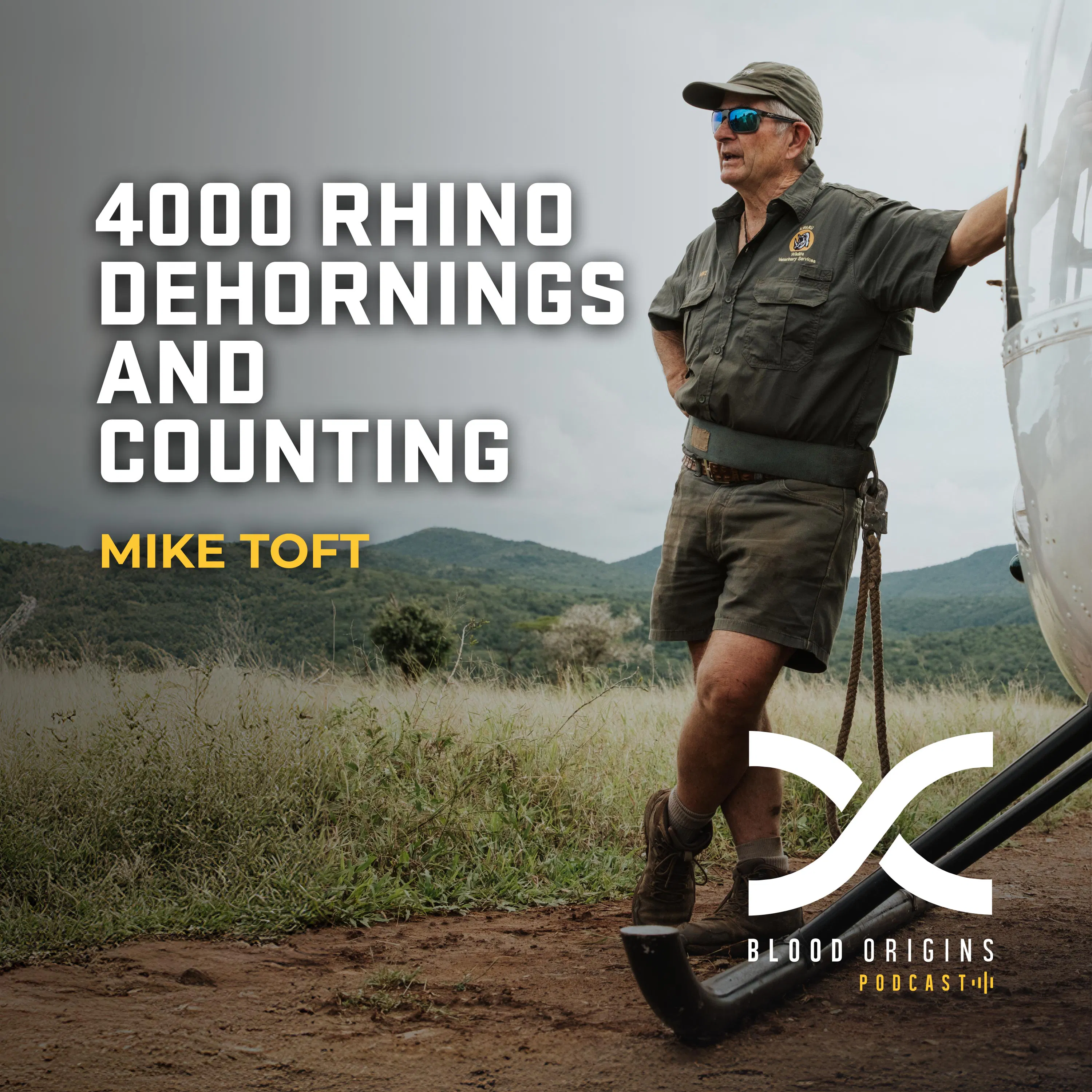
The Origins Foundation Podcast
Episode 580 - Mike Toft || 4,000 Rhino Dehornings And Counting
00:50:50
While Robbie was in Zululand starting to film a docu-series on rhinos, sustainable use of rhinos and all of the controversy around the trade in rhino horns, the team was fortunate enough to witness a couple of Rhino dehornings. The vet that performed the dehornings was Mike Toft, a wildlife veterinarian out of Kwazulu, Natel. A 30-year vet (no pun intended) of the wildlife veterinarian game, he has seen it all when it comes to rhino conservation. Robbie and Mike got together right after a recent dehorning by Mike of two rhinos that he’d darted from a helicopter less than an hour before the recording began. Mike recalls dehorning over 4,000 rhinos, and has arguably dehorned more rhino horns than anybody else in the world. Apologies for any shaking you hear in the background because Robbie and Mike recorded the podcast in Mike's vehicle as they were traveling between two dehornings.
Loading summary
Transcript249 lines
- [00:00]
FishingBooker
Fishing trips anywhere, anytime fishingbooker.com want to plan your next fishing trip without the hassle? FishingBooker.com is the best way to find and book a fishing charter anywhere in the world. Whether you're chasing trophy fish or just looking for a family day on the water, fishingbooker makes it simple, fast and secure. With thousands of experienced guides, verified reviews and 247 customer support fish, FishingBooker takes the guesswork out of planning. Visit fishingbooker.com and book your trip today. FishingBooker fishing trips made easy for almost.
- [00:35]
Midway USA
50 years, Midway USA has been America's go to source for just about everything for shooting, hunting and the outdoors. Go to Midway USA.com to see our latest deals and promotions and take advantage of our super fast same day shipping. If you need a cooler, a new fishing rod, another rifle, ammo or a reloading press, you can find it all@midwayusa.com thanks for your business.
- [01:04]
Mike Toft
Mike Toft is a wildlife veterinarian out of KwaZulu Natal. Mike Toft has been in the wildlife vet game for 30 years. Maybe a little more, a little less. He's a legend. He's a legend in that he has witnessed it all. He has been there, done that. Specifically when it comes to rhino conservation. Mike and I got together on a podcast post him dehorning to rhino that we had not we he had actually darted from a helicopter probably 45 minutes before we did this podcast. Mike and I had to drive around the property. It was about an hour's drive and so whilst we were driving around, I put a podcast headset on his head and we just had a good conversation. Mike has dehorned over 4,000 rhino. That doesn't mean individual rhino. He just has dehorned 4000 rhino horns. Arguably has dehorned more rhino horns than anybody in the world. That's why I say Mike Toft is a legend. Listen to this podcast, enjoy this podcast and absolutely share it. Because this wisdom, the experience that comes from these old school guys that have been on the front lines of wildlife conservation for decades are the people that we should be taking information from and implementing for the next three to four decades. Enjoy. So there's a reason why I started Blood Origins, and that reason is simple, is that I wanted to convey the truth about hunting.
- [02:52]
Brittany
It brings awareness to non hunters that.
- [02:57]
Mike Axelrod
It'S more than just killing animals.
- [03:00]
Brittany
How do I start it?
- [03:02]
Mike Toft
Brittany My name.
- [03:04]
Brittany
Does my hair look okay?
- [03:06]
Mike Axelrod
My name is Mike Axelrod. Start again. Yeah, I hated it too. Braxton, you said something in the card of Me? You said that you were living on borrowed time. There's a perception around who hunters are, what we're supposed to be. And a. A feminist that works for a nonprofit that is a hunter that has only eaten wild game for the last 20 years is likely not the thing that people think about when it comes to a hunter. There we go. You ever done a podcast before, Mike?
- [03:41]
Brittany
Yeah.
- [03:42]
Mike Axelrod
Yeah. Never done one in your vehicle before?
- [03:44]
Brittany
No, not on the move.
- [03:47]
Mike Axelrod
It's the best. These, these mics are just brilliant when it comes to you. You can just. You can roll down the road, down the highway and be fine and still talk. Yeah, Exactly. Well done. Two rhinos. Now we're up to 4,002 rhinos. Dhorn.
- [04:03]
Brittany
Yeah, it's a. It's a guesstimate of. Of how many we've done, but just here in KwaZulu Natal or all over the countryside. When I first started, I was doing it all over the country.
- [04:19]
Mike Axelrod
Well, Mike Toft, welcome to the Blood Origins podcast.
- [04:22]
Brittany
Thank you.
- [04:23]
Mike Axelrod
Appreciate meeting you. We've met each other now three times. Twice in the rain. Indeed. Once we did nothing together and then we call it. Then we relocated.
- [04:33]
Brittany
Five lions, five lines. Indeed. Yep. And now we've managed to do a couple of rhinos, cow and a cough combination.
- [04:39]
Mike Axelrod
And tell them. Just give us a little bit of an idea. What. What is the next, like 48 hours look like for you?
- [04:47]
Brittany
Well, it's a little bit concertinate. So what's happened with all of the rain has a lot of. Been a lot of delays. We haven't been able to get in and do the work. So tomorrow's a couple of rhino dehorning a treatment. One that's got a most likely a tick abscess backside this time of the year. Lots of high tick loads and lots of problems.
- [05:11]
Mike Axelrod
The tick load here is unbelievable.
- [05:13]
Brittany
Oh, yeah, it's crazy. This is the fourth year we've had such exceptional rain. So ticks build up with the rain, basically with the vegetation.
- [05:25]
Mike Axelrod
Wouldn't have immunity.
- [05:27]
Brittany
They do. Yep. So healthy rhino will still have a relatively low. I mean, you look at those two rhino we've just done.
- [05:33]
Mike Axelrod
Yeah. Plenty ticks.
- [05:35]
Brittany
They had a few ticks on them, but relatively speaking.
- [05:37]
Mike Axelrod
Yeah, I agreed. Correct.
- [05:39]
Brittany
Not a lot.
- [05:39]
Mike Axelrod
Not a lot as in comparison to driving through this grass and. Yeah, there's 100 ticks on your bonnet.
- [05:46]
Brittany
You know, one of the things you don't want to do here is going to take a little squat in the bush here.
- [05:51]
Mike Axelrod
No way.
- [05:52]
Brittany
Because you're going to come away with A vast array of pepper ticks all over and let me tell you, they get into every single conceivable spot. Very unpleasant.
- [06:04]
Mike Axelrod
So Mike, let me ask this and I'm known for doing hard questions, so maybe I'll let you introduce yourself first and then give you a hard question right off the bat.
- [06:13]
Brittany
No problem. Yeah, I'm Mike Tuft. I'm a wildlife vet. I've been a wildlife vet. I've been here in zululand for nearly 20 years. 99% of my practice is wildlife. I do do the odd dogs and cats for the guys on the reserves here, but my main focus is wildlife. We have a clinic, a wildlife treatment clinic and a wildlife treatment center with a, a big predator boma complex for bomas which we take in cheetah, lion.
- [06:47]
Mike Axelrod
Leopard, hyena, wild dog, whatever needs hold.
- [06:51]
Brittany
Yeah, caracal, that sort of stuff. So all what we would call priority species.
- [06:56]
Mike Axelrod
Yeah, yeah.
- [06:59]
Brittany
And yeah, that's basically it. My background is our.
- [07:02]
Mike Axelrod
Is there a quieter part of the day or the sorry, quieter part of the year for you? Yes, normal.
- [07:08]
Mike Toft
Look guys, I'm a hunter, right? And when I go hunting I like to figure out how to get my trophies back home as expeditiously as possible. Well, you don't have to look much further than Safari Specialty Importers. We know that trophy importation can be quite a headache. That's why Safari Specialty Importers strives to make it as easy and hassle free as possible. They have access to a bonded warehouse. You won't be charged storage fees and you get a dedicated team that's readily available and will update you at every step in the process. They'll even go one step further. Safari Specialty Importers is working with us and they are going to donate $100 from every shipment that they work with to conservation projects that include anti poaching, community development and wildlife conservation. At the end of the day, choose to spend your money with a team that's dedicated to you and is dedicated to helping show how hunting is a great conservation model. Hassle free logistics, fuel and conservation go.
- [08:08]
Mike Axelrod
With Safari Specialty Importers.
- [08:10]
Mike Toft
Hunting and shooting suppressed have become the norm in over 42 states where suppressors are legal. The growing popularity of suppressors has even led to legislative changes. You might have heard some things around the big beautiful bill, right? Including the reduction of the NFA mandated tax stamp. Before you used to pay 200 bucks. And now starting January 1st of 2026, the tax stamp is going to zero. However, why wait until January 1st? Our partners silence essential great friends of ours. They're going to pay your tax stamp right now. So if you buy a banished suppressor or other popular brands that essentially are qualifying purchases, Silence Essential is going to cover the cost of the tax stamp. They're going to save you 200 bucks right now. So make sure you don't miss out. Shooting SUPPRESSED if you're in the market for a new suppressor, whether it's your first or your next one, visit silenceessential.com or call them 866-811-6536. Silence Essential is going to cover your tax stamp right now. They're going to simplify the submission process and deliver your suppressor right to your door. Don't wait. Get your suppressor right now and start shooting. Suppress this season, Bushnell is eager to help you get set up for conservation success. That's right. They want to help you. The conservation and research community is dominated by good people doing good things and investing significant time and effort for the benefit of habitat and the species.
- [09:41]
Mike Axelrod
So what do you need to do?
- [09:42]
Mike Toft
Pretty simple. Send us your conservation story and or your conservation wish. Could be managing whitetails, could be understanding your environment or species or something else related to conservation. What would you be able to do if you had a great trail camera setup? We will select the best story every other month and send you a camera bundle, cell camera, normal SD camera, SD cards as well as optics, everything you need to get set up for success. I can't wait to see what you submit. You can email us, DM us, message us, whatever you want. We are not hard to find. Good luck.
- [10:20]
Brittany
Quite a part of the year is normally our hot rainy wet season. It's got extended this year by a month and a half. So from about late October through to end of February we pretty much downtime.
- [10:36]
Mike Axelrod
Gotcha. Except when lions escape. Yeah, it's supposed to be.
- [10:42]
Brittany
There's always those little call out things that keep us going as such. Yep.
- [10:47]
Mike Axelrod
And so the main majority of your work, if you went from, you know, March through October, Rio, what would you say is the main.
- [10:54]
Brittany
I would say 80, 90% of it is rhino work of some sort.
- [10:58]
Mike Axelrod
Moving, moving them. Treatments, dehorning and dehorning. Yeah, gotcha.
- [11:05]
Brittany
We do some elephant, we do a lot of lion work. We did a lot of cheetah work.
- [11:10]
Mike Axelrod
So Mike, one of the, when you look at models, you look at wildlife models across the world, obviously there's a consumptive use model, there's a non consumptive use model, Kenya being one of them. Kenya has moved to even I Believe something beyond a non consumptive use model, which is a interventionist model. Right. And so if, if a lion has a. I saw the other, probably a couple of months ago, lion had a snake bite on its head and Kenyan Wildlife service went in, mobilized the lion and treated the lion.
- [11:43]
Brittany
Right.
- [11:43]
Mike Axelrod
So hard question number one, you're going in and you're treating a rhino now for a tick abscess. Is that something we should be doing?
- [11:51]
Brittany
Okay, let's take the difference between lion and rhino.
- [11:56]
Mike Axelrod
Okay.
- [11:57]
Brittany
All right. So rhino won't breed much before she's six, seven years of age. She'll have one coffee free probably every two and a half to three years. So there's not a lot of rhino calves produced from a cow in her lifetime.
- [12:11]
Mike Axelrod
What is the average, do you think?
- [12:13]
Brittany
Anything from 6 to 8, probably, depending.
- [12:16]
Mike Axelrod
On predation, on general longevity of a female rhino.
- [12:20]
Brittany
They'll live to about 30, 35 in this area. They'll breed till they're around about late 20s, early 30s.
- [12:28]
Mike Axelrod
Okay.
- [12:28]
Brittany
And they're having a calf every three years. So you'll get six to eight or so.
- [12:32]
Mike Axelrod
Okay.
- [12:34]
Brittany
Whereas a lion can produce six to eight cubs and in three, four months time it can do the same again and same again. And it becomes exponential.
- [12:44]
Mike Axelrod
Do you say three or four months?
- [12:46]
Brittany
Yeah, it becomes exponential with lions. So we don't have a shortage of lions in South Africa. We have a shortage of space for lions.
- [12:54]
Mike Axelrod
Really Good point.
- [12:55]
Brittany
And that's the same for Africa. That is Africa's biggest problem now.
- [12:58]
Mike Axelrod
Space.
- [12:59]
Brittany
We're not short of animals, we're short of space for them. You give them, you give lions space, they will breed like flies. Give rhinos a space and a slightly longer time and they'll also breed well. I mean, you only have to look at how we've gone from supposedly anything from 20 to 60 individuals in Umfolozi, when they were virtually wiped out, 20 to over 20,000.
- [13:27]
Mike Axelrod
Wow.
- [13:27]
Brittany
In the last few years. Poaching unfortunately has put a huge dent in that success story.
- [13:35]
Mike Axelrod
Yep.
- [13:36]
Brittany
But all right, we, we were talking about lines and intervention.
- [13:39]
Mike Axelrod
No, that's intervention. The idea of, of intervene. Now that makes sense. Right? You want to. For a rhino specifically.
- [13:45]
Brittany
So there's the reasoning for why we would do a rhino. We've got 20,000 lines. We could have 20,000 within a few years if we gave them space. If we give rhinos a space, we're not going to get 20,000 in a few years, is going to take us 20, 30 years. So I don't believe that we need to intervene for lions in the most case. Okay, okay. There are some iconic lions that are huge tourist attractions.
- [14:15]
Mike Axelrod
Right.
- [14:16]
Brittany
And in those cases some of those parks do not want to lose their, their iconic species or their iconic attraction. Sorry. Or member.
- [14:28]
Mike Axelrod
Yeah, of course.
- [14:29]
Brittany
And of course they'll intervene to try and even in on the reserves I work on down here, despite the fact that we have a huge excess of lions, we do from time to time treat some of the really badly damaged ones, particularly if they are of great tourism value.
- [14:46]
Mike Axelrod
And would you say that when they have great tourism value it means that one, number one, obviously they're good looking lions. Two habituated lions.
- [14:53]
Brittany
Yep. Absolutely photographic. Yeah. All of those things. And because it takes a long time for these reserves to get a mature mail to the point where you've got something that people want to post on there.
- [15:09]
Mike Axelrod
Yeah. And you can drive up to and it's all connected. Yeah.
- [15:13]
Brittany
So yes, in those instances I think they're worth treating for the majority where we get youngsters that get smashed up by other lions, we tend to leave them be. It nature takes its course there.
- [15:29]
Mike Axelrod
What about cheetahs? Mike, you said you did a lot of work on cheetahs. Are cheetahs facing the same situation?
- [15:34]
Brittany
Cheetah we always intervene. You know, the numbers of cheetahs are much, much smaller. They under pressure from space, they're under pressure from predators and they're under pressure from humans.
- [15:46]
Mike Toft
Why do they get, why are they.
- [15:47]
Mike Axelrod
So susceptible to lions specifically? I hear all the time big, you know, where you've got big lions you have no cheaters because they smack cheetahs.
- [15:54]
Brittany
They certainly reduce the, the number of cheaters. The competition lion out compete cheetah any day on, on a, on a gram for gram basis, if you want to call it that. Cheetah are built for speed. They have very small mouths, small teeth relatively. And their bodies are lean and light. Lions have got large, incredibly powerful jaws, huge big canines. They have retractable, very sharp claws. They built for short burst killing machines basically. Whereas a cheetah is a much, much more gentle creature in that respect. And so if it comes up against a lion, it's a bit like a David and Goliath type.
- [16:46]
Mike Axelrod
Yeah.
- [16:48]
Brittany
So they end up being thumped. They also, they become savvy over a period of time. But unfortunately a lot of them are bred on reserves that bur have any lines. Don't have lines and then they get moved to line areas and then we have problems as a result. They do learn. Sometimes they don't learn in Time.
- [17:10]
Mike Axelrod
Yeah, yeah, yeah. So 90% or you just said 80% of your work in the, in the, in the month that you're doing the most work is rhino work. Correct. And we just obviously had a con, a small conversation over a rhino calf that you had immobilized. And one of the reasons why we're here, one of the reasons, the biggest question that we're trying to peek around a corner around is this idea of how do you value rhinos to conserve them?
- [17:45]
Brittany
All right, I'm going to step back just slightly and just give you a little bit of background to something and you might help you understand what's happening there. Fifteen years ago, a rhino calf and cow used to sell on the auction, the KZN Wildlife, which is a government national park auction for anything up to 600, 800,000 rand. It was a lot of money.
- [18:13]
Mike Axelrod
What's that in dollars?
- [18:15]
Brittany
Knock a naught off. And Harvard. So 30, 40.
- [18:20]
Mike Axelrod
30, $40,000.
- [18:21]
Brittany
Okay, okay. All right. And people wanted rhinos. That's where we were heading. Some of the rhino bulls were, were almost a million rand as such. Okay, okay, what's that? 50,000. 50,000 plus or minus 50,000 US then poaching reared his ugly head in a major fashion and it became a, from having rhinos and having it as an asset, it became a major liability.
- [18:55]
Mike Axelrod
What are we talking, 2008?
- [18:58]
Brittany
Yeah, around, around about there. Yeah, about 15, 20 years ago. And steadily the, the liability has increased.
- [19:07]
Mike Axelrod
Liability.
- [19:08]
Brittany
The liability for the, for the reserve owner who, who has a rhino on.
- [19:13]
Mike Axelrod
His reserve, people coming in and he's.
- [19:15]
Brittany
Got to put out much, much more in the way of secure fences, anti poaching units, dog tracking units, helicopter monitoring cameras, drone monitoring cameras, you name it. To the point that the average Joe Soap who, who has a game farm, who would used to keep rhinos, has given up rhinos and they no longer keep them. We've lost 20, 30. In fact, I think it's even more 30, 40% of our rhino carrying land mass that we used to have.
- [19:48]
Mike Axelrod
How many, how many hectares do you think that is?
- [19:51]
Brittany
I don't listen and I'm thumb sucking here because I can't remember the figures offhand, but it's quite appreciable and it's quite scary because you know, when you lose it to rhino, what you're doing is you lose it actually in most cases to, to cattle, to, in other words, to cattle.
- [20:08]
Mike Axelrod
Replace it.
- [20:08]
Brittany
Yeah. So you lose it as a wildlife area completely. So you're not only losing rhino, you lose the entire Biodiversity then wind with the rhino and that's a big issue. Those rhinos have subsequently fallen to. Yeah. Anything from.
- [20:26]
Mike Toft
So a cow calf today is 20,000.
- [20:29]
Brittany
30,000, maybe 60,000 rand.
- [20:32]
Mike Axelrod
So you're talking about a thousand dollars.
- [20:33]
Brittany
So we're talking of about two to three thousand dollars. Ye. So. And in some cases they have fallen to almost nothing. You can't give them away.
- [20:46]
Mike Axelrod
Same situation as lions, same situation as elephants, right?
- [20:50]
Brittany
Yeah, yeah, yeah, very much so.
- [20:52]
Mike Axelrod
Rhino specifically in terms of the security and liability around them.
- [20:56]
Brittany
So you say, you know, where is the value in rhinos and conserving them? So it now becomes a. It is no longer financially viable to keep rhinos. For most of these reserves, they now rely on public funding to help keep them. These big reserves have organized dehorning sessions.
- [21:20]
Mike Axelrod
Where when you say big reserve, you're talking public reserves.
- [21:23]
Brittany
No, I'm talking big private reserves. Because let me tell you, I believe the salvation of our, our rhino population is going to lie in the hands of the private landowner.
- [21:35]
Mike Axelrod
Has to.
- [21:36]
Brittany
South Africa has that unique, unique wildlife, wildlife management model.
- [21:44]
Mike Axelrod
Wildlife belongs to the person who owned it on his land.
- [21:47]
Brittany
Correct. And that has proved, if you look at it in the African context, incredibly successful. If you compare it against government owned and managed. Yeah.
- [21:59]
Mike Axelrod
It'd be interesting to know because the, the statistics are 19 in 19 in the middle mid-1970s at about 500,000 head of wildlife today. Nobody really can put a number on it, but they think between 22 and 26 million head of wildlife.
- [22:15]
Brittany
Correct.
- [22:15]
Mike Axelrod
It'd be interesting to see what that number looks like. Split public private. Because you would think the only way that the public areas increase their wildlife capacity is by increasing the number or new reserves that have come online to increase that wildlife number. All the private land areas have gone from cattle ranches and turned themselves into wildlife areas.
- [22:40]
Brittany
Yeah. And as a result, obviously the biodiversity comes back.
- [22:44]
Mike Axelrod
Have you seen that around here in Zululand? Have you seen 20 years that you've been here?
- [22:48]
Brittany
Yeah. A lot of these properties that I work on now were all cattle farms. And when I first started, we were still pulling up pieces of fence and fence posts and the likes and we had degraded land. We had old pineapple fields. You look back over it now and you think, I don't know where the pineapple field went, but that is a beautiful acacia savannah, open.
- [23:10]
Mike Axelrod
And the reason everyone turned across is because they saw value in the wildlife.
- [23:13]
Brittany
They saw value in wildlife from photographics.
- [23:16]
Mike Axelrod
And hunting or, and, or both.
- [23:18]
Brittany
Well, originally, hunting was very much a part of the Management situation on these reserves? Yeah, it very sadly has declined over the last eight to 10 years because of public pressure.
- [23:32]
Mike Axelrod
Don't you find it interesting? And again, you might have seen this. You look at the gems and I'm not going to name names. It's a place that you're going to tomorrow. You didn't name the name for me earlier, but I know where you're going tomorrow. That these places started as hunting places, hunting reserves got looked after, got restored, got conserved and they've gotten to a level now that they're like oh, thank you so much. We'll take that over as a photographic now.
- [24:04]
Brittany
Let me tell you, if they had the option to incorporate some hunting into their conservation model, they would, they would, yeah. And let me give you a very good for instance, so on so called those reserves. And let's not name them because they have massive excesses of elephant, rhino, lions, let's take cheetah out of the equation. But buffalo, in other words, a lot of the big five that pays a lot of money through hunting which sit on these reserves.
- [24:48]
Mike Axelrod
Yep.
- [24:49]
Brittany
We have now reached a situation where there are far too many lions on these reserves and now no longer any new reserves and or places to take these lions to.
- [25:01]
Mike Axelrod
Would ismvello issue a hunting permit at the same time as they would issue a destruction permit?
- [25:08]
Brittany
They may do. They work on a quota system and that's something that obviously would need to be negotiated with them. But what happens is that those reserves have to apply for destruction permits. We don't have places to place those lions. So we literally have to go and manage the population numbers by removing some of those lions and euthanasing them.
- [25:39]
Mike Axelrod
It's funny, you'd think these places that are obviously, you know, they're operating because they're a business looking to create a profit or they just philanthropically run.
- [25:55]
Brittany
Okay. So now you have to look at why are they no longer hunting, for instance, why do they not hunt some of those lions then? I have to hunt all of them.
- [26:04]
Mike Axelrod
Some of them, exactly.
- [26:05]
Brittany
Some of them are old males that are incredibly good trophies, if you want to call it that.
- [26:10]
Mike Axelrod
Yeah.
- [26:11]
Brittany
And they would. They don't have a place to go. They're too old to start a new population and they'll always become the new genes in a new population. So they've reached this literally their sell by date. Unfortunately we end up having to remove some of those lions. In other words, euthanasium. If we were able to hunt them there would be a huge dollop cash. A dollop injection into those coffers and those reserves would benefit hugely from the cash that would go into protecting rhinos, for instance. But there's one big problem and that is the whole worldwide anti poaching lobby that has.
- [26:58]
Mike Axelrod
Anti hunting lob. Fine.
- [26:59]
Brittany
Yeah, sorry, sorry. Anti hunting lobby. That is from their armchairs.
- [27:03]
Mike Axelrod
Yep.
- [27:05]
Brittany
And social media has a great deal to do with this, I'm afraid to say.
- [27:08]
Mike Axelrod
Yep.
- [27:10]
Brittany
They press the like or the dislike button and they get so many votes and suddenly the reserves are looking, you know, there's 50,000 votes against hunting from 49,999 people who have absolutely no idea what hunting involves and what managing a species like lion on these reserves actually entails. So yeah, we sit with that situation. So those reserves cannot afford the social media pressure that is generated by unfortunately a mostly uninformed. Uninformed and ignorant public that go on emotion rather than on fact and figure.
- [27:58]
Mike Axelrod
No, it's funny man, you say that but you know, you have a place like Timbavati. Phenomenal hunting model, phenomenal ecotourism model, photographic model working hand in hand. The photographics don't even know that people hunt there.
- [28:12]
Brittany
Listen, it's amazing. I'm not going to say to you that that isn't a model that some of these reserves have considered. And whether they do or don't is not for me to say.
- [28:22]
Mike Axelrod
Yeah.
- [28:25]
Brittany
But yeah, 100%. We're not talking of a major hunting component. No, we're talking of a relatively minor. But we say relatively minor as in number of people that come, but certainly from a financial basis, a significant contributor.
- [28:43]
Mike Axelrod
Well, Timberworth is like 66 to 1.
- [28:46]
Brittany
Yeah.
- [28:47]
Mike Axelrod
Money wise in terms of revenue generated. Not to mention that don't talk about water use footprints and carbon footprints and waste footprints, all of that.
- [28:57]
Brittany
And I mean I didn't even touch on that, but that's exactly where one goes with that particular thing.
- [29:03]
Mike Axelrod
So let's go back to the question on rhinos and valuing rhinos. Obviously we've, we've sort of touched on the idea of, you know, hunting a rhino is going to provide its value. Right. It's, it's going to provide probably the most significant value right now beyond probably the only thing that's comparable to it would be some of these philanthropic NGOs, rhino conservancies that could, yeah, even come close to matching to give you an.
- [29:31]
Brittany
For instance, again, 50% of carbs are for the most part males. That's it. Over a period of time it balances out and you get 50% rhino male. Males, rhino, females. You can only cope with a couple of mature rhino bulls on a property.
- [29:53]
Mike Axelrod
Why is that?
- [29:55]
Brittany
They establish territories and they become dominant. So the dominant bulls will then rule the roost as such. And the subordinates as such are ousted. They are either damaged by fighting with these bulls or they are pushed to the margins of the reserves, which is usually up against offenses. They then become poaching, you know, easily poached there as such. So the best thing is to remove these bulls and take, send them to other reserves where they could become the dominant bull.
- [30:31]
Mike Axelrod
You mean the sub adult bulls?
- [30:32]
Brittany
Yeah, the sub adults do. Almost adult bulls.
- [30:35]
Mike Axelrod
Yep.
- [30:36]
Brittany
Because like I say on most of these fence reserves, 5, 8, maybe 10 dominant bulls as more all they need, they have 20 or 30 bulls. What do they do with their excess? Yeah, another reserve that wants fresh blood and genes will only take a couple of them. It won't take the other the masses. So they're still left with an excess. So in some instances those, those rhinos, the only value they have then is potentially as, as hunting as hunted animals. That pushes their price suddenly from the mere 20, 30 to 150, 200, 300,000. Approaching some of the figures that we used to have.
- [31:24]
Mike Axelrod
Yeah, for sure. Like I think bull is going for 40 to 80 thousand dollars.
- [31:29]
Brittany
Correct.
- [31:31]
Mike Axelrod
So which is tremendous value in terms of when you convert it to rands and all of the liabilities.
- [31:36]
Brittany
But very few of the photographic ecotourism type reserves are prepared to risk the public. The PR nightmare, the PR nightmare that comes out of selling rhinos to hunting. And so, yeah, it's almost like they.
- [31:54]
Mike Axelrod
Need to do a PR campaign which is, okay, look, we're not going to hunt this rhino. And you'd have to try and find a, a place that would be willing to do this, stick their neck out a little bit, or you do it on a, on a hunting reserve, which is, okay, we've got an old bull, we're going to hunt him. We have someone who's going to pay 60,000 US. If you, the, you know, the, the lobby that says we don't want you to hunt that animal can come up with 60,000 US.
- [32:23]
Brittany
Correct.
- [32:23]
Mike Axelrod
We're happy not to hunt them anymore.
- [32:25]
Brittany
Yep. Let him die. Either let him die of either starvation or being killed by another rhino. Because that, that is the reality of saying let's no longer conserve him, let's preserve him.
- [32:39]
Mike Axelrod
Correct. Okay, correct.
- [32:41]
Brittany
The reality is that that rhino will die when he's challenged by a stronger, younger, healthier, more virile rhino.
- [32:49]
Mike Axelrod
So Mike, so Let's just, let's talk. Let's take that in the context of what we're doing in terms of dehorning the rhinos. Is that changing those kinds of dynamics now?
- [32:59]
Brittany
It has, it's changed it slightly. So what happens now is that they no longer have life threatening injuries inflicted upon them when they encounter a more dominant, stronger, younger bull. But they are battered and pushed and they're pushed into marginal areas. In other words, they go to less than good nutritional resource areas, which means then with their teeth that are beginning to wear and fall out, and that is a natural aging process, those rhinos start to get poorer food, poorer resources, less access to water and they start to lose weight and condition. And what we find often is that we will find them virtually starved to death. Now that's not an entirely abnormal situation. Even in the wild where we did not interfere in, in the good old bad days, there's still rhinos that eventually just died of old age, when we called it old age. What we really mean is that starvation ran out of the ability to assimilate food into their or nutrition into their bodies. So it's not entirely abnormal. But that is the reality. Now there are certainly a number of the public who believe that a rhino should die in its bed, if you want to call it that. In other words, you know, a death that is a natural one.
- [34:27]
Mike Axelrod
Peaceful one, Mike.
- [34:28]
Brittany
Peaceful perhaps, yes. And they of course will put that against a, and again in inverted colons, a violent death from a hunter's bullet. Now that animal that died peacefully in his sleep as such, starved basically to that point and contributed certainly his genes to the population. So yes, he was a valuable animal. And when his genes stopped being dispersed, he became no longer as such an asset, but more of a, a liability. A liability as such. You're right. That's the situation where in some cases where you have a bull that has reached that point, a hunting license probably could be applied for in the good old days. Now that has ceased to happen for the most because again we have public pressure and the anti hunting lobby against it. Now it's hard for me to say which is right and wrong. Here I give you the facts. I believe that some controlled version of hunting and an ability to generate an income in its latter years where he's done his bit. Yep, it's his final parting shot at giving that reserve a cash injection for generations of rhinos. Exactly. That are still there. So yeah, that's kind of how I feel about it. Would I want to go and hunt a rhino No, I wouldn't.
- [36:16]
Mike Axelrod
Neither would I.
- [36:17]
Brittany
Okay. But that's not the issue. There are people who do.
- [36:21]
Mike Axelrod
So that's, you know, to me, when you're, when I think about valuing rhinos, you've got an ecotourism model, you've got a philanthropic model, you've got a hunting model. Then there's a fourth that we, you know, challenged you over the rhino about. They got banned, it got taken away from us. A tool essentially in the toolbox that got taken away from us in 1977, which is the trade in rhino horn.
- [36:49]
Brittany
Yeah.
- [36:49]
Mike Axelrod
We are 50 years on from that 20. 27 will be the 50th anniversary, 50th year anniversary of that rhino trade discussion. 2017, Swaziland brought forward their proposal to sell their rhinohorn stock got shut down. 26 in favor, 17 abstained. 100 against.
- [37:10]
Brittany
Correct.
- [37:11]
Mike Axelrod
With great applause of it not moving forward.
- [37:16]
Brittany
It's the part that always bugs me.
- [37:18]
Mike Axelrod
We're going back to the lodge.
- [37:20]
Brittany
I think we're going past the lodge through to Amakosa.
- [37:24]
Mike Axelrod
Oh yeah, yeah, yeah. Okay.
- [37:26]
Brittany
Yeah.
- [37:27]
Mike Axelrod
Oh yes, yes, yes, yes.
- [37:28]
Brittany
It's the thing that bugs me basically. And I've lost my train of thought there for a second. Let me get back there.
- [37:36]
Mike Axelrod
The trade. 20, 17, 50, 40 years on. 50 years on now.
- [37:42]
Brittany
So if you look at the anti trade lobby saying that.
- [37:52]
Mike Axelrod
They'Ll say more, our rhinos will be killed because now it's legal.
- [37:55]
Brittany
Okay, so exactly that. Right. So let's have a look at them. And they asked for the time and the space to be able to mitigate demand.
- [38:07]
Mike Axelrod
Correct. Okay.
- [38:09]
Brittany
So they sent NPOs and the likes who went into China and Vietnam and Hong Kong and along with shark fin trade, along with abalone, et cetera, tried to reduce the demand by educating the public, the Southeast Asian public, as to why they shouldn't use these animals and these animal parts. And here we are 50 years further on. Has the demand diminished in any way? No, the short answer is it hasn't. And so then we need to unpick why has it not diminished what just happened? I don't know. We seem to have lost something.
- [39:04]
Mike Axelrod
There we go, you're back.
- [39:06]
Brittany
So we need to unpick why hasn't it diminished. With all of these efforts of demand mitigation that have been tried, put in place educational programs and the likes that have all been instituted, yet we are faced with incredible pressure on our rhinos.
- [39:33]
Mike Axelrod
Still, 35 rhinos. I'm a little loud now.
- [39:36]
Brittany
Yeah.
- [39:37]
Mike Axelrod
35 rhinos in 49 days. In Kruger this year.
- [39:41]
Brittany
Yeah. So we have to start saying what has gone wrong. They've done nothing to reduce the pressure whatsoever.
- [39:54]
Mike Axelrod
One could argue that there's more pressure because of all the liabilities associated with Ryan.
- [39:59]
Brittany
I believe there is more pressure. And again, this is my take on it, my thinking and my theory. Rhino horn, when it first was being used, started off as an ornamental piece of horn that was used in Yemeni, in Yemen particularly for daggers for coming of age, for the Middle east, basically. And it was used for some medicinal value in China and India. The medicinal value being initially it was punted as an aphrodisiac, which was a very small percentage. And then it has in the Chinese pharmacopoeia, it had an anti inflammatory effect that was used in conjunction with some herbs and the likes in what's called a decoction. And it was used for reducing child fevers and the likes. So that was the medicinal value the cost of rhinohorn now has reached in the region of. And these are only rumored figures, I cannot say that we can verify every single one of them, but anything from 60,000 to 100,000 US per kilo. Now, nobody in their right mind will go and use that to mitigate some child's headache or fever or the likes. In other words, the medicinal value of our rhino horn has virtually fallen away. So what's driving the trade? Well, the trade has got worse in the last 15, 20 years and one has to start looking at what is it. And I am led to believe that, and certainly through reading a fair amount of reports and the likes, that rhino horn has now become a major status symbol. It is the status of that rhino horn, or owning a rhino horn that has driven it to the realms of 100,000 per kilo.
- [42:17]
Mike Axelrod
Wow. And essentially like a rhino horn on the mantle.
- [42:21]
Brittany
Yeah. So who could own that sort of thing? Well, only the mega wealthy. What has happened in Southeast Asia?
- [42:29]
Mike Axelrod
Lots of people have become mega wealthy.
- [42:30]
Brittany
We've had people become mega wealthy in the last 15, 20 years. And it coincides with exactly what's happened with the rhino horn, with the rhino horn trade. And so my belief is that the majority of the trade is driven by status now and by very, in very simple terms, by restricting the access to rhino horn, we're driving the status of it even higher and higher all the time. So for as long as there's little of it out there and availability is little to nothing, the status will increase. Because who can own a horn? Very few people, and mostly the people with big money.
- [43:14]
Mike Axelrod
Imagine anybody could earn A horn.
- [43:16]
Brittany
So that big money buys a horn, he takes it to business meetings. They start to put out the message that it enhances their business, that it enhances their health, and that it's so expensive they can only dish it out to wealthy other clients and things like that. In other words, the status continues. And for as long as we restrict the horn access for the general public, I believe that we will continue to stimulate the elitist use of rhino horn and the status symbol of it. It makes sense if you now then look at that as being the driving force or certainly the predominant driving force. How would you reduce it? So I kind of look at that and I say, right, well, what you do is you take its status away. Well, how do you take a status away? Take, for instance, imagine if Joe Rich has a Ferrari now. Joe Poor down the road suddenly finds that Ferraris become very affordable, and he has one, too. He lives in a little apartment and he's. He's got his Ferrari now. Everybody drives around in one and got one. Joe Rich starts thinking, no, no, no, man. It's no longer a status symbol anymore. I mean, I'm just part of the crowd. And I'm giving this as an example, as an illustration. It obviously is, but it's a great illustration.
- [44:50]
Mike Axelrod
It's like a Rolex. So if a Rolex was.
- [44:53]
Brittany
So what does that.
- [44:54]
Mike Axelrod
100 bucks.
- [44:55]
Brittany
Exactly. He says, no, I don't want a Ferrari anymore. I'm going to go for a Bugatti. Thank you. And now I've got another SATA symbol. All right. So if we were to take rhino horn and to put it on the market in a controlled fashion, I'm not saying that it goes out there in a totally uncontrolled. There you go. Sort of exchange, a legal exchange broker, bit like diamonds. We could have, you know, a means of controlling them to a degree. And suddenly, yes, we're going to create demand to begin with. Absolutely. I do not deny that that is what will happen, because the inevitable will happen. Somebody will say, my goodness, I've seen somebody driving a Ferrari. I want to try it after a while. And he realizes they're actually a bloody uncomfortable and not particularly easy vehicle to drive. He realize it's really not worth spending that money on, and he'll rather spend his money on something else. We will get the initial search of people saying they've got to try rhino horn. They're going to see. But when the Joe Average can have a rhino horn on his shelf and pay a fair amount of his money, he's going to start thinking, well, it hasn't really helped my status and it certainly hasn't helped my health and it certainly hasn't helped my wealth. Maybe I don't really want a rhino horn. And I believe that if we supply sufficiently into the market to begin with, where we can allow that status to drop from 100,000 US per kilo to less than a thousand per kilo, we'll suddenly find that while it will have stimulated it to begin with, it's not going to stay there. And ultimately even those people who do want to have a rhino horn will be able to buy one on the market at a reasonable price from time to time.
- [46:53]
Mike Axelrod
Yep.
- [46:54]
Brittany
And that's my take on it.
- [46:55]
Mike Axelrod
And based on all the dehorning that you have been involved with, I've heard, I've had, I've heard people say something along the lines of we potentially have. And again, I don't know how they're. They're basing the. The supply and demand kind of scenario, but at least five to 10 years worth of rhino horns stored.
- [47:20]
Brittany
Exactly.
- [47:21]
Mike Axelrod
Ready to go.
- [47:21]
Brittany
100%. There are masses. There's hundreds of tons of rhino horn in stocks around South Africa in various vaults.
- [47:31]
Mike Axelrod
Unbelievable.
- [47:33]
Brittany
And there may be people who will continue to harvest horn and want to sell it on. For the majority. Most people won't. Although I do think it'll become a mixture of both some with and some reserves without. Only problem with that particular scenario is that it's an all in or all out situation. In other words, you do all your rhinos or you don't do your rhinos. It's very hard to dehorn one or two because all you do then is you put them at a disadvantage to the rest of the population. So on reserves that want to sell rhino horn, they will continue to harvest rhino horn from all of their.
- [48:14]
Mike Axelrod
But what about those reserves that would hunt them? Mike, can you not have that situation where you hybrids, a couple of that auntie horned and those are the ones being hunted?
- [48:22]
Brittany
Absolutely. You could easily have that. I mean there's so many different potential scenarios on those things.
- [48:30]
Mike Axelrod
Yeah, well, amazing. Well, let's hope it doesn't rain on us again. It's thundercloud growing over there.
- [48:38]
Brittany
We're a bit over the rain and to say that in Africa is not something you'll hear often from.
- [48:44]
Mike Axelrod
I think the farmers have said this is the most rain they've seen in 60 years at this time of the year.
- [48:48]
Brittany
Yeah, yeah.
- [48:49]
Mike Axelrod
Well, the boys from Wales, we blame the boys from Wales.
- [48:53]
Brittany
Right.
- [48:53]
Mike Axelrod
They brought their own.
- [48:54]
Brittany
They brought it with them. Yeah, exactly.
- [48:56]
Mike Axelrod
Mike, any final words on. Are you, let me ask this, are you. You've been in the game for a long time.
- [49:03]
Brittany
Yeah.
- [49:03]
Mike Axelrod
What do you. Are you optimistic about the future of rhino conservation? Are you pessimistic? Are you one of those that are going to say whenever we're going to see rhinos go extinct in 10 years?
- [49:17]
Brittany
No, listen, I don't believe in our watch that rhinos will become extinct. I do believe that it's going to be and still is a massive challenge for all of us. I think the thing that gives me, one of the things that gives me a little bit of hope is the.
- [49:36]
Mike Axelrod
Places like this is, is, is this, this Columb. What's the word I'm looking for? Amalgamation of all these reserves in this area that we're working with.
- [49:47]
Brittany
Yeah.
- [49:47]
Mike Axelrod
And all the amounts of rhinos that they have on is. I've been impressed. I mean, like, oh man, this is amazing.
- [49:54]
Brittany
Yeah, no, I think so. I think there's a little bit more, but I think we're going to run out of time for, for.
- [50:03]
Mike Axelrod
Yeah, well, I appreciate you, man, at the moment, but we'll do another one another time. But that was amazing. Perfect. Appreciate you, Mike.
- [50:10]
Brittany
Hundreds.
- [50:11]
Mike Axelrod
Well, that's it for today. Appreciate you listening as always. Leave a review, share it with your friends and most importantly, do what's right to convey the truth around hunt.
- [50:23]
Melissa Bachmann
Hey guys, this is Melissa Bachmann. Are you ready to stop spooking deer before it's even time to hunt them? Then you need the new Flex s dark cellular trail camera from spypoint with a no glow flash option, long lasting solar power and a ton of settings that can be changed anytime through the SpyPoint app. There are no more excuses for letting your deer get wise before the season even starts. So check it out for yourself and see why. The spypoint Flex S Dark is the unstoppable and undisturbed detectable scouting tool you need for your next hunt.
- [51:00]
Mike Axelrod
Bow hunting all comes down to a moment. And in the moment, you want equipment on your bow that will get the job done. Trophy Ridge products are the tools bow hunters trust. React technology sites, rests, stabilizers and quivers to help a bow hunter be successful in the field. And those tools are from Trophy Ridge.