← The Origins Foundation Podcast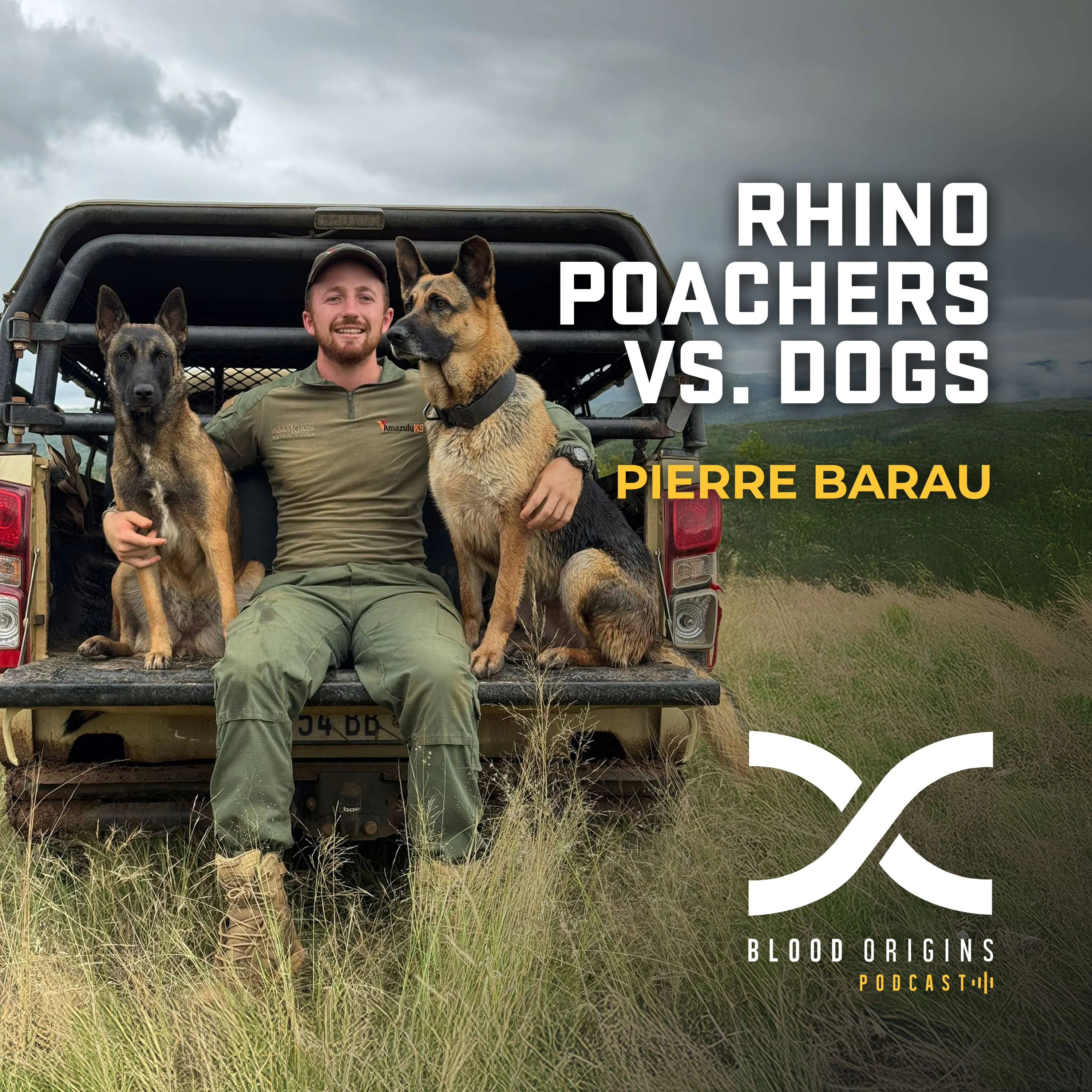
The Origins Foundation Podcast
Episode 585 - Pierre Barau || Rhino Poachers vs. Dogs
00:56:44
Pierre Barau is a dog handler from Réunion (a former French colony), an island off the coast of Southern Africa. He currently serves as a dog handler for anti-poaching efforts in the Mkuze Falls area of Zululand, South Africa. Robbie met Pierre while filming the first installment of a rhino docuseries in South Africa. Pierre and Robbie sit down to talk about the stark realities of rhino poaching, what Pierre and his team are up against, and much more!
Loading summary
Transcript411 lines
- [00:00]
A
At Midway USA we put customers first. The Nitro Express shipping system is icing on the cake. It was a big investment of time and money to take super fast low cost shipping to a whole new level. The Nitro Express helps ensure same day shipping and low shipping costs. We hope you enjoy the Nitro Express. We built it just for you, for just about everything. For the outdoors. Go to midwayusa.com I'm Larry Potterfield with Midway USA. Thanks for your business. Midway USA brand product designers have one straightforward develop high quality technically sound products and deliver them to customers at reasonable prices. If you are immersed in the shooting sports industry and pay close attention to.
- [00:43]
B
Every single detail, you know our products.
- [00:45]
A
Are built right and stand up to everyday use. Who has shooting mats and range bag systems to hunting clothing and just about everything for the outdoors. Log on and shop 247 with superfast shipping.
- [00:57]
B
Midway USA.com Pierre Barral is a dog handler that is French. He's not from France, he's from Reunion, which is an island off the east coast of southern Africa. Pierre Baral currently is the dog handler for anti poaching work in the Mikuzi Falls area of Zululand in South Africa. I wanted to sit down with Pierre as we start exploring this idea of rhino conservation. What is the path forward? What needs to happen? What's the reality on the ground from a poaching perspective? I wanted to hear from Pierre, the guy who runs a dog team that chases poachers, that is in charge of following up on poachers tracks to apprehend these guys. It's a fantastic conversations. It's super fascinating for anybody that's interested in anti poaching, what the dog handlers do, how they operate. This is the podcast for you. So enjoy. So there's a reason why I started Blood Origins and that reason is simple, is that I wanted to convey the truth about hunting.
- [02:15]
A
It brings awareness to non hunters that it's more than just killing animals. How do I start it? Brittany?
- [02:26]
B
My name.
- [02:27]
A
Does my hair look okay?
- [02:29]
C
My name is Mike Axelrod. Start again. Yeah, I hated it too. Braxton, you said something in the car to me. You said that you were living on borrowed time.
- [02:40]
B
There's a perception around who hunters are.
- [02:42]
C
What we're supposed to be and and a feminist that works for a non profit that is a hunter that has only eaten wild game for the last.
- [02:51]
B
20 years is likely not the thing.
- [02:53]
C
That people think about when it comes to a hunter surrounded by dogs.
- [03:03]
A
Yeah, of course, as soon as I sit down they all have to come and check.
- [03:07]
C
Yeah, of course. And the little Jack Russell who's trying to hump a huge German shepherd who's not going to be happy about it.
- [03:14]
A
And he's not learning.
- [03:15]
C
No, he's going to get Blixomed. He was. Look, he's trying to like, He's. His actions are like, you know, I'm gonna try. I'm gonna sit off to the side. I'm gonna try and hump her leg.
- [03:27]
A
And she won't see it. I won't touch her, you know?
- [03:29]
C
Yeah, exactly. Exactly. So where are we right now?
- [03:33]
A
Makuzi, Mkuzi Falls.
- [03:35]
C
Mikuzu Falls. How is that, like 20K? No. How far is it from the Swaziland border?
- [03:41]
A
Oh, it's not far at all. More than 20k? I'll say. Maybe like 50ks or so. Could be even closer in a crow fly. But yeah, I mean, if you want to get to the border now, it's like a half an hour drive from. Yeah. And you'll get to there.
- [03:55]
C
And that's a problem for you?
- [03:56]
A
Not really, actually, because people don't think it's a problem. No. People from Swaziland don't really poach rhino much. It's mainly Mozambique, the Big Issue, which also isn't that far away from. Yeah, it's a bit further, but it's just a little bit north. And that's where all the poaching comes from. Yeah.
- [04:14]
C
Well, Pierre, I don't think I got your last name this morning.
- [04:19]
A
Barrot. Barrot, yeah.
- [04:21]
C
French.
- [04:22]
A
French.
- [04:24]
C
Francais?
- [04:24]
A
Oui, oui.
- [04:25]
C
Me? No.
- [04:28]
A
Oh, man.
- [04:30]
C
But not from France.
- [04:32]
A
No, from actually Reunion Island. So it's a. It's a French colonized island. So usually I just tell people I'm from France because they don't understand where you really.
- [04:41]
C
They don't know where.
- [04:43]
A
They don't know where it is. And then when. When I tell them where it is, they think, oh, you're not actually French. But no, I've got a French passport and everything. We vote for the French prince.
- [04:51]
C
Is Reunion still a French colony today?
- [04:53]
A
It is, yeah.
- [04:54]
C
Huh.
- [04:55]
A
So if you look at the.
- [04:56]
C
The only French colony still existing, there's.
- [04:58]
A
There's a couple. There's Guyana, there's Guadalupe, and I'm pretty sure there's another one as well.
- [05:04]
C
How big is Reunion as. None. And it's in the Indian Ocean.
- [05:07]
A
Indian Ocean. East of the west of Mauritius. 200 km west of Mauritius about. Yeah. East of Madagascar.
- [05:14]
C
Okay. What would it be like if you took a straight line from Reunion across. Are you Hitting Tanzania or northern Mozambique?
- [05:22]
A
Northern, I think you get to Tanzania pretty much. Our northern was up, I would say more northern Mozambique because we've got a very similar weather.
- [05:30]
C
Okay.
- [05:31]
A
But it could be a little bit up to Tanzania. Yeah. The.
- [05:36]
C
How many, how many people live on Reunion?
- [05:38]
A
800,000.
- [05:39]
C
800,000?
- [05:40]
A
Yeah. But it's only 70 kilometer in diameter. So it's tiny. Tiny.
- [05:44]
C
Oh, so it's a circular island?
- [05:46]
A
Yeah, pretty much.
- [05:47]
C
And you guys come from a farming background?
- [05:49]
A
Yeah, my dad. Yeah.
- [05:51]
C
Sugar cane.
- [05:52]
A
Sugar cane, yeah.
- [05:53]
C
That's the staple agriculture in Reunion?
- [05:56]
A
Yeah, mainly all over. And we one of the biggest on the island.
- [05:59]
C
What's biggest? How many hectares?
- [06:02]
A
So we've got 500 hectares and I think the biggest one private guy is about a thousand and something. But then if you take it back to my great grandfather cuz now it's all split up with all the cousins and stuff.
- [06:13]
C
Okay.
- [06:13]
A
So if you take all the cousins together back to what my great grandfather had. Yeah, it's the biggest, I think it's,500 hectares of.
- [06:20]
C
Would you say that's the main commodity in Reunion is agriculture? What drives the economy of Reun Tsim?
- [06:29]
A
Not, not, not that much unfortunately. But I would say agriculture is a big thing.
- [06:35]
C
Why do you say unfortunately or fortunately?
- [06:37]
A
Well, unfortunately cuz I mean tourism can be great. When you look at South Africa, how much it helps the country. Hey, hey. Dogs trying to eat.
- [06:46]
C
Yelling like dogs.
- [06:47]
A
Hey. Yeah, they're naughty. So yeah, I mean when you look how much tourism helps South Africa and our neighbors malls as well. It just brings huge tourism and, and money to.
- [07:04]
C
Does Reunion have the same kind of beaches and coral reefs and stuff like that?
- [07:09]
A
That's the problem. We don't have that many coral reefs so we have a lot of shark attacks and that drives a lot of tourism away.
- [07:16]
B
Geez.
- [07:17]
A
So we don't have the hotels that Mauritius have so we can't compete with them in terms of beach resorts.
- [07:23]
B
Look guys, I'm a hunter, right? And when I go hunting I like to figure out how to get my trophies back home as expeditiously as possible. Well you don't have to look much further than Safari specialty importers. We know that trophy importation can be quite a headache. That's why Safari specialty importer strives to make it as easy and hassle free as possible. They have access to a bonded warehouse, you won't be charged storage fees and you get a dedicated team that's readily available and will update you at every step in the process. They'll even go one step further. Safari Specialty Importers is working with us and they are going to donate a hundred dollars from every shipment that they work with to conservation projects that include anti poaching, community development and wildlife conservation. At the end of the day, choose to spend your money with a team that's dedicated to you and is dedicated to helping show how hunting is a great conservation model. Hassle free logistics, fuel and conservation. Go with Safari Specialty Importers. Hunting and shooting suppressed have become the norm in over 42 states where suppressors are legal. The growing popularity of suppressors has even led to legislative changes. You might have heard some things around the big beautiful bill, right? Including the reduction of the NFA mandated tax stamp. Before you used to pay 200 bucks and now starting January 1st of 2026 the tax stamp is going to zero. However, why wait until January 1st? Our partners, Silence Essential, great friends of ours, they're going to pay your tax stamp right now. So if you buy a banished suppressor or other popular brands that essentially are qualifying purchases, Silence Essential is going to cover the cost of the tax stand. They're going to save you 200 bucks right now. So make sure you don't miss out. Shooting Suppressed if you're in the market for a new suppressor, Whether it's your first or your next one, visit silenceesscentral.com or call them 866-811-6536. Silence Essential is going to cover your tax stamp right now. They're going to simplify the submission process and deliver your suppressor right right to your door. Don't wait. Get your suppressor right now and start shooting. Suppress. This season. Bushnell is eager to help you get set up for conservation success. That's right. They want to help you. The conservation and research community is dominated by good people doing good things and investing significant time and effort for the benefit of habitat and the species.
- [09:56]
C
So what do you need to do?
- [09:58]
B
Pretty simple. Send us your conservation story and or your conservation wish. Could be managing whitetails, could be understanding your environment or species or something else related to conservation. What would you be able to do if you had a great trail camera setup? We will select the best story every other month and send you a camera bundle, cell camera, normal SD camera, SD cards as well as optics. Everything you need to get set up for success. I can't wait to see what you submit. You can email us, DM us, message us whatever you want. We are not hard to find. Good luck.
- [10:35]
A
But then we've got hiking trails which probably are some of the best hiking trails in the world.
- [10:40]
C
Absolutely beautiful, but still lots of virgin bush and stuff.
- [10:44]
A
Yeah, that's the thing.
- [10:44]
C
I mean, just watching your dogs, they're like sneaking in on the back room.
- [10:48]
A
Yeah, the clever things.
- [10:51]
C
Not to get jacked, too.
- [10:52]
A
Yeah, but the. The. Yeah.
- [10:56]
C
So there's lots of native bush on your Union still.
- [10:59]
A
I mean, 40 of the island is a World Heritage Site, so it's very untouched. So all the people that live, they actually live on the outskirts, and everything inside is just untouched wilderness. Not allowed to do anything with it. And there's some places, villages, where you can only get there either by helicopter or on foot. There's no roads, no all the way to get there. And those villages actually happened back in the days when. When they used to be slaves. The ones would escape and go in those mountains and then they would hide and they build those villages from there. All the people that live in those villages are ancestors from. From slaves. Oh, yeah. So it's rich in history.
- [11:39]
C
Wow. Very cool.
- [11:40]
A
But not so many people know about it.
- [11:41]
C
So when did you move to? So we're in South Africa right now, obviously close to the Swaziland border in a place called Makuzi. Let's get these dogs. Hey, lie down.
- [11:52]
A
They don't want to listen. Come here.
- [11:54]
C
Lie down.
- [11:56]
A
Hey, lie down.
- [12:00]
C
Come on. Come here. We're going to talk about you soon, I promise. Just lie down. Lie down. We are talking to two Belgian malawals right now, trying to get them to arm down and lay down. So these two are sisters? Yeah, Nala and Luma.
- [12:28]
A
Luma, yeah.
- [12:30]
C
What's the specific names for.
- [12:31]
A
So Luma actually means bite in Zulu.
- [12:34]
C
Okay.
- [12:34]
A
Because when I got her from the beginning, she loved to buy it all the time.
- [12:37]
C
And she's still the one that still likes to buy.
- [12:39]
A
Yeah. The one you saw today, it's quite clear. And Nala was. Well, it's quite a nice name. It's from the Lion King, so I thought, yeah, it would be a nice name. Not realizing that they actually sound very familiar. Both names, it took me out. Yeah, it's kind of.
- [12:57]
C
Okay.
- [12:57]
A
Some people get confused and.
- [12:59]
C
Are there specific rules to naming dogs?
- [13:03]
A
No, no, no, no.
- [13:05]
C
There's not. Like, I've always thought or heard that you have to keep it like a single, single vowel, a single syllable.
- [13:13]
A
Oh, I see. Yeah. Most people like that. My dad likes. Likes it like that because he says it's just easier when you call a dog.
- [13:19]
C
Yeah.
- [13:20]
A
It's just one word, and the dog just hears it. I don't I don't have any. Anything specific. I like using Zulu names.
- [13:27]
C
Yeah, yeah, yeah, I think.
- [13:28]
A
And that's about it. Like my dog, German shepherd and PC means hyena and Zulu. That's why I called it because they're one of the best trackers in the animal kingdom. So I thought, you know, hyenas.
- [13:38]
C
Yeah, yeah, yeah, yeah, yeah.
- [13:39]
A
Very clever animals.
- [13:41]
C
So you came, when did you come to South Africa?
- [13:42]
A
2015.
- [13:43]
C
2015?
- [13:44]
A
Yeah.
- [13:44]
C
How old are you now?
- [13:45]
A
25.
- [13:46]
C
Oh, dude.
- [13:47]
A
Yeah.
- [13:48]
C
And so you came to South Africa, you escaped Reunion?
- [13:53]
A
Yeah.
- [13:54]
C
To say, hey, I need to get out. And what is that noise?
- [14:01]
A
Not sure.
- [14:01]
C
Can you hear that?
- [14:02]
A
Yeah, yeah.
- [14:05]
C
One of its cell phone signal. It only comes now and every so often. Oh, well, that's not happening now. And you studied, you obviously went to school and then what made you fall in love with wildlife? What made you fall in love with.
- [14:24]
A
Well, when we were kids, we used to come here a lot because, I mean, Reunion to South Africa is not a four hour flight. It's about four hours. And a lot of people from Reunion love to come to South Africa for holidays. So we did that, went to Kruger and lots of other parks and I just fell in love with just wildlife back then when I was a kid. And that's when, when I had the chance to come here, I was like, well, it's going to be perfect. I'll come to South Africa to school and then on holidays I'll just make a plan to just work on game reserves and try to understand what conservation is about, what type of jobs you can have, because there's a lot of different things you can do. And along the way I started learning about different schools you can go to, different type of training, different type of jobs. And yeah, that's how I got to where I am now.
- [15:05]
C
That's. So when you left school, you went. What training did you guys, what did you do again?
- [15:09]
A
So I went to Beijan. It's called Beijing Nature training. It's a nature training school in Shushlui, which is about 100km from here, so not very far. And.
- [15:19]
C
But had you come, you came to school in Joburg or in, in Pitter Maitzburg.
- [15:24]
A
Okay, yeah. So. And an hour inland from Durban.
- [15:27]
C
So it was natural for you to stay in and around.
- [15:29]
A
This area was the place where I like to be. My uncle used to live here. He's moved now to Panama, but he's, he's from around here. So, yeah, it just, it was a little bit more familiar for me. Zulu people I kind of like the, the, the culture behind it and all the history and all that. So yeah, it made sense for me.
- [15:46]
C
Kwazak, so you did the training?
- [15:48]
A
Yeah.
- [15:49]
C
And when you came out of that training you were, what was the training for? Like to become Fog, Fogasa Level one.
- [15:55]
A
Kind of thing, basically. It's exactly that. So you get your FAGASA Level one. I did the three year course and.
- [15:59]
C
Fogasa is Field Guides association of South Africa. It's the Africa of Southern Africa. And it's the thing you need to be able to take game drives, right.
- [16:07]
A
And, and then do game drives, things like that. So you get that. But I did the three year course, which they're the only school to offer that. And during those three years, it's actually two years studying and then one year they send you into a place and you work there for a year. And in those two years you actually walk a lot. And that's, that's a big difference that, that they give all that walking experience because most people, they get their fasa, they go work at a lodge, but then they don't have any walking experience, which is very different, just game jobs. So I got that a lot and that's what made me fall in love into just the walking, being out in the bush on foot. That whole experience is just very humble. Luma, Luma. And yeah, so then after that, once I finished the, the training, I went into anti poaching training up in Hood Sprite, close to the Kruger. And that was very different. Six weeks of very, very intense training.
- [17:01]
C
So what did they do in that training?
- [17:02]
A
They try and break it on.
- [17:03]
C
So why did you decide to after Bijan to do this anti poaching thing?
- [17:08]
A
I don't know. I thought I always wanted in a way to do it. I was like, anti poaching looks cool. You know, you like you're a ranger and you're saving the wildlife.
- [17:15]
C
It's got a gun.
- [17:16]
A
Yeah, you got a gun. You're a cool guy, you know?
- [17:18]
C
Yeah.
- [17:19]
A
So when you're a kid, it's like everybody wants to go to the army and things like that because you think it's going to be cool and whatever. But very quickly you realize what it's about and that's why so many people quit because a lot of guys go there thinking, I'll be a cool guy, you know, I'll save the wildlife. And. And then after a couple days they realize how intense it gets and then they, they just quit and give up. And it started as that, but then the thing is I didn't quit because I just wanted to prove people wrong. That's always been my thing for now many years is just to prove people wrong. Um, and I pushed through it. I mean I probably lost 12 to 15 kgs in those six weeks. I was just to the bone skinnier.
- [17:57]
C
So what would a day look like at this anti poaching?
- [18:00]
A
So you'll go on night patrol every night. So you got an hour night patrol that the team leader decides. So it could be from 7 to 8 or it could be from 1 to 2 in the morning. Depends, doesn't matter. And then you wake up. I think we would wake up around 4 o' clock but you don't have any torches, you don't have any phones, you've got nothing. So my watch would, would ring and then I would wake up at four in the dark. And you have to kill camp properly. Properly. Like it has to be clean you, wherever you walk, you need to rake so there's no footprint behind you. Clean the, the fireplace and you pack your bags proper, you know, just like in the army. But now it's dark, you can't see anything. So you just go by instinct. And then around 5 o' clock you got PT session for about an hour. So it's just like physical exercise or whatever. And after that you got about another hour of once the sun comes out, then you start drilling sessions. So they teach you how to drill and things like that. And then there's an inspection that comes. We would fail it pretty much every day. And it's one of those things where one guy in the whole team messes up and everybody gets punished. So it would go from push ups to crawling like leopard crawling, walking like a duck and having to quack and the whole canvas here, it's like genuinely making fun of you.
- [19:11]
C
Yeah, yeah, yeah, yeah.
- [19:12]
A
And going into the, jumping into the dam, crawling out now in the sand, rolling around and yeah, there's an obstacle course we would do quite a lot. And then during the day we would have different exercises. A lot of time we'd be tracking. Teaching us how to track. We would do just normal patrol. Teaching us how to find snares, how to walk in the bush, doing what we call clandestine patrol. Because basically when they send you into an area that nobody knows that you're there. So you must not leave any track behind. Nobody. You don't make a fire. So it's all those type of patrol that you have that you might be able to do in the field. And then we also had some Survival course. Like four days of just survival. That was the hardest for me. I thought I was going to quit then.
- [19:53]
C
Wow. What made it so hard?
- [19:55]
A
Well, now you don't have any food. You already. It's already been like five weeks of training that you've barely eaten, so you've lost so much weight, you're so weak, and on top of that, it sends you in. In survival, and you've got nothing now. You need to find food yourself. So what we would do is we found sticks, and then we used our shoelaces from our shoes to make a line, and then we found little pieces of wire that we make it. We made into hooks and use grasshopper as bait. And we would go fishing. But now we actually went fishing into another property we're not allowed to. But you're basically poaching. But that's. It's. I know it's. Some people don't like it with that school, but they basically teach you how to be a poacher because they tell you if you want to know how to catch poachers, you know, you need to learn how to be a poacher. So they would literally go into the other.
- [20:40]
C
Into the damages and try and be undetected, obviously.
- [20:43]
A
Exactly. Nobody would see us. So whenever we would kill a car, see, people would hide in the bushes quickly and then. Yeah, feed the whole team like this. There was no. It was rough. I mean, they would. What they would do is, except for fish, obviously fish were allowed to catch and eat, but any other animals that we would catch, we had to catch alive. So, like, it's a tortoise, somehow, an antelope, if we caught one, it has to be alive. We bring it to the camp, and then the instructors had a cast and they would give us that amount of meat in exchange. So we don't actually kill the animal because, I mean, we still in conservation.
- [21:15]
C
Yeah, yeah, for sure.
- [21:16]
A
So they. There was that still that level of. Of. Of respect. But then at the end of the course, I mean, the carcass turned green and it was like worms on it, and they gave it to us, and I promise you, we threw it on the fire and we were like animals grabbing with our hands the meat and just eating it. We were so hungry. It's like. I mean, in the. In the camp, there's like a restaurant. And so with my. One of my partners, the one night patrol, we went there in the bins, trying to find like a little piece of chicken, little piece of pizza. That's how hungry you get, you know? I've. I've experienced real starvation to the point where you would eat anything.
- [21:53]
C
So after that entire experience.
- [21:55]
A
Yeah.
- [21:55]
C
Instead of saying that this isn't for me, you were like, oh, this is for me.
- [21:59]
A
Yeah. Literally I realized there was something. I wouldn't say there was nothing that I enjoyed about it, but it was something that I felt like it's magic now to do it and I'm very much to the guy that I don't let my emotions control me and my decisions. So I said I was going to do it at the beginning and I'm gonna just stick to it. I'm not gonna do that course forever. Eventually it's going to finish, so I must just push through it and I know I'll. I'll get better and I'll. A big objective that I gave to myself was that mental toughness I wanted to reach. I wanted to become like mentally unbreakable and I have to do something like this. And that's when I. Yeah, I finished it. I finished the course. And I promise you when, when you finish it, they give you a black beret. You get that BlackBerry on your head and it's like one of the Paris moment.
- [22:44]
C
Have you still got that black beret?
- [22:46]
A
See my house on the, on the wall? Still have it? Yeah.
- [22:50]
C
So you went from there and did you get employed right away?
- [22:52]
A
Yeah, so they actually offered me a job, but I already had a job before the course. So I told them, sorry, I can't work for you. So I went to some kinda which is very close from here.
- [23:02]
C
Okay.
- [23:02]
A
Almost. Almost Neighbors. We were about 20 minutes from them.
- [23:05]
C
And what is some kinda.
- [23:06]
A
It's another game reserve. Just like falls, just like normal reserves. And I was there.
- [23:11]
C
Photo tourism place, hunting place. What was it?
- [23:14]
A
Both. Yeah. So we're hunting and then the ecotourism as well. And when I was there, I was, I was doing a bit of everything and anti poaching, just reserve management form, you know, anything farm management related. I was basically and just under the. The reserve manager and I was, I would just do whatever I needed to do.
- [23:32]
C
But anti poaching was one of your tasks?
- [23:35]
A
Yeah, that was one of my thoughts.
- [23:36]
C
You were the only anti poaching unit or you had a team?
- [23:38]
A
No, we had a team. There was. Oh, there was about 30 to 35 rangers I think in Toya.
- [23:43]
C
How big was the property?
- [23:44]
A
12,000 hectares.
- [23:45]
C
Okay.
- [23:45]
A
Yeah. And. And then they wanted to. You wanted to make a canine unit. So he asked me, do you want to become a dog handler? And I was like, yeah, well, you know, I would love to do it.
- [23:53]
C
Had you at that time ever like experienced dogs, had they come into camp, have had you worked with any dogs?
- [24:03]
A
We've had. So there was a canine unit that would come maybe a couple days a month and do some patrols and whatever. So that was, I'd never gone further than that. So I've never worked with dogs before. But I always love dogs and I always knew it's something I wanted to do because it just, it looks so nice. A canine unit is such a specialized unit and they're the ones on the front line when, when poachers come in. And that's what I want. I want to be on the front line. I want to do the most dangerous job possible and make the biggest difference possible. So I always wanted canine unit. That was always the thing I wanted to do.
- [24:40]
C
So you got the, the, the, you, you couldn't obviously didn't know much about much about dogs. So you had to get sent off again for more training.
- [24:52]
A
Yeah, another six weeks course they sent me to to get trained and then I got to the, what the South African standard is of the H level, so dog handling level. There's five of them. So I got all five of them. But then the, what I did on.
- [25:05]
C
The six week course.
- [25:06]
A
On the six week course. Yeah.
- [25:07]
C
Okay.
- [25:08]
A
But then what I didn't realize then is you think now you qualified, you're good enough to, to do the job. But only now I realize actually the standard is so low that it just, it just doesn't matter at all whether you have it or not. I know so many people have the qualification and they're actually very not decent at all. Yeah.
- [25:26]
C
So then, so, so this, I want to, I want to explore that dog handler thing a little bit because now you're in a position and we'll get to the position. Are you hiring people like that that come in and you're seeing that they're not up to standard?
- [25:40]
A
Yeah, I mean in the past two and a half years I've had six handlers come and go. Some of them were never trained at all. And I did all the training myself from scratch and some of them had all the DH level. Understand it is just as, it's just too low and it's a problem because now they don't know it because they just got the qualification thinking, well I'm a qualified dog handler, I can do the job. I was also just as ignorant back then. I thought I knew what I was doing.
- [26:05]
C
So how did you, how did you figure out that you needed to do.
- [26:07]
A
More when we started having actual poachers coming in, and then the dog would just lose the track after a few hundred meters, maybe a kilometer. And I would just not understand what's happening. Like, I would not be able to give a feedback of why did the dog miss the truck? Why didn't. Did we not catch the guys? I was like, I. I don't know. The dog just lost the track. It doesn't make sense to me. Oh. And it's just because all the training we did is just very short tracks all the time. And you don't realize that if you don't do a long track in training, you'll never be able to do it on a real operation. And actually, the dog's job is only 50%. The handler has to put 50% of the other job. It's not you following the dog on a leash. And the dog does all the work and he tracks it. You actually need to put 50% of that work into the dog. And you could have the best dog ever. If you don't know what you're doing, you'll never catch the guys. And I've seen that with my dog. When she was fully trained, I thought, she's, it's too easy. I'm. I'm basically walking behind her. So now there's a new handler coming. I'm like, look, I'm going to lay the track. You're going to find me. It's very easy. She's such a good dog. You'll find me. And then they wouldn't find me at all. And then I would. Then I would ask all the people to lay the track, and I would walk behind and watch it. And then I realized the way the handler is handling the dog, he doesn't know what he's doing. Now the dog is getting confused because the dog doesn't understand why is the handler doing this? And that is not supposed to be like that. And then the dog would lose the track and not understand.
- [27:30]
C
Gotcha.
- [27:30]
A
Yeah. That's what the. It's very annoying of that standard is just so low.
- [27:35]
C
There's just elements that were missing.
- [27:37]
A
Yeah. Basically, the training is not intense enough. It's just basic. It just covers the basics. So it's good. Once you've gone through that training, you just know the basics.
- [27:46]
C
So you figured that out once you got your first dog?
- [27:49]
A
Yeah, after I got my first mpc. Yeah.
- [27:51]
C
Okay. She's been with you for two and a half years?
- [27:53]
A
No more than that. She's been three and A half years now.
- [27:56]
C
Oh, three and a half years.
- [27:57]
A
Yeah.
- [27:57]
C
Okay.
- [27:57]
A
I've had it when I was already at some kind of. Before I came here.
- [28:00]
C
Okay.
- [28:01]
A
I already had a. And so I did all my training myself. And then along the way I just learned. As she was learning, I was also learning and then asking a lot of questions. I'm the type of guy that if I know someone knows better than me, I'll like. I'll. I'll ask a lot.
- [28:15]
C
Who around here could you ask?
- [28:16]
A
So there's my mentor. His name is Colin Patrick. So he's not from here. He's from Hooch Pray close to the kuga. But he comes.
- [28:24]
C
Have you got a. Is that a down to the wire bracelet that you have on there?
- [28:27]
A
No, I used to have one. It broke off, but that one's not.
- [28:30]
C
Yeah, I thought the other one was a down to the wire bracelet. I just ordered like four and a half thousand dollars worth of down to the wire bracelets.
- [28:36]
A
Yeah, man.
- [28:37]
C
Got a cool collaboration.
- [28:38]
A
That's so cool.
- [28:39]
C
Yeah, yeah, yeah, yeah.
- [28:40]
A
Everybody, yeah. Weighs them. I used to have one and then it just broke off, but I need to get a new one. Yeah, it's very good what they're doing.
- [28:47]
C
So Colin Patrick is in Hood.
- [28:48]
A
Hood, yeah, he's. He trains dog all over the country, all over Africa to go. He's amazing. He's got so much experience. He's one of the pioneer of the industry. So really a top, top guy. And I've been lucky enough to. To go through his training and he's the one that changed me everything. Now the way this is after the DH level 5, way after when I, When I came here and we. We started finding the. The unique and we had to create it. We had funding for training for the handlers themselves. And then he would come down here or I would go up to Hood Sprite and. Yeah, I mean, I've learned so much even from his son, which is my age. He's got. They've just have so much experience and they just know exactly how poachers operate. They know exactly how to train dogs. And they've told me so much that the reason I'm so successful now with dogs is all thanks to him. 100.
- [29:38]
C
So you got NPC, who's three and a half years old.
- [29:40]
A
Yeah.
- [29:41]
C
Then you've got. We've already talked. We've already heard from Nala and Luna and you yelling at them.
- [29:45]
A
Yeah. All over the place. These two.
- [29:47]
C
So those two are Belgian Malawars?
- [29:48]
A
Yeah. Well, you can see why yeah.
- [29:50]
C
So why is everybody using Belgian Malawise?
- [29:54]
A
It's for many things. What the main thing is the, the drive that they have. These dogs have just so much drive. It makes it so easy to work with them. And they're so intelligent as well. Because the big thing about tracking is hounds are great because they've got a great nose and whatever, but they're not very clever dogs.
- [30:11]
C
So there are things like Belgium mellow. What you just show them once or twice and then and they just pick.
- [30:16]
A
It up, they got it and they learn from going on operation. They learn from things that you've never told them but they really understand what's happening and then they just learn by themselves. You don't need to teach them anything. All the things just exposing them to stuff and they just learn like with. When it comes to lions and things like that. I never told them to like stand your ground and be, be careful with the lines or whatever. They just learned from just growing up and watching the thing and, and a hound. If they found a line they'll run to it thinking is like nothing, you know. And that's why in the Kruger a lot of them get eaten because they're tracking, tracking and then they find pride of line. They just grind through the pride and then the lions just eat them. Whereas my dogs, when they bump into lions they'll like stand the ground, bark at the lions. The lions will usually get scared and they stay close to me as well because they know, you know now it's dangerous and whatever.
- [31:02]
C
Yeah, yeah, yeah, yeah.
- [31:03]
A
So that's why. And they're so great. Yeah, they're just not scared of anything. And they can jump so high. They're so athletic, so intense. So it makes it difficult on the day to day life. I mean you can see they just, they bite me all the time and they're barking and they're running all over the place. And PC is a lot more chilled because she's a German shepherd. But when it comes to work. Oh, it's just amazing. That drive is insane.
- [31:24]
C
Yeah, yeah, yeah. So they are so your two Belgian Malawas. I asked this question earlier to you. Are they. They tracking dogs?
- [31:33]
A
Watch dogs. So what are tracking dogs?
- [31:36]
C
What is the thing that you need here is. And from you, you've, you've figured you're starting to learn more and more and more about anti poaching. What is the thing that you need tracking?
- [31:44]
A
Human tracking.
- [31:45]
C
Human tracking.
- [31:46]
A
So the dogs can track anything, any animals. But I specifically teach them to track humans because the program, any human scent Any human.
- [31:54]
C
Or do you have to like. So let's just. You, you, we can talk. Let's use an example. Two weeks ago, you had an incursion.
- [32:00]
A
Yeah.
- [32:01]
C
Okay. He lost two rhinos.
- [32:02]
A
Yeah.
- [32:03]
C
Do they. Do you have to find. You know the movies? Like, you have to find a piece of clothing and the dog needs to sniff the piece of clothing.
- [32:09]
A
And not that much, luckily, because the worm is people. Poachers won't drop something behind them for you to find it and start the track. They don't want to get caught.
- [32:18]
C
Okay.
- [32:18]
A
So all you need is what we use the most is a track. So the actual footprint in the ground. Because I know.
- [32:24]
C
And they'll smell that footprint.
- [32:25]
A
Yeah, because I know the guys walked here. So there is scent here. Then I'll bring the dog to it, and then I'll tell them to track that. And then the dog will put his nose down, smell the human. Yeah. And then just know it's that guy. And then they'll start tracking. And then even if later on people have walked over the track, the dog stick to that specific person.
- [32:44]
C
Okay, so. So talk to me about this incursion that happened. So talk me through that whole situation.
- [32:50]
A
Yeah. So unfortunately I wasn't there, which I'm very, very bleak about. I was offside that day. And literally one day, one day I leave and that happens. So there was gunshots reported by the guys. They called me, they said anti poaching guys. Poaching guys?
- [33:04]
C
They heard gunshots in the distance.
- [33:06]
A
Yeah.
- [33:06]
C
Were they on patrol? Were they on patrol?
- [33:08]
A
So a lot of patrol. What we do, we call op, which is observation post.
- [33:12]
C
Yeah.
- [33:13]
A
So the guys actually just sit on top of a mountain or viewpoint and they just sit and listen. They watch, see if any movement, and they listen for gunshots. So the one guy heard gunshots, but he's actually. It was actually very close. And he said, I can hear the guys chopping the horn off and like hitting the r. He was that close. Like, he was really, really close. So then we. We thought he's like, okay, now it's serious. Because a lot of gunshot report is actually not real gunshot. It's elephant pushing down trees, a car backfiring on the road. And you think, no, you can differentiate. You. It's so similar. You mistake it a lot. So then all the teams went there. It was late in the afternoon during new moon. So that's what the poachers do now. They come late afternoon just before the sunsets, shoot the rhino, and then by the time they leaving the caucus it's already dark, and it's pitch dark because you can't see anything.
- [34:00]
C
Oh, so they're on the new moon. So not a full moon.
- [34:02]
A
No, it was a new moon. That's what they like doing now because they know full moon, there's light, so it helps us. And so all the teams arrived, and apparently the dogs never managed to pick up the truck at the carcass because it took them a very long time to find it, which is often the issue, especially in this area with the mountains. It's far to get there.
- [34:23]
C
They struggle to find the actual car.
- [34:24]
A
Yeah. So because there was a lot of miscommunication, because that's what. It's very confusing to me because the guy could hear the horns getting chopped off, which means it has to be really close. So it's very easy to. For him to point to where the carcass were. But apparently, from what I heard, there was a lot of confusion when he was trying to. He was bringing the canine unit to where he thought the guys are heading towards, which is not at all what you need. You need a starting point. Eventually, they got to the carcass, but then what happened is what we call a contamination. So someone before us got to the carcass and walked back. So now the dogs arrived. They're like, there's the caucus. So you send the dog to the caucus and you tell them to track there, because, you know they sent. But now, because one of the guys walked here recently, their scent is on top of everything. So the dog will always follow the freshest scent.
- [35:12]
C
Yeah.
- [35:13]
A
So then what the dog did, they picked up the scent, walked 50 meters and got to the guy that went to the carcass. And they were like, yeah, we found him. He's here. That's the guy you want us to find because that's his scent was there. So that was a lot. A big problem. And then they tried to, like, find the track again further on. They couldn't find it. But then what happened is we have a lot of cameras on the outside, and we've got some vehicles that are flagged. We know they. They're poaching vehicle. One of the vehicles drove through the. Through the cameras and sent an alarm. So now the team saw the car heading towards a certain direction. So one of the security team parked the car because it was night. Dark at night, we can't see anything. So they parked the car just outside next to a shop, and it turned the lights off and kept quiet. And that was a little bit of luck. But it's calculated luck.
- [36:00]
C
Sure.
- [36:00]
A
So what happened is it was maybe 12 o', clock, one o' clock in the morning by then, and the car arrived, drove past the security guard, never saw them, stopped there. And then all of a sudden they saw guys coming out of the bush. So it was the poachers that were, went, just went through the fence and were waiting in the bush for the pickup. Right at that spot right there. They saw everything, got to the car, put the rhino horns and the rifle in the car and that's when the security jumped out of the car, arrested the one guy and the other two managed to run off. And then the dogs came again. This time got the track. But now the problem is they truck for a while and you gotta understand outside the game reserves. Yeah, it's not bush, it's actually just villages.
- [36:40]
C
Yeah, just lots of people.
- [36:41]
A
People all over the place.
- [36:42]
C
Yeah, yeah, yeah.
- [36:43]
A
So now we're tracking with the dogs and they get to the one house and they can see the truck is going straight, that the dog is, is indicated it's in the house. But what you, you can't just rock up in the house. You don't have police with you. Yeah, unfortunately the police is extremely useless in this area. So we don't have police support. We just by ourselves. You don't actually know what the guy looks like. Cuz we barely see a, we saw a silhouette. We don't actually, we didn't actually see the guy. And now you just were going to rock into someone's house with guns, with dogs, with everything. If the guys do have a firearm and they shoot back at you, you, and then you start shooting again, you're going to get into huge trouble in court because the story is like you just rock into someone's house in the middle of night with raffles, for sure you're gonna defend themselves. Yeah, yeah. So then they had, then they had to call it off, unfortunately. So even though they knew the guys headed in that house, they were like, no, we can't carry on anymore. So these two guys got away. We apparently, from what I've heard, I don't have much on for information. It's not really my, my area. I'm more into tracking. But from what I've heard, we suspect the two guys. We think we know it is and we still. They still in the area actually. So we're trying to now follow them slowly and hopefully they, they make a mistake somewhere down the line and then we can catch them with something.
- [37:54]
C
Yeah, for sure.
- [37:55]
A
But right now we can't just go to them and arrest them.
- [37:58]
C
Have you had incidences here? So before. So you've, you, you moved from the place that you were, which was some kinda. Some kinda. Now you've, you've, you are at Amakosi.
- [38:10]
A
Yeah.
- [38:11]
C
And Amakosi, you've started a new canine unit.
- [38:14]
A
Yeah.
- [38:14]
C
Called Amakulu.
- [38:16]
A
Amazulu.
- [38:17]
C
Amazulu. Amazulu canine. And so that Amazulu canine now services all the area, all of the Amara.
- [38:27]
A
Any neighbors? So Mark Derek, where they lost the Tsuranos, we serviced there. And even, I mean all the way to town we've had issues where there's like robberies in town and the guys run away. They need us to chuck in the sugar cane. It's very tricky in the sugar caves. Dogs are not used to it. But I mean we, we deal with it and we go help out. We've had a few instances, people stealing firearms, people robbing the shops and then we have to, to bring the dog.
- [38:51]
C
Have you had a situation where you've come across a rhino carcass and put the dogs on a scent and found the poachers still in the bush?
- [39:03]
A
Yes, but not. It wasn't me that found the guys as in not us and the dogs, but it was the blocker teams ahead. Because a big part of the, of the job when you're tracking is not.
- [39:13]
C
Actually you're just not by yourself. Yeah, I'm not a whole coordinated effort. Right.
- [39:17]
A
Because a lot of people think it's the dog that's going to find the guys. It's actually a lot of the time we just tracking and telling all the teams where we heading and then there's teams that will go ahead at like a spot where we know poachers might go through and then that's how they catch them. So the lot of the arrest we make, I actually never even see the poachers. It's just I've been tracking, we track for a few hours and, and we on radio contact the whole time telling the guys, okay, now they've turned, yeah, they're heading west towards that area, you know, ecot or whatever the area name is. There's a guy in the control room that see our location and he sees where we're heading and he puts a team there. And a lot of time we hear on the radio, yeah, we've arrested the guys and then we're like, oh, well, well done. So that's amazing though. We never, us as the canine, as the trackers, we never got to the guys, but we still caught Them in.
- [40:04]
C
That situation, are your dogs on lead or they're doing what we did them today? They're off leash.
- [40:09]
A
Yeah.
- [40:09]
C
And are they moving? They're not just sprinting out ahead, right? No, they're coming in and out, in and out, in and out, staying in contact.
- [40:16]
A
And the one thing I've realized, which is very funny, I've never told them that, and that's when you realize how clever they are, is during a training like today or any other days, they just know it's a training. So they'll push distance a lot further. I mean, they can go 100, 120 meters. On the real operations, with real poachers, These dogs stay 50 meters. They don't go further than that, really. They just.
- [40:36]
C
They just know the difference.
- [40:37]
A
Yeah, they just know now it's a real situation.
- [40:38]
C
Maybe it's the way that your attitude is. Right.
- [40:40]
A
So that's.
- [40:40]
C
You're going to be amped, you're going to be nervous, you're going to be exuding, you know, some sort of pheromones and whatnot.
- [40:47]
A
I always tell the guys we connected to the dogs and they feel it. They know exactly what's happening. So on a real situation, I know it's real now. So now I'm serious. Adrenaline is pumping. I'll take things very seriously. I'm probably shouting a lot more and I get a little bit more aggressive and the dogs just feel it. And I was like, oh, that's real stuff. You know, let's stay close to the handler. You know, let's not just go and. And get the guys. Because even now on the training, they'll get to the guy that's hiding and they'll come and lick their face and all happy or whatever. Real poachers, when we hit contact with real poachers, the dog will actually stop and just freeze and, like, point at me and be like, oh, the guys are just there, you know.
- [41:22]
C
Really?
- [41:22]
A
Yeah, yeah. And it does happen. And the biggest thing that's very frustrating is when you hit contact, a lot of the time the guys run away and you actually don't end up catching them. So you see them, they write here and then they see you and you start chasing them. But you've got all that equipment with you, you've got those boots. These guys drop everything they have and they just run. And I mean, Africans can run like you won't believe. So fast and so fit. You just can't keep up.
- [41:47]
C
So you've been. You've been in this area for now.
- [41:52]
A
Three and A half years in Zulan, like that sort of area. Probably a little bit more. I would say four or five years. But three and a half years now.
- [42:04]
C
Tell people who have no idea what the situation is like on the ground from a rhino poaching, rhino conservation perspective.
- [42:14]
A
So a lot of we get a lot of questions especially from guests that come to the lodge and the question that always comes up is is it as bad as what we hear?
- [42:22]
C
Yeah.
- [42:22]
A
And I mean yes, because the stats that come out are true. Every single caucus that I found have to be registered and you have to bring the police and you have to open a whole case. So you can't just hide it and you can't keep quiet about it. So you have to report it and then it goes on to a whole system. And that's what, that's how we get the numbers so accurate. Cuz you hear like 451. It's like super accurate. You know, it's not an estimate around 400 rhinos will.
- [42:47]
C
Oh it's exactly 451 rhinos.
- [42:50]
A
It's because every single case is taken seriously like this. And I mean it depends where we are. So we very lucky. Exactly where we are. Talking about Am Kuz Falls and whatever. We don't lose that many rhinos. So we've lost two this year. I think we lost another two last year but that's pretty much it. You know, we don't lose that many rhinos cuz I think we do a very good job by just keeping everything safe from not just the canine unit perspective.
- [43:15]
C
So talk about the different layers. Obviously the K9 unit. What else have you got in terms of layers?
- [43:19]
A
We've got the normal patrol anti poaching unit. They're the ones just walking and just finding, getting as much information as possible. They're not the reaction unit. So K9 unit is very much reaction unit. So our job is when the east poaches, that's when game is on for us. But we don't patrol that much. Our job is not to just walk long distances and, and get as much information, you know, try and find incursions and things like that. Even though we do patrol long distance with the dogs when we train them because you have to, to go far and then you've got information as well. So we work very heavily on information. Trying to understand informant network. Yeah. Informal network. Yeah.
- [43:57]
C
And so is it. I would. You know one of the things that Cullen told me today is a lot of the anti poaching guys here are from the community yeah. So they must have tie ins back into the community. Right? The inform the information network. Yeah, essentially. Hey, this is what's happening. Hey. This strange person arrived. The strange cars around.
- [44:16]
A
But then the issue is they're not always on our side. That's why it's very 50 50.
- [44:20]
C
Because the community's not always on your side.
- [44:21]
A
Oh, absolutely not. Because, I mean, the thing in random poaching is there's so much value in the horn, so much money involved that the poachers actually have more money than us for information. So we get a lot of information and we know what's going on. But they know what's going on on our side as well. They know. They know who I am, they know my name. I mean, I've had a time where I was literally driving in town quite a while back, maybe two years ago, and I see like some dodgy people or whatever. I mean, there's always dodgy people all over. But one of the guy calls out my name and I look at him and I've never seen him in my life. And he's just like. He's like, hey, Pierre. And I look at him and he just looks at me and I've never seen him in my life. And I mean, it could be just a random guy that's friend with someone, whatever, but it could also be, you know, actual poacher.
- [45:04]
C
Are you super?
- [45:06]
A
Has.
- [45:06]
C
Has the. I'm assuming it has. Apologize for the question. Are you worried about your life?
- [45:12]
A
No, not really.
- [45:14]
C
Poachers, like.
- [45:15]
A
No, because. Because the thing I've realized then, coming.
- [45:17]
C
And taking you out as the canine union, like, we'll get this guy out. I'll get this guy out the picture.
- [45:21]
A
Yeah. But funny enough, they don't do that. That much more worried about getting the horn and whatever rather than they're getting rid of the. The security.
- [45:30]
C
It's not really at that level.
- [45:31]
A
No, it's not that level. It's not like a civil war type of thing.
- [45:34]
C
Okay.
- [45:34]
A
They just. They're just interested in the money. If we chase them and then we hit contact. Yeah. Sometimes they might shoot. Most of the time they actually try and get away. But then they might shoot, but they don't. They won't actually come and find you into your camp and try and get you out.
- [45:47]
C
Okay.
- [45:47]
A
That's why I'm not worried about my life. And I mean, where I live, I'm very deep into the property.
- [45:52]
C
For them to get to me, they really are.
- [45:55]
A
Is I really want to. Gonna have to come to me. Yeah.
- [45:58]
C
And They've got three dogs to deal with.
- [45:59]
A
Exactly. Three dogs.
- [46:01]
C
We've got firearms, two of which would go, oh they would.
- [46:04]
A
Yeah, yeah, yeah, yeah.
- [46:06]
C
100.
- [46:06]
A
And I mean there's lines and all these things on the way to me. So.
- [46:10]
C
Yeah, that's true.
- [46:11]
A
Yeah.
- [46:11]
C
So these guys aren't worried about because as you said this, lions running around everywhere here these boys come in, they just.
- [46:19]
A
It's unbelievable.
- [46:20]
C
It's the, it's the cost of that rhino horn. They don't care. They'll just sacrifice anything.
- [46:24]
A
Yeah. And the thing is a lot of people say, oh it's so shame cuz you know, they have to come to that to, to feed themselves. And it's like. No, they actually don't. Meat poachers coming from it. Yeah, they're just trying to feed themselves, trying to sell the meat, make a little bit of money to feed the families. But rhino poachers are actual criminals and they're going for horn because it's more valuable than. Than going to the mines and trying to get gold run is worth more money than. Than gold on the kilo. So that's, that's all. It's just that they've shifted from being going after. After banks and things like that to rhino horns because it's like, well, there's so much money involved and it's a lot harder to get caught because it's such vast areas for them to, to, to hide.
- [47:03]
C
Yeah.
- [47:04]
A
And now they're just after the money. They just want the money and they don't care about anything. Not scared of lions, not scared of elephants. And some of them do die sometime. We hear stories, you know, they got eaten by lions in the Kruger or whatever. They just do not stop. They do not care. I mean, sometimes there might be a group of poachers, let's say three. One of them gets shot and dies and the other two, two weeks later they're back again and they're poaching again. No problem. They just, they just don't stop.
- [47:28]
C
The drive of the Prophet.
- [47:31]
A
Yeah.
- [47:31]
C
Is so great.
- [47:32]
A
Yeah. Literally it's worth their life.
- [47:35]
C
Let me ask this question because I've obviously haven't asked it. What are your thoughts to. So currently, since 1977, the trading of rhino horns has been banned.
- [47:49]
A
Yeah.
- [47:50]
C
So almost 50 years. 20, 27 is 50 years since the ban. If, if I pose the question to you, would you be in favor or not in favor?
- [48:00]
A
In favor.
- [48:01]
C
In favor, absolutely.
- [48:03]
A
You have no idea why the amount of money we could make? I mean we could run and profit the whole game reserve solely just on rhino horns because we anyway doing it. We anyway cutting the horns of these rhinos. So. Because a lot of foreigners, they say, oh, but it's so sad. You know, rhino is not a. Is not a sheep or livestock. You can't just farm it. And it's like we anyway doing it, but now it's costing us so much money to do it.
- [48:26]
C
So you. When you say you were doing it anyway in this complex of private reserves, you essentially are. You've got.
- [48:32]
A
Yeah.
- [48:33]
C
Rhinos that you can use.
- [48:34]
A
Yeah. And we're cutting the horns anyway every two years or so to try and keep them alive. But now we're just losing money. We actually have to rely on donations from people because we can't afford it otherwise. It's just so much money. And it's just. Now you can. You can. If you legalize it. So now all the game reserves can sell it, meaning you can make a lot of money. You can up your security, you can up your fences and all your cameras and all your technology and whatever. And on top of that, you, in a way flooded the market. So now on the black market, rhino horn is not worth that much anymore because now you can get so much legally for so much cheaper. Then the demand for granohorn will decrease, meaning poachers won't have that drive to come and poach anymore as much.
- [49:17]
C
Yeah.
- [49:18]
A
And it will essentially just reduce the poaching numbers.
- [49:20]
C
Yeah. Interesting. It's all tied to value, man. You know, it's. How do you. It's such a tough scenario that you guys are in because that rhino horn is so valuable.
- [49:31]
A
Yeah.
- [49:32]
C
That. That rhino is worth, as I understand that something. I need to work out the exact numbers and pull them all together, but I think I'm pretty close in terms of the value of the rhino is 1,200% more dead than alive. If you think about it like that.
- [49:50]
A
Yeah.
- [49:51]
C
If you think about the cost of the rhino horn. Right. It's just. Let's just be very simplistic right now. You know, whatever the cost of the rhino horn is on the black market in China or wherever it's going, you know, I think it's half a million bucks on a big. On a big horn or something. I don't know the numbers.
- [50:09]
A
Yeah, yeah.
- [50:09]
C
But that rhino, if you hunted it, if it's like the most valuable thing that you can do with that rhino, especially in an area like this, where photographics isn't like king, king, king.
- [50:17]
A
Yeah.
- [50:17]
C
Right. That one rider, you know, is probably worth 60,000. 80. Let's call it 80,000 U.S. call it a hundred thousand U.S. you know, at 100% of its value, it's 200,000. So you're talking like 500%, if again, 500 to maybe a thousand percent value by going in and poaching it.
- [50:40]
A
Yeah.
- [50:41]
C
And you almost got to like, figure out how to flip that number. Like, how do you make a live rhino so valuable?
- [50:48]
A
Yeah, because.
- [50:48]
C
So valuable.
- [50:49]
A
Because the problem is nobody wants them. So even.
- [50:52]
C
Why don't people want them?
- [50:54]
A
Because now it's. You have them all of a sudden. You have to up your security. You're gonna get a lot more poaching, and you're not gonna make money out of it anyway. You're gonna pay for a rhino. It might get poached down the line. But even while it was alive, how much money you make from it? Like couple guests coming and taking a few pictures. But even then, they're not coming for the rhino. They're coming for just all the. An all.
- [51:12]
C
Sure.
- [51:13]
A
So it's huge.
- [51:14]
C
We.
- [51:15]
A
We actually, we've tried to, to sell rhinos in the past, and then I just hear my manager say, like, nobody wants it. It's worth nothing right now. Nobody wants rhinos. It's like you can't make money out of it. So now we have them and we keep them alive because we, we're so passionate about it. It's a whole species that can, that might go extinct. So we're not just gonna get rid of it because we're losing money on it. But I mean, eventually you got to think of the cost because we all private reserves and private reserves. Well, we, we got to make money somehow. We got to pay stuff. We got to pay things. We gotta. The land needs to be worth something.
- [51:48]
C
Something.
- [51:49]
A
So you can't just have rhinos for the sake of it and then just lose money every month. Like, we can't, we can't afford it.
- [51:54]
C
Yeah, yeah. You have to figure out the value.
- [51:56]
A
Yeah. Unfortunately, safaris is not as valuable as what people might think. I mean, we need so many guests.
- [52:05]
C
Photographic perspective. Yeah.
- [52:06]
A
For photographic perspective to just make the money back. I mean, if you look at Amakosi, the lodge is just not making profit every year. And we, we having a lot of guests coming in because it's just occupancy there. It's. It was about 55% last year. Yeah. Not great. It's going up this year, but I mean. Yeah, it's, it's just, it's so difficult to, to keep all the guests coming and all that money going.
- [52:29]
C
Yeah, well, it's, you know, it's difficult what to. You know, I've always said like for a place like this, from a photographics perspective, you gotta offer something, you know, out of this world for somebody to come here.
- [52:42]
A
Yeah.
- [52:43]
C
Because you've got. What's the competition between here and Durban?
- [52:46]
A
Oh, there's a lot there.
- [52:47]
C
Right. And so, you know, you've got to figure out how to get somebody up here, how do you get them to, to come a further distance, how do they get them past, how do you get them past Pinda, how do you get them past Tunda, Manyoni, all these places.
- [53:02]
A
Yeah. And that's always the thing that when I talk to the marketing team by us, they always say, they try and talk to the clients and the clients are like, why should I drive an extra hour, an hour and a half, I can get that just down the road, much closer. The roads are actually better then if you carry on coming all the way to us, it just gets worse and worse, the roads. So like there's no point. I might rather just go to Pinda or Manyoni for the same price and the same things that you offer.
- [53:27]
C
Yeah.
- [53:27]
A
And that's why it's just a tough scenario.
- [53:29]
C
Well, that's why everyone, when we say, you know, people say, well, photographers can take over everything.
- [53:34]
A
No, it cannot. And I mean, when you look at the rate photographic people are paying compared to hunters is just huge. I mean you can get one safari of hunters worth probably like 100, 150 guests coming to the lodge.
- [53:47]
C
100.
- [53:48]
A
So huge difference. Yeah.
- [53:51]
C
Well, Pierre, thank you, man. Like, it's so cool to meet people like you on the ground, you know, doing good work and this is your life calling, huh?
- [54:00]
A
Yeah, it is, I think so.
- [54:01]
C
And what do you mean you think so? No, it is.
- [54:03]
A
No, it is actually. It is absolutely. When I look at how difficult my life gets sometimes. Yeah. If, if it wasn't my life calling, I wouldn't be.
- [54:10]
C
And it is, it's a freaking tough life, man. You got your. At Beckon's call.
- [54:15]
A
Yeah.
- [54:15]
C
Every moment of the day, every moment.
- [54:17]
A
Of the night on standby 24, 7. And the thing is, you see a lot of documentaries about anti poaching and they tell you about, you know, they. For like three weeks or six weeks at a time, into the bush or whatever, away from family. But you never truly understand how difficult it is until you experience yourself. I mean, I've experienced loneliness at its deepest and it literally eats you alive. At a certain point, because you just do not see anybody. It's just you every day and it gets so hard. You don't see anyone, and it genuinely just eats you alive. It's probably. I would say it's probably the hardest part of my job. Worse than the poachers, worse than the. The big five. And, you know, walking at night and all the danger that. That loneliness is the hardest part of the job by far. Really is. Yeah. That's why even today, just spending time with you guys off, that's why you're.
- [55:06]
C
Like, I'm spending the whole time with you guys.
- [55:07]
A
Yeah. For the first time I've spent time around people in weeks. You know, I actually talk to people because it. You don't like. I don't talk to people. I maybe call my parents, be on the phone for a little bit, you know, that's about it. There's some days I don't see a single person, man. And you don't talk. And then they're like, oh, but you got dogs. It's like, it's not the same thing. Can't have a conversation with a dog, you know.
- [55:28]
C
Well, I bet you you do.
- [55:30]
A
Yeah. Do you know how to talk to them? Yeah, I do talk to them. I do. I do sleep with them on the bed. It's like, yeah, please. You know, you. Everything I have now. Yeah, it does help with the bonding, but now the. That's a tough job. It really is.
- [55:43]
C
Well, we appreciate you. We appreciate you being a part of this thing that we're building here. Thank you. And yeah, we've got some work to do. We're gonna go out and work in like 30 minutes.
- [55:53]
A
100%. I'm excited.
- [55:55]
C
Okay.
- [55:55]
A
But plenty time with people. I'm happy.
- [55:58]
C
Cheers, man.
- [55:58]
A
All right, thank you so much.
- [56:01]
C
Well, that's it for today. I appreciate you listening.
- [56:05]
B
As always, leave a review, share it with your friends, and most importantly, do.
- [56:10]
C
What'S right to convey the truth around hunting.
- [56:14]
A
Join us at a friends of NRA event where freedom, fun and firearms come together like nowhere else. With more than 600 events held across the country, there's always one happening near you. From exciting games to exclusive auctions featuring one of a kind firearms and gear you won't find anywhere else. Whether you're a lifelong hunter, a competitive shooter, or simply passionate about defending freedom, there is a seat for you. Visit friendsofnra.org to find an event near you and get ready for a night you won't forget. Want to plan your next fishing trip without the hassle fishingbooker.com is the best way to find and book a fishing charter anywhere in the world. Whether you're chasing trophy fish or just looking for a family day on the water, fishingbooker makes it simple, fast and secure. With thousands of experienced guides, verified reviews and 247 customer support, FishingBooker takes the guesswork out of planning. Visit fishingbooker.com and book your trip today. Fishing Booker Fishing trips made easy.