← The Origins Foundation Podcast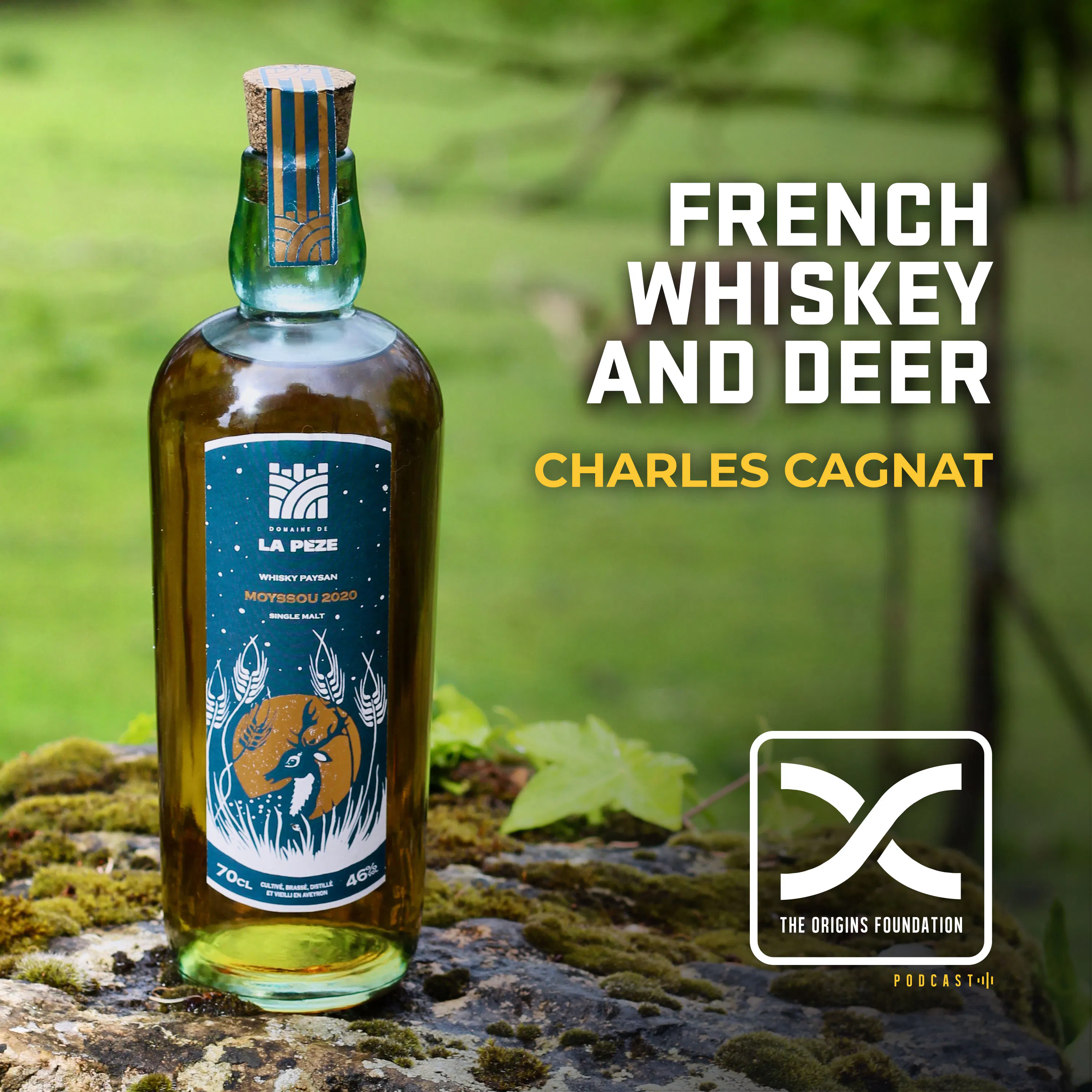
The Origins Foundation Podcast
Episode 592 - Charles Cagnat || French Whiskey And Deer
00:41:43
Whiskey distiller and deer farmer Charles Cagnat from southeastern France joins Robbie to talk about French whiskey and deer—a perfect combination in his eyes. His operation, Domaine de la Pèze, specializes in deer meat (and a little bit of whiskey). Charles dives into how to market it, sell it, prepare it, and much more. Learn about the use of fallow deer in the French landscape, from their introduction by the Romans to the present day, by tuning in right here!
Loading summary
Transcript151 lines
- [00:00]
A
Hunting is not easy, it never has been. It takes dedication, motivation, a lot of patience and quality gear. If you manage a food plot, put up stands or need just one more game camera, we can help@midwayusa.com we opened our doors in 1977 and continue to put customers first by offering super fast same day shipping for just about everything for the outdoors. Go to midwayusa.com for almost 50 years Midway USA has been America's go to source for just about everything for shooting, hunting and the outdoors. Go to Midway USA.com to see our latest deals and promotions and take advantage of our super fast same day shipping. If you need a cooler, a new fishing rod, another rifle, ammo or a reloading press, you can find it all@midwayusa.com thanks for your business.
- [01:00]
B
Charles Cagnat is a whiskey distiller and deer farmer out of the southeast corner of France. He runs an operation called Domain Dola Pez. If you want to look that up, it's Domaine D O M A I N e D o L a P e Z E Domain Dola Pez A previous podcast Guest T out of the same region of France introduced me to Charles and this podcast really dives into understanding deer meat really well. We diverge a little bit and talk about whiskey, but it's all about how France deals with deer and and specifically fallow deer and how you can sell it and how to go into the food chain. It's a very short, sharp podcast, just like you're used to, that explores a topic that you may not know anything about and give you a little bit more information on the use of deer meat, fallow deer meat specifically in the French landscape. So enjoy. So there's a reason why I started Blood Origins and that reason is simple, is that I wanted to convey the truth about hunting. It brings awareness to non hunters that it's more than just killing animals.
- [02:29]
C
How do I start it?
- [02:31]
B
Brittany My name Does my hair look okay? My name is Mike Axelrod again.
- [02:37]
C
Yeah, I hated it too.
- [02:39]
B
Braxton, you said something in the car to me. You said that you were living on borrowed time. There's a perception around who hunters are, what we're supposed to be, and a feminist that works for a non profit that is a hunter that has only eaten wild game for the last 20 years is likely not the thing that people think about when it comes to a hunter. I have been in France before and a good French friend of ours.
- [03:15]
C
She.
- [03:15]
B
Chastised me because I got her name completely wrong on the podcast. By the way, only at the end, did she say, no, my name's actually Therese. And I was calling her Therese. And she says, just call me T. I was like, t's fine. Well, T is helping us expand our French fingerprint. And obviously at the end of the podcast, I said to her, I said, I said, T, you know, is anybody else that's pretty cool that lives in our space, that does cool stuff in our space? And she was like, oh, yeah, yeah, yeah, yeah, yeah. I'm going to put you in touch with Charles. He's a cool Frenchman and he does cool things specifically with deer meat. She also said, you do cool things with whiskey, but we're not going to talk about whiskey today. Or maybe we will talk about whiskey. What's cooler, Charles, Whiskey or deer meat? Or they equal both together?
- [04:16]
C
No, the both of them are cool because we. It's not common things in France, actually. So it's cool things because it's not normal things here in France.
- [04:30]
B
So obviously France is not known for distilling its own whiskey. Wine. Champagne is the things that come out of France. But are you the only whiskey distiller in France or are there a couple more coming on behind you or in front of you?
- [04:47]
C
Or do you want to know exactly how many whiskey distilleries existing at the moment? We are more than 200 in France. In France at the moment, currently.
- [04:59]
B
Is it because French people are just deciding that they want to drink whiskey?
- [05:03]
C
They drink whiskey a lot already. We are the heaviest drinkers of whiskey in the world.
- [05:09]
B
I will challenge that. I have been. I was in India at the end of February and I have never seen people drink whiskey like the Indians drink whiskey. Like they come in at 4 o' clock and they pour a little bit of whiskey in a glass and they fill it up with water and they will have four or five of them.
- [05:31]
C
We are actually drinking 200 millions of bottle of single malt per year in France.
- [05:39]
B
That's crazy, man. Is it? Because. Is it a status thing, Charles?
- [05:46]
C
Whiskey has been introduced in France after the Second World War, of course. And it's been something that we've been drinking for many, many years now. And it's been. The popularity of the beverages grow. And for example, to give you an idea, in France, we are not drinking cognac nor Armagnac. We're drinking whiskey.
- [06:08]
B
What's the difference?
- [06:10]
C
It's the. For the cognac and the Armagnac, it's two different region where it's distilled wine, it's not barley or cereal Distilled it's wine coming from vineyards and people are.
- [06:25]
B
Distilling whiskey all across France. Or is it regional?
- [06:28]
C
All across France and the biggest region are Alsace in east of France and Brittany in the west of France with the Celtic part of France which has deep connection with Ireland and Scotland.
- [06:45]
B
Look guys, I'm a hunter, right? And when I go hunting, I like to figure out how to get my trophies back home as expeditiously as possible. Well, you don't have to look much further than Safari Specialty importers. We know that trophy importation can be quite a headache. That's why Safari Specialty importer strives to make it as easy and hassle free as possible. They have access to a bonded warehouse, you won't be charged storage fees and you get a dedicated team that's readily available and will update you at every step in the process. They'll even go one step further. Safari Specialty Importers is working with us and they are going to donate a hundred dollars from every shipment that they work with to conservation projects that include anti poaching, community development and wildlife conservation. At the end of the day, choose to spend your money with a team that's dedicated to you and is dedicated to helping show how hunting is a great conservation model. Hassle free logistics, fuel and conservation go with safari specialty importers. Hunting and shooting suppressed have become the norm in over 42 states where suppressors are legal. The growing popularity of suppressors has even led to legislative changes. You might have heard some things around the big beautiful bill, right? Including the reduction of the NFA mandated tax stamp. Before you used to pay 200 bucks. And now starting January 1st of 2026, the tax stamp is going to zero. However, why wait until January 1st? Our partners, Silence Essential, great friends of ours, they're going to pay your tax stamp right now. So if you buy a banished suppressor or other popular brands that essentially are qualifying purchases, Silence Essential is going to cover the cost of the tax stand. They're going to save you 200 bucks right now, so make sure you don't miss out. Shooting Suppressed if you're in the market for a new suppressor, Whether it's your first or your next one, visit silenceesscentral.com or call them 866-811-6536. Silence Essential is going to cover your tax stamp right now. They're going to simplify the submission process and deliver your suppressor right right to your door. Don't wait. Get your suppressor right now and start shooting. Suppress. This season. Bushnell is eager to help you get set up for conservation success. That's right. They want to help you. The conservation and research community is dominated by good people doing good things and investing significant time and effort for the benefit of habitat and the species. So what do you need to do? Pretty simple. Send us your conservation story and or your conservation wish. Could be managing whitetails, could be understanding your environment or species or something else related to conservation. What would you be able to do if you had a great trail camera setup? We will select the best story every other month and send you a camera bundle. Cell camera, normal SD camera, SD cards as well as optics. Everything you need to get set up for success. I can't wait to see what you submit. You can email us, DM us, message us whatever you want. We are not hard to find. Good luck and other barley. The barley that's being used. I know we weren't supposed to be talking about whiskey, Charles, but just. Look, you're just killing me here. I'm so interested is the barley. The barley is locally grown in France. You bringing it in or how is that working for the flavor obviously of whiskey?
- [10:14]
C
Interesting fact regarding barley and whiskey in making around the world. In Scotland you don't have any terroir.
- [10:23]
B
Yeah, the geology, that thing that gives the wine its thing. Right.
- [10:28]
C
For scotch whiskey, the barley doesn't have to come from Scotland. So the majority of the barley made of distilled in Scotland is coming from France or Ukraine and France. To give you an idea, you have one beer out of four in the world is made out of French barley.
- [10:49]
B
Whoa.
- [10:50]
C
So we have a very long history of making barley for brewing and for distilling. But in France we don't have the culture of distilling the barley because Louis XIV the Sun King forbade to distillate barley and only wine was allowed to be distilled because barley was only reserved to be eaten for food. So that's why we don't have the culture of distilling body.
- [11:22]
B
So what you're saying is if it wasn't for King Louis, you could have been the kings of whiskey in this world and not Scotland?
- [11:34]
C
I don't think so. Because the culture of. Because it's. It's exactly because I think this scotch whiskey and Irish whiskey is 400 years or something like that. Oh, okay. That's exactly the time of Louis XIV gave this forbade to desolate Bali. So no, I think they were way ahead of us. Armagnac for example in cognac. It was at this time also.
- [12:02]
B
Well, Charles Kac welcome to. I know. I absolutely butchered your last name. Cagnat. Okay, perfect. Charles, welcome to the Blood Origins podcast. Can you introduce yourself? What do you do, who you are, where you live?
- [12:20]
C
Many things to say. So first, thank you very much for hosting me. I'm very, very pleased to have this conversation with you. So my name is Charles and I'm 35 years old. And I grew up in southwest of France in a rural region called Aviron. And we call. We have in France something called the empty diagonal, and it's where in France you have nobody living. So I grew up also into the family house, which is a castle from the beginning of the 13th century, and it's been in the family for 450 years.
- [13:03]
B
Wow. Is it still in the family today?
- [13:07]
C
Yes, still, still. And I'm the 14th generation.
- [13:11]
B
Wow.
- [13:13]
C
Yeah. So it's. It's. It's been a farm for. For cows for many, many years. And so I grew up there until my. I was 18. And after I went for my business school and everything, and I went working abroad, I work in Cambodia for importing and distributing wine and spirit. And I came back five years ago, six years ago with the idea. I was still working into the wine business as an export manager for wine estate into the southwest of France. And I came up with this idea to make whiskey within the estate. So I left. I was lured by all the blazers of the globalization of Asia. And I was just at the. The call to go back to the motherland was too strong and to make something out of it.
- [14:10]
B
So you built a distillery. How big is the estate that you live on that's in your family?
- [14:16]
C
I'm not familiar with the acres, but it's 160 hectares, almost 400 acres. Yeah, something like that.
- [14:24]
B
Is it the classic French estate that has the big stone wall around the estate?
- [14:31]
C
No, no, no. We don't have any stonewall around, but we have roots. We have also fields. And for the deers, it's about 100 hectares, and the rest is for the barley, for hay, and for the woods also.
- [14:47]
B
What do you mean for the deer? 100 hectares. Is it high fence?
- [14:51]
C
Yes, high fence. More than 202 meters high.
- [14:55]
B
And within the high fence, what kind of deer do you have?
- [15:00]
C
Fallow deers.
- [15:01]
B
Oh, fallow.
- [15:03]
C
Fallow deers. Fallow deer. So we have the biggest fallow deer farm in France.
- [15:09]
B
Say that one more time. You have the biggest. The biggest fallow deer or the fallow deer farm?
- [15:15]
C
The biggest fallow deer farm in France. We have 1,000 fallow deers about. Yes.
- [15:21]
B
You have 1,000 fallow deer in 250 acres. That's a lot of deer in an area.
- [15:34]
C
It's a lot of deers. Yeah.
- [15:36]
B
You have to feed those deer, I assume. Right.
- [15:39]
C
So we had to do that during summer and during winter. And we do that with the hay we harvested in May and with the barley. We always had barley in the estate also during winter and just before the fighting season for the, for the deer.
- [15:57]
B
So I assume in the distilling process, is there a, A product that gets created afterwards that is organic that can be fed to the deer?
- [16:09]
C
Exactly. I, I don't remember the specific word in English, but it's like a mash.
- [16:15]
B
Or something like that.
- [16:16]
C
Yeah. The remaining of the marsh is the, the. The dry mash from the barley that. Yeah, it's spent grain. It's called Spain grain is given just after the brewing process, still hot. It's like 6, 65 degrees Celsius, and it's given straight to the deers. And they really love it during the, the cold month. I am distilling because I'm distilling like in Scotland from November to March.
- [16:47]
B
Gotcha, gotcha, gotcha. So why do you have. I guess the biggest question is, why do you have a thousand deer, Charles?
- [16:54]
C
So my mother, 35 juice. Yes. 37 years ago when she inherited the estate, it was, it was before it was cows and after it was changed to.
- [17:15]
B
To.
- [17:16]
C
I forget my words. Mutton. It's for the meat. Exactly. For sheep, of course. And sheep is really time consuming and it's complicated. And also the price of the meat was not very interesting. And we have connections and a friend had 25km from. From our estate, add a deer farm to a fellow deer farm. And she, she said, oh, it's a very good idea. With my father, it's a very good idea to go with beers. They do not require any attention during winter for birth and also for all the mating season. They can do that all on their own. We just have to feed them during dry season and during the winter and because I want to take care of my children. And so it's going to be a good balance between professional life and personal life. Because you know how farming is time consuming and also because it's a niche market, you are not subjected to the market prices and from all the big buyers and everything from the market of. For the sheep meat, cow meat and everything. And we can put our own prices on our own. Yes.
- [18:41]
B
So what is the market for your fellow deer? Is it A live market or is it a meat market?
- [18:47]
C
It's a meat market, a bit of live market, but it's very, very small for some of hunting. Hunting.
- [19:00]
B
Hunting estates.
- [19:02]
C
Yeah, but very small. It's not the biggest part, but we have a selection for the most beautiful male deers for this kind of thing. But of course, the main market is for the meat. And for the meat we sell about 200 to 250deers per year, 18 months old. So they are grown up. They have the size of a grown up deer. But the meat is very, very tender. It's the optimum of the tenderness of the meat. And you don't have any taste of venison, so you can just eat it without any, you know, for slow cooked for many hours or in sauce, for example. You just can cook it like a roe almost. Yeah, you can eat almost raw. And it's really interesting because it's finer than the roe deer and then deer for the quantity of the meat.
- [19:56]
B
So, Charles, obviously selling game meat is a foreign concept here in the United States. You cannot do it. It is a. It's part of the North American model of wildlife conservation in which the wildlife is a public resource here in the United States. That's why we would never be able to get it over the finish line to sell, say a whitetail deer into a supermarket or a restaurant. Now exotics in Texas, if you have, if you go through the respective, you know, fda, USDA inspection processes, veterinarian processes, whatnot, you can sell that into the food chain. And a company out of Hawaii called Maui Nui Venison does it very, very well. They're probably the only company that's shipping pretty much worldwide. Can you give me a little bit of the history about game meat selling in France?
- [20:50]
C
I can give you an history and I can give you also an history of faludier. It's very interesting how falud is ended up in France because falad.
- [20:58]
B
They're not native.
- [21:00]
C
No, they're not native. They were during the ice age period and after they disappeared. They come from Mesopotamia, so it means Iran and Iraq. And you have also subspecies there called Dama mercica or something like that.
- [21:14]
B
You have gazelle, I think.
- [21:16]
C
Bigger, I think. And it was introduced in France by the Romans because they took it from Mesopotamia and introduced it, for example, in Rhode island, in Greece. And they. Yeah, 2,000 years ago they brought it to France, to Gallia at the time. And at this time it was never running wild into France and into the woods of France. It was Always in closed fences estate. And also it was for example, for nobility and aristocracy and also for ornamental animals because of the antlers, of course, and also because it's the easiest one to be bred. Also compared to roe deer, which is almost impossible. And deer, it's almost domesticated. They can come and eat in your hand without any problem. And so through all the medieval ages and Renaissance and the modern times, they were growing up into the castles of the kings and the dukes and the counts and everything. And there were also. So for the beauty and for the tenderness of the meat. And after, in the 19th century, the falodillas almost disappeared in Europe. Almost. It was maybe only a population of Maybe less than 50 individuals in Denmark or northern Germany. I don't remember. And so all the population that you have in Europe is coming from this population. So the fallout is also studied for consanguinity. I don't know how you say into the. In English for very close cross breeding between genetic diversity. Yeah, yeah. The genetic diversity of the deer is very, very, very small. But you don't have any mutations caused by that. So they are studied by the scientific. So it's interesting also to see why it's not a problem compared when you have also limited population and you want to grow this population for endangered. So it's very interesting. So in France you have the deals only in farms, close fence farms. You can have some white population, but they just escaped and they are marooned from this estate. Like in Alsace, you have some of them. But the history of alodillas, it's never been a gaming meat because it was never wine. It was really bred for them.
- [23:51]
B
It wasn't. So what you're saying is it wasn't. Fallowdeer in France really isn't widespread in fields like roe deer. Right. It's not like something that was exactly. A farmer would go out and get one for the pot or a local would drive past and go, oh, I want to shoot that animal.
- [24:09]
C
No, never, never. So it was not hunted like deer or. But it was. It was for the chassacour, for venerie with the by made by the king and aristocracy with all the horses and hounds.
- [24:28]
B
Okay.
- [24:29]
C
You have trumpet song for the fallow deer. So it was enclosed woods. So it was hunt. But it was not common. Absolutely not common. But for all Europe also. Because now you have some very big farm also in England, I think that it was in Hyde park of St. James Park. You have some free roaming fallow deers in.
- [24:57]
B
Yeah, there's plenty, plenty Free roaming fallow deer in. In England, you know, that's just.
- [25:03]
C
But not in France. Not in France, it's never been. Yeah.
- [25:07]
B
So from. By. By French law, has there always. Have you always been able to sell fallow deer meat? Or give me the history of the.
- [25:18]
C
Law, the history of gaming it in France. So France at the opposite, I think, of England because of the French Revolution, everybody was allowed to hunt and everybody was allowed to have a gun to hunt, because before it was only on the right of the lords and everything. So it's deeply rooted in the culture that you hunt. It's very popular still now, even if it is diminishing and you were able to consume your meat, but to sell it to your local butcher and everything, it is more complicated. But we still have, for example, slaughterhouses allowed to get game meat from the hunters. So you bring that. There are special accreditation for that. They are not very numerous, of course, but in northern Averon, for example, all the hunters bring the game meat. They have roe deer, deer whore and everything to them. And they have all we call service veterinary in France. So it's the equivalent of the fda and they give a stamp of, okay, we made some analysis and it's good, it's fine to go to the mainstream market. So you can sell it after butchers. And it's starting to get popular because we have.
- [26:40]
B
If I was a hunter. So if I was a hunter, see, here's the difference. I'm a hunter here in the United States and I kill a whitetail. Private land or public land, there are butcher houses, there are slaughterhouses I can take my deer to, but I get my deer meat back, packaged, processed, whatnot. I cannot sell it. I can give it away, but I cannot sell it to anybody. And I can't sell it into the mainstream food chain. So what you're saying is there's slaughterhouses, I kill a rob deer, I'm like, okay, I'm going to take it to the slaughterhouse. There's a veterinary person probably employed by the slaughterhouse. He checks it, he stamps it to say, yep, approved for consumption by humans in France.
- [27:27]
C
Exactly.
- [27:28]
B
And I assume the slaughterhouses will buy the meat and then they've got a distribution network.
- [27:32]
C
Yeah, exactly. They have the distribution network. For example, to give you an idea, it's a butcher chain. It's not a big one because compared to the U.S. of course, it's like four or five or maybe three, and they just sell it through the butcher shop on that. But it's not very common, this kind of it's really depending if you have in the region a slaughterhouse accredited for game meat. And they are not that very common.
- [28:05]
B
So you are. So because of that law you can sell. You know, essentially you can either sell to the slaughterhouse or I assume someone like you who's got. You've decided, okay, we're in the business of.
- [28:21]
C
I could. But we are a bit different because we have a big capacity. It's like 250 animals sold only for Christmas and New Year's Eve Eve. And so this has to be why.
- [28:32]
B
Only Christmas and New Year's Eve.
- [28:34]
C
Because the animals are this time 18 months and it's at the time of the. Of the size, the tenderness on that. And also because it's easier to manipulate all the. The animals at this time and not to take one out of one and every day and everything. Because, you know, we are a bit specific because of the size. We saw that then in house, of course, because we would not be able to bring them to a slaughterhouse because they are wild animals and we have an exemption from the French government. And we have a visit of the veterinary before the. We kill them and after the slather house anti Morton and postmortem to say, okay, now this is clear to go into the mainstream market. But the slaughterhouse has a game meat accreditation. Of course.
- [29:25]
B
Yeah, of course.
- [29:26]
C
Just for us. Just for us. We are the only ones and so we need a big capacity to. To absorb these 250 animals in like two weeks. So we, we have to go through. Through a mainstream slaughterhouse. And it's much more closer to. To us than the. This slaughterhouse specialized into game meat. And after this go to another place where it's the. The meat is cut properly.
- [29:57]
B
And after butchered into specific.
- [30:00]
C
Exactly, exactly, butchered. And after it goes to. We only sell. We do not sell it directly from the farm to the customer because it's a bit complicated. And we sell everything to supermarkets in whole France. And so it's considered. It's a very small amount, of course, because the animals are small when they're killed. It's like the 26 kg or something. Something like that. So not that big. Yeah, per animal.
- [30:32]
B
And what are the kinds of cuts? What are the kinds of cuts that you are typically selling?
- [30:37]
C
But you know, the French cuts are very different from your cuts. So I want to have the equivalent. We have a pave steak, roti roti dough, roti apple, so shoulder roti back roti.
- [30:51]
B
Are you selling? Are you selling full hind legs?
- [30:56]
C
No, no.
- [30:57]
B
With the bone in it's all cut meat is off the bone.
- [31:00]
C
Exactly, exactly. We make also civil, you know, civil is made for slow cooking into wine and this kind of thing. And we sell also the liver. The liver is quite popular too.
- [31:15]
B
In the French market. I assume you don't grind any of the meat into mince meats or anything like that. I wouldn't think that that would be something popular.
- [31:24]
C
No, no, no, no. We, we. No, mince meat in France is not that popular. I think compared to the US it's really game meat for us is really an sauce. And except of the fallow deer because it did not taste venison. But it, I think in the restaurant is at the venison, it's starting to get more and more not popular. But restaurateurs are starting to explore venison because it's into the closed circuit into using the natural resources.
- [31:58]
B
Yeah, that's coming from the local landscape. That's what I was thinking. I was like. And maybe there's a question for you that I haven't asked you. Have you had any? Because I would have assumed you, Charles, would have had or developed 5, 6, 12 relationships with, oh, here's a Michelin star chef in a. In a little town down the road that says, I want your fellow deer. And I'm giving him like my fellow deer. There's a cut. Specifically, I'm holding it aside and it's going to his restaurant for Christmas and New Year when he's really busy.
- [32:34]
C
We tried it 30 years ago. But also, funny story, before the mad cow, we were exporting to Japan, like a quarter of the production was exported to Japan.
- [32:45]
B
What was being sold to Japan? Deer meat.
- [32:47]
C
Yeah, the food year. The food year started to Japan. Yeah, we were selling like 50 deers a year or something like that. Before mad cow. Yeah. Before 1997. Yeah.
- [32:56]
B
Oh, before mad cow disease.
- [32:57]
C
Okay. Okay, exactly. Yes. Because after all the embargo for old European meat was there and we tried with the rest of them. But the main problem with. With restaurant now it's changing. I will speak about after they were taking only the most noble parts and what we are doing with the other parts also.
- [33:18]
B
Yeah, yeah. Well, you've got the restaurant, you've got the. Well, you've got the supermarket chain now. Right. For them to. To be able to say, okay, if the restaurant says, I want cut A, B and C, the rest goes into the supermarket chain.
- [33:32]
C
We had a different business model. We sell to the supermarkets. We call that a kit. And within a kit, you have the full deer cut so you don't have any lost pound. So what they have to take is the full deer.
- [33:49]
B
Yeah. You'd have to find a restaurant that says, I want the whole deer and I'm going to break it down and make different dishes with different parts.
- [33:57]
C
Exactly. And now the mindset of the restaurateurs is really changing in France because it's, we want to, to take all the parts in account for and we can try different dishes with the, the less noble parts. So it's starting to get interesting in that part. So.
- [34:16]
B
Well, I feel like that's happening all over the world. Like you, you're seeing these, these, these chefs wanting to try new dishes. They want to be more local, they want to be more sustainable. They want to feel like the rest, you know, the, the people in eating like, oh, I'm eating venison from just down the road. And then when you have a whole deer carcass, especially over a Christmas to New Year period.
- [34:41]
C
Exactly.
- [34:42]
B
Every night you have a different venison cut because these restaurants are turning their, you know, every night there's a new special or something like that that the chef is producing.
- [34:50]
C
Exactly. So this is the new channels I, I will look after because I, I fear these changes coming, actually.
- [35:04]
B
Yeah. You know, to me, one of the things that we're super interested in from an Origins foundation perspective and narrative, talking about narratives around hunting and changing perceptions around hunting is food. And food is an amazing equalizer.
- [35:22]
C
And also a very interesting point because you know that we have the same movement in France with the non meat movement and everything. We have messages regularly on our email boxes. We are just a non human being that we've killed yet such animal, beautiful animal. We call that the, the Bambi syndrome here. And the point of that we were killing them into the estate was something we were absolutely not speaking about I think maybe five years ago. But now when you start to speak about the fact that the animals are slaughtered on the estate in the place they always know is a positive point for people to hear. And they're starting to be very sensitive to that. So it's starting to be a saves point actually to, to meat consumer.
- [36:21]
B
No, absolutely. You know, the whole knowing exactly where your meat comes from, where it was slaughtered, how it was slaughtered, whose hands touched the meat, the whole kit and caboodle. I think people are becoming wiser to that. I'm glad you brought up the whole like anti, you know, anti meat, anti hunting, anti use people because you know, you've got some crazies Here in America, obviously, Europe, I think, has a next level of crazies, specifically the United Kingdom and England.
- [36:54]
C
Have you in United Kingdom. They're well ahead of us. Yes, well ahead of us.
- [36:58]
B
Have you experienced any of that nonsense? You said you got a couple of emails.
- [37:03]
C
Yeah, yeah, but it's not that strong, actually. But, for example, you have a TV documentary on the farm after. I'm sure I will have one email of someone saying, you should be at the place of the animal.
- [37:18]
B
Of course, you should have been in the slaughterhouse instead of the animal.
- [37:23]
C
Exactly, exactly. And it happened also one time that the fences were cut. But funny thing, the fallow deals are very. I would say they absolutely do not like to be separated from the rest of the group. And so they maybe will have a look at the hole, maybe get out. But two days after, they just will have the will to get back with the. The others and the companions into the. Into the estate. It's very, very funny to see that they. They don't like the outside world.
- [38:00]
B
Charles, is there any. As we get close to wrapping this up, is there any. I know that you sell the meat as a kit. You've already talked about that. Is. Is there any, like charcuterie components to venison in France, Obviously French people are very well known for, you know, cheese and wine and grapes, and obviously dried meats are something that often put into those kinds of things. Are people starting to do that with fallow deer or deer?
- [38:34]
C
No, we used to do some pate, but we just stopped for some technical reasons. But it's quite popular to have deer charcuterie. Charcuterie, no, it's quite popular, actually. But you have to know that in charcuterie, you have always. A big part of pork. You never had 100% with venison, it's always. You will have 30 to 40% of pork meat inside because it would be too dry.
- [39:05]
B
Makes sense.
- [39:07]
C
But it's popular. It's popular. You're going into any countryside market, you will find this kind of charcuterie in one stem.
- [39:15]
B
You mentioned already sauce eisson.
- [39:20]
C
Yeah.
- [39:22]
B
Beautiful sausage. Beautiful dried sausage. Well, Charles, thank you so much for joining us on the Blood Origins podcast. How if people want to learn more about. Do you have a website there? People?
- [39:34]
C
Yes, of course. They can go into. Be careful with the French pronunciation. Ww.domaindelapez.com D O M I A N E D E L A P E Z E. Yes.
- [39:50]
B
Okay, we'll have that in the show notes.
- [39:51]
C
They can just type on Google pez Pe Z Whiskey.
- [39:55]
B
And they will find me P E Z E Whiskey.
- [39:59]
C
Yeah, exactly.
- [40:01]
B
Oh, good. Perfect. Well, Charles, thank you so much. I really appreciate t connecting us.
- [40:07]
C
Thank you very much, Robbie. It was a pleasure. And I hope that next time you're in France, you will we have a stop to.
- [40:14]
B
Well, now that I know that you brew whiskey, I'm definitely going to have to have a stop. And I assume there's multiple kinds of whiskey to taste.
- [40:22]
C
No, Absolutely not. Only one side, because I'm making. Of course I'm making. With a wine approach, you do one barley per year, and so it's the taste of the terroir and the taste of the vintage. And done. Finished.
- [40:38]
B
Wow.
- [40:40]
C
Yes.
- [40:41]
B
Okay, so I'll only have to drink one whiskey, but maybe multiple glasses of.
- [40:47]
C
One whiskey of different years of the harvest. Yes, exactly.
- [40:51]
B
Well, I look forward to that.
- [40:54]
C
I would be very happy. Thank you very much, Robbie.
- [40:57]
B
Appreciate your time.
- [40:58]
C
Bye.
- [40:59]
B
Well, that's it for today. Appreciate you listening. As always, leave a review, share it with your friends, and most importantly, do what's right to convey the truth.
- [41:11]
C
Around hunting, Bow hunting all comes down to a moment.
- [41:16]
B
And in the moment, you want equipment.
- [41:17]
C
On your bow that will get the job done. Trophy Ridge products are the tools bow hunters trust. React technology sights, rests, stabilizers and quivers to help a bow hunter be successful in the field. And those tools are from Trophy Ridge.
- [41:32]
B
Want to plan your next fishing trip without the hassle? FishingBooker.com is the best way to find and book a fishing charter anywhere in the world.
- [41:41]
C
Whether you're chasing trophy fish or just looking for a family day on the.
- [41:44]
B
Water, fishingbooker makes it simple, fast and secure. With thousands of experienced guides, verified reviews and 247 customer support, FishingBooker takes the guesswork out of planning.
- [41:55]
C
Visit fishingbooker.com and book your trip today. FishingBooker Fishing trips made easy.