← The Origins Foundation Podcast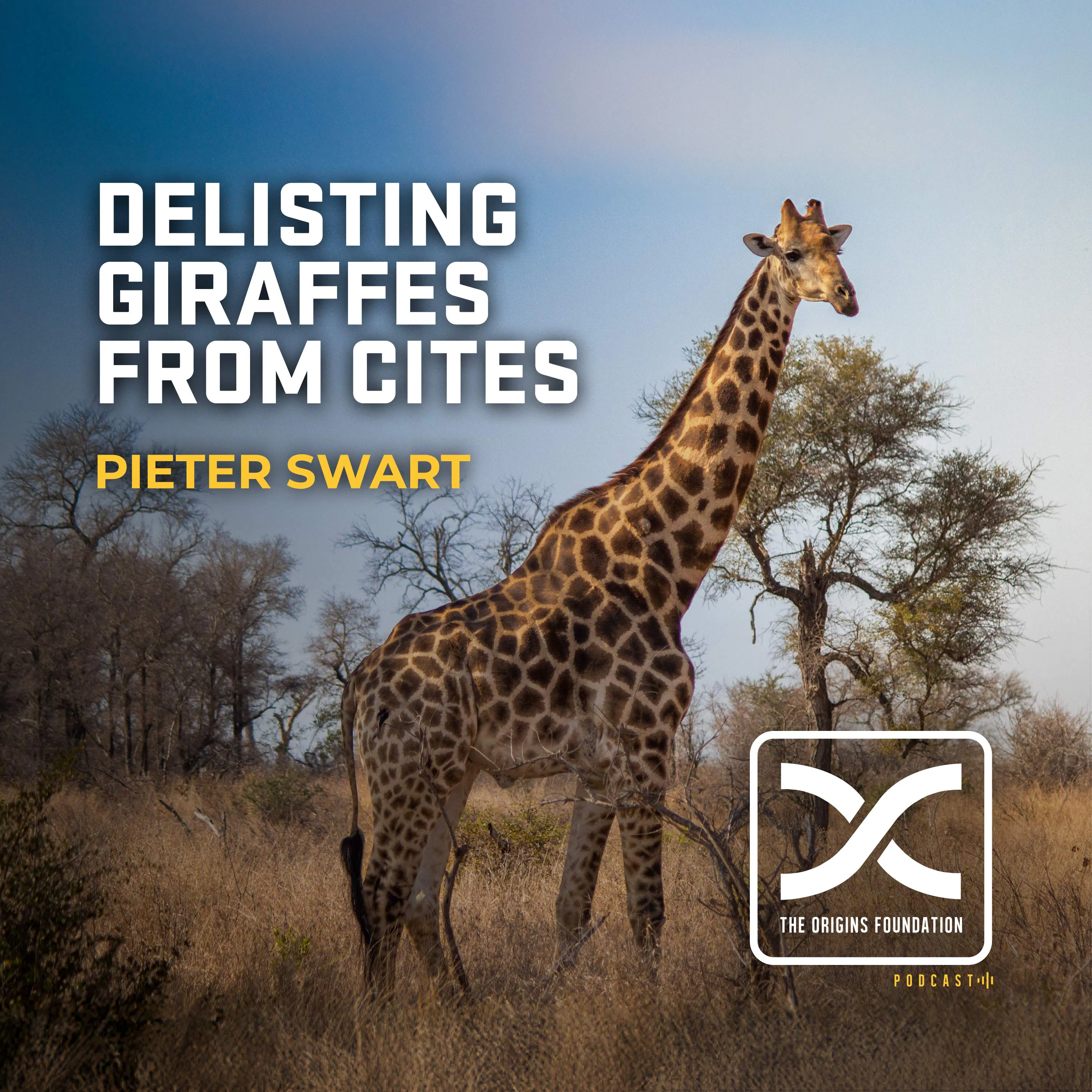
The Origins Foundation Podcast
Episode 594 - Pieter Swart || Delisting Giraffes From CITES
00:33:04
Pieter Swart, the President of the South Africa Taxidermy and Tanners Association, joins Robbie this week to discuss a recent proposal by the organization to delist giraffes from Appendix II protections. This proposal and its science were put forward to the DFFE (Department of Forestry, Fisheries, and the Environment) in South Africa, and the governmental agency has agreed and has moved the proposal forward to be reviewed, discussed, and voted on at the CITES COP in November in Uzbekistan. There is no reason this proposal shouldn’t be adopted and approved by CITES. The science is there, CITES requirements have been met, and the proposal is going forward. At CITES, the requirement to pass is a two-thirds majority vote—which is the political gamesmanship of South Africa up against a global political machine to fight for the science.
Loading summary
Transcript72 lines
- [00:00]
A
Join us at a Friends of NRA event where freedom, fun and firearms come together like nowhere else. With more than 600 events held across the country, there's always one happening near you. From exciting games to exclusive auctions featuring one of a kind firearms and gear you won't find anywhere else. Whether you're a lifelong hunter, a competitive shooter, or simply passionate about defending freedom, there is a seat for you. Visit friendsofnra.org to find an event near you and get ready for a night you won't forget. Midway USA has ammo for your next hunt. If it quacks, honks, whistles or cackles, snorts, gobbles, grunts, bleats or bugles, you need to shop before your season starts. At Midway usa, the right hunting ammo makes all the difference. And at Midway usa, we've got a massive selection of premium hunting ammo from top brands like Winchester, Hornady and Federal. From big game to small varmint, you'll find the perfect load for every hunt. And with fast, reliable shipping, you'll be ready when the season starts for just about everything. For hunting shop. Midway usa. Peter Swart is the president of SATA. SATA is the South African Taxidermy and Tannery Association. SATA put forward a proposal to the South African government to delist giraffes from Appendix two to being unlisted. The science is there. All of the criteria that CITES requires for giraffes to be delisted has been met. And now this proposal is now going forward to CITES and the cop the conference of parties that is meeting in Uzbekistan in November. For them, the 180 countries to vote on whether or not this is to happen. He needs a 2/3 majority vote. 120 of them have to say yes, we agree. So now between now and then, it's politics. It's all about information. So I wanted to have Peter on the podcast to talk about it. Peter is the first true real Afrikaans speaking individual we've had on this podcast. You will hear his accent. His accent is very strong. But we go into detail around the proposal and give you an idea of what's coming for giraffe delisting at cites. Very informative podcast. Very short, sharp, to the point. Enjoy. So there's a reason why I started Blood Origins and that reason is simple, is that I wanted to convey the truth about hunting. It brings awareness to non hunters that it's more than just killing animals.
- [02:38]
B
How do I start it?
- [02:39]
A
Brittany? My name.
- [02:41]
B
Does my hair look okay?
- [02:43]
A
My name is is Mike Axelrod. Start again. Yeah, I hated it too. Braxton, you said something in the car to me. You said that you were living on borrowed time. There's a perception around who hunters are, what we're supposed to be. And a. A feminist that works for a nonprofit that is a hunter that has only eaten wild game for the last 20 years is likely not the thing that people think about when it comes to a hunter. Foreign. Welcome to the Blood Origins podcast. How are you today?
- [03:20]
B
I'm very well. Yourself, Robbie?
- [03:23]
A
I'm very well. I'm very well. I apologize we've never crossed paths before. I don't know if you've ever heard of. Of us and what we do.
- [03:32]
B
I've heard a little bit, yes. But Stephen. Yes, he informed me about your. The good work you are doing there in the United States.
- [03:41]
A
Well, I appreciate that a lot. And a big shout out right in the beginning to Lazar Nell, connecting you and me together. You're not. Are you a taxidermist by training, Peter?
- [03:54]
B
No, I'm a businessman by training, but I've. I've employed people who. Doing the taxidermy work for me.
- [04:04]
A
Okay, so are you in the taxidermy business?
- [04:08]
B
Yes, yes, I am. I've got a factory that we are processing all the different things and doing the taxidermy work. Yes.
- [04:18]
A
Well, then that's definitely a reason why you need to close your email down, because definitely you'll have people asking, where's my. Where are my trophies? Are they shipping out today? When are they shipping out? Can I see pictures of my trophies?
- [04:30]
B
That's right, yes. They always asking that question, thinking that everything can be done within a very short time. Time frame. They want the things yesterday while it took a few months to get through the whole process of taxidermy work.
- [04:47]
A
Yeah, exactly. Peter, you have a very strong accent, and so this is a global podcast, and I want people to understand specifically your accent. Peter Swart, I assume Afrikaans descent in South Africa.
- [05:01]
B
That's correct. Yes. Yes, I'm Afrikaans speaking.
- [05:06]
A
And that is the accent that you are Afrikaans speaking, first language. And it's one of the languages that I had to learn as a kid in South Africa when I was growing up. And it's funny, Peter, every time I come back to South Africa, you know, it takes me two to three weeks, but I will just run straight into the cadence of talking Afrikaans again, understanding Afrikaans again. You know, it's a. It's a wonderful language. It's got some. Some sort of lyricism to it, but it's also got some sort of guttural, you know, parts to the, to the language.
- [05:43]
B
That's.
- [05:44]
A
That's so that's correct. So Peter, you represent Sartre right now?
- [05:52]
B
That is correct, yes. I'm the president of the South African Taxidermy and Tannery association for the last three or five years. I've been involved with the association since 2016. So yeah, that's my present position on the board.
- [06:10]
A
And the reason we're having you on the podcast is specifically SATA has submitted and got approved a proposal that is going to go to CITES and COP to delist giraffes, right?
- [06:30]
B
That is correct.
- [06:30]
A
Specifically Southern giraffes.
- [06:32]
B
The southern giraffe, yes. I was instrumental in making a. We, we had a chance to make a proposal towards our own government because only governments can submit proposals towards cities to the cop and we were. I made a proposal towards the government submitting all the documentation, scientific papers and documents that we have and luckily this time around they found it to be. To be quite good and they submitted the proposal to delisted Southern giraffe. Yes.
- [07:09]
A
Look guys, I'm a hunter, right? And when I go hunting, I like to figure out how to get my trophies back home as expeditiously as possible. Well, you don't have to look much further than Safari Specialty Importers. We know that trophy importation can be quite a headache. That's why Safari Specialty Importer strives to make it as easy and hassle free as possible. They have access to a bonded warehouse, you won't be charged storage fees and you get a dedicated team that's readily available and will update you at every step in the process. They'll even go one step further. Safari Specialty Importers is working with us and they are going to donate $100 from every shipment that they work with to conservation projects that include anti poaching, community development and wildlife conservation. At the end of the day, choose to spend your money with a team that's dedicated to you and is dedicated to helping show how hunting is a great conservation model. Hassle free logistics, fuel and conservation go with Safari Specialty Importers. Hunting and shooting suppressed have become the norm in over 42 states where suppressors are legal. The growing popularity of suppressors has even led to legislative changes. You might have heard some things around the big beautiful bill, right? Including the reduction of the NFA mandated tax stamp. Before you used to pay 200 bucks. And now starting January 1st of 2026, the tax stamp is going to zero. However, why wait until January 1st? Our partners silence essential great friends of Ours, they're going to pay your tax stamp right now. So if you buy a banished suppressor or other popular brands that essentially are qualifying purchases, Silence Essential is going to cover the cost of the tax stamp. They're going to save you 200 bucks right now, so make sure you don't miss out. Shooting SUPPRESSED if you're in the market for a new suppressor, whether it's your first or your next one, visit silenceessential.com or call them 866-811-6536. Silence Essential is going to cover your tax stamp right now. They're going to simplify the submission process and deliver your suppressor right to your door. Don't wait. Get your suppressor right now and start shooting Suppressed this season, Bushnell is eager to help you get set up for conservation success. That's right. They want to help you. The conservation and research community is dominated by good people doing good things and investing significant time and effort for the benefit of habitat and the species. So what do you need to do? Pretty simple. Send us your conservation story and or your conservation wish could be managing whitetails, could be understanding your environment or species or something else related to conservation. What would you be able to do if you had a great trail camera setup? We will select the best story every other month and send you a camera bundle, cell camera, normal SD camera, SD cards as well as optics. Everything you need to get set up for success. I can't wait to see what you submit. You can email us, DM us, message us whatever you want. We are not hard to find. Good luck. So for those that have no idea what we're talking about, can you explain what CITES is and what a COP is?
- [10:29]
B
Yes, for sure. CITES is a convention of international trade in endangered species. So what it does it set up the trade regulations to trade with different species, animals, plants, fishes, reptiles, everything that you can think of from nature. They set up system and cities turned 50 last year. So it's it's intern it is more or less based on the UN principles of the United nations. Then you have to so they wanted they want to support to stop trade or not stop they they want to regulate trade. Most of the reasons for to regulate trade is in endangered species is to see that it doesn't go extinct. So we we the the site is the different countries come to the G every three years at the conference of the parties what we call the COP and there they take proposals to either uplift species or delist species of downless species. So that is where everybody has got the opportunity to submit their proposals in the three year period up to the next one. They've got different working groups to also look at different species and to uplift or down list, make proposals to downlist these different species. Now in, in, in. Yeah, that is in a nutshell what CITES is about.
- [12:12]
A
And so the, and, and so a COP is the Conference of parties because this CITES is a convention. So it's a convention of parties. It's all of these people, all the countries, the parties come together and make decisions. And the strangest thing that I, that that baffles me about CITES is that everybody has equal votes. So for instance, South Africa, who probably has and you know the statistics here, 90% of southern giraffes, if not higher, has a vote. And countries like, you know, Switzerland, Luxembourg, Netherlands also have, each of, each of them also have a vote. But they don't have giraffes.
- [13:01]
B
That is correct. That is one of the drawbacks of CITES is that the countries that do have the different species, they are, they are just, they've only got one vote. Exactly. What you're saying is exactly true that we're sitting with. The problem is that if you want to convince, in the case of the giraffe, to convince them to downlist the southern giraffe, you need a 2/3 majority to take of voting of countries and that's about 180 countries. So you need 120 plus countries to vote in favor of the down listing. That is where most of our problems occur. Because if you look at the European Union they've got say 20, I'm not sure exactly sure, 20 or 30 states within the European Union they've got each one of those got a vote. So, and they vote as a block. So there votes going one way and it's very difficult to change their voting procedure there because they take a view of, before the COP even they take a view, they decided on which, how they're going to vote. So that is creating a problem.
- [14:22]
A
So the proposal that you've put forward. Let me understand this before we talk about the proposal. There are currently, is it four or five species of giraffe? Four.
- [14:35]
B
There's four.
- [14:36]
A
Four species of giraffe. And all four species are listed where appendix two or appendix one. Appendix two, Appendix two. So you can still trade but there's hurdles and regulations and additional things that you have to do because they're on appendix to.
- [14:56]
B
That is correct, yes. So yes, we still open up for trade and only the exporting country has to issue CITES export permit. It's not necessary that you have that. The importing country also, like on cite is one, the importing country must also provide an importing CITES permit. That is not necessary on the cites. Two, let's take.
- [15:21]
A
That's a very, very good distinction right there. Now let's talk about the four species of giraffe. As I understand it, Northern, northern Maasai reticulated and southern, right?
- [15:36]
B
That is correct, yes.
- [15:39]
A
The three species. Of the four species, three are not doing well.
- [15:46]
B
Yes. I think if you look at the, at the latest figures from the giraffe, what is the Conservation Foundation? If you look at the northern giraffe, they've got the figures of about 7,300, 7,030 specimen. The Maasai giraffe is quite, it's not so bad. They got 43,900 and then your reticulated giraffe got 21,000 and then the southern giraffe is just under 69,000 different animals.
- [16:25]
A
It seems like all of the numbers have actually improved very much so, yes.
- [16:30]
B
They have improved dramatically over the last last few years. And all of them are increasing in, in, in the numbers. The Messiah is only one day as stable, but the rest are all increasing.
- [16:45]
A
And so the southern giraffe is the one that you've peeled out. From a SATA perspective, you've peeled out. Well, not from a Sartre perspective. As you've mentioned, the South African government has championed the proposal. The South African government has peeled off the southern giraffe and said, hey, we have plenty of them. Population is not decreasing. Population is increasing. Even though we operate under a consumptive use model, we would like to see southern giraffe delisted from cites. Right. Taken off Appendix two and.
- [17:22]
B
Open up.
- [17:24]
A
Not unclassified, right?
- [17:26]
B
That's correct.
- [17:26]
A
What's the outcome there?
- [17:28]
B
Yeah, that is correct. That is. I just want to mention that it is not only the South African government, but it was a joint proposal that was supported by Namibia and Zimbabwe as well. They also are co proposers to the application to this cop. So it is from a southern African perspective. We feel that there's increase in numbers and we, we are doing what we can to preserve and conserve them. But we want to use them without all the hiccups and obstacles that CITES is providing is putting in the way.
- [18:09]
A
Peter, to be able to put a proposal forward for the government to accept it and for CITES to accept it. What did you need to do?
- [18:17]
B
Robbie, you have to look at, you have to look. What we have done is we look at the trade data from the giraffe was listed in 2019 on Citis 2 and the CITES website provide trade data of how, where the products and different products come from, from which country and to which country it's going. And we were able to determine that over 95% of all the giraffe exports that took place from 2019 originate from south and Southern Africa. The other 5% is a small amount of I think one or two specimens that was exported from any of the other African range states. That is also countries that have giraffe. But. But that was from north, I think it was from Mali or from Senegal. And then there's also a lot of the other 4% was from trade where people export from the European Union to the United States or vice versa. So it was already in the other countries in non range states and they just do the exports between them. So we determined from that database that 98 of 95% of all trade originate from southern Africa and South Africa makes the bulk of that of that exports was from South Africa.
- [20:00]
A
So you looked at the trade data. Did you have to do a non detrimental finding in NDF to support to you know, support the proposal to get the government to say yes, we support this proposal.
- [20:14]
B
Yeah, we didn't do an ndf. But it. If you look at the figures, you must also. I think one of the major obstacles that we had with the listing of the giraffe was that it is not only the hunting trophy that is exported, that is the skin and mounted or unmounted, but it is also there's a lot of giraffe. The bones are very, very much a sought after item all over the world because it is used in making knife handles and for other decorative purposes. And if you. Giraffe itself has got over just on the bones itself. It's got over 15 to 20 of these bones per giraffe and that is used for these type of products. So if you look at the trade data, if you look the trophies that was exported since 2019 was 2,800 trophies. That's hunting trope, mostly hunting trophies. But if you look at the bones, it was over 25,000 bones. That was what was exported. And that is one of the. With a listing the anti animals or the people that was animal rights. Yeah, animal rights organizations, they said, they look at the figures and said but there was over 20,000 animals being killed. But that's not true. That's a very small percentage of your population that is actually being hunted in South Africa. If you look at the figures it is over less than 5% of the population. That is an offtake every year. I think it's 3.5% of the growth is taken for hunting trophies. So the rest are they still there in the world and on the game farms?
- [22:16]
A
Peter, isn't that it seems like. I thought I remembered that being a problem in 2019 and I saw several articles written about it that this astronomical number of giraffes are being exported based on the CITES database, 30,000 or whatever it is, you know, half the population of giraffes. And is it, is there a fault in the CITES database? Why are CITES not not registering that it's a single animal being exported and under that single animal are, you know, 20 items within that single animal. That way the cite's database says, Hey, 300 animals were exported or 200 animals were exported in the database. And then within every, you know, animal being exported. Yeah, there's 20 items under that export. So the skin, the skull and you know, 10 bones.
- [23:16]
B
Yeah, that is, I think it's this problem with the cities, the registration of your different things and that we are still struggling to, to find common ground with everybody to know exactly like you said, to differentiate between the animal itself that is hunted and then the derivatives of that animal that can be used. And in the case of giraffe it is, it's quite a lot of derivatives can be used of it while in just a normal, like a, a rhino you can only use the horn and the skin and the skull. So it's only three or four different things that is listed under, under the cities that can be exported. While in the giraffe case it can be up to over 100 pieces of different bones and so on that can be exported. But it is a problem that we are working with cites trying we have bring it to their attention. They are aware that it is not perfect system presently and hopefully they will resolve it to make it more user friendly so that the importing country as well as the exporting country can show exactly what they are importing and exporting.
- [24:36]
A
Yeah, there's certainly a loophole there or a fault in the database collection of data that needs to be rectified. Because though the information is correct, it's being relayed in a different way that doesn't really show what actually is happening.
- [24:57]
B
That's correct, yes.
- [25:01]
A
Well, Peter, what's the process from here? So you've sub. You've got this proposal approved for submission to Cites copy is it with CITES now? And this is, you know, we're recording this podcast at the end of July, the CITES COP is in Uzbekistan in the middle of November. What happens between now and the middle of November?
- [25:22]
B
Okay, now we're starting to canvas different countries. We have a proposal that was submitted on our behalf by the Southern African governments. Now we have to get the message out to the different countries all over the world and talking about even small island countries like Mauritius. Yeah, Mauritius, to get there to, to, to, to explain to them what is the, what is the, the, the real proposal on the table. So that we were busy with, to propose to, to take this proposal to the different countries. I know there's guys in the CIC in, in Europe is working with the, is taking the proposal towards a European Union Parliament to see if they can try to convince them. And then we also have other partners that is from all over the world that we, that, that we want we're sending our proposal to. And they will then engage with their governments to see if they, if they can get support for, for this proposal. The cited secretariat will, in 90 days before the COP, the COP, they will also release their own findings to say if they support or reject the proposal. In 2019, they support or they rejected a proposal to uplist the giraffe, but it was voted in. So it's not clear cut if they support it or not, but then it will go to the cop and we will then in November be in a hall with 4,000 people and the governments of the 180, 190 countries will sit in front and they will debate this and we will hopefully have a chance to do some rebuttals on it and then they will take a vote and then we hope we can get the 2/3 vote in so that we can delist the southern giraffe.
- [27:38]
A
Well, you know, it would be a sad day if the European blocs or any other blocs vote no against it. Where the data clearly shows that the current trade has no impact, negligible impact on the population. The population is growing. Consumptive use of the animal has number one, no bearing on its population. But number two positively seems to be causing population stability, population sustainability and even growth in areas because of the value that consumptive use is driving around that animal itself. So I hope that, you know, obviously it's all politics at this stage. Unfortunately it's science doesn't drive this cart. You wish it did, but it doesn't. And so yeah, I hope that we can, you know, garner the, the 2/3 majority that is necessary and if, if 2/3 of the Majority don't say yes to it because let's be honest, there is no reason to say no scientifically.
- [28:51]
B
That is correct. Yes, that is totally correct. If you look at all the different criteria that they, they said that you specie must comply with. The giraffe does not comply with this, with, with, with anything specifically the southern giraffe. There's too many there. There are a lot of them in southern Africa. We are not killing them all of them. We only take off a small percentage of the growth of 5% of the population that is taken off annually, even less. And we are using these things and it's providing money and meat and everything for the communities and it is providing money for conservation principles and investment in conservation project. So it is, it is making our conservation efforts. It helps to carry on.
- [29:52]
A
Yeah, 100%. Look, and the only reason I think a country would say no is that is the little thing called the animal rights lobby. Right. And we know that they are prolific. We know that their voice is extremely vocal and strong and they have political power. And so, you know, countries that vote no, you know, after the cities cop, you know, we are all hoping that you do get the majority, you do get southern giraffes delisted. It'll be a huge victory. But if they don't, then, you know, we need to put people on a, on a, on a pedestal Linux and, and point to them and say, why did you vote no? Here's all the data, here's all the science, here's all the objectives that were met. Here's the CITES criteria for delisting. We meet every single one of them. So why, what's the reason? And really the reason comes down to you just do not believe in consumptive use of wildlife, you do not believe in sustainable utilization of wildlife and put them on notice.
- [30:59]
B
That's correct.
- [31:00]
A
And let the world know, let's use social media to our advantage for, for, for a second and put them on notice and make them, you know, show them for who they are and what they do.
- [31:10]
B
Yeah, yeah. Now unfortunately we are fighting a fight against a huge organizations that got a huge over billion dollar income from donations every year. And we as a pro use coalition and working for sustainable use, we don't get a lot of donations. So much of the fight is fighting from our own pockets. And yeah, we hope we will succeed. But let's see what will happen at the end of November.
- [31:42]
A
All right, I'm looking forward to hearing from you. I'm looking forward to watching it. Hopefully. Fingers crossed goes across the finish line just like Bontebok does, hopefully. And Peter, thank you so much for coming on the podcast, giving us that little bit of information. And yeah, please reach out to me. You've got my number now. You've got my WhatsApp number. Please let me know if if you hear anything. Keep us up to date with the news that comes from it. Okay?
- [32:09]
B
Thank you very much. Now thank you very much for the opportunity to be able to speak on your show on your podcast. Yeah, I will definitely let you know what's happening from outside and keep you updated as we progress. Thank you very much.
- [32:24]
A
Well, that's it for today. I appreciate you listening. As always, leave a review, share it with your friends, and most importantly, do what's right to convey the truth around Hunting Want to plan your next fishing trip without the hassle? FishingBooker.com is the best way to find and book a fishing charter anywhere in the world. Whether you're chasing trophy fish or just looking for a family day on the water, fishingbooker makes it simple, fast and secure. With thousands of experienced guides, verified reviews and 247 customer support, FishingBooker takes the guesswork out of planning. Visit fishingbooker.com and book your trip today. FishingBooker Fishing trips made Easy hey guys.
- [33:07]
B
This is Melissa Bachman. Are you ready to stop spooking deer before it's even time to hunt them?
- [33:12]
A
Then you need the new Flex S Dark cellular trail camera from Spy Point. With a no glow flash option, long.
- [33:20]
B
Lasting solar power, and a ton of.
- [33:22]
A
Settings that can be changed anytime through.
- [33:25]
B
The Spy Point app.
- [33:26]
A
There are no more excuses for letting.
- [33:28]
B
Your deer get wise before the season.
- [33:31]
A
Even starts, so check it out for yourself and see why the spypoint Flex S Dark is the unstoppable and undetectable.
- [33:38]
B
Scouting tool you need for your next hunt.