← The Origins Foundation Podcast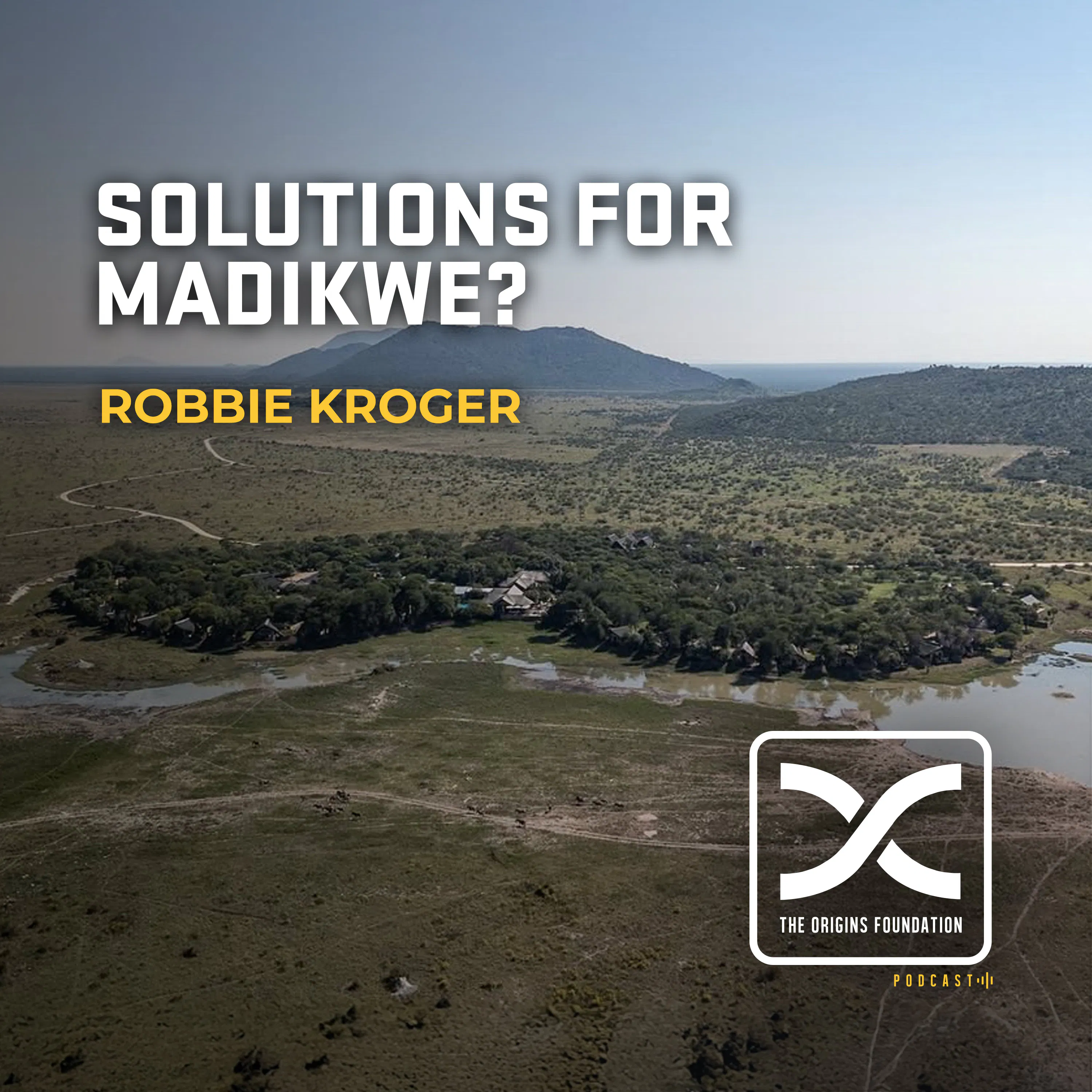
The Origins Foundation Podcast
Episode 600 - Solutions For Madikwe?
00:34:53
You have seen lots of recent discussions, talking heads, and articles about Madikwe, a nature reserve in the North West Province of South Africa, and its elephant dilemma. The Origins Foundation is firmly positioned to talk and deliver an understanding of the system from a practical conservation perspective. Robbie was forwarded a podcast radio spot in which a non-hunting economics professor was asked to bring his ecological perspectives to bear on the Madikwe situation. The interview was very biased and unfortunately didn’t have a voice from the sustainable use lobby, so we decided to bring our own voice to the table. Robbie reacts in this special episode to the radio/podcast interview titled “An Atrocity Planned in Madikwe.” Robbie plays the podcast for you and gives you an unscripted response to what he is hearing and gives his opinion on this Madikwe controversy.
Loading summary
Transcript65 lines
- [00:00]
A
Join us at a Friends of NRA event where freedom, fun and firearms come together like nowhere else. With more than 600 events held across the country, there's always one happening near you. From exciting games to exclusive auctions featuring one of a kind firearms and gear you won't find anywhere else. Whether you're a lifelong hunter, a competitive shooter, or simply passionate about defending freedom, there is a seat for you. Visit friendsofnra.org to find an event near you and get ready for a night you won't forget.
- [00:30]
B
Hey guys, this is Melissa Bachman. Are you ready to stop spooking deer before it's even time to hunt them? Then you need the new Flex S Dark cellular trail camera from Spy Point with a no glow flash option, long lasting solar power, and a ton of settings that can be changed anytime through the Spy Point app. There are no more excuses for letting your deer get wise before the season even starts. So check it out for yourself and see why the Spy Point Flex S Dark is the unstoppable and undetectable scouting tool you need for your next hunt.
- [01:07]
C
So I just received this. I don't know what you want to call it. Some sort of media podcast, maybe a radio interview on my WhatsApp and I'm just going to react to it now and we'll create a podcast I guess from it or YouTube video or both. That is from Prime Media Plus. And the title of this radio interview is an atrocity planned in Madi and they discuss Don. They discuss it with this guy called Don Ross and Ross Harvey. They speak out. Interestingly enough, John Maam is the guy who's running this podcast, this radio interview. He speaks to Dr. Don Ross. He's the head of School of Society, Politics and Ethics, the University of Cork. Truly interesting number one, that this interview guy does not bring on somebody who is from a the other side, right? The pro sustainable use. Like hey, I've got a differing opinion of what should happen at Mediwe. They don't bring that person on. And secondly, I don't understand why they're talking about ecological dynamics and paradigms and whatnot. So the guy that's a professor in the school of Economics, Society, Politics, Ethics. Yeah. So let's listen to this and then I'll just play it and stop it.
- [02:20]
D
And at the center of a heated I will elephants elephant control respond to what I hear it's owned by the north or managed by the Northwest Parks and Tourism Board. And recently the the Tourism Board put out a tender for the hunting of 25 elephants, some rhino and a couple of buffalo and a smaller number for the Pillensburg national park which the Northwest Parks and Tourism Board also manages. And it has now put that on hold. The debate has gone to Parliament. Lots of people have very, very strong views on it. We're joined now by Dr. Don Ross who is head of School of Society, Politics and Ethics at University College Cork and has a South African connection with the School of Economics at UCT where he is a professor with us now via Zoom. Don, good afternoo.
- [03:15]
E
Hello John, nice to be back with you today.
- [03:19]
D
Would you, I mean one of the most important things or perhaps the sort of beginning point one must establish is are there too many elephant in the Madikwe National Park?
- [03:31]
E
The current scientific consensus, that is the consensus among experts who have studied that specific elephant population is no, there is no basis for drawing that conclusion at this time.
- [03:46]
C
So let's start with that there. The, the scientists he Referring to is Dr. Sam Ferreira and Dr. Janetta Celia. Both of them are Sand Park Sambi employees. They haven't really specifically studied the Medicua elephant population, the Kruger park elephant experts. But 1600 elephants is the most dense elephant population. Fenced and open range almost in Africa. There is no greater density in South Africa right now. 2.7 elephants per square kilometer I believe is the Modiquir number or 2.1, something like that, very, very high, the highest anywhere in South Africa. So if somebody says they don't believe that the population is too high, they're all going to be talking about this thing called carrying capacity. You're going to hear them probably talk about carrying capacity in this interview. But there has to be the way that they were talking, there has to be a ceiling to elephant population. So let's just continue to see what they, they have to say.
- [04:49]
D
Okay, thank you. Because I, I was reading an article earlier today which is on the Africa Geographic website by Expert. You said it's the expert consensus. Roger Collinson, who was part of the founding of Mardiqua and part of bringing 230 elephant, the founding population into.
- [05:11]
C
So Roger Collison used to be the former director of Paputswana Parks. He's the guy who actually founded Medique. I know Roger Collison very well. We've had some great interactions, some great discussions. Roger's article on Africa Geographic is phenomenal. It is balanced thought, very thoughtful, very purposeful and he advocates for, for culling. He does not advocate for hunting because of the ecotourism system that is built in. Medico has a Very good ecotourism sector and hunting will probably hurt it more than encourage it. But he does say too many elephants, guys, too many elephants. There's also a need for cutting. There is a need to reduce them and maintain a smaller elephant population when you just look at things online. So if you, if you want to stop and Google the Tao Game Lodge, just google Tau Game Lodge. The Tao Game Lodge put up a fence in 1995 around its lodge and its cabins and its premises. And if you look at an aerial image of Medikwe and you look at the Tao Game Lodge, it is a oasis of trees in a desert of no trees. So there has been impact by elephants on the vegetation, on the trees. Do we have an infinite resource of vegetation on the ground? No, we don't. That's the kind of thing that will show you that there's probably too many of something in the landscape, I. E. Elephants.
- [06:40]
D
The reserve when it was formed, and he reckons that with the current population at around 1700, that's maybe 500 more than the reserve should have.
- [06:51]
E
I think the problem there, John, is that back in the day there was a when, when models of ecosystems were much simpler than we realize they need to be now. There was a notion that one could associate a fixed number, a fixed ideal carrying number or carrying limit to.
- [07:11]
C
See, he doesn't even know this guy because he's not an ecological individual, he's not a scientist. He doesn't even know that the word the term is carrying capacity. He's going by carrying limits and whatnot. That's the problem with this interview, that they're not talking to ecologists, an area.
- [07:28]
E
And say, well, that's how many of this sort of animal that, that, that that area can bear. It's come to be recognized over the last couple of decades that that's just a much too simplified understanding of how ecosystems work. You, you can't simply assign a single number for all time and except in case of very small places. I mean, obviously if you've got a very small place, you can, there's. Then there's going to be a fixed upper limit to whatever large animals you have. But that doesn't apply in a place as large as Medicare.
- [08:03]
C
So I would, I would agree with him. Carrying capacity has changed in its evolution, in thoughtfulness around the ecological paradigm, which is this carrying capacity used to be a number. Like we want this number, we want 500 elephants in Mandiquin. That's the number. But what we know today is that that number, the carrying capacity of a Certain species in a certain habitat will fluctuate due to a number of factors. Water availability and resource availability being the two factors that are the drivers typically of how many animals can be on a landscape. Predators also, but not in elephant scenario. There's not really a predator in the landscape. Okay. So yes, carrying capacity can fluctuate. I totally agree with him. Is there not a carrying capacity for an enclosed reserve like Modiqua? Yes, it is 75,000 hectares. Yes. There is going to be an upper limit at which there's going to be detrimental change, maybe irreversible to certain species, both vegetatives, fauna. So it is an enclosed reserve. You got to remember, Mediquia is enclosed. It's a fence around it. You can't escape it. And so you can't have indefinite growth of a species, especially an elephant. You cannot have indefinite growth. There has to be. There will be a ceiling at which there's going to be an effect and that effect will be irreversible or very difficult to come back from or there'll be a very large timeframe that will be needed for it to come back to a certain state, a desired state by the Northwest Parks and Tourism Board. So I agree and I disagree there. Okay. And that's the big crux of the matter here is that people are saying that there is no ceiling. They'll. I agree. They'll talk about carrying capacity now. Talk about carrying capacity being an outdated term. I agree. They associate carrying capacity with no ceiling to the number of animals that you have. And they'll say that Mother Nature should actually take care of itself. That's the problem that Modiquir is in right now, that Mother Nature did take care of itself in the drought of 2024 and a bunch of elephants starved and a bunch of other animals starved too. And the NSPCA said that's an animal welfare issue. So if you play the scenario out of no carrying capacity, major upper limits occurring and a major drought coming, which is resources. Right. Remember, carrying capacity is tied to resource availability. Then what's going to happen is going to have a massive die off of elements though natural. The animal welfare groups of NSPCA will say it's not because you should have managed it better.
- [10:56]
E
An ecosystem is not a static fixed thing. It's a dynamical system. There are cycles of rainfall and drought.
- [11:05]
C
He's just confirming what I said.
- [11:08]
E
The animals themselves, especially animals like elephants, engineer the ecosystem and cause it to adapt. And they're own habits as they adapt the ecosystem. So it, it Takes a much more sophisticated, sophisticated kind of dynamical modeling to, to focus on those limits. And I think what you're reporting that you saw is a failure to update. When the park was founded, there certainly were notions as to exactly how many elephants it could bear at the limit. But we know a lot more about those population dynamics than we did then.
- [11:45]
D
Because Roger Collinson says that culling them would be a huge mistake. You know, he points out the economic benefits.
- [11:53]
C
I think he says the opposite. He says that culling is necessary. He says hunting is going to be a huge mistake. So this guy, the, the interviewer, here's the problem number two or multiple problems. The interview is now going to start I think mix matching hunting and culling together.
- [12:14]
D
And the job creation benefits to the local communities of having my dickware there. And he says the, you know, the, whatever it is, 100 million rand that the culling of elephants would generate, most of it would go to the. So he said culling elephant hunts very.
- [12:31]
C
Little will trickle back elephant hunts. See he's mixed and he's, he's sort of mixing it all together. He's talking about Roger saying no to culling. When he said yes to culling, Roger said no to hunting. And now he's mixed culling as an opportunity to generate 100 million rand but then called it a hunt.
- [12:49]
D
Unity and it would threaten the significantly larger economic benefit of a billion rand and more to tourism.
- [12:56]
C
He's talking about hunting now hunting. That's what Roger was talking about.
- [13:00]
D
Absolutely. A non starter.
- [13:03]
C
No, he says hunting. He says no hunting is a non starter, not culling.
- [13:08]
D
But he makes the point that, well, he believes that there are too many elephant on Mardiqua and says he has been proposing elephant contraception for quite a long time and it's never been taken up. And so you know, if, if, if there's no consensus on whether there are too many elephant, then what do you do if there is a consensus that there maybe are 200, 300, 400 elephant. You're not going to cull those, surely you're not going to cull those. That would be disastrous. What do you do? Contraception is a long term translocation is incredibly difficult. Who wants elephants at the moment? So how does one manage debate this controversy, this whatever it is?
- [13:56]
E
So clearly immuno immunocontraception is under these circumstances the best objective.
- [14:03]
C
That is absolutely not true. Immunocontraception when Medique had 250elephants was probably the best path forward for elephant management and population. With 1600 elephants. Right now, the logistics of contracepting a population are quite astronomical. So you have to vaccinate elephants to essentially deliver the immunocontraception to that elephant. Okay. And so to be able to do that though, you have to hit the same herd with, within, within that herd you have to hit the same females and you hit it, have to hit it over a period of time. Dr. Cruz, in a Daily Maverick article, suggested a decade. In that decade, you have to, with the immunocontraception, hit the same females in the same herd over and over and over again. Logistic problem number one. Number two is the time frame. Over that time frame, the elephant population is increasing constantly until birth rates are less than mortality rates. Only then will you see a declining population. Up until then, and that may take 10 years. Your population is still going to grow, that population is still going to be eating the entire time. That population is going to be pushing on the resource availability. Some years like this year, great resource availability, that is, the elephants aren't going to starve to death. In other years, when you have a major drought, you're going to have a major catastrophe like 20, 24. But now your elephant population is actually higher. So what's going to happen? Animal welfare is going to get involved again because there's going to be even more elephants, young elephants and juvenile elephants specifically dying.
- [15:59]
E
The best means to the objective. I mean, I'm not disputing the idea that we need to manage the population. I. The debate has overwhelmed.
- [16:06]
C
So how do, if he's not disputing that we have to manage the population, how does he think we're going to manage it? Does he believe that he truly believes that immunocontraception is the path forward? It would. Again, it works for individual reserves that have 20, 30, 100 elephants, not 1,600 elephants. It can go in parallel with a culling program. You can absolutely target herds and start contracepting them whilst you're culling other herds. Absolutely, totally agree.
- [16:35]
E
Whether it. How urgent it is. Right. So, okay, now I don't think it's as urgent as call it then, but let's grant that we do. We must manage. Immunocontraception is something that is, we have plenty of capacity to do. There's an existing MOU with people who can do it though.
- [16:57]
C
So this MOU is with the nspca. So that's in place.
- [17:00]
E
Don't increase terribly quickly because they have long gestation periods.
- [17:04]
C
And so elephant populations in good systems will increase between 2 and 7% on an annual basis. Okay, so he's right. They don't increase, like overnight, but there's constant, constant, constant increasing.
- [17:19]
E
And mother elephants do not have twins, except very rarely. So it's easy to forecast the rate of increase in those dynamics. So it's actually not difficult to get ahead of them with an immunocontraception program. And we have the darting capacity and knowledge and people.
- [17:38]
C
My only problem with the immunocontraception program is, yes, the MOU is in place with the nspca, but does the NSPCA have the funds to deliver an immunocontraception program at the scale that is required in Mediqui? That then puts culling on the back seat, which means you have to go after all 1600 elephants. Do they have the wherewithal, the technology, and most importantly, the funds to be able to do something like that?
- [18:08]
E
So that could be implemented anytime. And I mean, unless one agrees that the population pressure is indeed very urgent, that hasn't got away from us. Where translocation is concerned, one has to also, you know, it's not an absolute. It's not a question of necessarily having to. To pick up 500 or 600 elephants and shift them across the country. Solutions can be looked at which allow them. Where we could build a temporary corridor for some elephants to areas where there's some water and then get them back.
- [18:44]
C
I have no idea. Let me let him finish his statement.
- [18:47]
E
Right. They all. Again, the point I made earlier, how many elephants the park can sustain is partly a function of where we are in a rainfall cycle and where we are in a vegetation cycle. So if one can temporarily shift the elephants to some.
- [19:03]
C
Temporarily shift elephants is the solution that this guy is promulgating. Temporarily create a corridor, like put a fence up, temporarily move people out of areas, temporarily buy land temporarily. This is something that is very difficult. Land acquisition, land connectivity, moving. You know, how do you even move the elephants? Like, do you. They're gonna find it themselves again, These are all just questions, right? Everyone thinks that the habitat expansion idea, the habitat connectivity idea is a very good one, and it is, but it's extremely difficult. I've worked in land acquisition and restoration ecology of land for 20 years. It's arguably the most expensive restoration conservation technique you can undertake because of the lawyers involved, because of all the land stuff that happens. You've bought a house, you've bought a piece of property. The title process, all of that process is just absolutely crazy. Especially when you add in that it's a government Doing the work, it slows it down tremendously. So you're talking about a two, three, four year process here. Okay. Then you've got potentially a resettlement program that has to happen. That's not going to go down very well in South Africa. Then you've got the idea of a land claim process. Modiqui just went through a land claim process and 40% of the Modiqui just went back to the community. That will happen. At the same time, you can't do land acquisition temporarily. And if you want to do it permanently, there are many, many, many roadblocks, including the money to buy the land and all of the fickle nature components of the business of land acquisition all the way up to day of closing. I've seen deals go bad in the last week. So land acquisition and land conservation expansion theoretically is a great idea practically. Probably has the least likely hood of getting off the starting blocks and even less of a likelihood of getting across the finish line.
- [21:15]
E
Elephants to some water for some of the time and then let them get back. That is also another mitigation mechanism. Mitigation mechanism one can adopt.
- [21:25]
D
But the, the big question is the question with which I started. Are there too many elephants? Obviously the Northwest Parks and Tourism Board believes there are elephants. You and many others believe that is not the case. And how does one, how does one reach some kind of consensus which leads to non controversial management plans when there are these fairly disparate views on the numbers and how sustainable the current numbers are and how, how much they need to be managed or don't need to be managed?
- [22:02]
C
I'd love to ask, what's his name, Don Ross, if there is a too many elephant number for an enclosed reserve like Mediqua. I'd love to get the answer to that question. Because if he believes that there is no such number, then that's the problem. Does he believe 2,000 elephants in 75,000 hectares is too much? Does he believe 2,500 elephants, 3,000 elephants? What is the number? He'll say, well, you, you have to calculate. Well, yes and no. You've got to have vegetation in place, you got to have vegetation monitoring in place to show a change in a vegetation vegetative state because of an animal like an elephant. However, if the Northwest Tourism Parks and Tourism Board desires an open grassland system, then that's exactly what elephants are doing right now, which is great. Like they're, they're moving it towards the vegetative state that somebody has said that that is our desired endpoint. Or do we want A mixed savannah, or do you want a closed canopy that has bush encroachment that happens when you have too little elephants in the system. So there is a balance here. And what is the end point? What is, what do you want? Like, what do the ecotourism lodges want? Open grassland, Open savannah, maybe, but there's going to be a point where even the open grass and savannah gets denuded because there's too many elephants. And so it's, it's strange that this guy, you know, if I was the journalist, I would have asked, like, what is the number? Is there a number?
- [23:36]
E
So, John, I would suggest that the bigger issue here, in fact, is that in some ways we had come to a policy consensus many years ago.
- [23:45]
C
Okay.
- [23:46]
E
And it's reflected in the regulation, which is that calling is to be the absolute last resort and to be done only when it's. When there's absolutely nothing else that can be done.
- [23:56]
C
What can be done? So he's talking about the elephants norms and standards that says you have to exhaust everything above the list before you get to culling, which is the bottom line option. Okay, so what can be done? We've already talked about immunocontraception. At that scale, logistically probably impossible. Unfeasible. Next, translocation. Translocation, never going to happen. Nobody in South Africa wants an elephant. Too expensive. But you just can't find a home for them. And then number three, land expansion, connectivity of habitats. Again, I've just talked through the logistical issues associated with land acquisition and expansion of conservation areas. Specifically when you have a government involved. So what's left?
- [24:45]
E
And that reflects the fact that there was widespread revulsion in the country and in the people who were tasked with actually doing the calls back in the day when elephant calls in South Africa were frequent, that this was, this was atrocious, that it was a terrible having to do it. I don't know how many listeners realize that when you call elephants you have to slaughter entire families because you mustn't leave survivors who will be traumatized and who will spread their, their trauma to other elephants that weren't even witnesses. So you've got to make sure there are no witnesses. You've got to take out the babies and everybody. It's awful for the people who must do it and it's horrendous for the elephants.
- [25:27]
C
So he just mentioned culling a baby being atrocious. Horrendous, I think was the word that he used. But in the same breath, somebody like this guy that would see a baby elephant Dying, starving, dead. In medique doesn't see that as horrendous or atrocious, yet the same result happened. So it's just a mechanism of the result. This one is more painful, longer term, more suffering, but as people will say, more Mother Nature esque, whilst this one is humans interfering, quote, unquote, or if you want to think of it a different way, managing an enclosed system.
- [26:15]
E
And so the tragedy here is, for the last, you know, 35 years, those of us involved with conservation and elephants, particularly in South Africa, have been able to say around the world, well, in South Africa, we stopped that in South Africa we got away from that. We do it differently now.
- [26:35]
C
So in South Africa, what he's saying, South Africa, there was a big uproar, obviously mainly from an animal rights perspective, but he's also saying there was a major uproar of utilizing the resource, utilizing the elephant meat, utilizing the elephant leather, all of the economic upliftment that came from it. There was an uproar associated with, and.
- [27:00]
E
It'S tragic to lose that, that red line. I fear if we don't notice, if we tell ourselves calling shall not happen, that puts the pressure on all stakeholders to make sure that they get ahead of these problems, to make sure they're ready with alternative methods. It forces us, you know, just as we would never call humans because we thought there were too many of them.
- [27:21]
C
If we think how I see a lot of people on that side will bring that into the conversation, they'll say, get rid of humans. Humans are the problem. And he's saying, would never cull humans. Yeah, because they're humans. People like Don Ross believe that elephants are like humans, sentient beings that deserve every single right associated with, with humanity. And that's why he's using that as an example.
- [27:51]
E
There's too many people in some place. We have to find a different solution. And I think that should be our attitude with elephant.
- [27:57]
D
It looks as if that might be the settling consensus. I mean, listening to the debate and different parties involved and very much of the same opinion in Parliament and the fact that the North West Parks and Tourism Board has withdrawn the tender for hunting and has put on ice plans to cull suggests that maybe on this occasion the, the academic led, the science led, the popular follow, revulsion against the prospect of culling looks as if it's, it's going to work and that there won't be a cull in Mardiqui.
- [28:32]
C
So here's the problem, right? If, if, if this happens, let's just play this out. If Culling is taken off the table. Elephant population is going to continue to grow. The next drought's going to hit. You're going to have 100, 200, 300, 400 elephant die. Culling by Mother Nature, that's what's going to happen. But that's okay, right? That situation's okay. The trauma, the pain, the suffering, that's okay. But according to the NSPCA and a growing social element around the nspca, that sentiment is not going to stand like this. This proposal of getting rid of culling, don't use it anymore, but we're going to use natural culling to reduce the population. That sentiment is not something that the NSPCA and broader society is willing to undertake, willing to stomach, willing to swallow. So now we're back to a catch 22. Contraception will not work and it'll take a decade. You're going to have this animal welfare issue grow and grow and grow as we go through different climate cycles and resource availability goes up and down. Translocation never an option. You can work on the land connectivity and the land expansion at the same time. That can also be a parallel objective. There's huge money involved and you've also got a lot of other logistical hurdles to, to jump over. And then if contraception takes a decade, then you're going to have an opportunity to maintain the population in the future. But if you expand and don't implement contraception or culling, you're going to be just kicking this can down the road. That's what's happening. You're kicking this can, this problem of elephant density and management down the road.
- [30:23]
D
Or am I being overly optimistic, Don?
- [30:25]
E
Well, you're being optimistic and I like to be optimistic. And so I'm very hopeful that you're right. I mean, in some sense, if that turn, if, if, if that optimism turns out to be justified, if this is stopped by, by a wave of revulsion, as you said, that would be a great moment for us. That would be something we could be proud of. In fact, it would reinforce the.
- [30:49]
C
So they're going to be proud of reduce, removing a management technique that they believe is atrocious and horrendous, but advocate for because of temporal scale of other management techniques. The increased animal welfare concern that will occur in Mediquia because many, many, many more elephants will probably starve to death and suffer and die.
- [31:11]
E
The proud message we've been conveying around the world for the past few decades that South Africa's got beyond this, even while other places haven't and this would show that we really had. That's, that is, it would show that it really was a national consensus and a civic consensus that culling elephants is simply wrong and mustn't be done. And if that's where this all ends up.
- [31:32]
D
Dr. Don Ross, thank you very much for talking to us this afternoon.
- [31:35]
C
I wrote an opinion rebuttal to Adam Cruz's piece in the Daily Maverick as well as Don Pinnock's piece in the Daily Maverick, all tied to Mediqua Elephants. At the time of recording this video and this podcast, I had yet to receive a response on whether it was accepted or denied. We responded in quite timely nature within 24 hours of those two articles being released on the Daily Maverick. And it was a way to put across a different side of the message. And we think that, you know, the Daily Maverick has shown interest in being unbiased from a journalism integrity perspective. There is a need for that. There is a need for realism in elephant management. There is a need for evaluating the management techniques through a lens of practicality, not theory. Because everything you just heard there from an immunocontraception perspective, from a temporary connectivity perspective is, is good in theory, but when it comes to the practicality of things, it's just not going to work. It won't.
- [32:40]
D
It.
- [32:40]
C
It, it just, it just won't. Immunocontraception is something that is going to work in a decade and essentially the, the milk has already been spilt. When it comes to Mediqua, immunocontraception needed to be implemented immediately on the 253 elephants that were moved into the park in the mid-90s. That's what needed to happen. Even at the, at a population of 500 they needed to. But at 1600 more drastic measures are needed to reduce the elephant population back down to. I don't know what the number is scientifically. I don't. We. Nobody knows. Nobody's done the, the population estimates. They don't even know what the actual number could be should be for Kruger based on vegetation dynamics. That is an incomplete science. There needs to be an idea of a vegetation endpoint put in place which is what do you want? Close canopy, mixed savanna, open savanna or open grassland and let the elephant density in Mediqui grow and reduce based on specific vegetation endpoints that come as a result of vegetation monitoring. Strategically paced, stratified, random. Whatever methodology you want to utilize in Mediqui, put it in place and over the next decade let the vegetation drive the need or, or lack of management for elephants. That's the science that we need. That's the science that will move the needle. We do not have that science. We cannot go back a decade and show the change. Probably could with gis, to look at changes in specific random quadrants in Mediqui based on a change in elephant population over time, but you can't go back to that point. You could go back to that elephant endpoint of a population and a desired vegetation endpoint through gis, but if. If we don't, then just put it in place now and move it forward. That's my say. What do you think? State it below in the.