← The Origins Foundation Podcast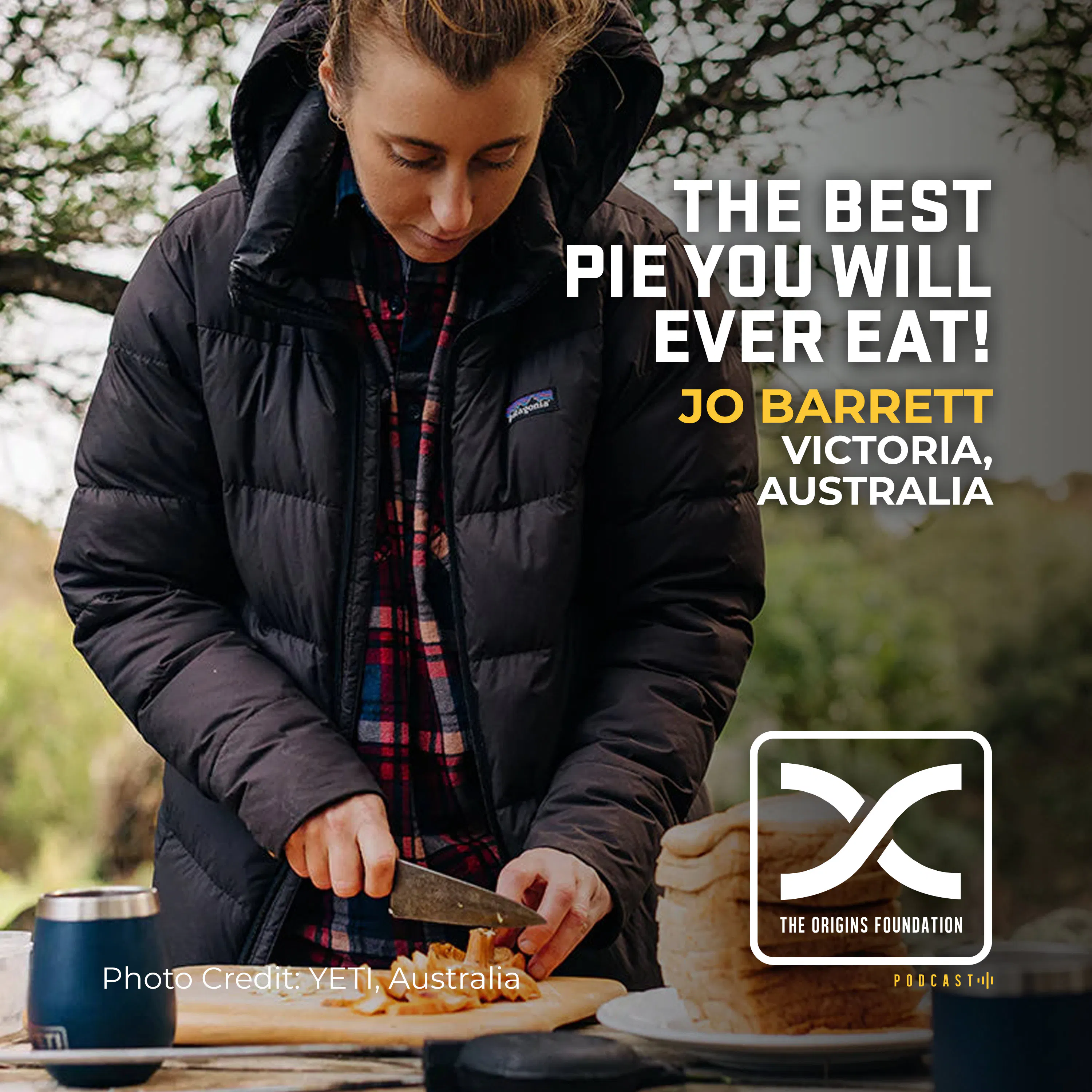
The Origins Foundation Podcast
Episode 613 - Jo Barrett || The Best Pie You Will Ever Eat!
00:38:53
Whenever Robbie is in Australia, he likely eats his bodyweight in pies (yes, those fluffy pastry things). One pie maker that Robbie was eager to meet was the incredible Jo Barrett. Jo Barrett, master chef, master pie maker, now a hunter herself, and one of the partners at Discover Wild Foods, who are taking wild venison and crafting it into incredible dishes—well, in Jo's case, incredible pies. It was by pure coincidence that Robbie was standing in line for a wild pie and saw Jo—and as is the common phenomenon around social media—they both met for the first time and managed to connect. Robbie convinced her to jump on a podcast in between pies being cooked at the Wild Deer Expo in Victoria, Australia.
Loading summary
Transcript211 lines
- [00:00]
A
Tito's handmade vodka is America's favorite vodka for a reason. From the first legal distillery in Texas, Tito's is six times distilled till it's just right and naturally gluten free, making it a high quality spirit that mixes with just about anything from the smoothest martinis to the best Bloody Marys. Tito's is known for giving back, teaming up with non profits to serve its communities and do good for dogs. Make your next cocktail with Tito's, distilled and bottled by 5th Generation Inc. Austin, Texas. 40% alcohol by volume. Savor responsibly.
- [00:30]
B
At blinds.com, it's not just about window treatments. It's about you. Your style, your space, your way. Whether you DIY or want the pros to handle it all, you'll have the confidence of knowing it's done right. From free expert design help to our 100% satisfaction guarantee, everything we do is made to fit your life and your windows. Because@blinds.com the only thing we treat better than windows is you.
- [00:51]
A
Don't miss blinds.com's year end blowout sale happening right now. Save up to 50% site wide plus a free professional measure. Rules and restrictions may apply.
- [01:00]
C
Joe Barrett is a master chef, a master pie maker. Now a hunter like Joe is amazing. Joe is one of the partners in discovered wild foods. They are taking wild venison and crafting it into incredible dishes. Her company, Wild Pie was serving pies at the Wild Deer Expo in Victoria, Australia. And they had a wild boar sausage roll which I literally ate my weight in. I probably had three of those a day. There was a venison and red wine pie. There was a flinders wallaby pie. There was a goat curry. Sri Lankan goat curry pie. Yes, I know, you're probably salivating. They were all absolutely divine because Joe's a pastry chef. And so I wanted to have Joe on the podcast talk about her journey in the pie world, her journey as a hunter. We're definitely going to do more with Joe in the future, especially as it relates to an a series of content that we're calling are you game? So really enjoy Joe. Go look her up, look up her pies. Look at the imagery around her pies. Because if you're not in Australia, you're not in Victoria, Australia. You really can't sample her pies. I'm sorry, I know I got you all fired up. Maybe she'll start shipping internationally if you ask her nicely.
- [02:19]
D
So enjoy.
- [02:24]
C
So 5 years ago there was a reason why I started this movement and the truth then, is the truth now that we need to champion our narrative. We need to champion the truth around what we do and who we are.
- [02:36]
D
There's a sweet spot where they've got, you know, too heavy and it's a burden to walk with. Too light and you whipping it.
- [02:43]
C
Why is the project so important to hunting community?
- [02:46]
D
It's. It's a. I think it's not only important, I think it's. I think it's vital. I think it's. It's just in time.
- [02:52]
C
It's like snakes and ladders. You guys are climbing the ladder and then somebody does something stupid and you just slide down. That is such an amazing analogy. Snakes and ladders.
- [03:02]
E
Yeah.
- [03:02]
C
You know, ivory in. In my opinion, was the plastic of its age. Okay.
- [03:07]
E
The expenses are going up. It goes a long way with families. We have families that do need it.
- [03:13]
C
Me close this door because I have a little wiener dog.
- [03:15]
D
What?
- [03:15]
E
You.
- [03:15]
C
Are you laughing because I said wiener?
- [03:18]
E
I'm really glad you finished the sentence out. I'm sorry the first happened. What are we doing here today?
- [03:25]
C
You're telling the whole world.
- [03:40]
E
My own voice.
- [03:40]
D
You did. Did you want me to unplug you so you don't hear your voice in your ear?
- [03:45]
E
That's all right.
- [03:46]
D
No, I like the sound of my voice. Beautiful voice, though. You beautiful voice, too. Geez. Joe Barrett, beautiful pie maker. Just before we start this podcast, what's the secret of your wild boar sausage? So that the world can know quickly.
- [04:01]
E
Oh, I told you not to tell anyone. It's cabbage.
- [04:05]
D
Don't tell anybody. Don't tell anybody. This is live. No, it's amazing. Joe Barrett, welcome to the Origins foundation podcast. I'm getting used to even just saying the new name.
- [04:16]
E
Thank you for having me.
- [04:17]
D
Dude, you're amazing.
- [04:19]
E
What you do is amazing.
- [04:20]
D
Geez, dude, Like, I've seen you, I've seen your work. I told you, like, I'd love to. If you'd be willing, we'd love to do the next story. Like, are you game on you here in Australia?
- [04:31]
E
I'm game. You.
- [04:33]
D
They look at you. I like that on the ball. 9:00 clock in the morning, we're at the field, the Wild Deer Expo Warrior Victoria. It was packed yesterday and the doors are about to open in 10 minutes. So if things get really hectic in our ears or the microphone, that's why the expo just opened. Introduce yourself. Who are you? What do you do?
- [04:56]
E
I'm Joe Barrett. I'm a chef, a hunter, fly fisher, and currently co founder of Wild Pie.
- [05:04]
D
Cross Omira just walked by. Look at, look at the shirt that he's wearing.
- [05:07]
E
He's looking good.
- [05:08]
D
Wild Origins Australia shirt. Did I give you one?
- [05:11]
E
Not yet. I'm after.
- [05:13]
D
After. What size are you, Neil? Oh, I don't have a small. I have to post you a small. I'll get you one. I think I've got a medium left somewhere. I think I've got one squirreled away in the vehicle. Have you always hunted like you grew up in Victoria?
- [05:27]
E
Grew up in Victoria, didn't hunt. Actually came from a family that's pretty anti firearms. Wow. So when I decided to get into.
- [05:35]
D
Hunting, were you growing up in the city or in the rural country or.
- [05:40]
E
Yeah, probably about 20 minutes out of Melbourne.
- [05:43]
D
Okay.
- [05:43]
E
And we definitely are a beach family, so holidays on the east coast and down on the great ocean Road. Never. Yeah, never. Not hunting at all. More facial.
- [05:52]
D
Weren't surrounded by people that hunted. I assume living in 20 minutes outside of Melbourne, Right.
- [05:57]
E
No. And. And not a massive meat eater family either. Like. And I probably. Yeah. And wouldn't say an adventurous eating family. So it wasn't until around 20. 20. 2021 when I started really understanding.
- [06:11]
D
5 years ago.
- [06:12]
E
I know. And that's how soon my journey into hunting and wild game started.
- [06:17]
D
So you were always interested obviously in being a chef.
- [06:20]
E
Oh, I feel like I came out of my mother wanting some ish. What a visual with a knife and a whisk.
- [06:30]
D
So he wanted to be a chef.
- [06:31]
E
Wanted to cook, wanted to be the connection between land and food. Knew that like we grew quite a lot of food just really early on and then it kind of wasn't there in the middle.
- [06:43]
D
But not livestock. Didn't have goats, didn't have pigs, no cows.
- [06:47]
E
It was just like a domestic veggie patch. But you know, early memories of that and then going into the kitchen and understanding where food was coming from. I had a lot of questions. You know, boxes of chicken breasts would arrive and I'd be like, where's the rest of the chicken?
- [07:02]
C
Look guys, I'm a hunter, right. And when I go hunting, I like to figure out how to get my trophies back home as expeditiously as possible. Well, you don't have to look much further than safari specialty importers. We know that trophy importation can be quite a headache. That's why safari specialty importers strives to make it as easy and hassle free as possible. They have access to a bonded warehouse. You won't be charged storage fees and you get a dedicated team that's readily available and will update you at every step in the process. They'll even go one step further. Safari Specialty Importers is working with us and they are going to donate $100 from every shipment that they work with to conservation projects that include anti poaching, community development and wildlife conservation. At the end of the day, choose to spend your money with a team that's dedicated to you and is dedicated to helping show how hunting is a great conservation model. Hassle free logistics, fuel and conservation go with Safari Specialty Importers. Hunting and shooting suppressed have become the norm in over 42 states where suppressors are legal. The growing popularity of suppressors has even led to legislative changes. You might have heard some things around the big beautiful bill, right? Including the reduction of the NFA mandated tax stamp. Before you used to pay 200 bucks and now starting January 1st of 2026 the tax stamp is going to zero. However, why wait until January 1st? Our partners silence Essential, great friends of ours, they're going to pay your tax stamp right now. So if you buy a banished suppressor or other popular brands that essentially are qualifying purchases, Silence Essential is going to cover the cost of the tax stamp. They're going to save you 200 bucks right now. So make sure you don't miss out. Shooting Suppressed if you're in the market for a new suppressor, Whether it's your first or your next one, visit silenceessential.com or call them 866-811-6536. Silence Essential is going to cover your tax stamp right now. They're going to simplify the submission process and deliver your suppressor right to your door. Don't wait. Get your suppressor right now and start shooting. Suppress this season. Bushnell is eager to help you get set up for conservation success. That's right. They want to help you. The conservation and research community is dominated by good people doing good things and investing significant time and effort for the benefit of habitat and the species. So what do you need to do? Pretty simple. Send us your conservation story and or your conservation wish. Could be managing whitetails. Could be understanding your environment or species or something else related to conservation. What would you be able to do if you had a great trail camera setup? We will select the best story every other month and send you a camera bundle, cell camera, normal SD camera, SD cards as well as optics. Everything you need to get set up for success. I can't wait to see what you submit. You can email us, DM us, message us whatever you want. We are not hard to find. Good Luck.
- [10:14]
D
Oh, oh, yeah, yeah, yeah.
- [10:15]
E
And just the quantity of food going from domestic household cooking into commercial cooking. It was just a lot of food. And just started to question where that was coming from. And then was really lucky. Kind of went straight from high school into the commercial kitchens and then won a scholarship and went to Canada and then saw. I was cooking over there and saw snow for the first time.
- [10:39]
D
I'm allergic to the white stuff.
- [10:41]
E
Yeah, it's not my grave. I left and it was probably 30 degrees around New Year's Eve and then landed into Calgary. Like minus 20. Yeah, exactly. And I was like, oh. And I was 19, first time away from home. I was like, what is this? And I kind of thought, where's the food coming from if it's snowing? And that was the.
- [11:02]
D
Oh, good question.
- [11:04]
E
Yeah. And when I started my apprenticeship, I was like, why aren't we cooking the food from here, from Australia? You know, we have all these beautiful indigenous ingredients. And I didn't quite realize at the time that was probably a profound thought in the industry. We were percent flying a lot of food in from other countries and it was all molecular gastronomy.
- [11:25]
D
Yeah.
- [11:26]
E
And I was like, but what about here? And that was probably the start of those thoughts. And then it was throughout my career that I started meeting the right people who also had those thoughts and realized that it is possible to cook like that. So started working in zero waste restaurants with Joost Bakker and Matt Stone, who.
- [11:45]
D
And are those two individuals working with wild game ingredients?
- [11:50]
E
No, it was still more about origin of food, where it was coming from, but there still wasn't the access to probably wild game. We just didn't have that at the time. I think kangaroo. Yes, sure. But I remember putting kangaroo.
- [12:04]
D
That would be pretty much the only thing that would be accessible, Right?
- [12:07]
E
Yeah. And that was around 2 2012, 2014. And I remember we put kangaroo on the menu and we had a heap of backlash and especially from.
- [12:16]
D
Well, do you remember what the backlash.
- [12:18]
E
Was specifically at that time? It was from indigenous people, which was really interesting.
- [12:24]
D
You're not allowed to eat it.
- [12:25]
E
Or it was an indigenous ingredient at the time. Like it was seen like that. It was probably one specific group. And then people just weren't really interested in it. And it was kind of at the height of kangaroo coming into the hospitality scene. People starting to use it and understanding. And then the market collapsed a bit and the demand dropped, which is what we see at the moment.
- [12:46]
D
Sure. You've got millions and millions and millions.
- [12:49]
E
Of kangaroos and millions. 1.5 million get killed, culled every year. We're only eating probably 20% of that.
- [12:56]
D
Wow.
- [12:57]
E
Wow. It's a lot of protein.
- [13:00]
D
So you're obviously on this gastronomic journey. What sort of gets you to the point where you're like, oh, I see a deer. And I see that as potentially food.
- [13:15]
E
I guess it started when I heard about we were killing animals and leaving them, like population, Government. Yeah.
- [13:25]
D
Helicopter culling.
- [13:26]
E
And then I thought, oh, we have deer in Australia. I was one of those people.
- [13:29]
D
Were you still living in Melbourne? Like Melbourne?
- [13:32]
E
Yeah, Melbourne. And then we started a project in Fed Square called Future Food System, which was a house that grew all its own food and sustained its inhabitants. And it was a really profound project.
- [13:44]
D
Sounds like a little cult.
- [13:45]
E
It was really cool. We have a documentary. So Greenhouse. Greenhouse by Yoast.
- [13:51]
D
Greenhouse by Yoast and Yoast. Is that chef Yoast Bakker.
- [13:55]
E
He's a environmental activists. So I worked with either growing food, local foods in particular, and food system, how they work with circular systems. And that project was really interesting. And it was around the same time I got into fly fishing, so fly fishing a lot. And Covid was on. And I met Billy Stoughton. He started. He started. Discovered wild foods and had worked. He was a hunter and had worked a lot in wild game harvesting. Okay. And met him in 2020. And he brought to my intention what was happening with the deer. And then I. I'm a deep dive kind of person. So I started to deep dive into and.
- [14:37]
D
And let me. At that point in time, if you can sort of push back your recollections. Do you have an opinion? Do you even know that people hunt? Do you even know that people eat deer? Do you have a perception of that framework? Or you just sort of like the general public that we love to talk to, which is. I don't really have an opinion. I don't even know what it's about.
- [15:02]
E
Yeah. My opinion at that point was I'm scared of firearms. And hunting has always seemed to be a pretty bogan activity in Australia.
- [15:11]
D
Explain what a bogan is. Because most of the people listening, I.
- [15:14]
E
Always forget that that's an Aussie thing. A redneck, you know, they go out hunting, they're just killing things, drinking, leaving rubbish in the forest, in the bush. That was pretty much my opinion. Yep. I hadn't. And then at the same time, I have a friend, Mark Lebroy, who we had always gone fishing and diving together, and he had gotten a bow and was hunting and I knew he was hunting and he's not a bogan, but a little bit of a bogan. Swears a lot. And he was my first introduction into someone who was hunting but obviously really cared about food because he was a chef. And then I met Billy, and he was someone who really cared about food and deer. My background was I hated food waste, as most people do. And I. So I started to find out. I was like, why are we killing them and not using them? That's protein. And then that was kind of the start. I went on a hunt up in the Hunter Valley.
- [16:10]
D
So who invited you for your first hunt?
- [16:12]
E
The guys at Broadside.
- [16:14]
D
Oh, nice. You went with Eamon.
- [16:15]
E
Yeah, and my third. Yeah. And that was my first hunt. The roar up. So it was the rot.
- [16:24]
D
And I remember, had you ever heard a stag roar? No, before that.
- [16:28]
E
And I. There was one point, we were walking across a valley. We're at the backside of a valley, coming into another one, and I could hear this grunting and roaring. And I. I remember getting goosebumps thinking, is that a monster?
- [16:39]
D
Yeah.
- [16:40]
E
Yeah, it was. And the.
- [16:41]
D
It's almost like when people get goosebumps like that. I get goosebumps for you right now. I think it's triggering something super primal within you. Like, that's why, you know, we called ourselves Blood Origins. Actually, before we were Blood Origins, it was called in the Blood. And it's because it's this thing that is, like, just seated somewhere primordially inside you. Everybody here, you take anybody the die hardest vegan, you put them in the bush for four days, something changes.
- [17:15]
E
Yeah.
- [17:16]
D
Why does it change? Like, it's because it's instinct. Like, animals have instincts. We have instincts, too. We just don't listen to them or we don't have to use them anymore because we're never put in that scenario to be like, holy shit, okay, now I have to do something.
- [17:31]
E
Yeah.
- [17:32]
D
But I know how to do it. I know how to do it. Somehow I do. It was like, well, they'll just curl up and die, right? They're just like, okay, I need to go do this. I need to build something. I need to break something. I need to sharpen something.
- [17:44]
E
Protect or harvest.
- [17:46]
D
How do you know that? Well, that's just like innately, you're like, okay, I need to probably stab something to kill it so I can eat.
- [17:54]
E
Yeah. Well, it was like that. So I was with this. It was all men, actually. And got there.
- [18:00]
D
Weren't worried about that.
- [18:01]
E
No.
- [18:02]
D
Look at my muscle from carry all the pies everywhere. Exactly.
- [18:08]
E
And because I'D always worked. I've got brothers and always worked in male kitchens. So I was. That never worried me. But getting there and having discussions with all of these guys in their camo gear with bows and firearms and we sat down to dinner and everyone was speaking about conservation and food and it was so the opposite of what I thought around shooting anything. It was all around, I'm going to shoot that animal because it's the right age and it's what I'm looking for. And then we ended up. We got a deer, we came back, we broke it all down and then we cooked it for everyone.
- [18:42]
D
And what was that like when you first, like you pulled the trigger on that deer?
- [18:46]
E
No, it wasn't me, it was Mark.
- [18:47]
D
Okay.
- [18:49]
E
But had I had been obviously around butchery, we'd done whole butchery.
- [18:53]
D
Had you been around a carcass with skin on?
- [18:56]
E
Yes, I'd seen it, but I'd never gone from the whole animal to cooking it all to serving it to people.
- [19:03]
D
At one time, had you been on. Had you been at a carcass that was warm skulls?
- [19:07]
E
Yes. Yeah. I wanted to be a butcher when I first. Yeah. So it wasn't. It was never the meat side of it. It was more the searching for the animal, the harvesting and then the serving. I'd never done that part hard. I'd been at farms where they would slaughtered an animal, but it was so different going out and trying to find it. It was. Seemed fair. And then we used every part of the animal and I came away. And then watching how all the guys interacted, it wasn't talking about women or all these things. I had just assumed it was actually chance for everyone to talk about their families or things. And I was like, every person needs to experience this moment. And that was probably the point where it changed. And shortly after that I got a bow. And then have had just the most incredible experiences with hunting.
- [19:58]
D
This is now again, just to remind everyone, this is four years ago.
- [20:01]
E
Yeah.
- [20:02]
D
This is 2025. 2020, 2021, right?
- [20:05]
E
Yeah.
- [20:05]
D
And overheard you in the kitchen talking about like, oh, this big red dag.
- [20:09]
E
On the property gone. Because then you. Once you spend a lot of time in nature, then you understand the. That experience is quite rare. Seeing things like that, you know, seeing an animal, you're sitting there and it walks past you and it has no idea that you're there. That's really, for me, quite a special experience. Or seeing a little fawn not know what you are and run up to you. I had that happen and I Was like, oh, I. You are nature. That's all these.
- [20:39]
D
You're a part of it.
- [20:40]
E
Yeah.
- [20:40]
D
Not a part.
- [20:42]
E
Yeah. And what we had tried to do with future food system, what I tried to work with in food, trying to explain that we are a part of a food system. When you are a hunter and you're sitting in nature, it's really evident that you are a part of an ecosystem. And so it had just reaffirmed all the things I'd done in cooking before. And considering I'd mainly worked in vegetables, I had also probably been a vegetarian for a while there. And now that I work in meat is really funny. However, I've never felt more connected to the environment and to the food system with. And, you know, I'm really lucky. Get to work on some really interesting things with food systems and what's happening in the Australian food system. Get a real insight into that and what we're doing at discovered wild foods. And with wild pie, I can show that, you know, we're kind of proving what is possible in a food system. Even if you are farming or you're harvesting food, we are taking it from the wild and serving it to people the hardest possible way.
- [21:43]
D
And you were talking about it last night. Then I made a reference to almost like oyster tagging. You're at a point now where we're going to eat a wild boar sausage roll, which, by the way, is the best sausage roll I've ever had in my life.
- [21:57]
E
Thank you.
- [21:59]
D
We won't get the secret away of why it's the most amazing wild boar sausage. But you could legitimately tell me through your traceability where that animal came from.
- [22:11]
E
Yeah. With the samba deer. Um, so we have discovered wild foods. Who are a wild deer harvesting company. We also do kangaroos and goat, but mainly we work with samba deer. And, yeah, we could tell you from.
- [22:24]
D
The shooter to the catchment, the watershed.
- [22:28]
E
Yep. The region, the processing plant we have in how long from that to it gets transported to our facility in Beechworth, where it gets boned, butchered, value added into meals or. Or our pies, and then we could point the pie to who shot that and where it came from.
- [22:45]
D
Has anybody done this in Australia before? Like, has anybody pushed, like, this wild use. Dare I say, wild use? This use of wild game.
- [22:57]
E
There's Anthony, who I know.
- [22:59]
D
Yep. Anthony Rowe.
- [23:00]
E
Yeah. I'm from Dharma. Dharma. But I don't think on the scale.
- [23:05]
D
That we're doing it, is it a regulation issue that's stopping people doing this? I know Aussie obviously has a Lot of rules and things. Yeah, we do.
- [23:14]
E
Especially in Victoria. I think it's hard. It's more so. It's hard and I think more so now what we're doing with the facility where we can value add and we are getting dear to people. You know, we have a box meat box subscription.
- [23:31]
D
Okay.
- [23:32]
E
Where it is one quarter of a deer and it is made up of bone broth. So we're using every part and we've calculated a quarter from steaks, burgers, sausages, value added meals, a pie, a lasagna.
- [23:46]
D
Wow.
- [23:46]
E
For the same price, if not less than you would for a box meat from another butcher of just steaks.
- [23:53]
D
Wow.
- [23:54]
E
And we have zero waste in our business.
- [23:56]
D
How are you not overwhelmed then by demand?
- [24:00]
E
Because of the conception, perception, Perception of deer. I think in Australia and also, you know, in the last 12 months with, I think the business has grown a lot. Obviously we started Wild pie in that 12 month period. And it's very much a customer facing. The pie was just a vessel to say, hey, we can have deer in a pie and you won't even know.
- [24:21]
D
And you'd love it. Because I think wild pig, everyone. I think even Wild pig as a worse connotation than deer.
- [24:27]
E
Yeah, yeah.
- [24:28]
D
Like dirty, stinky. No way are we gonna touch that and eat it. We're just gonna leave it in the field.
- [24:34]
E
Yeah. And so we kind of think of the pie as a bit of a gateway drug. So you try, try the barb and go, oh, I can eat venison. And then maybe go, I might cook a piece of venison. Because it is different to cooking a piece of beef. And that's probably been the boundary of entry.
- [24:53]
D
So you find a lot of people that ask you, like, how do I. I'm interested, but I don't even know how to cook it.
- [24:58]
E
Yeah. Even yesterday, doing the cooking demo and cooking venison rump. Two hunters who cook venison and eat venison still coming up and asking the questions that, you know, someone who's never cooked venison would ask. So it's definitely an education thing around cooking. And it's the same thing that I see in the food system where we're saying to people, cook more or eat more sustainably, eat whole foods. But if you get a vegetable box from a farmer and it's got like two carrots, an onion, a salad, like one celery, people don't know how to cook at all and how to plan their menu if they're not sure what's in their. In Their box.
- [25:34]
C
Right.
- [25:35]
E
The. The same. It's all coming back to cooking skills.
- [25:37]
D
Yeah.
- [25:38]
E
And you can see with what Wild D Expo are doing, with what they're trying to do with making it a bit more food focused.
- [25:43]
D
Yeah, yeah, yeah.
- [25:44]
E
Food is the thing that will connect us 100%.
- [25:47]
D
I think food is the narrative here in Australia, may not be the narrative all over the world, but specifically because you have an abundant resource. Deer, goat, pigs, camels, donkeys, name it. There's still lots more to name. Rabbits, there's just an enormous amount of resource on the landscape. Like crazy amount to the people in Australia, to the resource. It's. And then you put kangaroos on top of that, put wallabies on top of that. Not. My mantra is nobody in Australia should ever be hungry.
- [26:22]
E
Yeah.
- [26:22]
D
There should be freezers full of frozen.
- [26:24]
C
Meat everywhere that you can just go and get.
- [26:28]
E
Yeah. No one should be hungry at all with the amount of protein Australia has.
- [26:32]
D
Yep.
- [26:33]
E
So I think it's coming down to the effort to get the deer or the. Whichever animal. It's really easy to shoot. But the hard part comes from recovering and then, you know, all the food safety that we have and then the processing. So I think that's what we figured out a little bit with Discovered and Wild Pie. We have this middle thing where we're being able to process and make it really convenient for the consumer. And farmers are having the same issue as well. They are able to grow the animal, but there's this expectation that they're able to then get that beef or the lamb or whatever growing to the consumer. But how do they do that? They're meant to be the farmer. So. And I think we put a lot of onus on consumers to be like, hey, you should eat this. And then they go and try and find it and they don't know how to. So it's the middle, middle bit that's missing. And I think that's what we're trying to. Trying to break down.
- [27:25]
D
Yeah. I think that again, going back to the food narrative being the narrative that will sell hunting more in Australia, I think you've got this, you've got this gradient where you've got the bogan who likes to barbecue in its backyard, you know, the classic put a shrimp on the barbie kind of thing that benefits and fits very, very well with all the way through to Michelin star restaurants that are being served or are getting venison from a ewe from a discovered from an Anthony rowie, you know, that are serving it in their restaurants. And I Guarantee you that people are eating venison in their restaurants and going this is the most amazing thing in the world. But have absolutely no idea about population, about how things are being done. Like what affected you, like the culling operations, where it's coming from, what is the resource. You know everything about it.
- [28:21]
E
What's really interesting because I was watching someone eat a dim sim from another store yesterday.
- [28:26]
C
Oh, how dare that ain't.
- [28:27]
E
I thought what are we doing? And I was like I wonder if that person even thought about what's in it. And fair. They shouldn't have to.
- [28:36]
D
Yeah.
- [28:37]
E
However, if they are not even thinking about what meat that is, why not just we go around kill them all, make dim sims like speak to that demi company. We put all the venison 100% wild boar. They're still going to eat it.
- [28:51]
D
Can you imagine? They should be a freaking like frozen dim sun packet labeled like wild boar, dim sums or whatever. Kangaroo dim sums or whatever it is, call it whatever camel.
- [29:03]
C
I don't know. Don't even label it and it should be just freaking.
- [29:07]
D
Exactly. Don't label it and just have it frozen. It should be frozen commodity in every single Coles Target throughout Australia.
- [29:15]
E
Yeah. If you think about how many wild pigs we have and the fact that we import pork into Australia, that's crazy.
- [29:22]
D
My kids love wild pig. Like my, my kids earlier when they were younger we used to make the ribs of wild pigs out of Texas. They're corn fed so they're really, really good with a huge fat cap. Like the pork chops that come off of Texas pigs have like a fat cap of like half an inch on them. Unbelievable. And yes, I can make a French cut pork roast is really not. Not pork roast. I'm messing up my terminology of a lamb chop. So it is the, you know, you have to have the rib and whatnot. But no, then we'll just cook the ribs just like typical pork ribs that you buy in a grocery store. And my kids would make a. They call it a rib graveyard. So it would just be the bones just like all piled up together.
- [30:05]
E
It's so sweet. That's they're all the things, you know like. Or even comparing all the different types of deer we have in Australia and the how they all taste different. People don't even know. It's like cows. You know you have a Jersey or an Angus or venison's the same. Which is really cool. That's what I like about it. I think judging from the feedback we get with any questions, a lot of it has been around. How do you manage parasites? But we don't. I'm sure that we have that somewhere, but we're not. We don't have that in any of our populations. And it's probably more rigorously monitored them 100%.
- [30:47]
D
All certifications, all of the stamping that needs to happen again, you guys have. It's a rule state in an Aussie. Right. And when it comes to food, it's like an another level, another level of rules and regulations associated with you.
- [30:59]
E
So every single animal we gets inspected.
- [31:03]
D
Yep.
- [31:03]
E
Whereas, you know, in an abattoir, you get a kind of premortem postmortem look. Yeah, we're lucky with our food safety in Australia. But I can tell you there's still things that happen. And if you're looking for nutrient density in your food, you know an animal that's going and eating the thing that it's missing in its diet because it just knows instinctually. And then we harvest that animal and you're going to get all the vitamins and minerals and proteins and amino acids from that. That's what I want to be eating.
- [31:33]
D
Have you had anybody like push back on you? Not since I was gonna change. It's amazing. I would. That's what I would have guessed. I would have guessed that you'd received. You've received nothing?
- [31:43]
E
No. In the tech, do you know when we launched, we got emails saying, would you like to come and hunt on my property? And I thought as a hunter, I was like, look at all this access.
- [31:56]
D
I guess that's what I did. I built this wild pie company to get more access.
- [32:00]
E
Yeah. So that has been probably the really big change that I've noticed. People are really about it and really encouraging and the stories that are coming through of like I grew up hunting deer. My father or, you know, my brothers, they grew up hunting. And it's been a part of our lives. And to look at it now, it is.
- [32:21]
D
What does your family say? Because obviously they weren't hunters. They weren't big firearm owners. Like, what does mom and dad say now?
- [32:28]
E
They're so about it.
- [32:29]
D
Really?
- [32:30]
E
Yeah. They still don't like firearms. Understand. And I can see how the public don't want people.
- [32:34]
D
They're afraid. Right again. Australia is a, is a country that has been built on a very, very strict, like anti gun rhetoric based on, you know, history and tragedies that have happened here. And I get it. I get people like being afraid of it. They don't know. It's obviously things that, you know you don't know of that, you know, have the ability to kill and you should be afraid of them.
- [32:57]
E
I think so. And. But it's been amazing because I always use them as a bit of like an identifier of what's happening in the general public and to see if I can alter their conceptual understanding of what's happening. And then you just, with a bit of education and now, you know, took one of those quarterback boxes down to my dad and he was like, this is incredible. I cooked. He cooked his first venison rump steak the other day and he's like, I loved it. Never cooks. Hardly cooks meat at all. And then to go and cook venison.
- [33:26]
D
Yeah, yeah, you said not a meat family.
- [33:28]
E
And then to hear them talk to their friends and family about what's happening. So, yeah, it's really, really cool to see the change. I never thought it would happen in my family, but it has.
- [33:39]
D
That's cool. Well, I know it's 20. We're at 26 minutes. I know you said, robbie, you got to cut me off at 30 because you got pies pull out of the oven. What's next? Like, what is wild pie doing next? Like, how do you. How do you get into every Coles and Target and whatnot?
- [33:55]
E
Yeah, understanding what are the barriers? And I think that's work that we do with local food systems as well. Understanding that for small scale farming producers, they're all the big questions that everybody's asking. And you know, we're a small business, so learning how to market properly.
- [34:11]
D
Oh, yeah, exactly.
- [34:12]
E
Distribution, all those kind of things. And then, yeah, I would really like to look into the export market because I think two years ago I was in Portugal giving a talk about invasive species.
- [34:26]
D
Wow.
- [34:27]
E
And cooking. And I remember talking about wild boar. And a lady stood up and said to me, it's just ridiculous you guys aren't eating that. And I was so embarrassed. Sheesh. And I thought, yeah, in other countries this is a privilege and we are just wasting, wasting it. And now this is my mission. If we can show that the rest of the world want what we have, maybe it will make a difference. So working really hard with our team and we have the most incredible team. Really. It's a small team.
- [34:57]
D
Shout out Passionate. I met two of them yesterday. Amazing individual.
- [35:01]
E
Limo. And Aiden, Tracy down at the facility. And Tara, Jimmy, Billy.
- [35:05]
D
Amazing.
- [35:06]
E
Just working really hard to, I guess, expand and share what we're doing.
- [35:12]
D
Well, I got an idea for you. I plan to see it as I leave you to go get Pies, obviously, wild pie is a for profit business and you want to grow and you want to expand, you want to get exposure, because that's what grows a business, is exposure with the right people in the right environments. And I think from a Wild Origins Australia Origins foundation narrative, I feel like food is the entryway, is the gateway to having conversations that I want to have about, hey, do you actually know what hunting is? Do you actually know where food comes from? Do you actually know that hunting isn't this bad boogeyman that you should be afraid of anymore and it should be accepted in society? That's my goal in life. Your goal in life is to grow wild pie and make it this amazing thing in Australia and globally. I want to build experiences and I think food is the experience where you have this, you know, cool farm table and you invite influences, you invite models, you invite members of Parliament, you invite editors, writers, whatnot. And you sit 17 people down and like, we're in the fielding game booth now. And the first course is a duck course. Beautiful duck horse, right? Just this beautiful, you know, grilled to perfection, medium rare duck with whatever glaze you would put on it. And there's a little postcard that goes with every dish. And it's a. It's a description of duck hunting in Victoria and the precious of duck hunting, and that we have an abundant wildfowl population. And for five minutes, Lucas Cook stands up and he tells everyone very succinctly, very passionately, here's what duck hunting actually is. You're about to eat a beautiful duck that came out of the wild of Victoria. Next course, samba. Next course, pig. And all of a sudden you've got these 17 individuals that have reach, that have absolutely just changed their minds and then they push that message out into their communities and change their minds. And we host that experience in Victoria, we host in New South Wales, we host in Queensland, and we just slowly start knocking down doors.
- [37:27]
E
Yeah, I think the goal is to understand that no one should go hungry and that there's enough food for all greed people. The public need access to the food that's here and we need to work on making sure that they have access.
- [37:43]
D
To it and that they understand that it's actually good. Yeah, People see here Venice and like, it's gross. Doing that's the opposite.
- [37:51]
E
Yeah, just a bit of education, bit of cooking, a few pies.
- [37:56]
D
A lot of pies. A lot of pies. Joe Barrett, go get your pies out of the oven. Thank you so much for everything. I appreciate you as a friend and a supporter of what we do, and I look forward to doing more with you.
- [38:06]
E
Thanks for helping us get the word out.
- [38:07]
D
Yeah, 100%. Ciao.
- [38:09]
C
Well, that's it for today. Appreciate you listening as always. Leave a review, share it with your friends, and most importantly, do what's right.
- [38:20]
D
To convey the truth around hunting.