← The Origins Foundation Podcast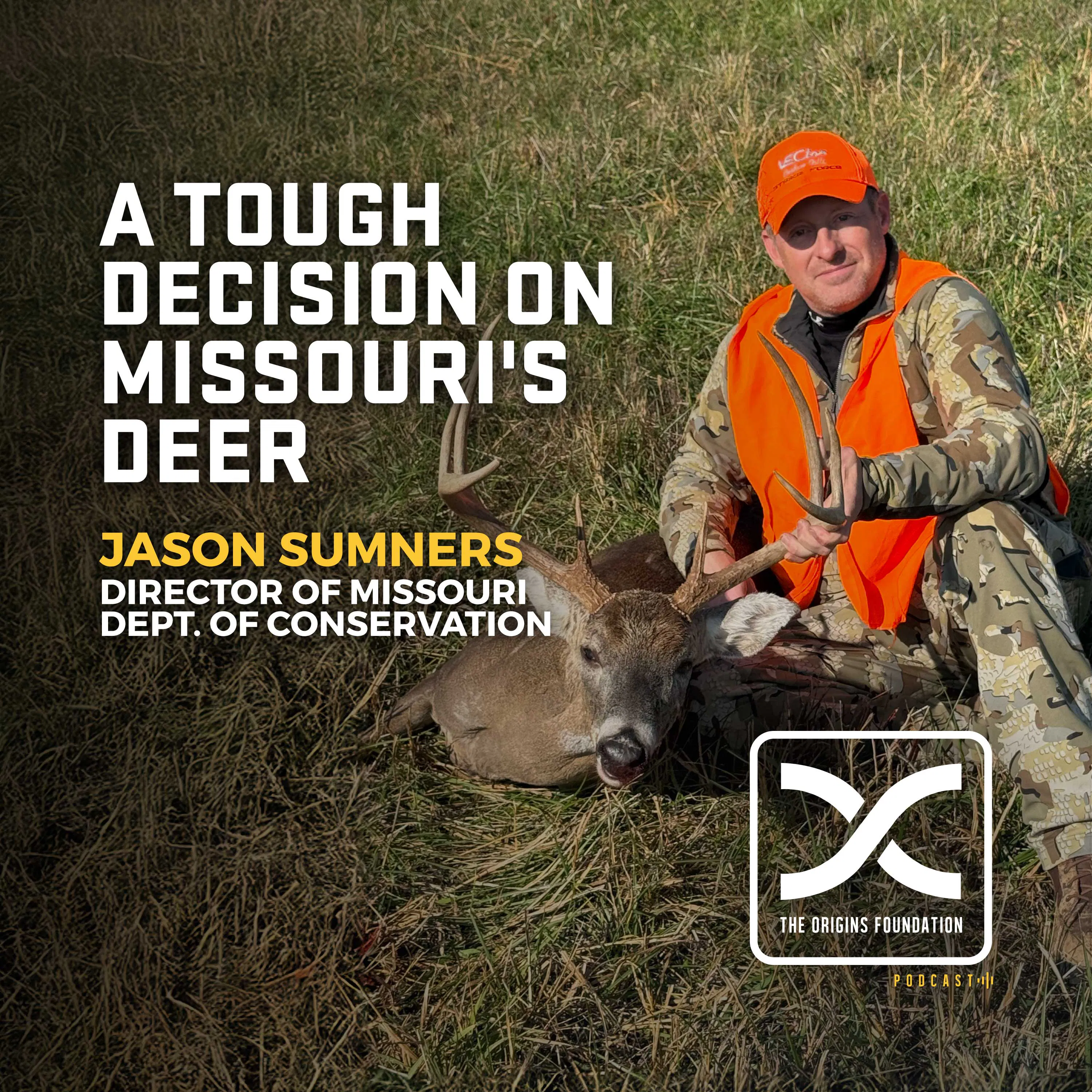
The Origins Foundation Podcast
Episode 615 - Jason Sumners || A Tough Decision On Missouri’s Deer
01:06:29
Missouri Department of Conservation (MDC) has made headlines lately for its controversial decision to end its postseason Chronic Wasting Disease (CWD) targeted deer removal program. Join Ashlee as she connected with MO MDC Director Jason Sumners, and they explain the decision and discuss MO’s deer and elk program, and CWD efforts in general. Ashlee and Jason also go into his background and the Missouri deer program writ large. This podcast is an incredibly informative resource for the CWD discussion, and all of the elements associated with it.
Loading summary
Transcript188 lines
- [00:00]
A
Want to plan your next fishing trip without the hassle? FishingBooker.com is the best way to find and book a fishing charter anywhere in the world. Whether you're chasing trophy fish or just looking for a family day on the water, fishingbooker makes it simple, fast, and secure. With thousands of experienced guides, verified reviews, and 247 customer support, FishingBooker takes the guesswork out of planning. Visit fishingbooker.com and book your trip today. Fishing Booker Fishing trips made Easy.
- [00:30]
B
Hi, everyone. Ashley Smith with the Origins Foundation. Thanks for joining us today. Missouri has been in the news a lot lately, specifically the Missouri Department of Conservation for their very controversial decision to end the postseason targeted deer removal program. The media has given a lot of reasons that they did this, and we wanted to go directly to the boss. So join me in welcoming director Jason Sumners as he discusses the entire Missouri Department of Conservation program and specifically why they chose to end this program. Thanks for joining us.
- [01:10]
C
So five years ago, there was a reason why I started this movement. And the truth then is the truth now that we need to champion our narrative. We need to champion the truth around what we do and who we are.
- [01:22]
D
There's a sweet spot with a gun.
- [01:24]
C
You know, too heavy and it's a.
- [01:26]
D
Burden to walk with. Too light and you whipping it.
- [01:30]
C
Why is the project so important to the hunting community?
- [01:33]
D
It's. It's a. I think it's not only important, I think it's. I think it's vital. I think it's. It's just in time. It's like snakes and ladders. You guys are climbing the ladder and then somebody does something stupid and you just slide that.
- [01:45]
C
That is such an amazing analogy. Snakes and ladders.
- [01:49]
D
Yeah.
- [01:49]
C
You know, ivory in. In my opinion, was the plastic of its age. Okay.
- [01:54]
B
The expensive little going up.
- [01:55]
D
It goes a long way with families.
- [01:57]
B
We have families that do need it.
- [01:59]
C
Let me close this door because I have a little wiener dog. What?
- [02:02]
D
You are.
- [02:02]
C
You're laughing because I said wiener.
- [02:05]
B
I'm really glad you finished the sentence out. I'm sorry.
- [02:09]
D
The first.
- [02:10]
B
What are we doing here today?
- [02:12]
C
You're telling the whole world.
- [02:13]
D
Go.
- [02:24]
B
Okay. We have got a great podcast today. We always have good podcasts, but I am especially excited about this one one because it is partially a redo of what was. Unfortunately, I think. And I've had to apologize to our guest today. The only podcast that I think was deleted somehow in the system, in the history of the Origins Foundation Podcast Bank. And it was a really good podcast and everyone needs to hear from our guests today. And they're going to now. And I'm so excited to welcome director Jason Sumners from the Missouri Department of Conservation. He leads one of the larger wildlife agencies, one of the larger state wildlife agencies in the country and is doing just a phenomenal job at the post. And I am going to let Jason introduce himself and just Jason, tell us a little bit about your history with the department and how long you've been in this role. And first of all, thanks for being here today. I appreciate it. And we've had to reschedule this a couple times because of sickness on my part. And just thanks for being here and thanks for doing this again.
- [03:40]
D
Yeah, thanks. Thanks for having me. I wondered if that was a podcast that was so awful Robbie accidentally deleted it or something. But so yeah, I'll continue to use that as an opportunity to give him a hard time. But no, thanks for the opportunity to come on. I appreciate your guys audience. I, I'm a native Missourian. I grew up in Missouri, went to school at Mizzou and then did what I affectionately call my sabbatical through the South. I went to graduate school at Mississippi State. So that's been a way for Robbie and I to sort of connect. Yeah, go dogs. And then spent some time in South Texas working on deer. And so I spent about eight, nine years post, you know, undergraduate working on graduate degrees and research in the Southeast. And then in 2008 got the chance to come back home to Missouri and start a private lands deer program, which was, which was something that we were just starting to talk about, right? Like you got these regulations that sort of guide and direct deer management at a broad scale. But so much really happens locally, right. Like individual decisions by landowners, whether they're production agricultural landowners or their regular recreational landowners. And really got the chance to kind of bring that how do we build a, a hunting community kind of mentality back to, to Missouri. Something that I'd had experience with when being in Mississippi with their, you know, long term DMAP program. Right. So got the chance to do that and then in, in 2010, you know, we had the unfortunate circumstance of finding chronic wasting disease and, and we, we moved through the commission move forward with reintroducing elk into the state. So I got, got thrown a couple big curveballs pretty early in my professional career. I think those things challenged me in a pretty substantial way. And since that time I've been moving up through the ranks in the agency. I served as our wildlife chief, so responsible for managing about 500,000 acres of public land and the 250 staff that were in that division at the time led our science branch, which is where all of our researchers work out whether they're our deer biologist or waterfowl biologist or sport fish ecologist. So led that team for a couple years and then about three years ago, four years ago now, I moved up into administration into the deputy director role and then about a year and a half ago replacing a long term director, director Paulie in the director role. So it's been, it's been a great experience and again, it's something that I never envisioned myself sitting in the director chair. I'll promise you that. I was pretty happy being a deer biologist and have a lot of fun. But, but the opportunity to impact conservation at a broader scale and then that use that direct connection to hunters and the public that I established through, you know, being one of those folks who managed a critically important species is something that I think has benefited me in this role.
- [06:34]
C
Look, guys, I'm a hunter, right? And when I go hunting, I like to figure out how to get my trophies back home as expeditiously as possible. Well, you don't have to look much further than Safari Specialty importers. We know that trophy importation can be quite a headache. That's why Safari specialty importer strives to make it as easy and hassle free as possible. They have access to a bonded warehouse, you won't be charged storage fees and you get a dedicated team that's readily available and will update you at every step in the process. They'll even go one step further. Safari specialty importers is working with us and, and they are going to donate $100 from every shipment that they work with to conservation projects that include anti poaching, community development and wildlife conservation. At the end of the day, choose to spend your money with a team that's dedicated to you and is dedicated to helping show how hunting is a great conservation model. Hassle free logistics, fuel and conservation go with Safari specialty importers in. It is 2026 and my friends, big changes have happened in the world of firearm suppressors. The $200 tax stamp fee is now gone. Huge win for hunters, huge win for shooters, and a huge win for your wallets. If you're thinking about elevating your shooting experience and adding a suppressor. Silence essential is the best way to shop. And you don't even have to get off your couch to do it. Go to silenceessential.com, browse hundreds of suppressor options. They literally have all of the popular Makes and models. Then their experts will walk you through setting up your account, creating a free NFA trust and then submitting your application to the atf. Once approved, Silence Essential ships your new suppressor directly to your door. That's when you're going to have to essentially get off the couch. It's a game changer, guys. You haven't done it yet. Do it. The old days of waiting eight to 10 months on a suppressor are gone. More like two weeks. Some have even gotten their suppressors in shorter timeframes. It's never been easier to start shooting suppressed. Get started today by visiting silencer central.com it's really the simplest way to get your suppressors. Bushnell is eager to help you get set up for conservation success. That's right. They want to help you. The conservation and research community is dominated by good people doing good things and investing significant time and effort for the benefit of habitat and the species. So what do you need to do? Pretty simple. Send us your conservation story and or your conservation wish. Could be managing whitetails, could be understanding your environment or species or something else related to conservation. What would you be able to do if you had a great trail camera setup? We will select the best story every other month and send you a camera bundle. Cell camera, normal SD camera, SD cards as well as optics, everything you need to get set up for success. I can't wait to see what you submit. You can email us, DM us, message us, whatever you want. We are not hard to find. Good luck.
- [09:43]
B
Well, I know your staff appreciates having someone at the helm who has experience from the trenches and has that biological scientific experience and knows where they've been. So I'm sure you can relate to them more sometimes than some of these political appointees who come in with, you know, maybe say a law degree or something. They're like, what?
- [10:08]
D
Yeah, yeah. I think that's the beauty of our system too here in Missouri in that, you know, I'm appointed by a constitutionally established commission. So we have four commissioners that are appointed by the governor and approved by the Senate, which we got two new commissioners that'll be going through confirmation here in the next month or so. And then they have, you know, responsibility carrying out that, that constitutionally obligated responsibility. And so what that has resulted in is a very stable sort of long term leadership structure. I'm only the 10th director in the, you know, nearly 90 year now history of the agency. And so it has allowed folks to either develop inside the organization or come in from the Outside with strong leadership skills and then stay for a while. Right. Build some deep understanding of the way the organ organization operates and yeah, I appreciate that and I. We've got such a great team. It's deep. I think a lot of that, again, that carry over the tradition and the culture here is attractive to a lot of people. So we're able to recruit some of the best and brightest minds from across the country. You know, we have folks from, from coast to coast, quite honestly, that work here, which is cool. Right? The ability to recruit and retain some of the. Some of the greatest and conservation is. Is great. And I just try to stay out of their way, provide them the support to do a good job well.
- [11:29]
B
And you guys have some really amazing habitat in Missouri. It's a beautiful state. You have huge rivers, you've got amazing waterfowl, huge deer. You now have elk. You have. I mean, it's just, I would say it's kind of a mecca in the country for hunting and fishing. So you do have a lot of responsibility and you have a lot of gifts that God has. Has given your state. I appreciate it. I just think it's a beautiful area. And I've personally worked with some of your biologists over the years in different capacities and, and they've all just been top notch. So just thanks for what you guys are doing. I appreciate that and thanks for letting them do their jobs. You have done a little bit of everything, like you said, but you're truly a deer biologist. That's your specialty. That's what you were trained in.
- [12:20]
D
Yeah. Yep.
- [12:21]
B
That's your expertise, right? Deer, yeah.
- [12:23]
D
But my, yeah, my heart and my core. I still got to take that hat off sometimes. When I, when I relinquished the deer biologist job, I told, I told the lady who replaced me. I was like, I'm here to support you, but it'll be hard for me to stay out of the way. But yeah, growing up, that's. That's all I wanted to do. Right. I went to college, went to Mississippi State stunner studying under Dr. Steve Demaris there. Worked for, with some of the best deer biologist in the country now the Caesar Claiborg Wildlife Research Institute for a number of years and then, yeah, like I said, came back to Missouri and led our deer management program for almost seven years. So, yeah, certainly a unique role to have someone who has been responsible for one of these statewide species to then be leading an agency.
- [13:08]
B
Well, and like you said, and that's what I really want to delve into today, because you guys have been hit lately with some major controversy and you've had to implement some controversial decisions. And so I want to talk about some things that you have had to deal with historically and that you're dealing with right now. You mentioned when you, shortly after you came to the agency and took over the deer program, CWD was detected and you introduced or you not personally, but the agency decided to reintroduce elk into the state. Let's, let's talk about elk first. What, what sort of led to that decision and can you talk about how that's gone?
- [13:53]
D
Yeah. So, you know, we were sort of part of that big push to introduce elk into the eastern U.S. in the early 2000s. You know, at the time that elk got reintroduced into Kentucky, it was something that the agency took a look at, did a, did a relatively large feasibility study looking at, okay, where would, where would the habitat condition be? Right. Where would we minimize, you know, public conflict? And identified an area kind of in the eastern Ozarks along the, along the current river. We have a really large conservation area there, Peck Ranch conservation area, and then a big chunk of national forest and one of the largest private landowners that is pseudo public in the LAD Pioneer Forest. They own more than 60,000 acres in that area. So at the time the Age identified an area in which if we were going to reintroduce elk, that would be the place to do it. But with the emergence of CWD and some concerns that existed there, and just some concerns over land owner land use and some conflict with landowners, the agency chose not to move forward in the early 2000s with, with an elk reintroduction. But then around, around 2010, the commission, you know, directed the agency to, to reconsider that. And so we went back to that original feasibility setting and said, hey, what might be possible, where might it might be best? And so yeah, we, we went again back to the, that Pecker Ranch conservation area place where very low public road density, we have no row crop agriculture. You know, the primary agriculture conflict that might exist would be with cattle production, which know, folks in northwestern Arkansas certainly deal with. Yeah, so we, we started a three year project of reintroducing elk. So in 2011, 12 and 13, we brought elk from eastern Kentucky into Missouri. By that time at least advances in cwd, you got them from Kentucky, so you got them from eastern Kentucky.
- [15:57]
B
They were doing so well in Kentucky from that reintroduction effort that you were able to take some of their herd. Okay.
- [16:04]
D
Yep, yep. And so a number of eastern elk restoration things sort of spawned from that. So we were the first ones to work with Kentucky on capturing and moving elk. They followed up with Virginia and then certainly elk to. To Wisconsin. But it was one of those where we. We'd started to see advances in CWD testing and things like that. And so we actually did rectal mucosa biopsies on all of the elk that we translocated before moving them into Missouri. Again, not a. Not an approved from a regulatory standpoint test, but one that is out there to try to minimize the risk of moving anything around. And we spent a bunch of time digging back into the history of where the elk from southeastern Kentucky had actually originated from the testing history of those original herds to try to minimize any risk of importing the disease.
- [17:01]
B
Okay, so how's the herd doing now?
- [17:03]
D
I mean, so the herd's doing relatively well. We probably have about 350elk on the landscape. We've been issuing five bull tags the last few years work. We're right on the cusp of issuing some antlerless elk tags if the population continues to grow. I see that as something that's just right around the corner. We modified the code, the wildlife code, so that when we're. When we're ready to do that, we have the authority and the process in place to make that happen. But, yeah, they're doing well. We get some really nice bulls harvested. It's a real cool place, too. It runs. The current river kind of runs through and bisects a big chunk of our elk restoration zone. And in that space, we have the Ozark Scenic Riverways, which the national park owns and manages. Yeah, it's just really cool. And historically, culturally, those were a lot of open fields that were managed in that open condition. And the park Service, you know, many times those parks get established, they have kind of that original, like, founding condition that they're supposed to be maintained in. Fortunately, that absolutely aligns with a good elk habitat. So we've been able to partner with Rocky Mountain Elk foundation, with others, tnc that own some land in the area, do good, you know, open lands, habitat management, and provide a real good place to. To grow elk.
- [18:27]
B
That's so cool.
- [18:27]
D
They're where they're away from people, and they really have caused little to no conflict.
- [18:32]
B
So what are those five tags? What's the tag go for?
- [18:36]
D
So we have a lottery system in which it's $10 to apply for an application. Four of those permits are allocated to any hunter, and then one is allocated to a qualifying landowner in the elk restoration zone. And so, again, we wanted to Provide an opportunity for landowners locally to make sure they had a vested interest and an opportunity to hunt those. And then the tag itself is $50.
- [19:04]
B
Wait, so you're not making like a gabillion dollars off these tags?
- [19:09]
D
Oh, gosh, no. Yeah. No, no, wait, Maybe.
- [19:13]
B
Maybe we need to. Maybe you guys need to like, auction one off per year and make a good billion dollars.
- [19:20]
D
Yeah, yeah, we asked about that. You know, so we, we had, we asked about that when we established the elk hunting season. How. How did our. Our Missouri citizens. And it's for residents only. You know, it's a restricted, limited opportunity for residents only. How did they want us to allocate the permits? And there was a whole wide range of thoughts and opinions, but the one thing that folks most coalesced around was absolutely not on an auction tag. And I understand that. And part of that, I think, relates to the fact that we have the conservation sales tax here too. Right?
- [19:53]
B
Yeah, yeah.
- [19:53]
D
So the agency generated source.
- [19:54]
B
You have a dedicated source of source.
- [19:57]
D
Through the dedicated source of funding. And so. Yeah, I understand. Appreciate that. And they, they felt pretty strongly that all, all Missourians should have the. At an elk if they so chose.
- [20:10]
B
So how many people applied for those this year, right?
- [20:13]
D
Around 9,500.
- [20:15]
B
That's fantastic, though. I mean, that's great. So it's a pretty good revenue raiser for the program.
- [20:21]
D
Yeah, so it generates some. It gives us some additional funds to do habitat work and to do some monitoring work. But much of the other work gets supplemented by broader wildlife restoration dollars or the conservation sales tax. I will say the. You know, the first year we had about 18,000 individuals apply, but then the low likelihood of getting drawn, you kind of get down to the hardcore, more serious group of folks, man, though if.
- [20:49]
B
You could just designate one tag for a non resident, and if it were only 5 to $10 to apply, I mean, you have people over the country applying for that thing.
- [20:59]
D
Yes, we would. We would. We have our own challenges with non resident participation that we're trying to work our way through too. So.
- [21:08]
B
Yeah, you and every other state right now.
- [21:10]
D
Right?
- [21:11]
B
That's a whole other podcast, Jason. We can't talk about that today.
- [21:14]
D
Yeah, we don't have time for that one.
- [21:15]
B
We do not have time. We've got to talk about, unfortunately, we have to talk about cwd and we are going to get some calls, we're going to get some emails. I cannot even imagine the calls and emails that you get and that you have gotten. So let's just start at the beginning. When was cwd. I know when it was, but let's talk. When was CWD detected in Missouri?
- [21:42]
D
So, yes, we detected CWD for the first time in a captive facility in February of 2010.
- [21:50]
B
And that was the first time it appeared in Missouri.
- [21:52]
D
That was the first time. Yeah. First time a deer in Missouri and.
- [21:55]
B
It was in a captive facility.
- [21:58]
D
Yeah, it was in a hunting preserve in. North. In north central Missouri. And then the following fall, the fall of 2011 was when the deer was shot. We detected a free ranging positive not, not far from there. So that really started the conversation around what do we need to do in terms of managing cwd.
- [22:21]
B
Do you have any idea where that deer came from in the captive facility? What state?
- [22:26]
D
We don't. Yeah. No, we don't. Yeah, we don't. They were like many other hunting reserves, bought and sold, you know, and moved animals around. So, yeah, it's unknown what the original source of that was.
- [22:42]
B
And you, having done so much work in Texas, have a very good familiarity and understanding of a state that has many captive facilities and works with them and movement and all that kind of stuff. Because different states have different models.
- [23:01]
D
Yeah.
- [23:01]
B
And allow different things. And so you have plenty of experience working in one that has lots of high fences. So, okay, so you were there, you were working as a deer biologist at the time, or were you wildlife chief by that point?
- [23:15]
D
Yeah, I was the deer biologist. Yeah. I mean, I was. I was. You were in 15 months into working for the agency. Yeah. When we, when we found it, you know, the, the background story there is that when I, when I came on board, you know, the disease was well established in Wisconsin. It had not yet been detected in West Virginia. But so those questions. Right. It was starting to spread a little bit eastward in Kansas, where we're beginning to pop up, and it's certainly been found in more captive facilities. What are we going to do as a state if we detect this disease? What's our response? And really, we didn't have a well fleshed out plan. The plan was, you know, if it's found in a captive facility, we'll work Department of Agriculture because of the links to usda, it's found in a free range population. We'll communicate well, we'll work with, with public health. But he really didn't prescribe a response. And so really, after I started, I spent the first. Yeah. That kind of 14, 15 months really digging into the various response plans that other states had. Had developed and spent a lot of time.
- [24:23]
B
You guys did not have a CWD plan already. Mapped out.
- [24:27]
D
We really didn't. We had had a real good surveillance plan like that. The crew here in early 2000s had started very intensive CWD sampling. So by 2010, we'd sampled 30,000 deer statewide and so had a pretty good handle on that the disease wasn't here, or if it was here, was it very low prevalence, where it would be more challenging to detect. Right. So you'd have to do a lot more surveillance. So it hadn't been here for a long time. It hadn't likely been going undetected for a long time.
- [24:59]
B
Okay.
- [24:59]
D
So what he did. Yeah, I spent time and really looked at, at one state in particular, and that's the state of Illinois, who, when CWD was found on the border with Illinois and Wisconsin in the early 2000s, they implemented some very intensive, very localized management actions. So a low prevalence disease, it spreads primarily from deer to deer. And so you want to get in there and try to detect it as early as possible because you got fewer deer on the landscape that are infected and try to remove those social groups that have infected individuals. Right. That's your best bet of, of catching it early on. And so look at the plan that they put together of doing localized targeted removals. Very intensive, small, focused areas following the season. Completely voluntary, based on support of landowners. And so in 2012, when we detected that disease, that's really kind of the model that we established. We. When a positive was detected, we'd identify a core area. And that core area was the section in which the positive animal was detected and then the sections around it. So you've got an area that's three miles by three miles.
- [26:11]
B
Okay. That's your core area is three by three.
- [26:14]
D
That's the.
- [26:15]
B
This is for the post season, targeted for the.
- [26:18]
D
And for in season stuff.
- [26:20]
B
So that's the CW zone is three by three by three. It's not county wide or.
- [26:25]
D
No, no, that's what.
- [26:27]
B
Ever had a countywide zones.
- [26:29]
D
So we define countywide management zones.
- [26:32]
B
Okay. That's part of the management plan.
- [26:35]
D
Yeah. Those management zones really were tied to things like mandatory testing during opening weekend, the fire deer season. They're tired. Restrictions to a swing. Yeah. Feed.
- [26:45]
B
Walk me through your. Walk me through your management zone plan real quick. And when was that implemented in.
- [26:53]
D
In various phases. Right. So as the diseases continue to spread, we've adapted our approach from a regulatory standpoint. But so I'll go back to the core areas. So in the core areas of a CWD was detected, we'd work with landowners if they wanted to remove Deer. Following the hunting season, we tried to remove some additional deer. Again, completely voluntary, based on what their desires.
- [27:19]
B
They removed them or you guys called them for them?
- [27:21]
D
Either or.
- [27:22]
B
Either or both.
- [27:23]
D
So either or Illinois was purely a staff led effort. We're like, well, I think we've got landowners who are willing to do it themselves or interested in doing themselves. And so very early on is basically this question. Would you be interested in removing additional deer? If yes, do you want to do it, go for it. If not, would you allow agency staff to do it? If you want to allow agency staff to do it, how many deer do you want us to remove? And so they control all of that. Right. Like, I mean, how she does.
- [27:54]
B
What's the downside on anything you just said?
- [27:57]
D
Right. How many do you want to do? Well, the fear is volunteer you do it. Yeah.
- [28:01]
B
Or we'll do it for you.
- [28:04]
D
Yeah. If you don't want to do it, fine. And the fear is that, you know, the fear concerns that folks have is, well, the neighbor authorized them to do it and I didn't. Right. So what, the deer getting removed? Well, oh, because they're.
- [28:19]
B
Oh, like those that could come onto my property and I want them and.
- [28:25]
D
Yep. Yep. Because we have relatively small ownership, especially in certain parts of the state.
- [28:31]
B
I mean, the same argument for. Well, my neighbor feeds, but I don't. All the deer are going over there. I mean, you know, it's a tough one. Personal property rights, like, you know, you can't.
- [28:43]
D
It's a tough one to. Nasty. Yeah.
- [28:46]
B
Wildlife moves, they don't belong to us, like.
- [28:49]
C
Yep.
- [28:50]
D
But the other thing that we knew they wanted was that, that hunters, landowners wanted the opportunity to do that during the hunting season. I would prefer never to have to shoot a deer after the hunting season. Right. Like that's a management time. It's not hunting like we're trying.
- [29:03]
B
They wanted to be able to shoot more during season.
- [29:06]
D
Yeah. So we. Yeah. So we created initial. Initially we called them CWD management seals. They turned into an actual permit themselves which authorized landowners to. To harvest additional antlered or antlerless animals. So we gave them the option of shooting additional bucks during the hunting season. But again, did they just apply for.
- [29:27]
B
A permit for that?
- [29:28]
D
Yep.
- [29:29]
C
Yep.
- [29:29]
D
They just basically shoot us. We send out notification that it's available because they're. They own land in a core area. We've got a pretty extensive landowner network. Yeah. They say, hey, I want to do it or I want my cousin to have the opportunity. And they could assign that. That authorization to them. So it gave again, very, very localized. This is in northeastern. Yeah. Southeastern Linn county, northwestern Macon County. Not across the entireties of the county. Right, right. So we gave them those als as.
- [30:02]
B
Obviously three by three.
- [30:05]
D
Initially. Right. If you find additional positives, obviously that area grows. But yeah, it's, it's a very small, intended to be a very small focal area around where the initial positives happen.
- [30:16]
B
Okay.
- [30:17]
D
From a statewide regulatory framework. Then we looked at, um, in this.
- [30:22]
B
Case, was that popular in the beginning?
- [30:26]
D
Yeah, yeah, yeah, yeah. And it usually is, it usually is the, the pattern and that's, that's part of the story here is the pattern that plays out is folks are interested, they're willing to participate the first couple of years and then it's not a lot of fun. And we're asking them to shoot additional deer, which hunters at large already have plenty of barriers in place to and desire. Lack of desire to shoot additional deer. I mean, we know that. Right. That's why longer seasons and lots of more permits doesn't always result in more dead deer. Right. Like the, the just the challenge of shooting more deer is real expensive to process.
- [31:05]
B
Yeah. Like all the things.
- [31:08]
D
Yeah. So you get, we get this pattern of initial participation and declining participation pretty quickly, like after year two.
- [31:16]
B
And that is even allowing you guys to go in and you know, okay, yep, yep.
- [31:23]
D
You got a few that are like, hey, we're on board. We understand we're going to continue through and they continue to this day. But that, that, that, that's been the pattern in the cycle since the very beginning.
- [31:33]
B
Okay.
- [31:34]
D
But from a broader regulatory standpoint, we, we then, we then took, you know, kind of a step back and said from a regulation standpoint, from a hunting season structure standpoint, what should we do? And so in, in, in that area, we had the antler point restriction, which was four points on one side, to be a legal buck to be harvested, which protects a really, really large portion of our one and a half year old bucks and very few of our two and a half year old bucks. So we know this disease is spread prevalence is much higher in bucks because of just their social interactions. And then their ability to disperse is a, is a process that could spread the disease farther than than a doe is likely to. So you get these two competing things that happen. So we remove the antler point restrictions so that we didn't have a route not, not to tell people that they had to shoot spikes and fork and horn bucks, but to not have a regulation in place that prevented them from doing that. That we knew likely had the possibility of spreading the disease.
- [32:36]
B
Right.
- [32:36]
D
So we removed that. Yeah. We put the restriction on. On bait, on feeding and minerals. We've. We've never allowed hunting over bait in Missouri for, For deer and turkeys. So we repealed that. You never know anywhere. If you, if you look back, like, maybe in the early 1980s, it was legal, but nobody did it. We hunted deer like rabbits. Right. Like, they drove deer out of wood draws. They didn't think about hunting in the same ways that we do now. No. So. So baiting deer never been legal.
- [33:11]
B
How have you guys gotten away with that? That's amazing. Love it.
- [33:16]
D
Yeah. So it's become a cultural thing. Right. Like, there's definitely a group of folks who would desire to. To place bait.
- [33:23]
B
People still plant food plots and, like, manage their habitat, and nobody's fighting with their neighbors because one's putting, you know, feeders out and the other's not.
- [33:33]
D
Yeah, yeah, right. Like I was in Mississippi when that fight, when that argument was really brewing up. Right. Like, it was. It was a big deal.
- [33:41]
B
It's still a big deal. It's still a big deal.
- [33:43]
D
Yeah.
- [33:43]
B
It's still a big deal everywhere.
- [33:46]
D
I don't think folks appreciate the conflict that that creates amongst neighbors. Yeah, it's not. It's not good. So, yeah, anyway, that's, that's where we stood sort of from a regulatory standpoint. The CWD management zone. We then implemented carcass movement restrictions outside of those management zones. So if you take a deer in one of those counties, only the, you know, the least likely to be carrying infectious material, so the brain, spinal cord, that kind of stuff had to be left locally. We've. We've made some changes to kind of try to relax that. So folks can take them home and dispose of them in a landfill. They can go to a meat processor or a taxidermist. The meat processors and taxidermists have to dispose of them in a landfill. And so that's one of the things I think gets lost is there's. There's this whole suite of things that agencies work to implement to try to mitigate risk of establishing new infections. And then when new infections do get established, what suite of things are they doing to try to minimize the disease unnaturally growing faster than it would? And that's where I put minerals and feeding into that category. Because you. Research has beared out that, that you concentrate unrelated do your social groups together when you feed and you, You. You put mineral out. Because the argument is, well, they interact and they're Socially interacting all the time. They're spreading it. Yeah, but they're spreading it inside of their social group.
- [35:15]
B
Right. What about.
- [35:16]
D
They're not spreading.
- [35:17]
B
What about moving live deer between pens?
- [35:21]
D
Yeah. So we didn't have any restrictions on movement alive deer prior to 2010. When that happened, we did a broad sort of risk assessment of all cwd, both in free ranging and in captive cervids. So in 2014. Yeah, I think it was 2014, the commission did approve regulations that restricted the importation of live whitetail deer, mule deer, and their hybrids into the state and also placed some restrictions on the source of elk going into hunting preserves. Again, to try to minimize risks. If you look back in time, in that 2012 to even, you know, 2015 timeframe, there were a number of captive deer facilities that were testing positive at the time, a number of additional ones that did test positive. And I think that along with some. Some really enhanced CWD testing is. Is resulted in our captive server. You know, our. We've. We've not detected an additional positive in a captive facility since that time.
- [36:22]
B
Since when?
- [36:22]
D
I think that's not what you'd be proud of. Right. Especially when you look at the detections that are occurring.
- [36:27]
B
Oh, yeah.
- [36:28]
D
And so we wanted to try to protect deer on both sides of the fence. I don't. I don't espouse this arguing about deer inside one side of the fence or the other side of the fence. Like, how do we keep deer healthy? That's. That's. That's my goal. And that's what we've worked to do. And we've worked really hard to really rebuild relationships with captive services industry, to understand the challenges they face and try to put a framework in place that. That minimizes the risk for them. Um, but it also tries to provide them opportunities.
- [36:57]
B
Can they still transfer between. By and between facilities within the state?
- [37:03]
D
Yeah.
- [37:04]
B
Okay.
- [37:04]
D
Yep.
- [37:05]
B
But you have pretty rigid testing protocols, right?
- [37:08]
D
We do. Yeah, we do. We. We've got pretty. Pretty stringent testing protocols on breeding facilities and on hunting preserves. And then we actually. We have mandatory movement reporting. Right. So we. We track where those movements occur again, all in the event that a positive does to get detected.
- [37:30]
B
Didn't even know where it's gone.
- [37:32]
D
Right, right. Because that's some of the challenges I see in other places. Like they don't really know where all these animals have moved.
- [37:38]
B
Louisiana recently, where it went.
- [37:41]
D
Throw a much broader. Broader brush over to try to figure that out as opposed to knowing better and then, you know, better protecting that industry in Many ways.
- [37:51]
B
So you have this amazingly integrated approach to trying to prevent the spread of the disease. With all these different things, you, you don't, you already don't feed. So you really don't have to worry about that in any sort of CWD management plan, which is probably a huge help. Way more than people realize because they, I would just assume, take it for granted living there. And so you've had this post season. I'm going to call it a DMAP program just because that's what we call it in, I mean, I'm, I live in Mississippi. What do, what do you guys call it? What was the name of the program?
- [38:29]
D
Well, we just call it winter operations.
- [38:31]
B
Winter operations.
- [38:32]
D
Okay. And it all really focused around our core areas. And so it was, are you, are they a core area landowner? And then what sorts of opportunities do they qualify for to apply additional management actions? So I view this all in this suite of active management.
- [38:49]
B
Just one tool in the toolbox.
- [38:51]
D
It's just one tool in the toolbox. Right. Just like the CWD management permits for a couple of years. The commission just approved rescinding a CWD management zone portion. We had a, we actually added some, some days to the end of our regular November portion of the fires. Deer season in CWD management areas that didn't result in a lot of additional harvest created some confusion. And so we pulled that back. Like these are all just a suite of tools we're trying to use to minimize prevalence of the disease.
- [39:22]
B
Right?
- [39:23]
D
Yeah.
- [39:24]
B
So for a number of years you guys are trucking along. It's a popular program, it's voluntary program. I do not know how many times we can repeat that. It is a voluntary program. They can chew them. You can chew them. When did the tide start to turn?
- [39:45]
D
So I, I quite honestly, I think it turned a couple years ago. It started to turn a couple years ago and I think it turned with some of the societal trends. And in that the mistrust of, of government has increased pretty dramatically. I think the mistrust of science, quite honestly has turned. And you know, we spent a lot of time trying to help build understanding and build awareness about the reality of cwd. What it is, what we know it, how we know that about it. But a number of folks have just started to create a lot of doubt, a lot of doubt and mistrust in terms of agency, motivations, the scope and scale and impact of the disease. Right. So in 2012 we were in a small little area, northeast Missouri. Now we have the disease in 30 plus counties and so you start to have a lot more folks that are impacted by it. And so I don't discount the fact that that's some of the challenge that we face in terms of where it's happening and how many folks are now impacted by this real hard management decision. I mean from the very beginning I've told folks this is like the hardest decision that we're asking a landowner to make. In many cases we've got folks who own recreational land, they've bought it for the purposes of deer hunting and now we've telling them that we've detected a disease that has the potential for long term impacts. Long term impacts. You don't see them today tipped over dead like you do at a water hole late summer from ehd in a bad year, right. They just melt away into the landscape. And it's something we're talking about. The impacts are going to be a, you know, a decade or two decades down the road that we're asking you to take and make a pretty substantial sacrifice today to mitigate and think about the future. That is one of the hardest decisions I think we're asking anybody to do. And so I think just that, that like realization and I think the, the strong sentiments that folks have and their deep care, passion for the white tailed deer combined with some of these things and these, these folks who want to breed mistrust and discount science has eroded as eroded support. But again, Ashley, as I talked about, the same thing happened in 2012 in terms of landowner participation, right? Like we had good participation and then it declines. And in 2014 when we detected it outside of, of Macon county for the first time, good participation and then participation declines. Right? So, so there's these broader big scale things that are happening but I think at the local scale some of those dynamics are still very much the same.
- [42:30]
B
So that people understand what we're talking about in case they haven't read the news, in case they don't live in or around Missouri or just haven't been reading anything about wildlife or conservation. You recently made the very, very, what I can only assume was just an insanely hard decision to rescind the post hunting season program, the winter program. And, and your press release, your statement in the press release I thought was very, very just transparent and real and I appreciated you kind of putting it all out there. It was not a like super glossy, I think that it was, I think it showed us what you're feeling at the time and I appreciated that, you know, you characterized it as a political, people said, you know, had turned it into a political disease. And I think that that's what's happening. And I'm not want to put words in your mouth. I don't have the quote right in front of me, and I'm sorry that I don't, because I think it was very good. A number of news outlets picked it up over the country. But can you kind of walk us through what happened this past year and what led to that decision?
- [43:56]
D
Yeah, yeah. No, I think it's. It's one that, yeah, you're right. It was pretty hard. As a deer biologist, somebody who's entrusted with and now agency director trusted taking care of this iconic species for the state, I don't think we take any of these decisions regarding deer management or wildlife management at large lightly. And so, yeah, it was. And it was one that has a pretty personal decision for me too. Right. Given my history and background and, and an op and an attempt to reflect the, the, the weight of these kinds of decisions. Right. We don't make these things easily. The decision to do targeted removals to begin with was not an easy decision, but ultimately it was a reflection of the, the continued slow spread of the disease across the state. And that, you know, our team's ability to implement this tool was being strained by, you know, the scale in which we're. We're, we're fighting the disease. And, and, and part of that we started to recognize a couple years ago, we, we need to find ways to encourage hunters during the hunting season to take additional deer. Right. And we'd heard from them about, okay, well how many is that? Like, what, what should be our goal? What should be our objective? And so we'd started setting Cory objectives as to how many deer we wanted to remove out of. Out of an area. And two years ago, we said, okay, let's pilot this in four areas. We're going to call it a hunter harvest initiative. We're going to pilot it in four areas. We're going to get staff together, they're going to go meet with the local landowners in these four core areas kind of scattered out across the state. A couple of them that were relatively new to the conversation and a couple of them that had. We'd been working with for a while and said, okay, here's the objective for this core area. Let's get as many deer tested as we can. Let's try to remove this number. And that number was different for each one of those core areas based on size and habitat and, and our estimation of what the local population was. And so we had some good success. In one core area, they met like 90% of the goal. During the hunting season, folks were out there shooting deer. During the analyst portion, we got a lot of deer tested. We had another one get about halfway there, and we had a couple where they kind of struggled. And our team said, well, we think we learned a lot about the communication, about some of the barriers that stood in the way of those hunters doing that during the hunting season. And so this last fall, we expanded that to 19 areas. And so our team spent a lot of time going out, meeting with local landowners, trying to help communicate. And in some cases, engagement was good. Had a number of folks show up, very interested, want to understand what was going on. In other cases, not many people showed up. And so, you know, what ultimately led to the decision was that we'd come off the major portions of our hunting season and we were up. We were at the point where we had to make a decision whether we were going to start contacting landowners to do winter operations again this year. And, and, and quite honestly, the leadership team here, we had a real hard conversation and said, look, guys, I don't. We need landowner and hunter buying support to be successful in this. That's where we are. We are at capacity to implement the tool. And is my belief, and it's still my belief, that our time is better spent building relationships and building understanding locally where the disease exists to try to empower and encourage hunters and landowners to take meaningful actions that we chose not to move forward and put a pause on our winter operations. And I use the pause word not a stop, because I don't know that we won't have a place where the landowners say, okay, we're good. Let, let's go ahead and do some of this after the season too. Right. Like, it's just a tool in the tool bag. We don't have to pull it out. We can leave it in there if that's where we end up being. But really, this has to be a collaborative approach, which is what sort of rewound me all the way back to my time in Mississippi. Right. Like understanding the DMAP culture. The initial work that I did here as a private lands deer bio is just say we need to create deer management co ops. Landowner co ops have landowners and neighbors talking to one another, really dictating their outcomes. So while the agency can direct the direction in a broad scale of deer and the health of the deer herd, local decisions are absolutely what makes conservation successful, regardless of what species it is, whether it's grassland Conservation or the stuff you guys are working on all across the globe. Right. Like it's about the people right there and we need to spend that time building those relationships and building understanding. And so that's the reason for the pause. There's no other reason. You know, I didn't get any outside pressure from the governor or, you know, any other insurance companies or whatever other rumor they want to, to fabricate. But it really was about the need to work with local landowners to come to a shared outcome for the future deer of the deer herd.
- [49:07]
B
So this was much less, as I feel like the media implied, about rooms full of landowners decrying CWD as a hoax and saying, you guys, we don't need to be shooting these deer. We're not stopping the disease. And much more about your team not having the capacity to go in and remove them and landowners just not wanting you to come in and, and shoot more deer. Is that what I'm hearing?
- [49:38]
D
Yeah, yeah. And I don't discount that the noise about mistrust, about not supporting the science doesn't influence the decision of those local landowners and the hunters and, and sort of agency level decisions. But yeah, at the end of the day, we've got to do, we can't do this alone, nor are we going to. Right. Like this is all, again, a voluntary program. It's about participation, is about support. It's about scale and scope of impact. Right. Like if you don't have enough support locally, the impact of removing deer or the impact of doing habitat work isn't as significant. And so we need that real community based approach to conservation. And I think that's where we are in many cases today. There's regulations. I prescribe to a philosophy that our regulations sort of create the sideboards. Right. Like we can help provide information to inform decisions, but in many of these cases it's about the local decision, you know, who, who actually is going to make a decision that, that dictates the outcome. And that's where we are with a lot of deer management issues.
- [50:46]
B
It sounds like, though, you had pretty good landowner participation and support during the season. Is that kind of a better case? Some.
- [50:57]
D
In some cases.
- [50:58]
B
When you expanded it to the 19 counties, how did that go as compared to the four?
- [51:03]
D
Yeah, so it was the same mixed bag, right? It was to 19 areas. It wasn't necessarily to a whole county area.
- [51:10]
B
I keep, I keep confusing your areas in your counties.
- [51:13]
D
Yeah, yeah, yeah. So it was the same mixed bag, right. We've got some places and we've got some core Areas where from the very beginning landowner support was really high. We've continued to see landowners, you know, participating at a really high rate and we've got other places where they've just not been participating. So the other side of that is we're now building a data set that shows the differences that are occurring locally. So in Adair County, a place where.
- [51:42]
B
We detect 25 people can see the proof.
- [51:46]
D
That's where we are so hard to finally have it right. We finally are starting to see some of these differences. Adair County, a place where we had a staff member who knocked herself out. She was a member of the local community. She spent a lot of time building relationships there. They understood what the challenge was, implemented pretty aggressive actions and there's still deer there, right? Like this is not an elimination program. That is not at all what we're trying to do. And prevalence has remained really, really low in that, that portion of Adair County. We've got some other places where from the very beginning participation and support was very low. And you can see prevalence beginning to increase and spread is increasing. Right. So not only the state to state comparisons exist between active management and more passive management. We now have the examples inside of the state where we've been more successful at managing prevalence than others. And so that's where we're going to have to go out and have one on one kinds of conversations about here's where we are, here's the, here's the reality of the situation.
- [52:52]
B
When Missouri has done, you guys have done a really good job of keeping your prevalence rate low and, and adhering to the non elimination method. I think that people hold you guys up because early on in the CWD days landowners got really upset about oh my gosh, we're going to have one positive and they're going to come and wipe out the entire herd. They're going to be gone forever. You know, and you guys have not adhered to that model and you've done a really good job of containing and, and I mean you're not ever going to just entirely wipe out the disease. I think we've, we've figured that out. And so if you can just contain it, keep your prevalence rate low, which all things considered, I mean, how many total counties do you guys have in Missouri?
- [53:43]
D
114.
- [53:44]
B
Okay, so and you, it's only in 30 counties and you first detected the disease in 2010. So for 16 years a spread from 1 to 30 out of, out of 140 counties is, I mean that's honestly good. People may not think that's good, but that's good.
- [54:03]
D
Yeah, it is one of the challenges we face. And part of that too is our history of surveillance. Right. Like, I think the, the ability for us to be reasonably successful in minimizing prevalence and, and, and the spread has been that, that, you know, the agency started testing in 2002 with great aggression. Right. Like, I mean, it was very intense. And since that time, we've continued to be very intense. We probably tested as many deer as anybody else, 25 or 30,000 a year the last several years. But that allows us to detect it at a very small, very localized scale. It's not the situation where Arkansas had relatively low level surveillance. They detect the disease, they go in and do an additional heavy sampling to try to estimate prevalence. And it's at 25% over a pretty large area. Right. Like every time we detect it now, it's at a very, very low prevalence. It's in many cases less than 1% and far less than 1%. So that's why that, you know, that very localized, very surgical, very strategic management allows us to kind of create this buffer and by quite honestly, years, if not decades before you get to the point where the disease builds to the prevalence that you see in, in western Tennessee, right. Like there's, that's pretty heavily infected area. And, and so then spread is going to happen much faster and, and all of those bad things. And it feels like one of those victims of your own success. Because we're criticized because we're shooting healthy deer to protect them from getting sick. Well, all hunting is shooting deer to protect them from overpopulation or mismanagement. Right. This is just a management reality and it's about the rate at which we harvest them. And so I think Missouri's been a state in which we've traditionally harvested deer. Pretty high rates. You know, our deer densities and our deer abundance is relatively low. And so that background high harvest rate is probably a great advantage to us in terms of the spread of cwd. If you have really low harvest rates, you're not removing very many infected individuals off the landscape. And so you're just making that problem worse. So it's just, we fought it as a disease, but really it's a fundamental challenge that we face as deer managers. How do we deal with, deal with this? And then you get the varying management perspectives that folks want to have, right? Like what do they want from the herd? You got a group of folks who just want to have the opportunity to shoot something, put it in the freezer you got a group of folks that might shoot something, they might not. Got a group of folks only want to shoot big antler bucks and they might shoot some does, they might not. Right? Like they want very different things from the deer herd. And when you talk about CWD management, it challenges all of those things like what are we going to do? And that's hard, right? Like that is, that is a fundamentally gnarly question even if you remove CWD from the equation. Right. So this isn't just a very simple we'll pull this lever and this is the outcome kind of thing. I do think in a lot of ways it's the misinformation that we, that we see today. I. Yeah, yeah, yeah. And it's, and it's gotten to the point where, you know, what really, really creates some concern to me is when, when I started having what I, what I think are pretty reasonable people asking questions. They're like, man, we need to do a better job communicating that. We need, we need to help build trust and understanding the science that underl decisions. We need to try to be more open and transparent about what information we are using to make these decisions, what the outcomes are. Be honest and empathetic about the challenges that we face when things are inconsistent. Talk about the fact that something is inconsistent and how you got there. Really try to peel the layers back and be as transparent as possible. So we've tried to do that. We've provided a whole bunch of additional information on our public website. In retrospect, I think we confused people, right? In some ways we provided too much stuff in a way that wasn't easily digestible. And so just being open, trying to be honest about conversations and getting back to that grassroots approach and trying to be as transparent as possible because I think there are too many things going on in society today where folks are frustrated with the way decisions get made and their ability to engage in that decision making process. So what does it look like? I mean, that's, that's the next steps. You know, the next steps are to, to do some town hall discussions, to, to do some smaller group conversations about, okay, well what does this future look like? You want, you say you want something different. What is that? How do we build that together and how do we do that in a way that is still grounded in science and still grounded in the facts that we know them as we know them today?
- [59:20]
B
Education, education, education. And you know, we are committed to telling the truth about hunting and education, I mean hunting and conservation and, and the sustainable use of Wildlife across the globe. And as you know, we put out a CWD series and just absolutely got railed on by people and some people that we didn't expect to get pushback from.
- [59:51]
D
I was one of those, because I won't forget, I had my headphones on and I was mowing the grass, and I heard somebody's like, oh, Robbie, you can't. You. You can't let him talk about that because that's not true. Right? Like, that's not true. So, yeah, no, I get it. It's a challenge.
- [60:07]
B
We try to present all sides and. And let people decide for themselves and. And, you know, but we want. We want science. We want to put forth scientific led approaches. And I think your agency is doing just a phenomenal job of that. So I'd like to commend you and thank you for coming on today. We wanted to. You'd have the opportunity to explain your side of the story, why you made the decision, because all the articles I read, I'll be honest, led me to believe that you had probably been surrounded with pitchforks by both politicians and landowners in a room and said, you know, it's your head or get rid of this program. So I'm glad to hear that that's not the case. I'm glad to hear that you. You know, this is just a. Maybe a pause, and hopefully you can bring the program back if. If necessary. And you still have all of the other many tools that you guys are using to fight this disease. And I think, honestly, doing a really good job within the state. I wish that other states were. Were taking such a proactive approach, and hopefully. And I think many of them are looking at you guys as one of the leaders. You only have a couple of weeks left, right? Archery season closes in a couple weeks. And is firearms done? Is that. Are you done with deer? Gun season ends.
- [61:25]
D
Yeah. Barf. All of our firearms, by the time.
- [61:27]
B
This comes out, they may both be.
- [61:29]
D
Yeah. Our archery season closes on January 15th, so we're. We're nearing the end of it. Our last real firearms opportunity are alternative methods, which include handguns and muzzle loaders. Closed right after New Year's. So, yeah, we're. We're pretty well done with the vast majority of the deer harvest for this year.
- [61:51]
B
Okay, well, you can come down to Mississippi because we have a few weeks left.
- [61:54]
D
Yeah. Right.
- [61:56]
B
Get out of the fray. You're always welcome down here. All right. I can talk to you about this for two hours, but no one will listen to us for that long. So in closing, I I try to ask all my guests this, and sometimes I forget. Well, you know what? We're not going to do that today because it's. We're. We're so far beyond time. Tell me your biggest hope for the future of wildlife in general, or Missouri, specifically, in the agency, as you, as you try to work to leave a legacy in Missouri, what. What would you like to leave as your legacy?
- [62:25]
D
I guess to me, it's always been about the relevance and the importance of the work. And, and that's why I, in many ways, very much appreciate the work you and Robbie do. I'll tell a funny story. You know, the Powerball was up to a billion dollars or whatever, and wife and I are talking about, what are you guys going to do if you win the Powerball? I said, I'll quit my job and I'll go to work with Robbie and Ashley. Right. Like, I'm, I'm serious. I mean, it's like telling the story about the importance of conservation and the relevance of the work we do to the quality of life of Missourians and folks in, on this continent and across the globe, you know, and so whatever small part I can do to, to continue to foster that, it's part of the culture, you know, Missouri conservation. I have the privilege for working for an agency that was created by the citizens, supported by the citizens multiple times through the establishment of the conservation sales tax. And, and just the, the relevance, the importance of nature and our quality of life and figuring out the ways that we change some of these gnarly systems that puts nature back at the forefront of some of the decisions that we make and understanding the importance of it, you know, and. And so we set in this cool spot in the middle of America. Like we were talking before. We got on the big rivers, the habitat diversity that exists here. We got the grasslands to the west. We got bottomland hardwood forest. I was on a call this morning about trying to protect some. Some of the last pieces of remnant hardwood bottle and hardwood forest in southeast Missouri, and just the cool things that happen here. But at the end of the day, it's all about whether the people continue to value nature, value the things that it gives us and the abundance that it has provided us through time, the ability to sustain that through time. If I can just do my small part to keep pushing that forward, I'll consider it a success.
- [64:15]
B
Oh, gosh, that's so true for our kids, for their kids, so that they want to continue getting outside. Well, look, we don't want you to quit your day job because we want you to keep doing it, doing what you're doing. But when you get ready to, we're here for you. Come on over. So thank you for being with us today. We sure appreciate it, and we look forward to working with you for many, many years on all, all of these things. And good luck with the deer.
- [64:41]
D
Yeah. Appreciate you guys.
- [64:43]
C
Well, that's it for today. I appreciate you listening. As always, leave a review, share it with your friends, and most importantly, do what's right to convey the truth around hunting.
- [65:19]
D
Sam.