← The Origins Foundation Podcast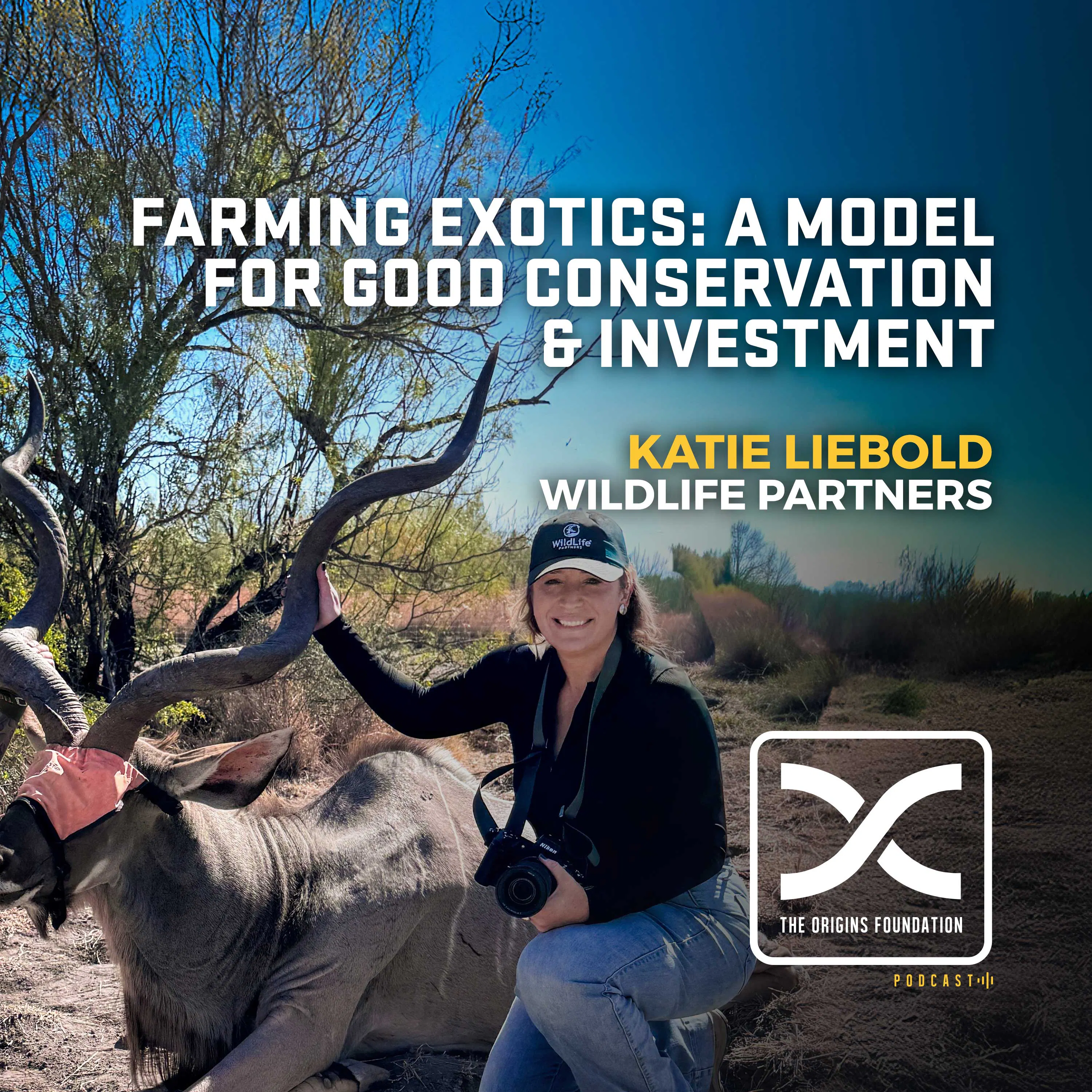
The Origins Foundation Podcast
Episode 624 - Wildlife Partners || Farming Exotics: A Model For Good Conservation & Investment
00:51:09
Ashlee is joined by Katie Liebold with Wildlife Partners, an investment and exotic wildlife farming and breeding group out of TX to discuss taking a capitalistic approach to wildlife. Their efforts have contributed to the recovery of multiple endangered and threatened species, while affording their clients an alternative revenue source.
Loading summary
Transcript158 lines
- [00:00]
FishingBooker Announcer
Planning a fishing trip shouldn't feel like a full time job. With fishingbooker.com you can find and book the perfect fishing trip within minutes. FishingBooker.com connects you with trusted fishing captains around the world. Booking is fast, easy and secure with access to verified customer reviews, loyalty rewards and around the clock customer support. Everything you need to book with confidence is in one place. So head to fishingbooker.com and start planning your next fishing fishing adventure today.
- [00:30]
Ashley Smith
Hi, guys. Ashley Smith, thanks for joining us today. We all know that farmers across America are making money farming and breeding livestock such as cattle. But did you know that you can do the same thing by breeding and farming exotic wildlife and help with the sustainability of certain species? Today we are joined by Katie Leibold with Wildlife Partners out of Texas. And we are going to talk about investing and breeding exotic wildlife, some of which are endangered and threatened, and taking a capitalistic approach to conservation. It's really interesting, it's really cool. And who knows, you may find a new. A new investment or hobby.
- [01:17]
Podcast Host/Announcer
So five years ago, there was a reason why I started this movement. And the truth then is the truth now that we need to champion our narrative. We need to champion the truth around what we do and who we are. There's a sweet spot with a gun, you know, too heavy and it's a.
- [01:33]
Katie Leibold
Burden to walk with.
- [01:35]
Podcast Host/Announcer
Too light and you whipping it. Why is the project so important to the hunting community?
- [01:40]
Katie Leibold
It's. It's a. I think it's not only important, I think it's. I think it's vital.
- [01:44]
Podcast Host/Announcer
I think it's, it's just in time. It's like snakes and ladders. You guys are climbing the ladder and then somebody does something stupid and you just slide that. That is such an amazing analogy. Snakes and ladders.
- [01:56]
Katie Leibold
Yeah.
- [01:56]
Podcast Host/Announcer
You know, ivory in, in my opinion was the plastic of its age. Okay.
- [02:01]
Ashley Smith
Expensive little going up.
- [02:02]
Katie Leibold
It goes a long way with families. We have families that do need it.
- [02:06]
Podcast Host/Announcer
Let me close this door because I have a little wiener dog. What? You are. You're laughing because I said wiener.
- [02:12]
Ashley Smith
I'm really glad you finished the sentence out. I'm sorry, the first happen. What are we doing here today?
- [02:19]
Podcast Host/Announcer
You're telling the whole.
- [02:31]
Ashley Smith
Wait, I know, I know. I like that. I can see the countdown. Robbie never gives me that when he starts it. And he's just. And I'll be like, wait, have we been recording? And he's like, well, we've been recording for three minutes. And I'm like, wonderful.
- [02:44]
Katie Leibold
Your nose. Yeah.
- [02:46]
Ashley Smith
Yes, yes, yes. Always, always. Something usually super embarrassing. But I. We are recording and I'm excited to have you on today. For all of our listeners, we have Katie Leibold and she is coming to us from. Are you in Texas today?
- [03:01]
Katie Leibold
I am, yeah. I'm at my home office in Bandera, Texas.
- [03:05]
Ashley Smith
Awesome. And where exactly is Bandera?
- [03:07]
Katie Leibold
It's about an hour north or northwest of San Antonio, kind of in the Hill country, so. So which is beautiful exotic wildlife headquarters, basically, of Texas.
- [03:18]
Ashley Smith
So exotic wildlife headquarters. So Katie is the vice president of marketing for Wildlife Partners and we are going to get more into that. But I am really happy to have her on the show today because she is going to talk to us about all things exotic wildlife farming, for lack of a better word, cultivating these exotic species. And there are so many of them. So I come from a background that is, so we're going to say vanilla in terms of animals and species. I grew up, started out pheasant hunting. Pheasant and quail hunting when I was young in Texas and Oklahoma, back when there were so many wild ones. And so I. And from a just professional world. I come from the, what I call deer, turkey, duck world. And that's, you know, mostly what I know about. And so you and I met at dsc, the DSC Summer show, and immediately hit it off because you're so cool and fabulous and have done all these really neat things.
- [04:30]
Katie Leibold
So you are. Right back at you.
- [04:32]
Ashley Smith
Well, you work for Wildlife Partners in this really amazing job, and I was so interested to find out how you got involved with them. You're also an unbelievable photographer. You have this wildlife photography profession on the side. So I want people to go check out your work as well. How. How can they follow you? Because you really do. You are truly talented. And what's your handle on social media if they want to go look at your stuff?
- [04:59]
Katie Leibold
Um, most of it is either going to be Wildlife Kate, if it's going to be for me personally, Wildlife Kate, or my website is my first and last name katielibel. Com. Um, and then I've got a few other. A few other things I dabble in as well, but the main one is just pretty much you can find me by my first and last name for pretty much anything. So.
- [05:17]
Ashley Smith
Okay, cool. Okay. So we are going to act like I know nothing about farming exotics. And. And that is actually fairly accurate because I don't know much about it. I know a little bit about what you and I talked about. We have a farm and we have horses and we have pigs. We used to have goats. And that that is a rather unfortunate story. So we're not going to talk about the goats right now, but we have p pigs and horses and that's the extent of my knowledge we actually have Right now we have a bunch of yearling bulls on our property, but we don't have any exotics. And I, ever since had I had a conversation with you, which is what precipitated this podcast, have been asking myself, why not? Because it sounds so cool. So just tell me first of all, tell me kind of in a nutshell what Wildlife Partners does.
- [06:14]
Podcast Host/Announcer
Look guys, I'm a hunter, right? And when I go hunting I I like to figure out how to get my trophies back home as expeditiously as possible. Well, you don't have to look much further than Safari Specialty Importers. We know that trophy importation can be quite a headache. That's why Safari Specialty Importers strives to make it as easy and hassle free as possible. They have access to a bonded warehouse, you won't be charged storage fees, and you get a dedicated team that's readily available and will update you at every step in the process. They'll even go one step further. Safari Specialty Importers is working with us and they are going to donate $100 from every shipment that they work with to conservation projects that include anti poaching, community development and wildlife conservation. At the end of the day, choose to spend your money with a team that's dedicated to you and is dedicated to helping show how hunting is a great conservation model. Hassle free logistics, fuel and conservation. Go with Safari Specialty importers. It is 2026 and my friends, big changes have happened in the world of firearm suppressors. The $200 tax stamp fee is now gone. Huge win for hunters, huge win for shooters, and a huge win for your wallets. If you're thinking about elevating your shooting experience and adding a suppressor. Silence Essential is the best way to to shop. And you don't even have to get off your couch to do it. Go to silenceessential.com, browse hundreds of suppressor options. They literally have all of the popular makes and models. Then their experts will walk you through setting up your account, creating a free NFA trust, and then submitting your application to the atf. Once approved, Silence Essential ships your new suppressor directly to your door. That's when you're going to have to essentially get off the couch. It's a game changer, guys. You haven't done it yet. Do it. The old days of waiting eight to 10 months on a suppressor are gone. It's more like two weeks. Some have even gotten their suppressors in shorter timeframes. It's never been easier to start shooting suppressed. Get started today by visiting silencer central.com it's really the simplest way to get your suppressors. Bushnell is eager to help you get set up for conservation success. That's right. They want to help you. The conservation and research community is dominated by good people doing good things and investing significant time and effort for the benefit of habitat and the species. So what do you need to do? Pretty simple. Send us your conservation story and or your conservation wish. Could be managing whitetails, could be understanding your environment or species or something else related to conservation. What would you be able to do if you had a great trail camera setup? We will select the best story every other month and send you a camera bundle. Cell camera, normal SD camera, SD cards, as well as optics. Everything you need to get set up for success. I can't wait to see what you submit. You can email us, DM us, message us whatever you want. We are not hard to find. Good luck.
- [09:23]
Katie Leibold
Sure.
- [09:24]
Ashley Smith
And that's a big question. So feel free to talk for as long as you need.
- [09:28]
Katie Leibold
Okay. Yeah, no, it's got, it's got a couple different elements. So Wildlife Partners is essentially the largest breeder and broker of non native wildlife in North America. And so we've been in business since 2016, so about going on 10 years now. And we have four ranches across South Central Texas totaling about 12,000 acres, about 5,000 animals total. And all of those animals are owned by investors.
- [09:54]
Ashley Smith
Okay.
- [09:54]
Katie Leibold
And so if you're an investor and you want to invest with us, when the animals are raised for breeding purposes, they're 100% tax deductible. So if you don't have your own ranch, you can, it's kind of an alternative investment that you can invest with us. We house your animals. You physically own animals on our ranches. We care, take them. And in return, the animals, thanks to bonus depreciation, are 100% tax deductible in the first year.
- [10:19]
Ashley Smith
A hundred percent tax tax deductible in the first year?
- [10:23]
Katie Leibold
Yes, yes. Thanks to.
- [10:25]
Ashley Smith
Kind of amazing.
- [10:26]
Katie Leibold
Yeah, no, it's, it's. And that actually the bonus depreciation was sunsetting until this year with the passage of the big beautiful bill brought that back to 100% in year number one because it was sunsetting from 2017. So this year's been a big year for the Industry and kind of, you know, fueling more growth with the passage of that bill and returning that to 100%. And then so the partnerships, they're structured in six year terms and then so you own your wildlife and within those six years they're going to produce offspring. And so that cash flow is the investment because we then sell the offspring on the backside to ranch owners throughout Texas and different parts of the country that are doing the same model, except they're doing it on their own property in their own ranch and they're, they're capitalizing on the same tax incentives, but they just have their own property to do it on. And so on the front side, we have our investors, they invest with us, they own animals, they get to participate in some elements of wildlife conservation because we do raise between 10 and 15 species that are on the endangered or critically endangered list. So that's a really cool and fun element that our investors really like. And then it's also for them considered active participation. And so they actually get to come out to the ranches, stay in our lodges, see their animals. Um, so it's, it's a really cool model in that sense. And then within that, so we've got our investors on the front side, our ranch clients on the backside that purchase the offspring that our invest Joan animals produce. And then within that, we also host several different events throughout the year. We've got two live auctions, we do an annual day of education where we bring in six to eight different speakers and they present on just different topics for the industry, whether it's vet care or feed or any insurance, all of that kind of stuff. And then we recently this year launched our, what we're calling Wild about Taxes. So it was a eight hour seminar exclusively dedicated to how to get the most tax benefits out of your wildlife investment, whether you're an investor or a branch owner. So we've got a lot of like really cool educational components that I really liked that we, I saw that, I.
- [12:32]
Ashley Smith
Saw that being advertised and I think it looks like you had a full house for that.
- [12:36]
Katie Leibold
We did, yeah. We ended up between in person and online. A little over a hundred people participate, which for a seminar exclusively about taxes. That's I feel like.
- [12:45]
Ashley Smith
Right, right. Usually you have to pay people to attend that.
- [12:49]
Katie Leibold
So.
- [12:50]
Ashley Smith
Okay, so how. So people can either basically invest in these species that you guys raise on your ranches and they can essentially own a piece of an animal. Um, so they almost kind of have a ownership share in these animals that you guys house, you take care of Them so they don't have to do the work. Um, they just have a value in these animals or they can buy offspring and own them themselves. Right. And take them and then they're, they have them. So like I could for instance, go buy what, like how many species do you guys raise in total?
- [13:28]
Katie Leibold
So we've got anywhere from 35 to 50. It just kind of depends. You know, there's some species that are very, very unique and there' a lot of quantities of those. But on average we've got, you know, 40 or so that we're reactively raising on our ranches. And like I said before, like 10 to 15 of those are either critically endangered or endangered, such as like the Grevy zebra gama gazelle, things like that. So there's a lot of options. And for our ranch customers it really, you know, depending what they're going to put on their ranches, really depends on their location regionally, um, what kind of habitats they have, how big it is. Um, but there's really options from super small. I mean if you have like say 2 or 3 acres, you could raise hog deer which are like a miniature, miniature deer, um, or things that small animals of that nature and they can be on your, you know, small ranchette and you can still structure it as a business where you're breeding these animals and, and capitalize on those tax benefits all the way up to, you know, if you have a 10,000 acre ranch, you can have kudu, you can have sable, you can have cape buffalo, it if you want. So.
- [14:35]
Ashley Smith
So you guys have Cape buffalo?
- [14:38]
Katie Leibold
We do, yes. We actually have the largest herd in North America.
- [14:41]
Ashley Smith
Do you really?
- [14:43]
Katie Leibold
We still do. I think we're still holding that title. Um, we've got a herd at our ranch in pettis that's about 45 individuals, which is quite a lot of cake.
- [14:51]
Ashley Smith
Oh my goodness, that is quite a lot. That is crazy. Um, okay, so I, I, I just. Okay, I have so many questions. So you have 40 to 50 species depending on, you know, the year or, or whatever's going on and then 10 to 15 critically endangered. Are most of these species African species native to Africa?
- [15:14]
Katie Leibold
Which are they really going to be? Your African hoofstock, your antelopes, you know, gumsbug, buzzbok, springbok, zebras, gazelles, all of that kind of stuff. But we do have some Asian species that are kind of in the deer and things like that. It just kind of depends. But the majority is African hoofstock. Yes.
- [15:33]
Ashley Smith
And is that because the topography and the climate mimic Most closely the Texas Hill country and the lower South Texas. Is that because that climate and geography mimic more closely that of Africa? Why? You know, what's the connection there?
- [15:52]
Katie Leibold
Yeah, I mean, that's, that's basically it. I mean, it is kind of the ideal habitat for them that mimics where they come from originally. And so all of those species do very well here. And they, they just, I mean, they, they survive quite well, they reproduce very well, and it doesn't get too hot, doesn't get too cold usually. So that's, that's a big reason why. And, and it's just kind of what the industry's grown towards with some of the hunting component as well. You know, people want to find some of the African species without having to go to Africa, which. That's a whole other topic.
- [16:22]
Ashley Smith
But, yeah, yeah, and I want to talk about that a little bit as we get into it. But so as far as the critically endangered and the endangered species, I know, like, with regard to import and export and CITES and all, that's really hard. Like, how. How did you guys come to be able to secure these endangered species? To be able to. Was it, was it so that you could help promote the species, like, sustainability? I mean, like, was that one of the goals of the organization?
- [16:56]
Katie Leibold
So I think what would be a better way to structure that is. Let me start with kind of a brief history of exotic wildlife in North America. Yes. Kind of build from there. So the way that this industry was kind of started was in the 1930s actually, so quite a long time. Almost a hundred years ago now.
- [17:12]
Ashley Smith
I had no idea.
- [17:13]
Katie Leibold
Yeah, so it was with the King Ranch, acquired some nilgai antelope from a zoo in California and turned them out on their ranch, the world famous King Ranch that's down in South Texas. And they were essentially just free ranging there. And this population grew and did very well. And as time went on, other ranches kind of began to do the same. And species that had been brought in and kept in zoos and things like that, while zoos were running out of space for them, didn't have anywhere to go with their offspring that they were producing. And so that's when private ownership kind of came into the picture. As we moved through the mid-1900s and whatnot, and then into the 1970s and 80s, the industry was getting quite a bit larger and really expanding and people were, you know, growing these herds of animals and things like that and moving into the 1970s, all imports. That was a big time when all imports stopped from, you know, other Continents and things like that due to foot and mouth disease. And so.
- [18:12]
Ashley Smith
Okay, I was wondering, because I remember, or I don't remember because I wasn't born in the early 70s, but I knew that it had, but I wasn't sure why. So.
- [18:22]
Katie Leibold
Yeah, so that. So a lot of people ask, well, why can't you just get more animals from Africa? Why are these ones here so expensive? You know, because the retail value of, say, a kudu or female sable is 40 to $50,000 each. And so people are like, well, can't we just bring in more? Can we just bring in more? Well, no, you can't. And you haven't been able to since the 70s. So what we have here, they've never reopened it? No, no. So there's been no exports of. Of African hoofstock in to the country since then. And so that's why what we have here, like, that's it. And so it's. Yeah, so it's, you know, it's a big responsibility for private landowners and whatnot to properly manage their herds and genetics and things like that, because we're not going to have any diversity coming in anytime soon. So. So that's kind of how that progressed. And then moving into the, like, through the 70s, 80s, 90s, I mean, the industry just kept growing and growing. And one thing that kind of skyrocketed the market prices was in 2017, they passed the Tax Cut and Jobs act, which made bonus depreciation 100% in the first year. And so the exotic wildlife are actually considered livestock in the eyes of the irs. And so they're classified the same as you would treat a cow or a horse or something like that. And so in 2017, people were, you know, people attack Spanish problems were just buying up these animals like crazy at that point, because you could fully deduct the purchase price in the first year. So that was, you know, pretty big deal for the market. And it's continued to climb, and it's leveled off a little bit since then in the last couple years, but it's. It's been a pretty big deal. And so in 2007 was the last economic impact study that was done on the wildlife industry. And at that time, it was a $1.3 billion industry in North America.
- [20:09]
Ashley Smith
Why has no one done an economic impact study since 2007, 20 years ago?
- [20:16]
Katie Leibold
Yeah, no, it is. That was almost 20 years ago, and it was 1.3 billion then. So you can imagine now. And with the big boom in the. In 2017 there, I think. I think they're working on another one that's supposed to be coming out sometime in the next year or two, and I'm excited to see how that compares to 2007.
- [20:34]
Ashley Smith
Yeah, yeah. Who did the one in 2007?
- [20:37]
Katie Leibold
I believe it was Texas A and M. Okay.
- [20:39]
Ashley Smith
Okay. Well, good on them. And I hope they're doing another one.
- [20:42]
Katie Leibold
Yeah, I think. I think. Last I heard.
- [20:44]
Podcast Host/Announcer
I think.
- [20:44]
Katie Leibold
I believe they are.
- [20:45]
Ashley Smith
Okay. Okay. Okay. Okay. So crazy. So. So all of the importing stopped in the 70s. You haven't been able to do so since. So so basically I say you guys, because you're in the industry, has been responsible for all of the sustainability of these herds since then. Are there any species that. That have been able. You've been able to ex import since then?
- [21:13]
Katie Leibold
I don't believe so, but I'm certainly not an expert in that area. There may be some from different parts of the world outside of the African continent.
- [21:21]
Ashley Smith
Not Hoofstock, though, so.
- [21:23]
Katie Leibold
Right, okay. So I'm not. I'm not gonna speak to it because I'm not super proficient on all of those details.
- [21:28]
Ashley Smith
Right. There's a lot. I know there's a lot of different.
- [21:31]
Katie Leibold
Yeah, as far as.
- [21:33]
Ashley Smith
Yeah, we're not going to talk about herpetology or anything like that, but like, as far as the ones that you raise.
- [21:37]
Katie Leibold
Yeah, as far as what we're raising, there's been no imports of those in recent years. So.
- [21:42]
Ashley Smith
So for the endangered, Critically endangered, threatened species, has there been any effort? Once. Because you guys have had a lot of success. I know from reading on. On bringing these species back to a. A really viable herd. I don't even know what the right word is, but, like, is there any talk of sending some of them back to Africa to help them over there? Because I would. You know, arguably, you guys are having more success in Texas than they are in some parts of Africa.
- [22:17]
Katie Leibold
Yeah, there's actually two success stories that are pretty cool. And then a third one that just happened this year, which is huge deal. And I'll get to that. One last. But. So in one example is going to be. In the 1970s, the Arabian oryx was declared extinct in the wild. And those, you know, those are originating from the Arabian Peninsula. And by the mid-1980s, they had done, you know, private landowners, in conjunction with zoos and different facilities here in the US and also some in Europe and things like that, established what they called the world herd. And they were able to reintroduce that group back into the wild in the mid-1980s. And then because they had kind of people had gotten serious there in that, in that region about wanting to reintroduce them and conserve them. And so they had made some, some conservancies for them and whatnot. And so they were reintroduced successfully back into the wild in the 1980s. And that herd is still maintaining today and is considered stable.
- [23:18]
Ashley Smith
Oh, nice.
- [23:20]
Katie Leibold
Some of the kind of first examples where animals actually got, you know, captive raised animals got re exported successfully back into the wild and they're no longer classified as extinct in the wild at this point. The other example of that was the Simmentar oryx. And so those were reintroduced in Chad in 2016. I believe they were considered extinct in the wild in the early 2000s. They were re released in Chad and other parts of North Africa in 2016. And that's another example of they're stable now, they're reproducing. You know, they're, they're not considered extinct in the wild any longer. So those two are good examples of where private land ownership outside of their native habitat has recovered those species from being extinct in the wild. And then one that I'm very excited about just this year, the Kenyan mountain bongo is one of my favorite species that we really like.
- [24:15]
Ashley Smith
What is a mountain bongo?
- [24:17]
Katie Leibold
First of all, it's a very cool antelope, that these ones are from the mountains in Kenya and they are just absolutely beautiful. They're a spiral horn antelope. They're a dark chocolate brown and they have these magical golden eyes. And they're actually one of the only antelopes that don't make any sound, which is wild. Really? Yeah. So they're some of my favorites. And in the wild there's less than a hundred, but they really don't know because they're very, very elusive. They're nocturnal animals and they live in, you know, the jungle forest area. So it's very hard to figure out exactly how many even still exist. But this year they exported about 17 individuals back into Kenya and really there. Yeah.
- [25:02]
Ashley Smith
So was that from some of your.
- [25:04]
Katie Leibold
Ranches at this time? It was not. That was some efforts with some private ownership in Florida and whatnot and other groups. So. But that was, that was pretty exciting news. I like to see that because, you know, those are some of my, my personal faves. So.
- [25:18]
Ashley Smith
Yeah. Yeah, that's really cool. That's really cool that they're doing that. I love, I love to see private partnerships helping public conservation, you know, benefiting and, and I like to see the world working together, you know, countries Working together, back and forth with. To help. Because, I mean, now it is really truly a global conservation effort. We have to work. You know, I feel like, yeah, in decades past, it was kind of like every country for themselves and now you can't think that way anymore.
- [25:48]
Katie Leibold
Yeah, no, that's not, that's not an option at this point. And we get a lot of feedback on, you know, some of our social media and things of like, just let them be wild and, you know, take them back where they came from. And I'm like, okay, well, this guy was born and raised in Texas and, you know, taking him back where he came from is not, that's not even. We, we can't come back to Africa. Like, that's not even a.
- [26:10]
Ashley Smith
Well. And the models of conservation are so different in the different countries in the different continents. And so you have to look at, you know, how they're managing wildlife in Africa is so different than how we manage it in the United States. And the situation with poaching over there in different places and, and even between each country in Africa, there's a chance that they might not fare so well in some of the countries versus others. And so, so when you say a particular rancher or landowner approaches you guys and says, hey, I want to. I would really like to purchase a couple of exotics for my farm, I don't even know where to begin. So what, what are the first steps and do you help them evaluate what would be a good fit for their area? Let's say they are up in Kansas. How do you figure out, like, what their property can hold or, you know, is there like a process that they go through?
- [27:11]
Katie Leibold
Um, so there is, yeah. So we've actually got a sister company called Wildlife Ranch Solutions, and that is what they do, is they will get with you. If you hire them, evaluate your property, they can build you an entire business plan. Because the business plan is really essential to make sure that you're documenting everything for the tax benefits. And so they can develop your business plan, they'll go out to your ranch, they'll consult, they'll. They can even go as far as, like, we're going to put a fence here, we're going to put a water trough here. I mean, it can go down to the absolute. I mean, they can build your entire.
- [27:42]
Ashley Smith
Facility for you so that you don't buy this really expensive commodity, basically, and then have it die within like a year.
- [27:52]
Katie Leibold
Well, and, and there is a lot that goes into that as well. And a lot of our salesmen are also really Good with this. And they can go out to your place and consult if you're not quite ready to commit to a full on, you know, meal deal with Ranch Solutions. But there's a lot of strategy around what animals can cohabitate with each other, what kind of pastures they need. You know, so for example, like a kudu likes a really brushy habitat, whereas a sable is kind of more plain skin. They like to be more wide open. Certain animals you don't, they can cross breed. So you don't want to put, you know, the wrong, like a nyala and a kudu and crossbreed. So you don't want to buy that and make a hybrid animal, which is not the goal, obviously.
- [28:32]
Ashley Smith
So you don't want any little weird.
- [28:35]
Katie Leibold
Little puppies totally frowned upon. So we try to avoid that at all costs. And so, yeah, so. So between either Ranch Solutions or our sales staff, if you're brand new, have no idea just starting out, they can literally take you every step of the way and consult on, you know, how to, how to do A, B, C, D from the very beginning. So we've got that, that option, which I think is really great because you can't find that hardly anywhere where, you know, you don't want it. Like you said, buy a super expensive commodity. And then you're like, well, I put my kudu out here and now I haven't seen him in three months.
- [29:10]
Ashley Smith
Disappeared. He is Hobner Vent, and he is, you know, four counties over. Okay. Do you ever have anybody approach you and like, you know, say somebody from Michigan and they're like, we want this. And you're like, sorry, buddy, you've got snow, you know, half the year and they're not going to survive. I mean, do you ever have to tell people, like, we don't think they're. Yeah. For you to buy in with us and come visit. Like, do you ever have to turn away on owning? I mean, because I'm sure people get really excited and they're like, oh, we, you know, want to have so and so, you know, species, because it's cool, but maybe isn't necessarily the perfect option for their, you know, geographies or climate.
- [29:55]
Katie Leibold
Yeah. So we do have to turn people down on occasion or, and, but it's, it's not necessarily that we don't have anything that can suit those kinds of climates because we do have, you know, certain species from Asia and things like that, like mark or the mark or goat, which can thrive in a colder habitat. So if they are, you know, in like North Dakota or something like that. We can give them alternative options. Yeah, but we're never going to be like, sure, here's your 10 and have any like, you know, whatever is that. Hate snow and good luck, see you next time. So that, that never happened. So there's times when you have to be like, okay, you know, your location is not suitable for these specific animals. But we can offer you, you know, these animals that like Himalayan tar, things like that. So, so there's lots of different options. And we.
- [30:38]
Ashley Smith
You guys have Himalayan tar?
- [30:40]
Katie Leibold
We do, yes.
- [30:42]
Ashley Smith
That is so cool. So they thrive in the hot climate down in Texas as well.
- [30:47]
Katie Leibold
I'm going to say it's maybe not their favorite, but they do well. Yes. I mean I'm sure they would prefer.
- [30:51]
Ashley Smith
They're ready to get out. They're ready to get out of there.
- [30:53]
Katie Leibold
And head north for a permanent summer vacation for them. But they do do well. Yes, we've got, I think we've got three or four herds of those at this moment. And we've also got the only pure, pure blooded herd of Cree, Cree ibex or the Cretan ibex from Greece. That's the only North American herd of those. So those are very cool as well.
- [31:15]
Ashley Smith
So cool. Okay, so do you guys allow hunting? Here we go.
- [31:20]
Katie Leibold
So, okay, yeah, no, we, we do not do any hunting on any of our wildlife partners ranches. Aside from, you know, some whitetail management, things like that. Just to. Just because it's within the high fence necessary, we're not, you know, necessarily opposed to hunting. Hunting has its place in the, within the industry and whatnot. And, and you know, some of our customers that buy on the back end are hunting ranches. But contrary to popular belief, the majority of ranches that raise exotics are not hunting ranches. A lot of, I think, oh, it's just high, high fenced can hunts everywhere, the whole thing. And it's honestly the majority and which we're talking close to 6,000 ranches and just Texas alone. The majority are raising them for the joy of owning the animals and for the tax benefits that come along with that.
- [32:08]
Ashley Smith
Okay, well good. You just made it a lot less controversial.
- [32:12]
Katie Leibold
Yes. Yeah. And that's a misconception where people, you know, the initial impression is just, oh, high fence hunting ranches everywhere or you go in Texas. But a lot of them aren't. It's a lot of our clients are very wealthy landowners. And I'll give you a quick example of like if you, let's say you have a ranch here or I Mean, even the ranch you have. So say, let's say Ashley's construction company has a million dollars worth of taxable income for 2025, and you're in the highest hypothet bracket, which is 37 and a half percent. So your, if you have a million dollars, your tax obligation for the year is $375,000 that you're gonna have to write a check to the irs. So say Ashley's construction company also has a hobby ranch where they go on the weekends and they have fun. And seven, that ranch is not currently earning you any tax deductions for the year because it's just a fun thing where you take the family on the weekends. So if you take that ranch, structure it as a wildlife breeding business, get your business plan, obtain $375,000 worth of exotic wildlife, you build your roads, you build your high fences, things like that, which all of that is also tax deductible in addition to the purchase price of the animals. So you've gone from, you've taken your ranch, turn it into a business where it will have tax benefits, you know, indefinitely from being a wildlife breeding business and now you don't have to write $375,000 to the IRS for 2025.
- [33:41]
Ashley Smith
Right, right.
- [33:42]
Katie Leibold
Yeah. So that's.
- [33:43]
Ashley Smith
And, and why, if those animals are providing you with the tax benefit, would you want to go then shoot them? Unless they're reproducing so fast that you have so many that, you know, you've reached a sustainable management level to be able to do that. But I can imagine that that would take a while to get to for a lot of these people.
- [34:03]
Katie Leibold
Yeah, most, most of these animals will have one calf per year, except for some of the smaller species will have one every. Some of them can have seven or eight months a calf every. Every that time period. But, but yeah, so a lot of it, you know, I mean, if you're talking about one calf per year and females have a very high retail value, the only time you see when people need to start doing management is when they get several bulls within a herd because they'll start fighting and whatnot. And then that's not a, not a good situation for anybody. And so that's when you, you have a capture team come out and move those animals out. So, so yeah.
- [34:36]
Ashley Smith
So how did you get into this business?
- [34:40]
Katie Leibold
It's actually a wild story, and I got into it completely by accident. So I've been with Wildlife Partners for about four, four years. A little, little over four years now. And Prior to working here, I had my own design and marketing business and I specialized in equine sports and like farming and ranching. So I grew up in Arizona. My cat, right. My parents were cattle ranchers, had a cattle feed lot, we had horses, sheep and goats, things like that. So I have a very extensive background in raising animals as commodities in that sense, and then raising horses for sport and competing on them and things like that. And so in 2021, I was kind of in a transitional place in my life where my business was doing well, but I've had some big life changes and I was wanting to move to Texas anyways. And I've always loved Texas. And every time I'd ever visited here, like it always felt like home. Like I was like, I'm gonna live here someday. And so in 2021, I was shopping for a place up near Dallas, kind of in the, in the like Weatherford area and whatnot. Cause there's a very high concentration of equine facilities there. So I'm like, I'll set up camp here, expand my business further. And so I was house shopping at that time period and looking for places. And it was just a nightmare because it was when the market was just bananas and you know, I'd put in, people were putting in offers, fifty to a hundred thousand dollars over asking price and just you had like a 15 minute time slot to view properties and things. And I'm like, this is ridiculous. And so I was. I'd been searching for a couple months and staying with some friends up there. And out of the blue a friend of mine that I'd known from the equine industry in Arizona calls me and she goes, hey. And I hadn't talked to her in probably six years. And she was dating one of the ranch managers here at Wildlife Corners at the time. And she's like, hey, I heard you're trying to move to Texas. And I'm like, well, how did you hear that? Like, I haven't told anybody that. You know, at the time it was kind of on the down low. And she goes, well, do you want a job? And I was like, I kind of laughed. And I was like, well, I was like, I mean, I have my whole business, but I'd known from her social media that I'd seen, you know, like some exotics on her on her social media and like zebras and things like that. And I'm like, what all those guys got going on down there. The time I used to get out, I knew zero, I didn't even know this industry existed. I mean, I was aware of like hunting ranches and things like that, but I didn't know the extent of what I was getting myself into. And so I was, I was like, well, I was like, I don't really need a job. I have my whole business that I've had for 10 years and I'm still growing it and building it. And I was like, but, you know, tell me about it. What do you. What is it? And so she's like, the job is. And it's, it's funny. Brian and Chris, the co founders of the company, we laugh about this because it's like an entry level position into the company, but it's actually one of the coolest positions. And it's not considered entry level anymore because we've grown so much since then. But it's the role of inventory manager. So basically the job was live on the ranch and drive around every day looking at cool animals, that is.
- [37:39]
Ashley Smith
And counting them, right?
- [37:41]
Katie Leibold
Yeah. Basically you're documenting births, if there's any deaths, you know, monitoring their health, things like that. Which, which all that translated over for me from raising cattle and whatnot. And like, I mean, I had all of that knowledge and it basically translates right over into the African Hope stock. And so, so there is a job.
- [37:59]
Ashley Smith
That exists that is to ride around on an ATV or a golf cart or truck or whatever and look at beautiful exotic animals and every day and inventory them and check on them. That. That is so many people's dream job.
- [38:15]
Katie Leibold
Yes, yes, it was for where I was at my life. So I. So she tells me about it and I'm like, so you're telling me you're gonna pay me to just drive around here and look at animals and no one's gonna bother me? And like, I just hang out and it's like, beautiful, this beautiful 2,000 acre ranch kind of deal.
- [38:32]
Ashley Smith
Did you come with a place to live?
- [38:33]
Katie Leibold
Yes. So she got it comes with housing, all your utilities, your Internet paid, you know, so and so 401k, health insurance. And I'm like, what? All right. I was like, I'll come down and check it out. And so I end up driving down like the following week, I think, and we're riding around the ranch and I'm like, okay, so tell me again. I'm like, you're going to pay me, right?
- [38:57]
Ashley Smith
What's the catch?
- [38:58]
Katie Leibold
What's the good drive around here and look at all these badass animals. Like, there's krabby zebra, there's bongos, there's I mean, just. Oh, my gosh, that's where the Cape buffalo are as well. So I was very fortunate that I got to kind of be there over, sort of caretaker for a bit.
- [39:12]
Ashley Smith
That is so fun and so cool.
- [39:15]
Katie Leibold
Yeah. And so I ended up taking the job and I ended up for about a year and a half period, I was doing both. So I would do the ranch job, you know, during certain hours of the day, and then I would. So I was working about 14 to 18 hours a day maintaining both my business and. But the ranch thing, every time, you know, that was kind of a breath of fresh air to get away from my other stuff. So it all went really well together. And so I did that. And then as time went on, the one funny thing that happened. And so I've progressed since then, obviously, to vice president of marketing. But the turning point for that was we had our fall auction, and I'd been working here for about a month, and there was an email that went out that said, hey, like, can our staff give us feedback on the fall auction? And I was kind of like, and I'm, you know, have extensive background event planning and all of that kind of stuff as well. And I was like, hmm. I was like, well, I've, like, got some good feedback, I've got some bad feedback, but I'm like, I'm brand new here. Like, who am I to say anything? And so I was like, you know what? I'm just gonna give em an honest review and see what happens. And so I type out this big, huge email, and it's got like, all the positive, a couple of things. I was like, I would do this differently. I would do that differently. And it was like radio silence for like a week. And I'm like, oh, my God. Like, I shouldn't have said anything. Like, that was stupid. Like, why'd you open your stupid mouth? And then like a week later, I get a call from the CFO at the time, and he's like, hey, I need to meet with you. And I was like. And that's all he says. And he's like, I'll be down there tomorrow at the ranch and let's. Let's meet. And I'm like, that's it. I'm gonna start packing my bags. I was like, I had a line. And he goes, you know, we. We really liked your email you sent about the auction. And I was like, oh, okay. I said, well, no one said anything, so I didn't know if that was well received or not. And he', no, no, it was. And I was like, okay. And he goes, would you be interested in taking over planning all of the events? And I was like, oh, okay. And he's like, you could still work here on the ranch, but you could also do that in addition to that. And at the time, we had the two auctions, and then we were just going to do the first, I think that year, the next year was the first year for the day of education. And I was like. I was like, yeah, absolutely. I would love that. And so I was like, that sounds great. Well, then as more time went on, I was just going bananas with my photography because this was like a brand new thing for me. Oh, yeah. Well, some of my photos got to Brian and Chris and then they realized they're like, oh, we have, like a real photographer working here. And so then I kind of progressed from there. Well, then they found out about my background and, you know, all of the other things that I. I had skills. And they're like, well, we actually really need somebody that can do all of that. And so it's just progressed from there.
- [41:52]
Ashley Smith
To where, My gosh, they had no idea how overqualified you were for the annaries person.
- [41:57]
Katie Leibold
And I was just living the time of my life with my camera out on the ranch. Just like, I'm like, this is the best.
- [42:03]
Ashley Smith
That is amazing. And now you are doing all the marketing for everything. And y' all are so huge. How many acres total do you have.
- [42:12]
Katie Leibold
Down there between the four ranches? It's a little over 12,000 at this point.
- [42:17]
Ashley Smith
Okay. That is so cool. I want to be put on the list for to come to an event. I'm dying to see at least one of these ranches. Whichever one you think would be the coolest one. I want to come down and ride around with you and pretend like we're inventory managers again.
- [42:34]
Katie Leibold
Yes. I love to pretend like I'm an inventory manager. And life was much simpler as I can imagine.
- [42:39]
Ashley Smith
I know. Can I take a few months off and just go do that?
- [42:42]
Katie Leibold
Somebody's like, out sick. I'm like, I'll do it.
- [42:45]
Ashley Smith
Yeah, exactly. I. I'm still. I'm just so fascinated by this entire industry. And I'm rethinking, like, why do we have horses and pigs when we could have, like, kudu? Except for. And I want to get your take on this. So you grew up in the equine and just kind of. We're going to call it regular, not regular, because there's so much work that goes into that. But what is the Biggest difference between like cattle and just horse, you know, regular, what we call good old American livestock, Livestock farming and exotic farming. What would you say the biggest differences are for somebody considering maybe getting into it or shifting gears or diversifying?
- [43:28]
Katie Leibold
Yeah, so there's, there's a couple things to consider with that. So I'll start with the positive. The positive being for, you know, depending on the species you're raising. So say you're raising a hundred cows that consume X amount of forage per day. If you raise an exotic species, you might be able to have a higher return on your money with a much lower overhead because they eat less, they're small, they do eat less. Yeah. So they eat definitely.
- [43:54]
Ashley Smith
Than horses. Right, because horses don't eat everything.
- [43:56]
Katie Leibold
Yeah, I mean the horses and cattle are going to eat significantly more than most of the exotic species are going to. So you can have a herd of say like 20sable or something of that. I'm just using rough embers, but that will, you know, be equivalent revenue as 100 or 200 cows or something. You know, I don't know exact math, but where you're feeding less, mouths less, you know, overhand with all of the different expenses and things like that. So if you have a smaller ranch, you can have less quantity of animals, but they're higher value, they produce a higher value offspring. So, you know, there's that element. And then on the, I don't want to say negative side, but on the flip side of that is you can't work these animals like cattle or horses. You know, you can't run them into a chute. You know, if you're going to capture them, you have to dart them and move them and have pretty good extensive knowledge on that. Which, which is kind of can also come in with. We've got two full time catch crews, a helicopter, you know, all the necessary things that go, go around capture.
- [44:58]
Ashley Smith
Is that the best way to gather them with a helicopter?
- [45:01]
Katie Leibold
And then.
- [45:01]
Ashley Smith
So it just, it depends what's easiest on them.
- [45:04]
Katie Leibold
Well, so, so we have some smaller species and things condensed down to smaller, you know, 10 or 5 to 1015 acre pens. And in there you can drive the buggy in or the can am and dart them from the ground. And then you just walk up on foot and, and you can, you know, tie them up and move them that way if they're on 500 or a thousand acres or you know, 5,000 acres.
- [45:25]
Ashley Smith
You can't find them.
- [45:27]
Katie Leibold
Yeah, you can't find them. You can't even get close enough. Half of the Time to get a dart in them anyway. So that's when the helicopter would come in. You know, it's usually a pilot and the guy darting. Sometimes they'll do what they call net gunning, which is where you launch a net at them, and then there's a team on the ground that swoops in and grabs them. So there's drones.
- [45:45]
Ashley Smith
Do you guys use drones to find them ever?
- [45:48]
Katie Leibold
So we do, actually. Yeah. So each ranch is equipped with a thermal drone that the inventory managers can use for thermal surveying. So they, like, if there's a really brushy pasture or, you know, we want to just get a really certain count or number, they can throw up the drone video the entire process, and you can actually see, like, differentiate on the thermal between, like, a kudu or sable or different species and things like that, and adults and juveniles and things like that. So we use it for that element. And then also to encapture if there is a concern where maybe they'll run into thick brush or something of that nature. We will put the drone up and. And you can actually, like, lock it in on them, and it'll sit there and kind of, you know, like, hover over them and whatnot until you can get there.
- [46:29]
Ashley Smith
So it's amazing how effective those have become for finding. And even the biologists at the various wildlife agencies have started using them for data collection. It's fascinating to me how much those thermal drones have able to increase our knowledge and just scientific data collection on these animals. So I'm sorry, you guys.
- [46:53]
Katie Leibold
Very cool. And then this year, I've been stealing them and using them for media purposes, which I've been RVing a blue.
- [47:01]
Ashley Smith
Can you. Can you fly it? Have you learned to pilot the drone?
- [47:04]
Katie Leibold
Yes, yes, and I have.
- [47:06]
Ashley Smith
Sure.
- [47:07]
Katie Leibold
Knock on wood. I have not crashed one. They're like $5,000 a piece.
- [47:10]
Ashley Smith
Oh, I know. Gosh, it's terrible when they crash.
- [47:14]
Katie Leibold
But I. I've shot some very, very cool drone footage this year, and I'm just kind of getting started with all of that. So I'm like, this is so. That's an absolute blast for me. So.
- [47:24]
Ashley Smith
I bet. I bet. Well, this has been fascinating. I am so interested in this. I'm dying to get into the field. I'm gonna have to talk my husband into it, so I may have to get him to one of your tax seminars.
- [47:36]
Katie Leibold
He's.
- [47:37]
Ashley Smith
He. So I joke. I heard the term the other day. Someone was talking about a lady who lived down on a farm, and this was from a city. City folk. I was in a Pilates class, and there were these ladies talking, and they'd been to her farm and talking about how she had turkeys and donkeys. And they said, what does she do with all those animals? Another lady goes, she just collects animals. And I was laughing to myself, and I thought, I love that term. That's me. I like to collect animals. So we have all these different things, and he's just gonna. If. You know, when I first brought it up to him after you and I talked, I was like, we. We really need to invest in some of these exotics. Like, it will really help with taxes. And he was laughing, and he was like, whatever. You know, this is just one of you. This is an attempt at you to get me to buy more animals. And I was like, no, I'm serious. I'm very serious about this. And so I'm gonna have to, like, print out the literature for it. Actually, I think I'm gonna have to get somebody besides me to tell him that I'm not making this up. Like, yeah, we need a zebra. We need a zebras.
- [48:37]
Katie Leibold
Yes, yes. He'll need. You need to get him to come to visit our booth at SCI or something. And he can get the rundown from Brian and Chris of the whole. The whole. We'll just trap him in there until he agrees.
- [48:47]
Ashley Smith
Exactly. Well, our Conservation One event is going to be in San Antonio in March, and so.
- [48:52]
Katie Leibold
Oh, that's right. Yeah.
- [48:53]
Ashley Smith
Okay. Yeah. I feel like we'll be close to your ranches down there, so maybe we can take a field trip.
- [48:58]
Katie Leibold
Oh, that would be a good time, too. Yeah. Because in March, we're done with all of our traveling and conventions and whatnot. So I'm kind of back.
- [49:04]
Ashley Smith
Back.
- [49:04]
Katie Leibold
Had bag at headquarters at that point, so. Yeah, no, that would be great.
- [49:07]
Ashley Smith
And I'll get to see you at a bunch of the conventions, so I'm looking forward to that. We'll get to. We'll get to hang out, so. Well, I appreciate you coming on today, and thank you for sharing all of your knowledge. I hope that everybody goes and finds Wildlife Kate on Instagram and social media, because she. She truly takes some remarkable photographs. You are very talented and just delightful to hang out with. I'm so glad to have met you and made a new friend. And just thank you for being on with Origins Today. And you guys just keep up the good work because I think it's really, really cool what you guys are doing and just helping with the sustainability of these different species.
- [49:43]
Katie Leibold
Yeah, thank you. I appreciate all of that. And this has been fun. I was when you mentioned it. I've been looking forward to it. So I'm glad we finally got to do it. And, yeah, it's been great. Good deal. All right.
- [49:53]
Ashley Smith
Thanks, everybody. Thanks for listening.
- [49:55]
Katie Leibold
Bye.
- [49:56]
Podcast Host/Announcer
Well, that's it for today. I appreciate you listening, as always. Leave a review, share it with your friends, and most importantly, do what's right to convey the truth around hunting.