← The Origins Foundation Podcast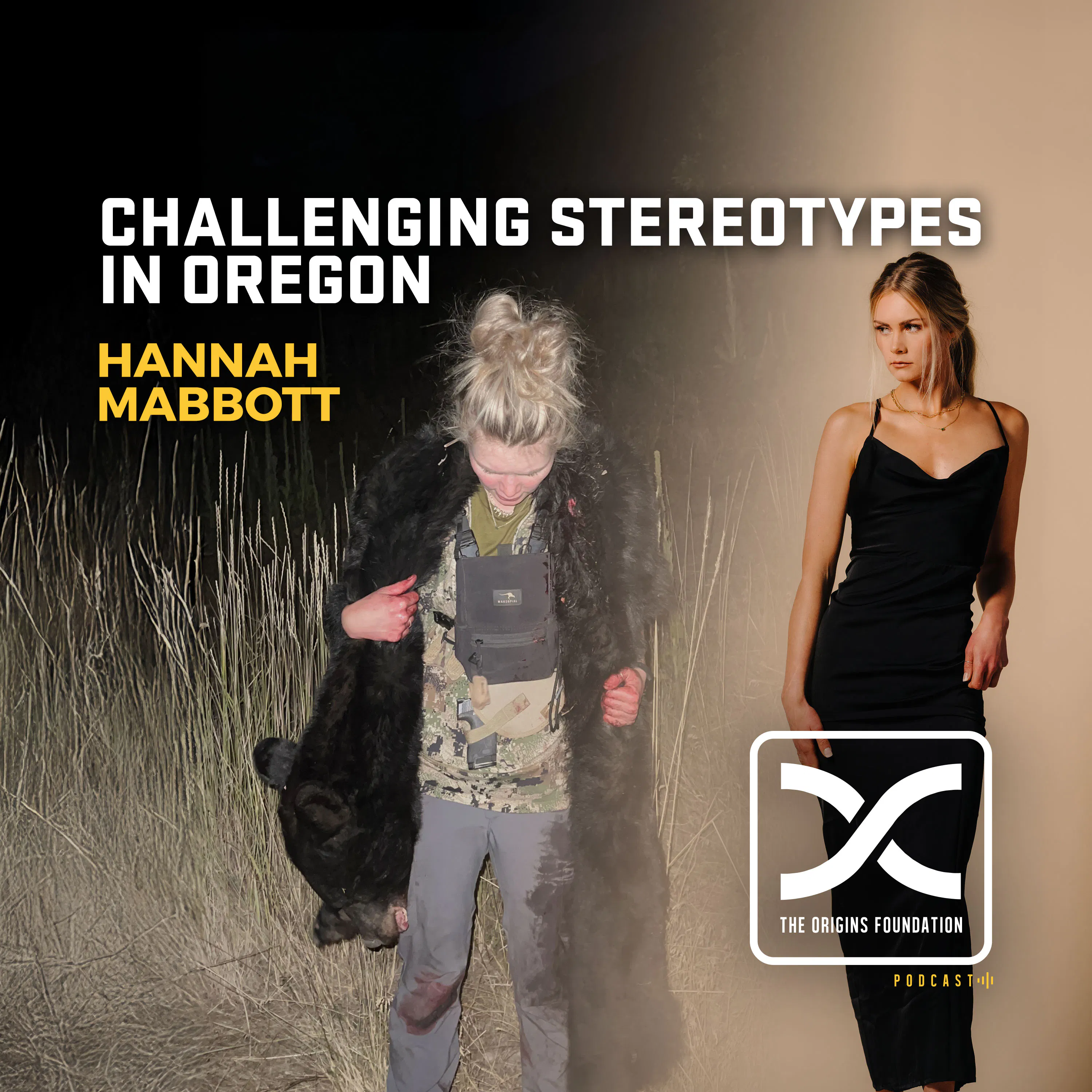
The Origins Foundation Podcast
Episode 630 - Hannah Mabbott || Challenging Stereotypes In Oregon
01:08:46
Hannah Mabbott, hunt operations manager for Hunt Oregon, joins Robbie to discuss her experiences as a six foot two volleyball player in the hunting world. She describes the stigma she faces around her hunting prowess and lifestyle, guiding 90% men on their hunts, along with the predator prey dynamics of mule deer, wolves and beyond. A fascinating podcast into the hunting world in Oregon.
Loading summary
Transcript235 lines
- [00:01]
A
Hannah Mallett is the hunt operations manager for Hunt Oregon. She's a 6 foot 2 volleyball player who at the age of 24 years old became the hunt operations manager essentially for a very large private lands ranch in eastern Oregon. If you follow her on Instagram, she is a very gritty woman. You can see her packing out bears and packing out elk. So I wanted to have Hannah on the podcast, number one, because she's a badass. She's just awesome. And number two, there's obviously a stigma around somebody like Hannah, six foot two, attractive girl in the hunting space guiding for the most part, 90% males. And also thirdly, she's literally been in the space for six, seven years and has seen mule deer populations, predator prey dynamics occur on the landscape over a very large landscape, 100,000 acres. So I wanted to get her opinion on things. So enjoy this conversation. Great one. Check out huntoregonllc.com enjoy. So five years ago, there was a reason why I started this movement. And the truth then is the truth now that we need to champion our narrative. We need to champion the truth around what we do and who we are. There's a sweet spot with a gun, you know, too heavy and it's a
- [01:29]
B
burden to walk with.
- [01:30]
A
Too light and you whipping it. Why is the project so important to the hunting community? It's. It's a. I think it's not only important, I think it's. I think it's vital. I think it's. It's just in time. It's like snakes and ladders. You guys are climbing the ladder and then somebody does something stupid and you just slide down. That is such an amazing analogy. Snakes and ladders.
- [01:51]
B
Yeah.
- [01:51]
A
You know, ivory in. In my opinion was the plastic of its age. Okay.
- [01:56]
B
Expensive little going up. It goes a long way with families. We have families that do need it.
- [02:01]
A
Let me close this door because I have a little wiener dog. What? You are. You're laughing because I said wiener.
- [02:07]
B
I'm really glad you finished the sentence out.
- [02:10]
A
I'm sorry, the first happen.
- [02:13]
B
What are we doing here today?
- [02:14]
A
You're telling the whole. You are not hunting right now, right?
- [02:29]
B
I'm not. I was two days ago and I will be tomorrow, but today I'm doing office work.
- [02:37]
A
Is elk still in season right now or what? Is it pleasing right now?
- [02:42]
B
It is well antlerless. So there's a damage hunt that's going on right now in certain areas of the state, specifically the area I'm in right now because it's a d elk emphasis zone.
- [02:54]
A
And so what does that mean?
- [02:57]
B
Well, the elk are traditionally not in these areas, and they're almost entire. Well, they're, they're all private. They're almost entirely ag fields or like cattle pastures, like grazing pastures for sheep, cattle, et cetera, or wheatland. And the elk just have started showing up in the last 20 years in drones. Like two days ago, when I was out with a hunter, we saw probably throughout the day, we probably saw 2,500 animals. What. I'm not exaggerating.
- [03:30]
A
And this is in a d elk zone. I either knocked. They want to reduce numbers.
- [03:36]
B
Yeah, it's. It's pretty bad. I know that it's been brought to the state's attention. We've got quite a few issues with it. But our biggest challenge right now is that because there's certain areas of the state that are not DL camphesis zones, people hear that there's these DL campus zones, and they immediately think, oh, this is, this is my backyard. These people are killing all of these cows in my backyard. And that's why the elk population is dropping so significantly. But the areas where these elk are the majority of the animals just stay there. And then of course, we get the, the wintering herds and the migratory groups that show up, usually late November, early December, depending on the weather. This year it's been unseasonably warm, so we haven't had as much damage yet, but it's very quickly piling up.
- [04:38]
A
Are people saying that you are taking too many elk in these zones? Is that what people are complaining about? These are hunters complaining about this. You're taking too many elk. We want more elk in the landscape.
- [04:52]
B
I've heard this. Um, there's been multiple arguments. Some people, I mean, frankly.
- [04:58]
A
These aren't depredation tags.
- [05:00]
B
These are depredation tags.
- [05:01]
A
Depredation tags for ag or depredation tags for the de emphasis of elk in these areas or both?
- [05:07]
B
Both.
- [05:07]
A
Both.
- [05:08]
B
Yeah. They're doing that for both. Um, so I've heard. Some of it, I think, is just because a lot of this opportunity, all of it actually is on private ground. And so there's some animosity there. I public land hunt myself. I understand the frustrations with that. But these elk are not leaving this property. They're not leaving the neighboring properties, they're not going back. We actually haze them year round with helicopters, drones, side by sides, pickups, all kinds of. And air horns, everything we can use to push them back onto public land, and they just follow us right back.
- [05:50]
A
Is the agriculture just too enticing? Of a resource for them.
- [05:55]
B
I assume there's the only predator they have in this area is people.
- [06:01]
A
They're not wolves.
- [06:02]
B
They don't.
- [06:02]
A
Don't you have a shit ton of wolves in Oregon?
- [06:04]
B
No, there's a lot of wolves. But in these d elk emphasis zones, the wolves really aren't there. Like it's ag land. It's closer to people the wolves will trap. You'll get one traveling through, but the elk can see for miles out here and so they can. The lions aren't there, the bears aren't there, the wolves very rarely leave the timberline and the elk feel safe.
- [06:28]
A
Look guys, I'm a hunter, right? And when I go hunting, I like to figure out how to get my trophies back home as expeditiously as possible. Well, you don't have to look much further than Safari Specialty Importers. We know that trophy importation can be quite a headache. That's why Safari Specialty Importers strives to make it as easy and hassle free as possible. They have access to a bonded warehouse, you won't be charged storage fees and you get a dedicated team that's readily available and will update you at every step in the process. They'll even go one step further. Safari Specialty Importers is working with us and they are going to donate $100 from every shipment that they work with to conservation projects that anti poaching, community development and wildlife conservation. At the end of the day, choose to spend your money with a team that's dedicated to you and is dedicated to helping show how hunting is a great conservation model. Hassle free logistics, fuel and conservation go with Safari Specialty importers. It is 2026 and my friends, big changes have happened in the world of firearm suppressors. The $200 tax stamp fee is now gone. Huge win for hunters, huge win for shooters, and a huge win for your wallets. If you're thinking about elevating your shooting experience and adding a suppressor, Silence Essential is the best way to shop. And you don't even have to get off your couch to do it. Go to silence essential.com Browse hundreds of suppressor options. They literally have all of the popular makes and models. Then their experts will walk you through setting up your account, creating a free NFA trust and then submitting your application to the atf. Once approved, Silence Essential ships your new suppressor directly to your door. That's when you're going to have to essentially get off the couch. It's a game changer, guys. You haven't done it yet. Do it the old days of waiting eight to 10 months on a suppressor are gone. It's more like two weeks. Some have even gotten their suppressors in shorter timeframes. It's never been easier to start shooting suppressed. Get started today by visiting silencercentral.com it's really the simplest way to get your suppressors. Bushnell is eager to help you get set up for conservation success. That's right. They want to help you. The conservation and research community is dominated by good people doing good things and investing significant time and effort for the benefit of habitat and the species. So what do you need to do? Pretty simple. Send us your conservation story and. Or your conservation wish. Could be managing whitetails, could be understanding your environment or species or something else related to conservation. What would you be able to do if you had a great trail camera setup? We will select the best story every other month and send you a camera bundle. Cell camera, normal SD camera, SD cards, as well as optics. Everything you need to get set up for success. I can't wait to see what you submit. You can email us, DM us, message us whatever you want. We are not hard to find. Good luck.
- [09:37]
B
So why would. And they've got plenty of food. The temperature is more mild other than the summers. It gets like 110, 120 degrees sometimes. But they just, they like it. I get it. It makes sense why, you know, they want to stay. And the calf retention has been incredibly high, which is fantastic except that we're trying to lower the numbers. And so it's. It's a little frustrating. And it's. It's hard to have this conversation with someone who may hunt other units that are well below management objective, like for instance, Minam, or even like our trophy units like Walla Walla, Winneha, the Walla Walla side, because that, that area, there's a unit, there's a Wall Wall unit in Oregon, and then there's units around Walla Walla, right on state line on the Washington side that have had a less than 1% calf retention rate for years.
- [10:37]
A
Is that in the. Is that like the, the blue elk herd or the blue. What do they call it? Right, yeah.
- [10:42]
B
Blue Mountain.
- [10:42]
A
Blue Mountain, yeah, yeah, yeah, up there.
- [10:44]
B
And it's almost entirely from mountain lions.
- [10:47]
A
Right.
- [10:48]
B
And that's what their studies have shown. And so, you know, the elk are plummeting there. It's only a matter of time before the herd is just decimated. Meanwhile, just a mere 40 miles away, we have so many. We're like, please, please get them out of here. Like, you know, any, any means necessary.
- [11:07]
A
And has there not been any conversations at the state level or NGO level for if there's too many elk in a de emphasized elk zone to say, okay, hey, why don't we just. We capture a hundred or capture 500 and move them into like a Washington state area or those Walla Walla areas.
- [11:28]
B
So I've, I've pitched that. If I got a response, it was, that's going to cost too much money.
- [11:37]
A
Oh, the Rocky Mountain Elk Foundation. That's what they do.
- [11:40]
B
Yeah. So there's lots. And I was like, what if we were able to, you know, collectively do a haze where we, you know, take. Because I've, I've done hazes with ODF and W. They come out and help. Sometimes we have neighboring landowners who all work together. It's literally like a wall of farmers and ranchers pushing elk back onto public ground. Like, what if we were to do that and push them to the Northeast, like where they, where we want more of them? And I was just told that's not going to work. But there wasn't. It doesn't seem like there's any effort to prove me wrong. It's just I'm, I think you're wrong and we're not going to do that.
- [12:21]
A
Yeah, too logistically challenging. Too much money to solve a problem that we have. Yeah.
- [12:27]
B
Yeah. And it's, it's really unfortunate because of, I mean, the animals we have are extremely healthy. They're fat, they're happy. You know, they're having a really good life over here. And I would be more than happy as, I mean, the landowners I work for would love it if someone came and took two to 400 head and moved them out of here. It would actually, it wouldn't change our success rates at all.
- [12:51]
A
Yeah.
- [12:52]
B
If they were to do that.
- [12:53]
A
Yeah. Well. Hannah Mabbit, hunting operation manager of Hunt Oregon welcome to the Origins foundation podcast. It's taken a while for us to lock this baby down.
- [13:03]
B
I know it's been. You've been super busy. You just got back from Florida, right?
- [13:07]
A
I got back from everywhere.
- [13:09]
B
Yeah. You've been, you've been all over the place, but yeah. And then, you know, seasons. I can't say it's winding down, but it's a lot less chaotic right now.
- [13:19]
A
Are you going to go to the show? Because I met you at Hunt Expo last year, which is in like six weeks time, eight weeks time. Are you planning to do that or just like stay at home, take a break after the season.
- [13:33]
B
So, you know, I'm, I'm not sure at this time. I've got, I've got a couple hunters. I've. I know I've got a group of bird hunters that are going to be around, but I could have someone take care of them. I just haven't decided if I want to take the time off to go down. It's a great show, great experience, super fun to meet a bunch of people and network and whatnot. But, um, I, I don't know yet. I just haven't, I haven't decided. But I'll probably just say, oh, whatever, and go down like for a day or two. We'll see. On a whim.
- [14:10]
A
So as the title of hunting operation manager, are you. Is this, Are you everything of Hunt Oregon? Is it you? Is it a bunch of. Is it a company? Can you tell me a little bit more about it?
- [14:25]
B
Yeah, absolutely. So the company itself was started by one of the family members of the ranch about 10 years ago now. And he's just really passionate for hunting. This ranch has been in that family for well over a hundred years. They kind of helped settle the area specifically like the Pendleton Pilot Rock area.
- [14:46]
A
Okay.
- [14:49]
B
And you know, they have this very large landmass and they're like, why don't we. Because they had been doing leases for a while. So he's like, why don't we just hunt it ourselves?
- [14:58]
A
Yeah, guard ourselves. How big's the property? Well, are you allowed to say
- [15:05]
B
the property that I guide on specifically is just under a hundred thousand acres.
- [15:13]
A
Okay. It's big. Yeah, it's big.
- [15:16]
B
Big. Pretty big. And there's other landowners out there that have, you know, like there's. One of the neighboring ranches is 50,000 acres and it's just one giant piece. It's all collective because it's a lot of ground, but there's a lot of.
- [15:30]
A
It's like, oh, it's not contiguous, it's not considerable. It's all breaking the broken up.
- [15:33]
B
Yeah, exactly. You've got like a 10,000 acre pasture over here. You've got like a 4,000 acre piece here. Like it's, it's pretty broken up. Um, not saying it's not a lot
- [15:42]
A
of property, but still a lot of property. What's the radius like if you had to leave from like a base and draw like a circle? Are we talking like 2 hour drive from a base? 4 hour drive to get everything looked at, taken care of?
- [15:56]
B
So depends. So if they, they have pieces of ground in four different hunting units that are all like kind of cornered into like Pendleton essentially. So it depends on which area in the ranch you're going to. But if you were to start in Pendleton, you could hit the southern end of the ranch in an hour. You could hit the western end of the ranch in about 35, 40 minutes and then the eastern end in about 40 minutes.
- [16:31]
A
Doesn't Pendleton have like a crazy little, maybe not so little rodeo? Yes.
- [16:40]
B
Yeah, it's a huge rodeo. Yeah, it's a big deal.
- [16:44]
A
And it happens in the, in the, in the elk season. Like middle of September, End of. End of September. Right. And the reason I know that is a lot of people don't know this because I keep my hunting pretty private. I was lucky enough to draw a non resident tag in the Mount Emily unit.
- [17:03]
B
Oh, when was this?
- [17:05]
A
This was 2020 24. 2024 was prior to me meeting you. And I killed an amazing bull elk with Steve west and the famous, I think they're called like the shoestring pack, the wolf Shoestring. The famous wolf package came into the drainage that my bull was in that we were looking for him the next morning and got to him before we did. And we couldn't find the bull. But two weeks later, Steve stumbled across the bull and I've got him downstairs. Just incredible. It was an incredible week. It was an incredible week.
- [17:44]
B
Anyway, Emily is a fantastic, fantastic unit.
- [17:48]
A
And so I drove from Legrand because Oregon was having a commission meeting. ODFW was having a commission meeting about the spring bear hunt and changing quotas on the spring bear hunt. And I was like, well, I'm in the state, I'll give verbal testimony. And so I drove across and then on the way back, obviously drove through Pendleton and on the way back I drove through Pendleton and It was like 6:00' clock at night or 6:30 at night. And it was nuts.
- [18:18]
B
Yeah, no, it's.
- [18:19]
A
Cause rodeo was on in town.
- [18:21]
B
Yeah, they have like well over a hundred thousand people that show up in this town of like 18,000 people for a week. And it's. I mean they've got Pendleton Whiskey Music Fest, they've got all kinds of things. They've branded that city very well. Pendleton Wool, which actually the company that I work for, they're a huge supplier of Pendleton wool because it was a sheep company. So.
- [18:45]
A
So the company's still a very much a multi use company. Multi land use company.
- [18:50]
B
Yeah. So cattle, they have a little bit of timber going on. Sheep, there's some farming and then hunting, of course, and they're tapping into Energy a little bit. But there's. Things have changed with that as far as politically, so we'll see.
- [19:08]
A
Are you hunting yourself? Everything, like what's in season is being guided.
- [19:16]
B
Yes. Yeah. So we do spring turkey, spring bear, you know, archery, elk and deer, rifle elk and deer. If you run into a fall bear or a mountain lion, go ahead. We always have our archery guys get the tags. It's only $16, so you might as well get it even for non residents. And yeah, if you, if you get an opportunity. But it's a little difficult because as far as like fall bear and fall lion goes, you can't bait, you can't use dogs. And if you were to take the time to take someone on a fall bear hunt, you're taking away from the time where you could be taking care of more grass feeders, more elk. And so that's, that's our priority. But I've taken people out, like, if they fill their tag in like the first couple hours of their hunt, the next day we'll go look for a bear. But yeah, the priority is definitely elk.
- [20:11]
A
How long have you been. Well, let me, I'll ask this in a two part question. Raised. Born and raised in Oregon.
- [20:19]
B
Yeah, born and raised in Oregon. Went to college in Oregon. Was living in Idaho for a while, and when this job opportunity came to be, I moved back from Idaho.
- [20:34]
A
Always wanted to be this. Always wanted to be a hunting guide in the hunting sector.
- [20:40]
B
Nope. I was actually working on my master's degree in public health and like MBA kind of pathway.
- [20:48]
A
So what's your degree? What's your bachelor's in?
- [20:51]
B
My bachelor's is actually in public health.
- [20:53]
A
Okay. There's an interest in what from that perspective. Um, so actually, what did you want to do with it?
- [21:00]
B
Yeah, I was going more of like a med school nurse anesthetist route. And then I kind of wanted to get more into the business aspect of things. And so I wanted to eventually like run a hospital or a clinic. And so I was working on like the business side of that, but still focusing on medical. But I got out of that right about COVID time. And that was when I got this job, which the stars aligned for that one because being in public health during COVID would have been a nightmare.
- [21:33]
A
It's weird, man. You ask people their trajectories to where they get to, and a lot of people come from out of like they come out of the middle of nowhere, which essentially is you. But your background. Have hunted your dad, mom. I'm not gonna assume who Took you hunting? Obviously being outdoors, being one. Been hunting your entire life?
- [22:01]
B
Yeah, been hunting the whole, whole time. And dad introduced us to it. My parents are definitely undulate hunters. Like they, they're both hard workers. Like they, they both worked a lot during our childhood and so our family vacations were we're going on a salmon fishing trip or we're going, it's deer season so I'm going to take a couple days off work and we're going to go deer hunting or we're going to go elk hunting. And so that, those were very positive memories for me as a kid. And it was very trial by fire because my dad was like, this is how I learn. This is how you're going to learn. And so I made a lot of mistakes at a young age and very quickly learned how to not make those mistakes. It was very humbling being like one of the people in camp that didn't tag out.
- [22:51]
A
Did you feel pressure? Obviously everyone's hearing that. Obviously you're a woman, you're a female in the space. For some reason there's an added barrier of entry for you guys. Somehow for some reason did you feel that in those times where you're like, I need to make sure I'm not like I'm not messing up or did mess up or learning the lessons?
- [23:19]
B
Yeah, I mean I've always been like, I was a three sport athlete when I was a kid and then when I was in high school I mostly just focused on volleyball and I did that year round so I was always in athletics. So the hiking and like that aspect, I could always keep up with everyone or like, you know, out, hike, whatever. And it was more just trying to fit in. And it seemed like in that environment the best way to fit in was to be as proficient as everybody, at least when I was younger. But now like when I was in college I, when I had transferred from the University of Portland to Eastern, I was able to get back into hunting because when I was a student athlete there's no time for that at all.
- [24:09]
A
Were you playing volleyball at the collegiate level?
- [24:12]
B
I was actually rowing crew. Oh, I rode crew from the University of Portland. Yeah.
- [24:16]
A
Okay.
- [24:17]
B
Yep. I'm six two so I've got the leverage and it was, it was a good sip. But yeah, so when I transferred and had a lot more free time when I wasn't going to school or working because I, I always wanted to, you know, I don't want to take out a lot of student loans and I made a few friends at the school, I Transferred to that, also hunted. And we just would go out all the time. We ended up skipping class quite a bit and just we wanted to do something different. So I had friends that, you know, wanted to go call for lions or do this and that, and that was not something I grew up doing. And so, you know, like, widening your perspective on the types of hunts you do makes you just overall a much better hunter. And I started helping friends out, friends, family, started kind of guiding on the side. And then an outfitter took me in and kind of trained me properly on how to do that more efficiently. And I had some pretty awesome mentors that taught me how to shoot long range and a few things like that. And I just got better at it. And then this opportunity presented itself and I threw my name in the hat. I still to this day don't know why I got it as a 20. I think I was 24 at the time when the job was.
- [25:34]
A
And the job was for. Obviously a big part of the job is guiding people.
- [25:39]
B
It's. Yeah, it's a huge part. So there's advertising, booking, property maintenance, scouting. Like, there's so many aspects to this job, but one of the main, especially this time of the year, is guiding. And I had never guided at that scale before. Like, you know, I take, I go help out with a cow hunt for like two day, two day hunts, like twice a month, something like that. But this is like in and out. You've got a group of six hunters, you're doing a double. And the day when you say you're
- [26:11]
A
doing a double, you're you two hunters to you as the guide.
- [26:16]
B
Yeah, yeah.
- [26:17]
A
Okay.
- [26:17]
B
Like taking doubles and then going out the next day and isn't as easy. Like, I, I know at the beginning of this we're talking about how many elk are here. That's just right now, like, it's still elk hunting other times of the year, you know, when the, especially when the migratory herds are gone and it's just the herds that are here and they've been hunted for years, so they, they kind of know what's going on. You still have to, you know, hunt and you have to hunt to your hunter's abilities, which a lot of people come out and they're like, I can't shoot past 200 yards. And I'm like, we're going to work on that, but we're still going to get you an animal. And so our shot opportunities, 100%, we're really proud of that. But we work really hard to keep that.
- [27:02]
A
Yeah, I Think people here in our community, you've heard this before. 100% shot opportunity or 100% guarantee. It almost denigrates it that it's like, well, this isn't really hunting anymore.
- [27:19]
B
Yeah, yeah. I had the guys out a couple days ago and they. One of the first comments because we went on a stalk and again we're seeing these elk from miles away. It's pretty open, but we've got rolling hills and whatnot. And you can only get so close to them before, you know, if they see a truck or a side by side, that's a death machine for them. So they don't put up with it. They'll take off from over a mile away. And so we get down in the canyon below and we look up on the hill and they're probably about a thousand yards away. And so we got out and hike and we have to, you know, have like a probably 600 foot elevation gain pretty straight up to get around behind them. So our wind is good and I mean we got within, got within 80 yards of them, but there was a little bit too much movement and they spooked and we didn't. Anyway, that stock didn't work. We ended up tagging later.
- [28:14]
A
But, but 100% shot opportunity means that you hunt. It doesn't mean that you. Yes, you know, walk, open the truck door, walk 200 yards. There's the elk shoot.
- [28:27]
B
We're not baiting them. We're not. Yeah, they're not going to be hung up on the fence lines. It's not high fence. These are wild animals. We're still working. But yeah, and I, I do have that conversation with any, any new hunters. About 75% of the hunters that are here are return hunters every year. Little bit more than that sometimes, but almost everyone comes back. But they know what the expectation is. But when we have new hunters, I have to explain, like you need to be able to do these things. It's a very physical hunt. We'll try to cater to your limitations, but there's only so much we can do.
- [29:03]
A
Hannah, I'm going to speak to the elephant in the room that you have to address. Probably every single time a new male hunter comes into camp is they walk in, there's a 6 foot 2 blonde girl who's attractive and she says, I'm your guide, I'm taking you elk hunting. How many? I just, I can just imagine the people's faces, guys, faces going, yeah, no, that's not that. We'll guide you, you just help us, you know, tell Us, where the elk are.
- [29:41]
B
You just drove around. Yeah. I mean, the first couple years.
- [29:47]
A
Did you have to prove yourself again, is what I'm. You know, it's. Again, we're told these. These hurdles. Right. The barriers. I wouldn't have that barrier.
- [29:55]
B
Yes, it was. The first year was very difficult. There was. I actually ended up deleting my personal social medias for a while. Um, there was a bit of cyberbullying going on, and there were a lot of negative things being said about my capabilities as, like, a hunter or, like,
- [30:19]
A
just because of outward appearances.
- [30:22]
B
Yeah, just. Yeah, just that. And that's, you know, and everyone has stigmas, but I don't have that issue anymore. Like, people know, like, when they show up, and my. I worked very hard to make sure my track record shows. Like, I'm gonna get you the animal, or at least get you as many opportunities as it takes you to get one, and it's not gonna be a problem. But, yeah, that. That's definitely an issue that used to occur. Definitely not now. And it. If it is still a thing, the second I'm, like, gutting their animal out is gone. That's not a problem anymore, is it?
- [31:05]
A
More of, like, once you get into the field and they see how capable you are, those perceptions disappear, I assume also, you know, walk up that mountain for the first time, and I don't know, somebody. I remember somebody telling me, like, an anecdote saying, okay, I don't care what you think about me, but my legs are going to do the talking when I get on that mountain and I'm going to walk. You not, you know, you're not walking in the dirt. I'm going to walk into the dirt. I'm going to walk into the ground, and I'm going to walk hard, and I'm going to get to the top, and I'm going to wait for you, and you're going to be huffing and puffing, and by the time you get here, you're like, all right, let's go. Let's keep going. And very quickly, they're going to realize, okay, okay, okay. My perception of you is not what it was supposed to be.
- [31:52]
B
Yeah, it's. And that's. I really haven't had to do that in a long time. When I was younger and still brand new at this specific position, that was kind of an issue. And I remember one guy in particular, because ultimately, at the end of the day, this is hospitality. And so I'm trying to give you the best experience possible as well. And that's different for everybody, of course. You know, like some guys want to like talk shop and other guys, they want it to be more of like a. I don't know, I don't want to use the word eastern style hunt, but like handshake after the gun goes off, kind of a very proper. And we can cater to all of that. But one guy, I had heard him make some comments about me in camp and he didn't know I was in the other room. And he wasn't sure about my capabilities because it was our first time hunting together. I think I was only about 25. So the next day I hiked him 17 miles. He did not like that. He actually sat in a tree stand the entire day after that because he was, he stoved up and I was fine. It was not a problem. But yeah, he, at the end of the day he was like, I can't, my feet hurt so bad. I can't feel my like calves and I like check my, my steps and I'm like, yeah, today was kind of rough, wasn't it? Anyway, see you in the morning.
- [33:15]
A
Oh man, I love that. That's just, that's just proof in the pudding right there. That's amazing. Amazing.
- [33:21]
B
It's pretty fun.
- [33:22]
A
How long have you been. So you've been in this position now? How long?
- [33:26]
B
So I've been here. This will be my sixth season.
- [33:29]
A
Okay. So six seasons. I want to talk a little bit about obviously Oregon and wildlife and prey population dynamics that you're seeing in Oregon. We know that they're, you know, not the easiest state to work in from a. A hunting perspective. Not as bad as Washington state, but no, Washington is.
- [33:52]
B
I feel bad for him. That's rough.
- [33:55]
A
But for instance, no mountain lion hunting with dogs or bait. Very opportunistic. Right. And the, the take rate is super, super low. You do do mu deer hunting as well. Every single unit as I understand it in Oregon is below objectives tied to mu deer.
- [34:16]
B
Significant.
- [34:16]
A
Somebody that's on the ground daily, almost daily, obviously through the hunt season, daily. What's going on.
- [34:28]
B
So it's a plethora of things. I, I know that a lot of people are like, it's the wolves, it's the lions, it's this, it's that, it's all of the above. Mule deer are not as efficient breeders as other deer species. And I also personally have seen mule deer does do less to protect their fawns than let's say a cow elk or even a whitetail doe. Whitetail does are pretty, pretty aggressive. Mamas like, they do a good job. But I've seen mule deer does the second a coyote's running at him, just run away. And that's not every single one. But, you know, I've seen it enough times to where I'm like, girl, come on, like, help him. He can't do anything. But I think predation is a massive problem. A lot of that has to come back to, like, the 1995 repeal of Hound hunting and baiting for bears and lions, because our populations of both of those are well above management objective to the point where Oregon, if you draw a spring bear tag, you can actually kill three bears. In this state, you can get a spring and two fall. All those tags are $16. If you're listening to this, come kill
- [35:41]
A
some bears, come to Oregon. Oregon. And is it easy to draw that tag?
- [35:46]
B
It's over the counter.
- [35:47]
A
Over the counter. 16 bucks for fall.
- [35:50]
B
Yeah, for fall. $16 over the counter, both tags. Spring is a draw. That draw is actually going on right now. You have basically the month of January, a couple days in February to apply. Those tags are super fun to get. They're getting a little harder to get because they're getting popular, which it's a bummer because I want to go every year. Not a bummer because of how many people want to go. That means that they're eager to.
- [36:15]
A
So why isn't is if you've got such a high bare density, and I would assume Oregon biologists know this, They've got the data, they've got the research. And I know that that whole commission meeting that I was in in October of 24 was debating increasing bare quotas in respective units. Has there not been another question asked of the commission to increase quota allocations?
- [36:43]
B
What gets brought up is that the fall tags are over the counter and as many people that want to come in out of state as possible can hunt them. There's no limit on that. And so that's what they keep coming back to. I think they're just concerned with just losing the bear hunting opportunity in its entirety. Because obviously we saw that with Washington state, their spring bear season, which was just kind of put. Pulled the. Pulled the rug out from under him with that one. That's a huge bummer. Hopefully they can get that back. It seems like there's a few lawsuits in place. Yeah, yeah, yeah. So I think they're most concerned about that. We know that the easiest time of the year to kill bears and hunt bears is in the spring. So it would be really awesome if we did A quota system with that, moved it to a quota system. Doesn't seem like there's much, much interest in changing.
- [37:35]
A
The appetite is not there. Plus the whole denning coming out the den. Sows and cubs.
- [37:43]
B
Yeah.
- [37:44]
A
Yeah.
- [37:44]
B
A lot of people think that, like, the hunters are out to kill, that no one wants a cub. Everyone wants a big boar. That's what everyone's after. No one's after the little ones. They want the big boar. They want a beautiful hide. They want really delicious spring bear meat. Um, Oregon conveniently has a lot of areas that are covered in wild onions in the spring. So the meat can actually be kind of fragrant. Um, I know my last spring bear here was. He was eating onions when I got him. But, yeah, it's. It's a frustrating situation. Um, but, yeah, the bear population's high. The lion population is also much higher than it arguably should be. And they're really the apex predator. Bears will push lions off their kills. Wolves will push lions off their kills, but the lions can just keep killing because they're so good at it. They're an incredible predator. And they're quiet. You're probably never going to see one. I know lots of people that have spent their entire lives in the woods that have never come across a lion. And I've seen them. I wouldn't say regularly, but once or twice a year I have some sort of run in. I know last archery season, one of my guides was hunting with his client down in a canyon, and they came around a corner to a male lion pulling his face out of a calf that he had just killed. Like, blood was still coming out of the calf.
- [39:11]
A
Wow.
- [39:12]
B
And my guide was trying to get his pistol out, and he looks at his hunter who's vibrating. He's like. Like, oh, my God. But we have run ins with him. That was at like 10 yards, maybe.
- [39:26]
A
Geez. Even close. Crazy.
- [39:29]
B
Oh, yeah, really close. So he couldn't get his pistol out fast enough, and there was no arrow knocked. So it was just kind of a whole thing. And if we hadn't had a hunter there, we would have probably tried to target that lion. I don't think he went too far, but, yeah. So we have run ins with them, which is kind of crazy if you think about it. So we need to be harvesting more of those.
- [39:53]
A
What about habitats? Obviously, I've heard a lot about mule deer habitats and habitat connectivity issues tied to mule deer. Is that something that has changed? So in the last six years that you've been operating in this role, what has that Looked like.
- [40:12]
B
So the habitat where I am is about the same. I think that there's a really significant habitat issue in the higher altitude areas. And I'm not talking about central Oregon, because central Oregon, yes, there's an expansion of people in that area because a lot of out of staters are moving to the Bend area because it's a really cool place. Um, but I'm talking about like timber grown and whatnot. There's a pretty big lack of feed. A lot of that has to do with the lack of logging. Um, so there's just these really dense thickets all over the place that you can't even walk through. There's no feed. So there's no reason for a deer to be there. And if a deer was to go there, they're really easy to get picked off by a predator because predators can kind of weave in and out of there and the deer are going to kind of get stuck. So there's no real incentive for a deer to be up in. A lot of these are like wilderness areas, public land areas, because there's no food. So that, that's definitely part of it.
- [41:19]
A
Is that just a result of a lack of management? Is that just a result of a lack of management from a public perspective and a private perspective or just.
- [41:29]
B
It's both? But I, it's mostly a public, public issue because most of that is happening on public ground. Because even where we are, like on the ranch I work for, they do active thinning and so they're constantly clearing. And a lot of that's for grazing because they put the cows in those areas in the summer. But the wildlife love it. Oh, the deer and elk are all over it. But those areas where they don't do that, you won't find a deer.
- [41:56]
A
Yeah, it's, it's, it's a. You know, we see the same thing happening over here in the southeast areas. You know, obviously elk have done very, very well over here, but, you know, the forests are climaxing to the point where nobody's actually managing them anymore. And you need these clear cuts. You almost like, you know, it's a big tornado or a big front comes through and knocks down a bunch of big trees and opens up a big clearing at all of this regrowth and pioneer species coming into the system that, you know, we all know that like clear cuts, you know, the, the breaks between different age classes of forest systems. They always hold animals, they always hold wildlife because of the resources that are on the landscape.
- [42:40]
B
Yeah, it's, it's really important to do that or, you know, as destructive as they are, the wildfires do incredible things for game. I know that we, Oregon a couple years ago had a historically tragic over a million acres lost wildfire season. But that ground the next year and the year after is so fertile, there's beautiful green shoots everywhere. The animals are all over it. It's providing great nutrients and it did clear out in certain areas. Granted, not all of it was timber ground, but in the areas where there was thick, reprody timber, it opened the landscape back up for these animals to come back and thrive. And it, it benefits everything from, you know, the, the birds, the squirrel species, deer, bears, eat grass like it's, it's very important.
- [43:31]
A
Yeah. Fire has been vilified for some reason as a management tool. It's very, very common as a management tool in, in Africa it's used all the time. Australia as well, or Australia near the urban areas, not so much. But in the Northern Territory, you'll see the Aboriginals just drop matches. They'll just burn the veld or the bush because they know it's good for it. And the reason why you have a devastating million acre fire is because the lack of fire management. That should be a mosaic, that landscape should be a mosaic of, oh, this 200,000 acres burned five years ago. Oh, this 300,000 burnt a year ago. Oh, this 300, 300,000 burned last year. And so now you've got this patchwork of various age classes of vegetation with various fuel densities. Then when the next fire hits, it's
- [44:22]
B
not going to burn.
- [44:22]
A
It burns 150,000 acres of pocket areas. Right, exactly. And so you've got this constant movement, constant succession, constant sort of climax regeneration system that for some reason is just not being. And again, the public land system, unfortunately in America, for how great it is, is so significantly underfunded and even, you know, being exploited now to, to we see, you know, the public land debate all the time right now in the news.
- [44:56]
B
Oh yeah, that's, that's so wild. It was like such a crazy concept to, to do that. And some of the points, like I understood, understood a very little bit of where he was coming from. Like specifically Senator Lee.
- [45:12]
A
Yeah.
- [45:12]
B
But the worst possible take on fixing that problem was selling off giant swaths of land to be developed where they couldn't even. I mean, some of those areas you couldn't get heavy machinery in there. Like what are you actually going to do with that? They just want to privatize it.
- [45:33]
A
Yeah, it's a resource extraction point of View, protocol, viewpoint, mindset, whatever you want to call it, it's very much. I get it, right? I get the whole America first. I get the whole, like, we need to utilize the resources we have at our disposal. But, you know, one of the things that makes us great is, makes this system so great is the public land. Like, I didn't have that. I don't have that in South Africa. There's not a single stitch of public land that you can hunt on in South Africa. Not a single square inch of public land that you can hunt on in South Africa. Okay. So I came out to Cody, Wyoming, and they drove me out of town and they stopped on this, like, little dirt triangle next to the road and they like, yep, we're just going to walk over here. And I said, this is public.
- [46:26]
B
We can do this.
- [46:27]
A
Yeah, we can do this. You're like, yeah, we just walk up to that mountain right there. And off we went. And it was amazing. Right? And you can carry a gun in there with the regulations of whatever season's in place. And even if there's not a season, you can carry a gun and then target shoot. Like, that's. You're allowed to. Like, that's what you can do, whatever. And it's not just somebody that, like you, who's American born and bred, like me, who's become an American citizen, but somebody from Australia can arrive in Cody, Wyoming, or wherever they want, park their car and go walking because of the system that is put in place. So that's what makes America magical and what makes our wildlife management model magical. However, at the same breadth, we do need resources and funding to be able to manage the resource that we have. The public land for the trust, for the community, for the people of America, but also the people of the world.
- [47:20]
B
Exactly. Yeah. It's. It's something that we shouldn't take for granted. It's. It's our privilege and our right as Americans to utilize this land to the extent that we see fit. Right. Obviously, regulations are very important because you don't want people just trashing it and destroying, you know, these areas. But we need to treat them with respect and reinvest back into them so they can continue to provide for the next few generations. Which comes back to your point about mule deer in Oregon. And I've said this for years now, I'm a little bit of a broken record, but a renewable resource is only renewable if you allow it to be.
- [48:13]
A
What do you mean in terms of mule deal?
- [48:16]
B
So there's definitely areas in the state where the population density has been minimized for years now. It's been significantly lower than its management objective for a long time. And there's still, they were still issuing thousands of tags for this area. There's probably not a thousand deer in that unit. Never mind a thousand bucks like this bring you like 400, 500 bucks in. I mean, there's so many units. They just reoriented all of the mule deer units in the eastern side of the state, anything east of the Cascades for this year. So we're going to see how that kind of plays out. But there's quite a few units that I know of where, I mean, they were giving out thousands of archery tags, thousands of rifle tags. They had opportunities for muzzleloader or they had even doe tags in these areas where it was like, why are you giving doe tags if there's hardly any deer around? You're getting rid of the, the moms, like they need to be able to reproduce and it, you know, they're not allowing that resource to renew. Yeah.
- [49:24]
A
And I don't. And I think, you know, to the point of what you're saying, you're a hunter, you're a hunt operations manager of a game ranch. That's sizable. If the state said to you, you know, based on population service. Again, I don't know how often ODFW is looking at surveys of numbers of mu. But if they came to you and they said we're going to have to reduce the quota of mudia in this unit.
- [49:54]
B
Right.
- [49:55]
A
Because there's no mule deer, I don't think there's many hunters out there of the right ilk that said, yeah, you're right, you should be.
- [50:06]
B
Yeah. You know, and the argument I keep hearing from the state and I've told them, I'm like, I'm an outfitter, I'm a guide. Please cut deer tags, please. Because even on the ranch that I'm guiding on my first year, I saw so few bucks. There were bucks a lot more than you would see probably on public land. But there were, there was, there was not numbers, and there's still not numbers and size of what should be there. And I told them, please cut tags. I'm only taking five buck. Hunters of fallout.
- [50:41]
A
That's what. So what are you doing? Let me ask this then. Let me turn the, turn the tables a little bit on you. If you're recognizing this problem and the ranch recognizes this problem. You said, you just said we're only taking five buck mule deer hunters out. What could you be taking on the
- [51:00]
B
70,000 acres that I deer hunt because there's only sections that I, the, the owners of the ranch like to deer hunt as well. And they, they have their areas on the section of ranch I'm taking. I, we have management hunts and we have trophy hunts and we take very few trophy hunters. We take one or two. I think this year we might be doing three because I've personally seen the population be able to sustain this because of the model we're doing. We're seeing bucks that I remember seeing when I was brand new to this job because they've got, you know, throat patches, ear drooping like all these. We, we can pattern these deer. They live in the same areas that are gorgeous mature trophy deer. Now I'm like, okay, we can start harvesting a few of these now, providing some hunter opportunity. So we're, we'll take maybe three and I trophy size. I'm talking like 170 plus.
- [51:58]
A
Okay. But I've never shot a mule deer so I assume that's big.
- [52:04]
B
It's, it's pretty good sizer. It's pretty good. And yeah, so a management buck for us is still a mature deer. You know, we want those older, older bucks but we don't want maybe their specific genetics. So like there was one buck we killed a few years ago that was like a 30 inch wide 3 by 5. He Everyone wants like the big four. They want a four score with kickers. They want all these fun things. They want a high score either Boone and Crockett or Pope and Young. And we do have some genetics that are just never going to produce that. And so those are the bull. You know, some people call it calling. Yeah, we call it management bucks. But some places say you're going to shoot a management buck and they're shooting basket four points that in two or three years would be a beautiful trophy buck. Those are what you want to stay. You want those three breeding does and those younger bucks actually do a really great job of servicing does. I've seen a few places on the property where there will be a group of 8 or 9 does and a beautiful 3 year old 140 inch 4x5 or 4 point that in a few years is going to be a great buck. But he's, you know, taking care of all those does. Whereas on another section of ranch there's a, there's one old crusty doe and this giant trophy buck standing over. He's not going to leave her for days. So he's only focusing on one. When this guy's like quantity over quality or, you know, however you want to put it. Yeah. So we want to do both of those hunts to, you know, kind of turn.
- [53:46]
A
So is that what. What you feel is the success now for you guys, for Muldir, is that your program is we're not taking these young fours, four buys and letting them. Giving them more time instead of whacking them before they get to maturity? Is that the plan? Has that been the plan?
- [54:06]
B
The plan? Yeah, that's part of it. Another part of it is just taking fewer deer, allowing more deer to. I don't take doe hunters out. I. Allowing more deer to reproduce. You know, doing predator control pretty consistently, especially coyotes in the spring. Again, in those areas, we don't really have the lion and bear issues. And so it's. It's just coyotes, little golden eagle sometimes, too, but I don't really worry about those as much. We still do have them out there, but. Yeah. So taking fewer deer, giving them time to come to maturity and very selective. Yeah, very selective harvest and taking far fewer deer than what we arguably could. It doesn't feel right to be taking a ton of deer off the landscape and our population has turned around. I've actually worked with some of the other neighboring landowners because these animals are constantly crossing back and forth and they're, you know, reducing their numbers as well. And it's.
- [55:16]
A
Everyone's winning. Everyone's winning.
- [55:18]
B
We're benefiting.
- [55:19]
A
Well, and you're going to bet you're not. You're benefiting now, but, you know, 10 years time, you're going to be even more from a benefit.
- [55:25]
B
Yeah, but we're just one little. One little section of private land over, you know, know, the entirety of the state. That's just not happening. And I see so often, you know, people posting pictures of this deer that I don't even know how they could tell that it had horns. And that's fine, but you're maybe getting 30 pounds, 40 pounds of meat, so you're not filling your freezer. You just removed a breeder from the landscape. You know, that deer may not even have been able to breed a doe yet. Like, he may have just. This was going to be his first year of maybe even getting in the pool, and he's not able to now. So I'm not sure if the. If just an overall significant tag reduction is what we need to do. I think. Yes. But also, I think there's more to it than that. Maybe an antler restriction or. I. I don't know. There's. There's so many ways you could go about it, But I just think fjordir need to come off the landscape.
- [56:36]
A
Yeah, it's a. It's a. It's a tough conundrum. That guy that, you know, shooting that spike, mule deer, buck, you know, again, you don't know the circumstances. Is his first hunt, is it the only opportunity that he got to go out? It's the only deer that he saw.
- [56:52]
B
Yeah. And. And those, you know, first deer, all that is great. But I've seen some people that every year they go out and shoot a spike right off the road. And I'm like, do you need to do that? Like, are you sure?
- [57:05]
A
Are there other opportunities for that hunter
- [57:09]
B
bear?
- [57:11]
A
Yeah, but it's so hard.
- [57:13]
B
I mean, I hate to constantly come back to that, but there's. That's a big one, I guess.
- [57:20]
A
It's so difficult. Like, in my brain, I say it's so hard to get a bear. Is it? But that's what hunting should be. But also, you want opportunities to be there to take animals, because that's what you want to do. You want to fill your freezer. Yeah, it's a tough conundrum, right?
- [57:39]
B
Exactly. And the meat's different. Like, you're not going to, like, cook a bear steak, medium rare. Like you could a deer. Like, you just.
- [57:45]
A
Well, you couldn't do that. You could.
- [57:47]
B
You could. You're just gonna suffer for that for a little bit. Um, but, you know, I. I constantly make the argument to people, like, I know a lot of people, and I grew up doing this myself. My parents were like, don't shoot a bear. They're gross. Um, we don't even want to deal with them. Um, but I've come to the mindset if I'm gonna be harvesting a deer or an elk an undulate, I should also remove predators from the landscape because I removed one of, you know, I removed one of its prey. Um, so, you know, to help the other prey species, I'm going to harvest a predator. And I ask people all the time that are, you know, they'll go spend all their free time and time off work, vacation, whatnot, deer hunting or elk hunting. And I'm like, you could be doing that with these other species and putting in just as much, maybe, arguably less effort tagging out and also helping the deer and elk in those units, like, whatever your favorite elk or deer unit is, I challenge you to go get a predator out of there. Even if it's a coyote. Like, you're going to be helping overall those ungulates in that Area and improving your success rate down the line if you do that.
- [59:07]
A
Yeah, it's a good strategy, usually.
- [59:09]
B
Yeah, usually the opportunity is like someone shoots a bear because it ran across the road in front of them, or shoots a lion because it was eating something that they found that was dead. And that's all great, but you could also just like, intention. Go out with the intent of hunting one of these.
- [59:26]
A
Yeah. And also, you know. You know, as you said, you. You. It's 16 bucks, right. So if you're going deer hunting and elk hunting, buy a $16 bear tag, put it in your back pocket, you. You want to hunt, you're there to hunt. The more things you can hunt, the better. Man, you got like, a massive truck rolling by or train rolling.
- [59:44]
B
Yeah, I don't. I don't know what that is. It's gone now. I think it was like a street cleaner or something.
- [59:51]
A
Oh, man. But, yeah, you're out there to hunt, so hunt and, you know, do some predator management whilst you're there. It's part of the experience you get. You know, when something's slow, you try something else. As you said, if you tag out early, keep hunting, and, you know, you're putting money on the coffers of the game and fish agency of that respective state at the same time. So.
- [60:14]
B
Yeah, yeah, it's. The deer thing is. So there's so many facets to it, but it just comes back to, you know, and you. You're always hearing people say, well, it's not like it used to be. I used to see deer here all the time. There's now.
- [60:30]
A
When was that? 1980, 1990. And how many people were in the state of Oregon then?
- [60:36]
B
Yeah, a lot. Less people, less hunters, less pressure. The weapons you were using at that time could not hit the ranges that, you know, these modern scopes and rifles, that's a huge part of it, too, because guys are dropping bombs on deer at 800 yards, and that was just not a thing back then. And
- [61:00]
A
streak Tina coming back?
- [61:03]
B
I think so. I think so. He needs to. He needs to go. Go north. But, yeah, the opportunity for deer in Oregon, we still have great genetics here. There's still deer around, but it's, of course, not what it used to be. Um, but I think that as a collective, just as hunters, we. We should take it upon ourselves to try to fix that, because it's clear that it's not happening at the state level.
- [61:34]
A
For those of that have been listening to this, that want to hunt Oregon, best way to hunt Oregon, tell them
- [61:42]
B
as in like hunting with me or just hunting.
- [61:43]
A
Oh, you can, you could, you can pimp yourself. You can pimp yourself. Go ahead.
- [61:50]
B
Well, you know, the, the draw is happening right now. You can apply for all of the fall tags up until mid May. If you want to get a spring bear tag, you should. Those are. The application is now and it goes until the end of, I think the first week of February somewhere in there.
- [62:10]
A
But yeah, this podcast probably going to come out after that. So.
- [62:14]
B
Okay.
- [62:14]
A
Hopefully next year get spring bear next year.
- [62:16]
B
Buy your point. Buy your point for next year.
- [62:18]
A
There we go.
- [62:20]
B
Yeah.
- [62:20]
A
Are there any over the counter opportunities for elk and deer in Oregon? Lots.
- [62:25]
B
Yeah.
- [62:25]
A
Okay.
- [62:26]
B
Lots on the west side of the state.
- [62:28]
A
Okay.
- [62:28]
B
So there are over the counter blacktail tags, archery, Roosevelt elk, which hunting over there is a jungle. Good luck. Steep and thick.
- [62:41]
A
Nice.
- [62:42]
B
But there's rosies and black tails and there's actually rifle, rosie and black tail tags too that are over the counter. Of course, turkey, both fall and spring bear, lion.
- [62:55]
A
And if they choose you as Hunt Oregon, they're like, nah, we don't want any of this public stuff. We want the. A good private land guide. Where can I get information about Hunt Oregon?
- [63:07]
B
Yeah, so you can definitely reach out to me. I've always got my, my work cell on me. We have a website, it's huntoreganllc.com. we've got a little inquiry thing on there. Or you can just email me@hunoreganllcmail.com from there. I'll, you know, if you're interested, I'll put my cell number out. I'm not gonna.
- [63:29]
A
No, don't do that, please.
- [63:31]
B
Not gonna do that. Um, but yeah, that's, that's the best way to get a hold of me. And we are booking now, as of
- [63:40]
A
you still got availability this fall.
- [63:43]
B
Very limited.
- [63:44]
A
Very limited.
- [63:45]
B
Very only. Only a few cow hunts available. Bucks and bulls are spoken for through next year.
- [63:51]
A
2027 Open or that's closed too?
- [63:54]
B
That's unfortunately closed. But cow hunts, yes, you could definitely do cows if you were to draw a spring bear tag in one of the units we guide in, we've got availability for that. And there's always upland birds. So if you like chukars, huns, pheasants, quail, we can make that happen too.
- [64:17]
A
And turkeys.
- [64:18]
B
And turkeys. We've got Thunderchi.
- [64:21]
A
I'm afflicted with that disease, unfortunately. Yeah, I love it. I absolutely freaking love it. And look when, before I hit that Oregon Mount Emily unit, I hadn't really? Elk hunted in the archery. I'd elk hunted once with archery elk, but I'd never been in the full on rut. And because I love, because I love turkey hunting. Like, I was like, what they were telling me is that turkey elk hunting is like turkey hunting on steroids. I was like, all right, well, I love turkey, I think. And it was legitimately exactly the same. But on steroids. Like you drive around, stop, make your calls, hear the response. All right, get positioned. Move, move, move. Call, call, call, call.
- [65:06]
B
You know, getting them to about the same range.
- [65:09]
A
Yeah, yeah. If they work out, it works out. If it doesn't work out, okay, get back in your vehicle, get back on your legs or your horse, go find another one.
- [65:17]
B
Yeah. And, and there's. Honestly, a ruddy bull I think is not as smart as a tom turkey sometimes. Oh, I've had, I've worked so hard on some of my turkey hunts, like both my personal and the ones I'm guiding. And I'm like, what am I doing? I'm doing this for a bird. Like, what is going on?
- [65:35]
A
No, you're doing it for an amazing turkey. Not just a pea brain. Not just a pea brained animal, which it is. But for some reason it outsmarts.
- [65:44]
B
Yeah, they've got some crazy good vision. Yeah, they can see everything. But yeah, it's, it's a good time and we can. I'd be happy to help, you know, even if you've just got questions about hunting in Oregon. You know, I'm not biased. I can help point you in the right direction even if it's not with us. Just happy to help hunters out and cool opportunity. I know it can be a little intimidating hunting in different states, but Oregon's pretty approachable as far as like cost and whatnot.
- [66:16]
A
Amazing. Huntoregonllc.com if you want more information about Hunt Oregon, Hannah, or anything. So go check it out. Hannah. Thank you.
- [66:27]
B
Thank you.
- [66:28]
A
Maybe we won't wait until this long to do another one. Okay.
- [66:33]
B
Yeah, sounds good.
- [66:34]
A
We'll just, we'll restrict it maybe six months time versus a year.
- [66:38]
B
All right, that's fair. That's fair. Six months is solid.
- [66:41]
A
All right. Hopefully our parts bump into each other this show season or during the year. Okay.
- [66:47]
B
Yeah, you should check out one of our shows up here. We've got a few going on.
- [66:50]
A
Oh, maybe, maybe we should do that. All right, ciao. Well, that's it for today. I appreciate you listening as always. Leave a review, share it with your friends, and most importantly, do what's right to convey the truth around hunting.