← The Origins Foundation Podcast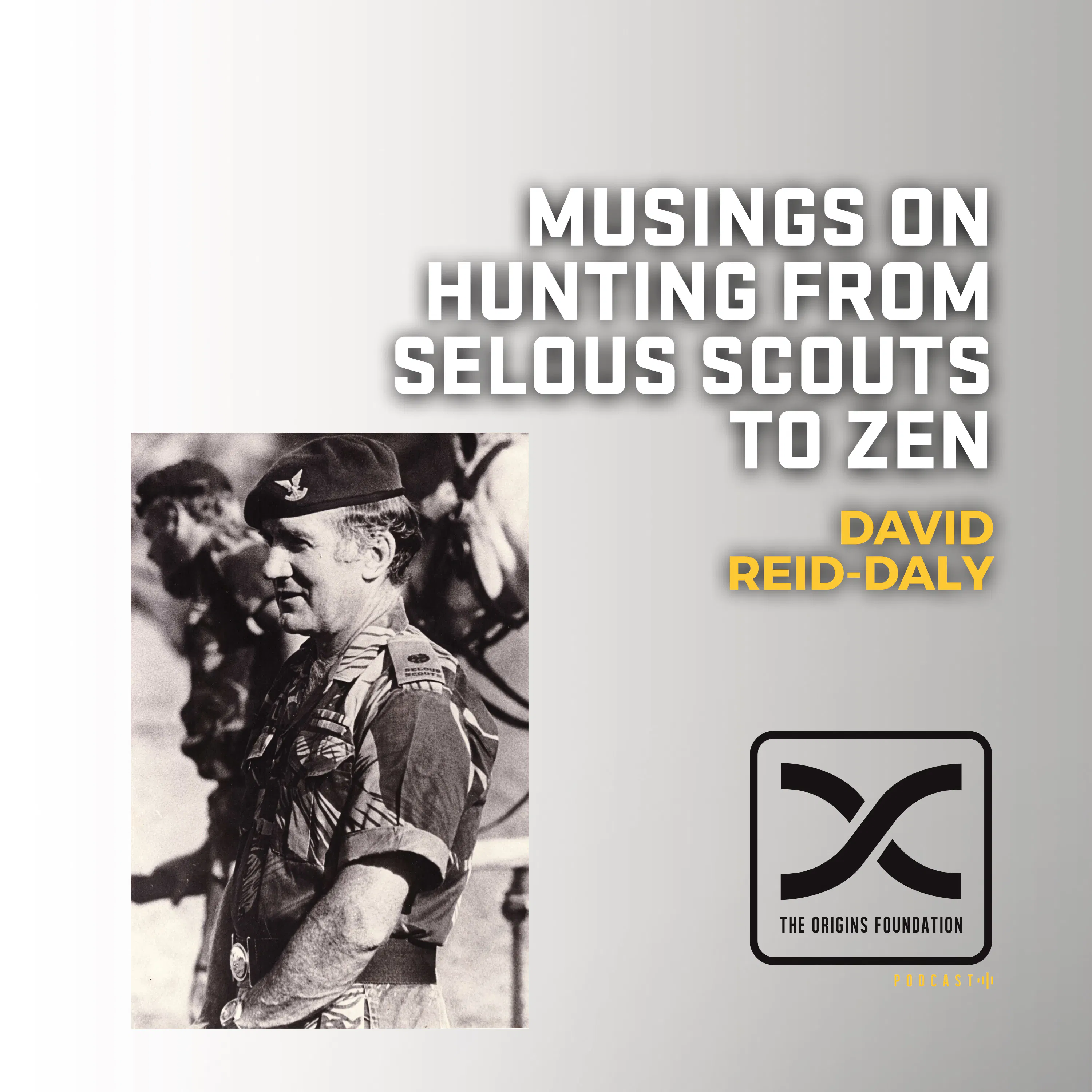
The Origins Foundation Podcast
Episode 631 - David Reid-Daly || Musings On Hunting From Selous Scouts To Zen
01:32:38
Robbie fights through “the crud” (we promise, that’s the scientific term for it) to bring you this important interview with David Reid-Daly. Originally an inbound DM to our instagram account that started out pretty hard AGAINST hunting, we learn about David, his life (his father was the original commander of the Selous scouts) to his thoughts on hunting and his realization that an open dialogue breeds real engagement with the non hunting audience. If you are interested in understanding how to have conversations with folks about hunting this is a podcast to listen to.
Loading summary
Transcript240 lines
- [00:00]
A
If you're a serious hunter and you haven't tried hex yet, this is the edge you're missing. Hunters have always talked about animals having a sixth sense, feeling you before they ever see you. Hex works by completely blocking your body's natural energy, helping you get closer without tipping them off. Most hunters don't believe it at first until they hunt in it. And once they do, it makes them believers fast. Go to hexhunting.com that's hecshunting.com and use code waypoint to save $20 on a full hex system.
- [00:30]
B
I apologize for being so nasally. I've gotten the crud. But today's guest, David Reed Daly, is one of those that just comes out of nowhere. He was a DM that came into our Instagram direct messages pretty hard against hunting and he said he wanted a podcast. I said, absolutely. Love to podcast with people like you. His dad was the original commander of the Sluice Scouts. He's got a fantastic history. The podcast is very lengthy, so in the first 45 minutes it's all about David and his life and where it got to today. So if you want to skip over the first 45 minutes at the 45 minute mark is when we start diving into hunting and hunting ethics and all sorts of things tied to why he actually wanted to talk to me. And what you'll find, like I found with everybody that is open minded is he's surprised at the way that we come across, he's surprised at the way I come across. He was expecting a fight, he was expecting a knockdown, drag out discussion wherein I laid out viewpoints, he laid out viewpoints. And he's like, wow, we actually are on the same team. And I said, yeah, you just need to have an open dialogue, an open discussion. I think you'll love the podcast. This is the kind of thing that we should be doing every single day with the non hunting audience and David is one of them. So enjoy it, listen to it, share it, absorb it, understand it and implement it. You guys have got the confidence to be able to talk like this. Do it. Enjoy the podcast. So five years ago there was a reason why I started this movement. And the truth then is the truth now that we need to champion our narrative. We need to champion the truth around what we do and who we are. There's a sweet spot with a gun, you know, too heavy and it's a
- [02:21]
A
burden to walk with.
- [02:22]
B
Too light and you whipping it. Why is the project so important to the hunting community?
- [02:27]
A
It's It's a. I think it's not only important. I think it's. I think it's vital. I think it's. It's just in time.
- [02:33]
B
It's like snakes and ladders.
- [02:34]
A
You guys are climbing the ladder, and then somebody does something stupid and you just slide.
- [02:39]
B
That is such an amazing analogy. Snakes and ladders.
- [02:43]
A
Yeah.
- [02:43]
B
You know, ivory, in my opinion, was the plastic of its age. Okay.
- [02:48]
A
The expenses were going up. It goes a long way with families. We are families that do need it.
- [02:53]
B
Let me close this door because I have a little wiener dog. What are you laughing because I said wiener?
- [02:59]
A
I'm really glad you finished the sentence out.
- [03:02]
B
I'm sorry the first happened.
- [03:05]
A
What are we doing here today?
- [03:06]
B
You're telling the whole world.
- [03:18]
A
That you've got. Or have you feeling a bit pukey?
- [03:21]
B
No, I don't know. I think it's just, you know, post nasal drip, you can hear nasally.
- [03:27]
A
Yeah, yeah.
- [03:28]
B
Blocked noses coughing up some good stuff.
- [03:32]
A
Yeah.
- [03:33]
B
It's just your typical, crude.
- [03:36]
A
I think you should go water skiing.
- [03:38]
B
That's not going to stop us.
- [03:39]
A
You should go water skiing on the. On the. On the sea.
- [03:43]
B
That's right. That's what. Look, my grandfather and my father. My grandfather specifically, back in the Mozambique days. That was his solution. It. You snorted salt water.
- [03:55]
A
Yeah. You can do that. That's a boring way. But if you go water skiing, then when you fall, if it all goes up everywhere and then it's like, clears the yard or.
- [04:05]
B
Or are all the orifices get salt water?
- [04:08]
A
Yeah, they do.
- [04:09]
B
They do.
- [04:10]
A
Yeah, they do.
- [04:13]
B
Well, David Reed Daly, I'm. I am. I'm excited that you finally got all the technology situated. I know we tried this once before. Couldn't get it to work. Now here we are. And these are the kinds of conversations that I actually quite enjoy the most. Because even though this is my podcast, I have no idea what you want to talk about.
- [04:38]
A
No, me neither. Yeah.
- [04:42]
B
And we exchange some ideas through direct message. They may be on the same page, they may not be on the same page, but these are the kinds of conversations and discussions that I think people enjoy and love. And I think they allow people to really think a little bit. Right. And that's what we're all about. We want people to think. We want people to have their own opinions.
- [05:10]
A
Fantastic.
- [05:10]
B
We want people to have formed their own opinions based on research, based on data, based on thinking through their position.
- [05:23]
A
Yeah.
- [05:24]
B
And that's great.
- [05:27]
A
Yeah. So what I did was I sat down and wrote out my position just in terms Of I wouldn't say my position, but I thought that in trying to prepare for today because you're a hunting person and we got in a conversation about hunting. The first title of the thing that I wrote was entitled because I'm a writer and I've written quite a few other books not related quite to this topic. And so I found that in my writing I'd say, okay, this chapter, as I start this book is going to be titled this. And so then as I start developing that thought, when I get to the end or the middle of the chapter, I realize, no, that's not what this chapter is about at all. Because as you know from writing, if you've done any writing, as you start to develop an idea, it starts to take you into places in your brain and give you other options that you didn't think about when you're first thinking about the subject matter. And then the chapter then becomes something completely different. That's how it's been for me.
- [06:36]
B
Sure, sure, sure. So what is the title that you came up with?
- [06:41]
A
So I came up, the first title was Should We Hunt or why Should We Hunt? And then I changed it to the Hunting Code. Interesting.
- [06:54]
B
Well, I like that. Look guys, I'm a hunter, right? And when I go hunting, I like to figure out how to get my trophies back home as expeditiously as possible. Well, you don't have to look much further than Safari Specialty Importers. We know that trophy importation can be quite a headache. That's why Safari Specialty Importer strives to make it as easy as and hassle free as possible. They have access to a bonded warehouse, you won't be charged storage fees and you get a dedicated team that's readily available and will update you at every step in the process. They'll even go one step further. Safari Specialty Importers is working with us and they are going to donate $100 from every shipment that they work with to conservation projects that include anti poaching, community development and wildlife conservation. At the end of the day, choose to spend your money with a team that's dedicated to you and is dedicated to helping show how hunting is a great conservation model. Hassle free logistics, fuel and conservation go with Safari Specialty importers. It is 2026 and my friends, big changes have happened in the world of firearm suppressors. The $200 tax stamp fee is now gone. Huge win for hunters, huge win for shooters, and a huge win for your wallets. If you're thinking about elevating your shooting experience and adding a suppressor Silence Essential is the best way to shop. And you don't even have to get off your couch to do it. Go to silence essential.com, browse hundreds of suppressor options. They literally have all of the popular makes and models. Then their experts will walk you through setting up your account, creating a free NFA trust, and then submitting your application to the atf. Once approved, Silencer Central ships your new suppressor directly to your door. That's when you're going to have to essentially get off the couch. It's a game changer, guys. You haven't done it yet. Do it. The old days of waiting eight to 10 months on a suppressor are gone. It's more like two weeks. Some have even gotten their suppressors in shorter time frames. It's never been easier to start shooting suppressed. Get started today by visiting silencercentral.com it's really the simplest way to get your suppressors. Bushnell is eager to help you get set up for conservation success. That's right. They want to help you. The conservation and research community is dominated by good people doing good things and investing significant time and effort for the benefit of habitat and the species. So what do you need to do? Pretty simple. Send us your conservation story and or your conservation wish. Could be managing whitetails. Could be understanding your environment or species or something else related to conservation. What would you be able to do if you had a great trail camera setup? We will select the best story every other month and send you a camera bundle. Cell camera, normal SD camera, SD cards, as well as optics. Everything you need to get set up for success. I can't wait to see what you submit. You can email us, DM us, message us, whatever you want. We are not hard to find. Good luck.
- [10:05]
A
Yeah. Because I started to look at how our genes are affected in creating our personality and creating what type of humans we are. So my field, I'm saying field of research, my field of interest being a psychophysical therapist is to what extent is our behavior inherited? And we're getting that behavior coming through our genes. And to what extent is our behavior social behavior or just even something that we, as we develop as a new human being, becomes something that's attractive for us to start exploring and finding out whether that suits us or not. So there's all these kind of variables.
- [10:58]
B
Background. What's your background?
- [11:01]
A
My background is, as you know, I came from Rhodesia.
- [11:06]
B
Okay.
- [11:07]
A
You know that I know very little about you. Oh, okay. So I grew up in Rhodesia. I grew up in the military camps in Rhodesia. My father was a professional soldier and he started out his life with the British sas. He was part of the Rhodesian Contingent and went and fought in Malaya. And when they came back, they then formulated this new Rhodesian Army. And I was born in 1960, so we were still part of the British Commonwealth. And then my father served in the British army, seconded from Rhodesia into Malaya, and he was part of the formation of the C Squadron sas. And then they came back to Rhodesia and then they decided that they'd start a new Rhodesia Regiment, which eventually all of that evolved into a number of separate, different regiments, one of which was the Rhodesian Light Infantry. So my father became a founding member of the Rhodesian Light infantry, and then I was born. So then I ran around like all the other little sprogs like me, a little army brat, and it was fantastic. I mean, if you ever have a life, if you ever have kids and you want them to grow up sane, you must send them to an army camp, because it's the world's biggest playground and it's safe, you know, you can't get interfered with by any pervert there. So it's a very, very safe environment for you as a kid. And then, of course, you grow up as an. You sort of mature very quickly. Well, I wouldn't say you mature very quickly because soldiers in themselves are. Or young boys, you know, they play around and mess around a lot. But, but, but you. There's a lot of dangerous stuff in an army camp, so there's lots of ordinances, hand grenades, and there's different explosive devices, and there's all sorts of stuff that gets used in the base and, and the different ranges where they go and shoot and all the rest of it. So as a kid, when you. As soon as you can walk, then they take you to a. To an instruction room where they go and teach soldiers. And then they set out all the explosives and then they show you exactly what everything looks like. And they say if you've come across anything that looks like this, whatever you do, don't touch it because it'll blow your hands off. You just put a ring around it, remember where it is, and then you come down, you call us, and then we'll dispose of it. And so you kind of like, you kind of grow up quickly, even though you're a kid and you play around and you're naughty like everybody else. You kind of. There's a level of responsibility that you grow into, so to speak, or you get at an early age, you know, and then of course, with my father, because I can't just say it's my father, because Rhodesians were very diff. We had a very different culture there. So when I was eight years old, when I was five years old, I think four years old, I fired my first heavy barreled F in at the range, started to shoot from that age. And then when I was about. When I was eight years old, I did my first trip with these soldiers. Training exercise, load up, get into a vehicle, drive out into the bush and do map reading, you know. And then from then onwards, every time I had my holidays, my father would put me with a training officer and I'd go off with a training officer and go and learn what soldiers do.
- [15:00]
B
You enlist yourself? Did you enlist yourself later on in life?
- [15:03]
A
I wanted to, but by that stage, the war was over. Unfortunately, my whole life had been geared to becoming a soldier, so it was a very disappointing thing not to be able to have enlisted.
- [15:17]
B
Did you. Did you then stay in Zim or did you move to South Africa? And what did you.
- [15:21]
A
Well, we had to move because my father. My father was a founder member of the RLI. And then in 1973, he resigned and he decided, you're going to become a civilian. And he flew overseas with my mother, and they went and had a party, and my mother was, of course, very happy. And then he came back, and the general of the army, who was a friend of ours, phoned him up and said, listen, the Prime Minister wants to see you. And so they went across to my father, went across to the Prime Minister's office, and they said, look, we starting a new counterterrorism unit. And I've spoken to the Prime Minister about it. The general's name was General Peter Walls, and we've discussed it, and I recommended that you become the new commander of this unit because you're the only person that I feel is the right kind of person to run this unit. And so my father started the Saloo Scouts. Don't know if you've heard of them.
- [16:25]
B
That is amazing. Yeah, I had podcasts earlier this week. It's funny you talk about Saloo Scouts. I had a podcast earlier this week talking about Salut, A historical dive into Salut himself. Yeah, amazing guy, 1971 to 1882. And then we did a second podcast from 1882 to 1917. Amazing guy. The guy that I was talking with, a guy called Paul Hubbard, is a historian in Zimbabwe. Amazing guy. Amazing guy. One of those informational, like, trip treasure troves.
- [16:58]
A
Yeah, yeah.
- [16:59]
B
And he's so into history and so into that.
- [17:05]
A
Yeah.
- [17:05]
B
When he was describing. Salud. Getting killed on the bridge in Tanzania against the Germans, a sniper shot him. He started crying.
- [17:15]
A
Oh, really?
- [17:15]
B
Started crying? Yeah.
- [17:17]
A
Wow.
- [17:19]
B
Anyway. Anyway, so your dad was the commander, the first commander of the Salu Scouts.
- [17:25]
A
Yeah, yeah, yeah, yeah. And so I grew. His name is Ron Reedaly. Ron Reed Daly. Wow. Yeah. Hell of a naughty guy. Yeah,
- [17:38]
B
well, she's. It's. But the Saloon Scouts are, you know, world famous, renowned. And he led them.
- [17:45]
A
Yeah, yeah, he led them and he trained them. And so I. I grew up with all those guys. Um, I know every. All the top operators and everything. I, they, they train me, so I, you know, I learned. I went on tracking courses, motor courses, explosive courses, before I'd even turn.
- [18:02]
B
A guy called, you know a guy called Mike Bromich.
- [18:06]
A
No, no, I don't.
- [18:09]
B
He was one of the trainers, I believe, in the Saloon Scouts, but maybe came after. Yeah, he wrote a huge book about Zimbabwean history and hunting and all the people in there and whatnot. He's an old fellow, real old fellow now, but super gentle guy. But he was tied to the Soothe Scouts.
- [18:30]
A
Now the head training officer there was Antwite, Lieutenant Antwerp.
- [18:35]
B
Okay.
- [18:38]
A
But there was all kinds of different training, you know, so that. So it started out of a very, very small unit with about, I don't know, 20, 30 guys. And then it very slowly grew from there. But, you know, I. I was. My father was an amazing guy because he took me with. With him all over the place. So, you know, I'd go into the ops room and watch them organizing troop movements and things like that. And then my father had a. Had a very large radio in his vehicle, which he could speak to, because my father used to advise the generals in Pretoria in South Africa. And so my father used to be able to communicate with him directly by radio. And then, of course, my father that. The radio. He had this big radio in his vehicle because he had guys out in Mozambique and Zambia doing reconnaissance, deep penetration reconnaissance. And my father was the kind of guy that he's very, very hands on. So when they built the Saloon Scouts, the Saloo Scouts had three camps. There's a training camp, they had middle camp, and then they had top camp. And where they had the operations command room, he got them to build an actual bedroom on that ops room so that if. If There was an op running, he was there 24, 7. He just slept. And they'd bring him food. He wouldn't bath, and he'd just sit and he'd be on the radio and he'd monitor everything. And if he needed to call in anything or bring any kind of backup, he was there 24 7. Wow. Wow, wow, wow.
- [20:31]
B
Amazing.
- [20:32]
A
He was an incredible leader. And if you speak to anybody, they'll say he was just unbelievable. So when the shit hit the fan and they call on the radio, he'd be the first voice that they'd hear. They wouldn't call someone else, it would be him. Jeez.
- [20:52]
B
Jeez. When. When, obviously he's in a huge position there. When did you guys leave, Zim?
- [21:02]
A
We left in 1979. There was a bit of an incident and so my father got. It's a long story. I actually thought you might have known. So. But. But he said, but. So there was a bit of an incident there where there was a general who actually was a friend of his and his name was General Hickman. And he got very jealous because the only person that my father communicated directly with was General Peter Walls, who was the overall general. And then he communicated with the Prime Minister and there was another side general by the name of General Hickman. And he wasn't allowed to know because the Seleuciats were so top secret because they were doing the pseudo warfare, you know, about pseudo warfare. So they locked it in very, very tightly and he didn't speak to anybody about anything. And Hickman was trying to find out all the time what was going on. What were these Seleucides doing, What were they doing? And my father wouldn't tell him and General Walls wouldn't tell him and certainly the Prime Minister tell him to fuck off, excuse my language, but he didn't need to know. And so he got terribly jealous. So what he did was he put a bug on my father's phone and he started bugging my father's conversations to try and figure out what the Seleuc were actually up to. And the, the bug that he put on my father's phone, it was a very low quality bugging device. And it was such a low quality bugging device that if somebody had walked, I think it was like 200 meters on the outside of the military camp fence. And they had a commercial radio and they were tuning the radio. The radio could tune into the bugging device. And so all of Rhodesia's top secret information could have been picked up by some gook walking on the side of the bloody camp, you know. And so my father was. My father was a very. What would I say to you? A very straight person. Very, very un. Scrupulously. Honest. And so when somebody did something like that, he'd get furious, especially with a friend of his, who this general was, because they'd all grown up through the army together, you know. Yeah, yeah, yeah. And so he. He went and they were all in the rli, the Rhodesian Light infantry, to begin with, before the Seleucites started. And so they had a meeting with officers at the. At the rli, and, you know, they have these regular. What do you call them, traditional type meetings and military guys. And they had one of these big traditional meetings where everybody gets together and has a bit of a toast to old friends, and a few people get up and have a speech, and then they'll just drink some beer and carry on. And so my father knew that the general would be there, and so then he arrived there and the general got up, and General Hickman got up and he gave a talk to everybody. And then my father. Apparently I wasn't there, but my father got up and said, before you go, I've got something to say. And then he swore at the general and called him a cunt, I think, and thanked him for putting the lives of his men at risk and sacrificing the secrecy of Rhodesia for some petty idea he had in his head because he wanted to try and find out.
- [25:06]
B
So I assume your dad found the bug.
- [25:09]
A
Yeah, my dad found the bug and they found the guy that put it in there. And when they clipped him on the ear a few times to find out why he had put it there, he'd said the general of the. The other general had instructed him to do it. Wow.
- [25:26]
B
Okay. So he makes this outburst, and so
- [25:29]
A
he gets up there and he swore at the general. And of course, in the army, you can't swear at a general, you know, that's an immediate court martial. And so my father got court martialed, and he was. So. It shocked him that a fellow commanding officer could even think of doing that, let alone actually doing it. And he was furious. So he swore at the guy and told him his fortune, and then he walked out and he said it in front of all the officers. I mean, if you say in front of the NCOs, maybe you could get away with it, but in front of officers, you're in serious trouble. Because even if you're the best person that have got the most medals and the best leader on the planet, because you. There's a.
- [26:23]
B
There is a subordination thing. It's a subordination thing.
- [26:28]
A
Yeah. And it's a disciplinary thing, you know, it's very, very serious. So he got court martialed, got taken to court, he got found guilty and he was fined something stupid or other. And my father, like I said to you, my father's a squeaky clean kind of person and he was also a military lawyer and so he thought no stuff you. So he sued the general in civil court, he took the court to the civil highest authority of the land and he sued the general. And the Chief justice was furious with the general and he said this, this case shouldn't have even come to court. This man shouldn't have even been court martialed. What the fuck is wrong with the army? You know, this is the, the Salus scouts. And this guy, we've got the entire weight of the Rhodesian war on his shoulders and this is what you do to him. What the fuck is wrong with you? So, so if, if you read the judgment, it's like, wow, it's like being hit with a whip by the Chief justice. And so my father was completely devastated that his own leadership could deal with a teammate.
- [27:49]
B
His leadership has had done, had turned on him. Exactly, yeah.
- [27:52]
A
So he said the army, fuck Rhodesia, I'm leaving. But the writing was on the wall. I think, you know, I think if the writing hadn't been on the wall that he, he would have might have fought a little bit harder, but maybe not. It really devastated him. So we left, but we couldn't stay in Rhodesia because Mugabe was about to come into power and Mugabe would have definitely snatched my father and killed him. So we were advised to leave and go to South Africa.
- [28:25]
B
So you're in South Africa. What do you become? What is your background?
- [28:29]
A
David? Well, I immediately tried to join the defense force but they wouldn't let me in because I hadn't been previously trained and they didn't at that stage, they didn't, if you were an immigrant, they wouldn't take immigrants. Only South Africans could do their call ups. And so no matter how many times I asked them and said, well this is who my dad is, and I've done just about everything, you know, test me on anything and I can virtually do it, you know, and, and they said no, no, no, no, no, you're a Roynecker. And we, we, we're South Africans, you know. And so, so then I had to go and do find other stuff to do, so I went and did a whole lot of other stupid commercial things. And then I, I, I tried to get into the supermarket industry and I worked in as a training manager. I did very, very well, but I hated the fact that there were no trees that I could see. I spent all my life in the bush. And there was all these neon lights and I'd go home and say, I'm going fucking mad. Going fucking mad. And then I thought, no, excuse my language. I just said, oh, fuck it. I'm going to go to the bush. Somehow I've got to get back to the bush. And then I heard a radio, a guy talking on a radio station, somebody I knew from Rhodesia. And he had started up an environmental education center in the Eastern Transvaal. Oh, no, no, no. He was training safari guides in the Eastern Transvaal. And a friend of mine who I also knew from Zimbabwe or Rhodesia. So there was a guy by the name of Dave Rushworth, and he was the guy that started environmental education in Africa, okay? And he was an ex national parks, Rhodesian national parks warden. He also was. He also started the British South Africa Police anti tracking unit. He was a phenomenal, phenomenal tracker. Probably one of the best trackers ever to walk on Africa. African soil. Just incredible. And he. He did all his ecological studies through America. And he'd studied and he'd learned about the father, I don't know if you know about Aldo Leopold, the father of modern ecology.
- [30:55]
B
Yeah, sure, absolutely.
- [30:56]
A
Yeah, yeah, yeah. Absolutely incredible guy. Anyway, so Dave took that syllabus and implemented in Rhodesia. And then when he left there, he came to South Africa and a very wealthy guy in England sponsored him and bought a game farm for him to run that program on the game farm. And then a guy, ex. Another ex parks guy, came through to Dave's place and said, look, I want to start training rangers. Let's start doing a proper safari guide ranger training program. Because there wasn't anything like that in South Africa at the time. And Dave said, yeah, sure enough. And then I heard that guy on the radio. So I phoned him up and I said, look, I want to come and visit. And I went to visit and one thing led to another, and he said, well, I'm looking for an instructor. So I said, look, I know how to lay landmines and blow up things with dead cord. I don't know anything about how do you walk a client onto Dangerous Game or anything like that. And he said, it's easy. I'll teach you. And so then I went through that whole process and I actually ended up being taught by Dave Rushworth, the ecologist. And then I started working with the safari guide training school. And then from there I then gravitated into, you know, working in Safari lodges and then got involved in environmental.
- [32:24]
B
How long have you been in that? Environmental Safari guide out for the space.
- [32:31]
A
I was in there for about 10 years or so.
- [32:34]
B
Okay, in that time, are you hunting at all? Have you hunted? Are you a hunter? Like, what is that side of you like?
- [32:45]
A
Okay, so when I was with the saloon Scouts, of course, you know, you've got to go and know how to hunt, because that's part of your survival training. And so. And so, yeah, the Salus got. Taught me how to track. And then one day, a very interesting guy. It's a pity that he's not alive. Cause you would have loved him. One of the sulusgauts by the name of John Fletcher, Real character. He actually came to America and he broke records riding bulls. But that's a story. Another story for another day. He's a wild character, and he. And he kind of, like, took me under his wing. And he said, no, you. He said, no, you got to go and shoot an animal. He actually gave me a list of things to do. Said, if you do all these things, then I'll call you a man. You know, one of those kind of mentorship guys, you know? So, you know, he said, the first thing you got to do is you got to get so pissed that when you wake up in the morning, you don't know what you did. And your friends tell you terrible stories.
- [33:44]
B
Was his nickname. No, that's. That's early. That's too early. Keep going, Keep going.
- [33:50]
A
Yeah, no, that's all right. But anyway, so. So. So then he took me. He took me hunting. And. And it was. It was the most incredible experience because he was so hard. Hard on me. So we tracked these animals the whole day. And then when we finally got a shot, he said to me, if I mess up the shot, then he's gonna be very disappointed in me. So I was, like, so nervous every time I. Because I was shooting with an FN with a red dot sight. And every time I lined up the animal, it would move. And then I'd think, oh, don't shoot it. You know, I've got to nail the thing properly, you know? And then I shot it. And of course, with an FN with the muzzle rise, I couldn't see anything afterwards, you know, and all the game scatters with the. With the sound of that shot. And so I didn't know if I'd hit it or if I hadn't hit it or what the hell had happened, you know? And I was, like, so nervous, and I thought, oh, I Fucked it up. And then he said, no good hit. It's dead. And I said, oh, what? And then he said, come. And then we walked, walked, walked. And there it was, lying dead, you know. And he took out his knife and he said, cut its throat. And I said, what? And he said, no, you got to cut its throat. Got to drain the blood out. Cut its throat. And then he took the blood and he baptized me in the blood. And then he said, okay, you got to take it to the vehicle. So I picked up the legs and I said, aren't you going to help me? And he said, I'm just going to say it the way he said it. He said, you fucking shot it. You fucking carry it. And I said to him, how the hell am I going to carry it? And he said, are you that fucking useless? So I said, well, I'm trying not to be. So he said, I'll show you how the poachers carry animals. So you know where they. They cut the back leg area.
- [35:56]
B
Yeah, they make a sling, make a
- [35:58]
A
slip and put the legs through the leg. Put the legs through. Yeah. So he put. Then he said, okay, well, pick it up. And. Jesus, I couldn't pick this bloody thing up. And I struggled and I struggled and I struggled, and eventually I got it and I said, help me. And he said, no, I'm not helping you. He said, you want to be a hunter, and you want to learn to be. Survive in the bush and everything, you pick it up. You want to be a saloon scout, you fucking pick it up. So I struggled and I struggled and I picked it up. And weird. We had arrived in an army truck, a troop carrier. You know how high those things are at the back? And he made me open the flap at the back. And then he said to me. He said to me. He said to me, put it in the back. And I just couldn't get in the back. I struggled and I dropped and I fell, and I climbed up and I fell for about half an hour. And he said, jesus, you're fucking useless, eh? And then he helped me put it in the back, and he said, now, I let you struggle like that because if you shoot one, you carry one. If you shoot two, you carry two. If you shoot 10, I'm gonna make you carry fucking 10. He said, you're not gonna go out there and just shoot like these civvies shoot. He says, I'm gonna train you to be a hunter. There's a whole ethical side of this. Excuse me, get lumpy in my throat. And so he Said to me, there's a whole ethical side of this. And he said, I don't want you to just go out there and kill things because you find pleasure in killing things. He said, we're going to take this back, we're going to skin it, we're going to turn it into biltong, we're going to cut some steaks of it and we're going to eat it. And all the men back at the camp are going to be happy because they're going to have fresh meat tonight.
- [37:46]
B
Do you think that that is almost the formative basis for your thought process right now? You obviously got emotional talking about it.
- [37:55]
A
I get emotional because I miss those guys and I miss that way of living and I miss being with that kind of a person because there's. I don't know about your hunting friends because I've. And that's part of what I was going to speak about today. Today is that I've seen hunters that do just shoot off the back of a truck and do terrible things. And I used, when I. When I worked in Manuleti Game Reserve, I used to be part of a culling team where we used to go and cull animals at night, you know, so you'd. You'd shoot 300 animals a night. And so I've gone. And then you'd skin them and chop them up and prepare them and all the rest of it. So I've gone through all of that where there's a whole level of, if you want to call it civility and professionalism, that there's a purpose behind it and you're not going to.
- [38:52]
B
The purpose of magnoleti was to reduce the population.
- [38:56]
A
Yeah, to control the populations. Yeah, yeah. And so that was before they dropped the fence with the Kruger National Park. So the Manyeleti was a private reserve that boarded on the Kruger national park. And then the Kruger national park had put a fence between the two. So now they don't need to do that because there's no fence. Then the game runs backwards and forwards. But back in that day they had to keep on controlling the impala population particularly. But I was also involved in buffalo culling and that type of thing, which is not nice, but it's better to have it.
- [39:36]
B
But necessary. But necessary, right?
- [39:39]
A
Necessary. It's necessary. When you put controlled areas with fencing, it's necessary. And that's why I argue against using hunters to kill elephants that need to be culled, because I think that a professional can culling team is better suited to do that. Because I had a friend of mine who. Who was involved with culling elephants in Zimbabwe back in the day, and. And I've seen video footage that he took. And they kill a whole whole herd in a matter of. Matter of seconds. You know, they'd have four guys that walk into the herd, they'd shoot the matriarch, and then they just go, bam,
- [40:21]
B
bam, bam, bam, bam, bam, bam, bam, bam, bam.
- [40:23]
A
And the whole herd. And it's not nice. It's not nice, but all those headshots all down, gone. Nothing. No. Oh, dear. Animals.
- [40:34]
B
Super ethical. Yeah, exactly.
- [40:36]
A
Just magic. It's just magic. And when I did culling, I was part of. A guy by the name of Dave Reynolds was the manager of the Magnoletti Game Reserve, and he was one of the main, or he is one of the main culling practitioners out here in Africa. And he actually trained me to walk on dangerous game. And I got my license through him. And when I was training with him, I actually said to him, I said, how many animals have you shot? And he said, well, I stopped counting at 27,000. And you can. I don't know if you can imagine this, but. Because all our culling was done at night with spotlights, so they did a lot of experimentation to find out if you kill a lot of animals in a reserve, how does it affect the game afterwards and how does it affect the rest of the herd afterwards. And so they found that if you use very, very bright lights and you do it at night, the impala don't seem to associate that cull or the. Their members being shot out with people
- [41:51]
B
with the big bright lights. Yeah, or people. Oh, okay, okay, people.
- [41:55]
A
So you can go. You can drive into the reserve the very next day in a vehicle, and they're not skittish, they don't run away. And so that's, yeah, very, very interesting. And so I did a lot of that with them. And in fact, I. I did a lot of things on that reserve. We did. Because I used to live in a rainforest above the reserve, and so I operated a leadership development, training and ecological teaching facility in rainforest. And then we would go down into Manyeletti Reserve, take them into the reserve to see elephants and buffalo and whatever. And then I got to know Dave Reynolds and the Manuleti team. And then one day they said to me, we're doing some game capture. Why don't you come down and do some game capture with us? So I said, yeah, for sure. And they just expected me to sit in the back of the bucky you know. And as soon as they jumped out to catch this impala, I was out there in front of them and I grabbed it first. So then they said. They said, oh, you like doing the work? So I said, this isn't work. This is fun, man. I'm from Rhodesia, you know, Any adventure is a good adventure, you know. And so they said, oh, well, we've got lots of work here, you know. And so every now and then they'd phone me up and they'd say, have you got 10 days free? And I'd say, yeah. And they'd say, okay, well, this is what we're doing. Come down. So I'd jump in my Land Rover and I'd go down to Manuelette Reserve, and then. And that's how I got to know them. And that's kind of what I was doing.
- [43:29]
B
And today, David, you run an organization called. Or part of an organization called Zen Meditation. And that's what threw me off. This entire time, I was like, man, I don't know what I'm getting. I don't know who I'm getting. Because of the. The sort of label of your Instagram, of your email, everything.
- [43:50]
A
Yeah, it kind of throws everybody out, I suppose. It's. Yeah. So that's my. That's my business. Yeah.
- [44:00]
B
As you said again, like a psych. You're in a psychoanalysis business of people and behaviors.
- [44:06]
A
Well, what happened was I. When I worked in the. In the bush, if you work as a safari guide, well, back in those days when you worked as a safari guy, you didn't get paid a lot of money. These days you can get paid a lot of money. But back in those days, being on safari wasn't that popular, and all the big heavy hitters that spend money weren't coming to Africa. And so I got tired of. Of not. Not having a. A large enough salary to enjoy my life with. And because I was running environmental education programs, I kept on getting requests from different corporate companies to come down and do work for them. And then I started doing some corporate work and having a lot of success at it. And so I thought, well, maybe I should go and get some formal qualifications. And you know how it is, you meet someone, you have a discussion with someone, and they refer you to someone else. And so then I went on this journey where I landed a contract for a big cellular network. Well, I developed an interest in rock climbing. And then I met up with a French guy, and we went around the country and we started building climbing walls.
- [45:28]
B
Okay.
- [45:29]
A
And then through him, I Met a very well known climber in South Africa and he and I joined forces and we started working together. I broke away from the Frenchman and we started running trips in, taking people and doing all sorts of crazy things. So we, we had a combination of taking people skydiving and taking people rock climbing. It's like an adventure company. And then through that adventure company, I got a call from the biggest cell phone company in South Africa. And they said, look, we heard about you and we've got these riggers that go on the towers. Can you come in and train us? Because at that point, no one in South Africa was qualified to train riggers. There was no, any, there was no formal qualification for riggers. And so then I went to my partner who, 30 years climbing, you know, and I said, how do I train a rigger? He said, oh, it's easy. So we set up a platform and he showed me how to train riggers. And then I went to my father's friend who is a very wealthy lad, and I said, how do I, how do I ask for money? How do I quote for training, you know? And he said, no, this is how you quote. And I said, okay, cool. And then I went to this company and they said, look, this is what we need and can you help us and all the rest of it? And I said, okay, yeah, I can help you. I said, let me just go and see what you guys are doing in the first place. So they took me and they were doing very dangerous practices. So I said, oh no, you guys are going to kill yourselves. I'll take it over and I'll run it for you and get it up and running. So then I wrote out a thing and I said, okay, this is how much I'll charge you. And they laughed at me and they said, is that what you're charging us? And I said, yeah. And the girl laughed. She took the piece of paper and she wrote a figure and she threw it at me and it was like eight times what I quoted. She said, you're in the commercial, you're in the commercial world. This is what we charge, this is what we pay.
- [47:36]
B
Wow. Wow. Amazing. Amazing.
- [47:38]
A
Yeah, yeah. And so then I, then I, yeah,
- [47:42]
B
no, keep going, keep going. So you trained all these rigors as all the cell phone towers are being built in South Africa?
- [47:47]
A
Yeah, yeah, I set that whole system up for the, for the, for that company. And, and then in that, in that process, I, I met a guy who was running the corporate gym for the, for the, the executives of the mobile company. And, and and then he was a sports massage therapist. And I don't know if I want to give you all the details, but through the sports massage therapist, he.
- [48:19]
B
You don't have to give me all these details. You don't have to give me all these details.
- [48:22]
A
But what was so interesting is that he then introduced me to a fellow by the name of Dr. Mel Sif, who was the guy that brought the Soviet Russian Olympic sports training system to the West. And he was in South Africa, and I went and trained with him, and then I trained with him, and then I went and trained in psychophysical therapy afterwards.
- [48:50]
B
All this time. All this time. David, are we. Are you still hunting? Did you. Are you. Are you recreationally hunting in South Africa at the time, or. No, that was done.
- [49:04]
A
No, no, no, that, that. I was going to the bush a lot. I was doing a lot of adventure stuff. I was doing a lot of climbing, but I wasn't really, really hunting. But I've. But I've got like a. Yeah, I wasn't really hunting at all. So. So, so I. I can't say that I'm a hunter and I. Yeah, but I, I, you.
- [49:30]
B
So you still don't have today.
- [49:33]
A
No, I still don't hunt today. I've been very outspoken about hunting, so that's probably what. What I was kind of preparing for.
- [49:42]
B
If you were given the op.
- [49:45]
A
Yeah.
- [49:46]
B
If you were given the opportunity to hunt today, would you hunt today?
- [49:53]
A
Probably. It depends, you know, it's. In preparing this thing, it was very interesting because if I hadn't written out my preparation, I would have said no. Why?
- [50:08]
B
Why would you have said no?
- [50:11]
A
I would have said no because I've become so detached from where I was in Rhodesia that I'm. There's.
- [50:21]
B
What a statement. What a statement. Isn't that the statement of statements? Right. That's exactly what's happening all over the world. Los Angeles, San Francisco, Cape Town, Joburg. Everyone's being disconnected from Mother Nature, disconnected from where food comes from. Disconnected like, oh, I'm not going to hunt. Actually. I hate hunting. How dare you kill an animal And. Hold on, hold on, hold on. I need to take another bite of my ribeye.
- [50:48]
A
100%. So even I had to go in for. Because I've trained in psychophysical therapy and I'm also trained in Zen. So it took me on a journey of real introspection to say, hang on a minute. What is really hunting and what is it that I'm opposed to? And let me separate that carefully before I throw a blanket over the Whole of hunting and say, oh, you guys are terrible. Look what you're doing to the poor animal populations. Or look at what you've done to the populations. And now. So then I stopped and thought, wow, wow, wow, look at that, you know,
- [51:30]
B
so, so it's so fascinating. It's so fascinating. That. And I think that's what we preach all the time. And if you've watched us, obviously you have watched me and you've watched us, you know, I'm not saying hunting is the best thing in the world and everyone should do it and that, That it's. It. It has no flaws and it's perfect. Hunting is a good management tool for wildlife. It's a good conservation tool, but it's not the panacea of wildlife conservation. Does it have its benefits? Absolutely, 1,000%. If somebody says hunting has no benefits, I will take you to the cleaners in showing you the benefits of hunting. But does it have benefits everywhere? No, it doesn't. Does it belong everywhere? No, it's, it doesn't. Can it be used as a supplemental tool to help communities, help wildlife in places that no other person in this world wants to go? Some of the places you've been, as a, as, you know, as a. As you were working with the Saloo Scouts. Absolutely. Because no tourist wants to go there.
- [52:43]
A
Yeah, it's. And, and more than that, you know, when I looked at this, I said to myself, well, where did I get my. Because I'm a bush bunny, so if there are no forests and there are no trees, I can't survive. And so my whole world. That's why I got into this Zen meditation, because Zen meditation is a bridge to connect people with nature. That's why I started my company. I wanted to get people out of the city and into nature. And if I couldn't get them out of the city, I wanted at least get them to put greenery into the city and grow the forest into the city, because it has such a therapeutic effect on human nature. And so that's been the basis of my company.
- [53:36]
B
In terms of, like, when you answered my question, like before you started thinking to the question I asked about whether you would hunt or not, you would have said no, but you've changed your mind. What do you think influenced your decision making to the point before you started thinking to say no?
- [53:56]
A
The turning point for me was, is the fact that. If people hunt the way I learned to hunt, where I don't even like to use the word ritual, because to me, it's not a ritual, it's It's a very power. A very, very powerful experience. And if you're with the right kind of people, man, they pull out the weapons a week before they're cleaning the weapons. They're talking about the hunt. There's a whole big mass of preparation beforehand. It's not a case like one of the things I saw where a guy was just shooting random animals off the back of the vehicle. And we had to give him a very wealthy Spanish businessman, and we had to grab him and say, listen, you shoot another animal like that, and I'll kick in the bulls harder than a bull will hit you. You are here to shoot that type of animal, and that's the only animal you shoot. Anything else that you see around here, that's not fair game. You don't just shoot anything you see that moves. When we point out and say, that's the one you shoot, that's the fucking one you shoot. And I don't care how much money you think you've got, that's the animal you shoot. So there's this whole process is better the word than ritual. There's this whole process that especially a young boy, but even a girl, I suppose, but that a person go through in preparation of the weapons. Learning the tracking aspect of it, learning how the animals move in the bush, learning their browsing habits, learning their watering habits. Just general. Not really general, but very specific tracking really gives you a very practical and clear understanding of nature in a very profound, very profound way. And then the whole procedure of being. So the guys that I trained with, a friend of mine, he took Fred Bear to shoot his first elephant. And he said to me, he said, you know, David, I used to think that shooting with a bow and arrow. I mean, this was years ago. I used to think that shooting with a bow and arrow was a bit like, pathetic, you know, that you couldn't kill anything with a bone and an arrow properly. He said, then Fred Bear came down and he hired me to take him up to an elephant. And this friend of mine, he uses an ash bag to track with. And he said to me, he got right underneath the elephant before the elephant even knew that they were there. And he said, and they were by this bush. And then Fredbear stood up, pulled out the bow, and he shot three arrows into this elephant. And he said, I timed it. He said, In 40 seconds, the elephant was dead. He said, the elephant just went like this, fell over and it was dead. And he said, I was gobsmacked, but he shot him with a recurved compound bow?
- [57:02]
B
Yeah, yeah, yeah. Old school. Old. No, no, just a recurve. Not a compound recurve.
- [57:07]
A
Oh, was it a recurve? Oh, but anyway, so compound bow is the.
- [57:11]
B
The mechanical bow, right? The mechanical with the cams and whatnot. Fredbear did not shoot a compound bow.
- [57:18]
A
I thought, I thought it was a compound recurve that he had shot him with. But. But anyway, no, that's.
- [57:22]
B
Those are. Those are two different kinds of bows. So you're right. He shot with a recurve. A recurve is a type of bow. A compound bow is a kind of bow. You can't have the both together.
- [57:34]
A
I think. I think you can. But anyway, we can argue about that later. But anyway, so anyway, he shot this.
- [57:40]
B
He.
- [57:40]
A
He shot this elephant watch with whatever bow he was carrying and it went down. And. And so that whole ability to stalk and track and get that close to the animal before you shoot him I think is a very important part of hunting. You know, I don't know what you think, but.
- [58:00]
B
But I think that, yeah, look, I absolutely, like. I think that. I think that the majority, the vast majority of hunters are exactly how you describe, right. The ones that want to get as close as possible, they want the experience, especially first timers.
- [58:17]
A
Right.
- [58:17]
B
I took my best mate from America hunting in the Northern Cape last year for the very first time, and he was amazed. Just like, what poop is that? What track is that? Oh, this is what we're doing. Oh, you see the animals, you see the difference between a male and a female. All of those elements, all the things that you're talking about, learning about the bush, like, hear that bird, That's a cloud of a rail. Boom, boom, boom, boom. You know, those. I think that happens, you know, again, the vast majority of the time. The problem is the greenhouse that we live in today, I. E. Social media, let's just. And call it Instagram if you want that greenhouse doesn't. Within the hunting fraternities greenhouse. And the way that I look at social media, Social media has. Think of all these greenhouses. There's individual greenhouses. They're all glass.
- [59:10]
A
Yeah.
- [59:10]
B
And the hunting fraternity has their greenhouse. And I'm sharing information in my greenhouse, I. E. Photos, information, videos, whatnot. And typically within my greenhouse, if you're in the hunting community space, I'm not showing pictures of trucks or spore or the clapper rail or the sunset or anything like that. I'm showing pictures of deer animals.
- [59:36]
A
Yeah.
- [59:37]
B
Because that's how I communicate in my greenhouse, in my Community space, however that was. And that's how it used to be. Right before the advent of social media in 2005. That's how it used to be. And without any problems.
- [59:50]
A
Yeah.
- [59:51]
B
However, with the advent of social media outside of that greenhouse, what you don't realize is there's a stadium of 2 billion, 3 billion people that can look straight through the greenhouse into your phones and see exactly what you're doing.
- [60:10]
A
Yeah.
- [60:11]
B
And there's no cognizant recognition that that whole stadium has no idea what we're talking about, which is the whole premise of why I exist. Right.
- [60:23]
A
Why? Why do you exist?
- [60:25]
B
To clarificate, to communicate that social license around hunting, what it is, the benefits, the impacts, the consequences to that stadium. That's looking over my shoulder.
- [60:40]
A
Okay.
- [60:42]
B
That's why.
- [60:42]
A
Iist. And then you get someone like me that throws firecrackers at you, and then we start a conversation.
- [60:49]
B
Oh, I think.
- [60:50]
A
And then we find out we're on the same page.
- [60:54]
B
All it takes is dialogue, David. Right?
- [60:57]
A
100%. 100%.
- [60:59]
B
Everybody gets so upset and no. Social media has no nuance. Social media comments have no context. You don't actually read the actual emotion behind it. That's why we're very purposeful in what we say and how we say it. Because I want to come across as respectful, I want to come across as gentlemanly, and I want you to understand where I'm coming from. Most times, people don't understand where you're coming from, which is the problem.
- [61:27]
A
So can I ask you a question? Because this is a. So.
- [61:30]
B
Of course.
- [61:32]
A
So I'll tell you where my real interest in this whole hunting story fits in. Because I spent so much time working with trauma, that's my kind of major in psychophysical therapy. And through the process of working with people with trauma, it suddenly made me stop and think about our relationship to nature and what are we doing to traumatize nature. So. So the basis of everything I do is tracking the foundation. When I. When I trained in psychophysical therapy, I. They said I was the best student they ever trained. And my trainer came from America and brought the American system here to South Africa. And they said to me, yo, we've never had anybody understand and grasp this stuff and work through this stuff as effectively as you. And they said, wow, that's amazing. And I put it down to the fact that I learned to track. And so when I looked at the human body and I could see the tensions in the human body, when they started to show me how all these tensions Appear, your emotional thought process appears in how your body structures itself. I could pick it up very, very quickly because I'm used to looking at very small details, either on the surface or many different layers above it. So when I looked at a client and walks through the room, I see them three dimensionally. I don't have to really like look too hard because when I'm following something through the bush, I'm looking three dimensionally anyway. I'm looking far ahead, left and right and all across my arc. And I'm looking at all these different levels at exactly the same time because I did a lot of poaching of trackers, sorry. And poachers are armed. And so it's one thing to go and track an elephant, that's a bit quirky, but it's an entirely different thing when you're tracking a poacher is armed because then you gotta be really switched on and you gotta understand what's the layer of the land and all the rest of it is. So in looking at. And then I got trained by this guy I told you about, Dave Rushworth. And so when I started to look at ecology and I saw how man had affected ecology, like if you take the guy you were mentioning, Cecil, not Cecil, Frederick Courtney Salou, after whom the Salus Scouts was named, on one level you could say man. He was merciless. He just went in and annihilated the elephant populations and he just hammered them. And him and all the guys of his era that were in there, they completely decimated the, the elephant populations, rhino populations, various buck went extinct. They went mad. And then eventually they said, oh my God, there's no more elephants in this area. What have we done? Oh, we better. And then they all became conservationists. And it's quite funny, I was talking to somebody yesterday. Norman Carr was the biggest poacher in the Zambia area and he's the guy that ended the, the government approached to start the Zambian national parks. And then he became this big conservationist. And so when I look at all of that and how the hunting community have affected the animals in the environment, I'm asking myself how much of that trauma is then fed back to through the gene pool, you know what I'm saying? And so we've created several restrictions for animal populations. The one is we put fencing, the other one is we put farming. So agriculture has a huge. Agriculture has more of an impact on wild reserves, in hunting, by any measure of anything. Yeah, yeah, yeah. And so when I look at that,
- [66:02]
B
what's the question you're asking.
- [66:06]
A
So I'm saying to myself, well, when the early pioneers came to America and came to Rhodesia, how would I say to you, even though they had a big impact on killing the elephants, now maybe I should word it differently. So those guys came and they went. Then there's a new era of hunters that arrived that were more conservation orientated. I'm interested to find out. So a lion hunts all day. He's got a 27%, about a 27% success rate in his hunts. A leopard is much more successful than a lion in hunting. The impact that they have on the herd, is it much more manageable for the herd itself than what happens to the herd in the hunting season? So how many hunters are there allowed to go into an area of a population and what effect is that having on the population in the long term, in the health and wellness of the animals?
- [67:33]
B
So I'd answer the question in two ways. I think there's a hundred thousand foot level view and to me, 100,000 foot level view. Say let's talk about it writ large across the entire South Africa as a country and then we'll go and to a farm level scale.
- [67:50]
A
Yeah.
- [67:51]
B
You know, hunting has, I don't think a lot of people, unfortunately, in the general public in South Africa realized how phenomenal, how phenomenally successful the wildlife conservation model of South Africa is.
- [68:07]
A
Oh yeah.
- [68:09]
B
I think that it's probably equal to, if not just slightly behind, just based on size and scale, to the North American wildlife model.
- [68:19]
A
Okay.
- [68:20]
B
If you had to ask me, Robbie, are there two, what are the two best examples of wildlife conservation models in this world? Number one, the North American wildlife model that was based on a public resource doctrine where animals were. There was no legal regulations around animals for the commercial use. In the late 1800s, early 1900s, Ted Roosevelt came into play, put in regulations, put in protections around habitats, implemented acts that implemented taxes on sportsmen, put legal regulations in place and change the mindset from a resource that is shoot everything to changing that value chain of the old curmudgeonly mature male is what you're after. Which changed the whole dynamic of allowing to grow a population. Same thing happened in South Africa between 1970 and 1991, culminating in 1991 with the Game Theft act of 1991, which allowed you then as a private owner to own your own wildlife resources. And because of that model, game numbers in South Africa went from half a million in the late 70s to. And you'll never be able to get an accurate estimate of how many wildlife Head of wildlife. There are in South Africa today. But there's between 20 and 26 million herd of wildlife in South Africa today.
- [69:47]
A
Wow.
- [69:48]
B
And the only reason you have that number of is because of the value brought to wildlife. Yes. Photo tourism. Yes. Ecotourism. Yes. Game ranching. Yes. Esthetics. But a vast majority of that value comes from sustainable use and hunting. So when you, when you couch in this trauma sense, we've increased the population by 10,000%. So what's the trauma like there in my brain? It would be difficult to quantify, if not negligible. Now go onto a farm level scale and say operator X likes to hunt his property. They're always going to be thinking, how can I hunt my property sustainably? Because these operators are in the business of making money.
- [70:43]
A
Yeah.
- [70:43]
B
I don't, unfortunately, you know, and people. Yeah, but they have to be. David.
- [70:51]
A
Of course. No, I understand. I'm just teasing you.
- [70:55]
B
People say no, I know, I know. Hold on, let me just cough. Unfortunately, I think that's one of the things that is driven like a nail through the side of hunting and operators is that how dare you commodify wildlife? Well, if we didn't commodify wildlife, we wouldn't have 20 to 26 million wildlife running around South Africa. We'd have 20 million goats running around South Africa because we commodified goats over wildlife. That's, it's just an economic equation at the end of the day. And so economics drives everything. And so the, the operator on the farm level, from a trauma perspective is thinking, I want my hunters to come in and have experiences. I want them to get their animals, I want them to be successful. What am I going to put in place that would reduce the probability of those things happening which comes into your trauma thing. If an animal is skittish, if an animal is wary of humans, you are danger. That is, I assume that's part of the trauma piece that's going to reduce all of these probabilities, right?
- [72:07]
A
Yeah.
- [72:09]
B
So hunting operators are using suppressors.
- [72:13]
A
Oh, they're using suppressors. Oh, that's good news. That's good news exclusively. That's what I was going to ask you.
- [72:20]
B
It reduces the disturbance on the land.
- [72:23]
A
Makes perfect sense.
- [72:24]
B
It reduces the trauma. Right. A lot of them don't shoot off trucks anymore. They don't want the association between the truck and hunting truck and killing the weapons have become highly, highly, highly efficient.
- [72:40]
A
Can I interrupt you? Can I interrupt you?
- [72:42]
B
Go ahead.
- [72:43]
A
On a bow. I'm a bowman.
- [72:45]
B
Right.
- [72:46]
A
I'm an Archer. And I was trained by a really good bowman here in South Africa. And through him, I met one of the top bow art hunters here. And I went to a meeting with him. And at that meeting, there was an American hunter, bow hunter, and Robbie. He showed me a video of his hunt in America, and I was speechless. He only shot an animal through the neck, and he killed it instantly. And I saw him shoot three animals in a row on a ridge. And they were all sitting down below and they were eating grass. And he shot the one and it dropped and the herd just stayed there and he shot the next one and it dropped and he shot. And I said to myself, my gosh, God, that is. That is to me, for me, that was like, that guy's the ultimate hunter.
- [73:46]
B
But to now, happens all the time. Even with rifles, though, David, that's the thing. Everyone can equate it, right?
- [73:52]
A
What I'm saying is now knowing that they're using suppressors, man, I'm on your side.
- [73:59]
B
Suppressors and everything. Here's something that people don't realize. If your guns are getting more efficient, your ammos are getting more efficient and effective, your optics are getting more efficient and effective, all those three things are aimed. And I would say this is the crux of the whole thing. All three of those things, all of the technology that's evolving, bows, guns, optics, engineers, ammo, they're all aimed at killing the animal with maximum effectiveness.
- [74:38]
A
That's not too. Okay, yeah.
- [74:41]
B
That is the goal. Let's be honest here. I'm a hunter. I'm coming to Africa. My goal is to kill something. I want to be matter of fact about that. I'll be frank about that. Now let's. Let's turn. Let's turn the mindset to somebody like you that's coming at it from a different perspective, a trauma perspective. How is it impacting the land perspective. All those things that I just described. Suppressor. Being able to shoot at a little bit further distance. 300 yards. 300 meters. 350 meters. Just as effectively as if I was at 80 meters. Means all of those elements are tied to animal welfare now.
- [75:26]
A
Definitely with a suppressor.
- [75:29]
B
But everything, not just.
- [75:30]
A
No, no, no, no, no, I get you, I get you, I get you.
- [75:34]
B
And so animal welfare is now top of mind, indirectly, to ensure the experience is correct, ensure the animals are right and so the animals aren't scared. To ensure the animals aren't skittish.
- [75:47]
A
Yeah.
- [75:47]
B
To cleanly kill an animal as effectively as possible. So that is the mindset of the vast majority of hunters and hunting operators all throughout the world. Now, the problem is because we're in the business of killing things. A bad apple is a very, very bad apple.
- [76:10]
A
Yeah, I've met them. Yeah.
- [76:14]
B
And so, unfortunately, you know, and I don't want to put. I don't want to put words in your mouth, but tell me if this is true. Your perspective, your perspective on hunting prior to going down deep and thinking and stepping back was influenced primarily by the bad apples.
- [76:30]
A
100%. 100%.
- [76:33]
B
100%.
- [76:34]
A
100%. But it's because. It's because my relationship to that environment now no longer exists.
- [76:48]
B
100%. 100%.
- [76:51]
A
Yeah. So how.
- [76:52]
B
Let me ask this question of you. How do I fix that? Because that's the business I'm in. And you're the kind of guy that just admitted that's where I came from. So how do I fix that? Like, if I'm moving forward in the next five years to have more of this that we just did, how do I fix that?
- [77:19]
A
How do you fix meeting people like me and taking them through?
- [77:22]
B
How do I. How do I get them to do what you just did? How do I. You just admitted to me the reason why it's a no reason why I have this. This bad perspective is because I'm so far removed from it now.
- [77:40]
A
Oh, well, then they'd have to come and I'd have to teach them. Take them through a Zen. Zen in the art of hunting. That would be my answer to you.
- [77:50]
B
We're going to build a Zen art of hunting masterclass on the global basis.
- [77:56]
A
Well, yeah, yeah,
- [78:00]
B
man. Man, oh, man.
- [78:03]
A
Yeah. But it's. It, you know, because, you know, as I wrote through this thing and as I said to you, there are so many. The guy that I trained with in many Letti, he then got recruited by a big. One of the largest technology companies here in South Africa. They bought a big piece of real estate and they developed the biggest private reserve in South Africa. It's a big, massive, massive place. And an American bow hunter again came out to shoot a rhino. This was back in the day when you could shoot rhinos. And so we wanted to see whether this guy could shoot straight or not. And so we took him down to the range. And then Reuben said to him, I want to see if you can shoot the shooter boat properly. And Reuben didn't know anything about bows. Shooting bows properly, you know. And the guy said, sure. And he. And he had one of these little notepads in his top pocket, and he took it out and he took out A page. And he walked over to the berm and he stuck it on there. And then we were walking back and as we were walking back, he just turned around all of a sudden, pulled out an arrow and he fired it straight in the center of the thing. And we were like, holy crap. There's not even a few guys with rifles that can do that. You know, I mean, he just was a blurb. And then he put a couple of other shots into it. Boom, boom. So Reuben said, yeah, well, definitely you can shoot straight. Let's see if we can shoot under. And. And so then Reuben took him out to this, to this rhino. And you know that he would stop within bow hunting range. The guy would take out the arrow and he'd pull it back and he'd look and he'd look and look and look and look and look and look. And then he'd stop and he'd hesitate and he'd say, no, I'm only going to shoot this rhino when I can shoot it with a perfect shot. And Reuben walked with him for a week and the guy wouldn't take a shot. And he came back, he said, no, I've had a fantastic experience, but I couldn't get that perfect shot. And he got back in a plane and he flew back out, flew off to America and he came back and he came back about four or five times and then eventually shot that rhino. And Reuben phoned me up and he said, man, I've never come across. He said, these American hunters are amazing. He said, I've never come across anyone with such ethics. But up in the rainforest where I lived, there was a Dutchman that used to come out and he used to track this bull, impala, bull. And he, he knew exactly its footprint. And he tracked this thing and tracked this thing. It took him weeks before he shot it. Wow, that's like really profound hunting to me. That's really, really profound stuff. You know, I, I get the thing. Look, I'm, I was, I, I grew up with the scouts and, and I lived in, when I ran the safari guide training school, when we needed meat, we'd take the rifle, go and find an impala, shoot him, take the impala skin and make meat. I mean, I wouldn't go through that whole big thing. I just would. Now, fast action. I've got to go and find an animal to, to get food for the, for the next few weeks. And so then I was off. Da, da, da, da, da. There's an animal. Bang. You know, so, David, I understand both sides.
- [81:41]
B
Yeah, as A non hunter right now, today.
- [81:44]
A
Yeah.
- [81:45]
B
If you had, and you do, you have the audience right now, what would you say to the audience to change the perspective of folks of your ilk? Non hunters. To go from I hate hunting to I accept hunting or I see what you're doing. What do you think? What do we need to do?
- [82:13]
A
Wow. I don't know. Just probably stick with the way you present because you are so disarming, you're so easy to speak with. When I've tried to speak to. Thank you 100%. When I've tried to speak to other hunters and try to raise questions like I've raised with you, it's put their heckles up. They've felt like I'm coming to tell them that hunting is a big taboo and they have to stop hunting. And the fact that you wanted to have a discussion and say, okay, well, what are all the points and variables and what is it that you think I do? Which is essentially what you said, what do you think I do? And you've just told me you use a high powered rifle. That's precision, more precision than anything else that's ever been around. You've got optics that help you with that and you're suppressing it. That suppression of that weapon is the biggest factor in frightening game.
- [83:19]
B
So that's why they use it. That's why they use we.
- [83:22]
A
I, I've been saying that for a hundred years here and nobody listened to me. So I just thought these hunters, you know, but obviously in America, you guys are more intelligent than, than the guys here. I shouldn't say that out too loud, but from the people that I was speaking to here, you know, but, but that, that makes perfect sense.
- [83:44]
B
Yeah, that's what, again, thank you. I appreciate you saying that because that is, that is something that I think we, you know, through a little bit of peer pressure do communicate out, which is be open, be willing to have discussions, be willing to ask questions. But also at the same time, you know, we're constantly giving them information about hunting, why we hunt, the ethics behind it, all of those elements, so that it buries into their brain so they feel confident enough to go, actually, I'm going to tell you what I believe. Yeah, but here's the other thing. You need the opposite to happen too. Right. This conversation wouldn't have been able to be had if you, David, were not as open minded as you are.
- [84:35]
A
Yeah, probably. 100%. 100%. 100%. I think the problem that you face in America could be because I've been discussing with somebody else on social media. And I think the problem that you face in America is that people like to argue for the sake of arguing. That's the one thing. And to really drill down to get the truth behind something. There's so many. It's like I may made a comment to someone and they said, you haven't mentioned woman in your comment. I thought, holy fuck, we're talking about trauma across a spectrum of humanity. And because I didn't mention the word woman in it, now I'm a misogynist or whatever she called me, I'm thinking that is like so hostile. And we trying to discuss. I'm on a site where we're talking about children who are face being affected by pornography and an effect that it's having in the schoolyard. And so I was trying to say to them that there's an underlying cause for that. It's not the pornography itself. And I'm going to use that as a case in point here, is that they are so locked in a static point of view that when you present a clinical researched paper, they cannot bear that it might be true. So they fight against looking at the actual truth of something because they've got a position in their little clique or their community and they will stick to that position, doesn't matter what happens. And I think that's the struggle that you're having in America is that to try and have a clean, open discussion with anyone. That's why I've got a whole thing that I compiled for this interview or podcast, because I thought you're going to come at me with blaring guns and have all these positions and you're going to come at me and I was going to say to you, wait, wait a minute. The history of hunting did this. This is what happened. And then to justify it by this, you can't, because this is the history. But look, if we separate the history and we separate. If you take Frederick, Courtney, Salou, No one knew about Africa till he came here. Virtually. Africa was a new place. The history of what we know about conservation now, that wasn't. That hadn't even been thought of. So the fact that he came down and he was shooting elephants and they were chasing him and he was getting this excitement of hunting, that's what happened in that day. So you have to be honest enough and say, well, that's how life was when the Vikings landed with their ships onto the shores of England and started hacking people to death. That was the reality of life at that time. So you can't go thousands of years ahead and then evaluate what people did back in those days when those people never had the. That's not that information. But there was no understanding yet of the implications of hunting, randomly killing thousands of elephants for their ivory so that you could make better piano keys. It's kind of like, do we tell the world that Frederick Courtney Salou was an elephant murderer and he was a bad man? Well, no, because he went and collected thousands of specimens that are in museums and places like that that educated thousands of people about the ecology of Africa. So it's kind of like, how do we have these conversations where we can be honest about the history, but then come together and shake hands and move forward together with maybe differing perspectives, but not with conflict, if that makes sense. Yeah, yeah.
- [89:12]
B
No, I think it's all about dialogue. Open being open to dialogue and opening to listening. And, you know, even if you are fixed in your position, you know, at the end of the day, the best, the best response that I always am after is somebody says to me, I still don't like hunting, but I understand its benefits.
- [89:40]
A
I would, I would say that the, the best way.
- [89:42]
B
That's it.
- [89:43]
A
No, no, I understand it, but I think that further than that, I think the best way to overcome anybody's sticking point is to take them on a hunt.
- [89:54]
B
For sure. Take them. Like we, that's what we always, always. When somebody's like, completely elephant hunting is the worst thing in the world, I say, well, come with me, let me show you. Let me go introduce you to a village that solely depends on somebody coming to elephant hunt. And once we leave that, if you're still anti it. Okay, totally get it. So, David Read Daily. I am so glad that our paths crossed. I'm so glad that you got your technological difficulties out of the way. I would ask you one favor. That thing that you have written out that, that the, the, the. The treaties that you are ready to fight back with me on, I'd love to read it. Would you be willing to share that?
- [90:38]
A
I was actually going to send it to you before the podcast, and I thought, no, I won't give you any ammunition for sure. I'll send it to you.
- [90:46]
B
Thank you so much. And you're in Cape Town, right?
- [90:51]
A
I'm in Cape Town, yeah.
- [90:53]
B
Okay. Next time I come through Cape Town, we'll sit down for a beer together. How's that?
- [90:58]
A
Yeah. And if you're going to come hunt in the region, I'll be your. I'll carry the, the. What is it? The the shooting stick for you or whatever.
- [91:06]
B
Oh, maybe I'll carry the shooting sticks and you can carry the rifle and we go hunting together.
- [91:11]
A
Sounds like a good plan.
- [91:14]
B
All right, David, you're the man. Thank you so much. I really, really enjoyed that conversation. My man. Great. He was an easy. Great perspective. Great musings. Thank you.
- [91:22]
A
Okay. You're welcome. Thank you very much.
- [91:24]
B
Well, that's it for today. Appreciate you listening as always. Leave a review, share it with your friends, and most importantly, do what's right to convey the truth around hunting.