← The Origins Foundation Podcast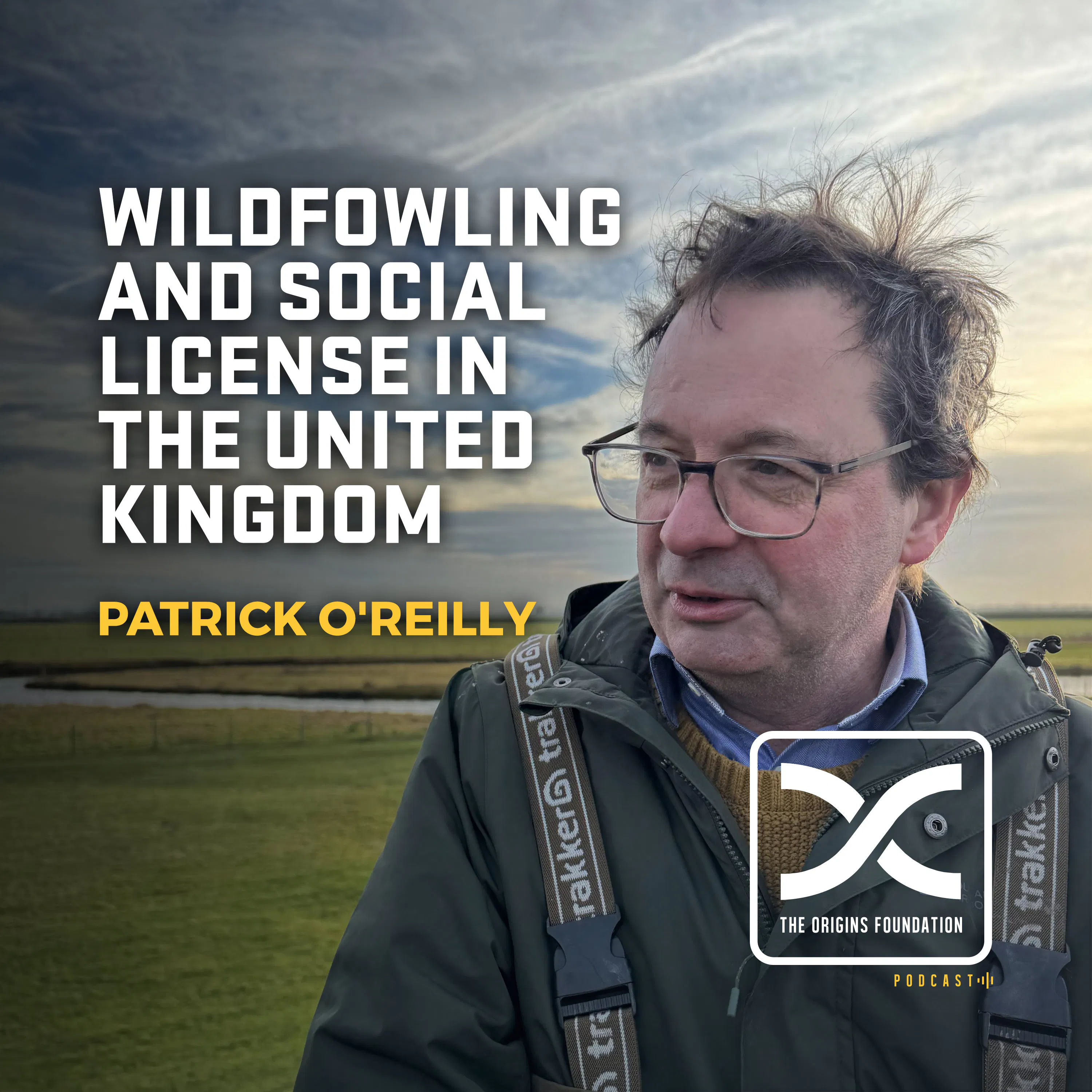
The Origins Foundation Podcast
Episode 636 - Patrick O’Reilly || Wildfowling And Social License In The United Kingdom
01:04:30
Patrick O’Reilly, a social scientist hired by the British Association of Shooting and Conservation was hired 2 years ago to connect about social license and the sociology that “allows” people to hunt chock full of information between an irishman talking to a South African about social license and how it extrapolates onto the narrative around hunting not just in Europe or far flung places but right here at home and all around the world.
Loading summary
Transcript142 lines
- [00:00]
Commercial Narrator
If you're a serious hunter and you haven't tried hex yet, this is the edge you're missing. Hunters have always talked about animals having a sixth sense, feeling you before they ever see you. Hex works by completely blocking your body's natural energy, helping you get closer without tipping them off. Most hunters don't believe it at first until they hunt in it, and once they do, it makes them believers fast. Go to hexhunting.com that's hecshunting.com and use code waypoint to save $20 on a full hex system.
- [00:30]
Planning a fishing trip shouldn't feel like a full time job. With fishingbooker.com you can find and book the perfect fishing trip within minutes. FishingBooker.com connects you with trusted fishing captains around the world. Booking is fast, easy and secure with access to verified customer reviews, loyalty rewards and around the clock customer support. Everything you need to book with confidence is in one place. So head to fishingbooker.com and start planning your next fishing adventure today.
- [01:01]
Podcast Host
Patrick O'Reilly is a social scientist that got hired by the British association of Shooting and Conservation two years ago. Patrick and I have become great friends with a colleague, James Green, who's in the wildfire and wetland space in the United Kingdom. Patrick and I connected on a podcast to really talk about social license, the thing that he knows a lot about. As you can figure, two scientists getting onto a podcast to talk about things that they love doesn't leave much breathing room between questions and answers as you will hear in this podcast. It's a fast paced podcast full of information from an Irishman talking to a South African about social license in the United Kingdom that pertains in terms of the issues to what we're doing in the United States, to what we're doing in Australia, to what we're doing writ large across the world from a narrative around hunting perspective. So enjoy. So five years ago there was a reason why I started this movement and the truth then is the truth now that we need to champion our narrative. We need to champion the truth around what we do and who we are.
- [02:12]
Patrick O'Reilly
There's a sweet spot with a gun, you know, too heavy and it's a burden to walk with. Too light and you whipping it.
- [02:19]
Podcast Host
Why is the project so important to the hunting community?
- [02:22]
Patrick O'Reilly
It's. It's a. I think it's not only important, I think it's. I think it's vital. I think it's, it's just in time. It's like snakes and ladders, you guys are climbing the ladder and then somebody does something stupid and you just slide down.
- [02:34]
Podcast Host
That is such an amazing analogy. Snakes and ladders. Yeah. You know, ivory, in my opinion, was
- [02:41]
Patrick O'Reilly
the plastic of its age.
- [02:42]
Podcast Host
Okay.
- [02:43]
Patrick O'Reilly
The expensive rule going up. It goes a long way with families. We are families that do need it.
- [02:48]
Podcast Host
Let me close this door because I have a little wiener dog. What? You are, you're laughing because I said wiener.
- [02:53]
Commercial Narrator
I'm really glad you finished the sentence out.
- [02:57]
Podcast Host
I'm sorry the first happened.
- [02:59]
Patrick O'Reilly
What are we doing here today?
- [03:01]
Podcast Host
You're telling the whole world. I think the thing that blew me away when Lewis and Jack were talking about it's that it only gets light around 8 o' clock in the morning and then it gets dark at 4:30. Is that what I'm running into?
- [03:29]
Patrick O'Reilly
That's what you're running into. It might be slightly longer. We're gaining about two, two minutes a day at the moment in terms of daylight.
- [03:37]
Podcast Host
So how. I never expected. Because you, you, I always think that you're on the same latitude.
- [03:43]
Patrick O'Reilly
Nope.
- [03:44]
Podcast Host
As me. But you're not. You're much further north.
- [03:47]
Patrick O'Reilly
No, quite a lot further north. We're kind of looking at Newfoundland.
- [03:52]
Podcast Host
Ah, gotcha. Okay, that makes more sense. That makes more sense. Patrick O'Reilly, I absolutely, thoroughly have enjoyed every time we have connected on a call together. And that's why I'm excited about this podcast of us sitting together. I am worried that we do not have enough bandwidth in Riverside to handle how much we both talk. So. But I'm excited because I know that, you know, I think this will just be a free flowing, rabbit hole filled conversation. What do you think?
- [04:34]
Patrick O'Reilly
Quite possibly. Quite possibly. You know, I don't think either of us have a very, very effective off switch. So. Yeah. And I could talk about this stuff all day. Like you'll know I'm not from a shooting background myself. So to me coming in and looking at, you know, what our members do in these areas, you know, every day is a school day.
- [05:05]
Podcast Host
Yeah. Why didn't you grow up in a shooting background? Did you not? Was that just not something your family did or you're from Ireland, right?
- [05:14]
Patrick O'Reilly
No, no. Yeah. I mean the shooting scene in Ireland is, is very different to the shooting scene in the uk there. For example, there, there's, there's very, very little driven pheasant. There's a few shoots. All right. To do the driven pheasant thing, but it's not a big part of, of, of what people do in Ireland when it comes to shooting. The shooting in Ireland is organized around gun clubs, which are generally speaking is the local farmers, whoever else wants a gun and obviously getting the license, which can be quite challenging in Ireland as it is in the uk. And most of the shooting that they do would be what you would call in the UK rough shooting was walked up shooting where you sort of basically go across a field, flush out some, some, some game and take a pop at it. And you know, it's, it's something that you're either really born into or you're not. And, and my family, we're never big into shooting. We're from a farming background. You know, a lot of people around us would have shot. My, my, my, my drug of choice was always fishing. Sure, we lived quite close to the Shannon system, which is, was at one stage one of the biggest salmon rivers in the world. Not so much now because they damned it for hydroelectric purposes back in the interwar period. But it is a fantastic place to go fishing for a lot of coarse pike, perch, bream, roach, all sorts of different coarse fish. And of course, along that, the, the banks there you've got large areas of wetlands, a system called the Callows, which is a kind of an interesting grazing system. It's grazed during the summer and then during the winter it's flooded.
- [07:00]
Podcast Host
It is 2026. And my friends, big changes have happened in the world of firearm suppressors. The $200 tax stamp fee is now gone. Huge win for hunters, huge win for shooters, and a huge win for your wallets. If you're thinking about elevating your shooting experience and adding a suppressor, Silence Essential is the best way to shop. And you don't even have to get off your couch to do it. Go to silenceessential.com, browse hundreds of suppressor options. They literally have all of the popular makes and models. Then their experts will walk you through setting up your account, creating a free NFA trust, and then submitting your application to the atf. Once approved, Silence Essential ships your new suppressor directly to your door. That's when you're going to have to essentially get off the couch. It's a game changer, guys. You haven't done it yet. Do it. The old days of waiting eight to 10 months on a suppressor are gone. It's more like two weeks. Some have even gotten their suppressors in shorter time frames. It's never been easier to start shooting. Suppressed. Get started today by visiting silencercentral.com it's really the simplest way to get your suppressors. Bushnell is Eager to help you get set up for conservation success. That's right. They want to help you. The conservation and research community is dominated by good people doing good things and investing significant time and effort for the benefit of habitat and the species. So what do you need to do? Pretty simple. Send us your conservation story and or your conservation wish could be managing whitetails. It could be understanding your environment or species or something else related to conservation. What would you be able to do if you had a great trail camera setup? We will select the best story every other month and send you a camera bundle. Cell camera, normal SD camera, SD cards as well as optics. Everything you need to get set up for success. I can't wait to see what you submit. You can email us, DM us, message us whatever you want. We are not hard to find. Good luck.
- [09:07]
Patrick O'Reilly
And there's a lot of shooting there during the, during the season. So it was a, you know, we didn't really. My family wasn't never really a shooting family.
- [09:19]
Podcast Host
Is it also in Ireland, very much tied to class. So if you were a rural farmer, was it difficult to hunt or was it like everybody was farmers, everyone knew each other, hey, come, as you say, rough shooting, which is come hunt, really. Come walk up and see what you can find and shoot a brace or two.
- [09:39]
Patrick O'Reilly
Yeah, I mean, there's probably putting. I mean, I'm not that familiar. This is my impression of it that you had these local clubs which would be local lads who would be members of that club. I wouldn't necessarily. I mean, class is a funny thing in Ireland. And to illustrate that I tell you about my own background, we returned, as my family would put it, as my dad would put it, we came back to Ireland. I was born in London, believe it or not, and we went back to Ireland when I was about 11, 12. And of course, my first or second year in school, we had a discussion about class. And I said, yeah, look at all those posh people on the horses hunting foxes just like they do in England. Isn't it terrible being 12 years of age and knowing everything and, you know, the minute the class finished, the two girls came over and hit me across their head saying, how dare you call me posh. So, you know, the hots, the hunting fraternity in Ireland is somewhat different, in my opinion, is somewhat different. And they would certainly say, I know Patrick Hayes, who's the head of hounds in Ireland. He would say that the hunt fraternity in Ireland is a bit more embedded, you know, whether that's true or not, because of course, the hunting crowd you know, the hunting people in the UK would.
- [11:00]
Podcast Host
And is it seen. Is it seen as something that is available to everyone in Ireland?
- [11:06]
Patrick O'Reilly
It's not seen as something that's necessarily available to everyone, but, you know, it certainly has a different social base to what you find in the uk. Okay. Having said that, shooting in Ireland, in my experience, is generally sort of quite interesting. It's like, I'm sure, you know, in. In your experience, you've come across situations where people don't want to tell you where the good fishing spots are, or they don't want to tell you where the good shooting is or the, you know. Right. And I always got the impression that a lot of the shooting in Ireland was kept low key because nobody wanted to tell you where the shooting was happening and where it was good and stuff like that. And the gun club system over there, as far as I can make out, is very much around local clubs, which could be made up of.
- [11:47]
Podcast Host
Of.
- [11:48]
Patrick O'Reilly
Of farmers. And certainly growing up, when I was growing up, it's different now, but when I was growing up, the farmers in Ireland would. A lot of them would be what we classify as relatively small farmers, particularly where we lived in East Galway, which is mainly finishing cattle, bit of dairy. It's changed a lot from that now. But when we were growing up there, certainly a lot of the farmers wouldn't necessarily regard themselves as being particularly wealthy people, and they wouldn't see shooting as something that was an expression within the community. It's something they did.
- [12:27]
Podcast Host
What's the word I'm looking for here? The pressure on hunting. Shooting. And I use hunting, but you've used the word shooting all the time, which is sort of. There's a difference, and you can explain that to us. The difference between hunting and shooting in the UK context is the same pressure occurring in Ireland today as it is where you are right now in the United Kingdom.
- [12:52]
Patrick O'Reilly
I mean, I don't really know the debate in Ireland as well as possibly I should. But, you know, there is a sense, certainly if I talk to some people in the hunting fraternity from Ireland, they would tell me that they have a greater level of public acceptance than hunting in the UK is. And when we refer to hunting. I'll get back to this in a second in Ireland as well. Generally speaking, when you talk about hunting being under pressure, it's fox hunting with.
- [13:26]
Podcast Host
And that's what hunting represents. Right. The word, the term hunting represents fox hunting. Specifically, it.
- [13:33]
Patrick O'Reilly
Not just fox hunting, but generally speaking, what some people call natural hunting, hunting with dogs, hunting with hounds, which involves no shooting forms of capture. With fox hunting really being the sort of the lightning rod issue for people in the debate. I mean, in Ireland, they've just recently had a private members bill in the Irish Doll, which is their Houses of Parliament, which was proposing a fairly comprehensive ban on.
- [14:03]
Podcast Host
And it got absolutely smoked. It got struck down. It was amazing.
- [14:09]
Patrick O'Reilly
That doesn't surprise me at all. Again, Irish class is maybe a bit different to English class, because in Ireland, I mean, it's not that there isn't any class, there certainly is. But in Ireland, traditionally or historically, one of the big tensions politically has been between urban and rural. And like a lot of countries in Europe and I think around the world, maybe.
- [14:35]
Podcast Host
Yeah, around the world. It's an issue around the world, yeah.
- [14:38]
Patrick O'Reilly
But I think in Ireland and certainly in some other European countries that I'm familiar with, the rural lobby tends to punch above its weight. You know, watching this will tell me, oh, that's not true, because we're getting hammered, which they are. There's a lot of stuff happening in the moment to rural areas all over the world, which is negative. But in Ireland, that dynamic has been pretty significant in the way that the politics has developed over there. And that's kind of reflected in the opposition to that fox hunting bill. That being said, public opinion in Ireland is quite significantly moving in the direction of travel, is towards more hostility towards fox hunting in particular.
- [15:31]
Podcast Host
And so the word, then the word shooting. Shooting represents up all of the bird hunting. Because then you've got stalking as well, right? You've got hunting, shooting and stalking. Shooting doesn't represent stalking.
- [15:44]
Patrick O'Reilly
Well, Basque, which is the organization. Myself and my colleague James Green, who, you know, work with, is the British association of Shooting and Conservation. We have multiple disciplines.
- [15:55]
Podcast Host
That's an interesting. The British association of Shooting and Conservation, not hunting and Conservation. Shooting and conservation, yeah.
- [16:04]
Patrick O'Reilly
And our members consist of people who shoot wildfowl. It also includes people who do the driven game, shoots pheasant in the lowlands and more so grouse in the uplands. Partridge. We also have inland wildfowlers. Those are people who maybe shoot ducks on inland ponds. We have a very, very strong representation from stalkers. No, not probably. I know when I looked at the numbers, we represent the largest proportion of people who stalk deer in the uk. But then we also do some of the sport shooting, the non live shooting as well. So we have a very broad membership which is very useful for us in a sense that, you know, we get a wide base of support which reflects a wide sort of range of interest. I mean, we also, for example, represent people who are involved in shooting for pest control. So, you know, it's a very, very broad church, but shooting in the UK denotes any. It includes any hunting of things that fly or things that run around on four legs, which is you. Which is done using the gun without.
- [17:30]
Podcast Host
Without the involvement of dogs, which then separates it into hunting.
- [17:37]
Patrick O'Reilly
We use dogs to basically for a variety of different reasons. Um, so, yeah, it's shooting with a gun with the assistance of Doug's. For, for example, picking up, retrieving.
- [17:49]
Podcast Host
Um, yeah, yeah, yeah. Oh, yes, yes, yes. That's what I meant. That's what I meant. It wasn't.
- [17:53]
Patrick O'Reilly
But. But basically you are not using the dog as the main way of capturing the prey.
- [17:58]
Podcast Host
Yeah, it's funny, I. I'm on this kick right now of. Well, I'm on this kick probably permanently. About narrative and rhetoric and the use of words and euphemisms. I just had a long podcast of the difference between kill and harvest. And it's interesting that there are these three differences, these three different terms. Where in the United States those three different terms would be the same term, hunting.
- [18:24]
Patrick O'Reilly
Okay.
- [18:24]
Podcast Host
There would be no differentiation between shooting, fox hunting, hunting and stalking. Was there a maybe. Just how long is the. How long have those. Has it been always the way that that's how it's been described, the differences between those three things? Was it a forward thought process of maybe shooting and stalking are just better terms for people to accept this thing?
- [18:58]
Patrick O'Reilly
It's a really good question to which I do not have a clear answer. My theory would be that as the debate has evolved, particularly during the 20th century, the distinction between hunting and shooting in the UK has become more significant because of the debates and the narratives that are evolving around the activities that we're involved in. And I'm not sure, I mean, I think the term do you shoot in the UK historically was an interesting question that people used to ask and possibly provided a way of identifying the different people's attitudes, but it's not something I've looked into in any great deal.
- [19:58]
Podcast Host
Interesting.
- [20:00]
Patrick O'Reilly
I think you're bang on the nail with that in terms of the importance of language and the way that we frame things. Yeah. And a lot of the work I do with Basque is actually about trying to, you know, pull things back and make sure that we are not being dragged into narratives that, you know, don't necessarily allow us to reflect accurately on what our members are actually doing.
- [20:23]
Podcast Host
Patrick, what is your official title? Because it's a very, a very unique title to a Shooting Association.
- [20:32]
Patrick O'Reilly
Yeah. I'm the head of social science. I quite often have to tell people it's not the head of socialist science. You know,
- [20:44]
Podcast Host
how many times do you have to tell people that it's actually a true science?
- [20:48]
Patrick O'Reilly
All the time. It's not particularly helped by the fact that I'm not sure myself that it's a real science either. You know, I mean, we were post truth before it was fashionable. Yeah. So a lot of my work, yeah, there's a bit of trying to explain to people what I do. I mean, science is a fun. I mean, I say what my job is mainly comprised of is listening to people and facilitating them to talk, particularly in this job because, you know, as. But you know, with the Wildfelders in particular, I spent quite a lot of time with them. And you know, when you get them going, when you actually get into a conversation with them, when you start listening to what they say. One of the great skills of being a good social scientist is being able to sort of identify when it's time to shut up and let people talk and tell their own story and, you know, providing the platform and the context and the, you know, the, the support to allow that to happen. And, and that's been one of the great learning experiences I've had since I started in this job, which essentially involves me trying to gather evidence to grow public acceptance for shooting in the UK and also to encourage, where necessary, some slight modifications in the behavior of our members or to look at how we, you know, build compliance and stuff. Like.
- [22:18]
Podcast Host
How long have you been in that position?
- [22:20]
Patrick O'Reilly
Well, I'm almost.
- [22:21]
Podcast Host
Well, how long has this position been in effect?
- [22:24]
Patrick O'Reilly
Position. This position started with me and I've been in it since January last year. So I. Wow.
- [22:30]
Podcast Host
It's a brand new position. They, they obviously bask from thought through this and said we need someone to start thinking 24 7.
- [22:42]
Patrick O'Reilly
Yeah.
- [22:44]
Podcast Host
About social license. About our social license. About our members social license.
- [22:48]
Patrick O'Reilly
Yeah. Yeah. Well, I mean, in fairness, I wouldn't necessarily see it entirely that way. I mean, one of the beauties of BASC as an organization, at the risk of sounding like I'm trying to blow smoke up their behinds, but one of the strong features of BASC as an organization is that whilst it's run professionally and people are employed, a lot of the people who are, I come across them back and my impression is that they're also really committed, passionate enthusiasts for what we do. They're shooters themselves or they're from shooting families. So they bring an awful lot of what I would call local knowledge to this. And they've been flagging the need for social license for a very long, long time. What I see is my role is essentially, is providing them, where possible, with. Well, I would like to think that my role is giving them a bigger set of boxing gloves, you know, figuring out if there's additional stuff where a little bit of a more scientific approach can strengthen or provide a boost to what they're already doing really, really well. You know, so, so, so I don't think that, you know, they suddenly woke up one day and said, social license. Oh, my God, we need an expert. And I hate to think that that.
- [24:14]
Podcast Host
What is, what is your background? Hat I'm.
- [24:17]
Patrick O'Reilly
Well, I've been. I've been doing social science for about 40 years. My main background is all about that.
- [24:24]
Podcast Host
And for somebody who doesn't know what social science is. What. What is social science?
- [24:29]
Patrick O'Reilly
Social science to me is simply about understanding why people do the things they do in the way they do, using the tools and the resources that they do in order to figure out how to work together to achieve their life goals, which might, in many cases, simply be getting up in the morning and stuff like that. And most of my work is involved looking at how people who live in rural areas interact with their environments to create the landscapes that they live in, make an income for themselves, educate their kids. And in that context, I suppose increasingly over the last 12, 15 years in particular, a lot of my stuff has dealt with environmental conflicts where, you know, you have sort of. And that's why I say, you know, a lot of the problems that I see our members facing are quite similar to problems that other people who have a connection with rural areas and coastal areas experience all over the world, which is an increasing pressure for them to essentially solve everybody else's problems, or at least that's the impression you get. And that's sort of been one of the recurring themes in my work recently is how you reconcile the needs, the interests and also the expertise and the skills and the knowledge of people who live in these areas with sort of new trends of environmental demand, of new trends in resource demand. You know, how do you actually. How do you actually, you know, get to a situation where people who live in these areas are able to continue to reproduce their way of life. Yeah. Whilst, you know.
- [26:17]
Podcast Host
And specifically now that you're working for Basque.
- [26:20]
Patrick O'Reilly
Yeah.
- [26:21]
Podcast Host
Your members.
- [26:22]
Patrick O'Reilly
Yeah.
- [26:23]
Podcast Host
How do they. How do they continue to do the things that they love to do?
- [26:27]
Patrick O'Reilly
Yeah, yeah. And I mean, I think one of the things that I'm really interested in trying to push is a wider understanding of how shooting contributes to landscapes and nature in the uk, which is something I think is quite often overlooked. I mean, again, talking about the wildfellows,
- [26:50]
Podcast Host
well, it's why we exist. It's why I exist.
- [26:54]
Patrick O'Reilly
Yeah, yeah. I mean, I think that's. I mean, it's one of the phrases I kind of use when I'm. When I'm talking about this, or one of the things I say to people when I'm talking about this is that, you know, if you look at the UK's landscapes, it's coastlines, you know, the three things that have shaped it more than anything else over the last two or three hundred years. Agriculture, industry and field sports. There's hardly a landscape in the UK that isn't fundamentally influenced by. By the presence of various different fieldsports and shooting in particular. A lot of the things that maybe people like me, if I was looking at a marsh, I say, oh, it's a marsh, it's caused by tidal floods bringing silt up and depositing a little layer upon layer upon layer. Until you talk to the wildfellers who work on those areas, who do a bit of shooting on those areas and who look after those areas, and you realize that that marsh exists in the form it does now because of what we've done over years using forms of knowledge which aren't necessarily taught in university, you know. So, I mean, one of the things, myself and James Green, who's my colleague with a lot of the wildfowling stuff that I do, is we talk about the blend and the importance of sort of making sure that we properly integrate scientific evidence, scientific information, technical innovations like, you know, could be as simple as a new gun site, better imaging equipment, drones and stuff like that. How we integrate all of that high tech and all of that, you know, formal academic knowledge with the sort of the local knowledge of the people who've worked in these areas for. Well, in some cases, in the case of some of these wildlife. I mean, we were interviewing people tomorrow, I think, or next week. Certainly we're talking to some people who are fifth, sixth generation wildfellers. They can trace their origins and their involvement in those areas back to the middle of the 19th century. So these are people who've lived in these areas for a long time, and they have this enormous bank of cultural experiences, cultural knowledge, traditions, practices. And I often compare it to an iceberg. When you look at what's happening in an area, when you look at what people are doing in terms of Conservation and shooting in an area and how they're managing those areas, you'll only see a fraction of what they're doing to maintain those areas is enormous amounts of the knowledge, the experience, the skills that they have, which don't really register to the naked eye. And part of my work, I suppose, is trying to tease that out and make it visible to people so the individuals who are not part of that world can actually see how valuable that resource is, that human resource that's in these areas. Because you don't get that at university. I've taught students for 40 years nearly, and you just don't teach people that kind of stuff. We can teach people how to, you know, evaluate water quality or do surveys and stuff like that, but you know, you can't run, you can't maintain, you can't manage a landscape with that sort of academic knowledge unless you also figure out how you bring along and tap into and utilize the local knowledge. And I've seen that in projects all over the world that I've worked in is that, you know, what tends to happen or what has happened quite a lot in my experience is people go in and say, we're going to sort everything out, we're going to solve all the problems, we're going to use this science, we're going to have evidence based solutions and all of that kind of thing. And I started off with a great burst of enthusiasm. And then the desk stuff hits reality and once desk stuff hits reality, once your theoretical stuff hits reality, then you get into the question of how you actually adapt what, you know, what you studied to a real world situation. And what I've seen quite often happen is it's almost like this epiphany moment where the environmental scientist turns around and says, we need to engage with people. And you say, yeah, no, really, really, you know, how important, you know, I could sort of like essentially my biography has been starting with projects where people have said, we need somebody to do the social bit. And then you say, where are you at? Well, we've done all the research and we made all the plans. You just have to tell people what to do. And that's actually wrong, you know. Yeah, sorry, yeah.
- [31:41]
Podcast Host
Pat, you've been in this world now two years. I'm going to make an assumption that you were sort of outside of the world prior to joining Basque. Is that a good assumption?
- [31:56]
Patrick O'Reilly
No, not really.
- [31:58]
Podcast Host
Were you heavily in the outdoor space, outdoor industry, space shooting, space?
- [32:03]
Patrick O'Reilly
I, yeah, I mean, I, I, besides doing the academic stuff, I had a second career which was Running. Well, I ended up running my own business in. In a completely unrelated area. I think that to be a good academic, to me, to be a good researcher, to be a good teacher, you also had to live in the real world as well.
- [32:27]
Podcast Host
But were you living in the shooting sports world? But I wasn't as an academic, no.
- [32:32]
Patrick O'Reilly
No.
- [32:32]
Podcast Host
Okay.
- [32:33]
Patrick O'Reilly
I wasn't living in that.
- [32:34]
Podcast Host
Okay, that's great. That's what I. That's what.
- [32:35]
Patrick O'Reilly
I was living in a rural space and I was living in a coastal space.
- [32:38]
Podcast Host
Okay, that makes sense. That makes sense.
- [32:40]
Patrick O'Reilly
But. But I mean, I think what you have to be very careful about. I think one of the reasons why I sort of came into Basque was a growing concern about the fact that academic environmental science across all the disciplines can become a very comfortable place where you can kind of sit in an office and come up, make a proposal, do your research. Oh, this is what we should do. Then, as I said, your proposals hit reality and they don't work. And then you say, oh, they didn't listen. And that can become quite a comfortable place for people to sit where they're just basically chipping away, knocking out their academic papers and not really giving too much thought to. To why it's not working in the real world. And I've always felt that if you really want to be good at doing research, you've also got to try and engage with the worlds that you're looking at in a really meaningful way and care about them. And I played that approach here to
- [33:42]
Podcast Host
work in Basque in the two years you've been there. What I'm intrigued to find out from you is, again, from a. Looking at it from a social lens, looking into our industry, looking into our space. If you had a magic wand, what is the. What is the thing that we need to do the most from a social perspective in our industry space? You. You've been in it for two years now. You've got your academic background. That's why I wanted to set the scene. I was just wanting to. Maybe the question is, what do we need to do more of or flip it? What are we doing wrong that we need to change?
- [34:35]
Patrick O'Reilly
I mean, I think the first thing I would say is I don't believe in magic wands at all. And this is something that I've constantly argued against is academic work in particular. A lot of it is based on magical thinking. It's based on the idea that you're going to do some research and you're going to create a solution.
- [35:00]
Podcast Host
Very astute observation. Very astute observation.
- [35:04]
Patrick O'Reilly
And One of the things that. I think I said it when I started with Basque, is that, look, you know, there is no magic bullet. You know, pardon the pun, or you're
- [35:15]
Podcast Host
not the magic bullet.
- [35:16]
Patrick O'Reilly
No, I'm definitely not the magic bullet. I mean, I think one of the things that you need to do is you need to accept that this is like bite and hold. You do little increments across the board, and that's how you make change. Some of the things that I think, believe it or not, one of the things I think that we need to do in the UK is recognize that it's okay to shoot and to celebrate what shooting is about. I think we need, as a community, ideally, and there's no single way of doing this, but I think we need as a community to get a little bit more onto the front foot, which is quite difficult to do because the media ecosystem around all forms of. Almost all forms of conventional land use in the uk, including agriculture. It just seems to be this enormous tendency in the media to assume that everybody wants a good environment, and that good environment can only be achieved by punishing farmers, hunters, shooters, all these other groups, fishermen as well. So there's this sort of. I wouldn't necessarily call it a struggle, but there's certainly a tension between what I would call existing land users, whether they own the land or just shoot on it, for example, and new audiences, new constituencies are coming in and saying, well, actually, we should be using this area in a completely different way. So I think we need to be a bit more proactive in saying what we do is good.
- [36:55]
Podcast Host
And what does that look like to you?
- [36:56]
Patrick O'Reilly
To me, that means things like saying, you know, as I said already, I think one of the things we have to keep telling people is that shooting is an intrinsic part of the UK's natural landscapes, if you want to call them that. I usually wouldn't call them natural landscapes. I call them landscapes with nature in them because I think we need to challenge that narrative that, you know, there's been this big fall from Grace and me can, you know, restore all these areas to some imaginary pristine that maybe never existed. So I think one of the things I'd like to.
- [37:30]
Podcast Host
Yeah, when do you think that pristine was actually there?
- [37:34]
Patrick O'Reilly
Well, 400 years ago, I taught on the pristine. Like, the US has had a very checkered history with the pristine as a concept. I kind of think that we have to sort of challenge that narrative by saying, look, we do not have. Have natural landscapes in the UK so much as we have landscapes with nature in them. That those landscapes are the product of human interactions with nature, like hunting and shooting over hundreds of years. And there is actually some value in celebrating what those landscapes are. It's like, as I said, if you look at some of the areas where our wildfowlers are active along the coast here, and there's often a sea wall which is raised area, which sort of cuts off the tidal area from lands per se, and quite often there's a jogging path on it or a path that is now used for jogging. And you'll see people looking over and sort of enjoying the countryside. They don't realize that's a managed landscape. They don't realize the work we do. And we have a job of work to do to actually remind people. You know, you would have landscapes in the UK and it's coastal areas in this, you know, natural environments, if you didn't have or had never had shooting and hunting in those areas. But they'd be very different to our actual landscapes. And, you know, getting people to understand that and recognize it and value it and understand that, you know, this is one of the things I push with our members is we're not just protecting shooting traditions for ourselves, we're holding them in trust for the entire UK population. This is part of the cultural heritage, the traditions, the natural environments of every single person who lives in this country within the uk. And that's what I think we need to be, is less reactive and more interested in actually making the case for what we do really well.
- [39:49]
Podcast Host
It's so interesting you say that, you know, I, I, I love the idea that if you don't have pristine landscapes, you have, you know, landscapes with, you know, elements of wild on them. Yeah, it would be an, it would be a fascinating exercise, even a social exercise, to that of asking the individuals with the wild components, the wild puzzle pieces on their respective areas, why do you keep that wild? Why haven't you changed it? And I would put money down today that the vast majority of the answers would be tied to some sort of wildlife conservation, some sort of shooting, some sort of stalking activity or tradition.
- [40:31]
Patrick O'Reilly
Absolutely. I mean, in the area where I live, which is quite an interesting area because it's Lancashire, so it's the cradle. Yeah, it's the cradle of the Industrial Revolution. You know, this is not sort of pristine, it's the opposite of pristine. You know, we have a history of heavy industry here. Preston, where one of the Wellfellen clubs I work with is based, was historically the biggest river port or one of the biggest river ports in the World, we have steam, we have coal. It's not, you know, it's the opposite of pristine. But if you look at maps of this area, and I've sat down with shooting people and looked at maps of this area taken from the early 19th century, they're a lot less wooded than they are now. And the reason why we have the woods, that we do have the copses and what have you, these little areas of COVID is often linked to shooting in those areas. So yeah, yeah, you know, again, it comes back to this. The people driving through these areas saying, oh, look at this lovely countryside, look at this wildness. They don't realize it's been.
- [41:41]
Podcast Host
You think shooting, do you think based on that point, do you think shooting and stalking have. Dare I use this term? Because I think it's being cooper co opted, but I would love to re. Engage and own the word. Do you think through shooting and stalking various parts of the UK countryside have been rewilded?
- [42:03]
Patrick O'Reilly
I'm very, very dubious about the term rewilded because it's been so weaponized.
- [42:09]
Podcast Host
We should weaponize it ourselves. Patrick?
- [42:12]
Patrick O'Reilly
Yeah, well, no, what I would say, well, there's two aspects to that, right. One aspect of that is that simply because something is wild doesn't necessarily mean that it's worthy of more preservation that something that's managed, right? So there's a lot of agro biodiversity. I mean, this is a point I used to make. It's probably one of the reasons why I don't teach anymore. But I used to say to people, if you look at, you know, plant and animal, plant and animal biodiversity across the world, there's an awful lot of agricultural and domestic plant and animal biodiversity which is equally, in my opinion, worthy of protection. So, you know, simply saying rewilding is better. That's a really bad idea. But certainly. And the phrase I would use is that, and I absolutely, totally convinced of this because I've seen the evidence scientifically and I know from talking to people, certainly shooting and you know, related activities in the UK have been instrumental in supporting nature recovery and maintaining throughout periods in our history where there was a huge drive to industrialize agriculture. They created oasis of wildlife on the UK landscape. And a lot of those oasis, case in point, where we live, going back to it, a heavily industrialized area where there's a huge pressure on land for settlement with land for industry, with land to produce food and, and where you see a lot of these little, you know, woodlands or hedgerows and stuff like that, where there is cover and stuff like that, you know, shooting has been instrumental in that. So. So one of the things that I try to get people to see is that not only is shooting intrinsically linked to conservation, but shooting is effectively a form of conservation in itself.
- [44:07]
Podcast Host
Because of. Sorry, because of what?
- [44:12]
Patrick O'Reilly
Because when you shoot, it's not just the act of shooting, it's all the other stuff that you do in order to make the shooting happen. Shooting provides the driver that enables a lot of conservation to take place. And particularly in a country like the uk, which like every other country in the world, is cash strapped at the moment. Right. The fact that you've got people doing shooting which can contribute to conservation and is done at pretty much zero cost to the government and in fact, in some cases actually generates income for the government, that's something that we shouldn't forget to say either, you know. So, yeah, I mean, I. The more I look at it, I think these points that you're making around. Yeah. Rewilding, you know, let's take that on. Let's look at how sensible that is. And, you know, because that's a part
- [45:05]
Podcast Host
of that, that's a part of that shooting legacy that you're describing. Right. It's like. And maybe it's also tied to another concept that I've been thinking a lot about lately, is the general public's viewpoint. Because we engage in this all the time. Whenever we do something, they're like, we get this a lot. Love to hear your reaction. Humans are the problem. Get rid of humans. Right. We need to, you know, dare I say, the English countryside in the 1700s was so much better than today. Then there's this idea, and I'm going to use a word very purposely, this idea of. It's not. It's this rewinding. It's a rewinding of like, this is what it should be. And it's like, well, we're never going to get there.
- [45:51]
Patrick O'Reilly
Yeah.
- [45:52]
Podcast Host
Based on the fact that we have, you know, a million percent more people today than it did before, we've got a lot more agriculture, we've got a lot more mouths to feed, and again, tied to this idea that we've just described, this rewilding. We've got pockets of areas in this country that are protected, that have increased, that do have more value and that are still existing today. Because of this thing that you actually hate the most.
- [46:21]
Patrick O'Reilly
Yeah, yeah, yeah. I mean, it's interesting you say that because we're just doing a bit of work and looking at some of the language around rewilding in the UK and in Europe. And this lovely phrase that I'm not sure if you come across it much as land is becoming available. You know, land is becoming available. Now, you know, I come from Ireland where we know a thing or two about, you know, property and where, you know, my mother would still sort of divide the world into two classes of people really, one of which is the people who owned land and the other one was people who didn't own land and, you know, the people who owned land and farmed land. Land is a stylus and a nature and they're not making any more of it. So, you know, when people use terms such as land is becoming available, it's very, very often the case that that land is becoming available because some people are being displaced. And again, it goes back to what I was saying about the importance of recognizing and preserving agricultural biodiversity and shooting related biodiversity as well as, you know, this notional pristine form of biodiversity.
- [47:35]
Podcast Host
Well, isn't that the, isn't that what's happening there? The land is becoming available? Because in their mindset, and one of
- [47:42]
Patrick O'Reilly
the interesting ironies of that is that in the UK situation, one of the drivers of that land availability is people going bust or people not being able to sustain agriculture anymore because of the same forces of capitalism, if you like, that a lot of people in the sort of the rewilding movement frown upon, for want of a better word. So ironically, rewilding is anti capitalist. Yet in the uk, the growth in rewilding is intrinsically linked to the fact that late capitalist agricultural markets are forcing people out of business. So they are in a sense the beneficiaries.
- [48:23]
Podcast Host
So do you think it's changing to a value on the land that actually is not, well, one is not there and number two is actually not beneficial. When you look at, at the end of the day to biodiversity and wildlife
- [48:38]
Patrick O'Reilly
conservation, it's very, very difficult to demonstrate benefit over time. One of the concerns I have with rewilding is longevity in the sense that I know we're dealing with clubs, shooting clubs that have been in existence for 70, 80 years. You know, Basque itself was formed, is, is the successor organization to Wagby, which was formed in, in the 1920s as the, you know, the Wildlife, Wildlife or Wildfowl Shooting association of Great Britain and Ireland. So that, that, that's longevity. I see with a lot of the rewilding stuff, there's enormous enthusiasm at the beginning. They often get bequests or they get sort of various different kinds of finance and stuff like that. But there is a bit of an issue with conservation projects running out of steam and being gone in five years or gone in 10 years or sort of experiencing blocks. My point would be that those kind of struggles over how we should value land and stuff like that, quite often the fundamental sort of laws of value managed property still survive underneath all of that. So to get back to your question, which I kind of forgotten now, you knew this would happen. When you say values changing in land, I think there's a huge conflict over how we value land. I think there's an enormous conflict over.
- [50:14]
Podcast Host
Oh, totally agree, totally agree. Like foresting a moor. Foresting a moor is better than leaving the moor as it is. And the benefits, sort of, the benefit chain on both are different, but ours is better.
- [50:29]
Patrick O'Reilly
Yeah, but I mean, if you look at UK agriculture at the moment, we're losing land from agriculture. People are celebrating that, you know, oh, land is becoming available, it's great. But what we're also seeing in the UK is a massive increase in feed agriculture. So what we're seeing is an intensification in the remaining agricultural sector in the uk. And the other thing we say in the UK is a lot of imported food from places that quite often might necessarily have the same kind of environmental standards as the UK has. Not to mention things like, you know, food, food, miles, all of those kind of, kind of things as well. I mean, I think, you know, what I would love to see is the people who are sort of standing on the seawall, if you like, throwing brickbats at our members and criticizing and condemning and saying the shooting is, is bad for the environment, would actually sit down and talk to us about, us about really working the problems rather than worrying about the ideology of it and saying, right, how do you improve the environment? What resources do you have? And let's talk to people about money, let's talk to people how this is financed and resourced over the longer period of time. Because looking at the sort of data that we're getting, shooting is really, really cost effective. I worked in Malaysia for about seven or eight years. Well, on and off, because I was associated after I came back and we worked with an underutilized crop or I worked with an underutilized crop organization. And then the entire focus of our work was, you know, finding high value alternatives to environmentally harmful agriculture. Now, you know, a lot of the things that I've just said apply to shooting. Shooting is a high value alternative to conventional agriculture which allows for a lot of environmental benefits if it's managed properly. You know, and to be honest with You a lot of shooting is managed properly because by definition, if it's not managed properly, you're not going to have anything to shoot in five years time.
- [52:33]
Podcast Host
So how do we tell the general public that?
- [52:36]
Patrick O'Reilly
One of the things that I'm hoping we can do is actually get them talking to our members face to face, stuff like that. I mean, I do a thing at the moment we're interviewing members and they're coming up with stories. So I got one guy from Scotland who tells a brilliant, brilliant story about him shooting on the foreshore and he comes over to Sea Wall and he sees this field full of Widgeon who are all sort of clumped together, melting the snow so that they can eat. So, you know, I'm thinking, looking at it from my sociological point of view, saying, oh, there's a, there's a citizen scientist because nobody ever, ever seen widget doing that before, at least not in Scotland. And then of course he says, you know, he goes on to say, oh, I didn't have the heart to shoot them. I just looked at them and, and then I got another story is a similar story about, from a, from a guy down, and yet he had been,
- [53:29]
Podcast Host
yet he had been on the other side of the seawall shooting widget that
- [53:32]
Patrick O'Reilly
morning to see, while shooting. And, and, and then I have another story, very similar story of a guy looking at 60 Widgeon coming up the river first thing in the morning and he said the sun was shimmering off of them so wonderfully I couldn't shoot them. You know, I'd love to get a few stories of shooters actually shooting stuff. This is a problem that I have. But, but when I play that story to people and then I put up, we've got lots of infographics, we generate an enormous amount of really good evidence to support the value of shooting. Well, I just play that and at the same time I'll show people the infographic and then I ask them at the end what is likely to make people look more sympathetically on shooting? Is it all the facts and figures or is it the story, is it the heart? And quite. Well, normally people, of course you always get. The contrarian will say, oh no, no, I need facts and figures. But the vast majority of the people will tell me it's the emotion, it's the emotions, it's actually getting that connection and re. Establishing that connection. You know, like people in the UK love nature. They're big nature lovers, they're big animal lovers. What we need to, I suppose, get them doing, I think what we need to do is get them talking to our members and then they'll realize that these people love animals. They have a fantastic relationship with nature, they care about the species they shoot, and for the most part, they're really, really keen on making it sustainable. Because if it's not sustainable, it's not going to last. And they've been doing it for decades.
- [55:06]
Podcast Host
Yeah, it's contradictory. It's contradictory to the premise of the thing that we love the most, what these guys love the most. If they weren't. Thinking about being able to hunt tomorrow or their kids being able to hunt, or their kids kids being able to hunt, then there would be no wildfowling anymore. It'd be a very selfish endeavor.
- [55:37]
Patrick O'Reilly
No, no, I mean, that's one of the points that we talk a lot about and it's one of the things our members are really, really strong on. And I got heaps of emails from people saying, you know, for example, my daughter has just started shooting and I want there to be shooting for her in 10 years time. Or, you know, I'm hoping my kids will take up shooting soon. It's a big thing. It's this idea of tradition and stability, you know, not stability, but you know, that it will be passed on. And then when I ask people what their concerns are, one of the big concerns are that there isn't going to be anybody to pass it on to you, you know. So, yeah, this is a big thing for our members is this idea of a legacy that they are protecting for future. I've seen similar things in a project we did, for example, in Borneal where you had people planting trees. They're never going to get the benefit of that. And you say, well, why are you planting these trees? For my children, for my children's family. So that there'll be trees here, you know. So, I mean, I think again, you know, from my own background, I understand the importance of a connection with land, you know, and, you know, and the connection with the nature that lives in that land. And that's a huge part of what our members are doing. So we are.
- [57:11]
Podcast Host
That's the story, right? That's the story. The story is the connection.
- [57:15]
Patrick O'Reilly
Yeah, yeah. And the challenge is how you tell that story to people who aren't part of that community, you know, And I mean, that's one thing. I mean, the first thing I did, one of the first things I did when I joined bas, I went out wildfounding and you know, after five minutes of listening to the stories, listening to the knowledge, you Know, I just thought we really don't need so much to do the huge arguing thing. What we need to do is we need to amplify what these people are saying. We need to give them a voice. We need to make sure that people are listening to them and that we're giving people the opportunity to talk to them. I think, I would hope at least that that's the kind of stuff that we will be doing over the next couple of years is actually confronting the public with the truth in relation to who these people are. I mean, I think one of the issues in the UK has been this sort of stereotype of who a shooter is and that's people who are opposed to shooting. Make hay of
- [58:27]
Podcast Host
my experience just bloodlusting murderers. Right, Patrick?
- [58:31]
Patrick O'Reilly
Well, whatever. Well, and from a certain class and having a certain accent and what you. Nothing could be further from my experience. I mean, I'm involved with te, I'm involved with Esteem Society, I'm involved in amdraman or have been in my past. And the same kind of people who are volunteering for all these various different things that you see across the uk, very similar to the people that we have in the shooting community that I'm working with on a daily basis. They're not, they're not necessarily, you know, these stereotypical elites who don't care about anything. There are absolutely huge range of backgrounds and stuff like that. And one of the things that I think is really important that we do is we get people in the room to sit down and talk to us and listen to what our members have to say. So we're trying to, I mean, we're launching a couple of things to try and capture some of that. So, you know, over the year we're hoping to increase the number of opportunities that we have to, to get non shooting people down to see what happens in some of the shoots and some of the marshes that are managed by our members. Some of the groups themselves are taking the initiative in this. I mean, again, not to blow their trumpet, but Preston up the Road works very closely with some of the local bird watchers. They bring them on, they work with some of the wildfowl and wetlands trust people around specific projects and stuff like that. So again, I mean, as I said, I don't see my job as doing something that's new, as maybe it's just giving a bit of extra oomph to things that people are doing.
- [60:09]
Podcast Host
Yeah, yeah, yeah, yeah, yeah.
- [60:10]
Patrick O'Reilly
And the more that we can get people to do that, I think the better. I mean, like you know, I could be very wrong, but I think it's very easy to condemn a theoretical shooter who is from an aristocratic background and, you know, wants to shoot everything in the world. It's very easy to condemn that sort of illusory, stereotypical, false stereotype. It's a lot harder to look somebody in the face who spent half of their lifetime conserving a wetland or conserving a woodland or managing an area, caring for the wildlife that lives in that area, supporting the biodiversity. And it's very, very difficult for somebody to look a person like that in the eye, I think, and tell them that they're wrong. When you got the evidence there in front of your eyes of the benefit.
- [61:01]
Podcast Host
Oh, we've got a better way to do it.
- [61:02]
Patrick O'Reilly
Yeah, yeah, yeah. So it's challenging narratives. It's the stuff that you do every day. You know, love it. Take narratives on and love it. And that's what we've been trying to do.
- [61:12]
Podcast Host
Well, Patrick, I'm excited for what we're going to do together. We mentioned a little bit, obviously we're going to do some work together. I'm not going to let the cat out the bag that we are coming to the UK for the first time and we are going to do some narrative work all around the storytelling, telling people who people are. And I'm excited about building this relationship. You know, I've. I've always felt like there's something there. I've always enjoyed seeing what you guys do at Bask. I'm a big fan of Bask
- [61:43]
Patrick O'Reilly
and.
- [61:44]
Podcast Host
Yeah, just connecting with you and connecting with James and the team is just. I think this is step one of multiple steps.
- [61:52]
Patrick O'Reilly
Yeah. I'm looking forward to seeing how you interact with these guys that we've lined up to meet you. I'm really looking forward to seeing your take on that. They're brilliant characters.
- [62:05]
Podcast Host
I'm looking forward to it. I think that's the best part of my job, is just meeting cool people in cool landscapes, or landscapes that you didn't even think are there. And that's the beauty about where we're going from a Preston wildfowling landscape is that. Yeah, you think it's this, like you've just said, this pristine, wild landscape in the middle of nowhere, whatnot. No, it's sandwiched between two. One industrial hub and one very eccentric tourism hub. And here is the wildfowling landscape.
- [62:40]
Patrick O'Reilly
Yeah, yeah, yeah, yeah. I mean, literally five minutes or not five minutes, 500 yards down a lane and you're completely divorced from all of the stuff. It's an incredible experience. I think you're really going to love it. I'm looking forward to seeing what you make of it.
- [63:00]
Podcast Host
Yes, sir. Well, Patrick, thank you so much, dude. I look forward to the next time we do this. And if anybody's interested in understanding more about basc, where can they go?
- [63:12]
Patrick O'Reilly
Well, they can contact us at. At Basque. We have a website which is. If you, if you type in Basque uk, you can get the website. Anybody wants to talk to me about this stuff, I'm@patrick.o apostrophe r e I l l y@basc.org.uk fantastic. And I can steer any inquiries to anybody else.
- [63:34]
Podcast Host
Fantastic. Yeah. And that's basc. B, A, S, C. The British association for Shooting and Conservation. Love it. Thank you, Patrick. Appreciate you a lot. No, well, that's it for today. I appreciate you listening. As always. Leave a review, share it with your friends and most importantly, do what's right to convey the truth around hunting.
- [64:01]
Commercial Narrator
This episode is brought to you by Boat Trader, America's largest boating marketplace. Whether you're buying, selling or upgrading, the Boat Trader app makes it easy with the biggest selection of new and used boats from dealers and private sellers. Browse, compare and even apply for financing all in one place. Download the Boat Trader app and start your search today. Outdoors isn't just a place, it's a lifestyle experience. The action and unforgettable stories with Silver Kings. Sundays at 8am Eastern on Waypoint TV. Wherever adventure takes you. Waypoint TV, your destination for outdoor entertainment.