← The Origins Foundation Podcast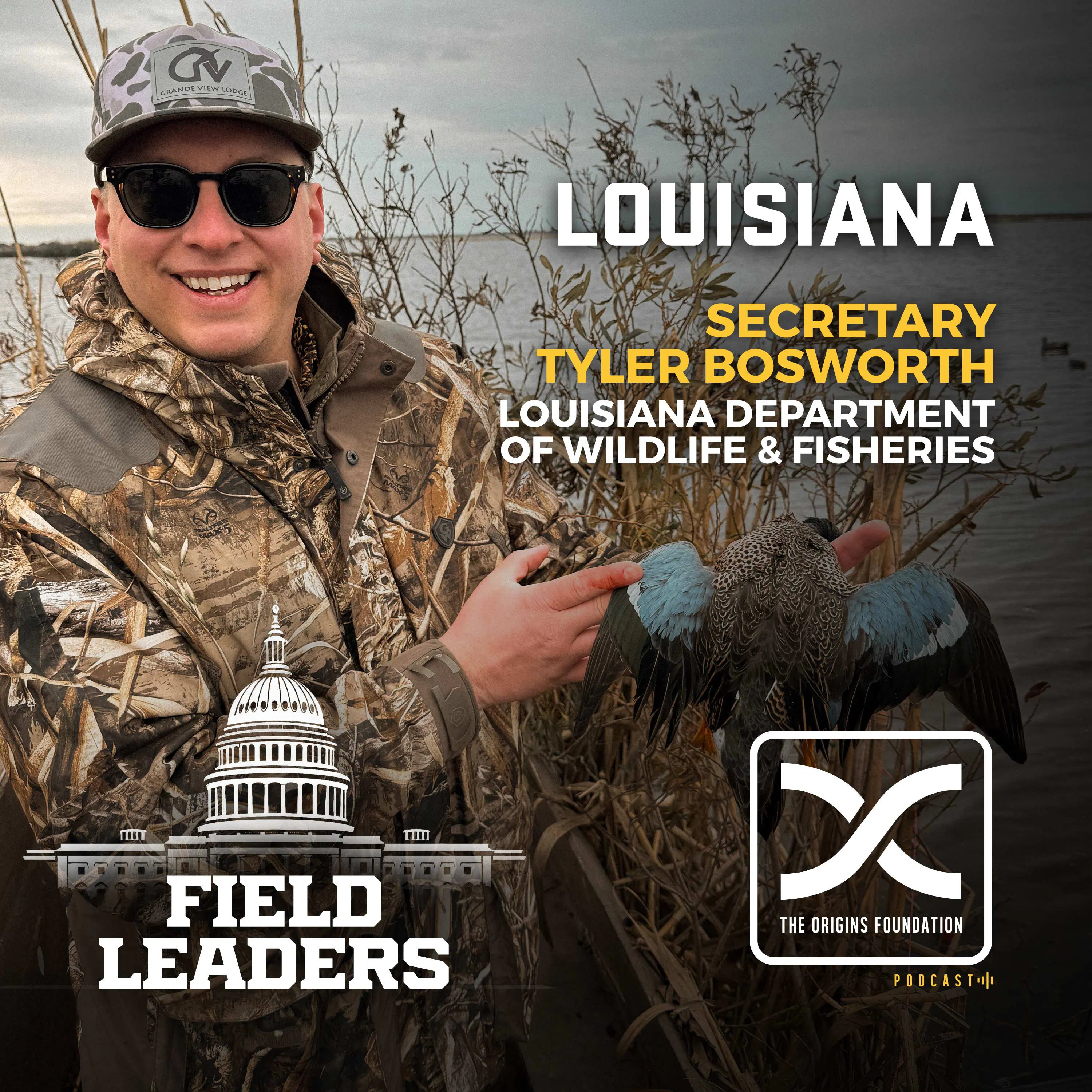
The Origins Foundation Podcast
Field Leaders Ep. 1 - Secretary Tyler Bosworth || Louisiana Department off Wildlife And Fisheries
00:48:28
Ashlee is joined by Secretary Tyler Bosworth of the Louisiana Department of Wildlife and Fisheries. Secretary Bosworth covers his rise to the top of one of the largest (and most critical) agencies in Louisiana, why LA is known as a “sportsmen’s paradise”, and why he loves his job so much.
Loading summary
Transcript165 lines
- [00:00]
Ashley Smith
Hi, this is Ashley Smith. Thanks for joining us. Today. I have the absolute pleasure of being joined by Secretary Tyler Bosworth of the Louisiana Department of Wildlife and Fisheries. Tyler has risen to the top of one of the largest agencies in Louisiana, known as the Sportsman's Paradise. And I think he may be having the best time of any wildlife agency director in the entire country. Tyler absolutely glows with joy, talking about his job, talking about his state, his love for the outdoors, hunting and fishing. Tyler was born a Cajun and is truly a joy to work with. He has big ideas, a big personality, a love for life, and I think you're going to truly enjoy this podcast. Thanks for joining us.
- [00:57]
Tyler Bosworth
So five years ago, there was a reason why I started this movement. And the truth then is the truth now that we need to champion our narrative. We need to champion the truth around what we do and who we are. There's a sweet spot with a gun, you know, too heavy, and it's a.
- [01:13]
Burden to walk with.
- [01:14]
Too light and you whipping it. Why is the project so important to the hunting community?
- [01:19]
It's. It's a. I think it's not only important, I think it's. I think it's vital. I think it's. It's just in time. It's like snakes and ladders. You guys are climbing the ladder, and then somebody does something stupid and you just slide that.
- [01:32]
That is such an amazing analogy. Snakes and ladders.
- [01:35]
Yeah.
- [01:35]
You know, ivory, in my opinion, was.
- [01:38]
The plastic of its age.
- [01:39]
Okay.
- [01:40]
Ashley Smith
The expenses are going up. It goes a long way with families. We have families that do need it.
- [01:45]
Tyler Bosworth
Let me close this door because I have a little wiener dog. What? You. Are you laughing because I said wiener?
- [01:51]
Ashley Smith
I'm really glad you finished the sentence out. I'm sorry. The first half. What are we doing here today?
- [01:58]
Tyler Bosworth
You're telling the whole world.
- [02:10]
Ashley Smith
All right, we have had. We have had a couple of minor technical difficulties, but I am here in the office of LDWF assistant. No, no, wait, hold on. We're going to back that up. We've had a couple of minor technical difficulties, but I am here in the office of LDWF Secretary Tyler Bosworth. I am so excited to be here with you, my friend.
- [02:37]
Tyler Bosworth
Hey, Ashley. Thanks for having me.
- [02:39]
Ashley Smith
Well, thanks for having me here in person in your office. And I noted beforehand that you are the guinea pig of me bringing this equipment in person and that it might. Might have a. We might have a couple of technical glitches and that I was hoping we would not have to call Robbie. And unfortunately, we did.
- [03:00]
Tyler Bosworth
Hey.
- [03:00]
It's like we're in a duck blind. I got one. One earphone on and one earphone off so I can hear you.
- [03:05]
Ashley Smith
So we are. We are podcasting together in person, but we have. Yes, we. If. If. Luckily, people cannot see us because we have our microphones, and we have one earphone on our ears and one earphone off our ears. And so Tyler is being a secretary. Bosworth is being a very good sport with me today, and I'm in his beautiful office in Baton Rouge, Louisiana, and there are. I'm sitting right next to a giant.
- [03:34]
Tyler Bosworth
Old turkey now in full strut.
- [03:37]
Ashley Smith
Full, full strut. He is right next to me. I can reach out and touch him. There are gorgeous pictures of cranes on the wall. It is really. Is a beautiful office. This is. I love this. We've got beautiful weather down here in Baton Rouge today, and we just had a lovely lunch with some commissioners and your executive staff, who I would like to compliment you on. I think you have assembled one of the finest teams in possibly the country. You guys not only have just a tremendous amount of talent, but you have a cohesiveness in working relationships that you just don't see everywhere.
- [04:17]
Tyler Bosworth
Thank you. Thank you. Yeah, I think our team, my team, sets ourselves apart in state government and on the national level. I was actually just talking about what message to put on our Christmas card out to folks, and I was, you know, mentioning that I want. I want to note that I love being able to work with my friends as my colleagues, because I really do feel like you mentioned the cohesiveness. That's what we bring to the table as an executive unit here at Wildlife and Fisheries. So I've got my executive counsel, general counsel, Cole Garrett. He's one of my great friends outside of work as well. Brian McClinton, who is our undersecretary and CFO. He serves as my deputy and basically my Chief of staff once I moved out of that position into the secretary's position at Stephen Clark. Great guy. Is the colonel. Ryan Montague. Excellent. Assistant Secretary of Fisheries. My assistant is Brooke. She keeps everything on track. We've got Rachel DeWitt. She is a. She is our.
- [05:24]
Ashley Smith
She keeps you on track.
- [05:24]
Tyler Bosworth
She. Well, she. She does, but she's our Director of operations. So sorry, Rachel. She's our director of operations. She really does have her hands on everything that we have going on here. And then Taylor Brazon, our communications director, she's out right now in maternity leave. She just had a beautiful baby boy, and we're very proud of her. And that as well.
- [05:47]
Look, guys, I'm a hunter, right? And when I go hunting, I like to figure out how to get my trophies back home as expeditiously as possible. Well, you don't have to look much further than Safari Specialty Importers. We know that trophy importation can be quite a headache. That's why Safari Specialty Importer strives to make it as easy and hassle free as possible. They have access to a bonded warehouse, you won't be charged storage fees and you get a dedicated team that's readily available and will update you at every step in the process. They'll even go one step further. Safari Specialty Importers is working with us and they are going to donate $100 from every shipment that they work with to conservation projects that include anti poaching, community development and wildlife conservation. At the end of the day, choose to spend your money with a team that's dedicated to you and is dedicated to helping show how hunting is a great conservation model. Hassle free logistics, fuel and conservation. Go with Safari Specialty importers. It is 2026 and my friends, big changes have happened in the world of firearm suppressors. The $200 tax stamp fee is now gone. Huge win for hunters, huge win for shooters, and a huge win for your wallets. If you're thinking about elevating your shooting experience and adding a suppressor, Silence Essential is the best way to shop. And you don't even have to get off your couch to do it. Go to silenceessential.com, browse hundreds of suppressor options. They literally have all of the popular makes and models. Then their experts will walk you through setting up your account, creating a free NFA trust, and then submitting your application to the atf. Once approved, Silencer Central ships your new suppressor directly to your door. That's when you're going to have to essentially get off the couch. It's a game changer, guys. You haven't done it yet. Do it. The old days of waiting eight to 10 months on a suppressor are gone. It's more like two weeks. Some have even gotten their suppressors in shorter timeframes. It's never been easier to start shooting suppressed. Get started today by visiting silencer central.com. it's really the simplest way to get your suppressors. Bushnell is eager to help you get set up for conservation success. That's right. They want to help you. The conservation and research community is dominated by good people doing good things and investing significant time and effort for the benefit of habitat and the species. So what do you need to do? Pretty simple. Send us your conservation story and or your conservation wish. Could be managing whitetails, could be understanding your environment or species or something else related to conservation. What would you be able to do if you had a great trail camera setup? We will select the best story every other month and send you a camera bundle. Cell camera, normal, SD camera, SD cards as well as optics. Everything you need to get set up for success. I can't wait to see what you submit. You can email us, DM us, message us whatever you want. We are not hard to find. Good luck.
- [08:56]
Tommy Tooma, Assistant Secretary of Wildlife. Very happy to have Tommy on board as Assistant Secretary of Wildlife. That was a gap we had in our executive team, obviously wildlife and all things wildlife. It's a, it's in our name and so it is a very important position. And to Tommy is that guy. He is the guy. Very, very astute, adept. He's a forester by trade, but he gets it. He's a team player, he's on board and it works very well with the executive team.
- [09:24]
Ashley Smith
You are relatively new to this position and there's been a lot of excitement, I think around your nomination and you coming in full time to this position because you just bring a lot to the table. Your policy background, your expertise. You're an attorney, right?
- [09:43]
Tyler Bosworth
Correct.
- [09:44]
Ashley Smith
So when did you become officially. When did you officially become Secretary?
- [09:50]
Tyler Bosworth
Yeah. So officially became Secretary. I was appointed by the Governor in March of 2025. Prior to that I was the Chief of Staff and Deputy Secretary under former Secretary Sheehan where I essentially shepherded through the legislative process, was the legislative liaison along with Cole Garrett and Brian McClindon, my, my attorney and my undersecretary. And, and we worked in kind of those capacities until Madison left to go work for the federal government and the governor tapped me to be the Secretary, went through the Senate confirmation during the legislative session and became full blown secretary of the department, which I tell people all the time. I'm a Louisiana boy, native, born here. I would love to say this is a dream come true, but this is not something I ever dreamed of. So just to have my hands on it and be able to influence the department in a positive way and the natural resources in this state, which I'm very passionate about, is just an incredible opportunity for me.
- [10:48]
Ashley Smith
So you really are passionate about this? I mean, I, I follow you on social media. I've known you since you were Chief of staff and I love watching you in this position because you are so excited about the opportunities you loved being chief of staff. I knew you then. And now it's like you just have been given this incredible opportunity because you are a public servant at heart.
- [11:12]
Tyler Bosworth
Correct.
- [11:13]
Ashley Smith
You're right. Already were. And now it's like you're living the dream. I mean, it's so great. Where are you from?
- [11:20]
Tyler Bosworth
So originally I'm. I'm from Gretna. I was born in Houma. Never lived in Houma. It was. It was just happens to my. My mother's going into labor while we were in Morgan City. So born in Houma, lived in. In Gretna until. Through third grade and moved to Gonzalez, Louisiana, and fourth grade. Grew up in Gonzalez, went to Gonzalez, went to GW Carver Primary, Gonzalez Middle. Graduated East Ascension high school, turned 18, moved to Baton Rouge. I got out of there. It was very rural when I lived there. And so it's not the Gonzalez Prairieville Santa Mall of today. It was very much different back then. Turned 18, moved to Baton Rouge. I met a girl, so the story goes. She's now my wife. We have two children. When I met her, this is really where I found my passion for Louisiana and everything that it had to offer. Her parents have a camp down in Coidre. So that's where I started. Experience in coastal Louisiana. Experiences saltwater fishing, being out on the water with family and friends, being able to take. Take part in. In that harvest and just experience it. And then, you know, progressively, as you're down there in a place like Louisiana, where we have all these coastal challenges, you start to see that the environment that you're accustomed to is ever changing. It's very dynamic, and it's usually not changing in a. In a good way. And so that's really what led me down the policy path and the interest that I have for Louisiana's outdoors. It's. I know we have problems here. I know we have some issues here. How can we step in? How can you be, you know, that advocacy voice and come in and help kind of shepherd these issues along? And like you said, it's just exciting. It's exciting work. And I get to be in charge of a department with 800 employees, 240 game wardens that are just the most professional folks that you could work with. And it feels like the. The world is at my fingertips.
- [13:15]
Ashley Smith
800 employees. It's a huge agency.
- [13:19]
Tyler Bosworth
It is.
- [13:19]
It is.
- [13:20]
Ashley Smith
And you guys have jurisdiction over a vast number of issues and species. I mean, you mentioned coquetry. People come from all over the United States to head down to the coast to Coquetry to Venice, to the various. I mean, some of the very best saltwater fishing in the country, some of the very best inland fishing in the country. And you guys have jurisdiction over both saltwater and inland fisheries. You have jurisdiction over hunting over all different types. Talk to me about some of the things you guys manage within the state.
- [13:56]
Tyler Bosworth
Yeah, sure. So you mentioned saltwater and inland fisheries. You could further break that down into recreational and commercial fisheries. Unlike some other states, we manage and we're in charge of regulating all of that. We manage and we own. We're the largest landowner in Louisiana. We own and manage about 1.7 million acres of property, which is. It's a. It's a lot. It's a lot. But. But as we say that, and it sounds like a lot, we are currently working with the federal government on kind of different ways that we can step in and help them manage their property so that we can expand our footprint and broaden our footprint footprint in active management and start to manage these things, kind of like unit complexes or blocks. Just a way to stretch kind of the resources that we have and leverage the resources that the federal government has.
- [14:46]
Ashley Smith
Because the states are right now seem to be doing a better job of managing their publicly owned land than the feds are, I would argue, just from what I've seen. I mean.
- [14:56]
Tyler Bosworth
Yeah, yeah.
- [14:56]
And I mean, look, the federal government manages massive tracts of land out west. And I know that they have national parks and forests, and what they have in Louisiana is much smaller of a footprint than they have elsewhere in the country. And so not to say that their focus isn't here, but we think we know what we're doing here. We know what. We know what we're doing here. And we have a lot of properties that we're currently managing that are adjacent to some federal tracks of land. We like to step in and be able to manage those properties in lockstep with how we're doing ours.
- [15:29]
Ashley Smith
And.
- [15:30]
Tyler Bosworth
And in return for that, we want to have increased opportunity for sportsmen to go on there and harvest things like the American alligator or do duck hunting and things like that.
- [15:39]
Ashley Smith
Yeah, Some more public hunting opportunities.
- [15:41]
Tyler Bosworth
Correct.
- [15:42]
More public hunting opportunities in exchange for increased management of those stepping in and taking kind of that place. And look, we don't. We don't want to take over. We don't want to take over their property. It's their property. But we, we would love to be able to have the opportunity to go in and. And work some of those properties in the same manner that we work our.
- [16:00]
Ashley Smith
Properties well, you guys experts on your own land. So I feel like the more you can boil it down, this is my perspective, the more you can get it down into local management, state management. I feel like the better it is for the local and the residents to have those opportunities. I love that you're doing that.
- [16:17]
Tyler Bosworth
I couldn't agree more. And you know, Brian Nesvik had been on the job for nine days and sent us an email saying, hey look, we'd love to meet with you. Here's some zoom times. We said, no, we're going to fly up to D.C. and we're going to have this conversation in person. And it was because we know what those relationships can be if you have the time and the patience to foster them. And so we were very thankful for him to let us in. I think we're the first state delegation to go up there and have a conversation. And I mean, we laid it out bullet point by bullet point. We want to help manage your properties. We want to step in and add that. But again, like I said, it's got to be in return for increased hunting access for residents of Louisiana. It's very well received.
- [16:56]
Ashley Smith
Oh, I love that. I did not know you all done that. That's fantastic. So, okay, so in addition to inland fisheries, saltwater fisheries, commercial and resident. So talk to me about some of the, let's call it terrestrial.
- [17:08]
Tyler Bosworth
Okay, yeah, yeah. I mean look, we manage, we, we manage waterfowl, we manage, we manage alligator. We have black bear here in Louisiana.
- [17:18]
Ashley Smith
Season just open.
- [17:19]
Tyler Bosworth
Season just opened.
- [17:19]
Ashley Smith
What? Saturday.
- [17:20]
Tyler Bosworth
Season open Saturday. We've got some good preliminary numbers. I think in the, in the first year a gentleman harvested an almost 700 pound black bear. And everybody kind of thinks of.
- [17:31]
Ashley Smith
Are you kidding?
- [17:31]
Tyler Bosworth
No, it was, it was a Boone and Crockett black bear in the first year. And everybody kind of thinks Louisiana black bear of this small bear. In the preliminary numbers that I've seen so far, there's been another 500 pound bear and one roughly about 600 pounds. We got some pretty just in the last two days from this.
- [17:49]
Ashley Smith
How many tags did you guys give out this year?
- [17:51]
Tyler Bosworth
This year we gave out 27 tags. That's including the secretary's tag that goes up for auction for conservation organization. Last year we had 11 tags total. 80% were male bear. We want to target male bear. We don't want to target those, those, you know, midlife females that are the reproductive stock for the, for the black bear population. We've got to be very careful about how we do this. We don't Want to be like other states that have rushed to have a season, wiped out a massive portion of the population, found themselves back in lawsuits and, and delay the season. Florida, for example, just got a season back after years of fighting through court. Once they had a season. We don't want to do that. We want to do it the right way. We want to do it in a very sustainable way that respects the resource and allows it to, you know, maintain a hauntable population.
- [18:37]
Ashley Smith
Yeah, I heard a 16 year old girl drew a tag, which I think is so cool. I'm excited about that. We're going to hopefully feature her and talk to her if she ends up shooting one.
- [18:48]
Tyler Bosworth
Amazing. I did hear that as well. I wish her the best. I hope she gets out there, gets to experience it. It's, it, it is a unique opportunity to get out into the field in Louisiana and all the things that you'll see. Even if you're setting out for a particular haunt, you, you know, you get to experience everything that we have. So very, very excited to see what, what ends up happening with her tag.
- [19:08]
Ashley Smith
Yeah, me too. Okay. You guys of course manage deer and there's ongoing issues with cwd. You're trying very, very hard to contain it within the state. But I don't know that a lot of people realize you only have jurisdiction over part of the deer within the state.
- [19:27]
Tyler Bosworth
That's correct. So we have, we, we manage the whitetail population and we manage herd level. A lot of times you'll see, you know, a fawn is being picked up by somebody. Well, we, we don't.
- [19:39]
Ashley Smith
The wild deer.
- [19:40]
Tyler Bosworth
A wild deer. A wild deer.
- [19:42]
Ashley Smith
We don't, don't have jurisdiction over, we.
- [19:44]
Tyler Bosworth
Don'T have jurisdiction over captive deer. But what we manage the whitetail population and the point I'm trying to make is that we, we have to manage based on what's best for that herd. Right. So right now one of the big issues that's kind of sweeping the nation is chronic wasting disease. And now we have jurisdiction over that wild her. But whereas in Louisiana we also have captive herds or livestock that falls under the jurisdiction of U.S. department of Agriculture and the Louisiana Department of Ag and Forestry. They have their own separate protocols and they have their own separate issues when it comes to CWD as well. So you know, when, when you get a positive test and a pin down in Jeff Davis, we just have to work very closely with the Department of Aggressive on traceouts from those pins and whatnot to ensure that that's not coming in contact with the wild, wild population. In areas where CWD does not currently exist or that we don't have detection of cwd. So I will say that in the last legislative session, Neil Reiser, we were with him a little earlier. He's a heck of a character. He brought a bill to create and establish the CWD task force and they've had three or four meetings now. I was very supportive of this task force. I'm not a task force, I'm not a growing government kind of guy. But because we have split jurisdiction over kind of these cervids in Louisiana, it's a good avenue to have everybody come to the table, be accountable and work towards common goals and solutions for mitigating the spread of this disease 100%.
- [21:27]
Ashley Smith
So do members regarding the task force, do people from or representatives from both Department of Ag and LDWF have to be on that task force?
- [21:38]
Tyler Bosworth
We were legislated. The task force was legislative, creative, legislatively created, like I said. And it, it outlines the membership of that. And yes, we do. Wildlife and fisheries, we have, we have a couple of people on it, our statewide veterinarians on their department of Ag. Statewide veterinarian is on there. And so again, that's the point of it is just to have members on the committee that, that know these things, that do these things and they can discuss these things and hold each other accountable in, in a public forum. I will say we, since the detection of a CWD positive deer in an ag pen here in Louisiana, Mike Strain, Dr. Strain, Commissioner Strain and his team have been very, very communicative with wildlife and fisheries. So we're, we're, we're working towards these things, you know, as best we can have a different kind of goals because wildcat, I mean wild deer, we manage that differently than somebody would manage the agricultural side of a captive servant. So.
- [22:37]
Ashley Smith
Of course, of course. Okay, so talk to me about some of the challenges you faced. You have not had. You know, I mean, and I don't think any agency does because wildlife is always going to have challenges. I mean, managing wildlife, it's just going to be non stop, non stop. And no matter what the state, it's one of the most highly controversial topics depending on the species. So what are some of the biggest challenges you've had since you came on board?
- [23:08]
Tyler Bosworth
Well, we, we had, we had a long period of relative peace. The, the fishery side, they like to get down with it. And so whether it's redfish size and slot limits or speckled trout size and slot limits, the issue that is kind of the elephant in the room, I guess, at this moment, which is the menhaden industry, those issues are challenging. And I'll tell you why they're challenging. It's because at Wildlife and Fisheries, we have to manage, like I said earlier, for the recreational fishery and the resource and for the commercial fishery and the resource. We are the regulatory body over both of those things. And so we have an obligation not only to the resource and the recreational fishermen themselves, but we also have an obligation to the resource on the commercial side, whether that be menhaden or whether that be shrimp. And obviously those things can have, because of the nature of fishing, can have impacts on the recreational side coming from the commercial side. And so, you know, it's not as difficult from a department standpoint in the sense that this is not necessarily a scientific issue. This is a user conflict issue. Whose fish are these? Who enjoys catching these fish? And, and the sacrifices that are having to be made so that other folks can fish. And so, you know, again, our biggest challenge is having to walk that type rope and that tightrope and make sure that we're not infringing on the commercial industry and the legitimate business that those folks have going on at the expense of any recreational fishermen and vice versa. And look, I said it at the beginning, and the environment in general, and look, I said at the beginning of this podcast, I'm a recreational fisherman. I'm doing it. That's what opened my eyes to, to Louisiana and its natural resources. And so I'm, I'm very keen to this argument. I actually drafted the bills when I was a staffer for the House Committee on Natural Resources originally to establish the buffer zones. And so I've been a part of this issue for six or seven years.
- [25:12]
Ashley Smith
I didn't know that.
- [25:13]
Tyler Bosworth
I don't know.
- [25:13]
Ashley Smith
You originally drafted the bill.
- [25:14]
Tyler Bosworth
I did.
- [25:15]
Ashley Smith
So you've been entrenched in it for a long time.
- [25:18]
Tyler Bosworth
I have, I have. And so Joseph Ogeron came, I guess, 20, 20, 2021, and he had this novel concept that, you know, we're going to push these folks off and try to protect this fishery. And so as a staff attorney for the Committee on Natural Resources, that, that bill fell on my desk. And so I worked very closely with him, worked very closely with industry and, and try to put a piece of legislation forward.
- [25:43]
Ashley Smith
So, yeah, and I think they've been effective. I mean, those ultimately passed. The buffer zones did, right?
- [25:50]
Tyler Bosworth
No, they did not pass the legislation. There was actually commission. It was a commission. It was a commission action that created the half mile buffer zone statewide and so that came out of a compromise between industry and the recreational side. Okay. And that was the relative piece that I was speaking of.
- [26:06]
Ashley Smith
Okay.
- [26:07]
Tyler Bosworth
Before. But the chairman Seguera, at the November commission meeting made a request of the department to sit down with industry and the recreational folks and start looking at these buffer zones to see if we could shrink them in some places. Ultimately, the map that we came back with did shrink it in some places from a half mile to a quarter mile. I'm indifferent on it. It's a, it was a commission action and a request that came to the department. We're going to put forth the best map that we can. The first map that we saw was just take it, just shrunk it down in certain spots. And we, we heard from recreational fishermen through public comment emails, believe it or not, my phone. Oh, gosh, people have my phone number calling me. And some of the points that they were making were very. The recreational side were making were very valid. And these were things that we had discussed internally at some point, one point or another. And we thought it was a good opportunity to go to industry and say, look, we'd like for you to consider some of these things that we're hearing from the public as well. And they did. And they did. And so ultimately it went from shrinking the buffer zone about 30% coastwide to an increase in 4.5% of the buffer zone because they're protecting some ecological areas behind the Chandelier Islands and then last island, which is. It was a CPRA project, that line ran kind of right through an island, and it would cause a lot of user conflict because recreational fishermen would see boats right up on that beach. That beach didn't exist until CPRA recreated it. And so we told, you know, we went back to the industry and said, look, it probably behoove you to have a half mile buffer around this as well, because it's going to prevent against a lot of this perception of user conflict. And so we were, we were able to do that as well.
- [27:50]
Ashley Smith
And now it's in the hands of the legislature.
- [27:52]
Tyler Bosworth
Now it's in the hands of the legislature. So it passed a narrow vote of the commission at the November meeting, and it will be in a public comment period starting here in November that runs for 30 or 45 days. Don't quote me on it. Cole Garrett would know that for sure. And then it gets kicked over as a summary report to the legislature for their action. And so obviously, Committee on Natural Resources for both the House and the Senate have legislative oversight of the department of wildlife and fisheries. And so that's how the process plays out.
- [28:26]
Ashley Smith
Yeah. Yeah. Well, you guys have a really, really tough job there, balancing the interests of both commercial and recreational. And I don't honestly feel for you because that fight has been going on for so, so, so long. And it's, it's going to continue. I mean, there's just. It's almost a no win situation.
- [28:44]
Tyler Bosworth
It is a no win situation. And I think the, the, the good part about this is it is a commission action. It's not the department coming in and saying, look, we have science one way or another. Because what we do have science on is the stock. Right. Redfish and speckled trout and flounder. And when we see something going on with that stock and we have to adjust size and bag limits, we have to stand on science. We have to be able to go to the public and say, look, we know we're going to change this and we know it's going to be unpopular, but we know fish and this is why we have to make these changes. And if we lose that credibility, we are, we are certainly going to be unable to move forward with actually managing fish stock for the recreational fishermen.
- [29:26]
Ashley Smith
Right, right. Okay. So you've got some stuff coming down the pipeline. Potentially got some very.
- [29:32]
Tyler Bosworth
We got some very. Some much more exciting stuff than menhaden.
- [29:36]
Ashley Smith
Okay. I mean, because, look, as important as it is, menhaden is not the most exciting thing to talk about. What is coming down the pipeline? That's a little more fun.
- [29:46]
Tyler Bosworth
Yeah, so, absolutely. Look, one of my. What I want my legacy to be here at the department of wildlife and Fisheries is increased access to the sportsmen and women and recreational men and women of Louisiana. And what that looks like to me is property acquisitions. They don't make any more of it. I said we manage 1.7 million acres and we have capacity to manage more. I would like to, like I tell my team, play Monopoly and just scoop, scoop up as much of this habitat as we can so that we can protect it for the future generations. And so, so that's point one is property acquisition, and point two is opening up hunting and harvest opportunities for new species. We started off with the black bear, and we came in on the heels of a lot of work that other organizations and this department had done. And we were able to go to the legislature and get the black bear season passed. Talked about it earlier, went from 10 tags to 27 tags. We're also looking at a recreational season for American alligator. Right now, the alligator season is commercial in Nature. There's a lot. There are over 2 1/2 million alligators in Louisiana. We have 4 million people in the state of Louisiana. And so you can see that it's kind of out of balance. Again, just like the black bear, we have to be very careful with what we do because there is a market there, a commercial market. So we don't want to upset the commercial market by adding more skins and meat. And so we have to take a measured approach on how we do that. Another thing that the recreational season gets us is access to federal lands. Right now there's a federal prohibition on commercial activities on refuges, federal refuges and federal properties. This would be purely recreational in nature, which would allow us, and this is a conversation we have with Brian Nesvik, which would allow us to access those properties for increased hunting opportunity. And so we're looking at American alligator. That's something that currently is a commercial operation tied to private landowners, large tracts of land. We're looking to add additional opportunity for just average joblo citizen of Louisiana to be able to go and experience what an alligator hunt is and not have to be tied to a commercial regime, if you will. One of the Governor's biggest priorities for us, and it has been for about a year and a half, is the Black Belly whistling duck, or aptly known as the Mexican squealer down here. These, these birds are, are having a change in migration. We've noticed through the, the Mississippi Flyway that they're more abundant in urban areas. They're more abundant in cities and ponds and on golf courses. And so what we want to do is have an experimental season on the Black belly whistling. Doug brought it to U.S. fish and Wildlife. It was shot down originally under the Biden administration. We thought we'd have more success under the Trump administration. We've spent two trips up to D.C. talking to the Flyaway Council and talking to the members of U.S. fish and Wildlife about this issue. We think it's critical and it'll give increased hunting and harvest opportunity to Louisiana duck hunters, which is very big for Louisiana because our duck numbers just aren't where they used to be. We're doing everything in our power in Louisiana to manage our properties in a way that is more suitable to duck and to attract duck. But if the ducks don't fly down here, that, that, you know, it's not that it doesn't matter, but it's not going to be because we're not doing everything in our power. Right. And so this is just a way to have an increase Opportunity on a species that, that are in abundance here. And so we want to have an experimental season in October to run after teal season. I think it'd be about nine days. And then we roll into big duck season. And another thing that we're trying to do with this species in particular is get it removed from the big duck bag limit. And so you would be able to shoot an additional number of black belly whistling duck in addition to the six big ducks that you get per day during duck season.
- [33:31]
Ashley Smith
We saw a lot when we were down here for tail season.
- [33:34]
Tyler Bosworth
Oh yeah. Oh yeah. And you can you hear them from.
- [33:38]
Ashley Smith
So have you ever eaten one?
- [33:40]
Tyler Bosworth
I have not. And full disclosure, I have the breasts and leg quarters of one vacuum sealed in my freezer right now. I just have it cooked it. I was going out of town so I vacuum sealed it. But that was one that I was looking forward to eating because everybody says that it is.
- [33:56]
Ashley Smith
I have not. I don't think, I was just curious about.
- [33:59]
Tyler Bosworth
Yeah.
- [34:00]
Ashley Smith
So anybody out there, if you know how they taste, please send us a text on our Google text and let us know. So I'm curious, what is DU and Delta's stance on the black belly whistling duck? Have they weighed in? Are they helping or are they just kind of sitting back like indifferent?
- [34:16]
Tyler Bosworth
Yeah, they, they haven't weighed in on it. We, I don't, I don't honestly know that we've sought their input on it.
- [34:23]
We.
- [34:24]
So one thing that we do really well is we, we go around and we talk to a lot of our state colleagues and we try to find out where they are and then our federal partners. And so we've had these conversations with those folks and I'm sure that they stand ready to step in. They're very supportive on the state level of the, on the state level for this hunt and to allow this increased access for this species. And I will tell you somebody who is very much in support is the agricultural community because when you look at some of these, some of these grain silos up and down the river, they are overrun by black belly whistling duck. And look, this isn't going to be, this isn't going to be a solution to everything. But, but it is popular amongst the people in Louisiana. It's not detrimental to the species. And I think it's a good way to step in and provide that increased access.
- [35:10]
Ashley Smith
No, I think it's a fantastic idea. I've just, this is the first time I've heard of it and I'm wondering like what, what the obstacles are who would have to say no. And I can only imagine that the Fish and Wildlife Service would just be worried that it would snowball that all of a sudden you have all these other states saying, well, oh, we'll open up whatever species or, you know, whatever, you know, we want more, you know, I don't know, redheads down here, because this is all we're seeing. Or, you know, I don't know. So I'm just wondering about the feedback. I mean, I. You have so many down here. There are so many.
- [35:46]
Tyler Bosworth
Yeah, truly.
- [35:47]
Ashley Smith
But, but they have to change the rule, right? Has to be the service.
- [35:50]
Tyler Bosworth
Correct? It has to be the service that changes the rule. And that's, that's what I was mentioning. We sent a letter under the Biden administration saying that this is something that we were interested in. And we cited all of the agricultural loss, up to a billion dollars a year or more in agricultural loss and various other reasons as to why we think it would be appropriate to do that. My team works really well. We work members very well, whether it be on the federal level or the state level. And it's all relationship based. And so we were able to come in on the back end under the Trump administration and have sit down conversations to say, look, here's where we are on this. This is what we want. How can we get to this without messing all of your other stuff up? Yeah, right. And it's just, it's just being able to sit down and have those professional conversations with folks to say, where, where can we meet on a middle ground to make sure. And originally the proposal that we had was shoot them during teal season. And they said, absolutely not, that doesn't work. Well, we didn't want that to be the end all, be all. How can we move forward? What can we do to get us there?
- [36:54]
Ashley Smith
So, well, you couldn't be more in a better prime position than right now in leadership with Johnson, Scalise, Kennedy, Cassidy, some of these people let low and appropriations. I mean, you've got just like a supreme team.
- [37:11]
Tyler Bosworth
We've got appropriators on the House and the Senate. We've got a very powerful legislative delegation. And that's just the Louisiana born folks.
- [37:19]
Ashley Smith
Right?
- [37:20]
Tyler Bosworth
Governor Landry has excellent relationships with Brooks Rollins, with, with, obviously Madison, with Kristi Noem, you know, and, and I, I was up in D.C. at a make America Beautiful Again event and the director of U.S. fish and well, I mean the director of. What's his name?
- [37:41]
Ashley Smith
Doug Burgum.
- [37:42]
Tyler Bosworth
Doug Burgum. Hey, tell the governor I said hello. And so he's got, he's got very close ties at the federal level and we recognize that here at Wildlife and Fisheries, we know the connections that we have. So we can call in and we can get meetings, we can have these conversations. We can insert ourselves into a federal process where other states may or may not have been successful. We talk about it all the time. If we can't get what we want done right now, shame on us.
- [38:11]
Ashley Smith
Well, I wish you the best of luck in that. I'm going to be interested to, to follow that. That is, I love the y'.
- [38:17]
Tyler Bosworth
All.
- [38:17]
Ashley Smith
That's one of the best things about your team is you guys have a lot of youth and enthusiasm and these ideas that, you know, even when Madison came in, you've been thinking outside the box, which is fantastic. And I remember both of you talking about how you didn't want to hear, well, we've never done it that way before. Don't come to us and say we've never done it that way before. And I love that because these are novel ideas. I want to walk back for a second about to talk about the alligator potential recreational hunt. So, and, and this is truly because I had no idea that you could not recreationally hunt alligators down here. Because so like, you know, I've come down and hunted an alligator down here on a tag that an outfitter got me. So walk me through this process because so many people do come down and hunt alligators here. Are they hunting off of outfitters tags that they've gotten that are technically commercial tags? Like how does this process work?
- [39:14]
Tyler Bosworth
Correct. And so I was actually with you when for that tag, that tag was tied to the piece of property where we hunted that alligator.
- [39:22]
Ashley Smith
Okay.
- [39:22]
Tyler Bosworth
And so how it works right now in Louisiana is you're a property owner, a bona fide property owner. You can submit to the Department of Wildlife and Fisheries to come and have your land surveyed to find out what your alligator population is. And then they will cut. You cite these tags, a certain number of cites tags. That's the conventional international. Yeah, that's it. And so these are all cites tags, federal tags. And that that tag system has really allowed Louisiana to manage our alligator population off the brink of extinction. Okay. So to back to back up landowner like the one we went and hunted with applies to the department. They're issued a certain number of tags.
- [40:01]
Ashley Smith
Okay.
- [40:01]
Tyler Bosworth
Now you go as an outside resident or resident.
- [40:05]
Ashley Smith
But they were also part of the program that was in the commercial farming operation.
- [40:10]
Tyler Bosworth
Correct.
- [40:10]
Ashley Smith
For years. And I think at their last couple of years.
- [40:13]
Tyler Bosworth
Yep. Yeah.
- [40:14]
Ashley Smith
So that they're phasing out of that.
- [40:16]
Tyler Bosworth
Yeah, that's right. That's right. But their tags will still remain commercial. Okay. They'll still remain commercial. So right now, the only way that you can get alligator tags is to be a landowner, and those tags are linked to that piece of land. Okay. So you have a piece of land in Gonzalez, where I'm from. I can't take your tag and go up to Lake Providence.
- [40:37]
Ashley Smith
It has to be on.
- [40:38]
Tyler Bosworth
It has to be on that piece of property.
- [40:41]
Ashley Smith
Is there a certain size or anything like that? I mean. Or you just have to have a certain number of alligators identified on the.
- [40:48]
Tyler Bosworth
Property, and that's it.
- [40:49]
Ashley Smith
Comply with that.
- [40:50]
Tyler Bosworth
That's it. They just come and do a survey and then. And look, I'll tell you, when we first came in our alligator program, all commercial, was writing about. We're issuing about 36,000 tags. This year, we've issued 56,000 tags. Okay. Because we have an alligator problem in Louisiana. Yeah, we have an alligator. We can't put duck dogs in the water during teal season.
- [41:07]
Ashley Smith
That's like an understatement.
- [41:09]
Tyler Bosworth
Absolutely. And so we. We have identified this. We are trying to get more alligator off the landscape, and I don't see any reason why we can't get a recreational season for Joe Blow, who has no land to get a tag and go out and experience what everybody gets to go do.
- [41:26]
Ashley Smith
When we were there, I believe it was that same trip, there were people hunting hogs at night, thermals, and killed a gigantic one down in the canal. And right after they shot and killed that hog, as they went to retrieve it, a huge alligator jumped up out of the canal, grabbed the hog, and swam off down the canal with it before they could retrieve their hog. Oh, yeah, like, that's how prevalent they are.
- [41:56]
Tyler Bosworth
No doubt about it.
- [41:57]
Ashley Smith
And that's so many places in Louisiana.
- [41:59]
Tyler Bosworth
Absolutely. Well, with alligator and hog. And hog.
- [42:02]
Ashley Smith
Right.
- [42:03]
Tyler Bosworth
And to my own horn here, since I'm on a podcast, that must have been the second largest hog that was harvested off of that property, because, boy, over Thanksgiving, I hit a 400 pounder on that property.
- [42:14]
Ashley Smith
So it's all the pictures. So speaking of, the secretary has a very cool Instagram page. You can go. I don't know if you want people.
- [42:23]
Tyler Bosworth
To go follow your Tyler Bosworth, you gotta. You gotta request it.
- [42:26]
Ashley Smith
Yeah, yeah. He's got an awesome Instagram page that you can follow his sportsman's pursuits and his really, really precious family. They are adorable. He's a beautiful Wife and the cutest kids. And he literally lives like walks the walk as an outdoorsman because he takes those kids hunting and fishing and everywhere he can. And it's so fun to watch you guys.
- [42:49]
Tyler Bosworth
Thank you so much. Look, I don't, I don't just say that. It's a way of life down here. It's you, you've got to.
- [42:54]
Ashley Smith
That.
- [42:55]
Tyler Bosworth
My kids can throw crab traps. My kids can throw cast nets with their mouth. They, we, we, we do it. We actually do it. My son loves to be in a duck blind with his dad. It's. I got to get my daughter out there to do it, but you got.
- [43:07]
Ashley Smith
To get her out there. Was that your first giant hog, like wild hog?
- [43:10]
Tyler Bosworth
That was my first hog hog altogether.
- [43:12]
Ashley Smith
Did you. How did you kill it?
- [43:14]
Tyler Bosworth
I killed it with a 308 for 474 yards. So no, not kidding at all. We, we had actually, we had actually made a duck hunt in the morning and shot our limited ducks and it was just a fantastic morning. And we were out on, on a side by side. I guess it doesn't matter what. John, John McInnis at Honeybreak and he was showing us the west side of that property because they're doubling their conservation efforts. And for anybody that only hears about Honeybreak is this exclusive hunting opportunity, best hunting opportunity in Louisiana. It is the private lands model for private. It's. It's the model for private lands conservation. 27,000 acres used to be soybean field in 2005 and now it is, you know, dense forest on half the property. They're doubling their conservation efforts on the west side of their property. Pouring just tons and tons of money into habitat. And it's incredible. And they ha. They have it there for a reason. It's because they're managing their property in a certain way and we've helped them with that. And so anyway, we're riding around on the west side of that property and we turned down, we turned down a road and way down the road we see a mess of hogs. And my, my buddy Jean Paul Coussin, he was actually my chairman when I was staffing the House Committee on Natural Resources Committee. And he got all excited and he wanted to shoot, shoot the hogs. And John said, yeah, shoot the hogs. And so we, we popped the tr. The bipods down and laid prone on the ground. And he pulled his range finder out. He said, no guys, this is 500 yards away. Don't shoot at those things. And he's like, we got to move closer And Jean Paul said, well, we can't move closer. We're gonna scare him. I said, I can hit it. He said, you gotta aim three feet above it. I said, I think two feet will do it. And Jean Paul's like, shoot him. So I hit him. And it sounded like hitting a water barrel.
- [44:56]
Ashley Smith
It is a beast. It is a nasty, nasty, nasty beast. I'm glad you took him down.
- [45:03]
Tyler Bosworth
I sent it to my bear biologist, John Hanks. He's the best in the business. Best large core. I said, it's not a carnivore, but how heavy you think this is? And he texted me back 350. And 40 minutes later, he texted me back 400. 425. He had been thinking about it, so.
- [45:17]
Ashley Smith
And it would register again.
- [45:18]
Tyler Bosworth
£400. £400.
- [45:20]
Ashley Smith
Crazy.
- [45:21]
Tyler Bosworth
It was. It was. It was a nasty beast, but it was. It was an awesome hunt.
- [45:25]
Ashley Smith
Well, that is so fun. I love it so much. Well, look, I truly think your legacy is going to be more public hunting for people in Louisiana, because I know you believe it and you've got the team to do it. And I wish you the best in everything. I. We will do everything that we can to help you. And I appreciate you coming on today and sitting with me through these technical difficulties. I hope your ear.
- [45:49]
Tyler Bosworth
We got to work it. At least I believe we did.
- [45:51]
Ashley Smith
Right, right, right. I think we did. Is there anything else you want people to know about LDWF and just what you guys are working on and doing?
- [45:59]
Tyler Bosworth
We are.
- [46:01]
We are in stride right now. We are accomplishing great things here. Wildlife and fisheries. We're managing our property in a completely different way than we were managing it before. I have cut these folks loose to go out and do the business that they are good at doing. So just come to Louisiana, go outside, hunt, fish, experience all the great things that this state has to offer because we have a lot of great things to offer.
- [46:23]
Ashley Smith
Awesome. And I can attest to that. I love hunting down here. I love fishing down here. So just keep up the good work.
- [46:28]
Tyler Bosworth
I appreciate it.
- [46:29]
Ashley Smith
Okay.
- [46:30]
Tyler Bosworth
Thanks for the venue. Thank you.
- [46:31]
Ashley Smith
Bye.
- [46:32]
Tyler Bosworth
Well, that's it for today. I appreciate you listening. As always. Leave a review, share it with your friends, and most importantly, do what's right to convey the truth around hunting.