← The Origins Foundation Podcast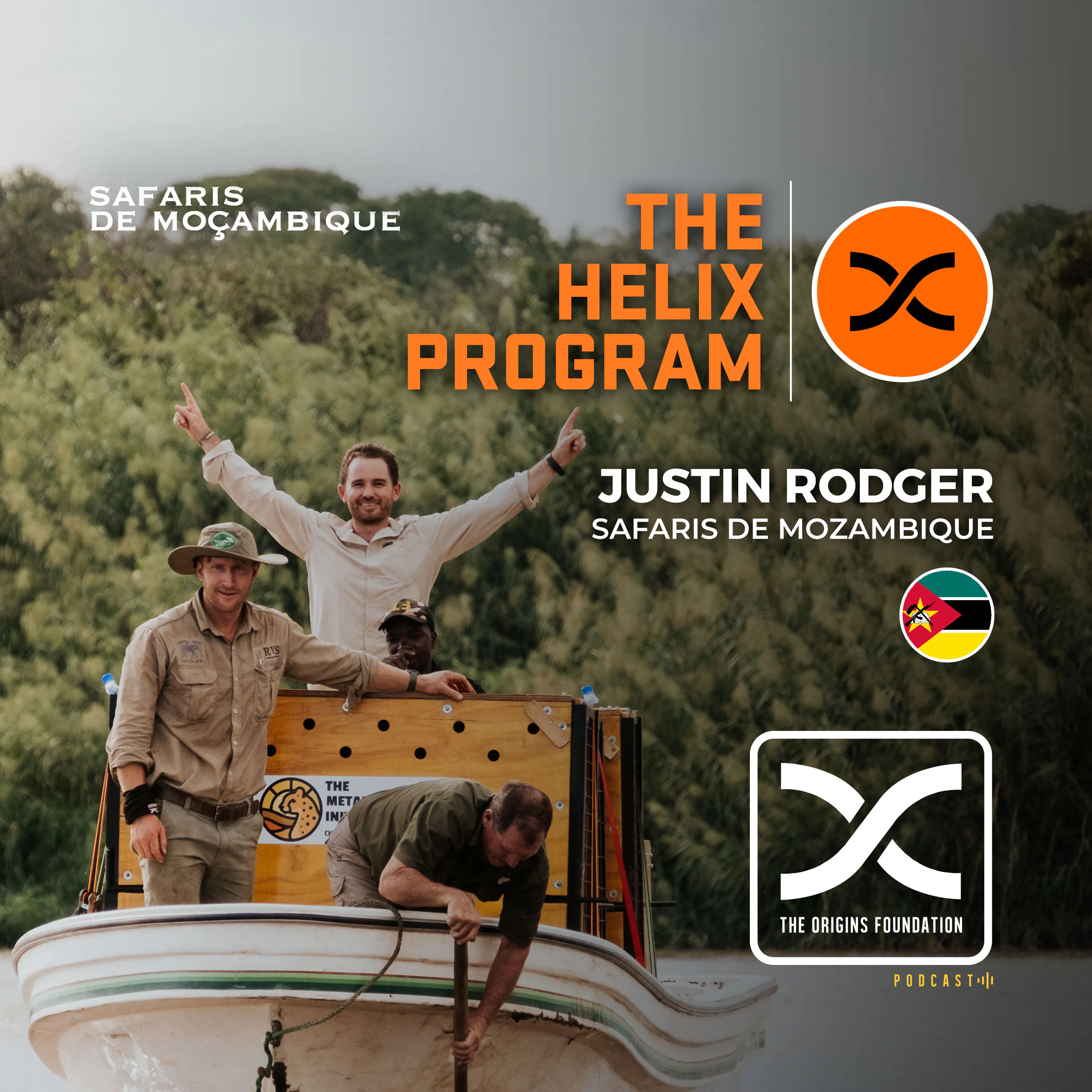
The Origins Foundation Podcast
Justin Rodger || The Helix Program #4
00:33:13
Justin Rodger, operations coordinator and part of the family run operation of Safaris De Mocambique (and base for our historic cheetah project!), joins Robbie for another Helix program episode to talk about what happens when you go hunting with somebody in a rural place and all the things that happen as a result of hunting with him. The whole emphasis of these episodes are for you to learn from different outfitters in different countries and hear directly from them about their impacts to wildlife, habitat, people, and communities.
Loading summary
Transcript62 lines
- [00:00]
A
Planning a fishing trip shouldn't feel like a full time job. With fishingbooker.com you can find and book the perfect fishing trip within minutes. FishingBooker.com connects you with trusted fishing captains around the world. Booking is fast, easy and secure with access to verified customer reviews, loyalty rewards and around the clock customer support. Everything you need to book with confidence is in one place. So head to fishingbooker.com and start planning your next fishing fishing adventure today. Planning a fishing trip shouldn't feel like a full time job. With fishingbooker.com you can find and book the perfect fishing trip within minutes. FishingBooker.com connects you with trusted fishing captains around the world. Booking is fast, easy and secure with access to verified customer reviews, loyalty rewards and around the clock customer support. Everything you need to book with confidence is in one place. So head to fishingbooker.com and start planning your next fishing adventure today.
- [01:00]
B
Justin Roger is with Safaris de Mozambique, a Helix program outfitter and operator of ours. You probably heard his name when we are talking about our cheetah conservation project. Safaris de Mozambique is where we landed the historic move of 16 cheetah into Mozambique. And so I wanted to have Justin on to give you a idea of what happens when you go hunting with somebody in a rural place like Justin. Justin's in rural Mozambique and you're going to hear from Justin on all the things that happen as a result of hunting with him. The community work, the people work, the upliftment, the education, the wildlife conservation work, everything that. So five years ago there was a reason why I started you spending your and the truth then with the truth now that we need to champion our narrative. We need to champion the trust around what we do and who we are. Wildlife and community. You know, too heavy and it's a burden to.
- [01:56]
C
To walk with. Too light and you whipping it.
- [01:59]
B
Why is the project so important to the hunting community? It's. It's a. I think it's not only important, I think it's. I think it's vital. I think it's. It's just in time. It's like snakes and ladders. You guys are climbing the ladder and then somebody does something stupid and you just slide down. That is such an amazing analogy. Snakes and ladders.
- [02:18]
C
Yeah.
- [02:18]
B
You know, ivory in my opinion was the plastic of its age. Okay.
- [02:23]
C
The expenses are going up. It goes a long way with families. We have families that do need it.
- [02:28]
B
Let me close this door because I have a little wiener dog. What you are. You're laughing because I Said wiener.
- [02:34]
C
I'm really glad you finished the sentence out.
- [02:37]
B
I'm sorry.
- [02:38]
C
The first half doing here today. Getting some, some good water coming in.
- [02:49]
B
Yeah. How's the dam? How's the dam looking? Like
- [02:53]
C
so kabura bass has come up, which is great.
- [02:56]
B
Really nice. Awesome.
- [02:57]
C
Yeah. Parts of, parts of the lake had, had gone back to river, but you know, the, the lake's actually pushing now and then Kariba is coming up fiercely. It's on 25% usable storage and the, the falls are, are pumping. You know, they haven't had water coming over the falls and I think more than 15 years that, that kind of volume hasn't been seen so amazing. I think in, so we could have
- [03:25]
B
water in front of Mbadsi camp. Potentially.
- [03:28]
C
Potentially we could. And it's already pushing to the, to the mouth of the Mbadzi river, which is great news. Yeah.
- [03:35]
B
Amazing. Amazing. Well, Justin, Roger, Safaris de Mozambique. Partner in crime in taking over the cheetah conservation world. Welcome to the Origins foundation podcast, a specific podcast series about the Helix program that you guys are a member of.
- [03:53]
C
Thanks, Robbie.
- [03:54]
B
So, Justin Rogers, welcome to the Origins foundation podcast. You are partner in crime and cheetah conservation, taking over the cheetah conservation space. But you're here today. We want to talk about the Helix program. You guys are a part of our Helix program. And the whole point of this podcast is to showcase the stuff that you do, the stuff that people don't actually get to see, the kinds of things that happen as a result of you hunting in a specific area. And you are hunting in a place called the Chumachada Chato Community Conservancy. Panami Safaris, the Mozambique. What's it like half a million acres that you guys are operating under in Mozambique?
- [04:37]
C
That's right. It's about 210,000 hectares. This area out of a, a bigger, a bigger landscape.
- [04:44]
B
Yeah, you guys have been in there 25 odd years now.
- [04:51]
C
Yes. So my dad started here in 2006, but the company has a, has a history dating back to 1987. So it's a, it's an old, an old company. Been here for a while.
- [05:07]
B
This part of Mozambique that you guys are in, super remote, right? It's like the corner of, it's right up against the Zimbabwean border. Zimbabwe borders you to the west, Zimbabwe borders you to the south. The Zambezi river borders you to the north, and the Caborabassa Dam borders you to the north. Just like this super unique, like block of land.
- [05:29]
C
Yes, we, we are very fortunate you know, we connect to that whole middle Zambezi ecosystem on the south side of the Zambezi river in Zimbabwe. And we've, we've got an incredible, incredibly diverse northern boundary which, as you say, is, you know, Zambezi river, but also opening up onto the lake. So it's a diverse area. And also being on the border with Zimbabwe and Zambia, it's a melting pot for different people and different cultures, and it's quite a unique part of the world.
- [06:02]
B
So a lot of people don't believe that hunting does anything for people, for wildlife and communities. And so one of the reasons why we're having this conversation is to prove to them that that's untrue. So let's start with a couple of things. Let's just start with the biggest thing, arguably, which is cheetahs. You have decided, like you wanted to get into your conservation space for what reason, Justin?
- [06:34]
C
So I think because of we, the right thing to do. You know, we've been here for a long time. We, we, I think like most other people who've, who've been operating in a, in a, in an area for a long time, you know, 10, 10, 15, 20 years, you have a relationship with the land and with the people who, who, who, who live in these areas and, and, and also with the wildlife. And, you know, having discovered a cheetah in this area, where previously we had thought they don't occur here, it was quite an exciting discovery.
- [07:15]
B
It is 2026, and my friends, big changes have happened in the world of firearm suppressors. The $200 tax stamp fee is now gone. Huge win for hunters, huge win for shooters, and a huge win for your wallets. If you, if you're thinking about elevating your shooting experience and adding a suppressor, silence Essential is the best way to shop. And you don't even have to get off your couch to do it. Go to silenceessential.com, browse hundreds of suppressor options. They literally have all of the popular makes and models. Then their experts will walk you through setting up your account, creating a free NFA trust, and then submitting your application to the atf. Once approved, Silencer Central ships your new suppressor directly to your door. That's when you're going to have to essentially get off the couch. It's a game changer, guys. If you haven't done it yet, do it. The old days of waiting eight to 10 months on a suppressor are gone. It's more like two weeks. Some have even gotten their suppressors in Shorter timeframes. It's never been easier to start shooting suppressed. Get started today by visiting silencercentral.com it's really the simplest way to get your suppressors. Bushnell is eager to help you get set up for conservation success. That's right. They want to help you. The conservation and research community is dominated by good people doing good things and investing significant time and effort for the benefit of habitat and the species. So what do you need to do? Pretty simple. Send us your conservation story and, or your conservation wish. Could be managing whitetails, could be understanding your environment or species or something else related to conservation. What would you be able to do if you had a great trail camera setup? We will select the best story every other month and send you a camera bundle. Cell camera, normal SD camera, SD cards, as well as optics. Everything you need to get set up for success. I can't wait to see what you submit. You can email us, DM us, message us, whatever you want. We are not hard to find. Good luck.
- [09:20]
C
And you know, it's for us to get involved in something like that, which is a lot bigger than ourselves and, you know, try and make a difference to obviously a species which is quite threatened across the continent. It was just an absolute privilege for us to be able to, to get, to get involved in a project like this.
- [09:42]
B
Justin, do you think the project would be possible in Mozambique outside of areas that are protected for hunting?
- [09:55]
C
That's a good question. I think it'd be tough.
- [09:59]
B
It's not impossible. It would be tough.
- [10:02]
C
It would be tough. Are a lot of great operators in Mozambique, you know, inside and, and outside the, the hunting space. You know, organizations like Bio Fund who are doing great work. You know, there's a, A, A, a really interesting project in central Mozambique, the Gorongosa project. They're doing great things there. So I think there are people out there outside of the hunting space that are doing good things. But certainly in this province here, there's, you know, outside of hunting, there aren't any operators, be it photographic or NGO really, that are active in the space. More recently there's been some interest in Magwe national park, which is Tet Province's only national park, which is to our east. Approximately 80 to 100ks, maybe a bit less than that.
- [10:54]
B
The one on top of the mountain, right?
- [10:57]
C
Yes. Yeah, there's this, it's quite a, quite a hilly area there up to the lake, and quite a challenge. Lots of issues to tackle there. And there are some of the big NGOs looking at CO management Agreements and what have you there, which I think will be a good thing. These big, massive national parks require huge resources, you know, to, to look after and, and, and, and that's difficult to, to make the economic case for in a place like this. You know, it's not the Serengeti. It's difficult to travel here. There's a lot of issues and, and it's an expensive problem to solve. So.
- [11:43]
B
Yeah, so the cheetah conservation project, we moved 16 cheetah biggest initial. As you say reintroduction. No, no, no, you don't say reintroduction. What do you say? Supplementation.
- [11:58]
C
Supplementation.
- [12:00]
B
Supplementation. Because of our lone male Punyami cheetah that's ever happened. Nobody's done anything bigger. We're happy to be a part of it, but you just don't. It's not only that, right? You guys have done so much other work in the places that you guys operate in. Tell me a little bit more about, like, the people and community work that you guys have done. Just.
- [12:26]
C
Thanks, Robbie. Yeah. So, you know, it's a community area, so we, we have communities that, that live inside the, the area. And, and you know, we, we share the land with the communities. The communities. You know, the, the wildlife is an important resource for the local community here. And the Chumachata program. So, you know, I think to, to understand that, you kind of got to look, look towards the, the history of the Chumachatu program. So actually, you know, this company was, was here before the Chumachachu program was established, and it was kind of born out of. Out of the Safaris de Mozambique project. Because in 1987, Emma Fora, which is a company, you know, came in and, and you, you had a few actors in the area, like the Ford foundation as well, who came in at, at a later stage. But in 1993, the project was approved for safaris to Mozambique. And that was to, you know, set up a camp in this area and explore a sort of, you know, hunting operation. And, and from, from that, that birth of the hunting activities in this area, it became apparent that there was a conflict that indeed did exist between the hunting operator and the communities. Because all of a sudden you, you had communities that had been living on this land for many years before this, you know, before the civil, during and before the civil war. And, you know, it was basically open season. There was no government presence here. Mozambique was going through a difficult time politically. You know, people were hunting, you know, the villages were utilizing the resources, you know, living off the land and all of a sudden there was a company that came in that's now in partnership with the government, authorized by the government to use that wildlife resource. And so there became an awareness that this needed to be managed in partnership with the community because it wasn't a sustainable thing to remove that resource, remove access to that resource from the communities and just give it away to a foreign investor. And so out of that, your kind of community based natural resource management model was formulated. And that was the Chumachatu program. And that meant that actually, you know, the government sat down with the communities and the operator and they developed a plan to say the community is going to continue to benefit from this resource. They're going to continue to get the meat from the hunting. You know, all the meat will be delivered to the communities. The animals need. There was a recognition from the community that it needed to be managed sustainably. It couldn't just be open season. So, you know, quotas were put in place and, and then there's also, you know, other, other benefits that, that came to the communities financially, you know, benefit sharing mechanisms, but you know, for the fees, concession fees and tags and everything that, that are paid to the, to the government. And so that's how, that's how the activities in this area were started. And that is what gave birth to the wider Chumachatu program that you see in other areas and in, in Tet Province today. So, you know, to, to come back to your question, you know, it's kind of linked to the start of this company and intertwined with the history. It's is about, you know, the sustainable management of a, of a natural resource to benefit, you know, the communities who ultimately are the custodians of the land and have been here long before any foreign investor arrived. And so, you know, that project has continued and you know, I think things like quotas have increased over the years. But also, you know, as a company, we've taken a, taken a decision to go over and above, you know, what is stipulated and try and do more for both the communities and also for the wildlife in the area. Because at the end of the day, it's all about sustainability. You know, we have a relationship with the land, relationship with the land. And we're always constantly thinking, how can we bring more benefits to communities, bring more sustainability to what we're doing, help the communities develop sustainably and secure a future here, you know, obviously for us, but also for the people who we live alongside with here and the wildlife. Of course.
- [17:13]
B
Yeah. Just tell me a little bit about the, you have obviously a concession fee, you have trophy fees by animal. What's that split down to the community, the Chumachacho community.
- [17:25]
C
So the community, if I'm not mistaken, gets 33% of those fees. And then I think the other 33% goes to the actual program to run, run the program. So that, you know, that goes into the, the overall budget for the program. And then the balance of 33% is split between the district and, and also I think it's the, it's either the provincial or the national government that, that get that revenue. So there's, there's a, is, there's a split. Yeah.
- [18:05]
B
Okay. All the people that you work, all the people that work for you, your, your anti poaching units, whatnot, they come from the community.
- [18:14]
C
That's correct. So we, we, we have approximately 70 employees and the majority are from the local community, which is, which is a major benefit. And, and, and you know, we, we get a, and like every other company in Mozambique, there's a, it's, it's actually a work, work permit quota. So I think you can have, I think it's 10% of your total workforce. So if you have 70 employees, you can have, let's say seven work permits for example, for expats. So you know, we have to adhere to that. And we aren't issued any more work permits than, you know, what then that number. We obviously submit the documentation at the department level and it's a big thing for us, you know, not only trying to find ways to employ, to be a bigger employer, but also, you know, how can we develop skills in the area, you know, and bring local people into the ranks and actually participating at the management level, which is, you know, something that we are tackling at the moment. But you know, coming back to the employment, that's a major one. You know, obviously you have big families in these areas. You know, one person can support eight people. So we constantly trying to understand with the projects that we're doing, how can we actually create more employment? Because it's a multiplying effect. If you can, you know, for example, do a rhino conservation project and employ 100 Game Scouts, you actually, you're empowering a thousand people who can, you know, send their kids to school, you know, get a, get a better level of education and etc. Etc.
- [20:04]
B
Yeah, you've built some schools in the area. Talking about schools.
- [20:10]
C
Yes, we have. We built a primary school in Bawa, a primary school in Kataruza village. So the two villages. And we, we also in the process of building a third primary school in a place called Nyanchenje. And then obviously, over the years, you know, when the community receives that benefit, that 33%, there's a local natural resource management committee which is made up of members from across the local community, let's say approximately 30, 30 leaders, and each village or area will come forward and say, well, look, we'd like to drill a borehole or we'd like to upgrade our primary school or we'd like to buy some agricultural equipment or upgrade the clinic or whatever that project may be, you know, buy a boat so we can, we can do a fishing project. And so over the years, you know, that, that also has, has, has brought quite a lot of benefit to, to the, to the schooling system in the area, but there's still a lot that needs to be achieved. You know, it's something that we tackling with right now is how do we, you know, there's 15,000 people in the area along the boundaries, most, mostly. So there's, there's a, there's a huge core wildlife area where there's, there aren't any people. But in these areas where there are people, the communities are growing and education is something we see as extremely important because, you know, people need to, to be able to, you know, develop. The community needs to develop in a sustainable way and people need to have opportunities and opportunities are limited in an area like this for young, uneducated people. And so we see education as very important and we constantly trying to find, over and above what we can do, other opportunities to help. For example, at the moment we're trying to work on a project to build a secondary school because most of the primary schools feed a secondary school which is across the river, which is not ideal. So we need one, we need one on our side of the river.
- [22:24]
B
Yeah. Tell me a little bit more because you have a success story, as I understand it, in your community liaison.
- [22:35]
C
Yes.
- [22:35]
B
So about her, how did you. You invested in her early, right?
- [22:39]
C
Yes, so, so we have, we have actually this, there's two, two people who are mainly involved in the community liaison here. The one is talento. Talento, sort of jumps between anti poaching and conservation side, but also community development. And then a young lady called Sumaya Bimo. So she came to us as an intern through Biofund's internship program and she's been here for a couple of years now and we offered her a, a permanent position and, and she's, she's fitted into the role really well with, with Talento you know, there's a lot of engagement that we have to do. Obviously, you know, when you've got all these different communities, you know, the, the, the most, the most valuable thing is, is sitting down and communicating with people. It's very easy in an area of this size to, to actually wake up one day and say, you know, there's actually a, there's actually a disconnect between us and that village. And you know, they aren't happy because they haven't spoken to us in six months and you know, maybe they think that, you know, we're not interested in what's going on there or you know, and vice versa. And so we put a lot of effort into, into having a, an engagement program where we actually meeting meeting with with communities regularly and, and sitting down together and discussing face to face at a human level. You know, you know, what, what are the challenges that you are facing and how can we help and vice versa, you know, it's, it's so, so there's, there's been this, this massive need for us to, to catalyze a proactive approach to, to dealing with community issues because, you know, and these issues can, small problems can, can quite easily become big problems just because of a lack of communication. You know. You know, I mean, an elephant comes into a crop and, and it, and it destroys someone's livelihood over a, over a 24 hour period or a herd of elephants, you know, destroys a hectare of maze that whole family can't eat. And you know, if, if, if there's not an effective, if there's not a good relationship and channel of communication between you and, and, and these, these communities, you don't hear about these issues and then the problems become a lot bigger later because, you know, people feel that, you know, no one's there to help or to assist. And so, you know, 90% of these issues can just be solved by actually sitting down and talking. And so, you know, we have that approach where we just like to be proactive and engage regularly and try and work with the communities to solve problems ahead of time.
- [25:31]
B
Yeah. You know, you talked about elephants and you, you've shared with me some photos of some PAC elephants. Does the government issue PAC licenses to you? Very quick, Easily.
- [25:44]
C
So to be honest with you, it's more of a, you know, from my perspective, we try and avoid it at all costs, you know, and, and we've sort of prioritized non lethal interventions. You know, try and chase, chase elephants out of, out of crops and, and you know, we have a, we A certain number of our game scouts, you know, actually practically not even anti poaching unit, they're more anti human wildlife, anti, you know, wildlife conflict unit because you know, the option gets a call and hey, there's elephants in the crops in this village. We're deploying people there and we, we trying to chase elephants out, you know, with non lethal methods and, and try and avoid it. But it gets to a certain point where you know, we as a company are kind of out of the issue and you know, the local community is communicating with the Chumachatu authorities and, and if that animal is deemed wounded or an, you know, an absolute threat to human life beyond any reasonable doubt, then you know, we, we actually sometimes called in by the, the local government and said, you know, you know, please can you go and deal with this issue. So that's how it, how it, how it, how it goes down. But you know, we trying to take a long term approach. We don't like the lethal method. You know, we want to try and stop the conflict. And so we're involved in a number of applications at the moment looking for grant funding to try and set up, you know, community, basically protected community zones for agriculture, putting, putting fences around. But, but obviously very key to that is well managed fences, you know, that,
- [27:35]
B
that you know, that are maintained.
- [27:38]
C
Yes. Can't just build a fence and leave because you know that that never works. And, and also you can't go in there with any community project and say, you know, we're going to do everything for you and then you must do X, Y and Z. You know, you got to sit down. The communities are partners in these projects. How can we manage this fence together? How can we build it together? Because it's for, for, you know, it's a, it's a partnership. And so we're looking at, at a number of ways to, to try and tackle that. There's also some great organizations in Mozambique like the Mozambique Wildlife Alliance, Joao Almeida, who are they doing great work collaring elephants, keeping elephants out the crops. We trying to look towards those, those methods.
- [28:18]
B
Yeah. Fantastic. The lastly you did you, you guys also from a, we haven't really touched on the medical side, the clinic side, obviously a very rural part of Mozambique. Didn't you guys invest in a community ambulance?
- [28:33]
C
That's correct, yeah. So, so for many, for many years, you know, what would happen is we'd get a phone call from somewhere in the community community and say, someone would say, you know, there's an emergency, my child's got malaria. My uncle's just been attacked by a crocodile. My cousin's just been, you know, squashed by an elephant. And they need to get to. And particularly women having complications with childbirth.
- [28:59]
B
We need to get to context here. There's many people that are taken by crocodiles in your system. Every year, like even like a week after the cheetah movement, one guy that everybody met, his daughter got taken by a crocodile.
- [29:13]
C
Absolutely plenty. This year, I think, I know four cases, people have died this year. Four people from croc attacks. Yeah, massive issue, massive issue. And we would literally send whatever Land Cruiser we had available to go and collect people from the local community and take them, you know, take them to the, to the, the clinic either in Trentopo or if it was a major case, it would have to go to the border and across the river to the clinic in Zumbu, which is a district level clinic, or even across sometimes to Zambia for cases they couldn't handle at the district clinic. And so it just became apparent to us that it was a major issue and we actually managed to work on a project and deliver a 4x4 patrol ambulance to the local community, which is stationed in Chintopo now. And that ambulance is fully equipped with, you know, oxygen cylinders and all the equipment. And you know, we did a big handover with the actually provincial district and local government to the community. And now the community has their own ambulance that, you know, they can use to attend to, you know, emergencies in the community. Health emergencies.
- [30:35]
B
Yeah, amazing stuff, amazing stuff. And you know, as a definitive point here, all the work you've done, cheetahs, people, education, schools, you know, human wildlife conflict, wildlife conservation, all of it is due to the fact that you're doing, you're generating funds and value for this area as a result of you guys hunting in this area.
- [31:02]
C
Absolutely, Robbie. And you know, the, the, one of the things that we, we struggle with is that, you know, we just want to do more, you know, because there's such a need for it. Once you start these things, you know, you realize that there really is a need to, to do more and more and more. And, and so it's quite a, it's quite a, you know, a task ahead to try and. Because, you know, it's. How long is a piece of string? We, we want to build schools and, and secondary schools and we want to upgrade clinics and we want to bring, you know, better doctors and, and it's, it's, it's, there's a huge humanitarian part of this which is, you know, which requires so much and I think we definitely wouldn't be able to do, we wouldn't have been able to do anything if it weren't for the hunting in, in the area and I, I really see the hunting community as important to, to actually taking it to the next level. Yeah. You know, and, and, and actually showing, showing, you know, the true heart of hunters as you've always said, you know. Yeah.
- [32:01]
B
Well, Justin, I appreciate the short, sharp conversation about your benefits, the impacts that come from somebody hunting with you, the consequences of their dollars on humanitarian aid, on wildlife conservation or community upliftment. We're proud to be partners with you guys and, and super fortunate to have you guys in the Helix program. So thank you so much, man.
- [32:23]
C
Thank you. Rabi. Yeah, really proud to be partners with you and just grateful to be here and thank you.
- [32:30]
B
Well, that's it for today. I appreciate you listening as always. Leave a review, share it with your friends and most importantly, do what's right to convey the truth around hunting.