← The Origins Foundation Podcast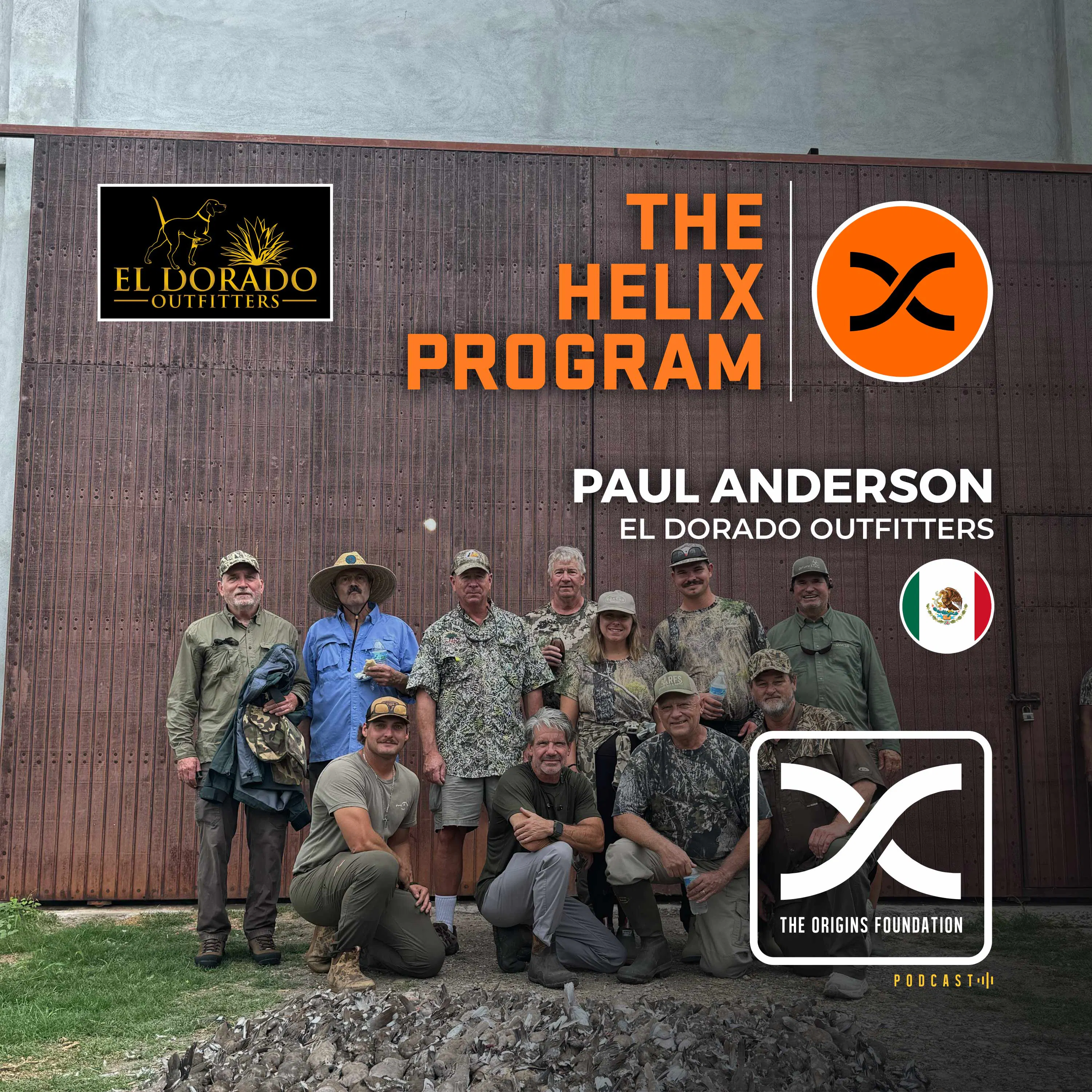
The Origins Foundation Podcast
Paul Anderson + El Dorado Outfitters || The Helix Program #1
00:44:19
Paul Anderson, owner-operator of El Dorado Outfitters, joins Robbie for the first of a series of podcasts tied to our operators and outfitters in the Helix program. Join Robbie as he explores the true impact of these outfitting businesses on the landscape and the resources they pursue.
Loading summary
Transcript169 lines
- [00:00]
A
If you're a serious hunter and you haven't tried hex yet, this is the edge you're missing. Hunters have always talked about animals having a sixth sense, feeling you before they ever see you. Hex works by completely blocking your body's natural energy, helping you get closer without tipping them off. Most hunters don't believe it at first until they hunt in it. And once they do, it makes them believers fast. Go to hexhunting.com that's hecshunting.com and use code waypoint to save $20 on a full hex system.
- [00:31]
B
Gordon Patril is a professional guide in Zimbabwe. I wanted to have a conversation with Gordon because he has been around Zimbabwean elephants since the mid-70s. Gordon was part of the amazing Zimparx board that, you know, many, many big names were a part of. Ron Thompson, Rowan Martin, Colin Saunders. Just amazing individuals doing amazing work. And so I wanted to pick his brain a little bit about old school elephants and what it looked like back in the day and what did they do back in the day. And you'll find out very quickly that Gordon has been around, has been in the places that everybody dreams about as a game ranger doing elephant management. He was even a part of the initial massive elephant relocation, probably the largest in the world that ever happened, from Gonorrhezo to all these different places, including Madikwe, back in the day. And so I want to talk to Gordon about elephants and just pick his brain. I think you'll absolutely love this conversation, so enjoy. So five years ago, there was a reason why I started this movement. And the truth then is the truth now that we need to champion our narrative. We need to champion the truth around what we do and who we are. There's a sweet spot with a gun, you know, too heavy and it's a burden to walk with. Too light and you whipping it. Why is the project so important to the hunting community?
- [02:00]
A
It's, it's a. I think it's not only important, I think it's. I think it's vital. I think it's, it's just in time. It's like snakes and ladders. You guys are climbing the ladder and
- [02:10]
B
then somebody does something stupid and you just slide. That is such an amazing analogy. Snakes and ladders.
- [02:16]
A
Yeah.
- [02:16]
B
You know, ivory in my opinion, was the plastic of its age. Okay.
- [02:20]
A
The expenses are going up. It goes a long way with families. We are families that do need it.
- [02:26]
B
Let me close this door because I have a little wiener dog. What are you laughing?
- [02:29]
A
Because I said wiener I'm really glad you finished the sentence out.
- [02:35]
B
I'm sorry, the first half. What are we doing here today? You're telling the whole world. All right, third time is a charm here, Gordon. Okay, I shouldn't have said anything, actually. I should have just like kept my mouth shut and said I haven't had any problems with podcasts at all in the last 24 hours. And then as I finished saying that 10 seconds later, here's the issue. How are the twins, Gordon? Are they good?
- [03:13]
A
Yeah, they're very well. Very well. Great to have. Yes. At home. Eden until the end of this month and then she goes back to Wanke and Abby till somewhere around April, she goes back to the valley to be with Stretch. That's fine at this stage.
- [03:32]
B
Very nice. Yeah, that is excellent. Gainfully employed right now as best as they can be. Right?
- [03:39]
A
Yes. Pursuing their license, which is great. Debbie and I both have ours, so it makes us kind of unique as a family. Yeah.
- [03:54]
B
So, Gordon, let me, before I go on, I'll introduce you to everybody. Gordon Pudrell, thank you so much for joining us on the Origins foundation podcast. You want to just give a little background who you are, where you are.
- [04:08]
A
Sure.
- [04:08]
B
You have a big elephant behind you if everybody's watching this through YouTube, which is very poignant for the topic that we're going to discuss today.
- [04:17]
A
So that elephant in the background takes me to one of my favorite places on this planet, and that is Gon Resour national park in front of Chiloto Cliffs. And I had the privilege of running the southern region of the park for seven and a half years and the whole park for a year. End of 88. Sorry, end of 87 through to 96. Absolute highlight. I was running Wangke national park main camp before then. So I am one of those fortunate individuals who achieved a lifelong dream. My dream was to work in deep wilderness with wildlife. And to me, the ultimate way to do that was to sign up as a game ranger. Much sought after job, A lot of competition.
- [05:07]
B
Oh, it's the, it's the job that we all wanted as kids. Right. I wanted to be that. As I was a 17 year old kid in South Africa, I said, I want to be a game ranger. Like that is the thing that South African kid, Zimbabwe kids want to be. Right.
- [05:21]
A
Well, I was blessed. So I, I joined at 17. I joined the fisheries division for seven and a half years, worked at various various fisheries research stations under ecologists Zim National Park. Right.
- [05:35]
B
National parks that you joined.
- [05:37]
A
Yeah. And then transferred across to wildlife management which is the organization that runs the big parks. And started off at Matusa Dona on the shores of Lake Kariba, which was out of his world.
- [05:52]
B
Jeez, I thought that, man, the only place you didn't go was Mana.
- [05:59]
A
I did. I then went from Matusodona to Mana. Another one of my bucket list goals. I spent a year at Mana. Absolutely incredible. Bit harrowing also in that it was at the height of the rhino poaching war that kept us very busy. And then from there I was transferred to Wange main camp for a year and then to Gon Resort. When I left the wildlife department, I went into the wildlife photographic industry as a professional guide. I am a hunter as well, together with my wife and we worked the wildlife tourism circuits. Wangki, Matusa Dona, Chisera, et cetera. Again, still spending time in the wilderness. And we're currently on our own private game farm 40 km northeast of Harare called Ballyvon. That's where I'm speaking from.
- [07:00]
B
It is 2026, and my friends, big changes have happened in the world of firearm suppressors. The $200 tax stamp fee is now gone. Huge win for hunters, huge win for shooters, and a huge win for your wallets. If you're thinking about elevating your shooting experience and adding a suppressor, Silence Essential is the best way to shop. And you don't even have to get off your couch to do it. Go to silenceessential.com, browse hundreds of suppressor options. They literally have all of the popular makes and models. Then their experts will walk you through setting up your account, creating a free NFA trust, and then submitting your application to the atf. Once approved, Silence Essential ships your new suppressor directly to your door. That's when you're going to have to essentially get off the couch. It's a game changer, guys. You haven't done it yet. Do it. The old days of waiting eight to 10 months on a suppressor are gone. It's more like two weeks. Some have even gotten their suppressors in shorter timeframes. It's never been easier to start shooting suppressed. Get started today by visiting silencercentral.com it's really the simplest way to get your suppressors. Bushnell is eager to help you get set up for conservation success. That's right. They want to help you. The conservation and research community is dominated by good people doing good things and investing significant time and effort for the benefit of habitat and the species. So what do you need to do? Pretty simple. Send us your Conservation story and or your conservation wish could be managing whitetails, could be understanding your environment or species or something else related to conservation. What would you be able to do if you had a great trail camera setup? We will select the best story every other month and send you a camera bundle. Cell camera, normal SD camera, SD cards as well as optics. Everything you need to get set up for success. I can't wait to see what you submit. You can email us, DM us, message us, whatever you want. We are not hard to find. Good luck. Amazing. Amazing. Yeah. I would say that you definitely have lived the dream of most people and I think that there's just like this, I don't know, mystique and awe about old school Zim Parks.
- [09:27]
A
Right.
- [09:27]
B
It's the legends of legends that worked for Zim Parks. You know, you've got the Ron Thompsons of the world, you, you name it. Like the guys that. Rowan Martin, everybody worked for Zimparx, like it was just like the thing.
- [09:41]
A
Yeah. So I had the privilege of working with those guys. We had. I'm obviously prejudiced, but I believe we had the best wildlife organization on the continent. Zim Parks, Rhodesian National Parks. I joined during the Rhodesian era, so caught that phase of the Wildlife department's history in 1977 and worked with amazing people. Glen could see what Zim Parks attracted. Very talented and incredible men. And the original.
- [10:25]
B
It's almost strange that everybody went to Zimparx. It felt that it feels this way and versus like everyone going into the private sector. Maybe the private sector wasn't what it is today.
- [10:36]
A
Yeah.
- [10:36]
B
But it just seemed like everyone was like, yep, that's where we're going. We're going to be a game manager, we're going to work with Zimpars, we're going to work for the government.
- [10:43]
A
That was a goal for many and obviously limited options, limited opportunities in the wildlife department. So there was huge pressure and competition. Originally the guys had to pass an SAS selection just to go for an interview. So it gives you an idea of how high the bar was way back.
- [11:06]
B
What did that look like?
- [11:08]
A
Yeah, I didn't have to do that. Thank God. But was that after you came in
- [11:13]
B
or before you came in for like the pressure? Okay.
- [11:16]
A
Yeah. A good 10 years before I came in. They just were able to select from the top. Yeah.
- [11:27]
B
So we got some guys to protect wildlife. That's it.
- [11:31]
A
Yeah.
- [11:31]
B
They were put through the ringers.
- [11:33]
A
Exactly. And none of it was for money. It was for the love of conservation and the job.
- [11:40]
B
Well, Isn't it interesting that you say. It's interesting that you say that right now that I want to. And I've been talking to John Lang and Rob Lurie about this. I want to do a piece on the ZIM standard, the ZPGA standard, to become a guide in Zimbabwe. If you don't know who's listening to this podcast, it is the gold level standard in Africa.
- [12:06]
A
Yes.
- [12:07]
B
400 people sit to write the entrance exam, and after four years, you have eight people left of that class. And it's almost like it's a reflection of 1960, where you're like, all right, fine, you want to work for us, you want to work in this country, fine, we'll put you through an SAS course.
- [12:26]
A
Yeah, Very, very high standards, which we're proud of.
- [12:35]
B
That is exactly what you need to be. It's like, is there a. Do you recall a conversation or a thought process on why the standard is so high in zim?
- [12:52]
A
In the guiding industry, hunting industry,
- [12:57]
B
it's the same. It's the same in zim, zpga. Like, there's no difference, you guys. Yeah, a guide. A guide can be a hunter or a photographics. You both have to shoot elephant to pass to get to your guide's license. So. But why do you remember. You've been around a long time, Gordon. Like, do you remember a conversation with folks that say this is what the bar is going to be?
- [13:20]
A
I don't, but I've often looked at the sort of person that is attracted and generally the kind of person attracted into the industry is someone who loves nature intensely and is in it for the love of nature conservation, wild places, et cetera. And hunting serves one type of access, of course, the photographic industry another. But it's that caliber of person that is attracted to these wild places. And I think ZIM offers something that other countries don't is the depth of encounter, contact with the wild. In both the hunting and guiding industry, we get right up close and personal with these creatures on foot and it's life changing. Just one of those done properly is incredible. People go away transformed. And as a guide, I love looking at. I turn around, I look at my guests to see the expressions on their faces at that moment. I get a real kick out of that.
- [14:39]
B
Yeah, yeah, it's amazing. I don't think anybody knows actually what it's like, know I was privileged to do a little bit of it when I was younger and did my research in Kruger park, you know, one of the Meccas. Again, just like a Matusa Donna Gon resort kind of places. And I think that's the lure of Africa. People are just like, well, I don't know, it's too far. And I was like, man, once you go and you get back on that aircraft and you're coming home.
- [15:07]
A
Exactly.
- [15:07]
B
Africa has buried herself under your skin. And you've got to. You're going to start itching, scratching at that itch to figure out how you're getting back.
- [15:17]
A
Yeah, you know, I've. We've guided guests who came to us at Wanki straight from the East Africa circuit. And as magnificent as that is, you know, I often think that East Africa got the lion's share of natural wonders in Africa. And I. I used to ask them, so how does this experience in Zimbabwe compare with that? And I expected them to harp on the number of animals and the volcanoes and mountains and natural wonders, but they said the wildlife encounter, interpretation and depth of experience here was tops.
- [15:58]
B
No, no, Gordon, one of the reasons why I wanted to have you on here is obviously, you know, what we do. We live in the. We live in this, like, edge of social license when it comes to hunting in the world right now. And obviously, one of the things that we are constantly battling is conversations around elephants.
- [16:26]
A
Yes.
- [16:28]
B
And obviously today, in my brain, and maybe I'll ask you this question. You've been. You've been in the Zim wilderness. Since when would you say. I want to be respectful here.
- [16:43]
A
I don't want to say that.
- [16:44]
B
You've been in the wilderness since 1930, haven't you, Gordon?
- [16:52]
A
Well, gainfully employed since 77.
- [16:56]
B
Okay, 77. Okay. So 77. You've been in the wilderness. Let's just call it that. That sort of. So you've been in there, you know, 40. Let's call it 50 years. And elephant populations have changed dramatically in 50 years. And so one of the things I'm very keen on is having people on that span that breadth of time and have been in the wilderness the entire time. I don't need scientists. I need people who are in the bush all the time. And so I'll pose a couple of questions to you and we'll have obviously, this conversation around it. Would you say that today there are more elephants in Zim than you've ever seen before?
- [17:47]
A
Oh, yes, definitely by a wide margin. A wide margin, yeah. I think the estimates today are over 100,000 or roundabout there. Each of the big parks is double or sometimes nearly triple its carrying capacity. Some areas, there's the odd area that is depleted, but it's very Concerning. I've been involved in elephant management. I've been involved in both population reduction by culling and I was very privileged to be part of the world's first ever mass elephant capture translocation operation in Gonresor, 1993 where.
- [18:35]
B
Oh, you were involved as the elephants moving to Mdiquir?
- [18:39]
A
Yes, I oversaw the operation. I was in charge of it. That was a thousand elephants captured live and moved to new homes as a form of population reduction.
- [18:50]
B
Where the other elephants go? I know the 250 went to Madiquira. Where'd the others go?
- [18:54]
A
So 600 went to Savi Valley Conservancy. 200 went to other conservancies and small game farmers, etc.
- [19:10]
B
The time when people wanted elephants.
- [19:12]
A
Yeah. So Mediquia was the most dramatic because we.
- [19:18]
B
I hear Deborah's being a voyeur in the background, listening and chirping whenever she needs to chirp in on information. You've got to capture Gordon. I hear you, Deborah.
- [19:28]
A
He can hear you do. She was there actively involved.
- [19:34]
B
That's amazing. That's amazing.
- [19:36]
A
It was a very. It was an interesting experience for me because I got.
- [19:42]
B
It was revolutionary. Right. It was the biggest elephant move ever.
- [19:46]
A
Yes. Ever never.
- [19:47]
B
1993.
- [19:48]
A
Yes. A feather in the, in Zimbabwe's cap. That's not claimed by our country. Tragically, others are jumping on the bandwagon and claiming they're the first to move to mass transligate elephants, but they're not. We were the first and we're still the biggest ever. Yeah, I got, I got to. I personally got a chance to compare capture and translocation with culling. I have been involved in culls, conducted my own culls as a necessary means to pull the numbers down. But here we had an option that had never been tried and that was to catch and move a whole population. Savi Valley got 600 and today. That was in 1993 and today the population's way over. Capacity at 2,500. But. But that's spanning what, 93 to today?
- [20:47]
B
Yeah, same as Mdikwyda. 250 to 1700 today.
- [20:51]
A
Yeah. And I can't believe the logic of some of the folk that criticize all this. The elephant. We planted a new population at Madequi. It had been exterminated hundreds of years ago, which is a great success story. We bolstered and boosted the Savi Valley population. And one of the complications of good elephant management is that one day you will have a problem. They will eat themselves out of house and Home, they will multiply it at least 5% per annum. And somewhere down the line, if you've done your job well, you will have a problem. The elephant population will exceed the ecological carrying capacity of the environment. And as managers, we have to have the courage to step into the problem and manage the ecosystem, manage the elephant. We offered the world a brand new way of doing this with the mass capture. I believe if we, if we're all very serious about elephant conservation, it is the best option in the short term to, to put elephant back into places where they've been poached.
- [22:15]
B
But, but where are, but where do we go today, Gordon? Like with, with currently wants an elephant today. That's the problem. Yeah.
- [22:24]
A
Yes, it is a problem for gonorrhea. Zor neighboring Mozambique doesn't want the elephant and that's an obvious solution. You've got large protected areas in Mozambique that are almost depleted. Very, very few elephant in them. They should get the elephant. We should.
- [22:45]
B
But what about the human wildlife conflict element of it, Gordon? Like, that's the thing. I think Mozambique is a classic example. Mozambique has area for elephant. They don't want them because they're afraid of the whole, like potentially a kazungu happening that happened in Malawi, Zambia, like, oh, we're gonna, you know, they're gonna knock down 30 people and kill 30 people and the people are gonna like, screw this, we don't want these guys around anymore.
- [23:08]
A
Sure. My, my, my take on that is it wasn't managed properly. You know, human wildlife conflict. You've got to, you've got to take into account the, the risks to rural communities around elephant populations. And to make it work, the wildlife department has to have a robust approach. There gotta protect people, their livelihood and there's gotta be, if it's done properly. I've been actively involved in campfire. If a community loses their dry land maize crop to a herd of elephant, we used to shoot that elephant and get the proceeds back to that community and they got cash in hand. That works. You don't get those people saying, you know, get rid of the elephant. We don't ever want to see them again. They've always lived with them and there's a practical benefit. But when it's not done like that, well, obviously they're just going to say to the politicians, you know, get rid of these things. We don't want them. So it's not a question of we don't know how to manage it, a question of management issues on the ground. Obviously corruption is a major factor, but I hear all kinds of conversations these days, like people are saying, we don't know how to manage the problem. That's absolute nonsense. We've had plenty of practice. We know exactly how to manage the problem. It's whether we have the will and the necessary means to do the job properly. We can do it. It's worked. It's worked magnificently. Yeah.
- [24:45]
B
It's the willingness to overcome the social license barrier, I believe, is the only thing stopping us with elephant management right now. Yeah, that's it. As you said, we have the tools, we know what works, but there's this social license, which is not something that. It's not something we need to be frivolous about. It's very important to think about.
- [25:12]
A
Yeah.
- [25:14]
B
But it is something that everyone worries about.
- [25:18]
A
Yeah.
- [25:19]
B
Gordon, tell me a little bit more about. Tell me a little bit more about. I want to understand elephants back in the day. So I want to understand. You're in the Wangi system, the Matusa Donna system, Gonorrheau. What was elephants? What was it like? What were the elephant systems like then in those areas?
- [25:41]
A
I would say they were very healthy.
- [25:46]
B
Lots of elephants, little elephants, hardly sworn elephants.
- [25:49]
A
No. Plenty of elephant, but I would say a healthy number of elephant. That's my point. I was involved in a cull of 500 elephant in Matusodona in the mid-80s. There were plenty of elephant. Plenty.
- [26:07]
B
So why was the coal undertaken in. In the 1980s? Was it was park saying, was there? I just want to get. Again, I just want to get an idea of what was it that they say, did they have vegetation objectives? Were they thinking that sort of way? Or they're like, we just want to balance. We think there's too many. Let's take out a couple.
- [26:29]
A
That was done scientifically. Ecologists established what they believe was the carrying capacity per square kilometer of that part of the Zambezi Valley, including the escarpment, and it was decided to take off 500 to bring the population down for the sake of the ecology, the woodlands, etc.
- [26:58]
B
Worked.
- [26:58]
A
It worked. It worked. I was there before and after.
- [27:03]
B
So there was a thought process then.
- [27:06]
A
Absolutely.
- [27:06]
B
Saying, we value. There was a value mindset put in place, I. E. We want the maroors around, we want the baobabs around. Like we're consciously thinking of that. So we need to reduce the pressure on those woodland ecosystems.
- [27:22]
A
Yes, absolutely. I was totally involved in that process. The ecologist running that particular operation was Dr. Russell Taylor. I think he did an incredible job.
- [27:36]
B
Yeah. Russell Taylor's still around Today I saw a presentation on elephants through him. I think he worked for WWF lately or something like that.
- [27:45]
A
I even participated in the aerial survey. So I got to see the populations from the air in counts. The consideration. I think one of the big considerations at that time was the impact of elephant and fire on the escarpment section of the park, which is a bad combo. Elephant tusk the trees and eat the bark in the dry season. In addition to browse, they expose hardwood. Seasonal fires come along and burn down old growth trees and you're just driving an ecosystem climax woodlands backwards. So a significant part of the coal was targeted in the escarpment, which is two thirds of the park. It was done scientifically. The counts were done extrapolated from aerial surveys. The ratio of animals to be removed was done scientifically to make sure that there wasn't a skewed takeoff, too many cows and calves, no bulls. It was done very, very well and the park did well. The baobabs, particularly these trees that live to nearly 2,000 years old. I mean we can't just sacrifice the baobabs for the sake of an elephant that only lives 70 years. The elephants can replace themselves fairly quickly, but Bobab can't. And the old growth mopane forests and brachistegial woodlands, et cetera. We have an obligation to manage the park as an ecosystem for all species and not just elephant. And I'm particularly concerned at the extreme high populations in Kruger national park in gonorrhe. Jor Savi has a problem, Madikwe has a problem.
- [29:53]
B
Everybody's got a problem, everybody's on a trajectory. And to me the trajectory is that you're either at the Madiquir kind of level problem. So Kruger, right now, if you look at the numbers, Kruger's population has stabilized like Gonorrhezo, Gonrose population has stabilized. But it's huge, right?
- [30:11]
A
It's too big.
- [30:12]
B
So you've just got to just, you've. They've made the conscious decision that that's the, that's a population and it has stabilized through density dependent measures. Okay, but, but is that right?
- [30:26]
A
It's way too high.
- [30:27]
B
Yeah, it's that, right. For everything else in the ecosystem.
- [30:31]
A
Right, exactly.
- [30:32]
B
All the biodiversity that comes from it. Yeah, but if you're not at that tipping point like on Rojo's there, Kruger's there, Mediqui is there. And I, and the, the situation of, I always say is this, I said nobody's actually decided what they want in Mediqui. So if Medici has Decided, oh, we value 3 meter plus trees. Well, you're already past that point and so you have to reduce elephants for a while to get back to that point. But if you actually just want a Serengeti where there are, there is no bush, there is no trees, it's just grassland.
- [31:11]
A
Yeah, because that's a value.
- [31:13]
B
That's a value choice, Right?
- [31:15]
A
Yeah.
- [31:15]
B
Then you don't have enough elephants yet.
- [31:17]
A
Exactly. Not to mention the erosion.
- [31:20]
B
Well, there's all those things that come with it for sure. But like Pilahnsberg's on its way there. Lots of little parks on their way there. They're all on the grade, they're all on the trajectory towards a gonna Akruger Amana. Look at Chobe. Chobe's there too. Right.
- [31:38]
A
So I was in gon resour at one of those tipping points in 19, arrived in end of 87. By 1992 when the great drought struck, we had 76 millimeters of rain in a low altitude poor rainfall area instead of 4 to 500 mils. It was so bad the mosquitoes and insects didn't even come out. And we went into a great drought with a high elephant population. There were about 7,000 elephant.
- [32:17]
B
Okay.
- [32:18]
A
In a park that should be carrying five. It was an absolute disaster. The elephant population exacerbated the effect of drought. They were limited to walking from available water in what was left in pools and rivers. And they had to eat everything within reach of that point. And so it looked like at the height of the drought someone had dropped a very big bomb on the Munesi Valley and the Lundi valleys, et cetera. It was just a scene of absolute devastation. My good friend Dr. Colin Saunders, who wrote gon resour plays for elephants, he was the national park's chairman for many years. An avid goer to Gonre Zor man, who did a lot for Gonresor, came and visited during that point and he went to an iron, what was an ironwood forest and it just looked like a scene from Vietnam. He fell on his knees and wept. That was a combination of drought and high elephant numbers. We implemented an emergency drought crisis management operation, took off by culling 200 elephant and began capturing elephant calves which were one of the first casualties. The poor calves could not keep up with the herds in these long treks to try and find food and get back.
- [33:57]
B
Well, that's the exact strategy that Kruger is implementing right now for their elephant population reduction strategy to reach this stabilized population goals. They've shut water out, right? So now they're causing elephants to move. Exactly. Yeah, exactly what you're saying, Right. They're making the elephants move further from the water to the food. Which means those that can't keep up,
- [34:24]
A
young calves going to be a population crash with a vegetation crash as well and a species diversity crash. It's not the wisest way to manage these ecosystems. Kruger used to keep their population down to 9,000 elephant in a 19,000 km squared national park. The woodlands and things were in beautiful condition. The Limpopa floodplain with its riparian forest was in beautiful condition. Got to manage these things properly and it's like you have to reinvent it.
- [35:02]
B
Do you remember, I don't know when last. Yeah, I don't know when last year in Kruger. Do you remember going over the Levuvu and turning at the signpost that says Fever Tree Forest? Do you remember that?
- [35:18]
A
I don't, no. I've only actually been to Kruger once. Yeah.
- [35:21]
B
Oh man, that's a pity because I think it would have been if it was somebody like you. There's a signpost that you go. It's a famous signpost. I remember doing it as a kid or even as a researcher. You go across the Luvu and there's the classic Krueger stone edifices that are like the, the, the road markers. And it says Fever Tree forest this way. 12Ks. Wow. There's five trees left.
- [35:47]
A
No.
- [35:48]
B
Yeah, yeah. And it's like it. And so the issue there, just like you noted with fire on the Matusa Dono escarpment.
- [35:56]
A
Yeah.
- [35:57]
B
Elephants come in there, they knock off a bunch of bark, they eat a couple of things kind of thing. And then they've exposed the tree in Kruger system to bora beetle.
- [36:05]
A
Yeah.
- [36:06]
B
And the bora beetle gets in, kills the inside of the tree, the creek collapses, falls over, done. Did you see in that battuzo Donna. Sorry, Notuzzo Donna, Gonorrhozo, drought situation. Was there a lot of elephant mortality,
- [36:23]
A
natural elephant mortality in the Munesi sub region, that's the southern sub region along the Munesi River. At one point we were finding 30 elephant carcasses a day. They were dying at the rate of 30 a day. My best estimate was we lost about 1500 elephant in the drought. We lost almost all the buffalo, lost the Lichtenstein Hardebeast. Small species like Sunni may have vanished. Don't think anyone's ever seen one since. And when the drought broke at the end of that season, so we caught calves, we captured and moved a variety of herbivores, grazers et cetera, and moved them to safe places and then brought them back. A lot of people don't even know that. Buffalo, waterbuck, all kinds of species. When the drought broke and it broke magnificently, we had a fantastic rainfall in spite of the moonscape environment. And farmers were saying to us, the grass seed, the grass cover and gonazole is finished. We'll have to reseed from the air. Well, I believe in the resilience of nature and God's creation. I thought, that's not going to be necessary. Well, we had good rain and the panicum was shoulder high that season. So we had magnificent grass regrowth. But the directorate decided to continue the elephant reduction. And that was when the capture operation was launched the following year in 93, and we were authorized to take off. We were actually told to continue catching calves. We didn't know how to do that. Clem had perfected that and we're talking about up to sort of 6 year olds. And then we were to cull the remaining of the herd and just bring the population down by a thousand. I said I didn't want that scenario. I chatted to Clem and I said, clem, we have got to make every effort to try and catch the whole herd. He said, well, you know, we've never done that. And he, I said, well, can you, can you give that a lot of thought and, and see what you can do? And to his credit, an extraordinary man. He developed a simplified technique to catch the whole herd. So we, he, we were there on the very first capture of seven. Took quite a few hours and eventually this was refined and we were catching and loading into large pantechnican trucks with modified containers. 12, 15 Elephant in an hour off to their new homes. And they would settle down, drink water in there.
- [39:22]
B
These would all be females and calves, no bulls.
- [39:25]
A
If there were bulls, yes, we loaded them, but we did catch bulls as well. Our problem was they were so big that we had to fit them in specialized containers because they didn't fit their huge shoulder heights. But we also moved bulls. Yeah, it was incredible.
- [39:44]
B
Yeah.
- [39:46]
A
The other aspect of the operation, which I was blown away by, was the low impact or almost no impact of capture versus culling. In culling. Once the culling operation starts, the horror of what's going on spreads, I believe, intrasonically by long distance communication through the population. The herds communicate and they disappear. They run in capture. We found we actually caught 700 elephant within a 20 kilometer radius of my base unhooded yeez in a cull. Yeah, unheard of. They would. In a cull, you would only get the first herd and then you would be going to remote parts of the park to find the rest. But in capture, we even loaded three herds on the same piece of ground on one day because the other herds didn't bother with whatever was going on. There was no distress. So it was an incredible experience to see this type of option.
- [40:53]
B
No, Amazing, amazing, Gordon. The other thing I'm super interested about, and again, one of the narratives that we're tackling constantly is this idea that hunting is shooting out all of the super tuskers is hunting is getting rid of all these big tuskers in Africa. That's why we're not seeing them anymore, whatnot. And so I wanted to have. I've had some conversations with some folks. I'm sure your part. Has your. Did your part ever interact with Derek De La Harpe?
- [41:25]
A
Yes.
- [41:26]
B
Yeah, had some conversations with Derek about gone on reserve.
- [41:29]
A
Okay.
- [41:30]
B
And so I just have this theory and I don't want to bias your what you're about to say with my theory, so maybe I'll just pose the question very simply. Back in the day, 80s, 90s, did you see big elephants?
- [41:48]
A
Were they big elephant?
- [41:50]
B
Yeah. Did you see any big elephants?
- [41:52]
A
Plenty, Plenty of them.
- [41:56]
B
Okay. Are they still big elephants today? Like you've been around?
- [41:59]
A
Okay, so to get to your question, when I'll rewind to Matusa Dona, where we had to. Had to take off. I think there were 30 bulls on an ad hoc basis and the meat was made available to and bought by the nearby crocodile farm. So once a month we'd have to go out and take out a bull as part of the culling program. And a spotter plan would be used and we would deploy. We had a problem finding a non trophy elephant bull. We'd walk in, you know, from the air. It's quite difficult to tell the size of the tuskers in a herd. We'd frequently walk in on 80 pounders, 60 pounders, 70 pounders and have to leave because a non trophy bull in those days. And when I managed the Cherezzi Safari concession, which was hunting areas around Gon Resort, a non trophy bull was a 45 pounder side. That's a big elephant today. And this was an offense to shoot something that size. There were lots of big tuskers. I believe what's happened in those days, the buffalo, trophy size, sable, et cetera, were managed by ecologists. And when the trophy quality from a hunting season showed a decline, the number of Animals were reduced and this seemed to have quite effectively preserved trophy quality. The gene pool that was being selected against had a chance to recover and large trophy animals would come through. I believe what's happened since is that indiscriminate increase in trophy allocations has just allowed everybody to shoot. From a hunting point of view, they've selected continuously everything out there. And now a 45 pounder today is considered a reasonable trophy, which is shocking because it wasn't like that in the 80s and 90s.
- [44:18]
B
There was an abundance with far fewer elephants.
- [44:24]
A
There were healthy elephant populations. Yeah. Fewer than there are today. Good point. Today we have this massive overpopulation with fewer big tuskers and an increasing number of tuskless cows and the odd tuskless bull. So between illegal poaching pressure selection and over indiscriminate hunting pressure, and I blame the Wildlife Authority for that, they should have kept a handle on this. We had established a system that worked. If the trophy quality declines, pull the numbers of animals allocated until it improves or do it drastically and it does bounce back quite quickly. So in Gon resour, I've always had a passion for big tuskers. I think I was one of those guys that wanted to collar the big ones and stop the hunters from shooting them. As much as that wasn't a popular thought at the time. I did collar one and I've got a picture of him. I got claim to collar this beauty for me. I don't know if you can see him.
- [45:32]
B
Yeah. Did you ever see him again?
- [45:36]
A
No. That's Clem sitting on it. I'm telling you.
- [45:44]
B
You're just nailing my hypothesis right now. These people, people colored these huge tuskers back then. Obviously you don't have satellite back in the day. It's all vhf, right?
- [45:54]
A
Yeah.
- [45:55]
B
And they colored them thinking, holy, we're going to find more about this big tusker. And they never saw the elephant again.
- [46:01]
A
Exactly. So they cover great distances, they disappear and sometimes we only saw a very big tusk. I saw another one in Gon Resort, a real butte. Only saw him once in seven and a half years. They have a way of moving.
- [46:21]
B
Yeah. Tell me about your. What do you think's happening there? Because Derek said the same thing. Derek is like. He sent me photographs of two monsters.
- [46:32]
A
Yeah.
- [46:32]
B
From a helicopter or a fixed wing plane and said they came into our lives and in 24 hours they were out of our lives and we never saw them again. Amazing.
- [46:46]
A
I think they're capable of moving quite big distances. I think of the Elephant that was collared and moved up towards angola and did 950 km in three weeks. Elephant, bull. So they're capable, I think, of doing more than we realize. They can be very secretive. In gone resour, we believed there was a nucleus of big tuskers around Nyam Tongwe, a central plateau in the middle of the park. And during my tenure, about 600 pounders were taken on safari. I've got photos of some of them by clients in neighboring hunting areas outside the park. But we saw big tuskers in the park that we like. I say saw once or twice and that was it. And they disappeared. And I don't mean disappeared and got shot. I think they disappeared and did their own thing. Yeah.
- [47:50]
B
Do you think that's still happening today, Gordon?
- [47:53]
A
I think so, but probably to a lesser degree because of the amount of pressure. But I do believe there are still more particularly gone resort, hopefully Kruger, Krueger and timber in South Africa. Yeah. I was of the opinion.
- [48:12]
B
I, I still think about. I still think it happens. I still think this massive big bull movement. I think bulls are still the same. Super secretive, don't show themselves. Show themselves once or twice.
- [48:26]
A
Yes.
- [48:26]
B
I think the. I think a hunter taking 100 pounder in Botswana is an artifact of exactly the situation that you just described in 1990, you know, 96 in Gonorrhozo. I saw this elephant once, we colored it, never saw him again. Same thing with a hunt, right? You come across an elephant, all of a sudden he's 100 pounder and you just happen to be on a hunt for an elephant and boom, you're lucky. Yeah. That to me is what's happening today. Like, I just had a. An amazing podcast with a guy called Carl for hoof out of Tanzania. He's into like thermal drones and moving elephants with thermal drones. It's fascinating stuff for human wildlife conflict. And he says he's got one elephant. Known man killer, killed 10 people, huge bull. They can't find him. Whoa. They know exactly where he lives.
- [49:23]
A
Yeah.
- [49:23]
B
And they see him once every six months.
- [49:26]
A
Wow. Incredible.
- [49:31]
B
I just, I just think that's where they are. I think. And again, to my hypothesis, I said people are like this, you know, to your point, there's probably less, you know, high density, 60, 70, 80 pound bulls. But I still think that there's big bulls and I think that they're there and they're moving around and nobody gets to see them. They're not this, you know, they're not the amber silly iconics that sit and everyone gets to see with a camera. Nobody sees these guys. Nobody knows these guys around.
- [50:00]
A
Yeah. No, I agree.
- [50:04]
B
Well, Gordon, I really appreciate the conversation, man. I'm just fascinated about old school wildlife management, especially when it comes to elephants. So. Yeah, I appreciate you coming on, man. I really, really do. Great.
- [50:21]
A
Well, thank you for the opportunity to chat and enjoy hearing your views as well. You're touching base with a lot of guys in this field and I appreciate what you do, Robbie. I believe we're living in times where emotion is driving a lot of conservation philosophy. And it's jolly dangerous. I think it's more dangerous than the poachers, to be honest, because the people who have the capacity to actually make a difference are misguided. And that really worries me. So it's so important to try and bring things back to reality. Yeah, Exactly.
- [51:03]
B
Ground level, 100%. Couldn't agree with you more, Gordon. Anytime you want to talk more about elephants, my phone's always open. Okay.
- [51:14]
A
Okay. Great. Excellent. Thank you, Gordon. Super. Cheers.
- [51:21]
B
Well, that's it for today.
- [51:24]
A
I appreciate you listening.
- [51:25]
B
As always, leave a review, share it with your friends, and most importantly, do
- [51:30]
A
what's right to convey the truth around hunting. Sa.