← The Origins Foundation Podcast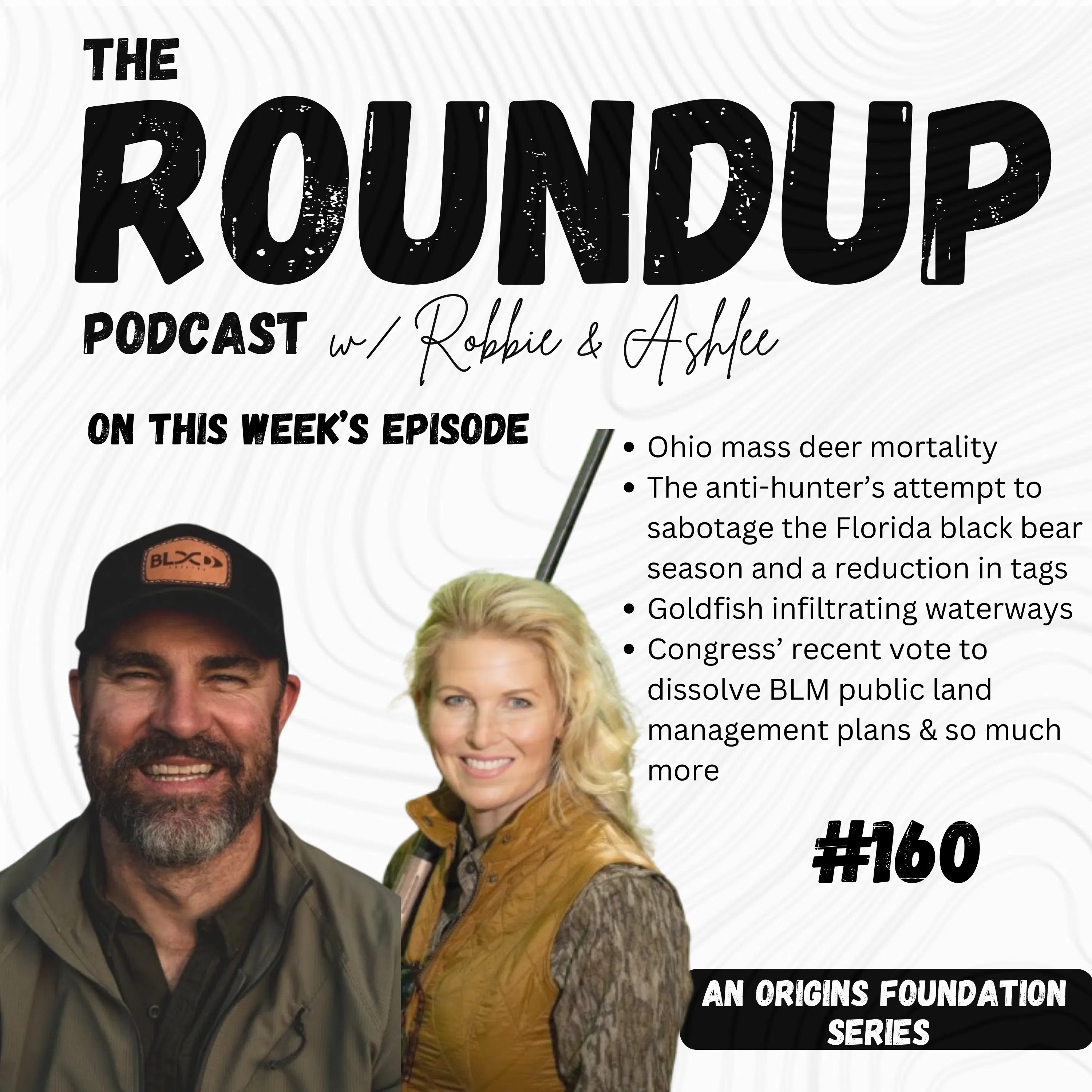
The Origins Foundation Podcast
Roundup 160 || Ohio Deer Mortality, Anti-Hunters Sabotaging Florida Black Bear Season, Goldfish, Dissolving BLM
00:51:04
On the Origins Roundup this week, Robbie and Ashlee dive into all sorts of news updates.
Loading summary
Transcript243 lines
- [00:00]
A
Atblinds.com it's not just about window treatments. It's about you. Your style, your space, your way. Whether you DIY or want the pros to handle it all, you'll have the confidence of knowing it's done right. From free expert design help to our 100% satisfaction guarantee, everything we do is made to fit your life and your windows. Because@blinds.com, the only thing we treat better than windows is you. Visit blinds.com now for up to 40% off site wide, plus a professional measure at no cost. Rules and restrictions apply.
- [00:30]
B
Tito's handmade vodka is America's favorite vodka for a reason. From the first legal distillery in Texas, Tito's is six times distilled till it's just right and naturally gluten free, making it a high quality spirit that mixes with just about anything from the smoothest martinis to the best Bloody Marys. Tito's is known for giving back, teaming up with nonprofits to serve its communities and do good for dogs. Make your next cocktail with Tito's, distilled and bottled by 5th Generation Inc. Austin, Texas. 40% alcohol by volume. Savor responsibly.
- [01:05]
C
So there's a reason why I started Blood Origins. And that reason is simple, is that I wanted to convey the truth about hunting.
- [01:17]
A
It brings awareness to non hunters that it's more than just killing animals.
- [01:25]
D
How do I start it?
- [01:27]
B
Brittany?
- [01:27]
C
My name.
- [01:28]
D
Does my hair look okay?
- [01:30]
C
My name is Mike Axelrod. Start again. Yeah, I hated it too. Braxton, you said something in the car to me. You said that you were living on borrowed time. There's a perception around who hunters are, what we're supposed to be. And a feminist that works for a non profit, that is a hunter that has only eaten wild game from the last 20 years is likely not the thing that people think about when it comes to hunter. Well, welcome back, miss. I am back. Healthy. Looking healthy.
- [02:09]
D
Oh, you're welcoming me back. Thank you.
- [02:11]
C
Yeah. Since last week. Yeah. To life.
- [02:16]
D
To civilization and society.
- [02:20]
C
We don't. The viewers don't know this or the listeners don't know this. If you're listening to this on podcasts, obviously if you're watching this, you're watching this through YouTube. I honestly think that Ashley and her kids are the sickest all the time. Essentially. It feels like you guys are sick all the time.
- [02:39]
D
No, no. Says the guy who was in the hospital with malaria once.
- [02:43]
C
Once.
- [02:44]
D
What? You were sick for like months and months and months.
- [02:47]
C
Four days. Four days I was out.
- [02:48]
D
Oh, my gosh.
- [02:49]
C
You guys Felt like it was a break for a month.
- [02:52]
D
I thought you were gonna pass out on the floor of dse. Literally, I thought you were gonna pass out on me. So I have been sick for about six months, and so have the kids. We just got way laid this past week, and. Well, actually. And then somebody was sick the week before that. I mean, it's just back to school. It's. You should just say, not actually petri dishes.
- [03:17]
C
The petri dishes of the kids should say that. Bring it. Bring it home.
- [03:21]
D
Mothers and their kids. I mean, it's just so. At church yesterday, we were. I sing on the praise team sometimes. And the bass player is this neurologist. And he was. He's kind of funny. He's kind of this, like, cute little grumpy old man. And, um, he was saying, you know, when I was doing my residency and then when I had to do pediatric neuro, and he was like, you know, remember my professor saying that kids are like the dirtiest little germ, just magnets. And just, you know, just picture a Chuck E. Cheese and how nasty they are. And, you know, kids are just nasty little things. Like, you're right. They are. Kids are just nasty little germ magnets. So every year, every single year, I feel like the end of August, beginning of September, here we go. Down for the count. I mean, you would think at some point we would develop some immunity to all these things.
- [04:21]
C
You would think.
- [04:22]
D
You would think. I know.
- [04:23]
C
Well, you're gonna get your immunity infusions next time.
- [04:27]
D
I am. You know, I was going to. On Saturday, the first time I escaped when Brad was watching the kids. Oh, yeah, go. You deserve it, honey. Get out of the house immediately. I went to get my nails done, and I got a text before I was even finished.
- [04:43]
C
Come back.
- [04:43]
D
Hey, yeah, the boys want whatever they wanted. You know, I don't know, canes or something. I'm sure it's always canes. I was like, I haven't even gone to do any of the errands, so. A mother's work is never life.
- [04:58]
C
Exactly. As a mother. Exactly, exactly. Well, we're glad you're feeling better.
- [05:04]
D
Feeling better. Kids are back at school, back in the land of living.
- [05:08]
C
Good, good, good.
- [05:09]
D
A little bit hoarse. Well, I are healthy at the same time. It's a miracle.
- [05:13]
C
Yeah, exactly. I had a bit of a hectic travel schedule at the end of last week. One went up to Sioux Falls, South Dakota, to go see Silence Essential, who's one of our podcast sponsors.
- [05:27]
D
Yeah, we love them.
- [05:28]
C
They had the 20th anniversary of the podcast of the podcast.
- [05:32]
D
I can't believe it's been 20 years.
- [05:34]
C
20 years. 2005 to 2025. Silence essential has been in, in existence. They've been going a lot longer than that. He was selling. It's just a crazy story. Maddox's story is crazy that he was a pharmacist that then. And, and the real story is going to come out on a podcast that we did with him that he just loved prairie dog hunting. He just got into it. He came from North Carolina where he never hunted, came from a hunting non hunting family, married a girl from South Dakota whose father had, you know, a room full of guns. So he's like, I better get into guns and I better get into hunting if I'm going to stick around with this family. And so then he got into prairie dog hunt because he's like, what do people do here? Like in South Dakota? Like what do you, what do you shoot here? And he goes, they either shoot prairie dogs or coyotes. And so he's like, all right, cool, I'll shoot prairie dogs. And quickly realized that he wanted his guns suppressed because it was loud all the time and he couldn't shoot as many prairie dogs as he wanted because then he got scattered, he got obsessed with it. And so now he's this huge company that's projected, he's looking projecting for next year to sell $500 million worth of suppressors.
- [06:48]
D
That's crazy because they're so good and now finally they're easy to get.
- [06:54]
C
Look guys, I'm a hunter, right? And when I go hunting, I like to figure out how to get my trophies back home as expeditiously as possible. Well, you don't have to look much further than Safari Specialty Importers. We know that trophy importation can be quite a headache. That's why Safari Specialty Importers strives to make it as easy and hassle free as possible. They have access to a bonded warehouse, you won't be charged storage fees and you get a dedicated team that's readily available and will update you at every step in the process. They'll even go one step further. Safari Specialty Importers is working with us and they are going to donate $100 from every shipment that they work with to conservation projects that include anti poaching, community development and wildlife conservation. At the end of the day, choose to spend your money with a team that's dedicated to you and is dedicated to helping show how hunting is a great conservation model. Hassle free logistics, fuel and conservation, go with Safari Specialty Importers. Hunting and shooting suppressed have become the norm in over 42 states where suppressors are legal. The growing popularity of suppressors has even led to legislative changes. You might have heard some things around the big beautiful bill, right? Including the reduction of the NFA mandated tax stamp. Before, you used to pay 200 bucks. And now starting January 1st of 2026, the tax stamp is going to zero. However, why wait until January 1st? Our partners, silence Essential, great friends of ours, they're going to pay your tax stamp right now. So if you buy a banished suppressor or other popular brands that essentially are qualifying purchases, Silence Essential is going to cover the cost of the tax stand. They're going to save you 200 bucks right now. So make sure you don't miss out. Shooting suppressed. If you're in the market for a new suppressor, Whether it's your first or your next one, visit silenceesscentral.com or call them 866-811-6536. Silence Essential is going to cover your tax stamp right now. They're going to simplify the submission process and deliver your suppressor right right to your door. Don't wait. Get your suppressor right now and start shooting. Suppress this season, Bushnell is eager to help you get set up for conservation success. That's right. They want to help you. The conservation and research community is dominated by good people doing good things and investing significant time and effort for the benefit of habitat and the species. So what do you need to do? Pretty simple. Send us your conservation story and or your conservation wish. Could be managing whitetails, could be understanding your environment or species or something else related to conservation. What would you be able to do if you had a great trail camera setup? We will select the best story every other month and send you a camera bundle. Cell camera, normal SD camera, SD cards as well as optics. Everything you need to get set up for success. I can't wait to see what you submit. You can email us, DM us, message us whatever you want. We are not hard to find. Good luck. Yeah, no tax stamps. So you can go right now. And I think they've got a sale right now. That is something along the lines of I'll check out the Instagram quickly because it'll be there. You can get your tax stamp covered right now. Let me see if they've got it. Yeah, stamp season. So because it's anything you want, they'll take care of the. They've got all sorts. The thing is with Silence Essential, what you don't realize is that yes, they have their own brand, which is the Banish Suppressor, but they keep everybody's suppressors. Noslers, Silencer, Cos Wilson, Combat Gunworks, Excel, Gemtech, lmts, off grid, whatever you want.
- [10:51]
D
Well, and that. That stamp was eliminated, you know, totally. So as of January 1st, you don't have to pay the stamp anymore.
- [11:00]
C
There is a little bit of skinny rumors coming out of D.C. that it may come forward and be implemented, like November sooner.
- [11:12]
D
That would be fantastic. So you still have to fill out the ATF form, but. But yeah, yeah, we had.
- [11:20]
C
Again, when the podcast drops with Maddox, you guys need to listen to it because it's. We. We go into all of it, like to the end result, which is. I said, look, you didn't get the Hearing Protection act passed. He said, yep, that's true. He goes, but we're working diligently to get to the point where you can buy a suppressor like you buy a rifle here in this country, go through the process. A dealer's going to have experience in this and they're going to say, look, if you're kosher, there's nothing suspicious in your past. It's going to take about 45 minutes and you'll get a response. So just hang out for 45 minutes, buy a couple of other things in the shop, walk out with your suppressor.
- [12:04]
D
And a lot of retailers are covering that with promotions. They're covering that 200. So check it out, because you can probably find somebody who is silence.
- [12:12]
C
Essential is they're covering it right now.
- [12:14]
D
Oh, that's fantastic.
- [12:15]
C
That's what I'm saying. They've got a. I don't know, some sort of promo code right now. Stamp season, they're calling it, same as hunting season that they're coming to stamp on your favorite suppressors.
- [12:26]
D
It just makes sense to protect yourself. Yeah, but I would. I kind of giggled when you said so. I've never been prairie dog hunting, neither of us, but it sounds kind of like squirrel hunting only.
- [12:38]
C
Yeah, but they shoot. Yeah. They come out of burrows.
- [12:42]
D
Well, I mean, I know. I know about prairie dogs. I mean, you know, when being born in Oklahoma and. But I mean, I just always thought of them as cute little. Little critters that pop up. I mean, I wouldn't think that there would be much meat on them. I mean, I'm sure it's.
- [13:01]
C
I don't think they're a meat animal.
- [13:02]
D
Little tidbit of some kind of.
- [13:05]
C
I don't know of anybody having cooked up a prairie dog. If you have.
- [13:09]
D
Oh, I'm sure people have cooked up a prairie dog.
- [13:13]
C
Well, if you're listening to this, people eat down here.
- [13:17]
D
Yeah, there, there are coon suppers and people eat squirrel down here. And I guarantee people have cooked up a.
- [13:27]
C
Well, if anybody out there is listening to this, has cooked up a prairie dog or eaten a prairie dog, text us, tell us.
- [13:33]
D
I'm probably mad. I'm laughing about it.
- [13:35]
C
601-790-0607 is the text.
- [13:39]
D
You didn't ask him that? That did not come up on your podcast whether he's eaten it. Yes. I mean if that's the kind of hunting he got into. Did you eat the prairie dogs?
- [13:50]
C
I don't want to, I guess. I don't know. I didn't even think about.
- [13:54]
D
See, Robbie, there's a difference in your interviews and mine.
- [13:58]
C
Mine are good.
- [13:59]
D
I know yours are good. Mine are just sometimes a little less.
- [14:05]
C
Serious, more inquisitive on random stuff.
- [14:09]
D
Yes, 100%.
- [14:11]
C
Yeah, exactly, exactly.
- [14:15]
D
Speaking of random, I feel like there's a lot of random stuff.
- [14:18]
C
Yeah, definitely today. So the event was awesome. Silence. The central event was awesome. There were a bunch of cool people there that I met. Then flew from there to San Antonio, Texas with a stop in Memphis that was a cancellation nightmare of nightmares because.
- [14:36]
D
You eventually got American again.
- [14:38]
C
Say that again.
- [14:39]
D
Because you booked with American again.
- [14:41]
C
Yeah, and I have to follow 10 days. Have to fly American in 10 days. And I'm not looking forward to it. I just need to get to Dallas, just one little flight to Dallas. So. Well, that was the case this, this time and it canceled on me. So.
- [14:55]
D
Yeah, well, if I were you, with your history, I would book Southwest to Dallas. Just saying. I know.
- [15:03]
C
I hate America. And then unfortunately, Saturday I was at a funeral of a guy called Ricardo Laoria, arguably one of the best bow hunters in the plant on the planet that nobody has ever heard of and just super sad. But a lot of good people there celebrating his life and have come down. Have come down from that 48 hour high. Had a break yesterday and now back on the on the wagon to discuss some crazy news that has popped up.
- [15:36]
D
I mean, I don't even know where.
- [15:38]
C
To start stuff today. There's a lot of start with goldfish being fed.
- [15:47]
D
Okay.
- [15:48]
C
I don't zoos.
- [15:49]
D
I don't know that this is super newsworthy.
- [15:52]
C
Oh, it is.
- [15:53]
D
It is interesting.
- [15:55]
C
Super. Look, if you're talking about sustainable use, there is a this story of people who are like now here's a question for you, Ms. Inquisitive that I Have like, I've already. You might have already googled this. Are people taking their goldfish and releasing them like from the tank into lakes and stuff up there, or is it just simply gold is getting flushed down the toilet and is turning up in lace because of being flushed down the toilet?
- [16:27]
D
Wait, did what qualify up there? I don't think this is an up there. This is a. Everywhere. Who. Okay, I would like to know who hasn't. Who hasn't either fleshed it and we're gonna. We. Goldfish, I think, are the worst problem because goldfish are technically carp. But who has not either flushed a goldfish down their toilet or put it in a lake or a river or a koi pond? Just something where they're like, oh, my gosh, we've got to get rid of this goldfish or these fish or whatever. Or a betta fish. I mean, I know, I know there are people that.
- [17:06]
C
No, I say up there because the article is based in Minnesota.
- [17:09]
D
Right. So. So just so everybody knows, this article has come out and in the New York Post. In the New York Post. And there is apparently a huge problem because so many people have been putting their goldfish, dumping them into waterways and ponds and lakes, and these things turn into mammoth goldfish and they start eating everything else. So they're. They're invasive and they're killing off all of the native fish species and growing into behemoth goldfish. So these officials are trying to figure out, what do we do, what do we do, what do we do? And so they have decided that as one of their solutions, they are now harvesting the goldfish and they are using them in zoos to feed the bears. Okay, so they're actually feeding multiple species.
- [18:05]
C
That's right.
- [18:06]
D
That all the species don't apparently like them as much. Varying degrees of excitement over the goldfish amongst the animal kingdom, but the bears love them. Okay, so we have.
- [18:21]
C
The brown bears are the ones that are loving it. So the. The article is quite humorous. It's a. Zookeepers have proposed a real grizzly, quote unquote solution feeding these shiny fin antelopes to hungry zoo animals. And early results are promising, says Kelly Captain, a nutritionist at the Minnesota Zoo in Apple Valley. And there's a picture of a tech Gabriella gypsum holding an invasive goldfish. It looks like there's a tub there. You're the carp expert. It looks like it's a bunch of carp, but also it could be a bunch of goldfish that may change colors.
- [18:56]
D
One of the pictures did not look like goldfish. They did look like carp, but maybe that's impossible. How big those goldfish got in turned color. Yeah, we, we. So I sent that article immediately to my husband because we have these goldfish that we inherited. When our school. This is. Goes back 2020, our kids run up. We are at the fall festival. The school fall festival. You know, they play little games. They all run around and here are little bitty kids come running up to us holding Ziploc bags with goldfish in them. Now, I personally think that schools should not be allowed to give live animals away to children without asking parents first. And I was like, oh, yay, goldfish. Because of course then we have to go buy a tank. I mean, it's not like. I'm sure some of them get immediately fleshed down.
- [19:52]
C
You've got beautiful gardens. You don't have a goldfish pond, a koi pond outside.
- [19:57]
D
This was when we lived at the farm and we had pond ponds. But like, we could have immediately thrown them in the pond, which would contribute to this problem that we have, which is exactly what my husband wanted to do. We're like, he's like, we're going to put them in the pond. And the kids are like, no, you know, tears, tears, tears. So we go get up. So we have had these goldfish now for five years. Five years we've had these goldfish.
- [20:20]
C
They're still alive.
- [20:22]
D
They're still alive. They were these straggly little, brown, orange, little bit of orange and white little nasty looking things.
- [20:29]
C
How big are they now?
- [20:30]
D
Big. Big.
- [20:31]
C
Holy shs.
- [20:33]
D
Orange. Spoiled. Spoiled.
- [20:35]
C
Have you had to increase the tank size over time?
- [20:38]
D
I never have. Because, you know, the bigger the tank is, the bigger they will grow. They will keep growing according to their tank size. And they're pretty big for this tank. It's in our kitchen. Like, that's bad enough because it's really hard. Oh, the cat drinks out of it. So I have pictures of my cat. He just likes to look at them. And he drinks out of the tank.
- [20:58]
C
And he's not swat him in them.
- [21:01]
D
No, but he killed a hummingbird this morning. I know I'm gonna have angry people texting me. Like, I know. Just awful, awful. I was so mad at him. Um, so he's a killer, but not the goldfish. He's. I mean, these are big goldfish. So anyway, my husband all of a sudden lately is like, we need to set the goldfish free. And he's. And I'm like, five years, five years in. You want to set the goldfish free. We need to go let him out in Mimi's pond. Mimi has a little koi pond. And I'm like, no, we've kept these goldfish alive. Now it's personal, you know, invested in these goldfish.
- [21:32]
C
I agree with Brad. Brad, I think you need to put it in the koi pond.
- [21:36]
D
You just read an article.
- [21:39]
C
It's a koi pond. It's a little. It's a. It's a ornamental pond outside someone's house.
- [21:44]
D
I know, I know, but beautiful. They may eat. So there's all these little babies in there. These little tiny little baby. And I'm afraid they will actually go eat Mimi's baby koi.
- [21:54]
C
Survival of the fittest. Then, you know, birds are going to. Could eat them, snakes could eat them. It's survival of the fittest.
- [22:00]
D
It's. It's turned into a little bit of personal pride that I've kept these things alive for five years. I mean, honestly, I've kept these goldfish alive longer than we have kept multiple dogs and cats. Jeez.
- [22:17]
C
All right, all right, all right. We got next article.
- [22:20]
D
Google. You know what? If anybody give us your goldfish stories, I would like to hear them. 601790-0607. Look at me knowing our number.
- [22:29]
C
Okay.
- [22:30]
D
All right. So what else. What else would you like to talk about amongst the plethora of things we have?
- [22:35]
C
Let's do. Let's just move a little bit to the east. Let's talk about Ohio and their deer problem. It's not a CWD issue.
- [22:44]
D
No.
- [22:44]
C
What is it? Is it an EHD issue? Yeah, yeah, it is ehd. It is.
- [22:49]
D
Yeah, it is EHD Ohio deer are dying off in droves. Like, catastrophically dying off. And so they are considering a rule change to limit the harvest in three counties. I mean, not yet statewide, but apparently. So they've been holding these public meetings to. To, you know, you have to put rule changes out for public comment. People can show up and. And voice what they want to do. And apparently at these last couple or the last listening session, public comment session was packed out. Packed, packed, packed, packed, packed out with hunters. And all of the comments were in favor of this rule change, which is a little. Little surprising to you.
- [23:31]
C
Well, it just. It just. No, it shouldn't be surprising to you. This is exactly what hunters do. It is like they see a problem. The deer population has tanked. The deer population has gone to nothing. There's a guy in here saying, my deer are gone. Athens county residents Boon Troy. Deer are gone. They're like, no, no, we shouldn't be hunting them anymore. Like, stop. We are okay not hunting them. We are okay not hunting them.
- [24:01]
D
So I agree with you normally, but do you think there would be acting this way if it were cwd?
- [24:09]
C
I don't think CWD does. CWD have the same catastrophic population decline as EHD does.
- [24:17]
D
It's always fatal. Always fatal.
- [24:19]
C
No, no, no, no. I totally. I understand that. I understand that. But it's drips and drabs.
- [24:23]
D
I don't think they die. They don't die. My understanding is they do not die as quickly with CWD as they do with the EHG and will you say the full name? How do you pronounce it in Encephalitic.
- [24:34]
C
Encephalitic. Hemorrhagic disease.
- [24:36]
D
Hemorrhagic. That's the one I always.
- [24:38]
C
Hemorrhagic. Yeah.
- [24:39]
D
Hemorrhagic.
- [24:40]
C
Hemorrhagic disease. Look, this, to my point.
- [24:43]
D
Episodic. Episodic. Not encephalitic. Episodic.
- [24:46]
C
Episodic. Hemorrhagic.
- [24:47]
D
Hemorrhagic disease.
- [24:49]
C
Disease if.
- [24:50]
D
And spread by gnats.
- [24:52]
C
If CWD caused 3,000 deer to die just like that. Okay. And you didn't see any deer. I think hunters would be like, we're not hunting because they want deer to be around. That's the whole premise of it. So these guys are like, don't hunt because there's only a few deer out there. There's not enough deer for everyone to hunt. We don't want to decrease the population any further.
- [25:23]
D
Yeah, a lot of hunters up there are actually calling for them to cancel the season entirely.
- [25:27]
C
Yeah.
- [25:28]
D
I mean, One resident had 30 dead deer in a one mile radius.
- [25:32]
C
It makes sense that that is exactly what hunters should be doing. They should be calling for no hunting. If. If you're truly interested in sustainability of the population and the health of a population, the hunters should be the first people to put their hands up and go, we're okay with no hunting season.
- [25:50]
D
It is kind of crazy. Kind of crazy and sad. I mean, I feel bad for the people out there dealing with this. So it's gotten a little crazy down in Florida right now with the first bear harvest.
- [26:07]
C
Holy smokes. Now, let's just talk about. There are statistics at the Wazoo associated with this. So did you have any, like, did you have any idea on how many tags they were going to sell? Did you. Did you have an inkling? No, I thought they would sell like 50,000, 60,000.
- [26:31]
D
Oh, I didn't think they'd sell that many, but I thought they would for.
- [26:36]
C
The first black bear season coming back. I thought yeah, they're going to have pretty good.
- [26:43]
D
I also didn't think though. I didn't. I mean I had heard rumors about the anti hunting crowd trying to sabotage it by buying but I didn't think they would actually put their money where their mouth is and really go in. I mean it would be really interesting. So just explain what's going on to people so they know what's happening.
- [27:00]
C
So bear season is, is now being proposed. It's being finalized. Commission said yep. We moving forward be season's happening this December in Florida and it's open right now.
- [27:10]
D
So residents 187 tags.
- [27:13]
C
187.
- [27:16]
D
Except for they just, they just changed it. But that's. We'll talk about that in a second.
- [27:20]
C
And so you could apply, you can apply for a permit. It's five bucks for the permit. I think non residence was 300 bucks or something like that. I can't remember. There's no real breakdown on the article that we found but 100,000 permits have been port thus far. That's $500,000 that is likely going to be steered towards the black bear program in Florida.
- [27:46]
D
Right?
- [27:47]
C
That is crazy.
- [27:49]
D
It's great. It's great news.
- [27:51]
C
Crazy point number one. Crazy point number two is we don't know how many of those tags have been bought by the anti hunting establishment because they don't want hunters to get the tags.
- [28:07]
D
And we know, we know that that is happening.
- [28:10]
C
We know that's happening. And if that is happening, it means that a bunch of anti hunters have bought have had to become hunters in the state of Florida. To be able to purchase attack you needed a hunting license number which meant you have to go through the hunter education course and pay for your hunting license, which is $17. Okay. So you can take that hundred thousand tags and assume that they've also all bought hunting licenses. So what did Travis say in terms of the hunting licenses? How much?
- [28:44]
D
They were 17 I think $17. Right, sorry.
- [28:48]
C
17 to 18 bucks. So you've raised $1.7 million from 100,000 people because those hundred thousand people have hunting licenses.
- [28:59]
D
Right.
- [29:00]
C
That's crazy. Point number two. So we've got a bunch of new hunters in Florida.
- [29:04]
D
Well, hunting licenses. We have a bunch of new hunting licenses.
- [29:09]
C
No, they're registered as hunters.
- [29:11]
D
Well, they are but I mean they're weak. So the anti hunters are trying to flood the the lottery by applying for tags that will be Drawn and then not used is what they're doing. And. And so to do that, they also have to buy a hunting license. So.
- [29:29]
C
And also be a hunter like you. They have to gone through the education. Hunter education to get a hunting license.
- [29:36]
D
Oh, online.
- [29:37]
C
Yeah. But still you had to do it.
- [29:39]
D
Right? Right, Right, right, right.
- [29:40]
C
Okay. Which means we don't know if.
- [29:42]
D
Which is also leveraged as Pim and Robinson money.
- [29:46]
C
So crazy point number three, we don't know if it's 10,000 or 50,000 new hunters are now registered in the state of Florida. Which means the state of Florida gets more money from the Pittman Robertson act. Delivered sportsman conservation dollars delivered back to Florida.
- [30:05]
D
Yeah, yeah.
- [30:06]
C
And then crazy point number four.
- [30:08]
D
Really? Go ahead.
- [30:10]
C
No, crazy point of what? You tell them about them buying up the tags and if they don't, they decide not to hunt them, what happens?
- [30:16]
D
Well, I thought that was one, but yeah, yeah. I mean, so if. No.
- [30:20]
C
What's the implication for next year?
- [30:22]
D
They buy up all of the tags and they don't get used. They will increase the number of tags available. They won't decrease them. They'll increase them.
- [30:30]
C
Yeah. Because they don't meet the quotas.
- [30:31]
D
Right. So it's completely backfiring the. This effort, which is just, I mean, the opposite of brilliant on their part. Somebody did not think this through.
- [30:43]
C
Yeah, let's. Let's not. Let's not worry about them buying the tags. Let's encourage them to become hunters and buy more tags.
- [30:53]
D
Please do. Please. PETA. Keep it up, guys. You're knocking it out of the park.
- [30:57]
C
You are knocking it out of the park. Now, little bit of seriousness. 187 tags was the commission's ruling when they first opened the be season. It has now been reduced to 172, 15 tags down. And the reason being is that there was a little bit of work done on the population estimate associated with the tag allotment, especially in this north zone. And when they redid it and they looked at it again because of the summer drought of last year and a bunch of the bears have returned into the Okefenokee. Okefenokee, right.
- [31:42]
D
Sounds good.
- [31:43]
C
South Africa. I'm trying to say funny name, Okefenokee swamp on the Georgia side. So they've gone now across the border. So there's less bears in Florida and so they reduced the numbers again. Makes sense we would all be for that because the science is showing there's less bears means less tax.
- [32:00]
D
Right.
- [32:01]
C
Cool.
- [32:01]
D
Right, Right, Right. Yeah. So that's kind of a fun Little situation going on down in Florida.
- [32:07]
C
I like it.
- [32:08]
D
We like following it.
- [32:09]
C
I like that a lot. I like that. All right, you pick one. Because I've been going through them well.
- [32:16]
D
Oh, okay. So this is not really anything to do with hunting, but I think this is just. People are crazy to me. So they have undercovered, uncovered. Not undercovered, but it was undercover.
- [32:29]
C
An undercover investigation has uncovered.
- [32:32]
D
An undercover investigation uncovered a massive weed growing operation under the COVID of the giant sequoias. How about that for a lot of undercovers? So this massive illegal operation in the Sequoia national park, they were growing weed on, like tons of acres. So it's just crazy to me what people will do. And I guess they just thought that, you know, wasn't patrolling very well and lots of. So it was in. On 13 acres within the Sequoia National Park. They removed 2377 climb plants with 2000 pounds of infrastructure and trash, pistol chemicals, gallon of meth, methaminophos. I don't know what that is. It's a toxic pesticide. It says banned in the United States. So I mean, this was not like a little mom operation. This is somebody. I feel like somebody should not say this out there. I'm just. This is. My hunch is that somebody on the inside was. Had like maybe was looking the other way.
- [33:43]
C
I don't know, man. Some of these places are so big. Like, Sequoia is 400,000 acres, right?
- [33:48]
D
It is.
- [33:48]
C
And this is very common in California, like in these state forests, these national forests, national parks where people don't go. People set up these huge cannabis operations and they grow them. What they say later on, they said the National Park Service in the last 20 years has seized over 300,000 plants between Sequoia and Kings Canyon because they're so big, nobody goes into these areas. So these guys just set up shop and they grow.
- [34:16]
D
Just. Just setting up their own little farm.
- [34:19]
C
Yeah, exactly.
- [34:20]
D
Crazy to me. That's crazy. So anyway, well, they got them. Sorry, no more. No more backyard situation in the Sequoia National Park. But speaking of public lands, this is. This is a little hard to explain, but they're on September 3rd. Okay, the house.
- [34:47]
C
This is the federal House.
- [34:48]
D
The federal House. Congress has voted to overturn. And so not. Not a committee, but like the entire House voted to overturn three Bureau of Land Management. So when we say blm, you know, there's Black Lives Matter, there's Bureau of Land Management. Usually in our context, it's Bureau of Land Management. So they voted to overturn Three Bureau of Land Management plans. These resource management plans, including this gigantic one called the Miles City Resource Management Plan. And so these are basically think of like a management plan that they have for national wildlife refuges and different things. They. They put these plans into effect to basically manage the. Manage that particular plot of public land. It creates a blueprint for multiple use, balances the economic activities like grazing, oil, gas development, other concerns with wildlife habitat, outdoor recreation and conservation. So when they put these plans into place, they go through a very extensive process. Ordinarily, all indications are that they did. In these situations, like NEPA is involved, they have ranchers come to the table, tribes, hunters, energy companies, conservationists. And there's a lot of time and effort and coordination and stakeholders involved when they craft these plans. So the Miles City plan was finalized in November of 2024, and it's one of the nation's largest ones. It's over 12 million acres of BLM land and 55 million acres of federal mineral estate. This is all in Montana. The other two aren't quite as big. So. So on September 3rd, Congress used what is known as the Congressional Review act to overturn this. So what's interesting about this is it's the first time this has ever been used to overturn one of these land use planning regulations. So I say this is kind of difficult to explain because you have to, one, not only know what these resource plans are and what they involve, but then you also need to know what the Congressional Review act is. Congressional Review act was passed in 1996, and it's a way that Congress can review and overturn or potentially overturn. They don't always do it. New regulations issued by federal agencies. So it's an oversight tool that they give to the legislative branch. So in case they come in and they're like, whoa, whoa, whoa, we think this agency overstepped its bounds. We're going to overturn that. Okay, so there are some specific parameters to the CRA and that they are supposed to ordinarily and historically, they have 60 legislative days to introduce the. This joint resolution of disapproval. And then that time, the rule can still take effect unless Congress acts. And in the Senate, they can be expedited for consideration, but not in the House. And they can't be filibustered over on the Senate side. So it makes the CRA a much stronger tool than normal over on the Senate side of things. So what's also interesting about this is if they do overturn one of these regulations or rules, the agency is barred from issuing Another rule that is, and this language is pretty important quote, substantially the same as another rule without authorization from Congress. So what is so interesting here and what, what has people very concerned and up in arms is so this, this CRA was not used very often and, and it was used in, beginning in 01 they used it for an ocean, an OSHA sorry ergonomics rule. And then in 2017 the Trump administration started very often more than any other administration to overturn a lot of Obama era regulations. And then Biden and Trump administrations both used them. Since then it's only supposed to apply to rules that agencies classify as regulations. And so there's this big question about whether these resource management plans actually count as regulations.
- [39:57]
C
What's the, what's the end result here? Like what's the, what's the end game here? Are they getting rid of the resource management plans? They can do whatever they want.
- [40:06]
D
Yeah, well it is. So the disappearance of this management plan is going to have like immediate, immediate repercussions. So like ranchers don't know how many cattle they can run. They don't know when their permits are going to be renewed. They don't know what's going to happen. During a drought, tribal cultural sites are left unprotected. Years of tribal consultation overridden. These science based safeguards for habitat like I guess thrown out the door. So like the Miles City resource plan for instance, it would have reformed coal seam leases and then without those reformed habitat for elk, mule deer, grouse, pheasants could be fragmented by energy development. And so I think that that's what's going on here. This administration, we've seen it in the potential rescission of the roadless rule.
- [41:05]
C
They are sale of public lands. Before that, the sale of public lands. What's the other thing that we were talking about?
- [41:11]
D
Well the sale of public lands was a little bit different situation because Mike Lee over and over and over, but.
- [41:17]
C
It still came out of Congress. It still came out of Congress.
- [41:20]
D
It still came out of Congress. The motivation behind that we kept hearing was because they needed to build more houses. Development, development, development. Whereas this, these agency rules and regulation changes and these things they keep trying to get around with. These different administration situations seem to be guided by energy development, logging, you know, commercial development type situation. So I, it's just, just concerning.
- [41:50]
C
There was one more thing that, that came out at D.C. that you were talking about. It wasn't the road this, it was something else. What was the next thing I'll have to remind myself.
- [42:03]
D
I know there's been kind of a lot.
- [42:05]
C
It just seems like there's. Yeah, it just seems like there's just this big push on, again, the public lands and changing them. And it's crazy.
- [42:14]
D
I mean, USDA has proposed this massive reorganization right now, but that's not really something that necessarily, we know is going to affect their work or I mean, they're trying to. A lot of the people that are working in dc, they are trying to get back out into the field and back into the field offices. And there's all this office space that's sitting vacant in D.C. or is super high rent. And so, you know, we've been asked to weigh in on the reorganization and many other conservation groups have, but at the end of the day, I mean, that's an, that's an administrative office. Administrative, like sort of. I don't, you know, for, for me, that's not a conservation issue that, you know, I mean, now if they, if they end up reorganizing, push people out into the field versus a D.C. office, like sitting at their desk and, and if you read the justification behind it, they're like, we have all these, you know, bureaucratic employees sitting behind their desks in D.C. at the highest rent in the nation. They should be working out in field offices where the AG is happening. I mean, it's kind of hard to argue with a justification. And it's not something that we know is going to have immediate or long term impacts. And so that's not something I feel like we should weigh in on. You know.
- [43:34]
C
There was something else tied to public lands. It's just escaping me right now. It's just escaping me. All good.
- [43:42]
D
I mean, the funding situation is ongoing and continual.
- [43:45]
C
Yeah, no, it was something else. They were going to reverse something and it was out for public comment and. Doesn't matter. Doesn't matter.
- [43:55]
D
Okay.
- [43:55]
C
It just seems to be a press, as we, as we've been noting, it just seems to be a press against public lands. And I agree with you. I think it's all tied to ideas of, of development.
- [44:09]
D
You know what's kind of interesting, and.
- [44:11]
C
I sure work in America, it's the public land man.
- [44:14]
D
Yeah, I know, I know. Well, and you know, so Montana Reps. Troy Downing and Ryan Zinke, these Republicans who, you know, Zinke was the big, big opponent for the public land sell off, both voted for this and they are refusing to comment on why they did, which is interesting. I think at some point they're going to have to talk about it, but this will head to The Senate now for a vote. So it'll be voted on within 60 days and it'll be interesting to see what happens. I think we will start hearing more about this as it gets picked up. I'm kind of just starting to hit the airwaves and honestly, it's just such a strange rule and mechanism and it's very convoluted. So that may be why it's not getting so much press. It's kind of, you know, people are a little puzzled, like, oh, well, what, what is going to happen with. If this is. If these are lifted. But the, the biggest problem is that whole similar, the whole similar rule language about how you can't issue another rule that is substantially the same. Because does that mean Congress cannot. I mean, does that mean that BLM cannot enter these resource management plans in the future? For other.
- [45:36]
C
How do you write a resource management plan that is substantially different than a resource management plan that you just.
- [45:42]
D
I don't know. I don't know. So did they just nullify these? I mean, it's, it's, there's just a lot, a lot of legal questions surrounding what just happened. We'll see. We'll continue to dig into it and monitor it.
- [45:58]
C
Perfect. Perfect. Let's do one more. One more. How about your. Guadalajara Zoo and a little baby tortoise that has been born celebrates Guadalajara Zoo. This is Mexico News Daily. Guadalajara Zoo celebrates the first hatching of the world's tiniest turtle. There are only 300 to 500 left of these. The world's smallest turtle.
- [46:29]
D
They're so cute. The Vallarta turtle. Vallarto. The. That's how you say it, right? Vallarta. Like Puerto Vallarta.
- [46:39]
C
Vallarta.
- [46:40]
D
Vallarta mud turtle. The species known as the casquito de Vallarta. And they're so cute. They are the little tiniest baby things you've ever seen. And 2.8 grams, 2 centimeters long. They are the width of an adult human thumb. They're endangered and.
- [47:02]
C
But they're only, they're only discovered in 2018. How cool is that?
- [47:06]
D
I know. And there's only 300 to 500 in the world remaining. And for these things to be so small, that's not very many. I mean, I feel like they could be eaten up all in one fell swoop. They're also highly trafficked. Highly trafficked. Because they're so endangered. They have. Okay, so this is terrible to me that people do this. So within the last year, two men reportedly disguised as Federal Environmental Protection Agency Profipa which is the Mexican federal environment. They stole 55 of these little baby turtles from a university lab in Puerto Vallarta. Just. It's awful.
- [47:46]
C
They're also getting pressured by urban expansion, man.
- [47:51]
D
They're highly trafficked in Japan, China and Korea. But they are trying to bring these guys back. And so this new little baby named, nicknamed Crumb or his dominion size hatched and they have six more eggs developing in the incubator. The incubation period is 120 days. This is the Guadalajara zoos breeding program. They're trying to increase the wild population. I think this is fantastic. I love turtles. They're so cute. They are actually tasty. We're not going to be eating these little, little tiny little things. They probably are about as good as prairie dogs. But I do think that, I mean, this sounds ideal to me for the type of wild to farm to wild program that Louisiana instituted when they were trying to bring the American alligator back, don't you think? I mean, if we could find some farmers to set up that program, they.
- [48:47]
C
Need some sort of farming propagation program. Um, the problem is like what, what's the resource value for the farmers to do the propagation of the turtles? That's the only thing stopping it.
- [48:57]
D
I think they'd have to be paid for a while.
- [48:59]
C
Yeah.
- [48:59]
D
So government raise enough for sure. Raise enough to get those people in Japan and China to buy some from them and then release, you know, half back to the wild.
- [49:06]
C
Oh yeah, that's, that's a good point too. Like figure out a way that you can make a propagated animal available to the trade market, reduce the pressures on the wild population and at the same time put more back in from the quote unquote rewilding program. So, you know, 40% of your hatchings or 10%. I think Louisiana started like 13% of the hatchings going back.
- [49:30]
D
They started out really high.
- [49:31]
C
Really?
- [49:32]
D
Yeah.
- [49:32]
C
Higher than 13%.
- [49:33]
D
I think it was higher than 13%. We'd have to go back and look.
- [49:38]
C
Okay. But yeah, great idea. That's what it's all about. Sustainable use. Figure out what people want, find a way to propagate them and then return them to the wild too. So that's what they did with American alligator. Massive conservation success story.
- [49:52]
D
That's right. We hope everybody is enjoying the beginning of hunting season. I'm going down to hunt some teal tomorrow.
- [50:00]
C
Honey break. We're gonna love honey break. Big shout out. Drew John. Honey break team. Good stuff. Don't miss em all. They fly like little rockets.
- [50:11]
D
I know. We're taking the boys. And so we may miss em all. Let's reshoot.
- [50:18]
C
All right, See you next week.
- [50:19]
D
Bye.
- [50:20]
C
Well, that's it for today. Appreciate you listening as always. Leave a review, share it with your friends. And most importantly, do what's right to convey the truth around hunting.