← The Origins Foundation Podcast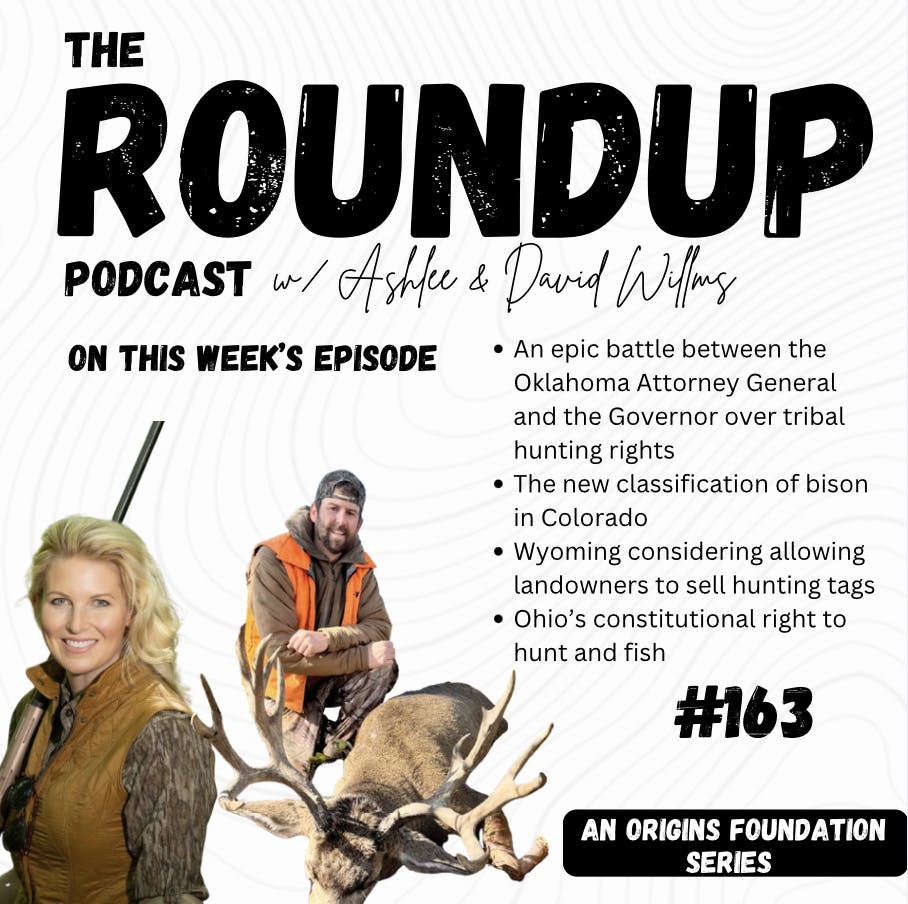
The Origins Foundation Podcast
Roundup 163 || Roundup with Ashlee and special guest host David Willms
00:59:39
Robbie is across the pond, so Ashlee is joined by special guest host David Willms to discuss the news of the week, including an epic battle between the Oklahoma Attorney General and the Governor over tribal hunting rights, the new classification of bison in Colorado, Wyoming considering allowing landowners to sell hunting tags, and Ohio constitutional right to hunt and fish.
Loading summary
Transcript173 lines
- [00:00]
A
At Midway usa we put customers first. The Nitro Express shipping system is icing on the cake. It was a big investment of time and money to take super fast low cost shipping to a whole new level. The Nitro Express helps ensure same day shipping and low shipping costs. We hope you enjoy the Nitro Express. We built it just for you, for just about everything. For the outdoors, go to midwayusa.com I'm Larry Potterfield with Midway USA. Thanks for your business.
- [00:31]
B
Tito's handmade vodka is America's favorite vodka for a reason. From the first legal distillery in Texas, Tito's is six times distilled till it's just right and naturally gluten free. Making it a high quality spirit that mixes with just about anything from the smoothest martinis to the best Bloody Marys. Tito's is known for giving back. Teaming up with non profits to serve its communities and do good for dogs. Make your next cocktail with Tito's. Distilled and bottled by 5th Generation Inc. Austin, Texas. 40% alcohol by volume. Savor responsibly.
- [01:03]
C
So five years ago there was a reason why I started this movement. And the truth then is the truth now that we need to champion our narrative. We need to champion the truth around what we do and who we are. There's a sweet spot with a gun, you know, too heavy and it's a.
- [01:19]
D
Burden to walk with.
- [01:20]
C
Too light and you whipping it. Why is the project so important to the hunting community?
- [01:26]
D
It's. It's a. I think it's not only important, I think it's. I think it's vital. I think it's. It's just in time. It's like snakes and ladders. You guys are climbing the ladder and then somebody does something stupid and you just slide.
- [01:38]
C
That is such an amazing analogy. Snakes and ladders.
- [01:41]
D
Yeah.
- [01:41]
C
You know, ivory, in my opinion was the plastic of its age. Okay.
- [01:46]
E
The expenses are going up. It goes a long way with families. We have families that do need it.
- [01:51]
C
Let me close this door because I have a little wiener dog. What you. Are you laughing because I said wiener?
- [01:57]
E
I'm really glad you finished the sentence out. I'm sorry, the first half. What are we doing here today?
- [02:04]
C
You're telling the whole world.
- [02:16]
E
Okay, I have got my good friend David Wilms with me today because Robbie has just landed in Cape Town. Santa. South Africa. He is on the road again. He is going to be on the road for the next three weeks, I think. So we are going to have a series of roundup guests and I am very excited to Have David Wilms back with us today. David out of Wyoming. He is the director. And I'm gonna. I'm gonna butcher your title. I think I call you something different every time I talk to you, but it's something close to Director of Legislative affairs for National Wildlife Federation or Director of Public Lands.
- [02:55]
D
Associate Vice President.
- [02:56]
E
Yeah, okay. Okay. Tell me your full title.
- [02:59]
D
Associate Vice President, Public Lands.
- [03:01]
E
Okay. Way more important sounding than I just made it sound. But you are a constitutional law scholar. You are a legal professor, you have taught law. You are an attorney. You are associate Vice President for National Wildlife Federation. You also have your own podcast, which is brilliant. I listen to it when I really need to know the ins and outs of something. It's a little wonky, which I love. I appreciate the wonkiness, especially because of our legal backgrounds and the policy bent that you have to your podcast. I love that. So if you guys out there want to know, like, why decisions were passed, the ins and outs of legislation, policy, wildlife, where it all intersects, listen to David's. What's it called, David?
- [03:49]
D
Your mountain.
- [03:50]
E
Your mountain. It is. It is really, really a good, fantastic podcast. So I have asked David to join me today to do the weekly roundup. We have a plethora of kind of random things to talk about, I would.
- [04:05]
D
Say, all over the place, like, all over the board, all over the country. Right.
- [04:09]
E
We are. First, I would like to talk about the plethora of animals, big game that you have shot, you, you got on the board in a big way this year so far. Tell me about it. You sent me last night, you were like, oh, yeah, okay. Yeah, I'm happy to do the podcast. And by the way, look at this. Look, look at these monsters that I've put down and your cutie, cutie son. So, yeah, tell us what you've been up to out there in the beautiful western states.
- [04:40]
D
Yeah, I, I was pretty fortunate this year that I, I was able to draw a really great mule deer tag and a really great pronghorn tag. And then I did not draw an elk tag in the, in, in the unit I applied. So I got an over the counter tag here in Wyoming. But it's been a number of years because we, we had some terrible winter. We had a really terrible winter three, four years ago that really wiped out our mule deer and pronghorn herds west of the continental divide all over the state. So populations have been down, licenses have been down. So I was really fortunate. This is the first time in years I've had all three tags in my Pocket. And I have this really weird superstition that how my dove season goes is going to set the stage for the rest of my hunting season. And I had a phenomenal dove opener. And so I'm like, this is my year, and it's just turned out great. I got myself a. I wouldn't call it a boomer buck. I got a nice buck pronghorn. But my son was there with me, so it's like the trophy of a lifetime, because he got to be there.
- [05:44]
E
And experience, and he is a nice buck.
- [05:46]
C
Yeah.
- [05:47]
D
Like, it's not nothing to be embarrassed about, and I would never be embarrassed about any of them. But it's. It was. It was just cool because he was there with me and, you know, he was telling me he just wanted me to shoot a dough all day. He's like, shoot that one. No, no, shoot that one. Shoot that. Like the whole trip. I'm like, no, son, we're gonna. We're going to look for a mature buck. That's what we're going to do. And sometimes you win, sometimes you lose. But it's at the end of the day, when we had one that. That gave us a. A nice shot. I'm like, all right, I'll take it. I've got him with me. I gotta do it. So I did. And then I followed that up with the. Probably the nicest mule deer that I've. That I've ever killed. It's the one. It's right here, right over my shoulder.
- [06:27]
E
Those antlers, for anybody watching, they're. They're peeking off, like, behind you in this, like, glorious. Just, like, mass behind your chair.
- [06:38]
D
Yeah, I got them back from the taxidermist already, and I'm doing a European, and it's my first non typical mule deer. So it. And just. So just. I think it's an 8 by 8 and lots of mass throughout it. It was just a really cool experience. I just. I just wrote a. An article for. It should go in Eastman's outdoor or Eastman's hunting Journal in the coming months about the. About that hunt. But it was a great meal deer. It was. It's such a good one that. So I took it. Sorry to. To ramble on a little bit, but it was just.
- [07:11]
E
No, no, I want to hear.
- [07:12]
D
Yeah, so I took it to get tested for chronic wasting disease. So I took the. And I wanted to. I'd never done this before. I'd never actually had a deer tested before. I just sort of always took the. Like, oh, well, if I get it, it was My time to go. But I know that it's, you know, the biologists really want more data and want to know what the, you know, what the prevalence rates are in certain areas. And this was a unit that definitely had CWD prevalence at a little bit elevated rate. And the big mule deer are the ones that are more likely to be carriers and moving it around.
- [07:44]
C
Look guys, I'm a hunter, right? And when I go hunting, I like to figure out how to get my trophies back home as expeditiously as possible. Well, you don't have to look much further than safari specialty importers. We know that trophy importation can be quite a headache. That's why safari specialty importers strives to make it as easy and hassle free as possible. They have access to a bonded warehouse, you won't be charged storage fees and you get a dedicated team that's readily available and will update you at every step in the process. They'll even go one step further. Safari specialty importers is working with us and they are going to donate $100 from every shipment that they work with to conservation projects that include anti poaching, community development and wildlife conservation. At the end of the day, choose to spend your money with a team that's dedicated to you and is dedicated to helping show how hunting is a great conservation model. Hassle free logistics, fuel and conservation go with safari specialty importers. Hunting and shooting suppressed have become the norm in over 42 states where suppressors are legal. The growing popularity of suppressors has even led to legislative changes. You might have heard some things around the big beautiful bill, right? Including the reduction of the NFA mandated tax stamp. Before you used to pay 200 bucks. And now starting January 1st of 2026, the tax stamp is going to zero. However, why wait until January 1st? Our partners, Silence Essential, great friends of ours, they're going to pay your tax stamp right now. So if you buy a banished suppressor or other popular brands that essentially are qualifying purchases, Silas Essential is going to cover the cost of the tax stamp. They're going to save you 200 bucks right now, so make sure you don't miss out. Shooting suppressed. If you're in the market for a new suppressor, Whether it's your first or your next one, visit silenceessential.com or call them 866-811-6536. Silence Essential is going to cover your tax stamp right now. They're going to simplify the submission process and deliver your suppressor right to your door. Don't wait. Get your suppressor right now and start shooting suppress this season. Bushnell is eager to help you get set up for conservation success. That's right. They want to help you. The conservation and research community is dominated by good people doing good things and investing significant time and effort for the benefit of habitat and the species. So what do you need to do? Pretty simple. Send us your conservation story and or your conservation wish. Could be managing whitetails, could be understanding your environment or species or something else related to conservation. What would you be able to do if you had a great trail camera setup? We will select the best story every other month and send you a camera bundle. Cell camera, normal SD camera, SD cards as well as optics. Everything you need to get set up for success. I can't wait to see what you submit. You can email us, DM us, message us whatever you want. We are not hard to find. Good luck.
- [10:56]
D
Decided to get it tested and I, but I wanted to know, okay, which lymph nodes do I take? So in the future if I want to do it myself. So I'm in there and they're doing the testing or pulling the lymph nodes out and then they say this is a great buck. Can we take a picture of it so that we can show our commission that they're. That the deer are coming back after this, this bad winter that we had. And I'm like, sure, that sounds great. And I would, I had just come back to town to process that deer before going out for an elk hunt. So I, I had the deer with me going back up to the mountain. So I, I just. The head, right, Because I was getting the, the lift nodes taken out. So I take the head back up with me for, for elk camp. And then I shot a nice 6 by 7 bull elk, which just capped my season on a general unit, which was amazing. So I'm coming back home and I stop in, I go through Laramie, Wyoming and southeast Wyoming and there's a game check station there. So I pull up to the game check station and they say, have any luck? And I say, yeah, I got a great mule deer and I got a really nice bull elk. And they wanted to check them and said, well, the mule deer has already been checked in because I had the lymph nodes done. And they looked at it and they said, oh, that's a great deer. Can we take a picture of you with it? And I said, well, I already did that. And they said, well, let's just take another one just in case they lost it. So I, so I take another picture for the same thing and then get back home. And about three days later, maybe a week later, I don't know, I'm going up to a state game and fish run, pheasant hunt, and at this one, you have to check in ahead of time and show your permit for this pheasant. So I check in, and the woman there behind the counter looks down and looks up at me, and she said, oh, you're the one that shot a great mule deer in unit whatever.
- [12:39]
E
She's seen your picture.
- [12:41]
D
She's seen the picture floating around the office. So I thought that was. That was just fun.
- [12:46]
E
So you've been having absolutely no fun at all, it sounds like.
- [12:49]
D
None. Oh, I hate. I hate hunting season. I don't know why I do it.
- [12:53]
E
I know. And it's especially terrible in Wyoming. Right. It's just. I mean, just. It sounds like Mecca up there. Like, amazing. We're.
- [13:01]
D
We're pretty blessed with some pretty amazing opportunities. I've still got an elk tag in my pocket because we can shoot more than one elk here. And. And so I still got an elk tag, and I ended up not hunting whitetail this year just because I don't. And I'm not going to use this elk tech because I just. I don't have the freezer space, and I've still got a great goose lease that goes on for three months, and I need to create space for. For geese.
- [13:24]
E
So do you guys have the hunter's harvest program up there?
- [13:28]
D
We do, and I've contemplated that as well. So I'm. It's possible I'll go out.
- [13:34]
E
It's a lot of work.
- [13:36]
D
It's a lot of work. Yeah, it's a lot of work. I'll help others. That's what I'll do. I'll help others.
- [13:42]
E
Speaking of extra tags or just tags in general in Wyoming, I think that's a pretty good segue to one of the issues we were going to talk about today, and that's the transfer of tags between landowners up there. This is, I think, a pretty big deal. And it's been contemplated out there for. It sounds like years and just has never passed, but it kind of sounds like this is a. Maybe a real possibility this time. Can you kind of walk us through that? Walk us through what's going on?
- [14:11]
D
Sure. So Back in the 1940s, the Wyoming legislature created landowner licenses, so to thank landowners for supporting habitat and supporting wildlife. And basically it was this idea. And this is consistent in a lot of other states, too. Right. Where it's. You're providing habitat, you're providing, you're housing these wildlife. You're probably suffering some crop losses and things throughout the year because of it. And if you want to hunt, you should be allowed to hunt your, you know, on your property or you should be allowed to hunt in this unit. So back then the, the legislature allowed landowners with a certain number of acres which is actually set by our game and fish department or Fish and Game. Ours is Game and Fish here in Wyoming.
- [14:54]
E
How many acres is it, do you know?
- [14:55]
D
It's 160. It's 160 now. So if you have 160 acres, you can qualify for up to two landowner licenses per species where there's a limited quota tag in that unit and you have to have a certain number of animal use days confirmed on your property throughout the year. So you can't, you can't just get a tag like you're not in, you don't have habitat because if you own.
- [15:20]
E
It and there's not, you're not cultivating it for wildlife, they're not showing up like. Right, right.
- [15:25]
D
If they're not there, you're not going to be able to get a tag. But.
- [15:27]
E
Right.
- [15:28]
D
It's pretty landowner friendly though, like the number of hours they need to be out there. So landowners can get up to two of these and. But they're for use for themselves and their family. They can't be transferred to anybody. Or if they're a corporation, it could be for members of the corporation. Right. So what's happened is you've had, you know, right now, landowners, if they either let hunters come out, out of, you know, the goodness of their heart and offer free access or they charge for access.
- [16:00]
C
Right.
- [16:01]
D
This would allow them to take these landowner tags and sell them to in the, the licenses themselves to individuals. And it's the hutting community in state. In the state has, I would say almost gone apoplectic over it. They're really, really concerned because the theory is if now a landowner can sell those tags, most land most. If you, if you look at numbers in the state, most landowners don't hunt. But if they could get those tags and sell them, the number of landowners taking landowner licenses would likely go up. And when that goes up, that means the licenses available for the general population goes down because it's taken out of the. You have a starting quota.
- [16:49]
E
Right.
- [16:49]
D
So say you have 200 licenses already.
- [16:51]
E
A lot more landowner licenses than general public hunting license. Right. Or just kind of.
- [16:57]
D
No, no. So the way it works is game and fish sets a quota of say 100 for a unit, landowners take theirs off the top of that. So if landowners, if you have 50 tags go to landowners, then there are only 50 tags left in that unit of the hundred quota that are available in the draw for everybody else.
- [17:19]
E
Okay.
- [17:19]
D
So the theory is if, if they're sellable then, or transferable to, by landowners to others that could sell them, then there would be fewer tags available in the draw than there are now. And in some units, you can look in the state, in some units, it's almost a certainty that 100% of the available tags would go to landowners and they sold. And you can look at New Mexico is an example of where they've done some of this. And in some units, almost all, then almost all of the licenses go to non residents.
- [17:55]
E
Okay.
- [17:56]
D
Taking away opportunity for residents. So it's a thing that has got people. It's shaping up to be a battle.
- [18:04]
E
Because they have done this in other states, like you said, New Mexico, Nevada, Colorado, they offer this. And I was looking into this, and some of these tags have sold for kind of insane prices. I mean, $30,000 Nevada elk hunt, $12,000 Colorado mule deer hunt, which, I mean, in the grand scheme of things, you and I know these tags go for these prices regularly. So that's not out of the realm of the universe. But it takes up some of those licenses that then diminish the pool in your lottery system like you're talking about. So it, it does sound like it's going to be a huge, huge fight. They say that when they've been proposed, when it's been proposed in the past, it's been some of the most contentious meetings they've had in the last 25 years. The last time they presented it, they got over 2100 comments from the public adamantly opposed to having transferable licenses. So it's, it's interesting. I was looking to see what the vote was, and it looks like it was seven to five. So it was a close vote in the Agriculture.
- [19:18]
D
It's moving out of committee. Yeah.
- [19:20]
E
Moving out of committee. Yeah. So, I mean, it looks like it's still got a ways to go. Do you know what next steps are?
- [19:28]
D
Yeah. So next step. So it's interesting because it was assigned to two different committees. It was assigned to the Agriculture committee and Travel Recreation Wildlife Committee. Most wildlife bills tend to go through the Wildlife committee, but this one was strategically sent to the Ag Committee.
- [19:45]
E
That's probably on purpose.
- [19:46]
D
I was very much on purpose. So the we have a Wyoming session is we have a We meet every year, but there it's not an all year. It's a citizen legislature that meets for a very short period of time. This year is a budget session and they have 20 days to pass a budget.
- [20:07]
E
So it's short.
- [20:08]
D
This is very short. And then. So every other year is a budget session and then every other year is a what we call general session. That's more like 45 days. So this will come before it'll be introduced as a committee bill, almost certainly during this budget session. And then it's just a question of can they move it through the process in that time frame?
- [20:31]
E
Well, I was going to say are they allowed to move non budget bills through during budget sessions?
- [20:37]
D
They are and they do, but it's. It. Yeah, they are and they do. But, but this one is so contentious.
- [20:49]
E
Maybe we'll have a hard time.
- [20:51]
D
It could have a hard time, you know, for me, like just, you know, editorializing a little bit. This is the type of thing, you know, I hate. I think landowners and hunters are, should be natural allies and we shouldn't. And this is unfortunately the type of bill that puts landowners and hunters at deep, deep odds with each other and creates tension and friction. I think this is one an example of something where you don't jam something through. And I know people get frustrated with the word task force or you know, or commission or whatever, but I actually think this is the type of thing that is so consequential to the relationship between landowners and hunters going forward that some kind of a task force to, to address the landowner license system in the state and the, the very real concerns that landowners have about losing money due to, to wildlife depredation and so forth.
- [21:49]
C
Right.
- [21:50]
D
And damage like that's worth having a really conversation.
- [21:54]
E
Cultivate both. Right. And Angie Bruce, who is the director of game and fish out there and is a really good director you and.
- [22:00]
D
I think she's great.
- [22:01]
E
She does a good job. She's expressed concern about this and so maybe if they could put together a study committee, do something, a task force to try to address the public, hunters and just hunters in general, concerns about a lack of their ability to draw these licenses and especially non resident, I mean resident licenses versus the landowner. Because you want to continue to encourage landowners to cultivate the environment for wildlife and do everything. Because a lot of these guys are putting tons of money in.
- [22:32]
D
Oh yeah.
- [22:33]
E
To protect and conserve the habitat. So you want both, but you got to find a balance. And this maybe doesn't seem like the best way to do it. At least not this, like you said, this vast, this contentiously. There, there has to be some way because you do want to, you know, raise the value of wildlife. I mean, that's good. And those dollars go right back in. But if a director is saying we're not even sure we want the money, if it's going to cause this kind of friction.
- [23:00]
D
They wouldn't get the money. They wouldn't get the money.
- [23:02]
E
Oh, because the landowner.
- [23:03]
D
The landowner gets the money. So it doesn't necessarily go back into the resource.
- [23:08]
E
Yeah, yeah. Because there's no way to guarantee that.
- [23:10]
D
There's no way to guarantee that.
- [23:11]
E
So see, it's just not in.
- [23:13]
D
It goes to the landowner to do with, do with whatever they want and it may be it goes back into.
- [23:17]
E
Hopefully some of that goes back in. Right.
- [23:19]
D
But not, not doesn't have to.
- [23:21]
E
Right, right. And there have been concerns in the past about landowners subdividing to get more tags. I mean there's just all sorts of concerns.
- [23:30]
D
Oh, it's hap. It happens like it's. I mean I can point you to very specific units of high trophy elk quality where we. Where. Because of that 160 acre threshold being pretty low.
- [23:42]
E
Yeah, that's pretty low.
- [23:44]
D
Especially in an arid place like Wyoming where you can't raise anything on 160 acres and survive.
- [23:51]
E
Right.
- [23:51]
D
You need, typically you need thousands of acres or tens of thousands, thousands of acres of deeded and then tens of thousands of acres of leased federal land to make an ag operation profitable.
- [24:03]
E
Right.
- [24:03]
D
So 160 acres tells you they're doing that specifically to get the landowner tags to be able to, to Hunt trophy.
- [24:11]
E
Two tags per 160 acres. That's.
- [24:14]
D
They don't have to hunt their land here. Yeah, they get it for the whole unit. So.
- [24:20]
E
So I don't like that at all.
- [24:21]
D
I'm not a big fan of that either. And it's driving land prices up and creating more subdividing in these high demand areas. And it's taking, it's sucking a lot of tags off the top. There are some units that, that have a lot of tags going to landowners. And then when you look at the acreage breakdown, a lot of them are these historic, you know, cattle ranches that have been subdivided into these 160 acre parcels. The other thing that happens is you get bigger ranches that, that want these. Maybe they're owned by a large corporation. I can think of a couple examples where they're owned by large corporations and then the corporation hires ranch managers. And what they might do is, is they might break that huge ranch into five smaller ranches. Smaller is a relative term. They still might be 10,000 acre ranches, but they break them into different corporate entities. So each corporate entity gets two landowner tags and then they start using those to give them to board members or big contributors, financiers, things like that, because they've broken these. So they haven't technically subdivided them. They're not building new homes, nothing like that.
- [25:29]
E
But.
- [25:29]
D
But they're subdividing them to game into llc.
- [25:32]
E
Yeah. To get the licenses. Yeah. It seems like this entire system maybe needs to be overhauled and just relooked at. I mean, just could be structured a little bit better.
- [25:41]
D
Yeah, I think there's some. That's right. Say the, maybe a task force instead of jamming something through a 20 day session might make some sense, a longer conversation.
- [25:50]
E
I think that makes a lot of sense. Moving across the country, a little bit farther to the east, let's talk about bison. You guys have a lot of bison. And Colorado is, has now change how they are classified. Not changed, but added a classification. And so bison can now be classified as both livestock and wildlife. And you might not think this is important, but that in the grand scheme of animal classifications, it's pretty important whether an animal, be it a cow, a dog, a horse, which we are working on kind of behind the scenes at the Origins foundation, or a bison is classified as livestock or wildlife. It determines who has jurisdiction over managing it, whether what you have to do to keep it, when what agency is in charge, whether it can be hunted, resources that protect it. All of these things go into it. So this is a really, I think, really interesting development. What do you think?
- [27:07]
D
I, I agree it's pretty common. I don't know how many people know that it's pretty common for bison to be classified as livestock in, in western states. There are a number of western states that have wild bison populations and, and frequently they're classified as livestock.
- [27:23]
E
Even the wild ones?
- [27:24]
D
Even the wild ones.
- [27:25]
E
Is that because we lost so many for so long in the landscape that they started having to basically farm them again?
- [27:34]
D
No, I think there's, there's a fear of a couple of things here. Right. So from a landowner perspective, there's this fear of one disease transmission.
- [27:43]
E
Okay.
- [27:44]
D
So bison can be carriers of brucellosis. And from a livestock standpoint, you know, Bruce, maintaining a state's brucellosis free status for your cattle herd is, is significant. You know, if you get two, like you get one brucellosis case job popping up in a livestock herd, that entire herd has to be removed. You get two in the state and you can lose your brucellosis free status for the whole state. So. Which makes it very difficult to export sell beef. So there's. There's these disease fears about bison and livestock commingling that lead to that. I think there's a. There's a. I don't know if I want to say it or not, but I will. You've probably seen it, right? There's this long standing. Well, let's put it this way. As you know, at the turn of the 20th century, if we wanted to white tailed deer, mule deer, elk, turkeys, black bear, go down the list, bighorn sheep, all of them. If we had an endangered species act at the time, all of them would have been listed as threatened or endangered in the early 20th century. But really, because of hunters, we recovered all of these species and they're at these. We're kind of at the good old days of a lot of these species now. Right, right. With the exception of bison. That's like the one thing that we wiped out that we didn't bring back the same way as everything else. And part of it is because of that relationship to livestock. You need a different type of fence to keep them in. There's the disease transmission issues, there's competition for resources. So it's like all of these things made it hard. So they've just been kind of treated as livestock for a long time. So it's a. It's a pretty big deal when a state like Colorado passes a law. And I think this was a result of a law. Right. It was like the legislature passed a law saying by. By X date. The commission needs to create a plan to.
- [29:49]
E
Well, it takes effect.
- [29:49]
D
Deal with this class.
- [29:52]
E
Unless there's a referendum, which. Who in Colorado there's a referendum on basically everything.
- [29:56]
C
Everything.
- [29:58]
E
Yeah. No. They will now be classified as both livestock and wildlife. And they actually went a step farther and they established a fee for the bison hunting licenses. Not a small fee either. $374.22 for a resident fee. Got to get that 22 cents.
- [30:16]
D
22 cents is key.
- [30:17]
E
22 cents key. And then $2,756.74 for a non resident license. But. So they established these hunting license fees, but they do not have a hunting season yet. And so Colorado Parks and Wildlife has. Is emphasizing to the public they're not proposing a regular bison hunting season at this time. They're simply trying to implement the provisions of law. And that they want these fees to go into effect so that they can establish basically a registration process for interested hunters to join a management roster. And that if the time comes for them to need to manage the herd, this free ranging herd, then they will pull randomly names from the roster of these people who have registered. And basically if your name is pulled, then you will get one of these, you agree to pay for one of these tags and then you can go help them with their management plan. Because while Colorado doesn't have its own wild herd established yet, they have this herd that's coming over from the Book Cliffs, it's called the Book Cliffs herd coming over from Utah. So they're wandering over. And so it's only a matter of time, I guess, when there will be enough on the Colorado landscape to have it be considered their own Colorado free ranging herd. So, you know, I am, I'm going to give kudos to Colorado for this, for being looking proactively forward because it's almost like back when states started putting into place and crafting their CWD management plans before they had CWD so that they would be ready to go when the time came. Like, to me, this is Parks and Wildlife doing this. And you and I know things are wacky in Colorado a lot of times because of the referendum process, because all this stuff goes on. They've got a lot of ballot box biology happening. But I mean, for the most part, Parks and Wildlife, I think, generally tries to do the right thing. So, I mean, I don't know what, what do you think on this? But, but I had no idea that they were classified as livestock in so many states. Do they have this dual legal classification or are they only livestock? Like, what about, you know, these ancestral lands that they've been taken over and the tribal authorities, you know, want to be able to hunt them again and you know, like, how. What's all this interplay going on?
- [32:59]
D
Oh, well, I'm not going to be able to answer all that kind of question, but I do know, like, that's.
- [33:03]
E
His own podcast, right?
- [33:04]
D
Yeah. Right.
- [33:05]
E
But when you did do one recently on that.
- [33:07]
D
That's true. But when you, when you look at bison that have been reintroduced on tribal lands, for example, tribes have sovereignty over sovereignty lands. And, and they typically treat them as wildlife. A lot of those tribes treat them as wildlife on, on the reservation lands or their tribal lands. Right. It's when they move off of those lands, how are they treated? And that that herd in Utah, a lot of them were introduced on tribal lands.
- [33:34]
E
Right.
- [33:35]
D
And then the state of Utah introduced more in, in another part of that same area. And it's that eastern unit of bison that's been moving closer and closer to within about 10 miles of the Colorado border. I thought it was interesting that the, that the state created this dual classification system when there actually right now are zero wild bison in Colorado like that like you know, to like prepping for the future. But I, I do think it's smart to prep for the future because I think there's going to be an increasing pressure over time to, to establish more free ranging bison herds across west and some of the their historic range. And so being prepared for that. Plus I mean you, you listed the price tag. I mean that's, it could be, it.
- [34:21]
E
Could be a lot of money, a.
- [34:23]
D
Revenue raiser for, for the wildlife agency right to, to have a managed hunt if the, if it gets, you know, numbers get to appropriate levels. I hunted bison, wild bison in Wyoming years ago. I drew a tag here and you know it's, it, it brings in some money. Like I'm not going to say that don't have thousands of tags but enough to, to, to bring in some revenue for the agency for sure.
- [34:49]
E
Yeah. Yeah. Well they're also prepping their enemies. That's the only other problem. Well there's that I'm putting this out there. They're mobilizing the antis so, so I, I foresee this getting more press and more attention and it'll be interesting to watch what happens. But anyway, I think this is kind of cool what's going on. I think, I think it's probably a good decision. I'm not going to give a grade because I gave somebody an F minus last time and we heard about it. So. But Colorado you might be getting. I think you maybe got an A on this. Looking proactively ahead.
- [35:23]
D
Here's the thing. I would say in Colorado this is your classic Front Range versus West Slope fight. Yeah, right. This is the, this is, this is kind of the urban rural fight the same way the mountain lion referendum was. You have. The West Slope folks are in particular in the rural areas are probably mostly opposed to having a wildlife classification for bison because of their fears around, you know, what does that mean for livestock producers and you know, the disease transmission issues and the, the crop loss issues and all that stuff. And then my guess is on the Front Range in the, in the metropolitan areas there's a lot of excitement like oh man, we can, we're gonna have wild bison herds. That'd be amazing.
- [36:10]
E
I think you're probably Right. You mentioned. And just briefly, we talked about the sovereignty that tribal nations have over wildlife on their tribal lands and the sovereignty that they have historically enjoyed. And that brings us to another. I think this is a super interesting situation. I would call it a situation that we have. Someone else that I was talking to referred to it as a blood fight going on in Oklahoma right now. So this is crazy to me. Some people, some of you out there may have read about this. So we have essentially the Attorney General of Oklahoma, Gentner Drummond, who is also running for governor in the fight of maybe the decade with the current sitting governor of Oklahoma, Governor Kevin Stitt. And it all stems from one of the. A Choctaw citizen was charged with hunting without a state issue license. And the attorney general, General Drummond intervened to have the charges dropped against him, saying he doesn't have to have a license. You know, he was hunting on tribal lands and one of the five, they call them the five sovereign nations in Oklahoma, and he didn't need one. And this is, you know, ridiculous. And he got the charges dropped. So in response, the governor has announced the appointment of a special prosecutor within the state who is willing to pursue charges against all of those who break the law in Oklahoma. And the issue has said, and he has said that he is going to go after everyone and that includes tribal citizens. And the issue is whether Oklahoma has the authority to prosecute tribal citizens for hunting or fishing within a tribal reservation if they don't have a state issued license. Stitt has apparently been a frequent critic of tribal sovereignty. And we're going to post this article. There's a really good article that breaks it down. We're going to post it on, on the Instagram. He claims the state has every right to charge a person who commits this type of, quote, crime within the borders. And Drummond has fought back and he says he has warned Oklahoma Department of Wildlife Conservation, the Oklahoma DNR agency has said that if they follow his orders that they are putting the state agency officials and game wardens at significant loss, legal and financial risk. And he's saying, look, these enforcement actions are not merely ill advised, they are unlawful and they are exposing individual game wardens to personal liability under federal law. And I mean, this just goes on and on and on. He sent them. General Drummond sent a letter on November 12th. So just a few days ago, he sent a letter to the special prosecutor. Oh, wait, no, this was. The governor sent it to him authorizing him to commence civil and criminal actions to enforce game of fish laws. And then the attorney general has sent the wildlife agencies something, telling them to stand down. I mean, it's just crazy. Like, I've never seen anything like this.
- [39:45]
D
This is wild to me. And I mean, I'm going to preface my immediate reaction with I know Oklahoma is a little bit different than maybe some other parts of the country with respect to there. I mean, there have been, there's been some recent litigation within the past five, six years, even over tribal treaty rights, for example. Right. And what's, what is considered tribal land in Oklahoma. So there's probably a little bit of nuance that I might miss here. And I'm going to. So my remarks are going to be pretty focused on my general understanding of the issue. But holy smokes. Like my, the understanding for my entire professional career is on tribal land. On reservation land, tribes have primacy over their, their own wildlife. They have their own wildlife agencies. They issue their own fishing license, their own hunting licenses. Some of them don't issue fishing or hunting licenses at all. They have the ability to make that, that determination their self themselves because of the sovereignty that they have. Usually related all the way back to the, to the treaty that established the reservation and the act of Congress that adopted that treaty and. Right. Like, and what's wild to me is the place, like, where there's actual controversy. I didn't think that was a place where there was any controversy. The place where there's still controversy is whether under certain treaties, whether tribal members would have to have state licenses if they're hunting on state or on, on state tribal lands.
- [41:25]
E
Right.
- [41:25]
D
Not on non tribal lands. Like there's, there's actually a question mark about whether if a tribe is hunting on an historic, some of their historic hunting grounds is defined by a treaty, but not on their actual reservation. Do they have to have a license? Not the, that's the. I mean, there is a legal question. The Herrera case that went to the Supreme Court in the past few years kind of raises. That's a question that comes out of it.
- [41:54]
E
But, but here.
- [41:56]
D
But not on the tribal lands themselves.
- [41:59]
E
Right. And this, he has said that they are, they do not have, like Drummond has said, you don't have enforcement policies when they're hunting or fishing in Indian country, which is what they use for the tribal lands of the five tribes. So most of eastern Oklahoma. And so I was actually born in Oklahoma City. Most of my relatives still live in Texas, Oklahoma. I'm just a transplanted Southerner. So you've got the five tribes and I'm looking at them now. Just so I don't miss one Cherokee, Chickasaw, Choctaw, Seminole and Muskogee. Which was closest to ours? Creek, Creek Indians. So I mean, and I pulled some deeper stuff because I was like am I, what am I missing? Like did something change? And just like you, I mean the tribes have always had the right to regulate their own nations. They make their own hunting laws, they make their own fishing laws. They don't have to have state licenses. They don't have to adhere to the state regulations while they're on their own tribal lands. And so I, I, there's like, I'm like what are we missing here that this governor all of a sudden like is there something that, is there a fact that we're missing that?
- [43:16]
D
And that's why I said prefaced all my comments with a I, I know Oklahoma, the, the legal, there was a case a number of years ago that sort of helped lay out what, what lands in Oklahoma were considered tribal lands. Right Historically tribal lands and where they, where tribes should still have jurisdiction. What I don't know is, is their co jurisdiction. I don't, I just, I haven't read that case in so long. I don't know if the, this governor is leaning in on some language out of that, out of that lawsuit. I don't know what it is. I just know that based on my general understanding and how things are applied in most other contexts I'm aware of, like you noted, tribes have sovereignty over wildlife on their own reservations. And in some instances they have tribal rights to hunt and fish that go beyond the boundaries of their own, their own reservation. And in those cases there is sometimes a dispute about whether or not they would need a state license in those instances when hunting on non reservation, non tribal lands. But even that is questionable.
- [44:33]
E
It's like there's something called trust lands that are considered a little bit different and that they're, and that so Oklahoma Department of Wildlife has held in the past that they have to hold state issued licenses if they're outside of the trust lands, even if they're still inside a reservation. And like, like federally held land counts as trust land, but not the entire reservation boundary. To me that starts getting really confusing both for law enforcement officers and for citizens who reside within there, unless they're so clearly delineated that they can understand. But the state right now the government's stated position is that unless the land is a federal trust land held in trust for a tribe by the federal government, that the, that they have to have a license.
- [45:40]
D
Wait, that, so that's a different distinction that you just said so.
- [45:44]
E
So state's stated position is that unless the land is federal trust land held in trust for a tribe by the US that tribal citizens hunting and fishing on the reservation land, but not trust land, still need a state license. So because the reservation land delineated by the state may be larger than that of the federal trust land that was set aside. Does that make sense?
- [46:09]
D
Yeah. That's an interesting legal nuance. Right. So the tribes disagree. Yeah, yeah, yeah.
- [46:16]
E
Tribes believe they have inherent treaty rights under tribal law.
- [46:23]
D
Which could be.
- [46:24]
E
And, and that the state is misapplying the court rulings. There's two. There's court rulings that they're relying on and that they also point out in previous years, there were compacts between the state and tribes governing hunting, fishing licenses, many of those. But the state is saying, well, many of those were expired and have not been renewed. And the tribes are saying, well, the state's new policy undermines their sovereignty and their lawful treaty and tribal rights and that the state is overreaching. This is super complicated. Super complicated.
- [46:53]
D
Yeah. Some of the, some of what you just said makes it. Potentially makes it a little more complicated. You know, I can think of examples where you could have a reservation boundary, for example, and then within that boundary, you might have lands that are owned by non tribal members that actually, from a jurisdictional standpoint, there could be question marks about who has jurisdiction over enforcement of criminal codes within those. Those lands that are technically within the. The border of the reservation, but are actually not trust. Tribal trust lands or owned by tribal members. There are question marks about that in, in, in other places as well. So it sounds like this is an issue where there's, there's, there's that question. Plus you have individual treaties in a lot of places that establish. And I, I won't pretend to know what those treaties are, but I can tell you, like the Fort laramie Treaty of 1868, right? There was language in the Fort Laramie Treaty of 1868 that said specific, in this instance to the Crow tribe in Montana, for example, that the Crow tribe had the right to the treaty right to continue to hunt game off the reservation boundary so long as game persists. So as long as it's there on. Or excuse me, on the unoccupied lands of the United States so long as game persists. So the question there is, what are unoccupied lands? And that was an issue that was litigated all the way to the Supreme Court. And you know, in that instance, all they said was that in this instance, you had tribal members coming into Wyoming to hunt in the Bighorn National Forest of Wyoming. And the argument from the state was that the creation of the national forest and the creation of the state itself, statehood invalidated those treaty rights. And all the Supreme Court said was, nope, creation of the national forest doesn't de facto create occupancy. And neither does the creation of statehood. And so now there's a continuing legal battle in that instance of, okay, what are unoccupied lands? Are these particular lands within the Bighorn National Forest unoccupied or are they occupied? And that determines the. The extent of the treaty? Right. And then there's another layer on top of that. And I'm saying all this to say it's super complicated. Right, Right. There's going to be some nuance here. The other issue is there. There are sometimes, you know, we have regulatory systems to manage wildlife to keep sustainable populations. And so there's a. There's a legal theory out there in some case law about, like, forgetting the exact. The exact. I hate when I'm on when I have a thought and I forget the exact word, but it's basically a regulation by necessity. Like, you have to adhere to these state laws and maybe you have to. To apply for a state tag because of the necessity of. Of regulation.
- [49:42]
E
Overwhelming policy justification of.
- [49:45]
D
Right. And so there's just a lot of these complicating factors and issues, and I'm guessing some of those must be at play in Oklahoma.
- [49:53]
E
Bit more. It. It does say that Governor Sit is appears to be asserting state authority over tribal jurisdictions in other arenas, such as gaming compacts and tribal state relations. So this is probably part of a bigger picture issue. But then the key legal hinge is what constitutes Indian country, which can limit the state's jurisdiction. And whether tribal lands or trust lands versus fee lands and talks about tax issues have come into play.
- [50:20]
D
Sure.
- [50:20]
E
So, you know, money's always involved. And then this McGirt vs. Oklahoma decision keeps getting cited over and over and over and over.
- [50:27]
D
That's the case I was thinking about. Yeah, that's the one I was thinking about.
- [50:30]
E
What is major crimes? Yes. Yeah. And it's major crimes. Tribal and federal authorities have jurisdictional reservation lands. But. But it dealt with felonies and was about criminal jurisdiction. Not really anything to do with hunting, fishing licenses and misdemeanors. So whether it's, you know, applicable and maybe, maybe not. Like, I will just have to follow this one because I'm super interested in it and may try to get somebody from Oklahoma Department of Conservation on to talk about it and maybe somebody from the five tribes who can come on and just kind of help us understand what's going on. Because I think this could have far reaching ramifications potentially across the country if other states start to. But hopefully, hopefully they won't because I don't want to see this going on anywhere else. I don't, I don't like this. I mean just to be honest.
- [51:20]
D
Yeah, I mean it sounds far more complex than, than we've been able to weigh into at all.
- [51:26]
E
For sure. For sure. I need to do way more research to be able to just for public everybody out there. I have not researched this enough to be able to definitively weigh in. We're just trying to bring you the news and tell you what's going on. And so those are a tiny bit of both sides of the issue with a limited amount that David and I have red. We neither of us are legal scholars on this topic. So how's that for a good.
- [51:54]
D
There, there, there you go. The, the massive disclaimer of. It's, it's, it's the old. It's complicated and it is, there's so much more to it. Just.
- [52:05]
E
It is.
- [52:06]
D
You just sort of pointed out the tip of the iceberg on so complicated.
- [52:10]
E
I knew you and I would have talk and talk and go far past our time. The only other thing I was going to point. This is great news. Ohio has a constitutional right to hunt and fish. Potential moving Senate Joint Resolution 8 has been introduced. It was introduced a couple weeks ago by State Senator Steve Huffman and he is seeking to amend the Ohio constitution. So this would be. This is a legislatively referred ballot initiative. IF approved by 3/5 of both legislative chambers, the proposal would appear on the November 2026 statewide ballot. So I think that's exciting news. We currently have. Almost half of the states have them. I think that's right.
- [53:02]
D
23 or 24, I can't remember which number but it's. Yeah, it's approaching half. And then you have a couple of states that have it for fishing only but not hunting. I think California, right. Has it for fishing.
- [53:12]
E
That's right. California is fishing but not hunting. And then what is the. Okay, so I know Vermont was the very first one ever. And I mean that was like practically before we even had hardly any states. 1777, Vermont enshrined the right to hunt and fish in their state constitution. Florida was the most recent, of course, in 2024, which turned into an epic battle I still, it's kind of crazy to me that it did turn into this big battle, but it did. Um, and then we have, yeah, two states that are fishing only and a whole bunch of states that are, are, Are kind of going that direction. I have a list of them. Alabama, Arkansas, Georgia, Florida, Idaho, Indiana, Kansas, Kentucky, Louisiana, Minnesota, Mississippi, Montana, Nebraska, North Carolina, North Dakota, Oklahoma, South Carolina, Tennessee, Texas, Utah, Virginia, Wisconsin and David Wills, Wyoming, all have these. California and Rhode Island. You only have the constitutional right to fish. So you can drop a line.
- [54:24]
D
You know, one state that doesn't have it, Colorado, I mean, I feel like.
- [54:30]
E
That'S not super surprising. Do we think it would pass given their voting history on all these referendums?
- [54:36]
D
I'm trying to remember if any, if it's ever, if that referendum has ever failed in a state, the constitutional right to hunt fish, it typically passes by enormous margins when they're on the ballot. And I am a firm, firm, like, ardent believer that all 50 states should have this. And I also, like, I was part of the, I was at the attorney General's office back in the day when it passed the. In. When it became law in Wyoming, when the initial law was passed through the legislature. And I, I helped with the legal review of that bill to get it in a place where it was good. Right. And the argument back then, we were one of the most conservative states in the country and we're one of the. From a proportion of the population that hunts were like number one or two. I think South Dakota might be one and we might be two as far as a. Per capita, like, who hunts. So nobody ever thought that, you know, your hunting rights might be at risk, that anybody could come in and take them away. And that's the perfect time to put an amendment like that in place. Like, you don't want to have that fight when it, when things are at risk. And I look at Colorado as a perfect example of Colorado 25 years ago was a pretty red state. Right. And nobody ever thought that we'd be, you know, potentially banning mountain lion hunting and ending spring bear hunts. Like, and, you know, all the things that Colorado's facing. Nobody ever saw that coming then. And I certainly, if they did, they would have been interested in this amendment 25 years ago. And so I guess my. Is it an end all, be all? I kind of view it as a, It's a nice thing to do. It's a good first line of defense. If you have, if you have, you know, any kind of attacks on hunting, it. Is it going to save you it's some basic protection.
- [56:35]
E
Right. It doesn't, it's not protection against regulations and restrictions and things like that, but it ensures that you will always have be afforded some basic right to get out there and secure your own food source for your family.
- [56:54]
D
And I, I would argue that in depending on the state and the, the language and their laws, that if a state commission or legislature tried to ban hunting for non biological reasons, for more social than biological reasons, that actually you could have a lot of success with that kind of a constitutional amendment defending the right to hunt or fish because typically they're the limitations on that are subject to reasonable regulation or something to that effect of, you know, effectively saying that the, the state agencies are the experts and the biologists and they need to be able to manage populations. And there might be some years where we have to reduce the number of tags or we have to close a season for a year because we had a huge win or die off or whatever. They should be allowed to do that. But permanently banning something for social or political rather than biological reasons, I think you'd have a decent argument in certain areas to, to push back on that if you have an amendment like that.
- [57:58]
E
I think you're right. I think you're right. I agree with you. Yeah. So we are rooting for Ohio. We'll be following that. I know your organization will hopefully be supporting it, as will ours. And you and I will personally, I think, do everything we can to see that pass. So I appreciate you being on today. I always enjoy your commentary and just want to make note that this, everything that David and I have talked about today, David is providing just as his own personal editorial and opinion as a, as a hunter and an angler and an outdoorsman.
- [58:35]
D
So thanks for saying that. I was going to say it if you didn't.
- [58:38]
E
Okay.
- [58:39]
D
I was going to say this. Just in no way does anything I said represent the views of the National Wildlife Federation. They represent the views of Dave Wilms.
- [58:46]
E
That's right. But we appreciate the views of Dave Wilms. And so thank you guys for joining us. And David, thank you for being on today. Hope everyone has a great week.
- [58:55]
D
It's a pleasure, always.
- [58:57]
C
Well, that's it for today. I appreciate you listening as always. Leave a review, share it with your friends and most importantly, do what's right to convey the truth around hunting.