← The Origins Foundation Podcast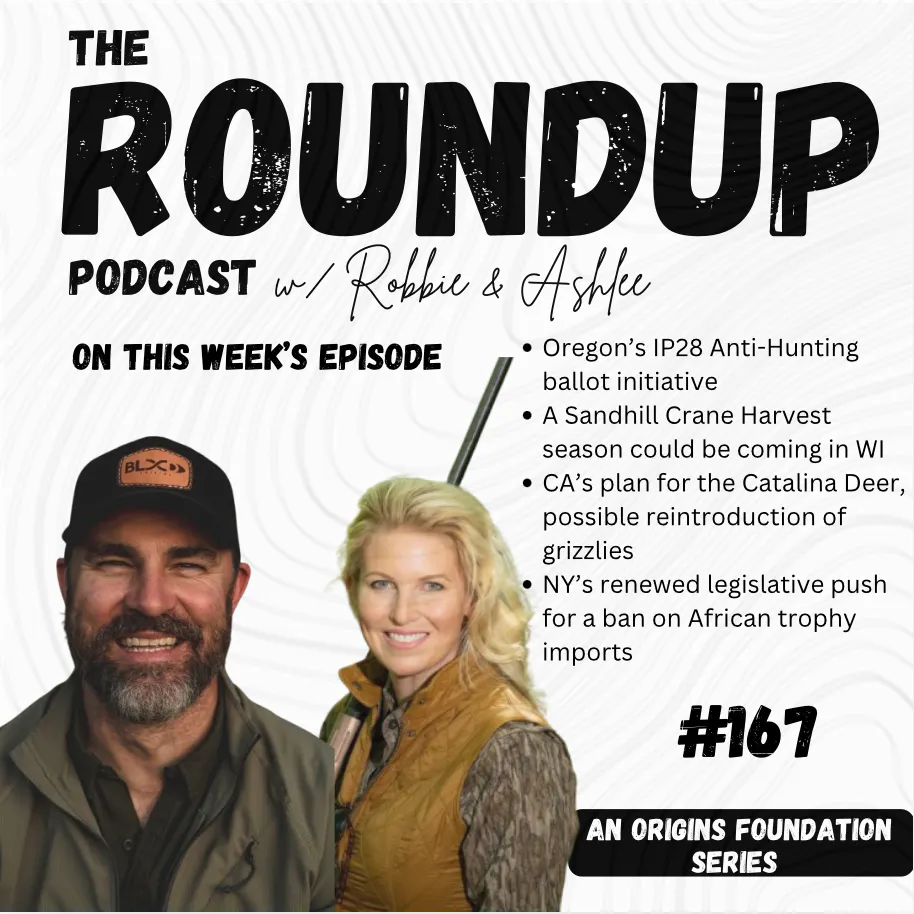
The Origins Foundation Podcast
Roundup 167 || Oregon’s IP28, Sandhill Cranes in WI, CA’s Catalina Deer, NY’s African Trophy Ban and more!
00:45:26
As Robbie prepares to jump on a flight to South Africa, he and Ashlee visit about the EXTREME anti-hunting and farming ballot initiative push in Oregon IP28, a Sandhill crane harvest bill that just passed the Wisconsin House and is headed to the Senate, a renewed legislative push in NY to ban the import of African hunting trophies and California’s attempt to cull all deer or Catalina island by aerial gunning while simultaneously trying to reintroduce grizzlies to the state.
Loading summary
Transcript265 lines
- [00:00]
A
Planning a fishing trip shouldn't feel like a full time job. With fishingbooker.com you can find and book the perfect fishing trip within minutes. FishingBooker.com connects you with trusted fishing captains around the world. Booking is fast, easy and secure with access to verified customer reviews, loyalty rewards and around the clock customer support. Everything you need to book with confidence is in one place. So head to fishingbooker.com and start planning your next fishing fishing adventure today. So five years ago there was a reason why I started this movement. And the truth then is the truth now that we need to champion our narrative. We need to champion the truth around what we do and who we are. There's a sweet spot with a gun, you know, too heavy and it's a burden to walk with. Too light and you whipping it. Why is the project so important to the hunting community?
- [00:55]
B
Who?
- [00:56]
A
I think it's not only important, I think it's vital. I think it's just in time. It's like snakes and ladders. You guys are climbing the ladder and then somebody does something stupid and you just slide down. That is such an amazing analogy. Snakes and ladders. Yeah. You know, ivory in my opinion was the plastic of its age. Okay.
- [01:16]
B
The expenses are going up. It goes a long way with families. We have families that do need it.
- [01:21]
A
Me close this door because I have a little wiener dog. What you. Are you laughing because I said wiener?
- [01:27]
B
I'm really glad you finished the sentence out. I'm sorry the first happened. What are we doing here today?
- [01:34]
A
You're telling the whole world. It's funny. You have that yeti. Show me that yeti again. I literally just went to academy and saw that exact camo Yeti.
- [01:54]
B
Well, I bought it in Memphis in that store.
- [01:59]
A
I don't think I've ever bought a Yeti product period.
- [02:02]
B
Well, you know what I say about this? Maybe somebody gave it to me, I wanted to buy it and then I think my brother or sister in law gave it to me for Christmas. I admired it. What is that store I told you I love so much in Memphis?
- [02:16]
A
Oh, I don't know. I can't remember. Bure or bureau or something like that. I want to say it was bureau B U R E or something like that. Doesn't matter.
- [02:27]
B
Anyway, I had to buy it is the coolest store. It's the best ever.
- [02:31]
A
Blue Yeti cooler. A blue yeti rambler. That 20 ounce rambler that you had had to buy one for South Africans. The South Africans are putting all their shopping orders in three hours before I have to take off to go to South Africa.
- [02:46]
B
Are you carrying them all to them?
- [02:48]
A
Yeah. Colby. Colby, one of our cameramen said, can I send pants to your house? I said, okay, cool. He says, oh, it's arriving on Monday. I said, well, you've got until 3 o' clock and then I'm out. Well, little did I know that he had bought six pairs of pants of the same pants.
- [03:09]
B
Six.
- [03:10]
A
Yeah. He must love that.
- [03:11]
B
Do you have to travel with those?
- [03:13]
A
Yep. I told him, meet me at the airport. I'm offloading off your pants and hats and everything.
- [03:18]
B
Oh, my gosh, that's hilarious. I cannot believe I can't find the store. Anyway, it's blue because I went to Memphis law school. I'm a tiger, and so it's blue camo because I. I really bleed orange. I have a V. I'm a Vol. So I bleed orange. But then I have a little bit of blue mixed in there because I'm a Memphis tiger. That's where my legal prowess comes from.
- [03:44]
A
Yeah, your tiger powers.
- [03:47]
B
Yeah.
- [03:50]
A
Anybody?
- [03:51]
B
So you. Last time we rounded up, I was recovering from the flu, and now this time you are recovering from the flu.
- [03:57]
A
Yes. Yep. I thought I.
- [03:59]
B
Only you did not get it as badly as I did. Either that or you got your zofluza in faster than I did.
- [04:07]
A
Number one. I thought I was doing super well over show season seven weeks. I didn't get sick at all. And then I left SCI on Saturday, so I only started feeling something on Wednesday. Thursday, felt something. I was like, man, if I wake up on Friday not feeling better, I'm going to go get a test for flu. Sure enough, positive for flu. And I've got three days of rest behind me now. I'm feeling pretty good today, and I have to fly 23 hours tonight.
- [04:41]
B
That is not exciting. But the trip is exciting.
- [04:45]
A
Trip is exciting. It's. It's. Honestly, it's. It arguably is the biggest week of our small nonprofit's life since we started.
- [04:58]
B
Explain what you're going to do.
- [05:00]
A
I'm going to present for 30 minutes.
- [05:05]
B
15? You only have 15?
- [05:07]
A
I have 30 minutes.
- [05:08]
B
Oh, 30 minutes. Okay.
- [05:10]
A
And then I'm going to have dinner with everyone, but you can talk a
- [05:13]
B
lot in 30 minutes.
- [05:15]
A
I've got three videos, and they're very sequential videos. And, yeah, I'm not going to let too much out of the bag because this roundup is dropping before I'm actually presenting.
- [05:27]
B
Oh, okay.
- [05:28]
A
So just know that it's.
- [05:30]
B
Can you tell people who you're presenting with? Because it's really cool.
- [05:33]
A
I'm going to tell you. I'm presenting two Bugatti, Bugatti and Bugatti. If you don't know what a Bugatti is, Bugatti is partnership with another company called Rimac and they build the fastest car in the world. They are. Their vehicles are also very, very, very expensive.
- [05:51]
B
And if you make this work, I would very much like to go to the Formula one somewhere.
- [05:59]
A
Are they connected? Is Bugatti and the Formula one connected? I don't think they are.
- [06:03]
B
I mean do you build the faster fastest car on the planet and not go to Formula one?
- [06:10]
A
I'm sure he gets invited because I think I remember Shannon being at the Monaco Grand Prix on a yacht. And mate, the CEO of Bugatti came by and said hello.
- [06:22]
B
So let's see.
- [06:23]
A
Yeah, we're going to be swinging in some of those circles this week.
- [06:27]
B
Yeah, they have a Formula one car, the Bugatti Bolide. Modern track only hypercar.
- [06:34]
A
Yeah, it's not a modern track, it's not a formula.
- [06:37]
B
Oh wait, forming are on par. It's not a sanctioned F1 compet.
- [06:41]
A
Correct. Look guys, I'm a hunter, right? And when I go hunting I like to figure out how to get my trophies back home as expeditiously as possible. Well, you don't have to look much further than Safari Specialty Importers. We know that trophy importation can be quite a headache. That's why Safari Specialty Importer strives to make it as easy and hassle free as possible. They have access to a bonded warehouse. You won't be charged storage fees and and you get a dedicated team that's readily available and will update you at every step in the process. They'll even go one step further. Safari Specialty Importers is working with us and they are going to donate a hundred dollars from every shipment that they work with to conservation projects that include anti poaching, community development and wildlife conservation. At the end of the day, choose to spend your money with a team that's dedicated to you and is dedicated to helping show how hunting is a great conservation model. Hassle free logistics, fuel and conservation go with Safari Specialty importers. It is 2026 and my friends, big changes have happened in the world of firearm suppressors. The $200 tax stamp fee is now gone. Huge win for hunters, huge win for shooters and a huge win for your wallets. If you're thinking about elevating your shooting experience and adding a suppressor, Silence essential is the best way to shop. And you don't even have to get off your couch to do it. Go to silenceessential.com, browse hundreds of suppressor options. They literally have all of the popular makes and models. Then their experts will walk you through setting up your account, creating a free NFA trust, and then submitting your application to the atf. Once approved, Silence Essential ships your new suppressor directly to your door. That's when you're going to have to essentially get off the couch. It's a game changer, guys. You haven't done it yet. Do it. The old days of waiting eight to 10 months on a suppressor are gone. It's more like two weeks. Some have even gotten their suppressors in shorter time frames. It's never been easier to start shooting suppressed. Get started today by visiting silencer central.com it's really the simplest way to get your suppressors. Bushnell is eager to help you get set up for conservation success. That's right. They want to help you. The conservation and research community is dominated by good people doing good things and investing significant time and effort for the benefit of habitat and the species. So what do you need to do? Pretty simple. Send us your conservation story and. Or your conservation wish. Could be managing whitetails. Could be understanding your environment or species or something else related to conservation. What would you be able to do if you had a great trail camera setup? We will select the best story every other month and send you a camera bundle. Cell camera, normal SD camera, SD cards, as well as optics. Everything you need to get set up for success. I can't wait to see what you submit. You can email us, DM us, message us, whatever you want. We are not hard to find. Good luck. Correct.
- [09:51]
B
Okay. Okay.
- [09:53]
A
Yeah.
- [09:53]
B
They were in the F1 Grand Prix in 1956. So what do people just buy them and drive them around and they just. People buy these and drive them around the.
- [10:05]
A
They have rallies. They have rallies all around the world and they send. They fly their vehicles to these different rallies all over the world. And I think that's the. One of the coolest things about this vehicle. It's this super, ultra modern, ultra fast, ultra expensive vehicle that is meant to be driven.
- [10:25]
B
Okay.
- [10:26]
A
Like, I saw a video of one of these vehicles having 176,000 kilometers on the, on the, on the odometer.
- [10:35]
B
That's crazy.
- [10:36]
A
So somebody's driving.
- [10:37]
B
It's crazy every day.
- [10:37]
A
It's the everyday car.
- [10:40]
B
Anyway, well, good luck. I'm excited.
- [10:45]
A
I'll let you know.
- [10:46]
B
I hope you have a nice suit to wear.
- [10:48]
A
I'm not wearing a suit. I'm gonna wear. No, no. Because these guys are coming in from driving all day. It's a super casual, relaxed evening. I'm gonna have a sports coat, collared shirt.
- [11:02]
B
Okay.
- [11:03]
A
Jeans. Chelsea's.
- [11:05]
B
Okay. Okay. The nice sport coat.
- [11:08]
A
Yeah. My nice ones. I actually got some nice. Some better ones. I don't know if you've seen.
- [11:12]
B
I love the one you had on sei.
- [11:15]
A
So am I going gray or purple? That's the only thing. Yeah.
- [11:18]
B
What?
- [11:19]
A
Gray or purple? I think I'm going gray.
- [11:22]
B
Okay, well, either way, we'll send photos,
- [11:26]
A
we'll send videos, and I'm sure we'll see plane.
- [11:30]
B
I'm sure we'll see pictures of your feet in the airplane.
- [11:33]
A
Oh, maybe. Maybe. All right. So did you get anything?
- [11:40]
B
SEI was fun. We haven't rounded up since sei.
- [11:45]
A
SEI was amazing. Was amazing convention. They just are, you know, kicking. They are scoring touchdowns every single year. And this year was just. Just felt even bigger. Even more people, more records being broken, huge hunts being sold. Field ethos. Donald Trump Jr. Keegan McCarthy sold a mountain goat hunt with them in Alaska. They sold two at $400,000 a piece. 800,000 raised.
- [12:19]
B
That is crazy. I could not believe how big it was.
- [12:23]
A
That was your first sci, right?
- [12:25]
B
It was my first wine and it's. It was holy moly, gigantic. So, so huge. And I didn't even get to really walk the floor and take in the full extent of. Because we had so many other meetings and events. And it was just really astonishing at how large of a convention it was.
- [12:48]
A
And they could. They could double their footprint easily. They just can't. There's no room to. Room. There's no room to grow.
- [12:56]
B
And that place is massive. And. And. And I was really impressed with their Hunter Action Fund. I went to the PAC luncheon, and it's one of. One of the largest, if not the largest pack in the country, which is phenomenal that hunters are having that big of a political footprint. So that's their political action committee, and it was filled with elected officials and members of Congress, and a lot of them spoke. And I just love seeing that hunters engage because we know that anti hunters are engaged. So it's great to see hunters engaged on that level.
- [13:37]
A
Yeah, the chapters support SCI big time. In the Hunter, in the. In the pack. Yeah, it was just. It was. It was. It went off on all levels, man. And we had all of the team there. We had Wild Origins India guys there. We had Wild Origins Canada guys there. You were there, I was there. Caitlyn was there. It was a big time.
- [13:55]
B
It was, it was super fun. And you debuted the amazing film in my footsteps.
- [14:03]
A
Did you cry?
- [14:05]
B
I teared up a little. They, I mean, it was so fascinating to watch. I mean, the, the, the footprint that that organization is having, the Amy Bell foundation and the, the impact that they're making on those children's lives in Africa is really unbelievable. I mean, I don't even think. They probably, they probably don't even know that the full impact that they're having.
- [14:29]
A
Oh, no, they don't. Well, that's just a classic point. We don't know what our full impact is hunting writ large.
- [14:38]
B
But if anybody doesn't know what the Amy Bell foundation is, and I did not before we made this film, please go look them up, because they're doing remarkable things and they, they fill bags anytime hunters go over to Africa on safari. They fill, fill bags and take just shoes and clothes and anything you don't need from your house over there and have a wonderful matching program and are providing scholarships to students who not only can't attend university, but just can't attend even grade school. I, I mean, don't have the means to go to. We take it so for granted in America that don't have the means to even attend. I mean, like eighth grade. Ninth grade.
- [15:22]
A
Yeah, yeah.
- [15:23]
B
Give them places to live.
- [15:24]
A
Well, Bongani story specifically in my footsteps. He took us back to the hostel that he grew up, that he went to high school in. And the hostel, he said, actually looked better than it was when he was there. And the hostel we saw, not a single American kid would ever step foot in that. No American adult, family member, parent would let a single, would let their child go into that hostel. Ashley, I'm telling you, it was unbelievably horrendous.
- [15:54]
B
Oh, I believe it.
- [15:55]
A
And there's kids living in there today going to school because that's the only place they get to live.
- [16:01]
B
Right? Don't believe it. We are so, so blessed over here, which is why we should pay it forward and pass it on. And that organization is doing it.
- [16:10]
A
That's it. A little birdie told me somebody was talking about my shooting prowess. Ashley, you have anything to say? Do you have anything to say?
- [16:27]
B
So word on the street has gotten around that you might not be the
- [16:34]
A
best wing shooter, like the world's worst.
- [16:38]
B
And, and I. Well, when you went, when you went duck hunting in December and you told me how many I'll, or I guess how many you didn't shoot. I was a little concerned. And then the next time you went somewhere, it's always something. I was like, what is going on? Listen, you're, like, really bad.
- [17:02]
A
Yes, thank you. Thank you. I appreciate you just, you know, letting me know everything that I know about myself. And as you know, in the. In my footsteps, the CEO of Safari Club International, Laird Hamblin, comes up and goes, hey, I heard quite a vicious rumor about you. I was like, really? What is it? Is it that you're, like, the world's worst wing shooter?
- [17:23]
B
Yeah, I don't think I said that.
- [17:24]
A
Thank you, Ashley. Thank you. No, you did. You did.
- [17:27]
B
I did not say the world's word.
- [17:29]
A
And I said. And I said, that is not a rumor. It's absolutely true.
- [17:35]
B
But you are decent with a rifle, so maybe you just stick to what you know.
- [17:40]
A
If you ask the slots boys, they've seen me miss quite a bit with the rifle, too.
- [17:44]
B
Oh, gosh. That's why we've seen you use a tripod in a bunch of the. The shots I've seen you with.
- [17:50]
A
I want to be confident in where the gun goes.
- [17:54]
B
Just keep practicing. Just keep practicing, Robbie.
- [17:57]
A
Ah. One day.
- [17:58]
B
One day you'll get better. He'll get better. Speaking of being able to wing shoot, big bill we've been watching Wisconsin House bill, or assembly, they call it Assembly Bill 117 to legalize a sandhill crane harvest season has passed the House in Wisconsin.
- [18:20]
A
So what are the chances of it passing the Senate?
- [18:24]
B
So I hope. Good.
- [18:32]
A
Now let's ask, would they come back with amendments or they just wouldn't pass. And if it doesn't pass their union bill, they.
- [18:38]
B
They have their own bill. So, I mean, look, nobody really gave this a. A huge no.
- [18:46]
A
I thought we weren't even going to get it through anywhere to start.
- [18:50]
B
Yeah. So it. It's. I was kind of surprised that it passed. So I. I attribute that to really good on the ground education and advocacy. There's a lot of groups up there trying to educate folks, especially in the legislature, on how much the sandhill crane has recovered up there. I mean, I think it is quadruple the levels that the Fish and Wildlife Service said it needed to reach to have reached a level that could sustain a harvest season.
- [19:26]
A
Bha, Delta Waterfowl, Wisconsin Wild Waterfowl association, sci, Congressional Sportsman's Foundation, Ducks Unlimited, Everybody is behind this regulated sandhill crane season. Pretty amazing.
- [19:42]
B
Yeah. And I think. I mean, I don't have a crystal ball, but since the Senate has its own companion bill, and since the Senate is mostly Republican, the majority is Republican, it passed along party lines in the House. So I would probably wager that it is going to pass the Senate. It doesn't have a huge margin, But Republicans hold 18 of the 33 seats. So I think there's a really good chance that. That it will pass the Senate as well.
- [20:17]
A
Wow. Wow. Big stuff. Big stuff.
- [20:21]
B
So that's exciting.
- [20:22]
A
Ashley, have we received any text messages?
- [20:27]
B
We have. I think I sent you. Okay. I'm gonna have to go in the other room, though, to read them. I sent you the only one we got.
- [20:36]
A
Oh. So if you want to text us.
- [20:38]
B
Charging in the other room.
- [20:39]
A
601-790-0607 if you want to text us, you can also leave a voice note. Let me find what you sent me.
- [20:46]
B
It's probably worth noting about Wisconsin that the governor is a Democrat, but hopefully he would still sign this bill if enough people reach out and pledge their support.
- [21:00]
A
Yeah, yeah, yeah, yeah. I don't see anything from you, but I do see. And we'll talk about this later. Maybe as IP28, you sent me a question from someone on our list about who, where they can donate on IP28. Was it something else from a text message that you think you're talking about?
- [21:20]
B
Google voice. This was a week or so ago. It's the last roundup. Yeah.
- [21:25]
A
Oh, okay. Okay.
- [21:27]
B
Not. Not anything really. Probably specific. Just somebody being very nice. Keep up the good work and some suggestions for future topics.
- [21:35]
A
Oh, yes, yes, yes. Amazing, Amazing. So if you do want to reach out to us again, that Google number is easy. 601-790-0607 if you have any guests that we should talk about, if there's any topics we should talk about. If you want to hear about me crushing Ashley on black bear hunting, bring it up again. Love to do that.
- [21:57]
B
Wait, you mean the topic of black bear hunting, not actual black bear hunt?
- [22:01]
A
Oh, no, no. I'm terrible at that too. Terrible.
- [22:03]
B
I was gonna say considering. Considering our gun skills. I think we probably know who would crush you. Although you would be sitting. You would have your bear sitting over a pile of donuts, and mine would be. I would be free chasing mine through the woods.
- [22:14]
A
Do you want to start this again? You want to start this again?
- [22:17]
B
I don't, I don't, I don't. I don't do. Like. You want to talk about New York.
- [22:24]
A
Yeah, yeah. So I want to look at. I'm going to just bring it up quickly. So every year for the last four years at least if not five years. There has been a big five African Trophies act this year. It's Senate Bill 5014 and interestingly enough, 5014. 5014. Here's what's cool about what we do, people.
- [22:58]
B
And it has passed the Senate, by the way.
- [23:03]
A
Okay, I didn't know that it passed the Senate.
- [23:05]
B
It has. It has passed the Senate.
- [23:07]
A
The bill passed the Senate Environmental Conservation Committee in February of 2026. You sure it's past the Senate? Anyway, just know that it's slowly moving forward. It has every year and at the last moment, it always fails. And if you Google right now, New York trophy hunting bill, on the right hand side, there is a Facebook post by Safari Club International saying the New York State Senate voted in favor of an African trophy bill. April 9, 2025. That video is our video. That's pretty cool.
- [23:46]
B
It passed the Senate last year. Passed this full Senate last year.
- [23:49]
A
Yes.
- [23:50]
B
And now it's on its third reading. Third reading in the Senate.
- [23:53]
A
Yep. It's been going and going and everything.
- [23:56]
B
It's about to pass the Senate. It's about to pass the Senate.
- [24:01]
A
So it's just, again, it's the classic scenario where these states are playing neocolonialists, thinking that they can dictate to African countries or other nations or other countries what they should be doing with their resources. They can't affect a hunting ban, so they're going after the trophies that are imported into the state. In the past, just like that video I talked about, we have brought African leaders to the table and they have sent letters. That's probably going to happen again this year as a coalition letter of African leaders will be sent to the New York House or Senate or the speaker to say, guys, why are you doing this to us? Again and again and again. Now let's just play devil's advocate for a second. And it passes the Senate, passes the House and goes to the New York Governor for signature. SEI in the past, this happened in Connecticut, sent a very strong letter to the governor of the state of Connecticut to say if you pass this, we're going to sue you because you're really usurping federal law here, which is esa.
- [25:07]
B
Right.
- [25:08]
A
And then cites aside, is an esa. Yeah. But every year.
- [25:14]
B
Yeah, there's a lot of interplay between federal and state federalism issues. And I mean, it's largely a symbolic bill, but so far it's a precedence bill.
- [25:26]
A
That's the problem. It's a precedence bill.
- [25:30]
B
Yeah, yeah, yeah, yeah. We don't want other states to follow though.
- [25:35]
A
No, no. And other countries too, you know, so we'll keep an eye on that. We'll probably say something about it as it starts moving forward. But it's just, it's your classic, classic classics tactic. So. And it's the same dude every single time that brings it up. Is that Sepulveda in the Senate and 10 co sponsors. I know, it's always the same people. It's like they forget about what we did last year and they're like, oh yeah, we'll co sponsor that.
- [26:12]
B
Well, you tend to see these same types of bills over and over and over and over.
- [26:16]
A
I wish it would just die. I wish these things would just at the end of the day just die. I wish there was a way legally
- [26:22]
B
to like guys, double jeopardy.
- [26:25]
A
Yeah.
- [26:26]
B
Once you're dead, you're dead no more. You only get one shot. Yeah, but then that would apply to our stuff too. Well, we don't want only one shot.
- [26:41]
A
Oh boy.
- [26:42]
B
But I mean, speaking of crazy Looney Tune bills, and I wouldn't even put this one like I. This is such a small. That that bill affects such a small microcosm of hunters and it's grossly unfair, arguably unconstitutional. It's a terrible bill. But this other thing that we've been talking about and have posted about on social media, the Oregon attempt, IP28.
- [27:11]
A
Well, it's not a bill. Right. It's a, it's a.
- [27:14]
B
No, it's a, it's right. It's an attempt to have, it's a referendum, right. To have a ballot box initiative where the voters themselves place something on the ballot.
- [27:26]
A
Dude, how can that, how can that pass?
- [27:29]
B
And well, here is how. Here is how. Because they are misrepresenting to the public when asking them to sign what the statute would do. So what they are presenting to the public and even so the draft. So what they do is they take the whole entire language and they summarize it. And even the summary of the bill that's out there does not convey what the bill will actually do. I mean it's a one paragraph little thing and it just, it really reads like it's an anti animal cruelty bill because this would amend the anti cruelty statutes which have all of these exceptions written into them. And what they are telling people, they show them this little paragraph and they say, hey, this is an anti cruelty bill. We're just, there's all these exceptions. They don't tell them what they are or the practical implications of them. And they say we are just extending more protection to Animals. Um, you know, and making it harder and more difficult for people to perpetuate animal cruelty. And. And then, hey, I mean, you can imagine walking around a college campus or, you know, especially young people that don't read. And I mean, think about people dressed like cats and dogs. Like, hey, here's. We're putting an anti animal cruelty petition on the ballot, so sign this. And they're like, okay, great. Meanwhile, they don't tell them that it would affect so much more, so much more than just.
- [29:11]
A
It'll affect somebody trapping a mouse and a rat in a restaurant.
- [29:16]
B
Pest control. Absolutely. Absolutely. You. You will no longer be able to engage in pest control. You will no longer be able to have chicken farms that. Not even chicken farms that kill chickens to eat the chickens, but chicken farms that produce eggs. Arguably, you can't artificially inseminate animals.
- [29:37]
A
I'm sure that it's still there. That artificial insemination was going to be classified as sexual abuse.
- [29:44]
B
Yes, 100%. You cannot artificially inseminate animals. You could not. If somebody had an unwanted litter of puppies, you could not abort those puppies. Now, you could abort your human child, but you could not in Oregon. But you could not abort puppies. Or you couldn't. You could not dart a horse to sterilize it. You couldn't perpetuate, I guess, can.
- [30:10]
A
What about. What about, like, spaying. Spaying dogs and cats and stuff like that?
- [30:17]
B
Nope. I mean, it's just. It is just like, it would literally, like, Oregon would immediately be overrun with dogs, cats, mice. I don't know if they have mosquitoes up there.
- [30:34]
A
Like, business. How would business operate? There would be no business. How would they enforce it?
- [30:39]
B
This would be something like that. Well, like Snake River Farms, I think probably a lot of people order Snake River Farms Beef. It's super famous beef from Oregon. Just think of, like, the salmon. I mean, no more salmon fishing. The famous salmon that you get from Oregon, what is that river that the Columbia people order? What?
- [31:04]
A
The Columbia. The Columbia's on the state line between Oregon and Washington state. You can catch massive, massive, massive river sturgeon. I guess you can't catch those anymore.
- [31:14]
B
No, it's just the most asinine. But what it really is, it's a testament to the dissemination of misinformation.
- [31:27]
A
Yep.
- [31:28]
B
And so now that they have over 100,000 signatures, they only have to get 117,000. I think 174 is the number. I might be off on the 174, but it's a little over 117 by July 2nd. So they have plenty of. They're going to get their signatures. I mean that's like nothing. They'll pay people to get them. Probably it will be on the ballot. And so now everyone has suddenly woken up, including us. I mean, I completely admit to have been caught unaware of this.
- [32:02]
A
We've been following it for years. It used to be IP3, it used to be IP13. They couldn't get the signatures. So I guess they've just reinvented what that little paragraph looks like and gotten some money obviously with paid individuals.
- [32:19]
B
Yeah, the only exceptions. Yep, the only exception. So what they do now for these ballot initiatives is they have these paid companies.
- [32:28]
A
Oh yeah.
- [32:28]
B
And it's, they operate all over the country in every.
- [32:30]
A
The same thing in Colorado. Three bucks a signature, five bucks a signature. Yep.
- [32:34]
B
Yeah.
- [32:35]
A
Yeah.
- [32:35]
B
And they go and they canvas and they pay people for their signatures and they're very, very good. And the problem is when you're usually they're on the side of trying to get something passed, not on the side of trying to stop something. You know, I mean these, these animal welfare groups have billions of dollars and they pour it into these things.
- [33:06]
A
Yeah, it'll be interesting.
- [33:08]
B
It's hard to fight it. It's hard to fight it because you're fighting billionaires that don't care about the truth. They put out mass amounts of propaganda and it's a very difficult situation and it, and it makes the regular citizens, common sense, law abiding citizens, feel very helpless. So it is a situation where we can't leave the people living in Oregon hanging out to drive by themselves. Like we really have to mobilize the entire country to try to help them and try to at least help with the information side.
- [33:40]
A
Well, there'll be a big, I mean
- [33:41]
B
there should be, but we can spread the word.
- [33:44]
A
There should be a big sector of the agriculture. Like farm bureaus should absolutely like put their full mic behind this. You would think.
- [33:52]
B
100%. 100%. And I think that they are starting to mobilize as well. Well, but I mean this really has
- [33:59]
A
reason to spend any money right now because there's no point right now they're going to get the signatures. It's like Colorado, the, the whole emphasis is August through to D Day.
- [34:12]
B
Well, I think, I don't think it's ever too early to start spending money against it. I mean we know it's going to pass. So I mean I would arguably, if I were a farm bureau, I would start running those ads now. Defeat It. Defeat it. Defeat it. Defeat it. Vote no. Vote no. Vote no. Vote no. Why wait?
- [34:30]
A
It's gonna be an interesting year. It's gonna be an interesting year.
- [34:36]
B
This is crazier than. I think this is crazier than anything we have seen. Any ballot initiative. We've seen. Oh, crazier than the fur ban in Colorado, but, you know, way crazier than the lion hunting band. Like, all the stuff we've seen has been bad. We've seen bad stuff. But this is the worst of the worst, most extreme.
- [34:57]
A
It's the most extreme. That's exactly what I was going to say. It's the most extreme, something that we've seen.
- [35:06]
B
It's shocking that it's going to be on the ballot. Shocking. Well, guess what, guys? I, If, I mean, if this passes, I. There's going to be a. I would be hitting the road and moving out of Oregon.
- [35:22]
A
She's. Could you imagine? Like, what about that? Like Oregon wine growers, like, in the pest control that they have to do. Like any industry that has big pest control.
- [35:36]
B
I know. I don't know. I don't know if it applies to insects or not because I don't know if their animal cruelty laws affect bugs. I have not looked into that.
- [35:47]
A
No, but they would be doing. They would. They would do some rodent control, you know?
- [35:52]
B
Yeah, yeah. I mean, I'm sure it affects putting up live wires to keep deer out from eating the vines.
- [36:02]
A
Yep.
- [36:04]
B
The only two exceptions are veterinary care. So. So spay and neuter, depending on. Yeah, it. Well, but is that considered voluntary? I mean, is it. Is it veterinary care in all situations?
- [36:19]
A
I guess we gotta ask the dog and the cat.
- [36:21]
B
Is that like elective surgery? Right. Like, do you.
- [36:24]
A
Do we have to ask the dog and the cat under this new rule?
- [36:27]
B
Because, you know, in the horse. Horse advocacy world, their argument is that horse doesn't want to have their ovaries taken. They don't want to be. They don't call it spade in the
- [36:39]
A
horse world, but I don't know what horse they're talking to. I've never talked. Have you ever talked to a horse? I guess you might have talked to a horse, but you never heard a response back from a horse.
- [36:50]
B
I do actually talk to the donkeys,
- [36:52]
A
but they do not talk back.
- [36:54]
B
I can't understand what they're saying back.
- [37:00]
A
Well, what else is going on? Catalina. Catalina, California grizzlies. California.
- [37:06]
B
Yeah, California. They're trying to kill all their deer. Kill all their deer on Catalina. But import and reintroduce. Grizzlies makes a whole lot of sense.
- [37:19]
A
Like, nah, it's just like, it's the same situation as Colorado. Like, bring the wolves back. Okay, look, I get it. I get the fact that having an apex print on the landscape is a cool idea. Okay, why?
- [37:34]
B
I mean, like, no, I think, you
- [37:36]
A
know, from our ecological perspective, like, filling all the niches in the ecosystem. I get it, but I also get.
- [37:44]
B
Unless you're a ranger.
- [37:45]
A
Yeah, but you can't rewind the clock, right? We're not going back to the 1700s. There's lots of people in the landscape. There's lots of roads. There's lots of train tracks. There's lots of everything. So it's just.
- [37:56]
B
That's the thing with California. It is so highly populated. Like, where. I mean, I assume they're just trying to reintroduce them to the northern part of California, but, like, I don't think they're checking with people to say, hey, how are you guys in this county? Are you all okay with it here?
- [38:16]
A
No. 100%. And look, there's grizzlies, you know, a couple of hundred miles, if not less than that, if not already brushing with the California line, that will naturally go there if it's right for them and the habitat's right for them and they'll go there. There's no reason to push the envelope of like, oh, we have to do this. You don't. You don't have to do that.
- [38:40]
B
What's the latest on the Catalina situation? Are they. Is everything under. Is it public comment right now, or is it.
- [38:49]
A
Oh, no, there's no public comment needed because of the serp. The way that they created the legislature, they were so smart politically. The. The lady who was their lobbyist put forward a. A piece of legislation called the serp, which is. I don't know what the S or the C stands for. California, Sorry, California Environmental Restoration Plan. I think that's what it's called. Well, what the SERP does is it allows you to bypass the whole public comment process. It's like, I can just do. If I've got a restoration plan that I submit to you, cdfw, I can do whatever I want on my property and with full intent that that was the route that Catalina island was going to take. It was.
- [39:43]
B
And cdfw, we think, took it because there are such major donors from Catalina or no CDFWs.
- [39:50]
A
They have to. They have to. Like, it's. Because it was passed in the legislature. It wasn't passed in the commission. It's passed in legislature. So the SERP is the serp. So anyway, there's a little. There's a lot of groups coming together to decide, like, what the next steps are legally. The whole, pretty much the entire island of Catalina island is up in arms and controversy and the city council is, is making moves.
- [40:17]
B
Has anyone sued to get an injunction to stop it?
- [40:22]
A
I think that there is probably on the horizon for sure. Yeah.
- [40:29]
B
So it's not a done deal.
- [40:32]
A
No, it's not. And look, to be honest, when the helicopters start flying, they start gunning deer, I think it'll be even. You could imagine the social media virality that will happen, how people are going
- [40:44]
B
to lose their minds.
- [40:46]
A
Yep, yep. Yeah, it's just, it's a, you know, Charles and Hal for Wildlife have done such an amazing job. Can you hear that buzzing? Oh, your lawn is being cut. All good, all good. We're nearly done. We're nearly done anyway. But yeah, so Catalina, there's so much happening. Charles, for Whitwam at half a Wildlife is just on a yeoman's job, put a great documentary together. If you haven't seen the documentary Killing Catalina, it's at like 170,000 views right now. Just. We, I don't know if you know this or not, but we paid for the documentary.
- [41:31]
B
Yes, I did. And, yeah, and it's, it's really great. He's, he's done an amazing job.
- [41:37]
A
Yeah, we're happy to support Charles in that kind of work that he does. So, yeah, you know, we'll see. We'll see. You know, this thing is changing week to week to week. So next week on the Roundup, we'll actually have Charles Whitwam on the Roundup. And we'll obviously be talking a lot about Catalina this time next week. So check back in definitely next week on that, and I'll give you an update on what I actually did in South Africa and what it was for.
- [42:05]
B
We will also let everyone know whether the mandatory harvest check, deer harvest check reporting bill comes out of Mississippi. This is going before the Senate committee this afternoon. It already passed the House, of course, the only state in the country that doesn't have it. And whether the House passes the Senate bear harvest bill, two bills we've been watching.
- [42:30]
A
When is the due date for those?
- [42:33]
B
So committee deadline is, I believe, later this week.
- [42:41]
A
And that is the deadline for it coming out of committee.
- [42:50]
B
General Bill's other changer is March 3rd. Yeah.
- [42:56]
A
Okay.
- [42:56]
B
They have to, they.
- [42:57]
A
So everything has to be out of committee by March 3rd.
- [43:01]
B
By March 3rd.
- [43:02]
A
So yesterday.
- [43:04]
B
Yesterday. Right, right. We're recording early Monday.
- [43:09]
A
So tomorrow. Yeah, but yesterday, when you're listening to this, I know it's confusing.
- [43:15]
B
Sorry, guys. One day we might be live. We should.
- [43:18]
A
One day.
- [43:19]
B
I mean, I don't think we edit anything out.
- [43:21]
A
Not only when you say some crazy things that you tell me to edit out.
- [43:27]
B
That never happens.
- [43:28]
A
Always in the beginning. Always in the beginning. You're like, oh, have you started recording already?
- [43:33]
B
Oh, but I thought you left that stuff in.
- [43:35]
A
I do.
- [43:37]
B
Okay. That's what I thought. Should have more things like dogs barking and vacuums running.
- [43:43]
A
Yeah. If I'd started recording earlier today, everyone would have.
- [43:46]
B
Everyone would have seen you going up and down in your chair. They did miss that.
- [43:51]
A
And you eating M and Ms. Yep.
- [43:53]
B
M and Ms.
- [43:55]
A
Anything else?
- [43:56]
B
Have an amazing trip. I hope you feel better and better and better. Can't wait to hear about it.
- [44:02]
A
I'll let you know. You'll be one of the first to know.
- [44:06]
B
All right, everyone, pass the word about Oregon craziness, please.
- [44:10]
A
Craziness. Ciao.
- [44:12]
B
Bye.
- [44:13]
A
Well, that's it for today. I appreciate you listening. As always, leave a review, share it with your friends, and most importantly, do what's right to convey the truth around hunting.