← The Origins Foundation Podcast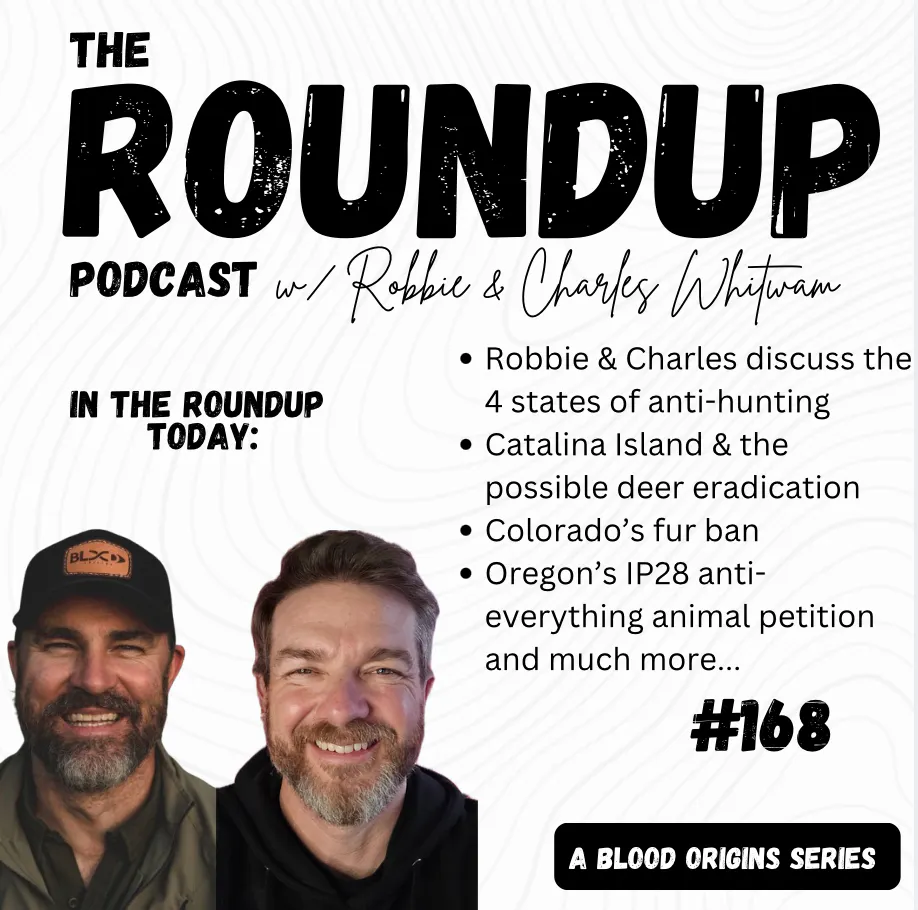
The Origins Foundation Podcast
Roundup 168 || The 3 stepchildren of anti-hunting: California, Colorado, and Oregon
00:47:17
While Ashlee is on Spring Break down in Florida, Robbie grabs Charles Whitwam from Howl for Wildlife to sub-in. Charles and Robbie naturally discuss the 4 step-children of the anti-use, anti-hunting community right now - which is California, Washington State, Colorado, and Oregon. Robbie and Charles give an update to where things stand with Catalina Island and the possible deer eradication by the Catalina Island Conservancy, they discuss the insanity that ensued from the Colorado Parks and Willdife Commission meeting about the fur ban, talk about the nonsensicalness of Oregon's IP28 anti-everything animal petition, and much more.
Loading summary
Transcript235 lines
- [00:03]
A
So five years ago, there was a reason why I started this movement. And the truth then is the truth now that we need to champion our narrative. We need to champion the truth around what we do and who we are.
- [00:15]
B
There's a sweet spot with a gun,
- [00:16]
A
you know, too heavy and it's a
- [00:18]
B
burden to walk with. Too light and you whipping it.
- [00:22]
A
Why is the project so important to the hunting community? It's. It's a. I think it's not only important. I think it's. I think it's vital.
- [00:29]
B
I think it's. It's just in time.
- [00:31]
A
It's like snakes and ladders. You guys are climbing the ladder and then somebody does something stupid and you just slide that. That is such an amazing analogy. Snakes and ladders.
- [00:41]
B
Yeah.
- [00:41]
A
You know, ivory, in my opinion, was the plastic of its age. Okay.
- [00:46]
B
The expenses are going up. It goes a long way with families. We have families that do need it.
- [00:51]
A
Let me close this door because I have a little wiener dog. What are you laughing because I said wiener?
- [00:57]
B
I'm really glad you finished the sentence out.
- [01:00]
A
I'm sorry the first happened. What are we doing here today? All right, so Ashley is not here today. And who we have with us is a replacement of for Ashley. A great replacement. Ashley's on family vacation this week. But there's no other person right now that is more up to date with the news in our hunting world than Charles Whitwam.
- [01:47]
B
Hello. That was. That was really generous and a lie, but yeah, thank you. How you doing?
- [01:54]
A
Yeah, thank you for coming. I'm good, dude, I'm good. I'm back from South Africa, everyone. Last week on the Roundup heard that I went to South Africa. I went to South Africa. I came back. It was the lowest of lows, as I was telling you before, and the highest of highs. We met some good people, got into some good networks, got put in front of Bugatti, which is a very high end vehicle in this world. Made in France. Got to meet the CEO. I gifted the CEO some cheetah cufflinks, some silver cheetah cufflinks that I bought from Patrick Mavros. He was very stoked with those cheetah cufflinks. And we started the relationship of potentially doing a partnership in the future. So all in all, three days on the ground, three days flying and sitting in airports and whatnot. What's a cheetah?
- [02:41]
B
What's a cheetah cufflink? What is that?
- [02:44]
A
A cuff? Well, you know what? A cuff.
- [02:45]
B
Yeah. What's a what? What is the what's the cheetah has
- [02:50]
A
a, it's, it's a silver cufflink and on the, on the outside of the cufflink where the design typically is of every cufflink.
- [02:56]
B
It's just a design of a cheetah. Okay, okay. Yeah, yeah.
- [02:58]
A
Design of a cheetah. It's really cool. Really cool. I was gifted one a pair and I was like man, this is the perfect gift for.
- [03:05]
B
Yeah.
- [03:06]
A
A CEO of a multi million, if not billion dollar company.
- [03:10]
B
Yeah, certainly that's a no. Wow.
- [03:15]
A
Unbelievable. Unbelievable.
- [03:17]
B
I just got back from guiding, I was guiding this weekend so I got back early this morning and what's early this morning?
- [03:25]
A
Like 1am in the morning? Yeah. And what are we guiding right now? Pigs.
- [03:31]
B
Wild pigs.
- [03:33]
A
Wild pigs. Are they good eating pigs in California?
- [03:37]
B
I think, I think they're the best if you were to compare them to any other state because our habitat here with just all the grass and acorns and all the habitat is just great.
- [03:49]
A
They're good, Good fat caps.
- [03:50]
B
Oh yeah, very good. And they're fat. You leave that on the meat. It's very good.
- [03:57]
A
Yeah, yeah, yeah. My kids, we used to make pork chops or out of pigs out of Texas with big fat caps, corn fed fat caps. I'm telling you what those pork chops, best pork chops I've ever eaten.
- [04:09]
B
Well they have, they have real flavor to them. You know I like pork, I like domestic pork but I, I, I really, I prefer wild pork. I really do. A hundred percent.
- [04:20]
A
Those ribs also doing them. The ribs are three, two, one. Like three hours of smoking, two hours basting. Man. My kids used to make, the oldest one used to make a wild pig rib graveyard in front of his plate. Just piles of bones.
- [04:34]
B
Yeah, that's good stuff. So we got two had some guys from Utah and some guys from Wyoming. Well one guy was from Wyoming, one was from Tennessee and the other father, son was from Utah.
- [04:50]
A
Both guns, archery, everything.
- [04:53]
B
It was all guns.
- [04:54]
A
Yeah, all guns. Okay. And you and everyone was successful.
- [04:58]
B
One guy did not get a shot. The guy's young son, he's like 12, 14. He did not get a shot. But, but everybody else did.
- [05:07]
A
Just did not see a pig or did not get on it quick enough?
- [05:11]
B
Both. Well, yeah, I didn't get it on it quick enough. Yeah. And then, and then we couldn't find any more after that. It's harder. It's in the winter. I like hunting in the winter because it's, it's comfortable for the hunters. It's not 115 degrees outside. But there's food and water everywhere. The pigs don't have to move much. Um, and we're in the coastal mountains, so it's not, it's, it's just, it's pretty rough. I mean it's, it's, it's very steep. And you have to go find the pigs. They're not moving very much. They don't have to. There's water everywhere. So a lot of hiking. And then finally, you know, you come up on, you're not seeing pigs, you're not seeing pigs. Then finally, oh, there's 15 over here. We finally found them. We had to go six miles, but we found them.
- [05:58]
A
Jeez, that's hectic pig hunting, man. Look, guys, I'm a hunter, right? And when I go hunting, I like to figure out how to get my trophies back home as expeditiously as possible. Well, you don't have to look much further than Safari Specialty Importers. We know that trophy importation can be quite a headache. That's why Safari Specialty Importer strives to make it as easy and hassle free as possible. They have access to a bonded warehouse. You won't be charged storage fees and you get a dedicated team that's readily available and will update you at every step in the process. They'll even go one step further. Safari Specialty Importers is working with us and, and they are going to donate $100 from every shipment that they work with to conservation projects that include anti poaching, community development and wildlife conservation. At the end of the day, choose to spend your money with a team that's dedicated to you and is dedicated to helping show how hunting is a great conservation model. Hassle free logistics, fuel and conservation go with Safari Specialty importers. Importance. It is 2026 and my friends, big changes have happened in the world of firearm suppressors. The $200 tax stamp fee is now gone. Huge win for hunters, huge win for shooters, and a huge win for your wallets. If you're thinking about elevating your shooting experience and adding a suppressor, Silence Essential is the best way to shop. And you don't even have to get off your couch to do it. Go to silenceessential.com Browse hundreds of suppressor options. They literally have all of the popular makes and models. Then their experts will walk you through setting up your account, creating a free NFA trust, and then submitting your application to the atf. Once approved, Silence Essential ships your new suppressor directly to your door. That's when you're going to have to Essentially get off the couch. It's a game changer, guys. You haven't done it yet. Do it. The old days of waiting eight to 10 months on a suppressor are gone. It's more like two weeks. Some have even gotten their suppressors in shorter timeframes. It's never been easier to start shooting suppressed. Get started today by visiting silencer central.com. it's really the simplest way to get your suppressors. Bushnell is eager to help you get set up for conservation success. That's right. They want to help you. The conservation and research community is dominated by good people doing good things and, and investing significant time and effort for the benefit of habitat and the species. So what do you need to do? Pretty simple. Send us your conservation story and. Or your conservation wish. Could be managing whitetails, could be understanding your environment or species or something else related to conservation. What would you be able to do if you had a great trail camera setup? We will select the best story every other month and sends you a camera bundle. Cell camera, normal SD camera, SD cards, as well as optics. Everything you need to get set up for success. I can't wait to see what you submit. You can email us, DM us, message us whatever you want. We are not hard to find. Good luck.
- [09:11]
B
Yeah, but it's so much fun. It's, it's, it's definite. When people think pig hunting, they think Texas or they think even, you know, central California and the barley fields.
- [09:22]
A
Sitting up on a, on a, on a feeder and just wait for those pigs to come in.
- [09:25]
B
This is like spot and stalking bear. It would be like that. And it's kind of the same thing.
- [09:34]
A
Any bear on that property? There are.
- [09:36]
B
There's a few on that property. The property we have north of there has a lot of bear, a lot more bear, but there's a few bear there. Lions. We did see a lion.
- [09:46]
A
What?
- [09:46]
B
There's a lot of lions there. Yeah.
- [09:49]
A
Hey, talking about bears and lions, did you hear about. And since this is the roundup, we talk about current events on the roundup and if you have any current events, you can Google us. Google us? Did I say Google us? You can text us at our Google number. 6017-906076-01790-607. I just saw something from the American Bear foundation about an Arizona bill.
- [10:16]
B
Yeah.
- [10:17]
A
Want to make bears and mountain lions like coyotes. Open season. What the heck?
- [10:23]
B
So I called John Kolizar on that on Friday to ask him, you know, does this have any legs? It's Going to committee tomorrow. If it gets out of committee, then. Then yeah, we'll get involved. I don't know a whole bunch about it besides what you just said, but yeah, it would. It would reclassify bears and lions and, you know, to, to just a predatory species like a coyote, I believe. And, and I don't know who is pushing this. I don't know. I imagine this is coming from the hunting side.
- [10:56]
A
It's got to be coming from the. What you think?
- [10:59]
B
Well, what would. I. I don't. I don't know. Why would.
- [11:03]
A
Yeah, you're right.
- [11:04]
B
Why would. It almost seems like a Utah move.
- [11:11]
A
Yeah.
- [11:12]
B
Yeah. True, true. So I don't know a whole bunch about it, but if it, if it does, I'm going to do some research today goes to committee tomorrow, a Senate committee tomorrow. If it gets out of there, then it goes to the Senate and then. And then I guess we have to get serious about it. So.
- [11:29]
A
Yeah, man, that just literally popped up right now. It's everything. Do you think we've had a quieter legislative season thus far than normal legislative? Legislative. Not like commission craziness. Yeah. Like New York's got that trophy hunting bill right now. Like it has every single year. Every year. Now this HB 2158. Are there any other, like, bills that we are like. I haven't. I, I don't. I can't think of anything right now.
- [12:04]
B
Not a whole bunch that, that, that come to mind that are big. Except. Except for some right to hunt and fish. You know, some bills in. What is it, New Hampshire.
- [12:15]
A
Okay.
- [12:16]
B
That BHA is, is pushing really hard on. So that's. That's awesome.
- [12:21]
A
Oh, there is, there's this also. The sandhill crane hunting.
- [12:23]
B
Yeah.
- [12:24]
A
That came out of Wisconsin. We were following that last week.
- [12:26]
B
Y.
- [12:26]
A
That did pass the House. And so I have to. Actually typically sends me all these alerts and whatnot, but it's in the Senate right now and it could pass the Senate, man. Be huge. Yeah, we thought we would. That. That actually had no legs. But again, backcountry hunters and anglers are on board with that. Bunch of sportsman's groups on board with it.
- [12:45]
B
Yep.
- [12:46]
A
So who knows? Hopefully, fingers crossed.
- [12:49]
B
No, there's some. There's some good pro hunting bills happening and I'm. And I'm still kind of waiting on what's going on with Ohio because they've. They've got a right to hun and fish, but they're. They're working behind the scenes right now, so we'll see if that's going to get.
- [13:03]
A
That hasn't come up for, hasn't been put up on a committee or anything like that, has it?
- [13:08]
B
It's. Yeah, it's in the legislature. We're just not sure if it's going to go anywhere. If this is the year, I'm, I'm waiting probably today. I should know if we need to get involved or not. Just waiting for the green light. So those are great. But no, we've been, you know, we have been focused on. So far. Legislative season isn't over with yet. Right. So we'll see what happens. But we've been focused on commissions and Catalina and all that good stuff. That's what's been taking up my time.
- [13:41]
A
Well, you'll be happy to know that I paid the bill for Catalina.
- [13:46]
B
Oh, for the, for the film.
- [13:48]
A
Yep.
- [13:50]
B
That's awesome. Thank you so much. That's incredible.
- [13:52]
A
Bill is paid, no problems. They should see payment coming through very shortly. So tell us, where are we right now with Catalina? I know that there was a lot of activity, a lot of people talking. There's been a lot of sportsman's groups, calls behind the scenes and potentially we obviously are raising money through a portal right now. If you want to go and raise some money. Obviously Hal has the link. We have the link for Catalina and trying to figure out sort of the next steps from a science perspective, legal perspective, whatnot. Right.
- [14:28]
B
It's basically at the. We got to go to the courts. That's, that's where we, we are at. No one's budging. The department's not going to budge. The Conservancy is not going to budge. There has been a lot more opposition recently in the last week, like official opposition. I guess
- [14:47]
A
one of the official opposes.
- [14:48]
B
Yeah. So not just Janice Hahn, which we know about, she's the LA County Supervisor, but now it was the LA County Council, I think like the entire LA County Council, I think that's what they're called. They officially, along with the LA County Fire Department, wrote a, a letter to the director and the conservancy opposing this and actually claiming that, you know, besides the Conservancy's methods of eradicating all the deer, they're opposed to that. But they're actually saying that they are creating a fire risk now by getting rid of the deer. So they're kind of taking it to, to that level.
- [15:33]
A
It's an interesting, it's. We, we, we have talked about this. It is interesting. There's no doubt that fuel load will increase. You get rid of any browsers or grazers that are on the system. There's no doubt that the fuel load will increase now in an environment like that. Obviously, they're looking to restore. And I would assume, again, I've never been in Catalina, so I'm making a big assumption here. Very few grasses out there, you know, a lot of herbaceous material that typically may not be, you know, it may not be sort of fire stimulants. Let me say that, however, I do know that a California environment is a fire, naturally, a fired. A fire environment. Right. You know it better than I do.
- [16:18]
B
Yeah, it is. It's very. Air. It's. It's a Mediterranean climate.
- [16:23]
A
And fire is a part of that climate. Fire, you know, very much sort of. It. It causes smoke. There's a lot of science that shows smoke and germination of seeds, and you need fire to sort of burn off sort of seed coatings for them to germinate. You need all these kinds of things. Granted, there's a lot of grass out there on Catalina right now because of past historical practices, that grass is just going to go up. There's. There's nothing to take it away.
- [16:50]
B
Yep.
- [16:51]
A
Except if they brought like 10 more bison there. Right.
- [16:55]
B
Or. Or goats. You know, they had goats. Maybe not tens of thousands of goats, but, you know, goats are used all over the state of California, all over the place. You drive down the highways, you see goats. They're fenced in. Let's clean up this area over here. Over here. I mean, all over the place.
- [17:13]
A
Oh, wow.
- [17:13]
B
They're used for fire mitigation everywhere. People have, wow. You know, their entire businesses are renting goats. You know, who needs goats? And here's a herd, Here's a herd. Here's a herd all over the place. You know, they, they could do that on Catalina and they had goats there, but they don't. The argument that I understand, it's very confusing because the conservancy isn't extremely clear on. On their science to me, but I think, I think when. When they are saying the deer are fire risk, they're coming from the angle that if there is a fire, deer prevent the regrowth because deer are browsing, they prevent the regrowth of vegetation. That is fire resilient.
- [17:59]
A
I think fire adapted.
- [18:01]
B
Yep, that's where they're coming from. They've done a terrible job at explaining that, but I believe that's where they are. That's their angle. So when a fire happens, there's deer, and when there's new growth, the browse
- [18:17]
A
pressure on the new growth is where the issue is.
- [18:19]
B
I, I think that's their angle and, but they, they don't say it like that. But from everything I, I've looked at, I'm like, this is what I think they're trying to say.
- [18:32]
A
For those that are not familiar with what Catalina Island Conservancy has, they have a thing called a serp, Right?
- [18:39]
B
Yep.
- [18:40]
A
And what does the SERP allow them to do?
- [18:44]
B
Well, bypassed. I don't know if this is legal or not. I mean, this, we don't know this, but it bypassed the environmental review. It bypassed the, the normal process that you would need to go through to, to conduct a project like this. So they got an exemption to do that. Whereas before the rmp, the restoration management permit, before that existed, they would always. You couldn't, you couldn't get an exemption. You would have to pass scientific.
- [19:21]
A
Is that why the department kept saying you don't have enough? They kept denying.
- [19:25]
B
That's the permit. No science.
- [19:27]
A
No science. No science. We deny the permit because they've been, They've denied the permit like three times, four times over the last 10 years.
- [19:34]
B
Oh, at least. Yeah. The first one that I know of was in 2007. Oh, wow. And then the latest that that was denied was 2023.
- [19:43]
A
Okay.
- [19:44]
B
And then the RNP was passed through legislation and then all of a sudden
- [19:47]
A
it's good to go.
- [19:48]
B
Yeah, yeah. Yep. And then the. So on Friday, I saw this. The LA County Bar association wrote a big letter now to Megan Hurdle, who is the new director of cdfw. She's had nothing to do with this Catalina island issue.
- [20:12]
A
Does she come from internal or is she an external.
- [20:15]
B
External.
- [20:16]
A
Okay.
- [20:18]
B
She's with the Autobond Society and other, a few other organizations. We don't really know much about her yet. I have, I have no opinion of her at all.
- [20:26]
A
Gotcha. Gotcha.
- [20:29]
B
But the Animal Law section of the LA County Bar association wrote a long letter opposing this as well and asking cdfw.
- [20:42]
A
So the pressure is mounting.
- [20:44]
B
Man, I'm just reading it like I'm just getting this. Yeah, yeah. So it's, it's going to take, you know, pressure from a lawsuit to get anything to change or to be re evaluated or, or maybe a full, you know, actually bring it to the courts and have a judge decide. I don't know.
- [21:03]
A
And it's so weird because the entire time we've been saying we're happy to pay for a thermal drone deer population estimate done, get an accurate count. Do we have 800 deer out there. Or 2,132 deer.
- [21:18]
B
Yeah.
- [21:19]
A
And then we've said it from the beginning. If deer number reduction is what you're interested in, which is what they want, but they want eradication. Put a management plan in place that puts certain actions in the queue that will ultimately get to the goal of we only want 100 deer on this island.
- [21:43]
B
Yeah. Just do it right. Do it right. Get the population count. Do the science right. Use the best available science and come up with a management plan that everyone seems to be happy with. Like, if they just did it right. Like, let's. Let's have a management plan. Let's. But first we got to figure out how many deer are there to come up with the management plan.
- [22:03]
A
I think both you and I would say would agree with it. Like, say the island says, we want 250 deer. Here's how we're going to do it, here's the count, and here's how we're going to do it. And we're not going to waste the resource. Cool. Do it.
- [22:16]
B
Yeah. Yeah. The issue becomes if. If we do account and it's, you know, it's over. Overseen by CDFW and it's an accurate count. Let's say there's less than a thousand deer, then I don't know where the conversation goes from there. From there. Because those deer numbers, they're basing the deer numbers on the supposed impacts that the deer are having on the island. If there's less than a thousand deer, I don't know where the conversation goes then. Because that really kind of destroys a lot of the conservancy's argument on this whole thing. Right. But that's. Regardless of that, we don't know what the number is. Let's get the number. Why are we so afraid to get the number? Why do we count 300 deer? Here's what happens. They count 300 deer in a spot survey. And I. I think I haven't made this clear enough because I assume people know what spotlight surveys are. But the way it works is they'll go out for three days, three evenings, three nights with spotlights. They'll count eyes because they reflect right. And they'll count 300 deer. They take that 300 deer and extrapolate that to the size of the island. So when they. When they're claiming there's 2100 deer, they're not out there like, oh, we counted 2100 deer. No, they're counting 300. And then assuming the deer density is equal across the island, they extrapolate that.
- [23:40]
A
Right, right.
- [23:41]
B
And that's where they come up with that number. So the, the hard number, if you can. I mean, spotlight surveys are tough because you don't, you're counting eyeballs. You don't know if it's the same eyeball from what, you don't know if you're counting the same deer. You know, all that. It's, it's, it's tough. I mean, that would be a tough way to go if, if you really wanted to get a. It's just not scientific. It's not accurate. But yeah, it needs to be clear to people. They're not counting 20, 100 deer. They're guessing that they're counting 300, 250 deer and then extrapolating that number.
- [24:14]
A
So when do we think, do we think things are happening? And are we talking weeks away, months away?
- [24:20]
B
I think there will be a press release possibly this week, like the, the litigation, the papers and all that. I think they're getting filed today if they weren't filed on Friday. Okay, so.
- [24:36]
A
Well, stay tuned.
- [24:37]
B
I thought that was going to be a week and a half ago that they were going to do it, but their, their deadline was, is actually this Wednesday, so. Well, they're still gathering since they had more time. They're gathering more information and all that, but they, they should be filing today. If they, if they didn't do it
- [24:53]
A
on Friday, this podcast is going to be dropping on Wednesday. So if you're interested in figuring out, like, what happened, obviously, go to Charles, go to Health or Wildlife. They will probably, we'll probably have something on ours, but keep up to date there.
- [25:06]
B
Yeah.
- [25:08]
A
Keeping along the controversy lines.
- [25:11]
B
Yeah.
- [25:12]
A
Colorado, our next best friend.
- [25:16]
B
That was a rough one.
- [25:17]
A
What the hell?
- [25:18]
B
That was a rough.
- [25:19]
A
What the hell? Like the insanity. Like it is the definition of insanity. The Denver voters of the city of Denver, who probably all of them voted for introduced wolves that also said to us, no, we don't want to ban predator hunting with hounds. Also said at the tune of 60%, no, we don't want a fur band. We don't want Diva Pelt, you know, cowboy hats at the rodeo to be banned or elk hair cattle flies to be banned. And then they went to the commission.
- [25:53]
B
Yeah.
- [25:53]
A
And the commission voted 6 to 4 in favor of doing the statewide, not just in Denver now.
- [26:06]
B
And what happened since then? So since the vote in Denver, which was in 2024, the governor appointed new commissioners that were aligned with the governor, and the governor of Colorado was not pro hunting at all.
- [26:20]
A
Right.
- [26:20]
B
And it's actually, it's actually he's very anti hunting. And to be specific, you know, the governor's husband's very, like, very outspoken anti hunting. So I think that's probably where that influence is coming from. I don't think. I know. I mean, we. We know that's where that's coming from. So. So in the commission meeting, they voted to extend it into rulemaking. So now the department. We don't know what this means. It was a very confusing meeting. The commissioners even said, I think you were on a plane or in South. South Africa. So many of the commissioners said, I don't even know what we're voting on. They were completely confused on what this all meant. It was a real. It was a mess. It was a completely disorganized mess. But they did vote it to push it down the line into rulemaking. What that means, I don't know. The biggest thing that stuck out to me is that the, the proponents, the. The people who wanted to end the sale barter trade of. Of furbearer furs, they were using the North American model to justify this. And that really. That really struck me. I didn't expect that. And so it set me down this rabbit hole of, well, what does the North American model say about it? What is, you know, John Oregon and Shane Mahoney and all of them and like, what does it say about this? And there was a lot to say about it. And the. That's. That's the biggest thing that I was like, I can't believe they're. They're saying this out loud. Because the North American model does not prohibit the sale, barter, or trade of furbearer furs.
- [28:11]
A
But it does prohibit. It does not. It doesn't look for the commercialization of wildlife.
- [28:16]
B
Right.
- [28:18]
A
Is that where they're standing? Is that the lake that they're standing on? This is commercializing wildlife?
- [28:21]
B
That's exactly what they're saying. Yeah.
- [28:23]
A
Oh, yep.
- [28:25]
B
So there it was almost like we were having a conversation that was taking place in the 1870s where they were saying, the market is driving the. The sale of these. The market is driving the harvest of these. Of these animals. Right.
- [28:43]
A
Which. Which market?
- [28:45]
B
A fur market. That's what.
- [28:47]
A
Which market. There's no fur market today.
- [28:49]
B
Right, but that's what, that's what they were saying. And a commissioner, Commissioner Jay Tushton says, you know, he's been. He said he, he's been teaching, he's a professor, wildlife law for 20 years. And, and he said, I can't find Anywhere in history where, you know, the commercialization of, of, of wildlife doesn't decimate that population. And I, oh my God. And he said, and I feel like that's what we're, that's what would happen here. And he was, he was almost putting it in a way like it, like this hasn't existed in Colorado for decades and decades and decades and decades. Like they were just voting on it for the first time. And I'm just going, this is, it was just such a wild conversation. They didn't know what they were talking about. And frankly, when they were bringing up the North American model, they didn't know what they were talking about with regards to the model. So at the end of the day, what happened is the department recommended that the commission denies this petition. And the, and Even the director, McClellan,
- [29:59]
A
right, Lauren McClellan even stood up there and said, deny the petition.
- [30:02]
B
The director did as well. Mark Vieira, who is their carnivore, lead carnivore biologist, I believe he gave an hour long presentation, I believe on, I think it was an hour on, on furbearer and, and Colorado's, you know, seasons and, and quotas and all that. But the commission still pushed it ahead. And the reason why, what I'm told from multiple sources, is that the governor said, you guys better pass this, get this through. And we do have some video from Samantha Miller, who was with it center for Biological Diversity. She was speaking to her supporters. She said, the governor directed us to not be outdone in Denver, make sure you show up. And they were outdone as far as people, you know, who showed up, showed up, people who did show up to that meeting. So it was kind of the commission, the decision that they made and how they did it, gosh, it really just looked like a bunch of egg on their face because they couldn't justify it. They couldn't justify it at all.
- [31:19]
A
And do they really need to? Because they've got the political will. It's like, it's like, yeah, if we're going to pass this, we're going to pass. It doesn't matter. We got the six votes. I'm going to move it.
- [31:28]
B
And that's what they did. That's what they did. Very similar to what we've seen in Washington and yeah, kind of similar to this Catalina deal where it was, it was really, you know, the commission tried to stay out of it as much as possible and say, oh, this is just on the department. It was really on the director of cdfw. The department never got A chance to speak on this at all and.
- [31:55]
A
Right.
- [31:56]
B
And in fact, some department biologists who were trying to give a better solution to the Catalina deer issue by, you know, proposing management solutions, they were moved from their position into another position so they would be off of this project. And hopefully that's also something you're going to see in the lawsuit. So. Wow. Political influence. This is what's happening at, at the overall. Right, Robbie. We see this in, in a few states. Political influence over is everything. And, and it really makes me kind of question what do we, what do we do here with this? Because this, this seems to be the play if, if the anti hunters have the right governor in place, meaning, you know, friendly to, to their influence. Okay. Well, we can use that Governor to influence wildlife decisions because it's all done through the commission, which I support. Like the commission should be where the decisions are made. But now we're seeing this, this process being a bastardization of this process. And I don't know, I don't know what the answers are there, do we? How do we, how do we fix that?
- [33:22]
A
Yeah. You know, honestly, it's a basic foundational pillar of society.
- [33:27]
B
Yeah.
- [33:27]
A
Which is democracy.
- [33:29]
B
Yeah.
- [33:29]
A
And everyone. And I, look, I, you know, I come to this country and now American citizens, I get to vote. But the way that the system is built here in America, especially in the federal system, like my vote doesn't count in Tennessee. It doesn't. Okay. And somebody like a swing state, obviously your vote counts. But I think people have become, especially on the conservative sustainable use side of the gamut. I think they've been a little lackadaisical. They're like, man, we don't need a vote. Why should we vote? Well, here is the perfect scenario happening in multiple places. Washington State, California, Colorado, in which politics, which comes down to people voting for a specific person, has major influence in a cadre of spheres, industry spheres, including wildlife management.
- [34:30]
B
It does. And it certainly goes both ways. I've seen a lot of comets thrown around on public lands, which, the whole. Public land. All the, all those issues, all those, all those bills and issues. I see a lot of people say, well, you get what you vote for. You know, we can't vote for these people. And I get that. Yeah, I get what you're saying. But so then what, so then who do I vote for? Folks who are behind anti hunting initiatives. I mean, come on, come on.
- [35:02]
A
It's kind of.
- [35:02]
B
You just can't make that comment. It's just we don't have the luxury of having that kind of political environment we have, we have two parties. They're not all the same on each party, but you just can't. It's a, it's just an ignorant statement. You know, it's like, oh, I should have voted for this guy. And now I'm going to lose, you know, hunting rights, get to keep public land maybe, but now I, now I get to lose hunting rights. You know, every, every anti hunting bill that I see, that has always come from, in, since I've been doing this in four years, I think 100% of those have come from Democrats. And every anti public land bill that I see, almost 100% of those come from Republicans. But not all Republicans are the same and not all Democrats are the same. So I'm not saying that, you know, I don't, I'm not over generalizing here, but it's just, it's a complex. It's, it's just complex. And, and it's, it sucks that our wildlife decisions come down to who the politicians are. That's not good. That's not good.
- [36:11]
A
Yeah. I wish there was a system and maybe there is one in one state that the commission isn't politically influenced, you know, is built off of, you know, science and they make, you know, science based decisions or they let the agency who, where the biologists are doing their job like this is their career, this is their vocation, this is the thing that they are, they spent their entire careers towards. They're the best decision makers out there and often are not subject to political influence. Maybe it's a pipe dream.
- [36:48]
B
Are there some states that are doing it better?
- [36:51]
A
I don't know. That's why I said I don't know. I don't know.
- [36:55]
B
I don't know. So,
- [36:59]
A
all right, last, let's talk about one. One of. The last thing we'll talk about is the other, the last stepchild. Well, Oregon.
- [37:07]
B
Oregon, yeah.
- [37:09]
A
That's a fun. There's four stepchildren. Really? Come on.
- [37:11]
B
Yeah.
- [37:12]
A
Washington state, Oregon, Colorado and California. Yeah.
- [37:17]
B
What's the next state gonna be?
- [37:18]
A
Is there, is there Arizona or New Mexico?
- [37:21]
B
Oh, New Mexico. New Mexico before Arizona for sure. Yeah. Yeah.
- [37:28]
A
So Oregon IP 2800,000 signatures on a petition to essentially make everything tied to any use of an animal. Yeah. Illegal.
- [37:43]
B
Yeah. Eating, farming, breeding, hunting, fishing, everything. Do you go to a restaurant that, that has locally sourced, you know, ribeye? Can't eat that anymore. Do you go to a, a farmer's market to buy your local meat? Can't buy that.
- [38:04]
A
Oh, and, and didn't you say that that restaurant that we're going to eat that ribeye in that restaurant would not
- [38:11]
B
be able to pest control. No pest control.
- [38:14]
A
Because trap any mice their property.
- [38:18]
B
That's healthy. That's healthy. So they have a hundred thousand and two hundred and whatever it is, 102,000 signatures. And I think it's important to know that they got the 102,000 signatures because the way, the way I understand it and what I've been told from people who have been approached by the signature gatherers is this is to prevent animal cruelty. That's the pitch. That's the pitch.
- [38:49]
A
And nobody asked the question. But so what, so what is this?
- [38:52]
B
Like what?
- [38:52]
A
Because they say, oh yeah, yeah, sure, just get out of my face, I'm signing it.
- [38:55]
B
Yep. And it's called the Peace Act. Oh man, it sounds good.
- [39:00]
A
Oh, man.
- [39:01]
B
Peace. It's peace something. Peace initiative, something like that. So it sounds great. Stop animal cruelty. Oh, yeah, I'll sign that. The guy.
- [39:12]
A
Of course, we all, we all are for anti animal cruelty. We are.
- [39:15]
B
Yeah.
- [39:16]
A
Why wouldn't you sign it? Yep.
- [39:19]
B
So this presents, you know, how many rabbit holes do you want to go down here? So this is ballot box biology. These are how things get onto the ballot box. They're not upfront, they're not truthful, they're not clear. Right. You're allowed to go get signatures and, and the folks can say, this is to prevent animal cruelty.
- [39:40]
A
All right?
- [39:41]
B
Now it's on the ballot. And then once it's on the ballot, it's called the Peace act or, or whatever. And you can come up with some clever words and headlines and titles to try and get this passed. And people don't know what they are, what they're voting.
- [39:58]
A
Well, they have the same process now. Obviously they're not as well organized as when Colorado was for IP or not IP was proposition 147 for mountain lions. 127. When they got the language put forward, obviously we challenged our side challenge and got the whole like word trophy hunting removed.
- [40:19]
B
Yeah.
- [40:20]
A
Which helped. Has anybody. I guess there's nobody doing that thing in Oregon or is there a mechanism to do it in Oregon?
- [40:27]
B
That's a good question.
- [40:28]
A
I don't know.
- [40:29]
B
I don't know the answer to that.
- [40:31]
A
I think it's too late now because I think we challenged that prior to them moving forward and getting the petition approved. Right. To go public. Yeah.
- [40:41]
B
What confuses me is how the Secretary of State. And again, I don't know how Oregon works, so maybe I could just come up with a ballot initiative that says nobody can drink diet coke after 8:30 at night or something.
- [40:55]
A
I don't know.
- [40:56]
B
And maybe they're like, yep, okay, as long as you get the signatures, we'll put it on there. I mean this, the implications of this, it's, it's, it's like if this were to pass, I don't, it's. If, if the voters were to pass this, would it passed. Pass constitutional muster. I, I mean that's hard for me to, it's hard for me to understand that you would think there would be some sort of a board that just says this is too wild. You can't do this. This, the entire economy would collapse for so many people. This isn't just hunting, not just hunting at all. It's, it's actually much bigger than, than that.
- [41:34]
A
Yeah, the farming, agricultural sector of things. But here's the commercial fishing.
- [41:39]
B
I can't remember the guy's name. Who is behind this. I've watched a few interviews with him and he's pretty clear and open about this. He says, I know this isn't going to pass this year, but what it does is it gets the conversation going, it opens up doors and I can keep bringing this back year after year after year and maybe whittle it down, figure out what people liked about it and what they didn't. That's a smart approach and this is
- [42:07]
A
where they've landed because before it was IP3, then it was IP13.
- [42:11]
B
Yeah.
- [42:11]
A
So this is round number three.
- [42:13]
B
Yeah. He has no expectations of this passing, but how bad it gets beat I think is more important here. Right. So for us there's a lot of folks. Ashley's made a couple videos that have almost. It seems like they've gone viral.
- [42:36]
A
Yeah.
- [42:38]
B
And Go Hunt did one too. That, that, that went pretty viral. And a lot of the comments are, if you're looking at comments are,
- [42:48]
A
oh,
- [42:49]
B
kind of people just being complacent or being apathetic. This is never going to pass. Blah, blah, blah, blah. This is crazy. If it does pass, I'll just become an outlaw. I think the focus here should be to beat this by 90 plus percent and with the hopes of this doesn't come back because, because this guy, he's, he's gotten a considerable amount of funding. Several, at least several hundreds, thousands of dollars. And if we can beat this so bad, it's going to make it harder and harder for him to get support on this for it to come back. At least that's, that's my thinking on it. It's also a real opportunity to connect what we do as hunters and anglers to the agriculture community, to people, to just also people in Oregon. We all eat food, we all get it for different reasons. We are all for responsibly, ethically, you know, killing, harvesting, butchering, whatever it is, you know, breeding practices, all those things. Certainly I think this is an opportunity for us to unite, to unite a little bit more on this and see where we can take this and effectively destroy this.
- [44:18]
A
Yeah, no, agreed. Agreed. Well, I think that's about it, dude. Is there anything else that's hot on the news? We covered the again the major stepchildren in our lives that we have to keep talking about and talking to. No.
- [44:35]
B
Travis called me Thompson while just now. So he wants to talk about all.
- [44:40]
A
Should have picked up the phone. I said I want to round up with Robbie. That actually would have been great before.
- [44:46]
B
So that would be about Ohio. So I'm looking forward to the right to hunt and fish in Ohio. Getting to work on that. So you know a good proactive bill.
- [44:56]
A
100%.
- [44:57]
B
That'll be fun.
- [44:58]
A
Yeah. IOTR is doing some great stuff. New Hampshire, right to hunt and fish. Ohio, right to hunt and fish. And I know they're trying to get something going in Maine. I don't know where they are currently with Maine.
- [45:10]
B
So yeah, I don't know either.
- [45:11]
A
Charles Wickwam, always a pleasure, brother.
- [45:13]
B
Thank you.
- [45:15]
A
Keep killing pigs.
- [45:15]
B
Am I going to see you in Denver or you're going to go somewhere else?
- [45:19]
A
No, it overlaps with two banquets that are in South Texas tied to our cheetah program.
- [45:26]
B
Nice.
- [45:27]
A
But we are sending a video.
- [45:28]
B
That's right.
- [45:29]
A
Stay tuned.
- [45:30]
B
Cool.
- [45:31]
A
It's coming. See ya.
- [45:33]
B
Thanks.
- [45:34]
A
Well, that's it for today. Appreciate you listening as always. Leave a review, share it with your friends and most importantly, do what's right to convey the truth around hunting.