← The Origins Foundation Podcast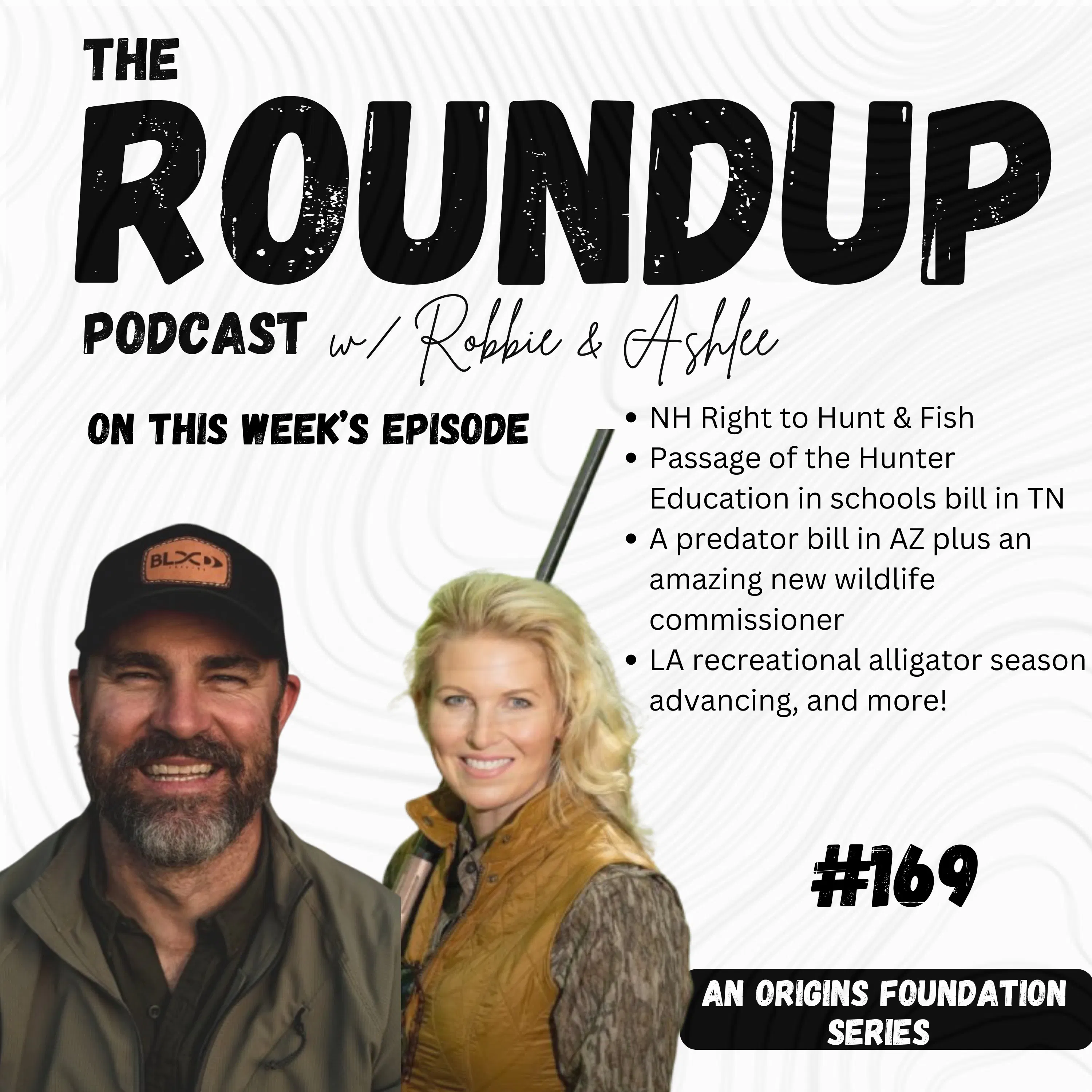
The Origins Foundation Podcast
Roundup 169 || NH RHTF, Hunter Education Bills in TN, A Predator Bill in AZ, LA Recreational Gator Season, and more!
00:41:37
Robbie and Ashlee jump into this week’s Roundup with a fast and furious run through the news around the country, including New Hampshire’s Right to Hunt and Fish epic crash after a disinformation campaign by anti-hunters derailed it, the failure of BOTH the bear harvest bill and the deer harvest reporting bill in MS, passage of the Hunter Education in schools bill in TN, a predator bill in AZ plus an amazing new wildlife commissioner, LA recreational alligator season advancing, and more!
Loading summary
Transcript201 lines
- [00:00]
Robbie
Planning a fishing trip shouldn't feel like a full time job. With fishingbooker.com you can find and book the perfect fishing trip within minutes. FishingBooker.com connects you with trusted fishing captains around the world. Booking is fast, easy and secure with access to verified customer reviews, loyalty rewards, and around the clock customer support. Everything you need to book with confidence is in one place. So head to fishingbooker.com and start planning your next fishing fishing adventure today. If you're a serious hunter and you haven't tried hex yet, this is the edge you're missing. Hunters have always talked about animals having a sixth sense, feeling you before they ever see you. Hex works by completely blocking your body's natural energy, helping you get closer without tipping them off. Most hunters don't believe it at first until they hunt in it. And once they do, it makes them believers fast. Go to hexhunting.com that's hecshunting.com and use code waypoint to save $20 on a full hex system. So five years ago, there was a reason why I started this movement. And the truth then is the truth now that we need to champion our narrative. We need to champion the truth around what we do and who we are. There's a sweet spot where they got, you know, too heavy and it's a burden to. To walk with. Too light and you whipping it. Why is the project so important to the hunting community? I think it's not only important, I think it's vital. I think it's just in time. It's like snakes and ladders. You guys are climbing the ladder and then somebody does something stupid and you just slide down. That is such an amazing analogy. Snakes and ladders. Yeah. You know, ivory, in my opinion, was the plastic of its age. Okay.
- [01:46]
Ashley
The expenses are going up. It goes a long way with families. We have families that do need it.
- [01:52]
Robbie
Me close this door because I have a little wiener dog. What? You are. You're laughing because I said wiener.
- [01:57]
Ashley
I'm really glad you finished the sentence out. I'm sorry, the first happen. What are we doing here today?
- [02:04]
Robbie
You're telling the whole world. I think we're setting some sort of record right now. What's this? Three in a row? Three roundups in a row?
- [02:20]
Ashley
I don't think it's three.
- [02:22]
Robbie
Oh, two then.
- [02:25]
Ashley
Actually, it's not even. This is one.
- [02:27]
Robbie
Oh, did we have a guy.
- [02:28]
Ashley
Did you do it, Charles, last week?
- [02:30]
Robbie
Oh, no, no. But I mean, we put a roundup out three times in a row now. Three or four times in a row, which is pretty amazing. Keep this up. Got to keep up the streak.
- [02:38]
Ashley
Good for us. Good for us. But not me and not you and I, because this is. We're restarting over at one.
- [02:47]
Robbie
Yeah, what's that? Like, how many, how many accident free days have you had at work? We're back to one.
- [02:53]
Ashley
Accident free.
- [02:55]
Robbie
Have you not seen that when you go into a big industrial complex, they have like this big board or they have a computer screen that says accident free days and they've got this tally of days like us Roundup.
- [03:07]
Ashley
Mine should probably be sick free sick, not been sick.
- [03:11]
Robbie
Absolutely. You should have that counter going because we may not hit 12.
- [03:16]
Ashley
But my last week I was on vacation, so technically those were not sick days on work, they were sick vacation days.
- [03:24]
Robbie
I think you should just track, like number of days you're sick because you got sick last, as you said, stomach bug for two days.
- [03:30]
Ashley
So you're on vacation, on spring break. Two days of stomach bug. That may have been food poisoning because it was so short.
- [03:39]
Robbie
Listen, you've been complaining about, like, you know, needing to drop weight and stuff like that.
- [03:44]
Ashley
I know I did. I did. Does my face look thin? Until I made up for it the last few days. And I think I never compensated for it.
- [03:54]
Robbie
I've always told somebody I said the quickest way to weight loss is a can of tuna. Open it up, stick it outside, let it go rancid and eat it.
- [04:03]
Ashley
Oh, I thought you were gonna give me like some new diet with.
- [04:07]
Robbie
It is a new diet somebody should take up. Take it up because you'll drop £10 in a week. It's not gonna be pleasant, but.
- [04:15]
Ashley
Oh, gosh, no, let's not do that. Nope.
- [04:19]
Robbie
Anyway, any text messages? I guess not. Come on, people, text us.
- [04:25]
Ashley
I got just some nice, like, hey, we're out here. We hear you.
- [04:30]
Robbie
Oh, cool. 601-790-0607. You can text us 601-790-607.
- [04:37]
Ashley
Well, we got one from Dave from Wisconsin who is such a great listener. And I appreciate your feedback, Dave, because you're so kind with an idea to talk about why houndsmen and trappers have issues getting along.
- [04:51]
Robbie
Oh. In Utah right now. But as I understand, they are starting to get along more. I spoke with John Behr a little bit and they are having meetings. So meetings are happening between the houndsmen and the trappers. There's also meetings happening between Utah Department of Wildlife Resources. I think it's DWR in. In Utah. And the houndsman and the Trappers and the whole controversy if you remember is that it's now full blown do whatever you want for mountain lions to remove them. And they've got this experiment in these couple of watersheds that wild sheep has found has funded and some others, ffw, SFW has funded it too to go into these, into these watersheds and trap the heck out of mountain lions to see if it has a response on mu deer populations in these watersheds.
- [05:48]
Ashley
You think it all comes down to mountain lion hunting or do you think this is sort of a general all over? In general they don't get along with it?
- [05:56]
Robbie
No, no, no, it's a good question. And mule deer, specifically mule deer are not like the most resilient species in the world. Whitetail will probably take them over if you ask Jim Heffelfinger. 5,000 years from now we won't have mule deer. They just are going to be extirpated because whitetail compete better with them. They're just not a hardy species. They're not a very clever species either. So who knows. But mildew are down across the range, not just in Utah. Right. And there's wild horses issues, there's climate issues, there's fencing issues, there's all sorts of things.
- [06:30]
Ashley
So.
- [06:31]
Robbie
Yeah, good question Dave. Yeah, good question.
- [06:33]
Ashley
Thanks. People are getting appreciate the feedback. Keeping our Google voice text.
- [06:38]
Robbie
Yeah for us 790607 text us us a voice note, let us know what you want us to talk about. Happy to talk about it. Yeah, let's stay home right now Mississippi. You two or three weeks ago we had a bunch of things that are happening in Mississippi and now they're all gone.
- [06:56]
Ashley
They're. They're all dead.
- [06:59]
Robbie
All dead. Look guys, I'm a hunter, right? And when I go hunting I like to figure out how to get my trophies back home as expeditiously as possible. Well, you don't have to look much further than Safari Specialty Importers. We know that trophy importation can be quite a headache. That's why Safari Specialty Importers strives to make it as easy and hassle free as possible. They have access to a bonded warehouse, you won't be charged storage fees and you get a dedicated team that's readily available and will update you at every step in the process. They'll even go one step further. Safari Specialty Importers is working with us and they are going to donate $100 from every shipment that they work with to conservation projects that include anti poaching, community development and wildlife conservation. At the end of the day, choose to spend your money with a team that's dedicated to you and is dedicated to helping show how hunting is a great conservation model. Hassle free logistics, fuel and conservation go with safari specialty importers. It is 2026 and my friends, big changes have happened in the world of firearm suppressors. The $200 tax stamp fee is now gone. Huge win for hunters, huge win for shooters, and a huge win for your wallets. If you're thinking about elevating your shooting experience and adding a suppressor, Silence Essential is the best way to shop. And you don't even have to get off your couch to do it. Go to silenceessential.com, browse hundreds of suppressor options. They literally have all of the popular makes and models. Then their experts will walk you through setting up your account, creating a free NFA trust, and then submitting your application to the atf. Once approved, Silencer Central ships your new suppressor directly to your door. That's when you're going to have to essentially get off the couch. It's a game changer guys. You haven't done it yet. Do it. The old days of waiting eight to 10 months on a suppressor are gone. It's more like two weeks. Some have even gotten their suppressors in shorter timeframes. It's never been easier to start shooting suppressed. Get started today by visiting silencer central.com it's really the simplest way to get your suppressors. Bushnell is eager to help you get set up for conservation success. That's right. They want to help you. The conservation and research community is dominated by good people doing good things and investing significant time and effort for the benefit of habitat and the species. So what do you need to do? Pretty simple. Send us your conservation story and or your conservation wish. Could be managing whitetails, could be understanding your environment or species or something else related to conservation. What would you be able to do if you had a great trail camera setup? We will select the best story every other month and send you a camera bundle. Cell camera, normal SD camera, SD cards as well as optics. Everything you need to get set up for success. I can't wait to see what you submit. You can email us, DM us, message us whatever you want. We are not hard to find. Good luck.
- [10:11]
Ashley
It's very interesting. I A lot of times in Mississippi things don't die necessarily on their merits. Sometimes they die just because the House and the Senate can't get along. I don't know that that is necessarily the case here, but for about the 12th year in a row, there has been an attempt to pass the mandatory deer harvest reporting.
- [10:35]
Robbie
12 years they've tried to get this through.
- [10:38]
Ashley
It's at least 12. It's at least 12.
- [10:40]
Robbie
And it failed again.
- [10:41]
Ashley
Well, it passed the House. Passed the House and it died because it did not come out of the Senate Wildlife Committee.
- [10:53]
Robbie
Do we know why?
- [10:54]
Ashley
Well, Chairman Suber said he just did not have the votes. I've got a list of some names. It's about five names, about five senators who are opposed to it. And.
- [11:08]
Robbie
And they're opposed to it. I remember you said something along the lines of overregulation of government. Is this.
- [11:14]
Ashley
That's all. That's all any. That's all anyone can. Like. I haven't heard any good reasons why. I mean, the agency has been begging for this bill for years and they so desperately need the data.
- [11:30]
Robbie
Why call the. Why call the agency, do this through the commission? Why can't the commission say that tied to tags. We need you to tell us what deer you kill.
- [11:42]
Ashley
I. I think then stat. I think it has to be done statutorily. All of the. If it's going to be mandatory. I mean, the other. The other type of reporting requirements have been set through the legislature. So I have to feel like the commission would have done it because this has the support of the commission and the agency.
- [12:03]
Robbie
Hmm.
- [12:04]
Ashley
So I think that they would have done it if they could have in this situation.
- [12:10]
Robbie
And maybe they need to come up with some crazy prize and do it voluntarily. Well, crazy prize at the end of the video for the people who report
- [12:19]
Ashley
this bill had been. Initially, the language of the bill was going to have penalties attached if you didn't turn in the harvest, you know, report and blah, blah, blah. And it had been watered down so drastically. I mean, you could turn in your tag with your, you know, there would be an app on your cell phone. You could do it via computer. You could do it written with paper, all sorts of different ways. And it basically ended up that there weren't going to be any enforcement penalties or violations. In the beginning. It was almost going to be a voluntary program. I mean, it was like not a fully voluntary program, but close enough. Like, it was just to get it started. Like, let's just get this going to make it palatable for everyone. And there's just such a distrust for some reason of. I don't know if it's agency motives. I don't. I don't honestly understand it. Which I think is. Is a problem that we have everywhere right now that there has been an erosion of trust on behalf of the public, in our wildlife agencies and our wildlife officials and these guys that are going to school to learn to be in this profession because they love it. Because nobody's doing it for the pay, I promise you. I mean, they're in it. Look, you were a teaching wildlife biologist practicing at one point, and you did it because you're passionate about it. Nobody goes into this to manage our
- [13:55]
Robbie
resources for us, you know?
- [13:57]
Ashley
Right, right. Because you believe in what you're doing. You believe in the sustainability of these resources. You want them to be there for your kids and their kids and for generations to come. You want these species to survive. Nobody becomes a wildlife biologist because they want to kill a resource or they want to keep people from hunting or fishing or enjoying them. So it's the weirdest thing to me. And nobody goes into this thinking they're going to make a lot of money.
- [14:24]
Robbie
And so how many of these like wildlife? And I almost know the answer to this question, but how many of these wildlife laws have to go through the legislature versus can be done at the commission level?
- [14:37]
Ashley
There is no way for me to answer that question. That 100% depends on the state and how their wildlife laws are written. So it all. It all goes. It all comes down to one, how their constitution's written, and then one, how their state code is written. You'll hear Mississippi code annotated, Tennessee code annotated. So there's a set of wildlife laws, and then also each state. Each state has its own judicial code that are laws handed down by judges. But so. So the wildlife laws are initially set first, constitution that prevails over everything. And then you have your code, your statutory law, and then you have your regulations and rules that the commissions can set. So constitution gives laws, sort of. That's the overarching umbrella. And then you have your state codes, and that gives the authority to set everything. And that's what delineates the authority to each wildlife agency and their commission. And it tells what they can and can do. And it varies wildly within each state. It also tells things like who appoints the state wildlife agency director, how they're appointed, how they're removed, how long their term is, things like that. And that varies wildly between each state. It sets up each state's wildlife agency, and those look different within each state. Even the names of them are different. So it all depends on what state you're talking about. If somebody has a question about it, like we could say, okay, well, Illinois does this, and here's the delineation of powers between the legislature and the commission. And sometimes legislatures will take power away from the state wildlife agency or their commission. Like remember this past year when we were talking about. I believe it was Minnesota. That was when they were. When they were. Was it Minnesota or was it Massachusetts? It was Minnesota where they were taking away the power of the state wildlife agency to make any rules regarding restricting they weren't allowed to do, like cwd, education, you know, like, things like that. So. So like they were taking away powers that the agency had always had and then they were restricting their power. So sometimes legislatures get in there and take it away. Sometimes they delineate it. Like right now, this Mississippi law was going to give the commission the power to set a bear harvest and issue the number of tags and start a lottery system.
- [17:36]
Robbie
The bear bill also died, right?
- [17:39]
Ashley
The bear bill died in the House. Yeah. So the harvest bill, now it actually went on the floor of the House and. But it did not pass. The Senate bill didn't even make it to the Senate floor because it did not come out of the Senate committee.
- [17:53]
Robbie
Do we know what it failed at in the House at? Do we know the numbers?
- [17:57]
Ashley
I was just trying to pull up the number to get the vote and
- [18:03]
Robbie
how many people in the House of Miss. In the House of Representatives in Mississippi.
- [18:09]
Ashley
Sorry, you. You got to. You know what? If you're going to ask me these types of questions, you need to give them to me ahead of time.
- [18:15]
Robbie
I don't know what you're going to talk about specifically.
- [18:17]
Ashley
I don't. I keep a lot of stuff up here, but I don't keep it all.
- [18:21]
Robbie
All right, hold on. We'll use Google.
- [18:22]
Ashley
I'll have to look it up. I'll look up the vote and you look up how many people are in this Mississippi house.
- [18:34]
Robbie
Easy, easy. 122. Look at that.
- [18:38]
Ashley
There you go.
- [18:38]
Robbie
I want to know what. I'd love to know what the split was for.122 for the black.
- [18:44]
Ashley
Hold on. And I'll give it to you.
- [18:46]
Robbie
But yeah, look, we thought it was a good build. The bil. It's not surprising that it didn't make it. It's okay. The science isn't there. They're still working really hard. Honestly, I think a bit of a year reprieve is going to set us up in the future for being in a very, very much better position for advocating for the bil. Because at the end of the day, what we're worried about is. Is simply the. The anti. You side. The anti bear Hunting side saying, okay, you're going to pass this legislation and we're going to sue you just like they did in Louisiana. And that's going to stymie things up until we have the appropriate population models and the appropriate population estimates with the conservative harvest. Take that they'll put forward and let the courts decide and. And move forward.
- [19:39]
Ashley
60, nay. 50. Yay.
- [19:44]
Robbie
Whoa.
- [19:46]
Ashley
Six absent are not voting.
- [19:49]
Robbie
And what did they need?
- [19:50]
Ashley
50%, six present, not voting. They had to have 66 to pass.
- [19:58]
Robbie
And they got how many?
- [20:00]
Ashley
60.
- [20:01]
Robbie
What?
- [20:02]
Ashley
And six people were there and didn't vote.
- [20:05]
Robbie
How that is. That's. That is atrocious. I'm sorry. If you are a politician in. In this country, not just Mississippi, and you're present and a vote is called, how dare you not vote? What is that? How is that legal? How is it legal that you are. That you are not. That you. I thought you would have to vote.
- [20:28]
Ashley
They abstain. They abstain, and they do that because they don't want to get. They don't want to get tagged. But to me, that is so weak.
- [20:36]
Robbie
That's weak. Super weak. Who have six. Call them out.
- [20:41]
Ashley
Black men. Oh, you're real blackman. You called Butler from Washington, Crudup, Holloway, James, Jones, Williams. Now, there were six that were absent that day. They didn't vote. They weren't there.
- [20:55]
Robbie
We. We lost. Not lost. Well, it just shows you. You're six away in 2027. Gosh, that is so close. That's way closer than I thought. That's way closer than you thought, too, based on your situation.
- [21:10]
Ashley
I'm actually surprised. I'm actually a little surprised. I'm looking at the nays, and there's quite a few members of the Sportsman's caucus who voted no. But look, we've talked about this. I thought this was a good bill. You thought it was a good bill. It could have gone either way. And I think there was a lot of confusion about this bill. It was not widely shopped around ahead of time. This was a bill that originated in the Senate, and so this was before the House floor for passage. The agency remained pretty ambivalent on this bill, and they're not, to my knowledge, did not take a formal stand on it. This would have set the season starting in two years, not now. And so it's. It is hard, I think, probably, for legislators to vote on a bill establishing a harvest season two years away, not knowing what the numbers are going to be at that time. So there. There was. There were a lot of unknowns. There are A lot of unknowns. I mean, you and I know we're working on the bear documentary right now here in Mississippi. We are going to know what the bear numbers in Mississippi are at that time, but nobody has a crystal ball, so we can't say here what they're going to be. What I liked about the bill was that it gives all discretion and authority to the agency and to the commission at that time to set the tag numbers based on what those numbers are going to be at that time. So I felt comfortable with it. I can understand how some legislators may not have felt comfortable with it. Now, the harvest mill, that. That's just a big F minus. Big F minus for not passing that bill.
- [23:03]
Robbie
All right.
- [23:04]
Ashley
Another F minus. Huge F minus. New Hampshire, you just failed. Failed, failed big time. And I wish we had a way to play a floor speech from a politician up there and just this was a big initiative for a bunch of partners up there for the constitutional right to hunt and fish amendment. This was going to be a legislatively referred ballot initiative where. So a lot of states have a mechanism by which the legislature. Legislature votes to refer it to the people. Then it goes to. So, so basically the legislature passes what
- [24:02]
Robbie
the language November was whether. Yes, they want this or not. Okay.
- [24:05]
Ashley
Yes. Yeah. It's called a legislatively referred ballot amendment.
- [24:08]
Robbie
And you'd think in a state that has a license plate that says live free or die that they would vote something like this in.
- [24:18]
Ashley
You would think. So apparently they lost. And these are our friends from the Congressional Sportsman's Foundation. And, and we have. We've had Fred Bird on here as a guest host several times. He's highly knowledgeable. He lives in New Hampshire. This is very personal to him. But apparently there was several legislators her who should have been yes votes, weren't there. So again, another, you know, people not voting. And then there was a major disinformation. This is sounded funny. A major disinformation campaign that occurred up there, which is no big surprise. We are seeing them all the time right now. And the big dim member who was against it apparently just straight up lied and made up about the bill despite already having answers and gave this huge floor speech where it was just insanely and patently false.
- [25:20]
Robbie
We should get that floor speech. Can I find it?
- [25:23]
Ashley
I have the floor speech.
- [25:24]
Robbie
Can you send it to me, please?
- [25:26]
Ashley
I can send it to you.
- [25:27]
Robbie
Thank you.
- [25:27]
Ashley
I'll send it to you right now.
- [25:29]
Robbie
Thank you.
- [25:31]
Ashley
Okay, so Chris, so that's, you know, sad. And so next year we all as a community need to get out in front of this ahead of time so that there is so much information, truth out ahead of time that people like her cannot discredit it. So that when someone hears something, they're going to say, that's not true. I know that's not true. That's what we've got to start doing as a community. We can't. We can't always play defense, and we can't always play defense at the last minute. And sometimes it's too late.
- [26:08]
Robbie
No. A hundred percent. We are seeing that across the board. We're not going to talk about it, but I told you a little bit about earlier about somebody attacking somebody. Yeah. It's time. No. And that's, you know, it's what we're good at. It's what we're good at.
- [26:23]
Ashley
Yep.
- [26:24]
Robbie
Your IP28 video is still going bananas. Have you seen it lately?
- [26:31]
Ashley
I have not checked lately.
- [26:32]
Robbie
325,000 views.
- [26:35]
Ashley
I got kicked out of our Instagram and so I'm waiting. We're trying to navigate which version of our Instagram password is current.
- [26:41]
Robbie
Oh, my. I need it technologically. Technologically.
- [26:44]
Ashley
No, no, no, no, no. You know, it did a reset. Asked me if I wanted to whatever, connect accounts, and so it logged me out. And so you continually.
- [26:52]
Robbie
Whenever it does that little. Connect the accounts, just swipe out of Instagram and log back in. It'll be fine. Don't ever say not now.
- [27:00]
Ashley
Can't log back in without password.
- [27:02]
Robbie
Click the accounts thing. I'm just saying in the future. Oh. I probably ground up material.
- [27:08]
Ashley
If you would tell me the password so I can get back in and check. Anyway. It's good.
- [27:11]
Robbie
Tell the whole world our Instagram password right now. Yes.
- [27:13]
Ashley
No, no, don't tell me now. I wasn't asking for it. Now,
- [27:19]
Robbie
Arizona, our lady, our friend, our champion, Jessica Manuel, confirmed by the Senate.
- [27:28]
Ashley
Awesome.
- [27:29]
Robbie
She is now the one of the five Arizona wildlife commissioners. And she was. We championed her for four years. So big congrats, Jessica. What else happening in Arizona?
- [27:41]
Ashley
There's one other thing right on that bill moving through to classify all of the apex predators as vermin.
- [27:53]
Robbie
Yeah.
- [27:54]
Ashley
Vermin, basically. Yes. Yes. That's not the official word. Yes. They. The animals to be labeled as predators, which basically means that they're all.
- [28:05]
Robbie
Something like that.
- [28:06]
Ashley
Yeah. They. They removed wolves from the list. So the commission voted to oppose the bill.
- [28:12]
Robbie
Good. They should.
- [28:14]
Ashley
Which is good. Yeah.
- [28:15]
Robbie
Yeah. Black bears and mountain lions should not be viewed as vermin.
- [28:21]
Ashley
It. It gives. It would give the public the right to treat all of These species the same way coyotes are treated.
- [28:29]
Robbie
Yeah. You can take them whenever you want, however you want, however many want. That is not how you treat big game animals.
- [28:36]
Ashley
That's right. That's right. Now, in Louisiana, they have always had. Not always, but for a long time, they have had a commercial alligator harvest season. That's the only way you can hunt alligators down there. You have to have a commercial tag. Now you see a lot of people hunting them, but that's because they go somewhere.
- [28:55]
Robbie
Private land tags. Yep.
- [28:57]
Ashley
Yes. Yeah. So they are trying to pass. And we talked about this on a little bit. We talked about this on the podcast with Secretary Bosworth. They. They knew. And we're going to try to run a bill through the legislature to begin a. What do you want to call recreational, recreational alligator harvest season. So that is moving.
- [29:19]
Robbie
Cool.
- [29:19]
Ashley
And it passed Senate Natural Resources.
- [29:22]
Robbie
Well, it should. They've got an amazing conservation success story. They've got an amazing population estimate down there. There's no reason why they should have limited recreational tags for alligator hunting in Louisiana.
- [29:35]
Ashley
That's right. That's right. And I haven't seen much about it in opposition. I've seen a lot of news about it, but I haven't really seen much in opposition to it. So that's. That's good. Tennessee passed a hunter education act similar to the one that Georgia passed. Passed both chambers. So it passed the House. It passed. The Senate is going to be signed into law. House Bill 2588.
- [29:58]
Robbie
Wow.
- [29:59]
Ashley
Authorizes LEAs and Public Charter schools to offer students in any of the grades a hunter education course approved by the Wildlife Resources Agency as part of PE health or safety instruction. Passed. This is what I think is exciting. Is it passed unanimously?
- [30:15]
Robbie
Nobody said no.
- [30:17]
Ashley
Unanimously in both chambers.
- [30:20]
Robbie
Damn.
- [30:21]
Ashley
Nobody said no.
- [30:22]
Robbie
When does that happen?
- [30:23]
Ashley
That is a huge. That's a huge win. Republicans, Democrats, everybody coming together saying, this is important. We get it. I mean, I honestly think that that is pretty amazing. That's pretty amazing. When's the last time anything passed unanimously in the entire. An entire state legislature? It does not happen very often. So big shout out to Tennessee. Tennessee gets our A plus of the week.
- [30:52]
Robbie
Thank you. I live in Tennessee. I'll take it.
- [30:55]
Ashley
Yeah. I am a Tennessean.
- [30:57]
Robbie
Ah, you take the Mississippian.
- [30:59]
Ashley
Little Rocky talk. Rocky top Tennessee.
- [31:03]
Robbie
Nobody wants to hear you singing and dancing on the roundup, Ashley.
- [31:07]
Ashley
I think they do. Go balls if you gotta get with it, Robbie. If you're going to live in Memphis, Tennessee, you got to cheer for either. You got to cheer for The Tigers or the Vols. Pick a team. Or Vanderbilt. Gosh, no. Don't cheer for them.
- [31:23]
Robbie
If you. If you. Let's let the people speak. If the people want to hear Ashley sing and dance, text us. 601-790-0-607 if you want to hear more singing from Ashley, you do sing in a choir, the church choir. So it could be pretty good. But 601.
- [31:43]
Ashley
I was 7, 9 06. UT singers too. I sang in UT singers. There was choreography to Rocky Top. It was bad. So were the outfits.
- [31:52]
Robbie
They were worse.
- [31:56]
Ashley
Hopefully that was all destroyed. Last time you asked the people's opinion, do you remember what it was
- [32:04]
Robbie
that I was right when it comes to bear hunting. And every answer yes.
- [32:08]
Ashley
You asked if everyone wanted to see me go to Africa and you had an overwhelming yes, multiple responses.
- [32:17]
Robbie
You're too busy to go to Africa, Miguel.
- [32:19]
Ashley
No, I'm not here in my schedule. Listen, it might take spring.
- [32:24]
Robbie
You must be in Africa right now. You best in mind that you weren't in Africa right now, but you were in. You were on spring break. You're on spring break.
- [32:32]
Ashley
This whole week is open. Whole week is open.
- [32:35]
Robbie
You needed to have left in the middle of spring break, which you said was essential.
- [32:39]
Ashley
If I had done that, I wouldn't have the summit flu. I would. I would have totally done that.
- [32:46]
Robbie
You would have gotten some African disease, probably.
- [32:49]
Ashley
Oh, I do get those.
- [32:50]
Robbie
Yeah.
- [32:50]
Ashley
But I can. I can muscle through it.
- [32:53]
Robbie
What else is on the docket?
- [32:56]
Ashley
So Florida did a few interesting things. They're kind of. So they. They took away the authority of the governor, who of course right now is DeSantis. They took away the governor's ability to spend in emergency settings. So that sounds very general. Right. But they did it in response to and directly because of the alligator Alcatraz situation.
- [33:29]
Robbie
Yeah. I was wondering how that. Because that was a big blow up and then we haven't heard anything about it lately.
- [33:34]
Ashley
Well, because I. It all got clawed back. I mean, apparently it was all ruled. And I have. I need to take a new look at the exact status of everything.
- [33:46]
Robbie
Nobody's there. Nothing's happening right now.
- [33:49]
Ashley
Which, I mean, you know, they had already spent what, 200 million, 300 million. Remember? I was like, I was raising hell about this. I was so pissed. One because it seemed so unconstitutional. They were using like FEMA funding, I mean, all this stuff. And it was like emergency and the state was paying for it. And supposedly they were going to be paid back by some federal funds, but who knows? And nobody's Getting federal funds for anything right now anyway. And then. And they were like, saying, oh, well, it's not going to hurt the environment. Meanwhile, they were clean, clearing all the roads and messing up the tribes and messing up the wildlife. All the stuff. I mean, it was just big fat environmental disaster right in the middle of the Everglades. Well, and then it. And then the judge halted it, and. But, I mean, they'd already spent, like, $200 million, so. Okay, great. So we've created a big, fat environmental mess and spent all this money. That's amazing. Good job, guys. So now the legislature has taken matters into their own hands and limited the governor's ability. And look, I'm a. I'm a big DeSantis fan, so I don't want to sound critical of him in general. I just thought, you know, sometimes people make mistakes and nobody's immune, including me. So they have limited his ability, which the problem is, like, I hate that they had to do that, because hopefully. I mean, what happens if we have another Ian come through and. And he needs to be able to spend money in an emergency situation for some kind of natural disaster? I mean, I haven't read that law that they passed, but because they did something so bad, they had to go limit it, and hopefully it won't cause irreparable harm in the future when they actually need to use that kind of stuff. So. You know what? Politicians don't do bad stuff and get your hands tied for the future. Sorry.
- [35:37]
Robbie
It's a little rant. A little soapbox.
- [35:39]
Ashley
No, no. Little rant. Yeah. You know, I don't. Alligator Alcatraz. Just. That has nothing to do with the ice part. That's totally side. This is all because of the environmental part. All right, so
- [35:53]
Robbie
we know that Colorado is still a mess. Colorado, the fur ban, May 5th and 6th is when it's coming back up for rulemaking. And everyone says that it's just like nobody knows what's happening. Here's the other thing that's crazy that has slipped under the radar because that whole meeting was so crazy. Charles and I talked about the fur ban. There was a citizen petition to the commission from the center of Biological diversity and either 17 or 27 other organizations telling the commission they need to halt paying wolf depredation claims from ranchers, which was the thing that they stood on in the beginning, saying, we are going to compensate. This thing is going to be tied in with everything that we do.
- [36:39]
Ashley
Yeah, we posted something about that, didn't we?
- [36:41]
Robbie
Another wolf died on Friday.
- [36:43]
Ashley
I know. I know the 14th.
- [36:46]
Robbie
14th. Yeah. 14th Wolf. Current survivable died survivability percentage is 44% in Colorado.
- [36:55]
Ashley
Can you imagine if we had only had. What did you say the percentage was?
- [36:59]
Robbie
44% survival.
- [37:03]
Ashley
What would you be doing right now if we'd only had 44% survival of our cheetahs?
- [37:06]
Robbie
Oh, I would be dead.
- [37:10]
Ashley
I would have had to send somebody to check on you at like 70% drinking heavily. You would have an old Fashioned sitting in front of you right now.
- [37:21]
Robbie
Yeah, yeah. So Colorado is just continuing to be the next Oregon. Really?
- [37:32]
Ashley
So all these. So what was their basis for halting the depredation payouts? That they just can't afford it anymore and there's been too much.
- [37:41]
Robbie
I don't know. I didn't look into it enough. But I think it was something tied to like abuse of the system or the, you know, more evidence needs to be shown, which is crazy, right? It's just. It's just.
- [37:54]
Ashley
Well, they were already like. Hadn't they gone like seven times over their budget already?
- [38:02]
Robbie
Yeah, yeah. No, the wolf depredation fund was absolutely decimated last year.
- [38:07]
Ashley
That'd be a great thing. If I could remember things that I had previously reported on stay in my head figures past that date. I feel like they had already gone over their budget like seven times this past year. And the depred. They blew the depredation budget way back when. They blew the whole budget. I mean, the whole entire budget has been okay, so here it's just a debacle. And, and.
- [38:32]
Robbie
And like, all right, Governor, March 26th citizen position regarding wolf depredation. Colorado intensely focused on modifying rules for lethal control and compensation. They wanted to strengthen lethal controls. Petitions argue that current Colorado Parks and Wildlife rules on compensating for indirect losses, that is reduced weight, lower conception rates, lack scientific backing, sightings that payouts have reached double the funding due to unverified claims. Crazy. And here's the other thing that's so cool about this whole thing is we are building a documentary in Colorado with all of this stuff happening at the same time. Talking to all the farmers, all talking about weights, all talking about conception rates. They have all the data. This isn't fictitious. The farmers are like, our carbs are down 20% in weight from previous years.
- [39:32]
Ashley
There's also a built in set of rules that these farmers have to satisfy to receive the compensation. Like there has to be carcasses. Their pictures like, satisfy, like, you know, because wolves kill a certain way and it's different from an animal dying by other means, so. I mean, it's not like they've been getting paid for just random. Cow fell in the river and broke its ankle. Whatever.
- [40:06]
Robbie
Yep. Anyway. It's crazy. It's crazy. Well, I need to cut our roundup short because I am running up against a hard deadline of a board meeting.
- [40:17]
Ashley
Well, we covered a lot of states.
- [40:19]
Robbie
There's a lot of things happening. New York, the trophy hunting bill. I'll say the last thing. New York trophy hunting bill seems to still be in the Senate. It came out of committee. It has not been, based on what I can see online, has not been voted on at all yet, so. And that's what happened last year. I think it just ran out of time. So we'll see. We'll keep watching.
- [40:40]
Ashley
Hopefully. Hopefully, it will happen again.
- [40:42]
Robbie
Yep. All right. Stay healthy. Do not get sick this week.
- [40:48]
Ashley
I will. I will stay very well this week. Hopefully.
- [40:52]
Robbie
Ciao.
- [40:53]
Ashley
Ciao.
- [40:55]
Robbie
Well, that's it for today. I appreciate you listening, as always, leave a review, share it with your friends, and most importantly, do what's right to convey the truth around hunting.