← The Origins Foundation Podcast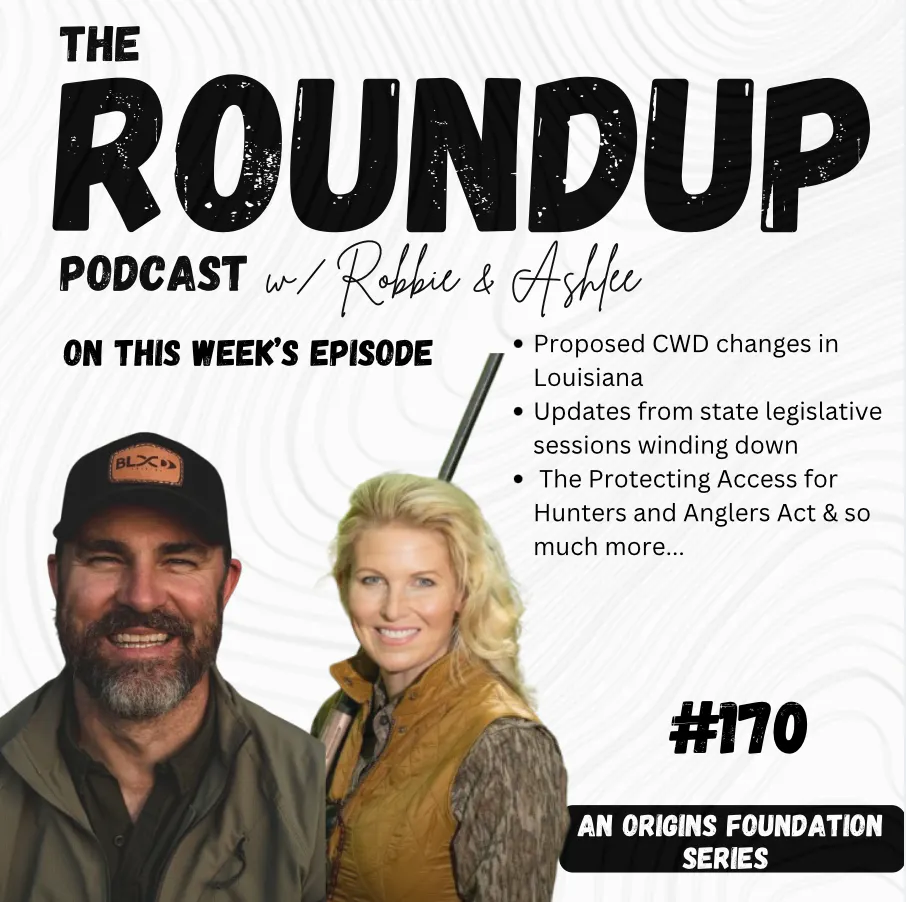
The Origins Foundation Podcast
Roundup 170 || Lead Ammo Protection, Court Wins, and Wildlife Funding Chaos Update
00:45:32
Robbie and Ashlee are back after both respectively traveling the last couple of weeks, with updates on new legislation passed by Congress to ensure lead ammunition and fishing tackle is not banned without scientific justification called the Protecting Access for Hunters and Anglers Act, the 9th Circuit's ruling that a California law banning firearms marketing in a manner attractive to minors is unconstitutional, updates from state legislative sessions winding down, proposed CWD changes in Louisiana, and federal funding issues causing havoc for state wildlife agencies because the federal agencies are not releasing appropriated funds.
Loading summary
Transcript187 lines
- [00:00]
A
Planning a fishing trip shouldn't feel like a full time job. With fishingbooker.com you can find and book the perfect fishing trip within minutes. FishingBooker.com connects you with trusted fishing captains around the world. Booking is fast, easy and secure with access to verified customer reviews, loyalty rewards, and around the clock customer support. Everything you need to book with confidence is in one place. So head to fishingbooker.com and start planning your next fishing fishing adventure today. If you're a serious hunter and you haven't tried hex yet, this is the edge you're missing. Hunters have always talked about animals having a sixth sense, feeling you before they ever see you. Hex works by completely blocking your body's natural energy, helping you get closer without tipping them off. Most hunters don't believe it at first until they hunt in it. And once they do, it makes them believers fast. Go to hexhunting.com that's hecshunting.com and use code waypoint to save $20 on a full hex system. So five years ago, there was a reason why I started this movement. And the truth then is the truth now that we need to champion our narrative. We need to champion the truth around what we do and who we are. There's a sweet spot where they got, you know, too heavy and it's a burden to walk with. Too light and you whipping it. Why is the project so important to the hunting community? I think it's not only important, I think it's vital. I think it's just in time. It's like snakes and ladders. You guys are climbing the ladder and then somebody does something stupid and you just slide down. That is such an amazing analogy. Snakes and ladders. Yeah. You know, ivory, in my opinion, was the plastic of its age. Okay.
- [01:46]
B
The expenses are going up. It goes a long way with families. We have families that do need it.
- [01:52]
A
Me close this door because I have a little wiener dog. What? You are. You're laughing because I said wiener.
- [01:57]
B
I'm really glad you finished the sentence out. I'm sorry, the first happen. What are we doing here today?
- [02:04]
A
You're telling the whole world.
- [02:16]
B
It just woke up.
- [02:18]
A
It has been a long Easter weekend, so understandably it has been.
- [02:23]
B
And we hung out with our awesome Catholic neighbor friends yesterday and there is nothing like a Catholic holiday.
- [02:31]
A
Catholics like to drink too.
- [02:35]
B
Yeah, well, that's what I mean. I was like, we'll come over. We'll just come over for a few minutes. And then eight hours later, those of
- [02:44]
A
you watching on YouTube, I look a little different today because I am undertaking some spring cleaning in this house and we are moving desks around and things around and making this a little bit more functional of a space.
- [02:57]
B
You're also moving around your microphone and going in and out.
- [03:02]
A
I will not move my head like this.
- [03:05]
B
Okay, yeah, perfect. I can hear you now.
- [03:11]
A
Yeah, we are.
- [03:12]
B
Had a good Easter weekend.
- [03:13]
A
Yeah, great Easter weekend. Finally off travel for a little bit. Had a great time in Wyoming with wyoga, the Wyoming Outfitters and Guides association, in which I saw all the people that are in our circles. Angie Bruce, the director of Game and Fish, their lobbyist, Bill Novotny, great individual and just got connected with some awesome outfitters and operators that I think the best part about it was the first presentation I gave was about us and the Helix program. And, and I asked them, I said, I don't want to make any assumptions, like maybe nobody in the audience has heard about me and us. This is Casper, Wyoming, the general meeting of Wyoming. So it's two and a half days of meetings and three quarters of the room put their hands up and said, we know who you are. And I was like, okay, that's awesome. And had some great questions from the floor. You know, just a typical general cowboy hat, vest wearing, collared button, collared shirt, jean cowboy boot kind of audience.
- [04:28]
B
Well, that is Wyoming in a nutshell, which is one of the reasons why I love that state so much. Good, good folks out there.
- [04:35]
A
Yeah, they're doing, they're doing great things there. They've got obviously friend of ours, Jess Johnson, works Wyoming Wildlife Federation as a government affairs person, lobbyist. She's moved a couple of great bills through the House. I met one of the house register representatives, Andrew Byron. Just extraordinary individual. Not just because, like, he loves wildlife, he's a big hunter, but the humor that this dude had, like in his speech, like talking to like, oh, representatives coming up, it was hilarious. I was like, oh, I wish all
- [05:14]
B
politicians were like, this dude had a sense of humor. Yeah, that would be nice.
- [05:21]
A
Sense of humor, joking, you know, that kind of stuff.
- [05:25]
B
Right, right. That's good.
- [05:27]
A
That was good.
- [05:28]
B
Glad you had a.
- [05:29]
A
And then I left there and went to Edmonton, Canada and did essentially the same thing for the Alberta Professional Outfit Society. Apos and APOS puts on every year their parliamentary MLA dinner. And their MLA stands for Member of the Legislative Assembly.
- [05:50]
B
Okay.
- [05:50]
A
And they put on a dinner which is just across the the road from Parliament House and they had like 80 MLAs there from both sides and the premier and a bunch of ministers I met the Minister of Tourism. I met the minister of. Minister of Forestry. It's a good friend of mine, Todd Lowen. He was there. He was sitting at my table. But the Premier, the Governor of the Province of Alberta is a lady Danielle. Danielle Smith, I believe is her name. And yeah, she was there and sat at the same table with her and she stayed. Was her birthday. April Fools is her birthday. I was giving my keynote speech on April Fools and she stuck. She stuck around until I finished talking and then she left.
- [06:41]
B
Oh, good. So good. Well, they need it up there. They need. They need our help. And all of those MLAs need to hear how good hunting is for Canada because they're constantly seem to be under attack up there.
- [06:53]
A
Well, my message was I'm a South African living in Memphis, Tennessee, telling you the Alberta Parliament about how good a job you're doing here in Alberta.
- [07:05]
B
Right. Well, how good a job their hunters and anglers are doing in Alberta.
- [07:10]
A
Yep.
- [07:12]
B
The Canadian government seems to be constantly in some sort of.
- [07:16]
A
It is 2026, and my friends, big changes have happened in the world of firearm suppressors. The $200 tax stamp fee is now gone. Huge win for hunters, huge win for shooters, and a huge win for your wallets. If you're thinking about elevating your shooting experience and adding a suppressor, Silence Essential is the best way to shop. And you don't even have to get off your couch to do it. Go to silenceessential.com, browse hundreds of suppressor options. They literally have all of the popular makes and models. Then their experts will walk you through setting up your account, creating a free NFA trust, and then submitting your application to the atf. Once approved, Silence Essential ships your new suppressor directly to your door. That's when you're going to have to essentially get off the couch. It's a game changer, guys. You haven't done it yet. Do it. The old days of waiting eight to 10 months on a suppressor are gone. It's more like two weeks. Some have even gotten their suppressors in shorter time frames. It's never been easier to start shooting suppressed. Get started today by visiting silencercentral.com it's really the simplest way to get your suppressors. Bushnell is eager to help you get set up for conservation success. That's right. They want to help you. The conservation and research community is dominated by good people doing good things and investing significant time and effort for the benefit of habitat and the species. So what do you need to do? Pretty simple. Send us your conservation story and or your conservation wish. Could be managing whitetails, could be understanding your environment or species or something else related to conservation. What would you be able to do if you had a great trail camera setup? We will select the best story every other month and send you a camera bundle. Cell camera, normal, SD camera, SD cards, as well as optics. Everything you need to get set up for success. I can't wait to see what you submit. You can email us, DM us, message us whatever you want. We are not hard to find. Good luck. Well, that's the federal state fight. It's a huge fight. Right? Same system as Australia. Like it's just wow, wow, wow, wow. You, you've been on the go too. You just came back from the North American.
- [09:35]
B
I have, I have. I was. So last Monday I went over and was in Vicksburg at the Corps of Engineers Environmental Research and Development center, which is this fascinating place where the Corps carries out all of their modeling and their. They build these life size scale models. Yeah, it's so crazy. Very cool. And then I got to see their simulator for when they have to do changes to any locks and dams or marinas or anything like that. So they have basically think of like a flight simulator on steroids. And these rooms are these giant flight, not flight. They're giant, basically barge simulators so that they can, when they're trying to figure out how if something's going to work or what they need to tweak or if barges are trying to go through here or there or giant ships or anything through like channels. Think about like the Miami project that they just did. Well actually, so the Tampa project and then the Miami one that is. Has such controversy right now. I asked them that and they were like, oh yeah, oh yeah, we're modeling that. And they're like, we do not weigh in on the political controversy or the effects on the environment. That's not our job. Our job is to say, okay, here's alternative A, B or C, here's what it's going to do. And then the policymakers have to decide, okay, well this is the least of all the evils or whatever. But so they go and they put their eyes on the ground and they take drone. They, I think they sometimes take drones, but more often than that they send their members of the team to meet with the stakeholders and like with the barge operators, with the marina or whatever, you know, the mechanism is. And they look and they study everything. And because they said, you know, AI or technology or whatever, it May be can only take you so far. You have to put eyes on the ground. You have to talk to the people that are doing it. Which I was like, that's great. Like, it's just another sort of reinforcement that AI isn't going to take over everything. And they were like, it's just impossible. It can't. So it was really cool to see that. And like, oh, we might bump into this if we. And of course, I'm not discussing it very eloquently, but I'm like, driving these big things through these shipping channels and what they have to do and for any little change. That's just. It was a fascinating, fascinating look at that. I'd never seen that before. I'd been to Erdtick several times. I'd never seen that before. And then I went to the North American Wildlife Conference, which is one of the biggest conferences in America, North America, for wildlife industry professionals. And especially. So the Wildlife Management Institute hosts this conference and afwa, so. Association of Fish and Wildlife Agencies. And so the Wildlife Management Institute is made up of professionals who are largely in academia or biologists, you know, the PhDs that are, you know, teaching at institutions. They have a lot of biological knowledge and expertise. And then afl, of course, is the organization that helps do advocacy for all of the different.
- [12:48]
A
Yeah, a lot of the hook and bullet departments from all around the country come and present their students come, present the preface. Professors can't present that kind of stuff.
- [12:56]
B
They do. There's a zillion sessions, and I mean, all over the board. You could. You really could hop in and learn about pretty much any issue in wildlife that we're facing today. I was in a lot of budget sessions, but just for the federal. Federal budget situation right now, and. And just legislative updates and things like that. And then helped. Jason Sumners, of course, the director of Missouri. We presented together at the one Health meeting, which is this effort to help people understand how it's all connected, like the health of animals and healthy biodiversity is connected to how healthy we are as humans. And us getting outside is so vital to our physical health, mental health, and that it's all interconnected. And it was really cool. There was a really huge turnout for that group. And. And I mean, they think that the landscape of state wildlife agencies is going to be completely different in 10, 15 years than it is now because of this effort to get the word out and recruit more and more people to the outdoors based on their health and animal health. So it's just this fascinating interplay they've started Attending. Different groups have started attending, like public health organization and private health. So, like the. There's a group that is essentially, it's alternative health professionals and. But it was attended by mostly doctors across the country, PhD, you know, practice practitioners, but who also believe that you have to include components of, you know, nutritional healing, exercise, outdoors exercise. Yes. Yeah. And they say this is one of the fastest growing components of the healthcare industry. In fact, it was almost impossible apparently to get a spot there to either attend as an exhibitor or an attendee. And so that was really cool to me because we do need more interplay between public health professionals and our industry, how we can work together on these initiatives. And so many times there's no crossover. So I think we'd all be better off if we were working together. And I think that you're going to see that momentum moving that direction as we start to bridge the gap between the two industries. Cool. Yeah, it was interesting. It was cool. Saw a lot of friends, saw Dan Gates, our friend, of course, that runs the Coloradoans for Responsible Wildlife Management out.
- [15:33]
A
So Corey Mason from Wildlife.
- [15:35]
B
Corey with wild sheep. Yeah. I saw Jim Inglis, who has helped coarse peasants forever in the past and does bobwhite quail now in a number of different things. Or I'm sorry, grass. Grouse.
- [15:46]
A
Grouse.
- [15:47]
B
With the grouse grouse and grasslands. Now there's a lot of our friends with conservation force John Jackson and Joe. And a lot of people were up there. So it was not in maybe the coolest place I've ever been.
- [16:01]
A
Where was it? Cleveland.
- [16:02]
B
It was in. It was in Columbus, Ohio.
- [16:05]
A
Columbus, Ohio. Yeah.
- [16:06]
B
And I'd never been there before. But they do have a hockey team. Some people went to the hockey game and apparently Ohio State is there. That's his claim to fame. So.
- [16:15]
A
Oh, Ohio.
- [16:18]
B
But it didn't look like the prettiest city. I'm sure I'll get some feedback on this. But I was like, oh, nothing was blooming. So that was part of the problem. It's still very dreary. No leaves anywhere.
- [16:31]
A
Yeah, I totally misread the weather thinking, oh, I'm leaving Memphis. 80 degrees, no problems. Landed in Edmonton, was 22 degrees. I did not even.
- [16:40]
B
How did you misread that?
- [16:41]
A
I didn't even look at the weather. I didn't look at the weather and take. I had enough clothes. Let's just say that I was wearing all my clothes. And the morning I left, it was snowing. I was like, okay, okay, okay.
- [16:56]
B
So, yeah, we're taking for granted our Our nice, beautiful spring down here right now.
- [17:03]
A
What's in the news right now? I know lots of legislators are still going, right?
- [17:07]
B
Most of the. Yeah. Most of the state legislate tours. Legislate. Most of the state sessions have either winded down or are in the process of winding down.
- [17:20]
A
And when you say winding down, it means don't. Is it Typically there's also like a. A cutoff time frame. Right. That's like, oh, no more bills are going to be heard post this time frame.
- [17:31]
B
Well, so I think you're asking me maybe about deadlines during the session. Are you asking me like, when they adjourn?
- [17:39]
A
No, no, no.
- [17:40]
B
Sign a die. I mean, get out.
- [17:41]
A
No, when you say things are winding down.
- [17:44]
B
Yeah. So there's, there's so like this is the last week of the Georgia congressional session and basically you're kind of at the very end of everything where they're usually into conference reports.
- [17:57]
A
Yeah, that's what I mean. There's no, like, new bills being introduced. Nobody's pushing forward.
- [18:01]
B
Yeah. Those deadlines.
- [18:02]
A
Legislation or anything like that.
- [18:04]
B
Right. I mean, there's a couple states that have really long sessions, but most of them have fairly short sessions. And some of them are every other year where they have a regular year, and then they just have a fiscal year where. Where they'll have a short session and they just work on budget issues. Like Texas is like that, Arkansas is like that. But most states have a specific number of days that they have to meet, and they spread it out over a certain length of time. And it varies a little bit. As you know, it's not usually like we go in on January 5th and we adjourn March 31st. You know, sometimes it is. But they have a certain number of days that they are in session, and then the leadership of that legislature will work to set how those days fall within a certain number of months so that they count toward the statutorily required number of days they have to be in session. But by this point, they're either adjourned, Mississippi adjourned. This past week, New Mexico's done. Several other states are finished. But some of them are like Louisiana goes through June, and Georgia, I believe, has a few days left. They always adjourn before the masters. So they will. They will adjourn this week. But at that point, bills have passed the House, bills have passed the Senate. They're largely in conference. If they have things to work out, if they aren't identical, and then a lot of bills are piling up on governor's desks right now to be signed. But. And then, of course, Congress, year round, they go year round. I mean, their only real break is for like a chunk of time is August recess. But even then, they've had to work a few days this past time. So there's some. There's some good things passing. One of the newest bills that just passed in Congress is not past the Senate yet, but it has passed the House Protecting Access for Hunters and Anglers act. That's House Bill 556. And what that does is it sets certain scientific criteria that have to be met before any federal agencies, Bureau of land Management, the U.S. forest Service, fish and Wildlife Service could put any type of prohibition ban. Yes. On lead ammunition.
- [20:23]
A
Is it specifically lead ammunition? Is that what it says? Or is it all things related to hunting and fishing?
- [20:30]
B
It is specifically ammunition related because what they're trying to do is getting. They're trying to get back to just basically historic and regular ways of like, less restrictive means of hunting. Traditional. Traditional hunting.
- [20:48]
A
And do we know how. How well it passed the House? Did it pass down.
- [20:52]
B
Yeah, down the line, 320 to 66.
- [20:56]
A
Whoa.
- [20:57]
B
Yeah. Yeah. So that was a big, big win. And the best thing about this is, even though it's really narrowly tailored, this bill is to ammunition, I think it's a good trend that something like this could pass that overwhelmingly. Because as we know, there is a pretty. Even though we haven't all Republican House and all Republican Senate and a Republican administration, there has been a lot of consternation between the administration and Congress and any sort of bill like this that it doesn't completely prohibit them from doing it. It just says, look, these scientific markers must be met. You've got to show at a minimum that using this ammunition, and they use the word primarily, primarily contributes to some sort of decline on this species population or is producing harm. And I think that's a really good thing because. And it's not just this administration. I mean, it's. It's been a growing trend in multiple past administrations that they issue executive orders, they issue mandates, the agency comes in and just does things without the oversight of Congress that I really think probably should be delineated to Congress. So I think this is good. They're. They're putting in some limits, at least on what they can do. Yeah. And considering right now that there are so much money, funding that has been congressionally approved, congressionally appropriated, signed by the President in terms of the 2025 budget funding that was passed in the big Beautiful Bill Act 2026, appropriations that the fiscal year runs through the end of June. And so right now we are in the middle of the 2026 fiscal year and they are working on fiscal year 2027 appropriations. Well, that money should have been divvied out to the states, whether it was grants from the Fish and Wildlife Service or the Department of Interior to states for their, just for an example, aquatic use of species plans or interjurisdictional fisheries work or from the USDA standpoint, NRCS funds that flow from the government to NRCS and then NRCS puts them on the ground in the various states and counties. Right. USGS funding for research in various states. It's all being held up. Much, much, much of it is being held up right now and going back even to 2025. So states are used to getting that money by the beginning of the fall of that year. And then sometimes there is a lag when administrations change, when a new administration comes in and they're having to appoint people. But this has been an exceptionally long lag in the dissemination of this funding. And so states are now having to make, they've either already had to cut off programs that have been going or they're starting to have to make layoffs and get rid of personnel. And the problem is once you stop a program that has been running on the ground for decades and, and if you can't just immediately pick it back up and start again if you don't get the money for six months or eight months and if you lay someone off, say, you know, and, you know, you are a professor at Mississippi State, if you lose someone that has the expertise on a, on a particular issue or species and you, you know, you think, oh, well, lay them off and bring them back. No, because that person has to go find another job. So you can't just fill that position. You don't just start and stop. People that have, you know, all of the knowledge and built up expertise and are. So it's, it's, it's getting to the point where it's, we are, we are quickly approaching crisis stage because even if some of this funding were signed off on tomorrow, it would still take several months for it to get to the states because of how the administration process works. So it's pretty bad.
- [25:07]
A
Not good, not good news at all.
- [25:10]
B
No, it's, and, and it questionable whether it's legal that they can withhold it for this long when it's been appropriate and signed off.
- [25:16]
A
You can the state soothe. They can't really. Right. Nor could the NRCS regional NRCS offices. Right. Who could sue?
- [25:28]
B
That's a really good question. I don't think. I don't. You know, that's.
- [25:33]
A
It's so weird. Like, you're suing yourself.
- [25:35]
B
Federalism. Yeah. Federal. Right. Well, it would be a state government suing the federal government, and it's happened before. But. But that also. I mean, how many states can afford to be tied up in litigation over money that they're not receiving?
- [25:47]
A
No way for, like, you know, 10 governors or 20 governors to get on a letter and just say, hey, what is going on?
- [25:56]
B
The directors have been doing that. The directors of the state agencies have been doing that. So, yeah, the next step, I think. I think it's getting to the point where you are going to start seeing governors elevating this issue and members of Congress as well.
- [26:09]
A
Right, Right. Man, did we have. Thinking through, like, obviously, we're winding down the legislative season. Do we have any bills that we can point to to say, like, hey, we gained ground from a hunting perspective, outdoor sustainable use perspective versus those bills that we lost ground.
- [26:32]
B
Several states passed hunter education in schools.
- [26:35]
A
Huge.
- [26:36]
B
I would consider that gaining ground because you are reaching.
- [26:39]
A
Georgia did it.
- [26:40]
B
Generation.
- [26:40]
A
Tennessee did it. Right.
- [26:42]
B
No, Georgia did it. Tennessee did it. I believe one other state did it as well. Out West.
- [26:47]
A
Okay.
- [26:48]
B
And I'd have to look that back up. But that. That was a good. I think that. I like that. I like those bills because they're reaching out to the younger generation, which is what we so desperately need.
- [27:01]
A
Mm.
- [27:01]
B
And, you know, if it's. Hopefully it'll become something cool to do in schools.
- [27:05]
A
We lost the right to fish and hunt in New Hampshire this session.
- [27:09]
B
Lost. That had a major misinformation campaign. Of course, the Ohio effort is still moving, so we are hopeful that that one gains more traction. There wasn't a lot of press around the New Hampshire one. I feel like it came up kind of suddenly and died a quick.
- [27:26]
A
We. We lost the sandhill cranes in Wisconsin by one foot. Crazy.
- [27:34]
B
We lost the harvest reporting bill in Mississippi.
- [27:37]
A
That has been up for how many years now? Straight 20 years.
- [27:40]
B
So many years. But it's still a loss. I mean, you'd think by now we lost the bear harvest bill in Mississippi, although that could have gone either way.
- [27:48]
A
I mean, but that wasn't. I wouldn't say that's a. I wouldn't say that's a. That was an vital run against us, right?
- [27:56]
B
No, no, no, no. That was just probably not enough education and some concern over the numbers not being there.
- [28:01]
A
Interestingly enough, I Didn't see any crazy bills out west get through, right?
- [28:09]
B
Not any. Not any crazy ones. Well, okay, so one bill in California got through, but I think it got through last year. It's been a while since it got through. Where they restricted firearms manufacturing or groups, any basically pro gun groups, from marketing any type of firearms.
- [28:31]
A
Oh, yes. To youth. Right?
- [28:33]
B
To youth, yes. Which is really hard to define whether an ad appeals to adults only or appeals as well to youth. And so the. The judicial branch of the Ninth Circuit, which is historically pretty liberal. So I think this was a huge win. Sci Safari Club and NRA and the National Shooting Sports foundation, there were some pretty big groups who were involved in this litigation. And the Court of Appeals for the Ninth Circuit held that the law violated the First Amendment by overly restricting lawful speech without advancing the state's asserted goal of reducing gun violence in minors. So that's what the state said that the bill would do. And the plaintiffs argued that the law would chill lawful and healthy youth hunting and shooting activities. So they ended up, the district court approved a settlement agreement that the state entered into declaring that the law is void, barring them from enforcing the law. And this is my favorite part. They required them to pay the nearly 500,000 in attorney's fees.
- [29:50]
A
So who paid the 500,000?
- [29:52]
B
What?
- [29:53]
A
The state of California Paid it?
- [29:55]
B
Yeah, they have to pay it.
- [29:56]
A
Wow.
- [29:57]
B
I don't know if they paid it yet, but they have to pay it. But that's. To me, that is fantastic. Because, look, if they're going to pass these stupid laws that are not constitutional, they need to think about it. You know, they don't just need to continue passing laws. And. And. And that goes for any state, not just California. I mean, we see it all the time, these bills that drop. And you're like, well, all right, that bill violates the Migratory Bird Treaty Act. That bill goes against your own Constitution. I mean, you just. The things these people file sometimes you're
- [30:26]
A
like, well, that's where it comes into their strength, right? Sci.
- [30:30]
B
Yes.
- [30:31]
A
Defending. You know, first for hunters. They are. They defend the right to hunt. And so they will go after. They've got a legal team of six people, I think seven people. They'll go off anybody. Like, that's why, like Connecticut, the trophy hunting ban that went through the Senate, they said, hey, Governor, do not sign this, because if you do, we're coming and we're gonna win.
- [30:54]
B
Right?
- [30:54]
A
And the governor's like, yeah, you're right. You are going to win. I'm not signing it. I'm vetoing it. Same thing's going to happen in New York if that thing goes through. I don't think it'll go through like it hasn't for the last four years.
- [31:04]
B
Right, right. And so they have a new center for Policy, Education and Advocacy. Is that. Or. Or maybe it's Advocacy, Education and Policy. Anyway, however, the order is they have this big new center for all those things and they're holding cles and you don't have to be a lawyer to take their courses. So if anybody's interested in wildlife law, they put on some really good stuff. You can go to their website and sign up. So. So it's really impressive. I'm excited that they're doing this.
- [31:33]
A
Yeah, they're doing some great stuff. And they're stuck in the middle of the Catalina Island Conservancy. Deer eradication.
- [31:38]
B
What is the latest with that?
- [31:40]
A
It's now in the courts.
- [31:42]
B
The courts have it.
- [31:43]
A
Everything's filed. There's going to be a presentation on April 23, I believe, and then there's a determination mid. Mid May, I believe, and then I guess mid May is when we'll know what moves forward, what doesn't move forward, how it moves forward, those kinds of things.
- [32:02]
B
Hey, this is totally changing the subject, but what's the latest with our cheetahs? Do you still check them every morning to see where they are? Like they're every morning.
- [32:10]
A
Yeah, everybody's good. We actually have. We believe we have a pregnant female right now. Kazi. Kazi interacted with one of our males, Bushcat, about. Well, now it's a week, no, not two weeks later. So probably 63, 64 days ago. Gestation period of a cheetah is 90 to 93 days. So that's it? That's it.
- [32:36]
B
So we'll know if we have a baby cheetah soon.
- [32:38]
A
We will know in the next mid May. By the end of this month. By the end of this month we should have either cheetahs on the ground or we were just fortunate enough to catch her one week apart with a very full belly after killing an impala. Which we doubt.
- [32:54]
B
Okay.
- [32:55]
A
Is what we did, because her. Her belly didn't extend like it was distended from food to extended way back towards her hind legs. So we think she's. Definitely thinks she's pregnant, that is.
- [33:09]
B
Are we going to get footage of the baby if we get it?
- [33:12]
A
Well, you know, we've got to be sensitive, right. Because cheetah moms are notoriously terrible moms. Except if she becomes a super Mom. Super moms. There are cheetahs that become super moms that raise four or five cubs consistently throughout their lives.
- [33:26]
B
Okay.
- [33:26]
A
We just don't know what. Kazi. Kazi's never had babies before, and so this is the first time. And she will start exhibiting denning behavior probably in the next 30 days. And denning behavior looks on the satellite imagery like hub and spokesman. So she'll center up into an area and then she'll go out and she'll come back and she'll go out and she'll come back and she'll go out and she'll come back. And she has exhibited this behavior before in this area, I think, called the. The Funduwe area. Lots of little dating sites in this area. So fingers crossed, toes crossed. Everything that you can cross, cross it.
- [34:06]
B
Do we have a new position opened for monitoring? Intern. Somebody sent me something about it and said they were thinking about hopping off the corporate ladder too.
- [34:18]
A
Oh, we did. We were. We were looking for a cheetah monitor, but that got filled. That got filled about. Oh, maybe Jacob's been there now maybe eight months, nine months, ten months ago.
- [34:29]
B
Oh, so there's not a new one out?
- [34:30]
A
No, no, no, no, no. Jacob Osvaldi is a young Mosa Bleakin Mo Mozam Beacon. He is exceptional. He's a really good. He's a really good. I call him a kid. He's, I think mid-20s. He's got his masters out of Garo. He's just a young. A young Mozambican who's just passionate about wildlife conservation. So we're super grateful to have him. He's doing exceptional job. I've got all the GIS data of all of our cats that is now being processed so we can start seeing territory. Home ranges, overlaps, distance that they're traveling. Just capture all these statistics that are part of this sort of historic project. The other thing that's happening in the background that I don't think I've even told you, so it's. I'm telling everybody for the world right now is that we had a major publication. We. We met someone who is a freelancer who sells stories to major publications, and she fell in love with our cheetah story and is trying to sell it right now to a major publication. I'm not going to tell you who it is because I don't want to jinx it, but it could be. It would be like the like if you had to tell me, Robbie, you get this. You can walk away and be happy.
- [35:57]
B
You will never Walk away and be happy.
- [35:59]
A
This one would. Would be close to it. Let me just say that.
- [36:02]
B
Well, okay. That's exciting. Speaking of, we have not had a roundup since Conservation One.
- [36:08]
A
Conservation One was amazing. Conservation One was out.
- [36:11]
B
It was amazing fundraising events. Congratulations.
- [36:15]
A
Thank you.
- [36:15]
B
You did fantastic. It was beautiful. Cool. Awesome. Amazing event.
- [36:20]
A
We're going to do it again next year. And if anybody wants to be involved, you need to get in early because, like, that room was sold out. There was eight seats in the room, and I've had already three or four people reach out and go, I want to be involved next year. I want to be there. And I said, okay, put your name early on the list and put your deposit in, because it's. It's only 120 people. Only FOMO bespoke event.
- [36:43]
B
Really fun. Really fun. Really cool place. I loved the place.
- [36:47]
A
Had you been to the MO before?
- [36:49]
B
I had not.
- [36:50]
A
Beautiful, beautiful place.
- [36:51]
B
Emma Hotel in San Antonio was. They were very gracious. Great service. Just a really cool spot.
- [36:57]
A
Yeah, 100.
- [36:58]
B
I loved it. Yeah. So that was. That was a big, big win, I think.
- [37:02]
A
Big win. Raised some good money, made some met. Met new people. New people. Got to know who we are, more people embedded in what we do. I even spoke to a lot of the waitress, the waitering staff. They were super keen. They're like, what do you do? And I explained, like, oh. And then I had one lady come up to me and go, so you're an animal conservancy? I said, yes and no. And so she just wanted to know, like, how is this possible? Like, how do you hunt yet still conserve animals and stuff like that. And she was super open.
- [37:33]
B
People do not understand that. Like, people don't understand that you can still want to save and rescue animals and also hunt them. Like, until you understand the true mindset of hunting and ethical hunting, then especially people that didn't grow up around it or with it. It's just a foreign concept. I think that people look at my page and see all the animals we've rescued and that we own, then also see pictures of me hunting and think, what? But they go together. They do go together. Most hunters I know have a bunch of animals.
- [38:05]
A
Yep, absolutely. They go together well. So, yeah, great event.
- [38:08]
B
There is something.
- [38:09]
A
We've had a great first quarter of 2026.
- [38:13]
B
I would agree with that. There's something on the agenda at this week's Louisiana Wildlife Commission meeting, and it's a little bit hard to determine exactly what's going on, but they have a CWD task force and I've gotten a few different versions of what's going to happen on Thursday. But I know that the task force has put together, I think some recommendations or at least some members of the task force and there is a proposal on the agenda to make changes to the CWD management plan in Louisiana. Now what mechanism they're using is I don't know. So because they, there is a legislative joint resolution that purports to change the law, actually changed the law, the existing regulations, but it did not go through and get passed by the House and the Senate and somehow they were going to present it at the commission meeting on Thursday. I don't think the commission was planning on doing it themselves. And so I said how, how can any changes to the existing law regarding the CWD management plan be made without it either going through the legislature and being signed or being put forth by the commission and you know, taking a vote on it, which would then go out for a 30 day comment period and then for a final vote. And, and I got some interesting responses to that. So I'm going to be there. I'm going to be at the LDWF commission meeting on Thursday. There are some fish issues and I'm going to be talking about the Mississippi River Basin Fishery Commission and they've asked me to give an update on that. And so I'm going to stay because the CWD stuff is all in the afternoon and figure out exactly what. I know what they're trying to do. I mean they're, they're basically shrinking the zone from 25 miles to 15 miles. And then there's another smaller five mile radius in certain circumstances. And they're going to allow feeding between September 1st and March, either March 1st or March 31st. I think it's March 1st, about a six month period surrounding the hunting season, which is obviously longer than the hunting season. But they will allow baiting within the zone. And, but then if, if a particular county meets a certain threshold for submitting six samples and they do not have a greater than 1.5% prevalency rate, okay, they come out of the zone. So they're trying to encourage more testing.
- [40:58]
A
Well, I like the use of science. I like the use of, use of data to inform decision making.
- [41:04]
B
Right. I mean it's a mix. Like there are parts that I don't like, parts that I do like and I don't know if they're going to present this in whole of. So it's. We will see. We will see.
- [41:14]
A
Interesting, interesting.
- [41:15]
B
So that's coming up. That'll be tomorrow, actually.
- [41:18]
A
Okay.
- [41:18]
B
This comes out. So I'll give an update. You are about to be gone forever in like nine different countries. Yep.
- [41:28]
A
Yep.
- [41:29]
B
So we don't know who we. We're going to have a series of roundups. Maybe I can catch you in one of those countries and we can do a remote roundup.
- [41:37]
A
I think we can. I think we can. We'll just figure out time zones and we'll do a roundup about where I am and we'll do roundups from the field like we've done in the past. We'll also do. You'll do roundups with other guests. So, yeah, I think it's all going to work out beautifully.
- [41:55]
B
We will enjoy following along on your travels.
- [41:58]
A
I will let you know. I will let you know. Thank you for the support. If you want to. You've had a couple of texts come through your Google number, haven't you? So we have a Google number. You can text us or leave a voice note or all sorts of things. And that number is very straightforward. It's 6017-9006-0760-1790-0607. Nobody's texted you?
- [42:27]
B
Well, just kind of some people back and forth with questions about the Louisiana alligator season and what exact regulations were going to be or how that was going to be structured. And that is actually still moving. So that's one of the bills that is still, still alive for Louisiana to have a recreational.
- [42:45]
A
Oh, yes, yes.
- [42:48]
B
It's still moving. It's advancing alligators for it. That's right. That is right. And yeah, not really anything super substantive.
- [43:02]
A
Well, text us. No, text us, send us a voice note. 601-790-607.
- [43:07]
B
We enjoy getting the highs. Hi. Listen to Roundup.
- [43:10]
A
There we go.
- [43:11]
B
Those pop in.
- [43:12]
A
Yeah, Ashley likes it when you say, yeah, Ashley, we agreed with you and we did not agree with Robbie.
- [43:16]
B
I very much. I'm very much like that. Although we haven't had any. Like, we haven't had any. You and I have not been sparring on our podcast recently.
- [43:26]
A
Well, I heard you had. I heard you had a little bit of sparring tied to high fence hunting at Conservation one.
- [43:35]
B
Oh yes. With Joel. Right. That was a margarita fueled sparring. Well, it is no secret that I'm not the biggest fan of high fence hunting and Joel said that he would make me a believer.
- [43:49]
A
That's what I said the entire time. You just need to take you.
- [43:52]
B
And it hasn't happened yet, has it? So I think I probably actually do need to go down there. He said, you've got to come down and visit.
- [43:58]
A
All right, we'll make a visit. We'll do a roundup from it from the field.
- [44:01]
B
He said, I think you'll understand then. And I said, he's so congenial that I told him. I said, I'll. I will podcast with you about it. It is. You know, I do think I should go see his operation so that I at least understand his point of view, where he's coming from, and. And so then we can discuss it. But I enjoy talking about these issues with people that can agree to disagree in a congenial manner.
- [44:23]
A
Exactly. That's what we love about it.
- [44:25]
B
People that go. Go off the rails.
- [44:28]
A
That's what we love. All right, Ashley, I don't know when next we'll talk on the roundup, but it'll be sooner rather than later.
- [44:36]
B
Thanks, everybody, for joining.
- [44:38]
A
Ciao, ciao.
- [44:39]
B
Bye.
- [44:41]
A
Well, that's it for today. Appreciate you listening. As always, leave a review, share it with your friends, and most importantly, do what's right to convey the truth around hunting.
- [45:00]
B
I just woke up.
- [45:02]
A
It has.